
Introduction
At a press conference on 31 August 2015,1 Germany’s then-chancellor Angela Merkel declared her own version of Barack Obama’s optimistic electoral slogan, »Yes, we can!«, asserting »Wir schaffen das!«,2 which roughly translates to »We can do this!« or »We’ll manage!«. She thereby expressed her belief that Germany was capable of welcoming an estimated 800,000 persons already in Central Europe and en route to Germany and that Germany’s state bureaucracies would be able to assess their asylum claims. In Germany, her statement is commonly understood as a central artifact of the so-called refugee3 crisis of 2015. As Merkel herself explained during the same press conference, this resulted from several preceding crises, namely, the war in Syria, the refugee situation in Lebanon, and the situation of asylum seekers at Europe’s southern borders under the Dublin III regulations. To solve this »central challenge«, she said, the federal government, federal states and municipalities should come together in a »national effort«, and that »German thoroughness« would have to give way to »German flexibility«.4
In this paper, I argue that reacting to several crises, Merkel unleashed an administrative crisis in the IT department of the Federal Office for Migration and Refugees (Bundesamt für Migration und Flüchtlinge, BAMF), where we conducted fieldwork.5 I analyse the sentiment of crisis among the IT staff and how the collective decisions made during the crisis altered the bureaucracy in the long term and helped introduce workflows that can be labelled as neoliberal or as part of New Public Management.
The text is divided into three parts: (1) crises, (2) the subsequent maintenance, and (3) reflections on the resulting ›new normal‹. The first section begins with historical bureaucratic crises that will serve time and again as examples of how particular bureaucratic crises have long-term consequences. I continue with the crises in Syria and Lebanon mentioned by Merkel and describe how they led to the refugee and administrative crisis in Germany. The ensuing administrative crisis will be my first main case, which I analyse by drawing on Victor Turner’s theory of ritual and his concept of liminality.6 During the period of liminality and crisis, a shared sentiment of crisis allowed for an extremely streamlined production of new IT tools, using all kinds of technological and bureaucratic shortcuts that deviated from the standard work protocols and led to the profound integration of external IT companies.
Ending the period of crisis and liminality was a strong movement towards structuring or reincorporating the unstructured IT developments, creating a new normality incorporating the long-term effects of the effectuated changes. This section is called »maintenance«. Using the example of the software MARiS (Migrations-Asyl-Reintegrationssystem, MARiS), a workflow and data management system to manage asylum applications, I will elaborate on that post-crisis normality and how it ushered in a quasi-permanent role for external IT companies at BAMF. Those IT companies hired to work alongside BAMF IT staff brought in their sentiments of efficiency, neoliberal ideas, and corresponding services.
In the last section about the self-evident ›new normal‹ I reflect on how the digital tools that were introduced or expanded during the crisis turned into new infrastructure. And like most infrastructures, this means that for some, it becomes a continuous maintenance task, and for others, it is just an integral, rarely questioned, and essentially invisible tool. In other words, the change resulting from the crisis eventually became a ›new normal‹ through a process that the philosopher Hans Blumenberg described as the production of the seemingly unproducible, that is, the production of »matter-of-factness« (»Selbstverständlichkeit«).7
The crises
The relationship between crisis and change is not new to social anthropology or public administration. In (early) social anthropology, an entire research school on the extended case method worked with »situations«, a concept which, for Max Gluckman, »refers to a total context of crisis, not just contradictory and conflicting processes but a particular tension or turning, a point of potentiality and of multiple possibility«.8 Much more recently, the anthropologist Janet Roitman analyses the pervasiveness of crisis narratives and explains how crises can be a starting point for contingency and (neoliberal) transformation, as we will also see in this paper. Roitman also concludes that noncrisis narratives »someway subvert the temporalization of history«9. In this paper, I offer a relatively brief critique of a particular refugee crisis but do not reflect on the crisis in general. Instead, I focus on the sensitive experience of a crisis by looking at the affects and emotions of a group of people experiencing a crisis within a bureaucracy, and how their shared sentiment of crisis is crucial to the change that ensues.
Bureaucratic crises and institutional change
Two cases published within the pages of this journal also demonstrate that the relationship between change and crisis is not new to administrative history. The first such case, with an eerily similar timeframe to the case of digitalisation presented in this paper but precisely 100 years earlier, was the introduction of typewriters into the British civil service as described by Michael Moss and David Thomas.10 Before the introduction of typewriters and typists into the civil service, so-called copyboys and scribes were an important part of the administration. Typewriters were generally introduced in the early 1880s and were fairly widespread outside state bureaucracies by the 1890s (the same could be said of desktop computers 100 years later). A British officer saw typewriters at work in the General Headquarters in France during the First World War (a crisis situation), and excitedly suggested increasing mechanical agents, among them typewriters, in the British Civil Service to increase general efficiency.11 One (usually) female typist with one typewriter and the help of carbon paper could replace three men (scribes and copyboys) working for the British Civil Service, changing the gender and general composition of the service as well.
After the war, despite considerable downsizing of the Civil Service, typewriters and female typists remained. By 1930, the word modern had entered the civil service.12 Modern was associated with, first, using machines and, second, with efficiency. The introduction of typewriters and – as I will show throughout this text – the parallel situation of increased digitalisation entail (1) installing new machines, (2) employing new caretakers, (3) altering the composition of the workforce, and (4) of the material workflows, (5) introducing new standards and procedures, and (6) justifying this all under the labels modernisation and efficiency.
Analysing the so-called Tornado crisis, a military procurement scandal in Germany in the 1980s, Johannes Löhr discusses the role of external consultancies and their long-term impact on state bureaucracies.13 After a hike in prices for equipment, the consultancy firm McKinsey was invited to the Ministry of Defence to reorganize the procurement regulations. Löhr and others like Boswell14 note that such external overview by consultants can be used to shift institutional power relations towards the leadership or as ammunition for change.15 Although a newly elected government in 1982 put the project to alter procurement regulations on hold, it took it up again two years later. The change contributed significantly to the neoliberalisation of state administrations.16
In both cases, a crisis provided the impetus for institutions to change. In this text, I explore how participants’ affective and cognitive arrangements during the crisis – in other words, how a collective sentiment of crisis – allowed the situations’ »potentialities and multiple possibilit[ies]« to play out and ultimately cause change. The sociologist Jürgen Friedrichs defines a societal crisis as a »perceived threat to institutionalised action patterns«17 that contain pattern and legitimacy problems requiring quick solutions and, thus, institutional change. A »sentiment«, as defined by social anthropologists Jonas Bens and Olaf Zenker, »connects cognitive processes of forming opinions and judgements with affective and emotional dynamics«,18 thus combining rationality with emotions in decision-making processes. It can be individual, but also collective – a kind of institutional affect«.19 In the present case, we see individual perceptions of stress together with collective perceptions of a crisis. Drawing on Victor Turner’s theory of ritual and its central concepts of liminality and communitas,20 I will analyse the collective sentiment of crisis to explain why the internal affective administrative relations, as well as the collective behaviour around and within the IT department of BAMF, seem to have changed drastically in late 2015 and 2016. When the collective mission ended, and the sentiment of crisis faded – a situation similar to Turner’s post-liminal phases – BAMF employees reorganised, (re)structured, and dealt with the altered digital environment and its maintenance, which included new caretakers, machines, workflows, standards, and a new workforce.
Assuming an affective urge to change in a crisis in the context of a bureaucratic setting is, of course, in contrast to a Weberian emotionless bureaucracy, an ideal type that he understood as the should-be (»Seinsollende«), the ideal.21 It is also not just a minor human deviation from this ideal type, of which Weber himself was conscious and which he referred to as the being (»Seiende«). In contrast, a sentiment of crisis is a relatively short-term institutional sentiment in which actors’ affects, emotions, and imaginaries merge with cognitive reflection to play a prime role in long-term bureaucratic and institutional change.
Such relatively short-term changes in sentiments, however, can have long-term impacts. This is exemplified by the typewriters, which remained in productive use until the introduction of PCs and the altered procurement regulations in Germany, which contributed to a neoliberalisation of state administration and might have contributed to the introduction of the New Steering Model, which is basically Germany’s version of the New Public Management.22 In the case presented here, continuous post-crisis work on the maintenance of digitalisation is provided, to a large extent, by external companies. Alongside the rather small number of programmers at BAMF itself, IT companies produce new standards of working tools. As the companies piggybacked their ideas of good management through programming into the digitalised administration, they encouraged customer orientation23 and integrated themselves into the continuous functioning of the bureaucracy.
Their work and their participation is slowly becoming just ›normal‹ as they become part of the infrastructure and are thereby barely visible to the observer. The philosopher Hans Blumenberg24 calls this societal process »technicisation«, which he broadly defines as the »constant growth and condensation of the world of things« into our lifeworlds.25 Tools, so he argues, that were once extraordinary and new (think of steel for knives) later simply become integral pieces of our lifeworlds (e.g., our kitchens), merged into the obviousness of workflows. Similarly, the profitable work of those IT companies in the administration of a state bureaucracy, once surprising and extraordinary, turn into a regular job for some (developers) and into infrastructure for others,26 becoming the not-so-new administrative normal, or just the way things are – self-evidently – done, as Blumenberg puts it.
The crises in Syria and Lebanon
The situations in Syria and Lebanon provide necessary background that allow me to contextualise the refugee crisis in Germany and the administrative crisis that had long-term consequences for the IT department of a particular German federal office. The conflict in Syria began as civil unrest in 2011 that turned into an increasingly complex war in the following years, putting civilians from all political factions at risk. Millions of Syrians fled their homes, towns and regions to seek refuge within Syria itself or abroad in Turkey and Lebanon. In 2014, three years after the start of the war, neighbouring Lebanon hosted around 1.5 million Syrians, of whom 900,000 received assistance from the World Food Programme (WFP). To put it differently, one in five of Lebanon’s residents were Syrians; later, the ratio was one in four. Lebanon’s relative proximity to the Syrian cities of Damascus and Homs and the fact that it is an Arabic-speaking country were among the reasons Syrians sought refuge in Lebanon.
Despite the numbers, there were no large Syrian refugee settlements. Instead, Syrian migrants lived in smaller refugee settlements or simply in towns and cities in Lebanon. The Lebanese government had decided against creating large refugee settlements to avoid laying the foundations for more permanent refugee settlements such as those that already existed in Lebanon. One such refugee camp is Shatila near Beirut, which is now essentially a 70-year-old town lacking basic infrastructure. Originally established for Palestinian refugees, who now mostly continue to have the status of stateless refugees, this 70-year-old settlement constitutes a kind of »permanent temporality«27 and serves as a negative example for the Lebanese government. This policy of the Lebanese government, combined with the lack of a clear alternative for supporting Syrian refugees within Lebanon, made it difficult for the WFP to distribute foreign aid to the 1,750 different locations, as journalist Venetia Rainey noted.28 As a result, Syrian refugees struggled to access food and health services and lacked adequate shelter in the cold, snowy winter of 2014.
In addition, in 2014, the WFP could not purchase necessary commodities when several countries failed to provide promised funding. In October 2014, the WFP announced that it had to reduce its monthly expenditure on food rations by 40% in Syria, by 30% in Lebanon, and completely in Turkey.29 The crises in the region for the coming winter were manifold. The key findings of a UNICEF report put the suffering of the people in technical terms:
The proportion of [households] with borderline food consumption scores (FCS) increased from 10% to 14%. The percentage of HHs not consuming vegetables or fruit daily doubled to 60%, while the percentage not consuming vitamin A rich food groups jumped from 21% to 33%.30
In 2015, the WFP was unable to stabilise its financial situation and warned publicly of the dangers the coming winter posed. This food, shelter and aid crisis in Lebanon (as well as in Turkey and Syria) was an important factor motivating an increasing number of people to leave the relative geographic and linguistic proximity of their country of origin and head along dangerous routes to the EU. In contrast to the years before 2015, these routes did not stop in Greece or other southern EU countries as stipulated in the Dublin II and Dublin III regulations; rather, refugees were able (or were allowed) to continue their journey towards central Europe in general and Germany in particular.
The refugee crisis in Germany
As most readers will know, since 2003 the Dublin II (Regulation 343/2003) and since 2013 the Dublin III regulations (Regulation 604/2013) stipulate that the first EU country where a person is fingerprinted or applies for asylum is responsible for that person’s asylum procedure. Many of those who wanted to apply for asylum in Germany were kept back for years in Greece and Italy using the Dublin regulations and in Turkey and other states by means of other treaties. In practice, this has led to a drastic reduction in asylum cases in central European countries such as Germany and an increase in asylum cases in southern EU countries, especially Greece. Germany’s ensuing so-called refugee crisis of 2015 presupposes this normality that I refuse to recognise as ›normal‹ because this normality has led to human suffering in Greece, Turkey and Italy. Moreover, it showcases European inhumanity and a lack of solidarity among EU member states. Asylum cases in Germany had decreased so dramatically in the years prior to 2015 that by 2014 there were only 165 decision-makers left, and employees described the asylum department as »quite slowed down« (Interview 2020). The resulting refugee crisis in Germany was then a consequence of the war in Syria and the lack of funding in Lebanon, of an asylum system in the EU that overburdened Greece for years, of the resulting low number of asylum seekers in Germany, and of a downscaled German asylum administration.
In Germany, this normality changed rather suddenly, that is, after all the other EU states between Turkey and Germany suspended the implementation of the Dublin regulations and let the migrants pass. However, the term »refugee crisis« referred not to their previous living conditions nor the reasons for their flight or the Dublin III agreements but to their arrival in Germany. This normality was finally restored after 7 March 2016, when the Turkish government and the EU agreed to promote the rapid return of migrants to Turkey and to stop illegal migration to Europe (the so-called Refugee Pact).
A lot happened in Germany during the period of the refugee crisis in 2015, and it is difficult to fairly summarise the situation. It includes a huge culture of welcoming and intensive volunteer work at train stations and arrival centres, the radicalisation of political discourses and the rise of the right-wing extremist party Alternative für Deutschland, the largest non-military mobilisation of the Bundeswehr in Germany to date,31 accelerated parliamentary procedures, a massive infrastructural and administrative effort to manage the accommodation and registration of refugees, and much more. In this text, I will limit myself to the site of our fieldwork, the IT department of BAMF.
When Angela Merkel announced a national effort to quickly process, register and decide on the fate of every asylum seeker, she unleashed another crisis, which has been called an »administrative crisis«32 or, more dramatically, a »failed state« and »failed Stadt« (a play on words using the similarity of the German word »Stadt« (city) and the English »state«).33 In interviews, my interlocutors would use the terms »migration crisis«, »refugee crisis«, »mode of crisis«, »time of crisis«, »Amtskrise« (official crisis), or simply »the situation in 15/16«, often in combination with various adjectives meaning »difficult«. Miriam Schader argued that it was hardly a crisis; rather, it was a situation of fundamental uncertainty that served as a »catalyst for local structural change« via externalisation and imitation.34 I agree with her conclusion but not with the path to it. I argue that the tremendous stress on the administration seems to have produced a collective sentiment of crisis among the employees that allowed the change to happen, and I will adopt the term administrative crisis to refer to the respective period. I also use the term administrative crisis to portray the situation within BAMF and, more particularly, within the BAMF IT department without intending to refer to the refugee crisis overall.
Sentiment of crisis and liminality
To make sense of the sentiment of crisis and the resulting group behaviour during the administrative crisis in the IT department,35 I draw on Bens and Zenker’s work on sentiment and Viktor Turner’s theory of ritual and analyse the period of administrative crisis as a liminal experience of a collective kind in a bureaucratic setting. The sentiment of crisis that I will describe relates directly to bureaucratic sentiments, defined as »relatively stable discursive regimes [that] offer conceptualisations, evaluations, and normative expectations, if not prescriptions, of how bureaucracies should work«.36 And crises destabilize such discursive regimes, leading to affective, normative and cognitive reevaluations. Thus, sentiments of crisis are collective, crisis-induced regimes characterized by an affective and cognitive urge to alter previously stable institutional prescriptions and procedures, routines and conventions. This urge reflects the perception that these institutional prescriptions are inadequate for addressing the current crisis. In our case, this urge became a collective commitment, almost perceived as a part of a collective mission, and was directed towards implementing new (digital) solutions for BAMF. Bens and Zenker offer a scale of sentiments: »macro-level sentiments« move in a societal discursive frame (the discursive context of the refugee crisis can be considered as such); »meso-level sentiments« can be institutionalised and materialised arrangement[s]« and »micro-level sentiments« concern individual action.37 The sentiment of crisis that we observed during our research corresponds to the latter two levels. As I will describe below, the individual sentiment allowed for collective action that would not normally have been possible in BAMF. The sentiment of crisis made major and lasting change possible because many participants felt and perceived the need to change something fundamentally and quickly, and together they entered into this mode of change.
To describe this collective sentiment of crisis, I turn to Viktor Turner, a social anthropologist who, in his work on rites de passage, observed the inversion of structure (sometimes called »anti-structure«) in society during rituals, during which participants develop »an intense comradeship and egalitarianism. Secular distinctions of rank and status disappear or are homogenised«. The participants are often led by a ritual leader38 who, Turner theorises, often has no such status outside the ritual transitions. He calls this new group with relatively little status differentiation »communitas«, and the collective experience of inversion »liminality«. I stress that I am drawing inspiration from Turner’s theory of what happens in liminal spaces; I am not suggesting that a German bureaucratic institution has suddenly forgotten all about hierarchies any more than Turner suggests that people forget about hierarchies during carnivals or other ritual moments. In these moments, which Turner calls »passages«, people are more daring to question those authorities. Passages are
open to the play of thought, feelings and will; in them are generated new models, often fantastic, some of which may have sufficient power and plausibility to replace eventually the force-backed political and jural models that control the centers of a society’s ongoing life.39
For this reason, it seems helpful to understand the crisis at BAMF as a passage in Turner’s sense of the word. During the crisis, BAMF adopted new procedures for assessing asylum cases, shortened the training of decision-makers, hired as group leader Dr. Franz-Jurgen Weise, an outsider with a military background, and brought in external consultants, who played an important role in reorganising BAMF and paved the way for an expanded IT department. I argue that the period of the collective bureaucratic sentiment of crisis can be viewed as a liminal phase in which the participants opened their usually stable bureaucratic sentiments up to new sentiments and welcomed or allowed change to happen. As this change was not only imposed from the outside but was also seen as necessary to counter the effects of the crisis on the inside, the change could be more pronounced. Turner further described liminality as moments of increased acceptance of pain and suffering, heteronomy, and entry into a »subjunctive mood, where desires, hypotheses, possibilities, and so forth, all become legitimates«40 After a period of liminality, the person or group in transition returns to »normality«, and the group is reincorporated or reaggregated, returning to its »rights and obligations vis-a-vis others of a clearly defined and ›structural‹ type«.41
I will now turn to the IT department of BAMF itself. In 2014, BAMF was perceived as a relatively modern and functioning institution, according to one of our interviewees. Indeed, as mentioned above, in the legal context of the Dublin III regulations, this was the case when BAMF had a relatively small and manageable number of applications per year. Then, in 2015, at the beginning of the refugee crisis, the interviewee recalls, BAMF was publicly called out as a non-functioning federal office. Such a shift in public perception is similar to what Turner describes as »one of those composite rituals that contain aspects of status elevation along with aspects of status reversals«42 Eighteen days after the speech by former Chancellor Merkel that I referred to at the beginning of this paper, the then-president of BAMF, Manfred Schmidt, left his post for personal reasons, and one day later, a new head was introduced: Franz-Jürgen Weise.
Merkel tasked Weise with pulling BAMF out of the supposedly dire situation. Explaining the pressure and urgency, one interviewee said, »And then [Merkel] said: ›Weise, get us out of this situation!‹« Similar to an instructor in the liminal phase of a ritual who has complete authority to fulfil the common good,43 Weise would prove to be a powerful manager for the coming year, and he left shortly after the crisis was over at the end of December 2016. Despite holding a powerful and consequential position, he never officially became president of BAMF. BAMF did not pay his salary because he was already employed as head of the Federal Employment Agency, and dual employment was impossible.44 The administrative crisis with Weise as the new head of BAMF changed the work of BAMF enormously. »That was the time of unrest«, another interviewee (2020) explained.
One interviewee described this feeling of unrest, crisis and stress that was still present, years later, in the minds of those who had participated in and taken responsibility for the decisions taken during the crisis:
All parties, from the right to the left, talked down to us. […] That really hit us hard. It wasn’t just people drowning in the Mediterranean. People died here too. Anyone who made a bomb somewhere in Europe somehow got through to here. (Interview 2020)
This BAMF employee felt the stressful responsibility of all future possible terrorist attacks. This resonates with Turner’s description of liminality and passages as moments of pain and suffering. For the BAMF employee, the period of communitas and liminality was also understood as a time of pain and suffering, translating into stress and commitment.
This collective commitment (similar to communitas) was also present among the MARiS development team when they entered the »subjunctive mood« of possibilities,45 as one employee recalls:
If you don’t keep trying for the impossible, you can’t make it possible. And back then […] it was an impossible goal. You can’t do such a huge project [such as the MARiS add-on] in three months. Normally it takes two to three years, [what] we built at that time in order to enter the biometric data from outside. For example, we had to register asylum seekers at the border with mobile devices. […] Sometimes, if you keep everybody together and everybody has the same focus, you can do a lot. And you need the right people and a vision that they can all identify with. (Interview 2020)
Normally, it takes two or three years to specify requirements and procedures, plan the integration with other software in a way that fits with the rest of the administration’s software architecture, and seek input and approval from relevant stakeholders. These normal procedures were parallelised and partially ignored to quickly create a product that ultimately did not follow all of the rules but did work. The period during which MARiS was developed is a good example of a passage in which many people shared a sentiment of crisis, ignored some of the rules, overlooked some minor or major discrepancies of procedure, and ignored the usual due process in order to solve the perceived (or real) crisis. In a way, the shared sentiment of crisis served as a catalyst for rapid change. When people stopped allowing such slippages and started to restructure, we also find the end of communitas, the end of the liminal phase, the exit from the passage, and the end of the sentiment of crisis.46
In other words, this crisis-induced stress and pressure created an all-encompassing urge to act, function, and produce results daily. Another respondent explained:
All the physical-technical support was regrouped into one department. […] And then, of course, the operational work came to the fore. There were no longer any longer-term strategic things to work out, just activities, the implementation of directives, new instructions, new processes and so on. (Interview 2021)
Instead of long-term planning, employees were working in the here and now in a high-pressure situation not only for the individual but also for the group to provide as many usable tools as quickly as possible to enable the decision-makers to do their work. In addition to internal pressure, the Federal Office received external intervention (or support) from two different types of bodies: first, from the Federal Employment Agency, which provided hardware and space in its server centres, as well as staff on secondment, who received only brief training to become decision-makers; and second, Frank-Jürgen Weise hired external consultants to act as outside supervisors. Under his leadership, McKinsey, KPMG, Ernst and Young, and other consultancy firms evaluated BAMF, which also brought about changes.
Their overview of the processes took place during work. As a result, BAMF became a very controlled environment with external supervision. Some employees recalled: »You had to meet a certain – yes – work target every day« (Interview 2021). As a result, a daily work target was first discussed, then abandoned for reasons related to labour law and subsequently introduced to some extent. One employee explained that the daily work target would have had to be authorised by BAMF’s Employees’ Council (Betriebsrat). The Employees’ Council, on the other hand, would insist on the quality of the procedure of the managed asylum cases (a bureaucratic sentiment of legalism) and not on the number of cases (a sentiment of efficiency), as a focus on quantity would potentially reduce the quality of the procedure.47 To maintain pressure on individuals or to control the outcome,
the method chosen was actually to calculate an average number of hearings or notifications per week, as an average for all the field offices, and that would be the value – we were then informed – that would be achieved in the whole office. And if one office deviated significantly from that, they were questioned, right? Why? (Interview 2020).
This additional pressure from outside created a kind of feedback loop, yet again increasing the pressure and stress and possibly prolonging the crisis. Decision-makers’ daily work was controlled by others and by an ›average‹ performance target, which is unusual for a legalistic environment and something that Turner would call ›heteronomy‹.
This focus on weekly or daily performance was also seen in other projects, such as an internal ticketing system that the IT department had to program in a hurry: »Then they wanted their own ticketing system. And in the refugee crisis, we had these consultancies everywhere, something was being built everywhere, it was really terrible sometimes« (Interview 2021). The ticketing system was one of several smaller projects that were developed quickly but without official approval and not according to the legal standards of bureaucratic programming.48 Such projects were later referred to as »bootlegging projects« (»Ubootprojekte«), which are always difficult to reintegrate into the overall system, as Claudia Michalik observes.49 Similarly, a system for organising incoming mail was quickly built. Only later, after the crisis, was it replaced by an »efficient and stable microservice architecture« (Interview 2020). Thus, step by step, BAMF (re)integrated bootlegging projects into its general software architecture.
MPs of the Left Party raised a parliamentary question regarding the legality of hiring consultants without a public tender.50 The Parliament ultimately determined that the consultants were hired in accordance with German administrative law, based on an EU communication that allowed the hiring of consultants without a call for tenders in situations of extreme unpredictability.51 In 2020, journalist Niklas Dummer calculated that BAMF paid €56.4 million to consultants between 2015 and 2020, of which BAMF only publicly tendered €21 million.52 This practice of hiring McKinsey and others without public tenders may express the urgency (or a bureaucratic sentiment of crisis) felt by BAMF employees or their substitute president, Hans-Jurgen Weise. Still, it was also criticised and investigated by Civil Society Organisations and journalists from news outlets such as fragdenstaat, Netzpolitik.org and others.53
While most of the criticism of external consultants is probably valid, one staff member pointed out that the mere presence of outsiders and the pressure of exposing internal bureaucratic processes and sometimes deadlocked procedures to external reviewers during a crisis had the effect of opening minds to change:54
[T]he situation in our office became very extreme. With a tenfold increase in the number of new arrivals, it was simply necessary to develop and speed up the IT processes, which had become bogged down in some areas. And then, driven by the new head, Mr Weise, there were a lot of external consultants who prepared fancy PowerPoints with all the ideas that were already floating around in people’s heads and pushed to get the funds for it and to make sure that it was also clear in the heads of the directorates and also supported in the Federal Ministry of the Interior. (Interview 2020)
The rapid introduction of external consultants profoundly affected the working environment at BAMF. The consultants did not invert the structure, but they were able to transport ideas from below to the top.
In summary, the decision in 2015 to let refugees into Germany despite Dublin III55 – thus, even if they had passed through a third country – and to process their asylum claims through individual case reviews (instead of via group recognition as was the case with refugees from Ukraine in 202156) led to an administrative crisis. The BAMF IT department was responsible for supporting this process. A critical mass of BAMF employees, I suggest, experienced a sentiment of crisis and collectively entered a different mode of work that bears similarities to the liminal phase of a rite of passage as described by Turner. In this almost-liminality with a subjunctive mood, ›normal‹ rules did not fully apply, change was welcomed, and external experts and digitalisation were part of the process. The double crisis thus reinforced a digitalisation process in which software was written quickly, with little institutional coordination, and with people working overtime producing bootlegged projects.
These bureaucratically unusual processes were only accepted as part of a sentiment of crisis and were subsequently objected to in November 2016 by, among others, the General Staff Council, as an internal project briefing later summarised:
During the refugee crisis of 2015-2017, a number of electronic tools were self-developed in the operational units to better plan and control the use of resources. In November 2016, the General Staff Council objected to this situation, as these electronic tools are potentially suitable for performance control and are used without the involvement of committees.57
According to the internal document, a »Tools WG [working group]«58 was set up to involve, at an early stage, committees composed of representatives from units such as the Accessibility Office, the Staff Council, the Finance Department, and the IT Architecture Department in the process of creating new software and revising old software. Later, BAMF set up a Project Management Office to organise a structured software acquisition and programming procedure that all software projects had to follow and to watch over the participation of the relevant committees. After the crisis, that is Turner’s post-liminal moment of restructuring, BAMF’s IT department was reorganised in a new and even more highly structured way, and continued to reintegrate bootlegged projects and take digitalisation further.
Meanwhile, the software architecture was also thoroughly rethought, opting for many intercommunicating microservices, all of which need to be maintained and updated. In 2020, BAMF was working on around 130 projects. Software maintenance at BAMF is divided into procedures and projects, which are handled differently. A project is either the development of new software or a major update, and a procedure takes care of the many small requests, tickets and changes. It is also possible that procedure and project exist in parallel, such as when BAMF prepares a major upgrade while still having to update the running procedure. At the beginning of our research, procedures and projects were strictly separated, but recently this distinction has been increasingly questioned within BAMF, along with the realisation that the period after an update is merely the period before the next update.
I will now turn to the updating and maintenance process of the above-mentioned software project MARiS. It is one of BAMF’s long-term projects, but it also serves as an example of the long-term consequences of the technicisation of lifeworlds in general and of the sentiments of crisis in particular, in the wake of which IT and consultancy companies have been able to inscribe themselves, their mode of reasoning and their sentiments of efficiency into BAMF’s IT department, thereby creating a post-liminal ›new normal‹.
Maintenance
MARiS, as noted above, is one of the central software packages of BAMF and is a workflow and document management system (frontend software, middleware, interfaces and a core database) that pre-structures decision-making processes for managing all asylum applications in Germany and stores the associated data. Although it existed before the crisis, its development is part of the increased digitalisation efforts after 2015. It is thus an example of the long-term effects of crises and digitalisation – similar to the above-mentioned introduction of typewriters and the changes in the procurement system. Public pressure, individual stress, and a collective sentiment of crisis combined to bring about new leadership, the presence of consultants, and, in the end, the decision to significantly expand BAMF’s IT department.
BAMF developed MARiS in 2005 by carrying out a major upgrade of the predecessor software named Asylon (Asyl Online, 1992-2004). In 2008 or 2009 (my interviewee could not remember exactly), Albert Maximilian Schmid, the then-president of BAMF, tasked one of our interviewees with upgrading MARiS. That means that three or four years after the 2005 launch of MARiS, BAMF started a new upgrading process and adapted the technical basis of MARiS in the following years. This version went live shortly before the administrative crisis in 2015. »And thank God!« our interviewee (2020) said. »When the asylum crisis hit [in 2015], we had already completed this process. That’s why we were able to survive it. Otherwise, it would have been a major catastrophe.«
Before 2015, most immigration authorities (e.g., the municipal foreigners’ authorities) had one or, at most, very few computers with a direct connection to MARiS. Of course, BAMF’s asylum decision-makers used the software regularly. As the number of decision-makers was approximately 165, only rarely would a hundred users be using MARiS and its database simultaneously.
One of the interviewees remembers that in 2015 and early 2016, BAMF IT quickly built the above-mentioned add-on for registering biometric data directly into MARiS in first reception centres. »And then sort of mobile fingerprints were taken on the spot, and the first things were stored directly in MARiS« (Interview 2020). In late 2015 and early 2016, BAMF distributed laptops with the necessary tools for identification with direct access to MARiS. As a result, the number of users increased dramatically, often to more than a thousand simultaneous users. Initially, this led to regular crashes of MARiS. With the help of the Federal Employment Agency’s computer centres, the IT department could eventually scale up the server capacity to increase the bandwidth in line with demand.
Although MARiS was praised by some of the IT employees mentioned above, BAMF quickly decided that it needed to upgrade the program much further, and on 5 November 2015, issued a public tender for a four-year MARiS upgrade project worth more than €25 million. Allotting €25 million to a single (albeit important) public contract over four years was part of the huge increase in IT funding. This €25 million for one company was more than BAMF had spent on the entire IT department in the four years before 2015. Concurrently, the federal government increased the allocation for BAMF’s IT department from €10 million in 2015 to €110 million in 2016. Subsequently, it remained above €100 million until at least 2023.
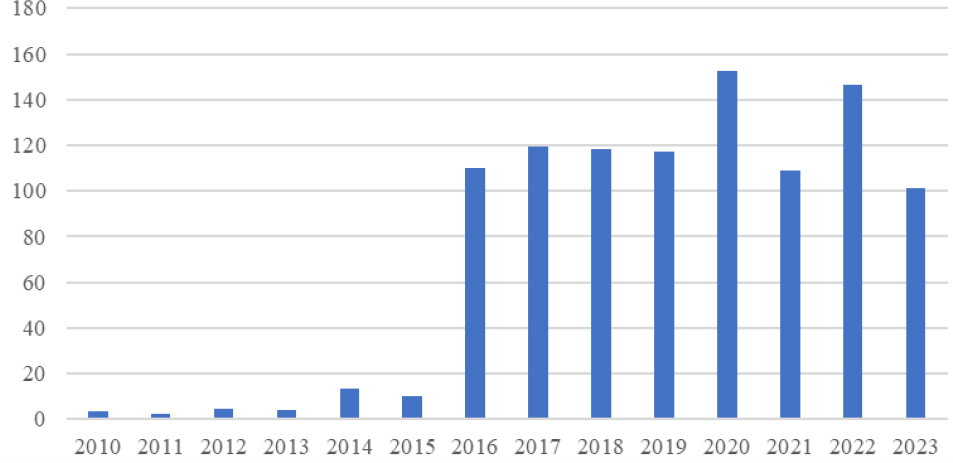
Figure 1:
IT expenditure at BAMF in Million Euro (Copyright: Sureau, Timm, on basis of publicly available sources59).
Such high expenditures are related to the fast initial expansion during the crisis, the need to continuously update hardware and software, and the continued reliance on outside companies. I will try to unpack these dynamics in the following, mostly based on the MARiS example.
This increased spending corresponds in part with suggestions from McKinsey, KPMG and other consultants working at BAMF, who suggested accelerating digitalisation processes to cope with BAMF’s challenges. They argued that digitalisation efforts should be planned for the long term but should also be able to support the short-term stabilisation of the existing system.60 The reports generally revealed some of the inner workings of BAMF but cannot be regarded as in-depth analyses of the work of BAMF. Despite such documents, it is difficult (for me) to determine the exact role of the consultants or other private companies in the decision-making processes that led to increased funding. Public bodies such as Germany’s IT Planning Council also regularly and persistently promote digitalisation. However, the consultants’ power to effect change and to transport messages from below to the top level was clearly felt. The private actors also had the power to undermine transparency efforts by simply disagreeing with the publication. While McKinsey and KPMG agreed to publish most of their contracts with BAMF, the consultancy firm Roland Berger simply did not, so their work could not be analysed. This provides a striking example of the power of private actors in public-private partnerships, a dynamic often analysed in neoliberalisation processes.
When the new MARiS project team started in 2016, the BAMF IT department had just gone through several experiences during the crisis that the MARiS team tried to learn from and incorporate into their planning. The experiences were, first, the upscaling of server capacity due to a large increase in the user base; second, the pressure and overview from external consultants; third, bootleg projects that did not follow proper procedure; and fourth, bootleg projects that did not match the system architecture. Learning from these lessons and possibly from the advice of external consultants, and to organise and envision a future IT rather than producing short-term responses to immediate problems, BAMF introduced its Digitalisation Agenda to inform and plan its project accordingly. The agency has also been very public about this endeavour and has published regular updates about the agenda since its inception. In addition to the digitalisation agenda, BAMF’s IT department expanded and started to develop proper project management alongside MARiS, which later evolved into the Project Management Office, where we could carry out some of our research. This also laid the foundation for detailed procedures for each software project that included the involvement of the Accessibility Office and the Employees’ Council, the preparation of an economic feasibility assessment, and the involvement of the IT Architecture Department to increase interoperability, reduce the number of different operating systems running on the servers, and ensure the use of common frameworks and a common coding system.
The increased IT Budget also surprised some employees, who had expected the IT department to shrink as the number of asylum applications decreased. By now, however, it is rather clear that the necessity of continuous legal (due to new regulations and laws), technical and security updates ›forces‹ BAMF to be dependent on the IT department and thus, in its current state, also on the companies responsible for the respective software. These dependencies are partly reflected in BAMF’s IT expenditures of more than €100 million annually after 2015.61 BAMF thus appears to be consciously addressing the important task of continuous and permanent maintenance of the digital infrastructure and foreseeing the need for future upgrades. These expenditures have also benefited private companies, which have now become integral to BAMF’s IT infrastructure. Despite many hiring campaigns and offers of paid vocational training, BAMF cannot employ enough programmers and spends most of its money on outsourcing work and insourcing programmers from private companies, making it a very profitable market for IT companies. During one of the internal workshops for another software package, a BAMF employee gave two reasons for this system of dependence on companies. First, he noted that the public service wage agreement (TVoD) was the root of the problem, as it regulated salaries significantly lower than comparable jobs outside the state bureaucracy. Second, he complained that
they want to save money by outsourcing, but they could have hired cheaper. But they don’t want to because they want to be able to fire people. Nobody thinks about the long-term costs. As an economist, you can calculate everything very precisely. After all, it’s our tax money that’s being wasted. (Interview 2021)
To give an idea of the general IT labour shortage, let me turn to software testing at BAMF. Programming involves constantly testing changes, updates and features. Testers are, therefore, an important part of programming teams. BAMF employs 13 testers directly and 45 externally through contracts. Together, they are responsible for some 130–150 software projects, while the core software MARiS alone employs one test manager and seven testers. One employee complained that internal and external testers are still insufficient for all the BAMF projects. As a result, like many other projects at BAMF, a significant part of MARiS is upgraded, programmed and tested by external programmers.
One interviewee pointed out that for major upgrades like the post-2015 MARiS project, BAMF develops the new software completely separately from the old version, leaving the main (running) MARiS procedure to stand still for years to avoid developing in two different directions and to minimise changing the scope of the new project. As a project can take several years to complete, this can cause difficulties for the people who work with and get accustomed to the running software. The IT department is then often reluctant to accept changes to the software.
In this way, the MARiS project team and the IT department actively worked to avoid future crises such as those experienced in 2015. They also insourced and outsourced a great deal of work to IT companies, as BAMF was unable (or partially unwilling) to employ enough IT workers. Thus, the agency was rendered dependent on external contractors, whose presence has become the ›new normal‹ at BAMF.62
A self-evident ›new normal‹
In this text, I have argued that a series of war- and refugee-related crises eventually led to an administrative crisis within BAMF, which I explored through retrospective interviews about this period and which still had an impact at the time of our fieldwork. In this period’s accounts, a collective sense of stress, urgency and exception, which I call a sentiment of crisis, was evident. This collective sentiment displaced or merged with bureaucratic sentiments, allowing for a rare and unusual opening up of the usual bureaucratic sentiments, which can be defined as »relatively stable discursive regimes [that] offer conceptualisations, evaluations and normative expectations, if not prescriptions, of how bureaucracies should work«.63 Ultimately, the collective sentiment of crisis allowed for a fundamental change within BAMF, with long-lasting consequences. In the case of BAMF, these consequences included a drastic increase in the budget for digitalisation, the insourcing of IT staff, the outsourcing of IT work to IT companies, and increased dependence on them. This overall process is reminiscent of the introduction of the typewriter mentioned at the beginning of this chapter, which piggybacked modernity, efficiency, typewriter repair systems and the increased employment of women in the British civil service. It also has similarities to the German military’s procurement system change that triggered neoliberalisation and de-etatisation in the 1980s.64 Adding empirically and analytically to these examples with the case of BAMF, I have provided data to suggest that individual stress led to an institutional affect called a sentiment of crisis that played an important role in collectively opening up for rapid institutional change. I am not suggesting that institutional change in state bureaucracies cannot come about in other ways. I am arguing that, in certain situations, a sentiment of crisis can be the key to opening up normally stable (i.e., incompatible with rapid change) bureaucratic sentiments, allowing for a collective pull towards change.
Looking at the passages from normality via liminality to a new normality, Turner professed that some of the ideas from the liminal phase remain. Some of the new, often fantastic models generated in the liminal phase, he argues, »may have sufficient power and plausibility to replace eventually the force-backed political and jural models that control the centres of a society’s ongoing life«.65 But how can such crises have such long-lasting effects? How do such ideas turn into a new normality? I will turn to Hans Blumenberg, a philosopher of technology, to try to answer this. As suggested by Turner’s rites de passage, the post-liminal situation is the moment of consolidation of the institutional quasistructure and the return to normality. In the BAMF case presented here, this new reality included increased digitalisation (understood as both new tools and the ongoing process of transforming BAMF into a paperless bureaucracy), as well as the external companies necessary for further development and maintenance. It also includes companies that can influence future developments by providing their technical knowledge and thereby solidifying path dependencies. As usual, the newly introduced technical systems involve new standards and documentation procedures.66 They are, therefore, not minor changes but involve the establishment of complex new systems for maintaining, reporting, updating and implementing the standards, as well as a system for teaching and maintaining the new technical systems, making them, in fact, socio-technical systems. They have to be integrated or added to the existing set of rules, as Berger and Rohringer argue about the introduction of innovations,67 to be transformed into ›the new normal‹.
This institutional shift towards digitalisation is an example of a process that Blumenberg calls technicisation. As mentioned earlier, he defines technicisation as the constantly increased usage of tools and the normalisation of those tools, which he calls the condensation of the world of things« into our lifeworlds.68 He argues that integrating new technologies is conceptually more than merely producing things and providing services. Rather, it is the production of the seemingly unproducible, new self-evidence in which we take certain things for granted. Referring to Husserl, Blumenberg explains that such newly created lifeworlds, with their matter-of-factness, feel increasingly comfortable as one gets used to the new technologies and perceives them as a normal, unquestioned, constant and safe part of one’s lifeworld.69 And who would not see digitalisation as the new normal? Some people will use newly created infrastructures, such as the MARiS add-on, in their daily work without understanding the technical effort required to keep it running and up to date. The necessity of extensive, long-term maintenance might initially be surprising, but that, too, eventually becomes the new normal for those who take care of it. The integration of this new world of things into normality eventually makes it harder and harder to imagine that »it could be different«. The normality or matter-of-factness produced does not invite questioning, as doing so would suddenly make the comfortable, safe zone questionable and epistemologically unsafe. Blumenberg understands the process of producing normality – normalisation – as slowly closing one’s eyes to the constant reproduction of lifeworlds to eventually understand them less but to perceive them as understood in their matter-of-factness. We have accepted older technologies with all of their implications – for example, steel knives, as mentioned earlier, or the production chains of steel, and then of cars, and the building of extensive street networks, and, yes, fatal car accidents as well – and in doing so, Blumenberg argues, we obscure by accepting. By making it normal, we also make it more difficult to understand the underlying ethics of normality.70 We also tend to forget the power of steel companies in our societies.
The process of technicisation that Blumenberg examined, in which technologies become the new matter-of-fact, the new normal, combines the ideas of blackboxing, in which we do not understand how things work,71 layering technologies on technologies,72 and infrastructurisation – the idea that we start ignoring the structures on which we stand and only notice when they break down or malfunction and thus usually obscure their very existence.73 Maintenance and updates are integral to socio-technical and infrastructural systems, without which they will eventually become a major problem. The adage »[t]o invent the train is to invent the train crash«74 is particularly apt for software with online connectivity, as servers are under constant and often automated attacks from all over the world.
BAMF’s IT department constantly tries to cope with this new reality of increased workload and funding by hiring new staff, but this has been and is largely unsuccessful, as the low public-sector salaries are unattractive compared to the standard salaries offered by private IT companies. As a solution, BAMF decided to insource companies that would take on the constant updating and programming work and gradually become embedded and normalised in the various layers of the digitalised administration, or, to put it differently, of the digital infrastructure.75
In a way, server software has a social life,76 as if it forces77 administrators of government databases to employ IT companies to maintain and constantly update them if they are to do us no harm. This new post-crisis normality of revised lifeworlds with their new matter, which is taken as fact, is, on the one hand, rapidly taken up and used as a daily, taken-for-granted tool by employees and, on the other hand, assiduously maintained by IT departments and companies as their daily jobs. To put it another way, the technology behind new software is a black box. This suits us just fine because we do not need to understand its inner workings, nor do we need to. We eventually just get used to it. However, those responsible for this black-boxed digital infrastructure must continuously maintain it or pay someone else. The additional work is forgotten when short-sighted decisions are made to digitalise with external companies. And the users, BAMF IT and the companies paid to maintain the infrastructure eventually understand the new software processes as their normal work. These tools have become so self-evident that BAMF employees protect them and thenew lifeworlds they represent, including the expensive necessary maintenance with rather new but apparently stable bureaucratic sentiments.
Conclusion
In this paper, I offer insights into the affective lifeworlds of bureaucrats during a crisis in and of their institution and how this led to institutional change with long-term consequences. Periods of crisis often increase individual and group pressure to quickly produce tangible results. Drawing on Turner’s rites of passage, I illustrate how such a collective affective response – a sentiment of crisis – created a space in which adherence to old procedural norms was reduced and new solutions could be – and effectively were – introduced, facilitating rapid and fundamental change. Bureaucratic sentiments in state institutions usually underpin »prescriptions of how bureaucracies should work«,78 and make them extremely resilient to change. Still, they can also be precisely the very catalyst that builds up to upheaval in those rare cases when a significant number of bureaucrats collectively feel the urge for change.
In the case of BAMF, the consequences have been the insourcing consulting firms to the tune of €56.4 million over five years, an even faster pace of digitalisation at the BAMF, a lasting increase in the IT budget, as well as an increased dependence on outside companies, all of which has changed the role of the IT within BAMF and of private IT companies within BAMF’s IT department. For BAMF, this is nonetheless the ›new normal‹ their new set of tools, which is now protected by new, stable bureaucratic prescriptions.
About the Author
Timm Sureau is a post-doctoral researcher at the European Centre of Just Transition Research and Impact-Driven Transfer (JTC) at the Martin Luther University Halle-Wittenberg, where he studies just transition governance in the post-mining region of Central Germany. With an ongoing focus on the anthropology of the state, his interdisciplinary research combines anthropology, science and technology studies (STS), and affective, yet socio-legal perspectives to understand societal change. Previously, Sureau has conducted fieldwork in South Sudan, Sudan and Germany, exploring topics ranging from students’ political discourses, state formation and migration management to the affective dimensions of digitalisation within German migration bureaucracies, which led to this publication.