
The terms ›files‹ and ›administration‹ generally evoke images of rather complex bureaucratic structures, producing mountains of papers to manage even the simplest matters. While this picture conveys a critical undertone, it nevertheless implies a highly specialised written administration applying sophisticated tools and processes. These cultural techniques once had to be developed. In this more elusive era in the history of administration, the question was rather if something written is needed at all, and the few documents drawn up were little specialised. Managing increasing masses of paperwork only just started to become an issue, prompting an eclectic exploration of appropriate techniques. Matters as an organised layout, tabulation, referencing documentation, and the keeping of records were the subjects and results of countless innovations. This paper aims to shed light on the transition period between the rise of pragmatic literacy and the beginning of the so-called »age of files«, which is generally dated to the early modern period. The transition period, when written documents were already dominant but had not yet penetrated every part of administrative life and the administrations experimented with several ways and means to cope with rising challenges and demands.
The paper provides an analysis of the land administration of two different monastic estates, Lambach in Upper Austria and Klosterneuburg in Lower Austria, in the 15th and early 16th centuries. Based on the description of each of the monastery’s practice, it will be argued that several different institutional factors can be seen as a driving force of administrative evolution and innovation, which enabled the monasteries to keep up with the rising administrative, legal and social demands. Meeting these challenges, the monasteries pursued different strategies for managing their landed property, showing that the development of bureaucratic use of written texts should not be seen as one of the ever-increasing rationalities but rather as the result of a multilayered cultural process.1
Since the publication of Michael Clanchy’s »From Memory to Written Record« in 19792 at the latest, research on pragmatic literacy has been an increasing topic in Medieval Studies.3 His influential book highlighted the already mentioned complex cultural process behind the rise of literacy in the Middle Ages as well as its implications for text production and reception. By establishing three categories for the analysis of the role and character of texts in societies – making, keeping and using – Clanchy greatly influenced the way pragmatic literacy was approached.4 Since then, its boundaries were expanded more and more, integrating or expanding to anthropological research as well as communication studies.5 The basic idea – also for this paper – is that writing something down necessitates the selection and ordering of information. Furthermore, this process of writing is part of a realisation of an act, embedded in administrative, economic or political order. Analysing texts based on these assumptions enables us researchers to gain insight into silent knowledge contained in the practice of writing.6 Methodically, this approach expresses itself not only in ascribing much importance to the economic, legal and social background of each administration but also in analysing the materiality and layout of the administrative sources to gain insight into their use within an administration.
Written Records in Medieval Land Administration
Addressing monastic case studies as well as the administration of landed property as object of research is an evident choice regarding medieval Austria. Next to towns, monastic administrations have to be considered the most advanced at these periods, with the administration of noble estates generally being underdeveloped in comparison. Landed property, on the other hand, can be considered at the centre of the development of administrative techniques, since due to the manorial system it was both an economic production factor and the basis of lordship, the rule over land and its inhabitants.7 Having lost most of their antique origins, the Carolingian period led to a renewal of written culture, concentrated in ecclesiastical institutions, namely monasteries.8 Ecclesiastical institutions were on the forefront of the development of written administrative records due to their scriptoriums for writing liturgical books, which provided them with the skills as well as materials to introduce writing into administration again.9 Regarding landed property, the driving force for the development of written records has to be seen in new legal requirements. Written documentation gained more and more legal relevance in court. Since the 13th century, the transfer of property ownership or at least hereditary tenure was generally documented in charters or deeds. Such property-related deeds also made up the majority of single-sheet written documents.10 Landlords were under great pressure to put their (property) rights and claims into writing since the chance to be confronted with written claims and evidence when disputing about sovereign rights in court was rising. To defend themselves against claims of other landlords on their property, they had to keep records. Written property records therefore were not only a predominant tool of administration but also an essential instrument of lordship.11
Property administration was not formed only by the requirements of the legal system though. During the course of the Middle Ages, the property rights themselves underwent great change. Serfdom was gradually abandoned and substituted through several new forms of tenancy, with different rights connected to these forms. It was rather uncomplicated to administer property rights like Freistift, at the will of the lord, where the tenants hardly had any legal lever against the landlord. Freistift was a form of short term ›lease‹ where the landlords had the right to evict the tenants or raise their rents every year.12 Such lesser property rights were gradually replaced by more generous ones like Leibgeding and Erbzinsrecht. Leibgeding was a tenure limited to the lifetime of the tenant.13Erbzinsrecht was hereditary tenure. This long-time tenure confronted the landlords with new challenges. The tenants’ scope increased considerably and they could enforce their legal rights against the will of the landlord through the courts.14 Therefore, the latter now had to defend themselves not only against claims by other manorial lords but also against claims by their own tenants. Furthermore, since hereditary tenure in the form of the Austrian Erbrecht, Kaufrecht, Burgrecht and Bergrecht15 allowed the tenants to sell, mortgage and in some areas even to split up their properties, the landlords had to increase their effort to keep track of these changes regarding tenants or property structure. Losing track of one’s own property not only risked the rent-based income but could also lead to the alienation of properties, when they were claimed by other landlords in the following.16
The demands on the administration of the estates could greatly differ based on the dominant forms of tenure as well as the surrounding (legal) competition and customs. Klosterneuburg and its properties in a wine growing area next to Vienna had to comply with other demands and challenges than Lambach with its rural properties. In the following, we will present both monasteries and their ways of administering property, as well as some of the factors and circumstances shaping them. A detailed description of the source documents, their content, form and references will shed light on micro-level processes of land administration and reveal remarkable differences between the two monasteries. The subsequent analysis reflects use, interrelations, traceable developments and functional differentiations and it sets the two case studies in their specific contexts and in perspective to each other.
Heiligenstadt, Stift Klosterneuburg
The Klosterneuburg monastery is situated in eastern Lower Austria at the shore of the Danube. It is consolidated with the identically named town and lies only a dozen kilometres north of Vienna. The monastery was founded in the early 12th century and since established an extended estate. In the late Middle Ages, it owned rights and properties all over Lower Austria and had a strong manorial presence in its immediate environments and thus in Vienna’s hinterland. Viticulture played a central role in its economy.17 The possessions were managed by the monastery’s canons, which held offices within the organisation or were responsible for incorporated parishes. In this study, the monastery’s case will be exemplified by such a parish called Heiligenstadt. It is situated halfway between Klosterneuburg and Vienna and is one of many administrative districts. The affiliations with the parishes intensified since the beginning of the 14th century, the bookkeeping however remained decentralised.18 Heiligenstadt was officially incorporated in 1307, although it has been under the patronage of the monastery long before. Since the early 14th century, however, the priest in Heiligenstadt was always a monastery’s canon.19 Heiligenstadt was a prestigious parish. Several former parish priests rose to the highest offices within the superordinate monastery, namely in the 15th century.20 Since the 14th century, the acting priest had a bailiff, Amtmann, to his side, and in the late 15th century, two co-operators and five chaplains supported him in his various duties.21
Conducting a Land Transaction
The monastery’s properties in Heiligenstadt were bestowed to tenants in free hereditary tenure, which allowed various kinds of transactions including sales.22 The contractual side of such dealings with landed property is represented by legally binding deeds. An example for such a document would be the stipulated sale of a house in Heiligenstadt on 4 January 1454 by the tenant Ulreich Retich.23 The deed was issued in the name of the seller, sealed by the monastery’s canon in his capacity as parish priest and manorial lord (and probably as issuing authority) and by another attestor who was requested to witness the deal. Ulreich confirms that he sold his house to a married couple. In the deed, the parties involved and the object of agreement were named and the conditions and legal disclaimers were recorded. For different transactions and legal acts, distinct deeds were drafted and retained by the contracting parties. In Klosterneuburg, such deeds only survived in small numbers but are often mentioned in the manorial registers.
While the actual transactions happened among tenants, the landlord was still involved in the process. Deals such as the one exemplified by Ulreich Retich’s deed had to be brought to the attention of the manorial lord.24 In his capacity as primary owner of the land, he granted the tenurial right to the new tenant by issuing a deed of bestowal.25 Technically speaking, each land transfer involved the old tenant surrendering his right on the property and the new tenant being bestowed with it by the landlord. On few occasions, Heiligenstadt’s registers mentioned a document called Aufsandbrief, which served to surrender or assume the right on a property.26 Lambach’s sources, however, are much more instructive on that matter and can illuminate the process in more detail.
Information Management
The parish’s internal administration of landed property was meanwhile organised in books. Land transactions were recorded in rentals and registers. Other than comprehensive chartularies or issuing registers, these books were solely concerned with transactions connected to landed property. They exclusively recorded bestowals and encumbrances.
The estate registers from Heiligenstadt we know of today start in 1454.27 The parish owned and managed property in three neighbouring villages: Heiligenstadt, Nussdorf and Grinzing.28 While in other districts the rents were to be paid to the monastery, the beneficiary in Heiligenstadt was explicitly the parish priest.29 It was he who acted as manorial lord vis-à-vis the tenants and the estate registers are titled and dated in his name. Elsewhere the book’s introductions name Klosterneuburg’s provost and – in the codex for Meidling and Hietzing – additionally the supreme cellarer. The latter was responsible for the monastery’s estate registers in general.30 The different administrative district’s registers from the second half of the 15th century are indeed identically organised. Folio one of the Meidling–Hietzing register from 1458 explains their structure and content: The register lists the different properties – houses, vineyards, gardens and more – and it records the rents and their recipient. The instructions elucidate that at the very front of the codex there was a table, listing old and new bestowals in sequence. When a change happened, it should be added to the table first and then the deeds, describing the course of events, were to be recorded in the rear of the book. Furthermore, the entries should be designated by a number (Figs. 1 and 2).31
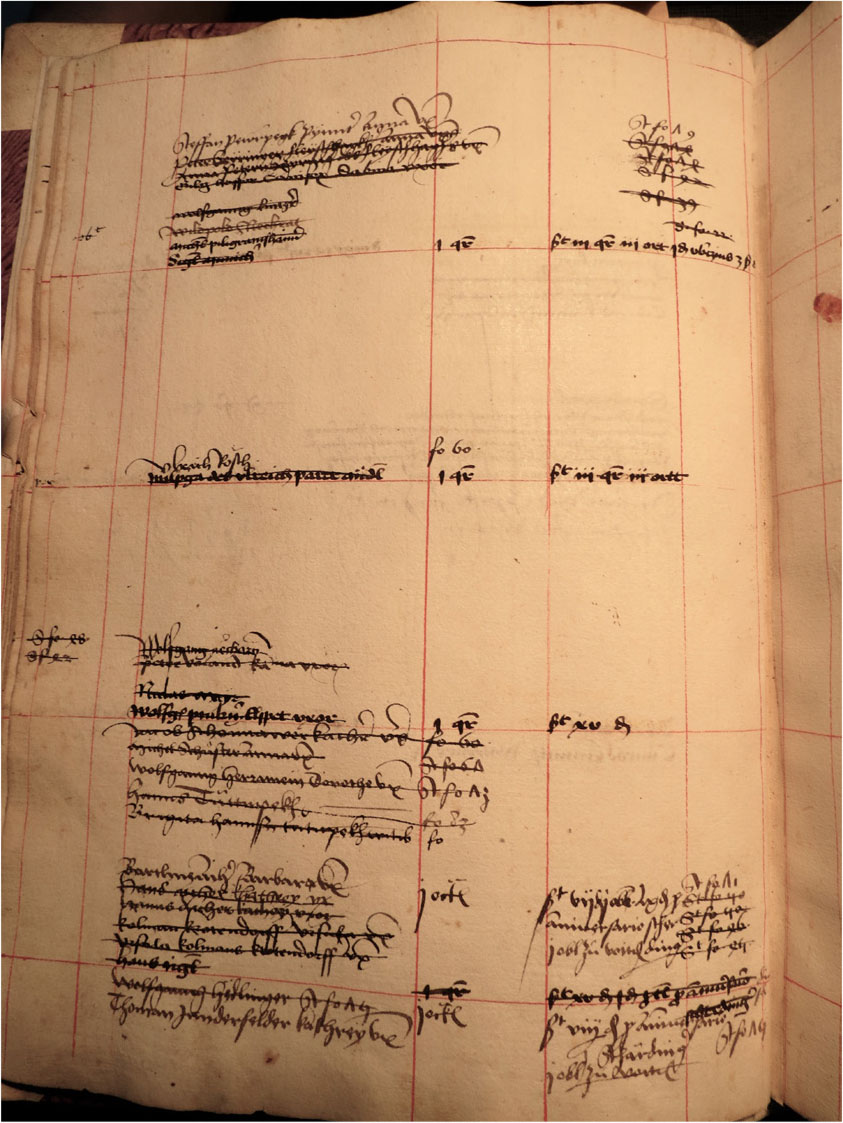
Figure 1
Extract from the rental (Source: StAKl, Grundbuch 8/1, fol. 11v).
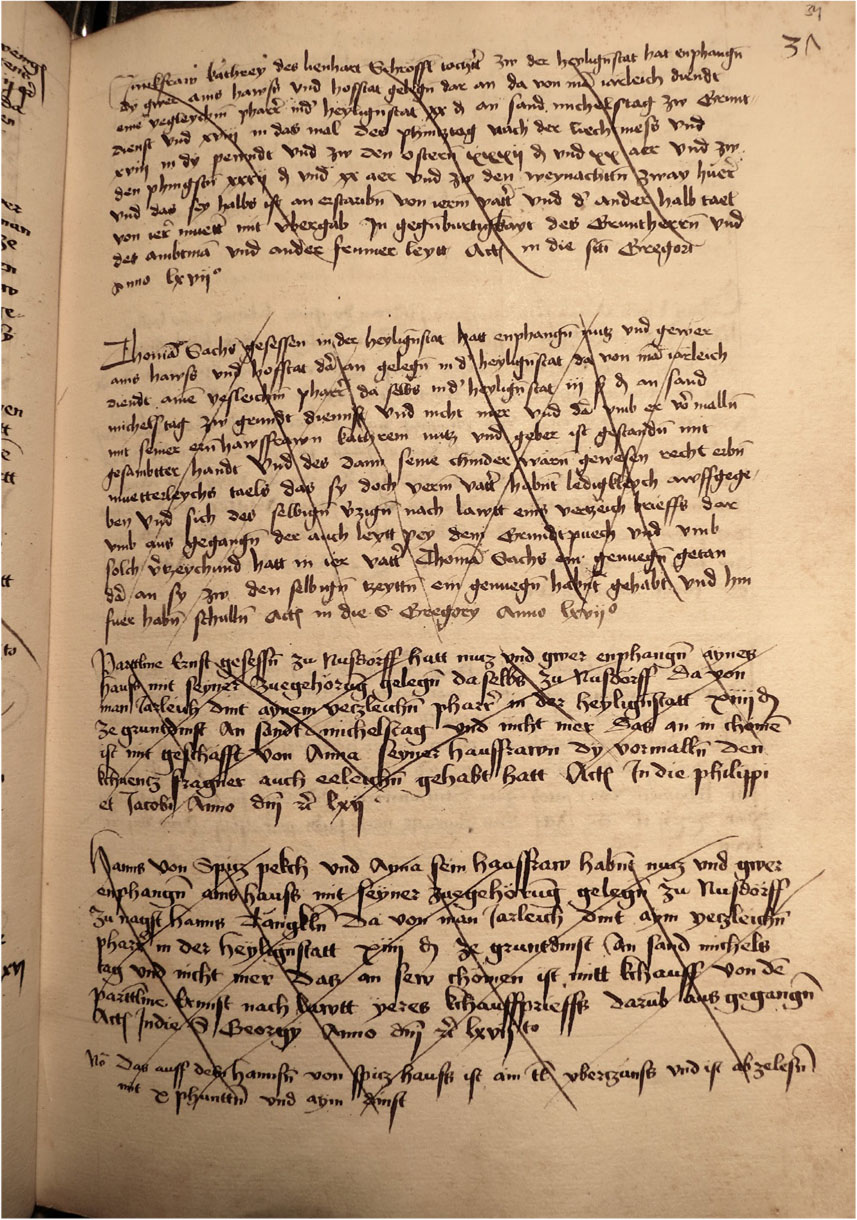
Figure 2
Extract from the register of bestowals (Source: StAKl, Grundbuch 8/1, fol. 37r).
The here-described sections of the estate register are the rental and the register of bestowals. The rental, Dienstbuch, is organised geographically and as introduced it was outlined as a table, structured by red lines. In the parish of Heiligenstadt, it lists properties with houses and farmstead vineyards32 in the mentioned villages Heiligenstadt, Nussdorf and Grinzing and to the better part vineyards in the surroundings, listed by location.33 With every horizontal line, the record of a new property begins. In the main column, the changing tenants are listed. Out-dated entries are crossed out. The next column contains a keyword, describing the property. Vineyards are often characterised by their size only. Next to it, the rent in money or must is registered, sometimes with extra information: a specific property name for example or further obligations. On the margins to the left or to the right, references to the bestowals or mortgages are noted. They refer to the folio numbers in the register in the rear.
A variant of the rental is focused on the payable rents and dues.34 Its layout is identical. The duties however, are described in more detail and on the margin to the left a series of ascending numbers appear on the records. Those probably represent the years in which the duties were properly remitted and collected. Concerning Heiligenstadt, the monastery’s archive in Klosterneuburg also preserves a handy booklet from 1489.35 It seemingly served the purpose of rent collection. The periodical monitoring, however, was not registered by numbers but by ascending alphabetical letters.
The register of bestowals, Gewerbuch, is organised chronologically. It records bestowals in condensed form but still provides a wealth of information. It names the new and old tenants, the nature of the transaction with connected legal acts, the location of the property identified by its neighbours,36 and it describes rents and dues with day of payment and finally the date of the registration. Most of the entries are crossed out. Perhaps because they were obsolete. Sporadic annotations give extra information on later incidents or on the whereabouts of the corresponding deed. Encumbrances in the form of mortgages, Satz, and second mortgages, Überteuerung, were recorded sometimes in the same register together with the bestowals and sometimes in separate paragraphs. In other manorial contexts, registers of encumbrances and bestowals were kept in distinct books.
Finally, Heiligenstadt’s properties are also registered in the Klosterneuburg monastery’s large urbarium from 1513.37 This volume has a very different appearance than the herein before-mentioned documents. Similar to the rentals described above, it lists properties geographically and names tenants, rents and dues. But it depicts just one point of time. No cancellation, no correction, no alteration was made. The handwriting is legible and ornate with generous spacing. The initial on folio one is decorated and coloured. The volume itself is of massive size and bound in leather including clasps.
Overseeing the different documents in Heiligenstadt’s property administration, we recognise an interconnected and polyfunctional documentation system that could meet multiple requirements. The rental, organised in table form, carries condensed information on properties, tenants and rents. It was kept up to date and displays the history of changing tenants at first sight. Together with the index,38 specific entries were easily accessible. Notably because its geographical structure reflected the well-known site. The register of bestowals and encumbrances on the other hand was kept as a journal. It contains details on land transactions, their preceding incidents and the issued deeds. The references from the rental to the register connect the outline with the details, and simultaneously they connect the geographical with the chronological structure. This allowed finding information starting from various queries. The different rentals served the purpose of current administration; the small-sized and handy booklet was maybe used in rent collection. Meanwhile, the register of bestowals and encumbrances could have answered legal questions as well and probably preserved tradition and memory. The large urbarium finally displays representative elements while being unscathed showing neither cancellations nor annotations.39 Though, its function seems not to have lain in the active administration. It might have fulfilled legal functions and was used in contexts of representation.40
Stift Lambach
The monastery of Lambach is located in the central region of Upper Austria and was founded in 1056.41 Most of its holdings were located within 40 kilometres of the monastery but it also owned property in Lower Austria.42 The property structure in the region was characterised by hamlets and single farms with larger settlements generally being divided into different lordships. Apart from agriculture, which was mainly farming and mixed husbandry, with some cases of specialised animal husbandry, Lambach also owned forests and had important fishing rights for the river Traun which flows next to the monastery.
Lambach’s property administration was conducted on two levels. First there was the central administration situated within the monastery, which is the object of research in this paper. Second, there were the Amtmänner, bailiffs, who headed several, geographically defined offices, Ämter. The geographical location of some of these offices changed in the period under research,43 but their number always amounted to five or six. Regrettably, no sources regarding the work being done by these bailiffs survived.44 It stands to reason to assume that they were involved in the administration of the monastery’s properties at the local level,45 though no such references can be found in the sources. Contrary to Klosterneuburg monastery’s parish Heiligenstadt, where the property administration happened at the local level of the parish priest, in Lambach the transfer and therefore the administration of property and its rights was conducted at the monastery itself. The stages of conducting a land transaction were the same in Lambach as in Klosterneuburg. After sending an Aufsandbrief, which in Lambach’s case was called Aufgabbrief or Bittbrief,46 or surrendering the property in person, the process of bestowment to the new tenant began. At its end stood the Erbbrief, the written deed. Apart from obliging the new tenant to pay rent, it could also be used to force him to fulfil other demands.47 In some cases,48 the new tenant was required to provide the monastery with a Revers, essentially a copy of the deed but written in the tenant’s name and sealed by himself or third parties. It served the better legal binding of the new tenant to the terms of his tenure.
Information Management
The central question regarding the functionality of Lambach’s property administration is how the monastery managed to keep record of the properties and their tenants. Each land transaction made it necessary to identify the holding and verify the tenure in being, in order to avoid later protests or objection by unknown third parties. In Lambach’s case, the administration of properties was greatly complicated due to the practice of partible inheritance in combination with the possibility to split up properties or own them in forms of tenancy in common. While such practices were not that uncommon by itself, in most cases such forms of shared or co-ownership were in some ways limited. The most common form was co-ownership by spouses, which was normally the result of specific forms of the marital property system. While these cases were limited to two persons, more could be co-owners in cases of co-ownership by a group of heirs. These cases often only lasted until a main heir was named, who then compensated the others. Furthermore, such co-ownership tended to be a form of joint tenancy,49 where the share of ownership interest was not freely transferable but the other tenants had to agree and were also often the heirs. This resulted in fewer economic possibilities and therefore also fewer transactions. Lambach’s form of tenancy in common did not have these limitations. They could transfer, sell or debt their share of a property without the consent of the other tenants and it was not uncommon to keep one’s share for a long period. The marital property regime increased co-ownership further since community of acquests and gains was practiced. Combined with the possibility to split up properties, this flexible practice of property co-ownership and division resulted in a large number of transactions, which constantly changed the monastery’s property and tenant structure. To manage this complicated situation, the monastery had several administrative documents at its disposal. Each provided different amounts of information about its properties.
First are the urbaria.50 In Lambach’s case, they contain lists of the monastery’s landed property and its rents, with the individual holdings being identified by either their own name, the name of their current tenant or just the type of property in connection to its location. For the period under review, there are two full and one incomplete urbarium extant for Lambach.51 The focus of the urbaria on the rents already indicates their main use within the administration. While at least urbarium B from 1441 illustrates an effort to keep the urbaria up to date regarding the tenants, the same cannot be said about the others. Even urbarium B is in no way suitable to give a correct picture of the monastery’s tenants though. The reason for that is the already-mentioned characteristic of the Erbrecht which allowed properties to be split up or possessed in forms of tenancy in common. When comparing the documentation of land transactions of these years with the entries in the urbaria, one can swiftly ascertain their superficial documentation. Not only are many split up properties listed as whole but also there is almost no mentioning of all the different proprietors of the shared holdings. Therefore, one can safely declare that while the urbaria played a role in the administration, it was mostly confined to providing information for rent collection as well as a broad overview over the monastery’s landed properties. This conclusion is supported by an analysis of their changing structure and layout. While in the first extant urbarium written in 1414 a text block structure is dominant, we can already observe the use of a table structure in some cases. This structure emphasises the rents of each tenant by listing them in a separate column. The same can be observed in the urbarium of 1441. In the incomplete third register, written between 1441 and 1463, the text block structure is totally dismissed in favour of a tabular structure. The last extant medieval urbarium from 1463 finalises the evolution by completely changing the structure of the entries. Until then, the main structure of the registers was formed by the administration offices and within them by the different kinds of rent which had to be paid. Now these rents formed the main structure of the register, followed – depending on the kind of rent – either by the offices or the property right of the holdings.
The second and, for this study, most important documentation of land transfers were the Briefprotokolle.52 Of these registers of issued documents concerning landed property or tenants,53 three books are extant for the years 1442 to 1445, 1446 to 1451 and 1457 to 1461.54 Regarding their type, they can be described as representing the late form of such medieval registers, which makes them most useful for an analysis of the administration. There are several ways such registers could be used in administration. One way was to inscribe the text of the issued deeds after they had been written, based on the original deed or its written draft. That was most likely how the similar Gewerbücher in Klosterneuburg were created. The other way, which is generally associated with later forms of registers, is to draft the document directly in the register, so that the Briefprotokolle can be seen as a mixture of draft books and registers of issued documents.55 As such registers, they provided the text and therefore generally the full amount of information regarding the properties.56 It has been argued for Bavarian monasteries that the necessity to keep track of the properties held in hereditary tenure was one of the driving forces for the development or introduction of such registers.57 The example of Lambach fits into this picture regarding the fact that the deeds – either in the form of drafts in the registers or as archived originals – and the Aufgabbriefe were essentially the only information sources for several major aspects of the property situation of the monastery, foremost the split-up properties or the ones held in tenancy in common.
The importance of the deeds is underlined in their use in the administrative process of conducting a land transaction. The text of each deed includes a passage concerning the evidence of the property right of the former tenant. After stating the transferred property, its property right is mentioned, followed by a phrase that this property right was proven by a written deed. Furthermore, the information about which abbot issued the deed is given.58 Consequently, the monastery also seized the old deeds when new ones were issued. This prevented the old deeds being used for fraud,59 which was a common reason for destroying such documents or rendering them useless in other ways.60 This process also shows the importance of the deeds for the tenants. They provided them with a high legal security and enabled them to go to court and process against their landlord.61 The administration in Lambach made further use out of the old deeds by collecting and archiving them. With their role within the administration as it is, storing them as well as the Aufgabbriefe, Bittbriefe and other similar documents was essential. With around 2250 original charters, deeds and so on still extant as original up to the year 1500, Lambach has an – at least for Austrian standards – exceptionally rich archival inventory regarding these documents.62 Especially remarkable is the number of the extant Aufgabbriefe or Bittbriefe. Elsewhere, these kinds of documents seldom survived since they were legal documents of lesser importance and only written on paper instead of parchment. We do not know exactly why they survived in such numbers in Lambach or why they did not in other (monastic) administrations. It cannot be ruled out that it is just a case of Überlieferungszufall, a survival by chance without deeper meaning. Though, there are arguments against that. We do know that they were deemed important enough at their time to store them in the monastery’s archive. This fits into the general picture, since, like the deeds, these documents provided the monastery with full information about the properties and their former and current tenants. Further insight into how the administration handled these documents is provided by their Dorsualvermerk. These are short annotations about their content at the back of the different documents and deeds stored in the archive.63 The Dorsualvermerke show a reorganisation or at least an improvement of the archival organisation regarding these documents during the 15th century. The already existing annotations were supplemented or expanded. This shows what information was deemed most important at the time: the name of the transferred property. While the name was already mentioned on many of the stored deeds and other documents, it was now often enhanced or adjusted to the name the property was currently known by. Rudimentary existing information was augmented to facilitate a faster and more correct attribution of each document to a certain property. Apart from the information about the property, another one regarding the document itself was the focus of this archival reform: the information regarding the kind of document was added. While, for example, the Dorsualvermerk formerly only mentioned the property and its location, now it also mentioned that the document was an Aufgabbrief. This allowed the administration to assess its legal quality as well as made it possible to search for certain (kinds of) documents. In cases of deeds written by the monastery itself, this information was omitted. This can either be seen as them being labelled as the standard case and therefore also being described by their lack of this information or they were identified by their materiality. Written on parchment and sealed with a characteristic ecclesiastical Vescia-shaped seal, they were easily identified as such.64
Around 1500, the methods to keep track of the monastery’s properties held in some form of tenure were improved. A new office book was written, focusing solely on documents concerning such properties. This time it was not used for drafting new deeds and so on but existing documents were copied. Its structure and finding aids were a great improvement to former times. It included an index based first on location or office and second on the kind of document, property right or kind of transaction.65 The use of property rights as category was already introduced in the urbarium of 1463 and is a logical choice for the organisation of documents related to land transfers since the property right greatly affects the kind of transaction and document possible. It allows to form a separate category for the properties which are the hardest to administrate, since things like splitting up properties or tenancy in common required the property being held in hereditary tenure.
Each entry in the index mentions the kind of document, the holding and the involved person, like the new tenant in cases of land transfers, as well as the folio of the book on which the entry can be found. The numbering of the folio is not continuous but starts anew with each administrative unit, once again mirroring the overlying administrative structure of the monastery. This steady layout further facilitated the browsing through the entries. The full text copies of the documents follow the same structure and each entry is followed by a very short abstract, similar to the corresponding entry in the index. The register includes entries dating back to the first half of the 14th century, so it is clear that it was not just used to keep track of the legal documents of current tenants and properties but to improve the access to the documents stored in the monastery’s archive. While the register could not fully replace the sealed documents in the archive due to it being of less legal value,66 it could substitute for them if only information about their content was required. Since no references to the originals can be found, one also has to conclude that it was not used as a finding aid for the archived documents. Furthermore, there are only a few later entries by another hand, so the book does not seem to have been in use for a very long time before another method of land administration was found.
Internal Process of Conducting a Land Transaction
The extant sources also allow us to reconstruct – to a certain extent – the administrative practice regarding the internal process of conduction of a land transaction. Especially the drafts give us insight into the production process of the deeds. Such information is provided by annotations as well as by deletions and additions to their text. The registers have to be seen not only as the central instrument of written documentation but also of communication during the process of writing a deed. Both were aided by a steady layout (Fig. 3).
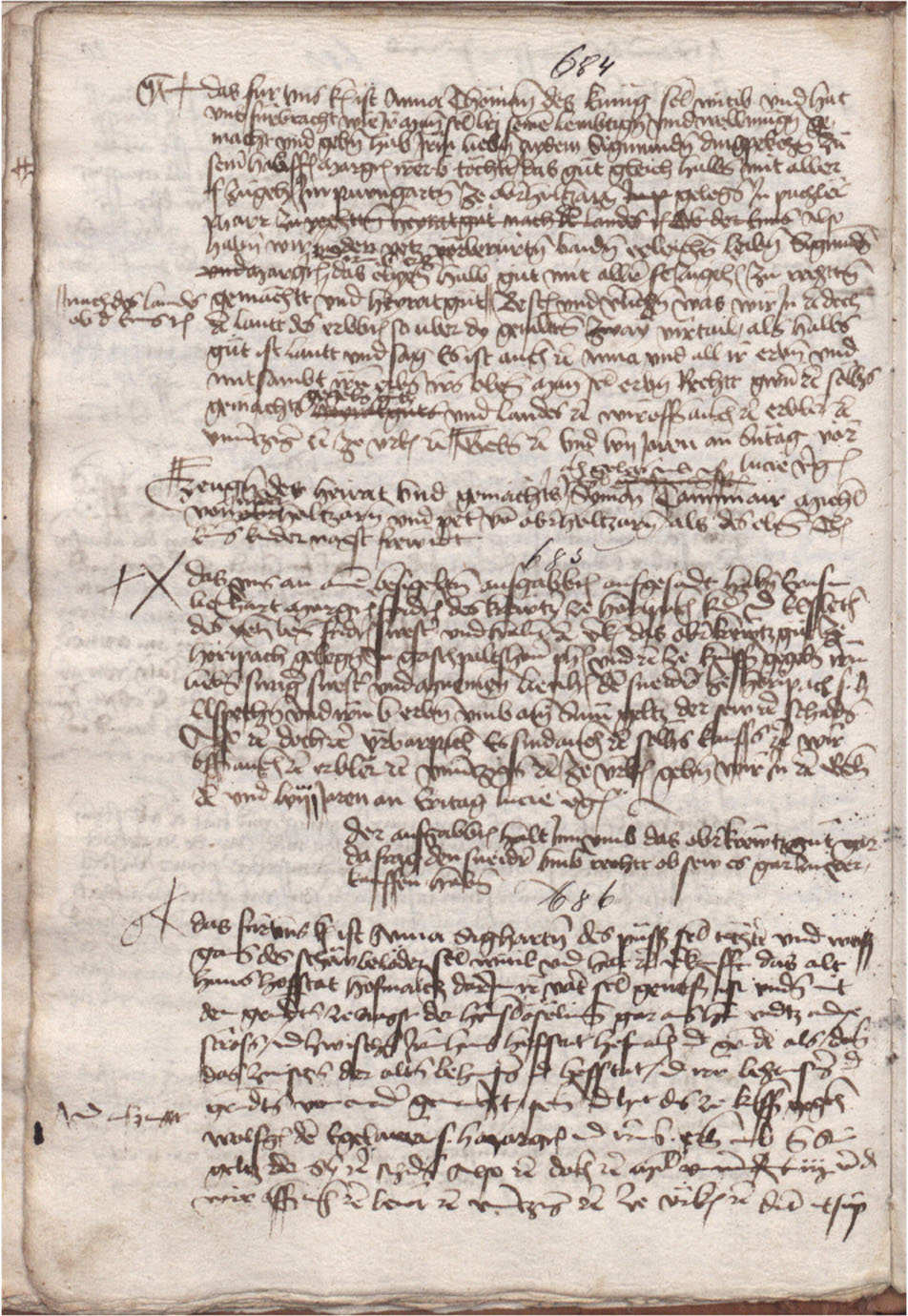
Figure 3
Extract from one of the Briefprotokolle (Source: OÖLA, Herrschaftsprotokolle, L880, fol. 20v).
The pages were vertically structured into two areas: first the main space for the basic text of the deed and second the left margin. This left margin was reserved for both corrections and additions and it was always situated on the left, regardless which side of the folio the entries were written on. Therefore, the writer of the deed – which did not have to be the same as the writer of the draft – was always confronted with the same structure. Different kinds of annotations had their fixed position. Situated at the beginning of the entry, different signs indicated which parts of the production process were already concluded. Corrections and additions began with an insert sign corresponding to another one in the text and were situated at the height of line where they should be inserted. Administrative remarks, on the other hand, which did not concern the text itself but were directives regarding issuing dates, taxes and so on were placed indent under the entries and could be further emphasised with a border, especially when a task had to be done before writing the deed. Due to this steady layout, a writer looking at the drafts immediately knew which parts of the entries concerned him in the different stages of the production process, therefore minimising the risk of mistakes and oversights.
The contents of the different remarks, as well as the drafts themselves, tell us several things about the process of writing. First, the drafts were often revised over some time. When the former tenants went to the monastery and presented their old deed or sent their Aufgabbrief, in many cases that was only the beginning of a negotiation process regarding the future of the property. This was especially true for cases of inheritance but also happened when a property, or part of it, was sold, most notably within the family. Most of the corrections concern only minor changes in wording. Other corrections and particularly the annotations concern aspects, which have to be the result of a change of mind or negotiations and therefore of a longer process. In some cases this is made explicit, for example, when the annotation mentions that it was »discussed« and »now« only one of the sons will be the new tenant instead of his mother and his siblings67 or when the annotation remarks that the deed above should be written in another way and provides the names of different new tenants.68 These remarks could be phrased in first person or be unspecified. It can be assumed that the writer of the draft was more often than not also the writer of the deed, though the registers show several different writers being involved in the production of deeds in the same period. The character of the annotations as means of communication stayed the same, either in the form of a reminder for the writer of the draft and deed himself or as instruction to other writers who wrote the deed based on his draft. That the process of writing and issuing a deed revolved around the registers can also be seen in them often containing financial information regarding the collected tax for the deed. For these annotations the writer had to return to the registers after the deed was already written and issued, showing that their role was not contained to just the process of writing the deed. Despite of the entries being the draft of the deeds, they were already dated. Since the dates are generally written by the same writer as the text and do not indicate in any way to have been added later, the date of the draft determined the date of the deed, which is confirmed by comparing the drafts with extant deeds.69
In cases where the available information was incomplete and had to be added later – most often the rent – a blank space was left in the draft to be filled once the information was provided.70 The rent is also where we can ascertain the role of the estate registers in this process, which was rather small. Their main function was to provide information about the rent of a holding. This can also be seen in the wording of the deeds. Here quite often the phrase »laut Urbarbuch«, according to the urbarium, is used, which in the deeds translates into »nach Inhalt unseres Gotteshauses Urbarbuch«, according to the urbarium of our house of God. Though, that was only one way to declare the rent. Instead of referring to the urbaria, the deeds either declared the actual rent or referred to other deeds.71
Analysis
A comparison of the two monasteries’ property administrations shows considerable differences. While Klosterneuburg focused on different forms of specialised but interconnected registers, Lambach was heavily reliant on the deeds or other forms of single-sheet documents, either as originals or as drafts in registers. Nevertheless, both kinds of administration seem to have worked for the respective monasteries. While the different solutions for the same task are in no way unusual, it is still worth trying to analyse both cases regarding the question of what could have caused this different development.
Different sources at the Klosterneuburg monastery point to practical, legal and economic motives for keeping and renewing its estate registers. In the introduction section of an extensive novel urbarium, completed in 1513, the monastery’s provost Geörg Hawsmanstetter explained the reasons behind his efforts. He argues that the manor’s estate registers were defective and in ›diffuse disorder‹ due to either adverse circumstances or negligence.72 Poor administration as the intrinsic motivation for improving management, however, only partly serves as an explanation. An appointment letter from the same decades provides further insight. This letter authorises supreme cellarer Bernhard Diemer and explicitly names the estate register as an instrument to confront two problems: the alienation of properties on the one hand and unpaid dues on the other.73 These two reasons for keeping registers touch on two not entirely congruent issues and in addition are describing counterparties on different levels: first the issue of legal assertiveness towards manorial competitors and second the issue of an efficient management of due collections in dealing with tenants. While legal validity of a document was established by tradition, consistency, form and publicity,74 efficient administration in contrast depended on actuality, currentness and adaptivity. In the sources mentioned however, the estate register was considered the adequate means to serve both functions. This conflict of objective was faced by a further differentiation of written documentation, which was a widespread phenomenon in the 15th century. Some of the documents were stripped of their legal function in favour of administrative purposes.75
In the case of Klosterneuburg monastery’s written documentation, differentiation has been observed by Maximilian Fischer (1782–1851), the monastery’s then-archivist and librarian, in 1845. He catalogued the manuscripts in his archive and reflected on the development in administration.76 In the early days of the monastery, all kinds of acquisitions including landed property were recorded in one large volume called the Saalbuch. This book comprised donations, swaps and court decisions in chronological order and it served – in performative usage and along with witnesses – to secure the monastery’s claims on possession and income. Over time, it continuously increased in size and volume. Fischer speculated that further developments happened for practical reasons and in connection with the collection of dues, but no evidence survived. However, approximately since the middle of the 13th century, new books emerged. These urbaria list landed property and related claims. The older ones only allowed a rough overview. Changes in property and regarding tenants were not systematically tracked, yet on occasion new books were added. Until the early 16th century, Fischer counted 11 urbaria.77 In the course of time they were joined by yet additional documents: rentals, Dienstbücher and registers for bestowals and encumbrances, Gewerbücher and Satzbücher. Some of these books date back to the 14th century but the series for most districts commence in the first half or the middle of the 15th century.78 As to the urbaria, Fischer attributed a legal function to the registers of bestowals, which – according to him – explains their careful preservation in the monastery’s archive.79 Meanwhile the rentals, he assessed as mere extractions of the urbaria, compiled for the purpose of due collection.
The preserved documents in the monastery’s archive illustrate the development of differentiation and thus the ability to meet multiple requirements. One of the reasons for properly kept estate registers was to prevail in the concert of manorial lords. Manorial competition was a driving force for development in the sector of written documentation and innovation could have been the result of exchanges of cultural techniques.80 Many of the administrative districts of the Klosterneuburg monastery – Heiligenstadt among them – were located in the wine-growing environments of Vienna. These areas were subject to strong manorial fragmentation.81 The different manorial lords in the surroundings of Vienna organised and maintained their property registers independently. But in course of time, their systems harmonised progressively.82 Important was the proximity to Vienna. As many burghers and urban organisations were strongly involved in viticulture, some were directly connected to the Klosterneuburg monastery as tenants or acted as mortgagees on its properties. Vienna’s city council and the monastery’s provost even corresponded concerning the estate administration. In a letter from 1466, the former urged the outstanding bestowal of two vineyards to a suburban widow burgher.83 While the historiography of law reveals the differences between the estate registers of the city and those of the surrounding manorial lords, it simultaneously acknowledges the influence the older urban registers exerted, notably during the 15th century.84 This relationship is clearly visible in the similar vocabulary of legal acts as well as in the denomination of documents.
The Lambach monastery chose another way to administrate its properties. An analysis of the characteristics of its system reveals how they correspond to several factors of Lambach’s property situation. When looking at these institutional parameters Lambach’s system was embedded in, one can ascertain several influential factors: first the property rights. One of the defining characteristics of Lambach’s Erbrecht was the flexibility regarding splitting up the properties or owning them as larger groups in forms of tenancy in common. As stated before, it was a major influence factor that each tenant could command over his share in the same ways as with properties held by a single tenant. This offered the tenants the upmost economic possibilities and flexibility. On the other side, regarding administration, it posed a great challenge for the landlord, since it caused frequent changes in property and tenant structure. It is questionable if a rigid documentation like in the case of Klosterneuburg, where every property had its own entry in the registers, allowing the documentation of all the changes, would have been able to keep up with these constant structural changes. Properties that got split up could still be documented in such registers, as is the case in Heiligenstadt’s rental. Here, the record of the divided property was translated into two different entries between the lines of the table and the subsequent changes were then recorded separately.85 Contrary to Lambach, these divisions were long-lasting though.86 Neither were there frequent changes in groups of co-owners documented, nor did the properties constantly get (partially) united and split up again. In Lambach, this was often the case and the monastery solved that problem by differentiating its property administration into two sectors. On the one hand were the urbaria which documented the monastery’s properties based on rent units. Instead of recording the actual property structure and its tenants, they gave an overview of the original, undivided properties. Apart from acting as an overview over the monastery’s properties, the role of the urbaria has to be seen more in the financial administration. Their changing structure during this period backs this conclusion. Their focus shifted from documenting the properties of each administration office to documenting different kinds of rents that had to be paid throughout the year, structured based on the property right of the holdings.
Contrary to Klosterneuburg, which was embedded in and influenced by an area with several developed administrations, neither Lambach’s neighbouring town Wels nor other monasteries like Stift Kremsmünster seem to have put Lambach under pressure to adapt to a regional state-of-the-art property administration to defend its legal rights. Instead we can observe an evolution of Lambach’s own system based on single-sheet documents, corresponding to changes in property rights and structure as well as associated administrative challenges. Fragments of older records of bestowed properties, dating back to the 1420s,87 show that at this time more rudimentary means of documentation were used. They resemble Lehensbücher, registers of bestowed fiefs. Instead of documenting the whole deed like the Briefprotokolle,88 they only inform about the most important points of the bestowals in shortened entries and do not record other property-related transactions like mortgages and so on. Simultaneously, the monastery already archived the different single-sheet documents connected to its property administration. Creating registers has to be seen as the next step in dealing with the increasing amount of transactions and the equally increasing difficulties of managing them. They served both the increasing production of deeds as well as the administration of the concerned properties. They provided the full information for each transaction regarding what (part) of property was transferred as well as all the different tenants involved in the transactions. The received Aufgabbriefe and seized old Erbbriefe acted as security and legally more binding documentation, whereas the urbaria provided the broad overview over the holdings of the monastery and their rents.89 When looking at these factors, Lambach’s way of dealing with the challenges of its property administration can be seen as efficient. Its lack of a rigid structure provided the necessary flexibility, whereas the workload was reduced since it was not necessary to create additional records. The downside of this system is its poor overview and more difficult access to relevant information. This can be seen as the reason for producing the office book of 1500. Instead of changing the system as a whole, the new book reduced the overview problem with its structure and index. Nevertheless, this system would most likely have been inadequate if not for another relevant factor: the properties held in Erbrecht were the minority. Due to the characteristics of the estate registers, the precise number of Erbrecht properties is hard to determine but the quota was most likely around 30 per cent of Lambach’s properties. This number was rather low for Upper Austria in these times.90 Therefore, the high complexity of administering Erbrecht holdings was at least in parts counteracted by their relatively low number. Due to this low number of properties held in Erbrecht, it is also possible that their administration was seen as something that could to be dealt with separately, with a specialised system, instead of changing the whole administration due to the administrative needs of a minority of properties. This contemplation would also fit the characteristics of the administration’s development, where each step forward can be seen as an evolution based on existing structures. Instead of revolutionising the administration – or adapting models from other administrations – the Lambach monastery enhanced its existing practice in comparable small steps, to correspond to new administrative challenges.
Conclusion
Looking at the differences and similarities of the property administrations of Lambach and Klosterneuburg, we can clearly see the character of the late Middle Ages as time of transition between the Age of Charters and deeds and the Age of Files. Defining for this time are the official books, Amtsbücher, whose development from general documentation to separate, specialised series91 mirror the development of (written) administration in the Middle Ages as a whole. At the beginning stood the charters, which served as means of securing legal rights. Soon, simple internal written notes followed, before written documentation and proof were indispensable in legal conflicts.92 Ensuing from polyfunctional documents, serving legal as well as administrative purposes alike, specialisation and differentiation unfolded.93
In our study, we identified several institutional factors that proved to be influential regarding the organisation of the manorial administration of landed property. First, the patterns of landholding: whether properties could be divided or be owned by a (fluid) group of tenants affected the complexity of their administration. The more stable the property and tenant structure was, the more structured their administration could be. The evolution of property rights in the Middle Ages, which granted the tenants more and more possibilities in dealing with land tenure, also steadily increased the demands towards their administration. Second, the communicative and competitive framework the institutions were embedded in: the appearance of records and administration practices were not only shaped by the economic necessity to achieve a functioning organisation of properties and rents but also ensured sovereignty. To defend one’s rights, it was not only required to dispose written evidence. The produced documents had to correspond with regional legal and cultural customs to get accepted.
While Lambach’s administration was largely based on charters, deeds and their text, Klosterneuburg’s parishes transitioned to a book-based administration. In both cases, the choices of these tools of administration can be seen as continuous reactions to different demands of the monasteries and their specific surroundings. Therefore, what we observe is not a linear progress of rationalisation but rather a heuristic process, torn back and forth by conflicts of incongruous legal and economic objectives and driven by multilayered cultural influences and innovations.
The different solutions found by the two monasteries for an only at the first glance identical challenge showed that at this time local factors were still more influential than later on, when official requirements began to shape the administrations of estates to an ever-expanding extent. In the following centuries, property administration became more and more subject of scholarly and legal thoughts. In the drafted law code for Lower Austria from 1528, the »Institutum Ferdinandi«, no obligation to keep an estate register was imposed. Yet, the importance of written deeds for all kinds of legal acts was highlighted. Registers, however, are mentioned in the private-law treatise of Bernhard Walther in the 1550s, citing their significance related to the registration of bestowals on the one hand and the encumbrances on the other.94 Over the centuries, what has once been means for internal administration and in regional legal conflict rose to state-wide concern.
Acknowledgements
The authors are listed alphabetically and contributed equally to the paper. Johannes Kaska is researching the Lambach estate while Samuel Nussbaum works on Heiligenstadt and Klosterneuburg. The authors would like to thank Peter Becker and Thomas Ertl for encouragement and support, as well as Karl Holubar and Thomas Stöttinger for the helpful assistance in the archives.