
Introduction
Unmanned aerial vehicles (UAVs), commonly known as drones, have significantly impacted various industries, including agriculture, surveillance, logistics, and disaster response. Their versatility and growing affordability have led to their increasing adoption in academic environments, where they serve as a valuable educational and research tool. Universities worldwide are leveraging drone technology to teach students about aerodynamics, control systems, embedded programming, and artificial intelligence (AI). By integrating drones into engineering curricula, students gain practical experience in designing, programming, and optimizing UAVs for real-world applications.
The relevance of this research stems from the growing demand for practical, hands-on experience in engineering education. While theoretical knowledge is essential, students benefit greatly from experimental learning with cutting-edge technologies. Quadcopter platforms, in particular, offer an accessible entry point into drone research, allowing students to explore topics such as flight dynamics, automation, and computer vision. Given the rapid evolution of UAV technology, universities require a cost-effective, reliable, and modular drone system suitable for research and experimentation.
Despite the potential benefits, selecting the appropriate drone configuration presents a challenge. The choice of drone type, hardware components, and control software must align with educational objectives while remaining budget-friendly. This research addresses the need for a structured approach to selecting a quadcopter prototype optimized for university-level research and teaching.
The goal of this research is to develop and validate a modular quadcopter platform tailored for advanced university education and research in UAV design, control systems and autonomous navigation. The primary academic application of this research result is to provide hands-on technical courses in engineering and computer engineering courses, such as AI, Internet of Things, Robotics, etc. The platform is intended to serve as a practical tool where students can directly engage in the design and prototyping on UAVs, moving from theoretical concepts to physical implementation. For university research, the proposed platform acts as open and accessible testbed. It is designed to facilitate the empirical testing of existing control and route planning algorithms, such as PID controllers, A* pathfinding, and, more importantly, to serve as a foundation for researching novel solutions. This includes advanced areas like AI-driven autonomous navigation, sensor fusion techniques, and development of sophisticated flight control systems, providing a versatile tool for both student projects and faculty-led research. The research is guided by the following objectives:
analyse different drone types to determine their advantages and limitations in an academic setting;
examine essential hardware components, including frame materials, motors, propellers, batteries, and communication modules, to identify the best choices for university research drones;
evaluate flight control software to determine the most effective platforms for controlling and automating drone operations;
explore self-driving capabilities and assess potential solutions for autonomous navigation;
propose a comprehensive quadcopter solution that balances affordability, ease of use, and research potential.
This study employs a comparative methodology, systematically analysing different drone types, hardware components, and software solutions. Data is gathered from academic sources, industry reports, and technical evaluations, ensuring that recommendations are based on empirical evidence. Each component is assessed based on key performance metrics such as durability, efficiency, adaptability, and cost. The research culminates in a detailed comparison table summarizing the best hardware and software choices for university-level drone research.
The results of this study highlight the superiority of multi-rotor drones, particularly quadcopters, as an optimal choice for academic applications. Among the various hardware options, carbon fibre frames, brushless motors, Li-Po batteries, and RF-based communication modules emerge as the most suitable components for research-oriented drones. Regarding software, platforms such as PX4 and ArduPilot provide extensive flexibility and customization options for students experimenting with flight automation and control algorithms.
Furthermore, the study explores emerging trends in autonomous drone technology, such as AI-driven navigation, GPS-assisted flight, and computer vision-based obstacle avoidance. These technologies enhance the capabilities of research drones, allowing students to develop and test advanced automation techniques. The findings of this study contribute to the development of an effective drone research platform that supports university-level education in engineering, robotics, and AI.
So, this research offers a structured framework for selecting an optimal quadcopter prototype tailored to academic needs. By integrating the best available hardware and software solutions, universities can provide students with a powerful learning tool that fosters innovation and technological advancement.
Literature Review
This section reviews existing research and developments in drone technology, emphasizing its burgeoning applications within university-level education. UAVs have transcended their origins in military and commercial sectors to become powerful pedagogical tools. Various studies have explored the benefits of using drones to provide students with practical, hands-on experience in a wide array of disciplines, including aerodynamics, embedded systems, robotics, and artificial intelligence [1, 2]. The literature suggests that the integration of drone-based projects and lab work significantly improves student engagement and the comprehension of complex engineering and scientific concepts. As noted in [2], the use of drones in education fosters an environment of experimental and project-based learning, which is critical for developing the technical and problem-solving skills required in a modern workforce.
Research has consistently shown that UAVs enhance engagement and the understanding of intricate engineering principles. The tactile nature of building, programming and flying drones provides a tangible context for theoretical knowledge. Such, a study [1] discusses a quadcopter testing platform designed for educational environments. The study highlights how modular and programmable drones provide a hands-on approach for students, demystifying the complexities of flight control, aerodynamics, and sensor integration‥ Similarly, [2] examine the role of programmable drones in educational competitions, emphasizing their role in developing STEM skills. Demonstrated modularity approach allows students to experiment with different components and software, fostering a deeper of the system as a whole.
The role of programmable drones in educational competitions is another significant area of research [2, 3]. These competitions serve as a powerful motivator for students, encouraging them to apply their knowledge in a competitive and collaborative setting. Research in this area emphasizes how such events are instrumental in developing a broad range of STEM skills, from coding and hardware design to project management and team-work.
The spread of affordable and open-source drone technology has been a key driver of its adoption in universities. For example, research [4] presents an open-source, low-cost drone developed for mechatronic courses. This work provides valuable insights into creating cost-effective UAV designs that are accessible to a wider range of institutions and students. The use of open-source hardware and software, such as ArduPilot and PX4 platforms, is central to this effort, enabling customization and innovation without the constraints of proprietary systems. Similarly, the work [5] proposes a modular UAV approach for engineering education, demonstrating how flexibility in design benefits not only coursework, but also advanced research projects. This adaptability allows students, teaching and research staff to develop and test novel applications, from environmental monitoring to infrastructure inspection.
The educational impact of drones has been a subject of several comprehensive reviews, securing its place in modern approaches in pedagogy. A systematic review presented in [6], explores the diverse applications of UAVs in education, confirming their positive impact on learning outcomes. Another work [7] analyses trends in drone-integrated STEM education, highlighting the shift towards more integrated and interdisciplinary approach. Furthermore, in work [8] case studies on the use of open-source UAVs in STEM education were analysed. These studies showcase principles of the use of drones in creative and artistic endeavours, such as aerial photography and cinematography, broadening their applicability across different academic disciplines.
Recent tendencies in drone technology are closely connected with the wide implementation of AI tools. The integration of artificial intelligence opens additional options for educational drones as well. The incorporation of AI-based navigation and computer vision is essential for fostering innovative research and preparing students for the future of the drone industry [9, 10]. By working with autonomous and semi-autonomous systems, students gain practical experience in developing and implementing complex algorithms for tasks such as object recognition, simultaneous localization and mapping (SLAM), and autonomous flight in GPS-denied environments [11, 12].
The brief literature overview provided indicates that modular, programmable and cost-effective drones, particularly, those leveraging open-sources platforms, offer the most effective solutions for university education. The ability to engage in hands-on, project-based learning not only deepens students understanding of core engineering and computer science principles, but also equips them with the practical skills needed for their future careers. The continuous integration of AI and autonomous capabilities will further secure the role of drones as an indispensable tool in the modern university curriculum, fostering a new generation of innovators and problem solvers. Thus, this work presents one of the possible solutions for drone prototyping for university usage developed implementing modern best practices in the field.
Methods
This study adopts a comparative analysis approach, evaluating drone technologies based on performance, cost, and educational value. Data was collected from academic sources, technical specifications, and expert recommendations. The study sample includes various drone types, hardware configurations, and software platforms, ensuring a comprehensive evaluation.
A systematic comparison framework was applied, assessing components such as drone frames, motors, batteries, flight control software, and autonomous navigation systems. Quantitative metrics such as efficiency, durability, and cost-effectiveness were considered. The methodology ensures that recommendations are data-driven and aligned with university research needs.
The research findings contribute to the development of an optimal quadcopter prototype tailored to university education. The proposed model integrates the best hardware and software choices, ensuring a balance of affordability, reliability, and research potential.
Results
At first, we analysed available drone types for university research and study projects. The provided literature analysis indicates that drones can be classified into three main categories based on their flight mechanism: Fixed-wing Drones, Single-rotor Helicopters and Multi-rotor drones.
Fixed-wing Drones operate similar to airplanes, using a fixed wing for lift. They can cover long distances and have higher endurance but require a take-off and landing area. These drones are ideal for surveying and mapping projects.
Single-rotor drones (helicopters) use a single large rotor for lift and a tail rotor for stability. They offer better flight efficiency and higher payload capacity than multi-rotor drones. However, they are complex to operate and maintain.
Multi-rotor drones, including quadcopters, hexacopters, and octocopters, use multiple rotors for stability and manoeuvrability. They are widely used for research due to their ease of control and ability to hover [13].
Thus, fixed-wing drones are ideal for large-area surveys and mapping due to their long flight endurance but need significant space for take-off and landing. Single-rotor drones offer high efficiency and payload capacity, making them suitable for carrying research equipment, yet their complexity in operation and maintenance is a drawback. Multi-rotor drones excel in manoeuvrability and hovering, making them the most versatile for university research, though they have limited endurance and payload capacity. Analysis of the pros and cons of each solution in terms of university educational purpose is summarized in Table 1.
Table 1
Drone types pros and cons
| Type | Pros | Cons |
|---|---|---|
| Fixed-wing | Long endurance, high efficiency | Needs runway, limited manoeuvrability |
| Single-rotor | High payload, efficient flight | Expensive, complex controls |
| Multi-rotor | Stable, easy to operate, good for research | Shorter flight time, limited payload capacity |
Based on the provided analysis, we may conclude, that multi-rotor drones, specifically quadcopters, provide the best balance of cost, ease of use, and flexibility for university research projects.
Next, we analysed hardware components used to build a drone. The performance of a quadcopter depends heavily on the following components: drone frame type, motors, propellers, batteries, communication modules and camera systems [14].
The frame houses all components and influences the drone's durability and weight. Among typical solutions for the frame material, we may choose among:
Carbon fibre: Lightweight, high strength, expensive.
Aluminium: Durable, heavier, and cost-effective.
Plastic: Low weight, less durable.
Depending on the frame shape we may have the following multi-rotor drone types.
Quadcopters (I4 “+” and X4 “x”) are the most common type of multi-rotor drones used in research and education. The “+” and “x” configurations differ mainly in control dynamics. The “+” configuration simplifies flight control for forward motion but limits manoeuvrability. The “x” configuration is more intuitive for control and provides better stability, making it a preferred choice in educational settings. However, quadcopters lack redundancy—if one motor fails, the drone will crash.
Hexacopters (I6 “+”, X6 “x”) offer greater stability, higher payload capacity, and motor redundancy. The “+” configuration provides a straightforward control scheme but is less agile. The “x” configuration improves manoeuvrability and stability, making it preferable for applications requiring precise movements. Hexacopters are ideal for carrying heavier sensors and cameras, making them useful for aerial imaging and research projects requiring additional payload. However, they consume more power than quadcopters.
Coaxial hexacopters (IY6 “+”, Y6 “x”) use a stacked rotor design, improving lift while maintaining a smaller frame. The “+” configuration offers a simpler control scheme, while the “x” design enhances stability. These designs provide redundancy and increased thrust but are mechanically more complex and less efficient due to airflow interference between stacked rotors.
Octocopters (I8 “+”, V8 “x”) are suited for carrying heavy payloads and maintaining flight stability. The “+” design prioritizes straightforward control, while the “x” configuration improves manoeuvrability. Their high redundancy allows continued flight even if one or two motors fail. However, their power consumption is high, making them less efficient for long-duration educational projects.
Coaxial Octocopter (X8). The X8 design offers high payload capacity and redundancy in a compact frame, making it excellent for research requiring heavy equipment. However, it suffers from aerodynamic inefficiency due to rotor stacking and higher power consumption.
The judgement on pros and cons for each analysed frame shape is summarized in Table 2.
Table 2
Comparison on multi-rotor drone frame types
| Design | Stability | Manoeuvrability | Payload Capacity | Redundancy | Complexity | Power Efficiency | Best Use Case |
|---|---|---|---|---|---|---|---|
| I4 “ +” Quadcopter | Moderate | Limited | Low | None | Simple | High | Basic flight control training |
| X4 “ x” Quadcopter | Good | High | Low | None | Simple | High | General educational research, aerial imaging |
| I6 “ +” Hexacopter | High | Moderate | Medium | Moderate | Moderate | Medium | Mapping, aerial imaging, sensor deployment |
| X6 “ x” Hexacopter | Very High | High | Medium | Moderate | Moderate | Medium | Precision control research, robotics projects |
| IY6“ +” Coaxial Hexacopter | High | Moderate | Medium-High | High | High | Low | Medium-payload research, compact sensor platforms |
| Y6 “ x” Coaxial Hexacopter | High | High | Medium-High | High | High | Low | Compact research projects needing redundancy |
| I8 “ +” Octocopter | Very High | Moderate | High | High | High | Low | Heavy payload research, stability-critical applications |
| V8 “ x” Octocopter | Very High | High | High | High | High | Low | High-precision manoeuvring with heavy payloads |
| X8 Coaxial Octocopter | Extreme | High | Very High | Very High | Very High | Low | High-payload research requiring maximum redundancy |
The analysis provided allowed us to conclude, that for an educational drone project, quadcopters (X4) are the best starting point due to their simplicity, affordability, and ease of use. Hexacopters (X6) offer a balance between stability, redundancy, and payload capacity, making them a good choice for research applications requiring additional sensors. For projects requiring heavy payloads, octocopters (V8, X8) provide the best stability and redundancy but come with higher costs and power requirements.
The next component needed for projects are motors. Motors are needed to drive all the construction, and we may choose between the following motor types for this educational purpose:
Brushed motors: Lower cost, shorter lifespan.
Brushless motors: High efficiency, longer lifespan, ideal for research applications.
For low-cost university project available propeller sets are:
Plastic propellers: Affordable but fragile.
Carbon fibre propellers: More efficient, durable, recommended for research projects.
Batteries recommended for drone projects could be chosen between:
Li-Po (Lithium Polymer): Lightweight, high discharge rate, ideal for drones.
Li-ion (Lithium-Ion): Longer lifespan but heavier.
For control aims also communication modules are needed. Specifically, following:
Radio Frequency (RF) modules: Reliable for short distances, needed to be used for drone remote control.
GSM Modules (3G, 4G, 5G): Allow long-distance control and telemetry data transmission.
Finally, to provide more options for educational and research purpose, it is desirable to equip drones with a camera module. We chose two camera types for this project:
Standard camera: Used for visual monitoring.
Thermal camera: Useful for search and rescue or environmental monitoring.
Based on the necessary components for the project, we’ve summarized possible options indicating the most suitable to be used in this project, in Table 3.
Table 3
Drone hardware components choice options
| Component | Options | Best Choice for University Research |
|---|---|---|
| Frame | Carbon fibre, Aluminium | Carbon fibre |
| Motors | Brushed, Brushless | Brushless |
| Propellers | Plastic, Carbon fibre | Carbon fibre |
| Battery | Li-Po, Li-ion | Li-Po |
| Radio Module | Wi-Fi, RF, Bluetooth | RF-based module |
| GSM Module | 3G, 4G, 5G | 4G |
| Camera | Standard, Thermal | Standard (for general research) |
After the quadcopter hardware is assembled, the next step is to develop control system software for flight control. Quadcopters require sophisticated software for flight control and autonomous operation. The most common platforms are:
ArduPilot: Open-source, widely used in academia.
PX4: Open-source, with support for advanced features.
Betaflight: Focused on racing drones.
DroneKit: Python-based, excellent for custom research projects.
Table 4 provides comparison analysis on these platforms.
Table 4
Comparison on flight control platforms
| Software | Features | Best for University Research |
|---|---|---|
| ArduPilot | Open-source, versatile | Yes |
| PX4 | Open-source, advanced features | Yes |
| Betaflight | Racing drone-oriented | No |
| DroneKit | Python-based, research-focused | Yes |
In order to increase the range of research options, and the range of technologies used for educational purpose, the drone should also be able to fly in autonomous mode. In this regard, we explored options available to build autonomous flight system. Key approaches include:
Computer Vision-based Navigation: Uses cameras and AI models for obstacle avoidance.
LiDAR-based Navigation: Uses laser sensors for depth mapping.
GPS-based Navigation: Relies on satellite positioning.
Sensor Fusion: Combines multiple data sources for optimal navigation.
Each of the listed approaches has its own pros and cons as summarized in Table 5.
Table 5
Methods used to build autonomous flight systems
| Method | Pros | Cons |
|---|---|---|
| Computer Vision | High accuracy | Needs powerful processing |
| LiDAR | Precise 3D mapping | Expensive |
| GPS | Simple, widely used | Less accurate in urban areas |
| Sensor Fusion | Best accuracy | High complexity |
Finally, based on the analysis provided, we decided that the most suitable quadcopter prototype for university research should include:
Frame: Carbon fibre for durability and lightweight performance.
Motors: Brushless motors for high efficiency.
Propellers: Carbon fibre for better stability and durability.
Battery: Li-Po for optimal power-to-weight ratio.
Flight Controller: PX4 or ArduPilot for flexibility in research applications.
Communication: RF-based modules for short-range control and 4G GSM for long-range telemetry.
Sensors: GPS for positioning, computer vision for obstacle avoidance.
Camera: Standard HD camera for general research, with the option to add thermal imaging for advanced studies.
This setup ensures cost-effectiveness, ease of control, and flexibility for various research applications.
As result, a prototype of quadcopter drone was created based on the analysis provided (Fig. 1) and successfully tested for initial flight capabilities.
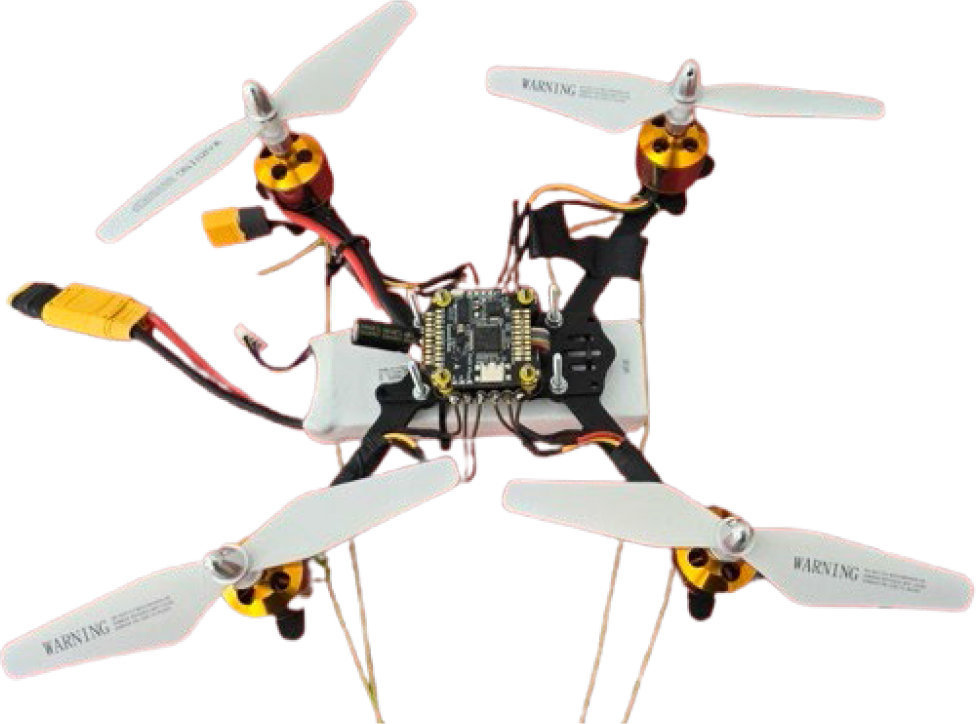
Figure 1.
External appearance of developed quadcopter prototype
Conclusions
This study has highlighted the importance of integrating drone technology into university education and research. The findings confirm that quadcopters provide an optimal balance between cost, performance, and accessibility, making them a suitable platform for teaching aerodynamics, automation, and AI applications. By systematically analysing drone types, hardware components, flight control software, and autonomous navigation technologies, this study has provided a structured framework for selecting an ideal drone prototype for academic use.
Key conclusions include:
1) Quadcopters are the most suitable UAV type due to their stability, affordability, and ease of use.
2) Carbon fibre frames, brushless motors, and Li-Po batteries provide the best trade-off between durability, efficiency, and performance.
3) PX4 and ArduPilot software offer the most flexible and adaptable solutions for educational drone applications.
4) Autonomous navigation using GPS and computer vision enhances research opportunities by enabling AI-driven drone applications.
By implementing the proposed quadcopter prototype, universities can create a robust educational platform that fosters hands-on learning and innovation. Future research should explore advancements in AI-driven flight control and swarm robotics to expand the scope of educational drone applications.