

1. Introduction
The expansion and consolidation of democratic systems have significantly boosted the analysis of electoral behaviour in recent decades. Multiple approaches seek to define the electorate’s motivations when voting. The spatial models associated with Anthony Downs’ (1957) approaches have been some of the most popular. According to this approach, the perceived distance between voters and parties on a given scale would be the key factor when it comes to deciding on the vote. However, the application of this logic has revealed a number of shortcomings in areas where the factors explaining voting behaviour cannot easily be condensed into a single dimension (McKelvey 1976; Schofield 1978), such as regions with centre-periphery disputes.
The study of the electoral behaviour of non-statewide parties in these territories has opened up a door to the specific study of this type of case. On the one hand, a wide variety of works have focused on regional components as the main explanatory factors, such as language, identity or ethnicity (Rokkan, Urwin 1983; Van Houten 2007; Fitjar 2010). Others have highlighted the pre-eminence of the ideological variable and socio-economic elements, as is the case with statewide parties (Fernández-Albertos 2002; Lancaster, Lewis-Beck 1986; McDonough et al. 1986). Integrated models including variables of both dimensions have become more prevalent in this type of study, leading to the need to find mechanisms for assessing the weight of each of the dimensions when deciding on the vote (Enelow, Hinich 1984). However, studies dealing with this type of multidimensional analysis have traditionally done so from the synchronous point of view, focusing attention on a certain time (or within a limited period), without paying too much attention to any possible evolution over time. This trend can lead to bias in the analysis of electoral behaviour, by hiding changes in the importance of each of the different dimensions when it comes to voting for non-statewide parties.
A paradigmatic example of the change in the importance of cleavages when it comes to voting could be the case of Convergència i Unió (CiU) and its ramifications in the region of Catalonia in Spain. The study of electoral behaviour in this territory has traditionally been approached from the point of view of both the ideological cleavage, in the left and right axis, and the centre-periphery cleavage, in the nationalist axis (Balcells, Roig 2008). However, Catalonia and its party system have undergone a deep process of change over the last two decades, and a major transformation is apparent in its electoral behaviour. Many studies have analysed the transformations taking place in this territory and its political system, mainly because of the so-called procés 1 (Jaráiz et al. 2017; Rivera, Jaráiz 2017; Serra et al. 2020). Similarly, CiU, as one of the main Catalan coalitions ever since the decentralization process started in Spain in 1978, has been the subject of extensive specific analysis (Barrio 2006, 2009; Marcet 1987, 2002), of particular interest are the works analysing its transformations as a result of the development of the pro-independence process (Barrio 2014; Marcet 2017).
CiU was originally founded in 1978 as a coalition of two parties, in order to participate in the electoral cycle that was opening up after almost 40 years of General Franco’s dictatorship in Spain: on the one hand, Convergència Democràtica de Catalunya (CDC), founded in 1974 under Jordi Pujol’s leadership, initially with the intention of becoming the pal del paller 2 or main reference in Catalan politics (Barrio 2009: 57); and, on the other hand, Unió Democràtica de Catalunya (UDC), a party set up in 1931, during Spain’s Second Republic, with Christian Democratic ideology (Barberá 2011). Historically, CiU has been a moderate coalition as far as its territorial claims are concerned, in favour of pacts with Spain’s central government and with a goal to govern at regional level. Its historical leader, Jordi Pujol, came to an agreement in Spain with both the PSOE centre-left governments and the Popular Party (PP) centre-right governments, when these parties required his collaboration, in order to govern throughout the 1980s and 1990s. He was at the helm of the Generalitat (Regional Government of Catalonia) uninterruptedly from the first regional elections right up to 2003. After two parliamentary terms governed by the Socialist Party of Catalonia (PSC), he recovered the presidency in 2010, though this time under Artur Mas.
However, it has not been immune to the changes that have taken place in Catalan society; of which, in many cases, it has also been the instigator. The main transformations affecting both Catalonia and CiU most probably resulted from the turbulent process of regional reform initiated in 2004 and from the consequences of the global economic crisis in 2008 (Cazorla, Rivera 2017; Muñoz, Tormos 2013). These structural transformations were to radically transform it, in its organization (Barrio 2009) as well as in its ideology (Barrio 2014). As far as the former is concerned, there was what Panebianco (1990) called a “change in the configuration of the dominant coalition,” the usual three phases being replicated. First of all, an organizational crisis, mainly generated by strong environmental pressure, defined by the two above-mentioned external factors (regional reform and the economic crisis), as well as the internal ones (CDC’s corruption cases). A second phase, in which, in response to this critical situation, new alliances were forged, and the core leadership was renewed. In this case, with the UDC abandoning the coalition due to the sovereigntist turn taken by CDC, as well as with the arrival on the scene of new pro-independence leadership at the hands of Carles Puigdemont. And, in a third phase, a restructuring of the organization itself, marked by a successive change in initials and a process of ideological redefinition. In this respect, in the face of the momentum of the independence process, CDC decided to run together with Esquerra Republicana de Catalunya (ERC), leftist party in favour of the sovereignty of Catalonia, in the regional elections of 2015 from the Junt pel Sí (JxS) platform, a group with a markedly pro-independence character that brought together different figures from Catalan civil society. CDC’s last congress was held on 8 July 2016, where the majority of its members3 decided to re-found to become the Partit Demòcrata Europeu Català (PDeCAT). This duality at the organizational level had repercussions with respect to ideology, giving rise to successive internal crises between more moderate and more radical postulates on the Catalan independence process (Marcet 2017). In the regional elections of 2017,4 given the impossibility of repeating the joint candidacy with ERC, CDC (which still formally existed) and PDeCAT supported the Puigdemont candidacy through the platform Junts per Catalunya (JxC); but internal tensions grew until June 2020, when Junts was formed as an independent party. In the regional elections of 2021, Junts emerged as the third most-voted party in the Catalan Parliament, just one percentage point behind ERC and three behind PSC, acquiring CiU’s electoral legacy, and leaving the moderate PDeCAT without parliamentary representation. In the last elections in 2024, Junts managed to regain second place, but more than six points behind the PSC and with the pro-independence forces having lost the majority they had held in the Catalan Parliament in recent elections.
The thread of continuity that can be seen in this process of organizational and ideological transformation has been described by some media commentators as “the convergent gene” (Juliana 2017), in allusion to the capacity for mutation and adaptation of a social, political and partisan space depending on internal and external factors. In this respect, the aim of this work is to analyse the evolution of the electoral behaviour of political parties in territories where there is more than one main cleavage, on the basis of the case study of CiU and its successors; or what will henceforth be referred to as the (post)convergent sphere. To this end, three specific objectives are set out. In the first place, the analysis of the evolution of the location of this political space, as regards both the left-right ideological dimension and the Catalan nationalism dimension, from the 1995 elections to those held in 2021. In the second place, the minimum distances between the electorate and where they place their party of reference in relation to each of the dimensions will be calculated, in order to estimate which of the two has greater importance when it comes to voting. In third place, in order to analyse the importance of factors beyond these two cleavages, logistic regression models, including different types of explanatory variables for voting, will be created.
The present work is structured as follows in order to develop these objectives. Following this introduction, there is a brief theoretical overview of the main schools of electoral behaviour analysis together with their development in the study of the Catalan case in general, and of CiU and its ramifications in particular. Next the main hypotheses of this work are presented. The methodology used is then explained, followed by the presentation of the main findings based on the specific objectives listed above. Finally, the main conclusions are presented, together with the open discussion beyond the Catalan case.
2. Electoral behaviour analysis models
Traditionally, when analysing electoral behaviour, three classic models have been distinguished, each with its own focus of interest. First, the Columbia School and its attention to socio-demographic variables (such as social class, racial and religious identification, and place of residence) led by Lazarsfeld, Berelson, Gaudet (1994). Second, the Michigan School and its interest in voters’ individual attitudes, as well as their party identification, as determining factors when casting their vote, led by authors such as Campbell et al. (1980). Third, the theory of rational choice or economic voting, as a predictive model based on assumptions about the rational electoral behaviour of voters, developed by authors such as Arrow (1951) and Downs (1957).
However, restrictive conceptions of each of these models soon became obsolete. The determinism of the first model could do little to explain the sudden changes in electoral results over time. Besides, the second model did not take into account how the electorate’s opinion on specific issues, or on the opinion of a particular leader, could affect party identification and, therefore, voting. However, it is probably the third model that has received the most criticism. It is difficult to speak about a single model within this school of thought; it is more appropriate to speak about different models within this line of analysis; e.g. the retrospective or reward-punishment model (Key 1968); or the issue-priority model (Budge, Farlie 1983). Although perhaps the best known, and the one that has subsequently undergone the most revisions, has been the spatial model initially developed by Downs (1957). According to this model, the most successful party will be the one that, ideologically, is closest to where the majority of the electorate stands. Thus, political parties will tend to converge towards the centre of the ideological spectrum, understood as the space occupied by the average voter. In this way, both the average voter and the parties will be able to move within this ideological space in search of convergence. This simple idea, which has been extensively developed at the theoretical level, has shown its limitations at the empirical level in multiparty, proportional and those systems where the number of ideological dimensions is increasing (Dowding 2018). It has shown even greater limitations when valence issues (i.e. issues on which all voters want the same thing – peace, lower unemployment, or less insecurity) have dominated the electoral debate; or when the electorate is not sufficiently informed to place the parties (or themselves) in that ideological space. In such situations, the electorate will have to make its decision based on other types of variables, such as the trust placed in one candidate or another (Stokes 1966).
In this regard, André Blais’ contributions will be among the most critical of this kind of models. As he explains in his work To Vote or Not to Vote: The Merits and Limits of Rational Choice Theory (2000), the contribution of this theory will be limited in three ways (Blais 2000: 137–138):5 (a) it will not be valid for people with a strong sense of duty (to vote); (b) among the rest, the essential elements that define rational models (i.e. the probability that the vote will change the outcome, the benefit that could be obtained, and the cost involved) will have the expected effects, but their magnitudes will be reduced; and (c) people predict the probability of change inconsistently with the calculation of benefits. This is why their main focus will be on the sense of duty that would motivate people to vote.
It is at this point that the importance of non-instrumental factors re-emerges. However, not in terms of the theories of the first two traditional schools mentioned above (Columbia and Michigan), but from a renewed approach. In this sense, contemporary psycho-sociological schools will shift their focus from partisan identifications in a restrictive sense to the psychological bases that underpin them. Thus, partisan identification will come to be understood as a social identity on which the decision to vote is based (Greene 1999; Green et al. 2002; Lewis-Beck 2008). As with the construction of any social identity, this process will be conditioned by the socializing agents that play a role in early childhood, although this does not mean that these identities are immutable, as they may vary over time due to both internal and external factors.
These socio-demographic characteristics have been particularly important in the development of ethnic theories on the electoral strategies of non-statewide parties. In this type of theory, elements associated with ethnicity, such as language, religion, or race, are fundamental when these types of parties define their electoral strategies (Chandra 2005). However, subsequent studies have questioned whether this type of ethnic outbidding is exclusive to non-statewide parties, suggesting that it may also be used to articulate the strategies of statewide parties (Sanjaume-Calvet, Riera-Gil 2022).
In this way, social characteristics and psychological considerations are intertwined, understanding party identification from an expressive rather than an instrumental perspective. Similarly, these considerations regarding the importance of socio-psychological variables do not completely invalidate the usefulness of spatial models. As mentioned above, the objective of these models is to make marginal predictions; that is, to analyse the differences that occur when shifting the position of parties on the ideological spectrum (Dowding 2018: 37). However, these changes should not be understood in a restrictive manner, as the result of an individualistic calculation aimed solely at satisfying the selfish interests of the voter. These evaluative processes may also have as their objective the well-being of the social group to which the voter belongs, or even of the country as a whole (Weeden and Kurzban 2014). In this way, these processes are deeply rooted in psychological dynamics related to the feeling of group belonging, where the social characteristics of the members play a fundamental role. Therefore, without ignoring the fact that the rationalist models originally developed have tended to lead to partial interpretations of a complex social reality (Blais 2000, 137), these types of models also constitute exploratory techniques of electoral behaviour, which must be developed with other types of socio-demographic and psycho-social methods for optimal development (Dowding 2005: 454).
2.1. Analysis of the electoral behaviour of CiU voters and their successors
This same interdisciplinary path is the one which the analysis of Catalan electoral behaviour has followed, although different focal points of interest have been differentiated over time, following the three schools described. First of all, the studies that stressed the importance of socio-demographic variables when casting the vote were at their height particularly in the 1980s and 1990s (Font, Ferrer 1998; Pallarés et al. 1999). Studies that specifically highlight the impact of these types of variables on the behaviour of the CDC’s electorate in its early years can be found, highlighting its markedly male composition, advanced age, native origin, university education and its Catholic component (Marcet 1987). However, we can also find more recent approaches related to this type of sociodemographic variable. Such is the case of the debate that has arisen around the Catalan language as an explanatory variable for Catalan electoral behaviour. On the one hand, authors such as Sanjaume-Calvet and Riera-Gil (2022) point to a process of de-ethnicization of the political dynamics of Catalan nationalist parties as a strategy to attract votes during the period of greatest territorial confrontation between Catalonia and Spain (2006–2017). In other words, these parties would not have used the Catalan language as an electoral tool. According to their results, the use of Catalan would have gained weight among statewide parties. On the other hand, the results of Orriols and Simón (2024) point in the opposite direction, underscoring the fact that language has been a robust predictor of voting behaviour in Catalonia over all three decades. However, its importance would decrease when the national identity or nationalist position of voters is taken into account, highlighting the link between these and the Catalan language itself.
In relation to the second school mentioned, the studies on Catalan electoral behaviour have incorporated other types of psycho-social or evaluative variables; both from an emotional point of view, as in the case of the assessment of leaders, or the perceived closeness of voters to their party; and from a more rational point of view, evaluating certain socio-economic contexts. With regard to the former, since the 1990s, several works have underlined the importance of leadership in the Catalan case, at that time around the figure of Jordi Pujol (Pallarés, Sauret 1995), as the great unifying leader of Catalan nationalism. Works like these on leadership have increased in number in recent years (Ortega, Mata 2013; Rico 2014), as a result of the enhancement of the affective component when casting a vote. Despite the change in direction resulting from the pro-independence process, the evaluation of leadership would continue to be relevant, particularly in the case of Artur Mas voters (Rivera, Jaráiz 2016: 38). In addition, the importance of the emotional bond with respect to CDC and its vocation to be pal de paller, mentioned above, likewise fits in this dimension (Marcet 1987; Culla 2001).
With respect to context-related variables, over the course of the first two decades of CiU’s mandate, the positive rating of Catalonia’s socio-political situation, and of its management by its President, Jordi Pujol, was key to explain the electoral results (Pallarés, Sauret 1995: 85). Even in the 2015 elections, which were directly influenced by the plebiscitary nature given to them by the Catalan nationalist parties, the assessment of the regional government’s performance would continue to be a determining factor when it comes to casting votes (Orriols, Rodon 2016). Nevertheless, evaluation of the Catalan and Spanish contexts as far as electoral behaviour is concerned took a new approach. The comparatively favourable or unfavourable comparison between Catalonia and Spain was no longer one of the determining factors, but rather the sense of grievance felt by part of the Catalan electorate, mainly due to the fiscal situation of the territory with respect to the state (Barreiro 2016: 197).
Third, there are analyses carried out using spatial models on ideological and nationalist cleavages. According to the first studies carried out using this approach, political competition was basically established in the left-right dimension in the case of general elections; whereas, in the case of regional elections, the nationalist issue was gaining greater prominence (Padró-Solanet, Colomer 1992). As time went by and more statistical methods of analysis were used, more sophisticated studies were drawn up and reflect more exactly the intensity of each dimension and its impact on the electorates of each party. Balcells and Roig (2008: 5), for example, posited that the ideological cleavage would have been the dominant one in the regional elections throughout the period from 1999 to 2006, although increased significance of the nationalist dimension could be appreciated in the last elections; as well as other emotional aspects, such as the importance of leadership, gained relevance with respect to traditional cleavages. The increased importance of the nationalist dimension would have become more pronounced during the years in which the independence process was at its height. Various studies have empirically confirmed this trend, mainly in relation to the 2015 and 2017 elections. Pereira (2017), for example, highlights the importance of nationalist distance when deciding how to vote in the case of the main opposing parties (JxS/CUP – Candidatura d’Unitat Popular – and PP) compared to the others in the 2015 elections, while Lagares (2017) emphasises the internal homogeneity of the voters of the aforementioned blocs.
Although these analyses provide indications of the changes that have taken place over the years, they are fragmented snapshots of the electoral behaviour of the (post)convergent space at different moments in time, or during relatively short periods. In this sense, their approaches do not allow their evolution to be analysed over long periods of time. Therefore, one of the main objectives of this work is to analyse a relatively long period of more than 25 years (1995–2021) in order to analyse the continuities and changes that have taken place from a more integrated and panoramic perspective. These transformations will be evaluated by analysing the evolution of the different types of variables mentioned: those related to the ideological and nationalist dimension, those of a psycho-social nature and those of a contextual nature. To this end, based on the observations of the aforementioned previous studies, the following specific hypotheses are proposed:
With regard to the importance of each of the two dimensions mentioned (H1): the importance given by CiU and their ramifications voters to each of them would have evolved, from a greater emphasis on the left-right ideological axis to a greater emphasis on the nationalist dimension, in parallel with the development of the procés.
With regard to psycho-social variables (H2): on the one hand, the assessment of their main leaders (Pujol, Mas, and Puigdemont) would have been a key factor throughout the entire period; and, on the other hand, the identification of their electorate with their reference party would also have been decisive, despite the political changes that have taken place in recent elections.
With regard to contextual variables (H3): given the characterization of CiU and its successors as the “ruling party,” the assessment of institutional management would have been essential, even at times when the debate on the constitutional reform gained momentum.
3. Methodology
Data sources for this work were the post-electoral surveys carried out by the Centre for Sociological Research (CIS) on the regional elections held in Catalonia from 1995 to 2021 (code numbers: 2199, 2374, 2546, 2660, 2857, 2970, 3113, 3202, and 3306). The methodology used is adapted to the three specific objectives listed in the introduction. First of all, to analyse the evolution of positioning on the nationalist and ideological dimensions, the self-positioning of respondents on both cleavages will be used as a reference, with the average self-positioning of voters for each party being the score assigned to each party in each year analysed. To this end, scales from 1 to 10 are used, where 1 stands for the minimum Catalan nationalism or Left-wing and 10 stands for maximum Catalan nationalism or right-wing, respectively, in each dimension. Although this work focuses specifically on the case of CiU and its successors, the data from the rest of the parties that have won parliamentary representation in at least two elections are included, in order to make a broader comparison over time. Likewise, the position of society as a whole is included, given by the response of all the respondents, weighted by the specific weight of each party.
Second, with a view to assessing the proximity perceived between this electorate and their party of reference, the minimum distances of the electorates with respect to their party, in relation to each dimension, is calculated. The calculation of these minimum distances is done using the following formula:
where V i is the respondent’s self-position and p i is the position they give to each party with respect to each dimension. Then, these results are interpreted using logical formulae in line with the approach developed by Pereira (2017). As the minimum distances can be repeated with more than one party, and as there are multiple combinations of parties with possible minimum distances, the analysis will be limited to highlight the minimum distances with respect to one, two, and three parties, respectively. However, as can be appreciated in Table 1, in these last two options (two and three parties) only those combinations that include CiU or its ramifications will be included, at least as one of the parties to which there is a minimum distance.6 This methodology will allow us to make a first estimate in order to assess which of the two dimensions described could have been more important when voting for this political option.Table 1
Minimum distances (%) regarding the ideological and nationalist dimensions of the voters of CiU/JxS/JxC (1999–2017).
| 1999 | 2003 | 2006 | 2010 | 2012 | 2015 | 2017 | ||||||||
|---|---|---|---|---|---|---|---|---|---|---|---|---|---|---|
| NAC. | IDE. | NAC. | IDE. | NAC. | IDE. | NAC. | IDE. | NAC. | IDE. | NAC. | IDE. | NAC. | IDE. | |
| MIN CiU | 33.8 | 41.3 | 33.7 | 56.8 | 31.8 | 43.1 | 20.4 | 29.3 | 21.7 | 24.9 | 28.8 | 28.4 | 13.8 | 22.5 |
| MIN ERC | 10.8 | 3.1 | 5.5 | 2.1 | 8.1 | 5.2 | 6.3 | 4.1 | 11.5 | 9.8 | 2.7 | 10.7 | ||
| MIN POD | 9.1 | 3.1 | 9.4 | 4.2 | 5.4 | 1.7 | 5.3 | 4.8 | 7.3 | 5.2 | 7.3 | 13.9 | 7.6 | 7 |
| MIN PSC | 5.6 | 12.9 | 6.4 | 10.5 | 7.4 | 9.5 | 6.3 | 8 | 3.4 | 11 | 1.8 | 6.3 | 1.8 | 8.2 |
| MIN PP | 3 | 2.2 | 5.1 | 0.4 | 2.7 | 1.7 | 2.2 | 2 | 0.9 | 1.2 | 0.8 | 0.6 | 0.2 | 0.5 |
| MIN C’s | 1.4 | 6 | 2.8 | 2.3 | 0.9 | 1.3 | 1.5 | 0.9 | 0.1 | 0.7 | ||||
| MIN SI/CUP | 7 | 4.8 | 5.1 | 5.7 | 14.9 | 11.9 | 3.4 | 4.6 | ||||||
| CiU = ERC | 13.4 | 1.8 | 11.6 | 0.8 | 18.2 | 0.9 | 5 | 4.8 | 10.3 | 7.6 | 15.7 | 3.7 | ||
| CiU = SI/CUP | 2.9 | 3.6 | 2.8 | 0.4 | 34.1 | 4.5 | 1 | 0.8 | ||||||
| CiU = POD | 3.5 | 1.8 | 7.6 | 1.7 | 3.4 | 0.9 | 2.2 | 2 | 2.8 | 1.2 | 2.5 | 6.8 | 1.9 | 4.4 |
| CiU = PSC | 2.2 | 11.1 | 2.6 | 7.6 | 2 | 4.3 | 2.6 | 2 | 0 | 3.7 | 6.5 | 6 | ||
| CiU = PP | 0.9 | 2.7 | 0.4 | 3.4 | 0.7 | 0.9 | 0.4 | 1 | 0.2 | 0.9 | 0.2 | |||
| CiU = C’s | 1.4 | 6.9 | 0.8 | 3.5 | 3.2 | 0.3 | 0.5 | |||||||
| CiU = ERC = POD | 1.7 | 1.8 | 2.6 | 0.4 | 2 | 0.9 | 0.6 | 0.2 | 0.3 | 0 | 0.8 | 2.5 | ||
| CiU = PSC = POD | 3.5 | 2.2 | 3.8 | 1.7 | 2 | 2.6 | 1.8 | 1.8 | 0.4 | 1 | 5.4 | 0.7 | 2.7 | |
| CiU = PSC = PP | 0.4 | 0.9 | 0.4 | 0.4 | 0.6 | 0.2 | 0 | |||||||
| CiU = ERC = PSC | 0.4 | 0.4 | 0 | 1.7 | 0.2 | 1 | 0.4 | 1.1 | 0.1 | 1.7 | ||||
| CiU = ERC = CUP | 8.1 | 0 | 10 | 0.2 | 37.4 | 4.3 | ||||||||
| CiU = POD = CUP | 0.3 | 0.5 | 1.8 | 2.8 | 0.2 | 0.3 | ||||||||
| CIU = PSC = C’s | 0.9 | 0.8 | 0.7 | 0.6 | ||||||||||
| CIU = PP = C’s | 0.9 | 0.3 | ||||||||||||
| Other options | 11.7 | 14.7 | 10.7 | 8.4 | 13.5 | 13.8 | 23.3 | 23.5 | 21.5 | 19.6 | 6.1 | 11.1 | 11.9 | 19.4 |
| Total | 100 | 100 | 100 | 100 | 100 | 100 | 100 | 100 | 100 | 100 | 100 | 100 | 100 | 100 |
| Total CiU/JxS/JxC | 60 | 64 | 62.8 | 74.4 | 62.8 | 62.1 | 46.7 | 52.8 | 49.4 | 46.2 | 67.7 | 55.4 | 72.2 | 30.9 |
Source: CIS. Own compilation.
Third, with a view to making a broader analysis of the voting components of this sphere, logistic regression models are created for each election. Their aim is to detect factors that have an important capacity to explain the vote beyond these traditional cleavages, this technique being widely endorsed by similar studies (Lagares 2017; Mo, Pereira 2018; Pereira 2017). In all cases, the dependent variable is the vote, dichotomizing it among those who voted for CiU or its ramifications (value 1) and those who did not (value 0). The explanatory variables are determined based on the factors that were shown to be important in this type of analysis in Section 2 and in the study of the electoral behaviour of Catalan people. Specifically, on the one hand, a series of socio-demographic variables, such as age, origin, studies, knowledge of Catalan language and the Catholic religion, is included. The aim would be to verify whether there has been a change in the importance of these types of variables, or simply, as the most recent studies suggest (Rivera and Jaráiz, 2016; Lagares, 2017), whether they do not have a significant influence on voting behaviour. On the other hand, a group of psycho-social variables, such as the assessment of the different (post)convergent leaders, proximity to CiU and its derived organizations, the assessment of the management of the Govern and the assessments of Catalonia’s economic and political situation, are added. Given the weight that specialist literature has placed on the assessment of institutional management and the socio-political context, it is interesting to see whether the importance given to these elements by its electorate has changed as a result of the development of the Catalan independence process, having been replaced by elements relating to ideology or identity. Finally, a third group of variables commonly used in the creation of spatial models of an ideological-political nature is included, such as self-positioning on the Catalan nationalist and ideological scale, national identification (Linz-Moreno question), and the ideological and nationalist distances between the respondents and CiU and its ramifications. These last two variables are created using the same formula for calculating minimum distances. The reason why they are included is to determine, depending on the intensity shown by their coefficients, which of the two dimensions is more important when casting the vote, and to identify a possible evolution over time. In some cases, where the wording of the questions was not exactly the same, some of them have been assimilated, omitting them if they were not collected in a given year.
4. Results
First, a broad outline is provided of the evolution of the position of all the Catalan parties in the period from 1995 to 2021, regarding both the nationalist dimension and the left-right axis. Figure 1 shows the evolution of the nationalist dimension. First, the general trends are mentioned first, and then the evolution of the parties is described. On the one hand, it should be noted that until the period 2006–2010, the lines on the graph are closer together, which would indicate a centripetal trend in the party system. From that point onwards, they begin to diverge, which would indicate a trend towards polarization. In relation to the position of each party, two exceptions to the general tendency to maintain the relative position can be identified. In the first place, in the 2021 elections, for the first time, Ciudadanos-C’s (a party that first emerged as a civil platform in 2006 in opposition to sovereigntist demands) is in a position that is more distant from Catalan nationalism than the PP itself, after becoming the main reference for the opposition to the pro-independence movement and after winning the 2017 elections. At an even greater distance is the far-right party Vox (2.5), which won parliamentary representation for the first time in 2021.7 A possible transfer of votes from the PP to Vox could help explain the former’s more centrist position in these elections. The second exception is the fact that JxC overtook ERC in the 2017 elections, after presenting a joint candidacy in 2015,8 for the first time becoming the most nationalist party. In this respect, worthy of mention is the continuous climb by this electoral space on the nationalist scale from 2010 onwards, in the heat of the pro-independence process.
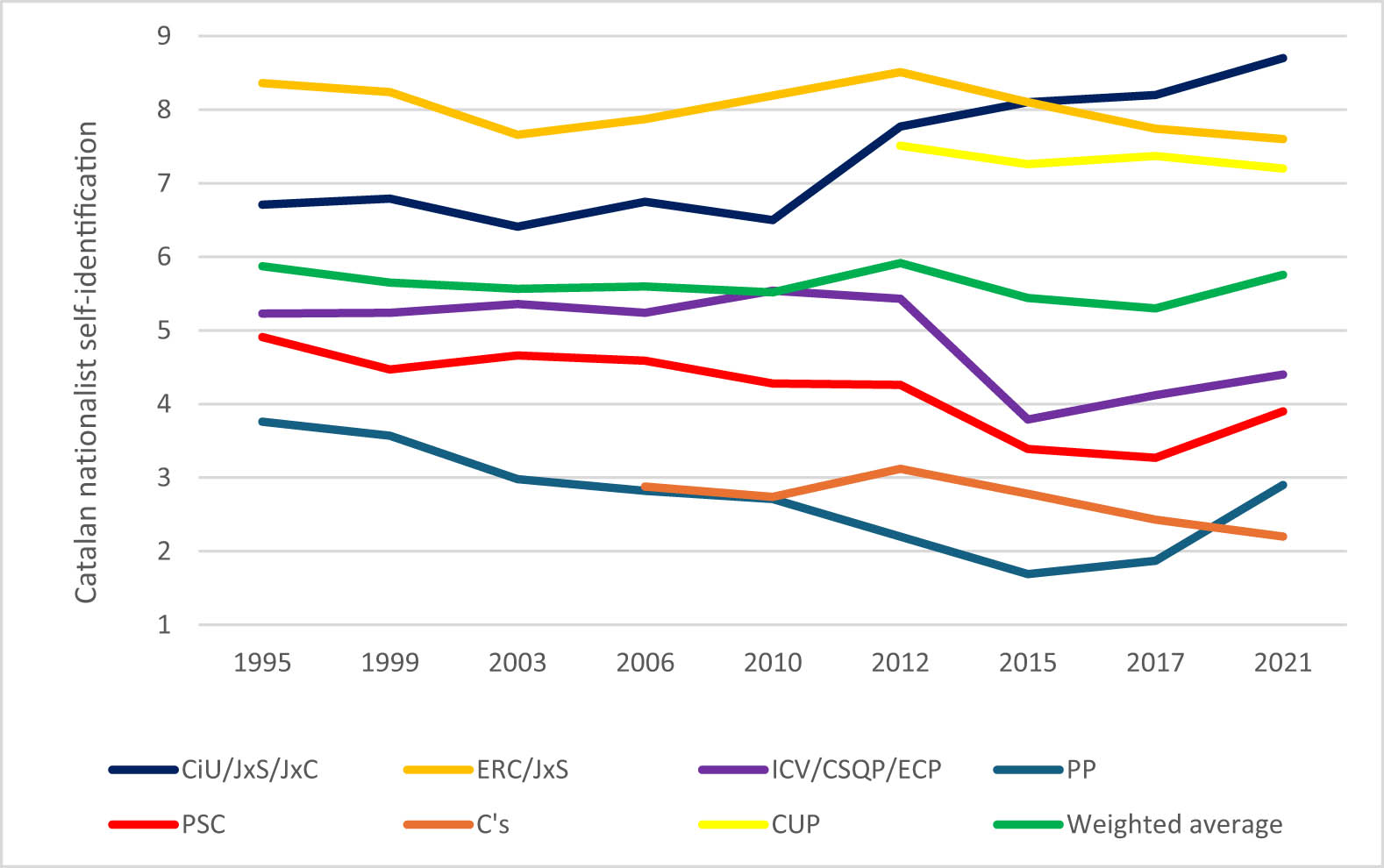
Figure 1
Evolution of the Catalan parties on the Catalan nationalist scale (1995–2021).
Source: CIS. Own compilation.
With regard to the evolution of ideological positioning, Figure 2 shows mainly one similarity with the previous one. Namely, up to the period from 2006 to 2010, a general stability is evident, with the parties maintaining their relative position, something that begins to vary from then on. As previously pointed out, if the stimulus to the changes in the nationalist dimension has been associated with the regional reform process begun in 2004, the changes in ideological position could be associated with the global economic crisis that started in 2008; although there are studies that underline the interrelation of both in the process of transformation of the Catalan political system (Serrano 2013: 524; Muñoz, Tormos 2013: 5; Cazorla, Rivera, 2017). On a general level, a slight shift to more left-wing positions of the whole of society is apparent from 2010 onwards. It is particularly noteworthy in the case of CiU/JxS/JxC, above all in 2015, as a consequence of their running together with a left-wing party such as ERC. It maintained this general trend in the following elections, up to 2021 when it was practically in the same position as an historically centre-left party, such as the PSC. On the opposite flank are the most right-wing parties, which, in turn, are the ones revealing the lowest rates of Catalan nationalism, namely, the PP and C’s. This is in line with what was proposed by Massetti (2009: 525), who, following the analysis of different European nationalist and pro-independence parties, concludes that, as a general trend, centre, centre-right, liberal, or conservative parties are less likely to hold positions that are favourable to secession.
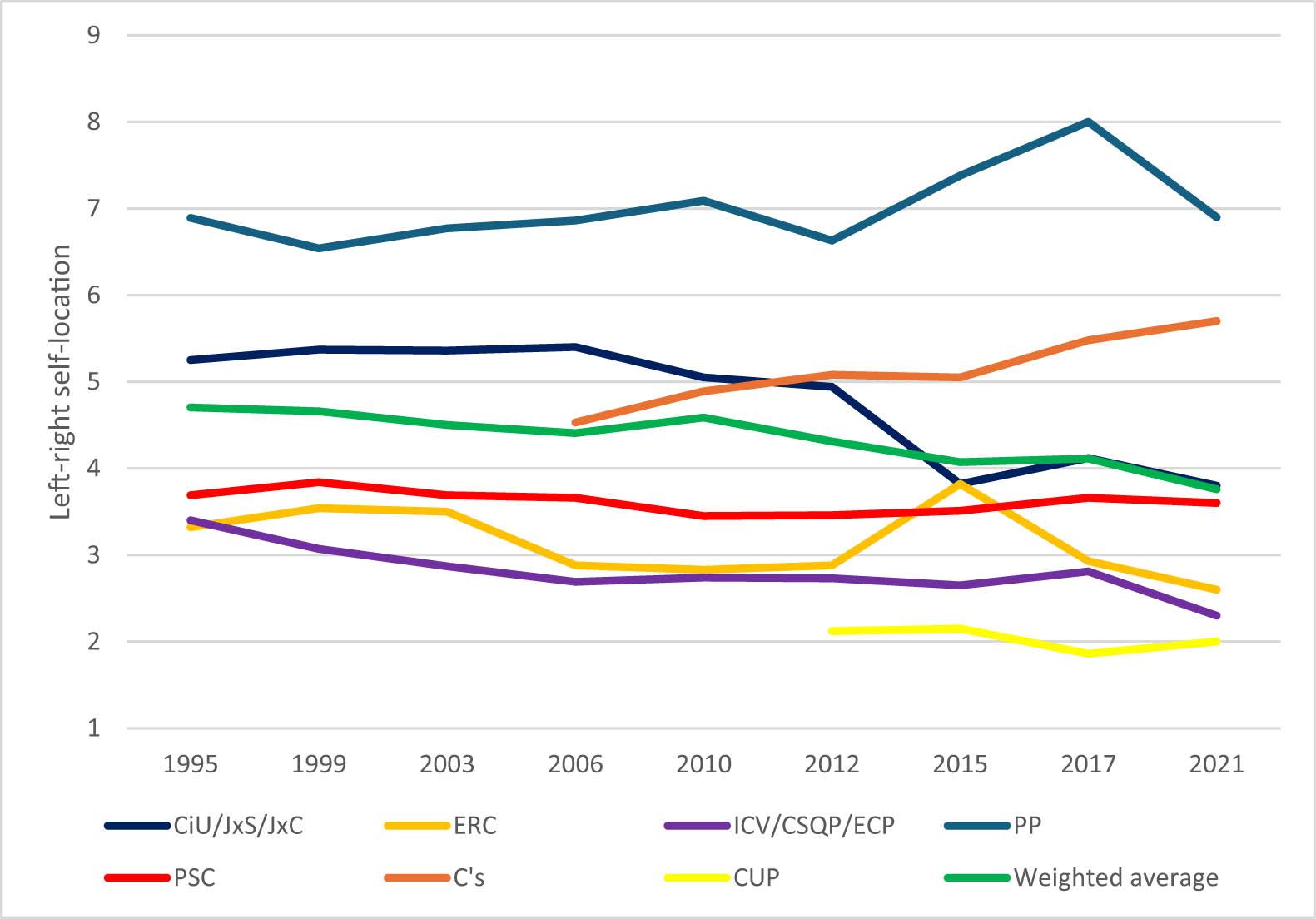
Figure 2
Evolution of the Catalan parties on the left-right scale (1995–2021).
Source: CIS. Own compilation.
Second, in order to make an initial assessment of which of the two dimensions has been more important among the (post)convergent electorate, spatial models will be applied to calculate the minimum distance of its voters with respect to the party they vote for on each of the axes. As expected, Table 1 9 shows how in the vast majority of cases (post)convergent voters identify exclusively with their party of reference as the closest option, both from the ideological and nationalist point of view (in bold is the option with the least distance each year). This would indicate the significant exclusive nature of the voters with respect to their party. However, this rule is not repeated in all cases. Particularly noteworthy are the results for 2015 and 2017, the period when the procés was at its height, when this electorate felt equally close to JxS/JxC as the rest of the pro-independence forces in the case of the nationalist dimension; with 34.1% feeling equally close to JxS and to CUP in 2015, and 37.4% feeling equally close to JxC, ERC, and CUP in 2017. These data show the close internal bond of the sovereigntist space at the time. This will not be the case in the ideological sphere, with CiU/JxS/JxC being the closest option in all cases.
As far as the evolution of the weight of each of the two dimensions is concerned, based on the data in the row “Total CiU/JxS/JxC” (i.e. all the cases in which this electoral option appears as the closest, either exclusively or sharing a minimal distance with some other option10), it can be observed that, over the course of practically the whole period from 1995 to 2010, there is greater proximity in the ideological dimension (by scarcely seven tenths of a percentage point the same did not occur in the 2006 elections). This would indicate greater closeness of the convergent electorate to his party in this area, in line with studies that suggested greater importance of this axis during this period (Balcells, Roig 2008: 5). However, this trend reversed from 2012 onwards, with a gradual increase in proximity on the nationalist scale in successive elections (49.4, 67.7, and 72.2%, respectively), to the detriment of the ideological one. Regarding the connections between the two dimensions and the impact the procés could have had even on the configuration of ideological preferences, particularly striking is how, during the least turbulent time of the entire period (1995–2012), ideologically speaking, the second option that CiU voters felt closest to was the PSC. However, in the period when polarization between blocs was at its greatest, voters felt closer in relation to this dimension to ERC (or even to En Comú Podem – ECP – in 2017), than to the PSC. All this, despite the fact that, as shown in Figure 2, self-positioning of the voters of both parties was practically the same.
As part of a deeper analysis of the electoral behaviour of these voters, the results of the voting components from logistic regressions are presented in Table 2. As already mentioned in Section 2, three groups of variables are differentiated: socio-demographic, psycho-social, and those relating to ideological and nationalist dimensions. As far as the first group is concerned, no data of particular significance persisting over time are provided. Occasionally, Catholicism, education, and age emerge as significant variables in 2012, 2015, and 2021, respectively, but with a very moderate incidence in the case of education (16% less likely to vote for JxS if the level is increased) and age (being slightly more likely to vote for if the older you are), and slightly more pronounced in the case of those people who consider themselves Catholic (80% more likely to vote for it). The language component is slightly more prominent, showing up on three occasions (1995, 1999, and 2006), with the vote for this option being more likely among those who have a greater knowledge or those whose native language is Catalan. Yet, none of these variables is constantly present.
Table 2
Significant variables in the electoral behaviour of CiU/JxS/JxC voters (1995–2021).

|

|
Note: The grey cells indicate the absence of data for that year *p < 0.05; **p < 0.01; ***p < 0.001.
Source: CIS. Own compilation.
A second group of variables grouped together is that of a psycho-social nature, with an aim to analyse the importance of the electorate’s evaluative dimension. Two areas were differentiated within this group: on the one hand, those of a contextual nature, which implied an assessment of different aspects related to the current situation; and, on the other, those of a more affective nature. With regard to those of a contextual nature, the evaluation of the Govern is seen as important in three of the six cases analysed.11 Two elements stand out: on the one hand, the approval of management in 1995 during Pujol’s mandate (those who approved being more than three times more likely to vote for CiU than those who did not); and, on the other hand, in the period of tripartite government from which CiU was excluded (2003–2010), the negative assessment of the tripartite coalition favoured voting for CiU. Likewise, the assessment of Catalonia’s political situation appears as a significant variable on two occasions (2012 and 2021), its voters being particularly critical in this period. In this respect, it can be concluded that the variables related to the situation are relatively important among the (post)convergent electorate. However, this importance does not appear to be homogeneous throughout the period, dropping in the period in which the procés was gaining strength. Even more noteworthy is the impact of variables, which evaluate the closeness or distance felt with respect to the candidates or the party. Both appear as significant explanatory variables in practically all the cases analysed. As can be expected, the closer one feels to the electoral options of the convergent sphere and the higher their leaders are rated, the more likely one is to vote for them.12 In this respect, it is worth highlighting that the successive changes in initials by this electoral space from 2015 onwards has not had any impact on the electorate’s feeling of proximity to the resulting parties or coalitions. These results reveal the importance of certain factors which are usually left in the background when analysing voting components, as opposed to other rational or ideological variables.
A third group of variables is related to the political variables associated with ideology and nationalism. With regard to the debate on the pre-eminence of the national or ideological dimension, in view of the whole of the period analysed, the greater relevance of the latter over the former is worthy of note. On the one hand, this would be evident in terms of the ideological self-placement of respondents, proving significant in 7 of the 9 years analysed. Those leaning right are more likely to vote for this electoral space. On the other hand, this is also reflected in the distances perceived between the self-positioning of the respondents and the position given to CiU (and its branches). In all the cases analysed, the distance in the left-right dimension is seen as a decisive factor when casting the vote, compared to the three that reflect the Catalan nationalist distance (2003, 2010, and 2015). This shows the importance of the ideological axis when voting for this option, in line with what was stated in previous studies (Balcells, Roig 2008). In addition, as can be seen from the coefficients obtained, in two of the three cases in which both variables show up in the same year, ideological proximity does so with greater intensity than nationalist proximity.
Nonetheless, this trend is not constant throughout the entire period and was reversed at one of the key moments of the procés. In 2015, when CiU and ERC ran jointly a candidacy under the name of Junts pel Sí, nationalist proximity prevailed over ideological proximity. This would also be influenced by the ideological diversity that this coalition would have, with a party from the centre-left (ERC) and another from the centre-right (CDC), making the determining factor when voting for it the proximity in the nationalist dimension. However, possibly striking is the fact that in the elections held in 2012 and 2017 (when the debate on the recognition of Catalonia as a nation predominated), the distance in the latter does not appear. A series of interrelated factors may explain these results. On the one hand, how the sovereigntist parties stood for the elections: together in 2015 and separately in 2012 and 2017. On the other hand, it should be noted that the proximity in the nationalist dimension in the last 2 years is very high among the different pro-independence forces, particularly in 2017 (as pointed out in Table 1). Third, the electoral balance of power must be taken into account, as CiU/JxC y ERC’s electoral results were gradually levelling up, with a drop in the former’s and an increase in the latter’s. In other words, the fragmentation of the nationalist sphere into two main parties (similar from the point of view of votes and their nationalist location) may result in the fact that this variable is not determining in the regression models formulated, but it is politically relevant. It cannot be ignored that these models calculate the probability of voting for one party over all others collectively, thereby dichotomizing the voting variable. Thus, a close proximity with regard to the nationalist dimension can be appreciated among CiU/JxC voters with respect to their party (category “1” of the dichotomized dependent variable), and likewise among ERC and/or CUP voters with respect to CiU/JxC (category “0” of the dependent variable); so that the coefficients returned would not show this differentiating characteristic between both categories.
Moreover, it must not be ignored that the variable related to national identification appears in 2021, with the chance of voting for CiU dropping by 80% among those who feel “as Catalan as Spanish,” or by 40% among those who feel “more Catalan than Spanish,” both with respect to those who feel “only Catalan.” In this respect, it is interesting to note the evolution in this aspect, as in 1999 (when this variable is found to be significant), it was four times more likely for those who felt “more Catalan than Spanish” to vote for it, than those who felt “only Catalan.” In other words, in this last period, exclusive national identity appeared to gain ground as an explanatory factor.
5. Conclusion and discussion
This study aimed to analyse the evolution of the electoral behaviour of CiU voters and CiU’s successor parties. This objective was based on the limited number of relatively comprehensive longitudinal studies covering both the period of the procés and the previous years, with a view to analyse the change in the importance of the factors traditionally used to explain voting intentions in this political space. This limited number of extensive analyses has meant that the study of Catalan electoral behaviour in general, and (post)convergent behaviour in particular, has been carried out in a fragmented manner, based on the analysis of specific elections or, at best, on limited periods that did not include the two main phases of Catalan political dynamics together. In this regard, one of the main contributions of this work has been to carry out an integrated analysis of such a long period in order to analyse the changes that have taken place in the electoral behaviour of this political space.
To this end, we first analysed the evolution of the positioning of Catalan political parties since 1995, both on the ideological axis and on the nationalist axis. Broadly speaking, the results revealed two main stages in the configuration of the Catalan party system; a first one, up to the middle/end of the first decade of this century, characterized by stability in parties’ relative position and a relatively centripetal dynamic; and a second stage, in which the distances between parties around the two large blocs increase and there are some changes in their relative positioning, this being particularly striking in the case of CiU and its ramifications in both axes, moving towards more nationalist and leftist positions. Second, the minimum distances in both dimensions of this electorate were analysed, yielding the following results (H1): (a) the close proximity of that electorate with respect to its party of reference in most cases; (b) a shift in trend around 2012, shifting from greater proximity in the left-right axis to a greater proximity in the nationalist axis; and (c) a close bond in this latter axis of (post)convergent voters with the other pro-independence parties in the most intense years of the Catalan independence process (2015 and 2017).
These data helped us to contrast the first hypothesis, showing a significant change in the relative position between parties on each axis. To go deeper into this contrast, different logistic regression models were set up to explain the specific voting components in each election, taking as a reference the variables which specialized literature had highlighted for the Catalan case. In this regard, three main ideas can be highlighted. First, regarding the importance of sociodemographic characteristics, including those related to ethnicity, such as language, contrary to what is suggested in the literature regarding their importance in electoral behaviour of non-statewide or ethnic parties (Chandra 2005), in the case of (post)convergent electorate, they do not show significant importance throughout the period, not even in the period of the procés. This should not contradict studies that have suggested that political parties use Catalan language as an electoral tool to win votes, whether statewide parties (Sanjaume-Calvet, Riera-Gil 2022) or non-statewide parties (Orriols, Simón 2024). In the case of the former, apart from limiting this use to statewide parties, the analysis will be based on a study of the speeches made by political elites (top-down approach); whereas in our case, we have started from the knowledge of Catalan language as a differentiating factor when deciding how to vote (bottom-up approach), showing no significant relevance in the (post)convergent case. In the case of the latter, our work has shown that when variables related to the ethnic vote (such as language) are included in the same model, together with elements that go beyond it (government management, ideological perception, etc.), the former lose significance compared to the latter.
Second, with regard to the dispute over the importance of both dimensions, the logistic regressions appear to be generally in tune with the previously analysed minimum distance tests, with a change in trend detected in the period during which the pro-independence process was at its height. However, this tendency does not show so clearly in the regressions, probably due to the proximity in the nationalist dimension between the sovereigntist parties. In this regard, it should be noted that the methodology used, dichotomizing the dependent variable, makes the group of non-voters for this option particularly heterogeneous, and these results could be explored in greater depth in the future using other techniques. In any case, it is important to highlight the significance of these variables related to political identification (both nationalist and ideological) throughout the entire period analysed.
Third, beyond the importance of the ideological and nationalist dimensions, voting component analyses have shown the importance of a number of other evaluative variables that have not often received the same attention. In relation to the hypotheses put forward, the importance of elements of an affective or emotional nature, such as leadership and identification with the party of reference throughout the entire period, stands out in the case of (post)convergents voters; showing that the successive changes in initials have not had a decisive effect when it comes to voting for them (H2). These results would highlight the importance of psycho-social models that emphasize the relevance of political identifications, both collective (with parties) and individual (with leaders). However, the tautological risk involved in results related to partisan and ideological identifications should be addressed in subsequent studies. In addition, the results show the importance of contextual variables (H3). As far as the electorate of CiU and its derivatives is concerned, specialized literature already highlighted the importance of the management of the Govern in the electoral results of this political option, also reflected in the results obtained in this work. In this sense, followers of this psycho-social school of thought may question whether it is partisan identification (or identification with a particular leader) that conditions the assessment of the government’s performance of that party or leader. However, the collinearity analyses between variables carried out prior to the construction of the logistic regression models would limit this risk. In addition, the loss of importance of this variable from 2010 onwards, while those related to party identification and identification with the leader remain important, seems to be in line with the idea that, from that time on, the debate on the territorial model predominated over institutional management.
Funding information
Authors state no funding involved.
Author contributions
GS was responsible for the methodology and quantitative analysis, as well as for developing the first part of the theoretical framework. JA elaborated the second part of the theoretical framework. EE prepared the introduction and conclusions. GS, JA and EE were equally involved in the research design, formulation of research questions, and overall revisions. GS additionally undertook the overall revision and formal and linguistic editing of the manuscript and acted as the corresponding author.
Conflict of interest statement
Authors state no conflict of interest.