
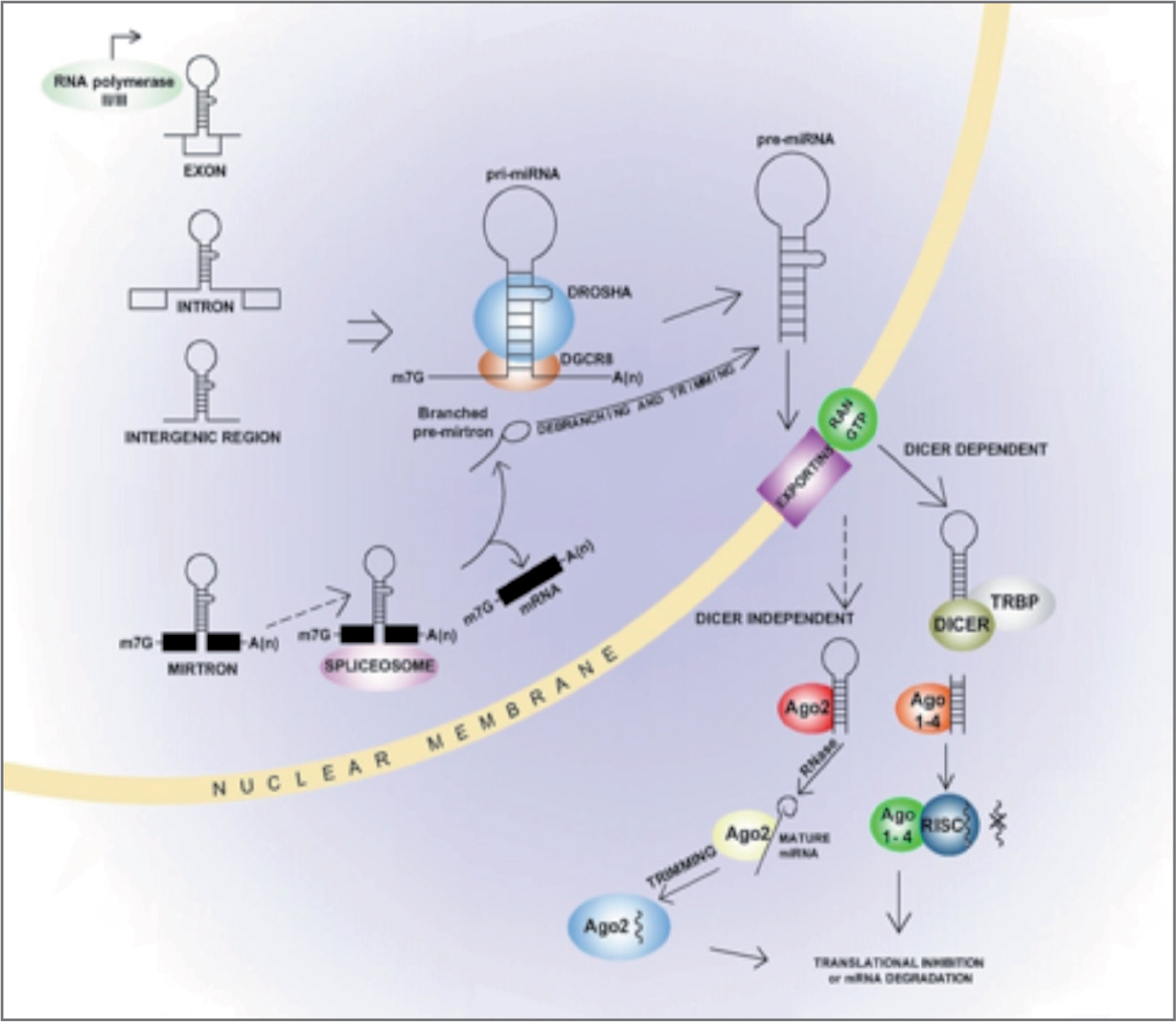
Fig. 1
Canonical and non-canonical pathways of miRNA biogenesis. miRNAs are usually transcribed by polymerase II. However, some miRNAs can be transcribed by polymerase III (e.g. from miRNA clusters that are spread among Alu repeats). In canonical biogenesis, the primary transcript (pri-miRNA) has a post-transcription typical loop structure that can be hundreds of base pairs long. Pri-miRNA is recognized by the protein DGCR8. Enzyme Drosha is associated with DGCR8 to form a microprocessor complex which removes the tails of miRNA and cut pri-miRNA into smaller precursor miRNA (pre-miRNA). Pre-miRNAs can then be exported into the cytoplasm. It is carried out from the nucleus through the nucleopore by the transporting molecule Exportin-5. In the cytoplasm pre-miRNA is recognized by the large RNAse protein Dicer. Dicer cleaves the stem loop to form a double stranded miRNA molecule. In the next step after cleavage, the guide strand is loaded into the Argonaute family of proteins and the passenger strand is degraded. The miRNA-induced silencing complex (miRISC) is formed. miRISC is then targeted to its target mRNA sequence. Once bound (usually at 3’ UTR region of mRNA), there are two ways that miRISC can inactivate mRNA – mRNA can be directly cleaved by RISC activity or this complex physically prevents ribosome subunits from binding and this leads to inhibition of translation. This figure also depicts two non-canonical miRNA biogenesis pathways.