
1. INTRODUCTION
The history of Jews living in the Upper Silesia Agglomeration goes back to the 13th century, although available sources state that the date of their main settlement dates back to mid-16th century (Będzin) [5, 6]. This is due to the fact that at the beginning the Jews were forced to live outside the city borders, and it had not been until the end of 15th century that they could settle down within the city walls [7]. It can be stated that the first documented settlements of Jews took place in the 17th and 18th century: Gliwice, Jaworzno: Szczakowa and Ciężkowice, Sosnowiec and Modrzejów [17].
Throughout 19th century, there was a dynamic growth of the Jewish community in the Upper Silesia Agglomeration. Development of ore and coal mining brought about an increase in their settlement in cities and suburban villages where mines could be found. Due to the fact that in the whole of Upper Silesia the Christians posed no competition for them, the cities which later formed the Upper Silesian Agglomeration became attractive for Jews. Moreover, more qualified workers started settling down in that area, which allowed them to take up administrative positions as well as become board members at factories or banks. Favorable railroad connection together with a close proximity to the Russian Empire and Austria-Hungary, increase in civic consumption, financial ties with Prussian magnates brought about the creation of a wealthy and influential Jewish bourgeoisie. Fortunes which they had gathered along with the education acquired and assimilation all led to changes in the social and professional structure. In the 19th century, the Jewish community laid the foundations necessary to establish their own places with a cemetery and a synagogue [17].
2. THE PURPOSE, THE SCOPE, AND THE CURRENT STATE OF RESEARCH
There are a number of publications in Polish and world literature on the history and culture of Polish Jews in various contexts [e.g. 3, 10, 14, 17, 19, 22]. However, no studies have been found concerning cemeteries located in the area of the Upper Silesian Agglomeration. The data used in this article come from published and unpublished residual research, conducted by enthusiasts or published on internet portals [29–38]. The aim of this study is to determine the state of preservation of 17 Jewish cemeteries existing in the area of the Upper Silesian Agglomeration. The background to the study was a discussion of the spatial and cultural conditions of the Jewish cemeteries, which allows for a better understanding of the specificity of these cemeteries in the culturally different reality of the cities that are currently part of the Upper Silesian Agglomeration. Only three of the Jewish cemeteries are inventoried: two active and one inactive, and their sites are legally protected. The prospective aim of the study is the conservation protection of all 17 cemeteries, for the memory of Jewish cultural heritage not only on a regional scale. The synthesized information presented in the article serves as a foundation for further research.
3. JEWISH CEMETRIES IN THE UPPER SILESIA AGGLOMERATION
Cemeteries in Hebrew are defined in various ways. They all, however, contain a notion of home. In Polish, one could also find notions: kirkut, kierkow, kierchol (from German: Kirchhof – churchyard, where the dead were buried [9, 12].
Jewish cemeteries set up in large cities of the Upper Silesian Agglomeration constitute necropolises typical of metropolitan clusters of Jewish communities. This was manifested in the rich tombstone form which constitutes a stone record of the diversity of Upper Silesian Jewish community during the prewar period, both in the scope of their customs as well as their financial position [18].
Some Jewish cemeteries were completely devastated during the German occupation: in Będzin, at the junction of streets Zawale and Modrzejowska [; in Dąbrowa Górnicza at Ludowa Street [5]; in Gliwice at Na Piasku Street, a place where Germans acquired the tombstones and used them as building material [16]; in Katowice at Kozielska Street [13]; in Sosnowiec – Modrzejów, at Pastewna and Gospodarcza St [1]. Some of them no longer exist: two cemeteries in Będzin; one of them was transformed into a park, at the junction of Zawale St. and Modrzejowska St.; in Bytom near Katowicka St. and Piastów Bytomskich St. Through the area of the cemetery, on the north-west slope of the Castle Mountain, at Podzamcze in Będzin, there are footpaths leading in and out of the city park.
After the war, the cemeteries which were often forgotten became the source of building material for the purposes of building new investments and were used by the locals [5]. Tombstones were used to cobble streets and roads: Jewish cemetery in Będzin Warpie, at the junction of: Zagórska St. and Sielecka St.; a Jewish cemetery in Sosnowiec, located at Gospodarcza Street was used for its tombstones, which were taken out to harden one of the streets [4, 5].
At some of the cemeteries, symbolical monuments were built to commemorate the Jews: in Chorzów, at Krzywa Street; in Dąbrowa Górnicza at Ludowa Street; in Gliwice, at Poniatowskiego Street; in Jaworzno at Al. J. Piłsudski Street, where one can find a plaque in their memory; in Katowice, at Kozielska Street; in Sosnowiec, at Pastewna Street and at Gospodarcza Street. The memory of the deceased was also recorded on special plaques devoted to the deceased. They were placed in the corridors of residential houses or in houses of prayers. Most of these monuments survived until the present day throughout Zagłębie, particularly in Będzin. Only two Jewish cemeteries are being protected in Upper Silesian Agglomeration. These cemeteries can be found in the city of Będzin [15] and in Zabrze [27]. The cemetery in Bytom was entered into the register of real estate with historic designation from 31st Dec. 2011 to 16thJune 2012. [25].
Fundamental to Jewish thinking about cemeteries are two important aspects. Of great importance are the assumption of a cemetery for eternity and the fact that cemeteries are sacred but ritually unclean places. The whole area of the cemetery should be walled off or fenced in and failing that there should be clear borders marked by a ditch or an embankment [23].
Enclosing a grave or an entire cemetery with a fence was supposed to ensure peace for the deceased as well as signal to the living that this place marks the “unclean” zone [10, 20].
However, some cemeteries located in the area of the Upper Silesian Agglomeration that endured do not have clear borders anymore: Będzin - on the northwestern slope of the Castle Mountain, at Podzamcze and at the junction of Zawale St. and Modrzejowska St.; in Chorzów at Krzywa Street.
Burials were organized by funeral brotherhood by name of Chevra Kadisha, which means the Holy Brotherhood. Apart from looking after the sick and homeless, they also dealt with the organization of funerals and the management of cemeteries. Such brotherhoods existed in every Jewish commune [8].
An indispensable part of Jewish funeral rites is the custom of keeping the body of the deceased away from the “living space”. To this end, special buildings – pre-burial houses – were built in the necropolis, for example in Gliwice on Poniatowskiego Street and on Na Piasku Street (in ruins), near the main entrance; in Bytom at Piekarska St.; in Katowice at Kozielska St.; in Mysłowice at Stawowa St.; in Sosnowiec at Gospodarcza St.
At the cemeteries there were also rooms for the cemetery’s caretaker or the undertaker: e.g. at the southern wall of the necropolis in Bytom, and in Zabrze at Cmentarna St. These buildings did not have windows looking onto the cemetery, this protected them against the ritual uncleanliness. With time, the rooms for the cemetery service changed into administration offices of the Jewish communes [7, 24].
In the Upper Silesian cemeteries, in the course of the 19th century, monuments resembling Greco-Roman tombstones began to be erected: e.g. in the Jewish cemetery in Katowice at Kozielska Street, where there are richly decorated tombstones alluding in their architectural form to Roman buildings, tombstones in the form of sarcophagi in Bytom, on ramparts at the Gliwicka Gate, in the area of Katowicka and Piastów Bytomskich Streets. These tombstones resemble portals or porticoes with columns, semicolumns or with pilasters carrying a beam.
In early middle ages, the sepulchral monument took on the form of a stele, a so-called Matzevah. They are present on all preserved graves. A Matzevah is a vertical slab crowned with triangle or a semi-circle on which a symbolical representation was rendered. It featured Hebrew or German-Hebrew inscriptions, ornamented with old-testament symbols. It was placed at the headrest or near the feet of the deceased. They were made of gray sandstone and from limestone.
Today, at two active cemeteries of the Upper Silesian Agglomeration: Katowice and Sosnowiec, there are sandstone Matzevot standing next to monuments made of marble, granite and other types of stone. What is more, inscriptions in Hebrew are often giving way to epitaphs written in Polish of German. Next to traditional Matzevot, there are also tombstones which often come in form of obelisks; or there are magnificent mausolea as well as rows of tombs embedded into the walls of the cemetery, e.g. as in Gliwice at Na Piasku St. Some Matzevot have been moved: some from Będzin or from Chorzów – from Krzywa St., to a Jewish cemetery in Bytom. At cemeteries established inside the Upper Silesian Agglomeration, there are still some uncovered Matzevot, on the north-western slope of Castle Mountain at Podzamcze in Będzin and in Sosnowiec at Pastewna St. Sensationally, an image similar to an eagle of the republic of Poland appeared in Matzevot, e.g. in Będzin, on the Matzevah of rabbi Jakub Natan on the Castle Mountain, probably for his service during the Kościuszko insurrection (1794). A fragment of the said Matzevah is currently held in the Museum of the Zagłębie in Będzin.
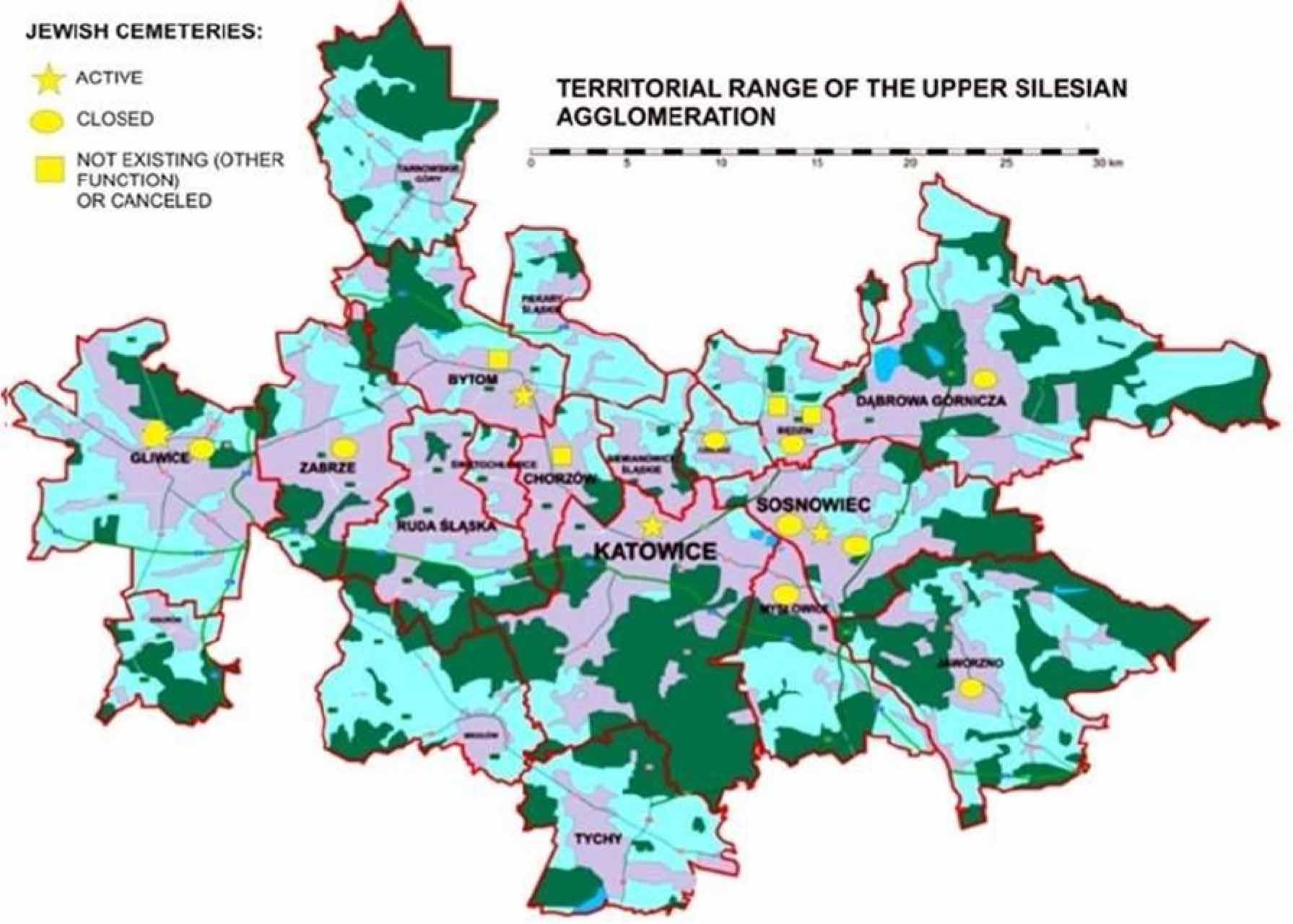
Figure 1.
Approximate position of Jewish cemeteries in Upper Silesian Agglomeration (Own study)
Table 1.
Table provides basic information on the 17 cemeteries located in the Upper Silesian Agglomeration area
| Town | Location | In operation | Area | |
|---|---|---|---|---|
| 1. | BĘDZIN no 1 | At the junction of: Zawale St. and Modrzejowska St. | Approximately 1592 to 1894 [5]; no longer in existence. | Approx. 0.3 ha. |
| 2. | BĘDZIN no 2 | North-western slope of the Castle Mountain, Podzamcze. | 1831 until the end of the 70s of 19th century [5]; closed. | Approx. 1 ha. |
| 3. | BĘDZIN no 3 | At the junction of: Zagórska St. and Sielecka St., Warpie. | From about 1870 to 1969 [15]; no longer in existence. | About 0.3 ha |
| 4. | BYTOM no 1 | The city ramparts in vicinity of the Gliwice Gate | 1720-1965, not in existence. | 0.2 ha (initially 1.75 ha)[25] |
| 5. | BYTOM no 2 | Piekarska St. | Since 1866 | 1.2 ha [25] |
| 6. | CHORZÓW | Krzywa St. | 1862-1958, 1972; liquidated [21]. | 0.8 ha |
| 7. | CZELADŹ | Będzińska St. | 1916-1948 [5]; inactive. | More than 1.5 ha. |
| 8. | DĄBROWA GÓRNICZA | Ludowa St. | 1929 to – about 1936 or later [4]; inactive. | 0.5 ha. |
| 9. | GLIWICE no 1 | Na Piasku St. | 1815-1953 [26]; inactive. | 0.63 ha. |
| 10. | GLIWICE no 2 | Księcia Józefa Poniatowskiego St. | 1902/1903; active. | 2.5 ha/1.7 ha [26] |
| 11. | JAWORZNO | J. Piłsudski Alley | After 1850-1942 [11]; no longer in existence oldest part/inactive. | 0.25 ha |
| 12. | KATOWICE | Kozielska St. | 1868 [13]; active. | 1.1 ha. |
| 13. | MYSŁOWICE | Stawowa St. | Two parts of the cemetery: active until 1700 and 1864; currently inactive. | Approximately 0.4 ha [29]. |
| 14. | SOSNOWIEC no 1 | Pastewna St., Sosnowiec Modrzejów | About 1790 [1], inactive. | ? |
| 15. | SOSNOWIEC no 2 | Gospodarcza St. | 1886 [1]; active. | 1 ha |
| 16. | SOSNOWIEC no 3 | Stalowa St., Sosnowiec Milowice | Probably 1936, [1]; inactive. | ? |
| 17. | ZABRZE | Cmentarna St. | 1871-1954 [27]; inactive. | 1.5 ha |
Another form of a tombstone was the Ohel. It is a small tomb made of brick, stone or wood and featuring a simple form of a quadratic prism and equally poor equipment. It was topped with a pitched or a semicircular roof, usually equipped with door and sometimes with windows [2, 24]. Ohelim are erected by Jews over the graves of rabbis and zaddikim and their male descendants. They were also erected for the sake of the deserving [2]. They survived in: Będzin on the north-western slope of the Castle Mountain at Podzamcze in Będzin; in Sosnowiec at Gospodarcza St; a destroyed one can be found in Czeladź at Będzińska St. Tombstones which resemble ohelim were erected for the sake of erudite people, e.g. the Meyers’ family tomb, built in the form of a detached chapel made after the neoclassical fashion at the Jewish cemetery in Gliwice at Na Piasku St.
4. RESULTS OF THE ANALYSIS OF THE CONDITION OF JEWISH CEMETERIES IN THE UPPER SILESIAN AGGLOMERATION AREA
1. BĘDZIN no 1
Condition: No tombstone survived. In 1942, Germans destroyed the necropolis and after the war the cemetery grounds were leveled. No information on mass graves. Borders of the necropolis unclear. Area not fenced, entrance on the side of the public road. It present serves as a public park.
Remarks: So-called “old Jewish cemetery”. No information to confirm that there used to be a Jewish cemetery.
2. BĘDZIN no 2
Condition: As many as 250 intact tombstones, as many as 550 broken or damaged tombstones, in total about 800. The oldest date back to 1831. Part of the cemetery is located west of the stairs leading up to the Castle Mountain. It was partly buried during the time when the underground was created in 1944. It may be assumed that in that area there could still be about 100 tombstones buried underground. There is no division into male or female part. No information on the location of mass graves. In the past, an ohel stood in the center but only its foundations remained. The borders of the necropolis are not clear, although there is a rebuilt gate leading into the cemetery, as part of an enclosure made of a stone wall. The entrance is open on the side of the public road and the city park.
Remarks: In direct vicinity of the necropolis, there is a recreational area. Footpaths of the city park lead through the grounds of the cemetery.
3. BĘDZIN no 3
Condition: At the place of the old cemetery, there now stands a building material wholesaler as well as a truck depot. Part of the wall remained. In 2008, a part of the Matzevot found were moved into the Jewish cemetery at Podzamcze.
Remarks: In the 60s of 20th century, many tombstones were used as building material on the territory of a bus terminus, then the whole area was covered in concrete and asphalt. In 2008, it was discovered that the railway loading platform, built in 1969, had actually been made of cut up Matzevot.
4. BYTOM no 1
Condition: The cemetery is currently an empty square between the tenements. It can be entered through a gate which can be found at number 3–5 Piastów Bytomskich Street. The necropolis is marked by an appropriate notice board on the wall of the building. Tombstones were transported into the municipal cemetery. In 1995, courtesy of the Towarzystwo Opieki nad Zabytkami [Society for the Preservation of Historical Monuments] a monument was erected, the so-called “Wailing Wall”, on the grounds of the new Jewish Necropolis at Piekarska St. The oldest tombstone that survived dates back to 1757. The last burial took place there in 1897. Apart from traditional Matzevot, there were also tombstones built in the form of sarcophagi.
Remarks: -
5. BYTOM no 2
Condition: An active cemetery [25], within the grounds which were gifted by Otto Friedlaender. The cemetery is based on two intersecting alleys, with smaller footpaths leading off it. In 1990, at the cemetery there were: 1307 independent tombstones, 122 flat tombstones, 34 earth tombs and 11 likely burial places as well as: 627 Matzevot, 261 obelisks 19 columns, 71 plaques, 17 pylon monuments, 8 sarcophagi, 38 architectonic monuments. Most of these objects were damaged [25]. In about 1890, with funds raised by Moritz and Otto Friedlaender, a neogothic pre-burial house was built within the cemetery, which is still active. The southern part is taken up by old Matzevot, dating back to 19th century. The oldest tombstones survived in the children plot on the right side of the main entrance. The north part serves as a cemetery where contemporary graves can also be found. The area is entirely fenced in by a tall, partly plastered, brick wall dating back to 1894. Along the southern wall, there is a rectangular two-floor residential building which is occupied by the caretaker. The oldest tombstone dates back to 1868.
Remarks: Along the fence, starting from the northern wall, at B. Prus Street, an architect M. Miodoński and a sculptor St. Petrus built a Memorial Wall which consists of Matzevot which were salvaged from the Jewish cemetery. In the vicinity, a monument commemorating Dutch Jews, victims of indentured labor in Silesia during World War the Second, was raised.
6. CHORZÓW
Condition: The cemetery is still in existence. Before the outbreak of WW2, it occupied the lot in the shape of an elongated rectangle. The entrance used to be located near no. 18 Krzywa St., the cemetery extended nearly to the modern-day J. Kilińskiego St. At the gate, there was a pre-burial house, which was built in 1898 and demolished in 1964. The area does not have an enclosure, there are relicts of a brick wall. The borders of the burial area are not clear. At present, at the place of the cemetery there is a Park Pod Kasztanami [a Park Beneath Chestnut Trees]. In 2006, on the edge of the park a monument was raised to commemorate the Jewish community living in Chorzów.
Remarks: In 1973, remains of 32 people were exhumated to be later laid in a Jewish cemetery in Bytom.
7. CZELADŹ
Condition: About 3200 tombstones survived. The cemetery can be distinguished by a division into several parts. There are separate plots for men, women and children. Tombstones of men were arranged in 88 rows while those of women in 91 rows. By the entrance, there is a destroyed ohel. Borders of the necropolis survived and comply with those of 1939. Entrance into the cemetery is located on the side of the public road, through a lockable gate. The area is in order and there are trees growing in it.
Remarks: During the WW2 at the rear part of the cemetery, bodies of approx. 100 Jews were burn inside a synagogue in Będzin. Later, as many as 400 Jews, murdered in 1943 during the liquidation of the Czeladź ghetto, were buried there.
8. DĄBROWA GÓRNICZA
Condition: More than 27 tombstones survived, although in various condition. The area of the cemetery was originally enclosed with a wall. During the Second World War, Germans partly devastated the cemetery while further devastation continued during the communist era. Most damage took place in the 70s, during the construction of the Mydlice estate. In 1993, a symbolic monument was erected on which there is a seven-pointed menorah. The oldest tombstone dates back to 1929.
Remarks: In 2012, in a forest behind the lapidarium, fragments of tombstones were found.
9. GLIWICE no 1
Condition: The area of the cemetery was divided into 7 plots, separated from each other by alleys. As many as 1500 people were buried there. In the middle part, on a small hill, there was a plot intended for the deserving members of the Jewish commune. There, about 150 deceased were laid to rest. Until today, about 700 tombstones have survived in the territory of the cemetery, arranged in equal rows. The last funeral took place in 1937. The most magnificent monument is the family tomb of a Gliwice industrialist Bendix Meyer, 1900, standing by the main alley. It was built in form of a detached chapel, erected in neoclassicist style, crowned at the top with vases covered by palls. Near the wall of the cemetery, there is a row of 28 tombs resembling antique portals with frames in the form of columns or half-columns, on which an entablature with the deceased’s family surname was placed. The area of the cemetery has been enclosed with a wall and a gate. At the main entrance, there are ruins of an old pre-burial house. It was devastated during the Second World War. The oldest tombstone dates back to 1825. Probably, in 1844 or 1845 numeration of tombstones was introduced. The numbers are visible at the rear side of the tombstones. In 1936, at that very cemetery there were 1445 tombstones.
Remarks: During Second World War, Germans acquired the tombstones as building and stone masonry material.
10. GLIWICE no 2
Condition: The cemetery was designed by Max Fleischer. Until today, as many as 600 tombstones have survived, including family tombs. They have features of historicism, secession and modernism. In the cemetery, 900 people were laid to rest. The arrangement of plots is well preserved. Through the middle, there runs the main alley, lined with tall trees. Tombs of the most eminent Jewish families from Gliwice were erected alongside it. There is also a monument made of gray granite in form of a cube, founded in 1932 by the German Association of Jewish Frontline Soldiers. It was dedicated to the 58 Jews who died during the 1st World War. In 1904, a neogothic preburial home was made of an ornamental clinker brick, on the basis of Max Fleischer’s design. The building features a one-floor body, tripartite and symmetrical. The facade is 43 meters long. The whole construction was covered with a hip roof. The preburial house consists of three main parts: the central one – a grand prayer room with an exit directly onto the cemetery, the morgue – a place where the deceased was prepared for burial in accordance with the rules of Jewish religion, and the third part – the apartment of the caretaker. The central part is two times bigger than the lateral wings. It is surmounted with an 8-part cross and rib vault. At the vault, there are still some fragments of paintings and ornaments. Upper parts of the vault were ornamented with a fresco which shows a starry sky. On the ribs of the vault, there are remnants of ornaments showing plants and geometric figures. In the main hall, on the eastern and western wall, there are tall ogive windows with fragments of stained windows showing geometric themes and three David stars. In the 1980s, the building temporarily served as a carpenter’s workshop. At present, it serves as headquarters for the Memorial House of the Upper Silesian Jews in Gliwice [28]. Until Second World War, both the cemetery and the house served their primary function. During the war, Germans devastated a part of the cemetery, taking numerous tombstones. The preburial house was turned into a military warehouse. Until 1942, as many as 895 people were laid to rest there. In 1946, burial rituals were resumed. During the war, the building served as a military warehouse but was not destroyed. On the territory of the cemetery, 10 plots of different dimensions, still arranged in the same way, were allotted. Until today, as many as 600 tombstones survived, including family wall tombs in the Western part of the cemetery which have features of historicism, secession and modernism. The oldest tombstones date back to 1904. 900 people were laid to rest in that cemetery. There is also a monument which was erected on the mass grave of Jewish prisoners murdered during the so-called march of death in Gliwice in 1945. The necropolis is enclosed with a brick wall and two wrought iron gates.
Remarks: First burials of the Gliwice Jews were performed in the separated plot, on the territory of the nonsectarian cemetery, located at the present day Kozielska Street. In 1940, part of the cemetery was given up to a neighboring nonsectarian Lipowy Cemetery. After 1945, the cemetery and the pre-burial house were used by the post-war Jewish Commune, operating in Gliwice, while in 2007, the caretaker took up his residence in the side part of the building. The Jewish Commune handed it over to the City of Gliwice. The cemetery was liquidated in the 80s of the 20th century. In 2012, the president of the city decided to renovate the former Jewish burial house and then transform it into a branch of the Museum which was given the name of the Memorial House of Upper Silesian Jews.
11. JAWORZNO
Condition: A fragment of the cemetery survived with 340 tombstones, the oldest of which dates back to 1884, the last was erected in 1942. Matzevot were arranged in rows. The area of the cemetery was enclosed with a wall.
Remarks: In 1995, a plaque was unveiled to pay tribute to the Jews who had been murdered during Hitler’s occupation. The cemetery was reconstructed in the 90s of the 20th century, thanks to the efforts of the Jewish people, former citizens of Jaworzno. The renovated necropolis does not do justice to the original.
12. KATOWICE
Condition: Register of monuments no. A/1414/90 as of 29th Oct. 1990. The area of the cemetery was enlarged in 1927. After the war came to an end, the cemetery was further enlarged. Approximately 1,400 tombstones survived in the cemetery, such as grand tombs of three Jewish generations, distinguished personas when it comes to the development of Katowice. Some of the tombstones were richly decorated while some of them contain reference to Roman constructions in their architectonic form. The oldest tombstone dates back to 1869. In 1869, a grand pre-burial house was erected. It contained a mourning room which resembled a theater, in which chairs for the mourners were arranged into a semi-circle as well as a room which belonged to the funeral brotherhood of Chevra Kadisha. Two years after it had been built, it underwent a complete makeover. In subsequent years, one more pre-burial house was built for Chevra Kadisha which was extended in the 20s of the 20th century. In 1870, the alleys were covered in asphalt [13]. During the 2nd World War, Germans party devastated the necropolis. Bodies of murdered defenders of Katowice were brought there. In the middle of the 20th century, a monument commemorating the victims of the Holocaust was built in the cemetery. It took on the form of a wide altar. On the stelae which surmount the mensa, or the altar top, Polish-Hebrew inscriptions were carved. On the mensa, a plaque was placed commemorating six families which were murdered by Germans together with two standing votive candles. The territory of the cemetery is enclosed with a stone wall.
Remarks: In 2009, the main stage of the renovation and reconstruction works of the complex of the Chevra Kadisha buildings was finished. It serves as the headquarters of the Foundation. In the pre-burial building, there is a plan to build a Jewish museum, devoted to the history of Silesian Jews.
13. MYSŁOWICE
Condition: Initially, the burials were performed on the right-hand side of the Stalowa St. That oldest part of the cemetery had been destroyed, with all its traces covered up. At the second one, a newer cemetery, almost 400 tombstones or their fragments survived, including 55 Matzevot, out of which 23 are flat, lying on the ground and 10 are broken. There are 77 obelisks, including 75 lying on the ground and 2 broken; 1 overturned column; 6 other architectonic monuments and 10 probable graves, according to the initial architectural inventory, kept at the Jewish Historic Institute, taken in 1989. The height from floor to ceiling at its highest point amounted to more than 7 m, while its length was 16.5 m. Over the entrance, a David’s star was put. The house was designed and built by Georg Schalscha, a builder from Katowice. In 1905, the old pre-burial house was replaced with a new one – bigger and higher. In 1905, the wall which borders on the existing sports school was raised by 50 cm, while in 1914 the walls of the cemetery, from the side of both streets, were raised up to 2 m. At the beginning of the Second World War, the plot on which the new Jewish cemetery had been built was confiscated by Germans. In 1942, the owner of a construction company called Plüschke, rented the building where the morgue had been for business purposes. The exact date of when the building was pulled down is not known. On the basis of drawings, it was possible to perform a visualization of the old and the new pre-burial house, visible from the side of Stawowa St. [38]. It is probable that together with the cemetery, also the first pre-burial house was built at Stawowa St. From there, it was possible to enter the cemetery. The area of the necropolis is overgrown with lush plants and trees. The cemetery is enclosed with a tall brick wall. The older part is presently a park located near an estate. Only one tombstone, erected in the 18th century, survived on the territory of the new cemetery.
Remarks: In 2013, the cemetery was put in order and more than 40 fallen Matzevot were stood up.
14. SOSNOWIEC no 1
Condition: At the cemetery, on a hill near the Czarna Przemsza river, around 300 tombstones (or their fragments) survived, including 250 which were put upright during conservatory works. An indefinite number of monuments can be found in the rear part of the necropolis, covered with earth and overgrowing with grass. About 20 small fragments of Matzevot were stacked near the entrance, in a place enclosed with a steel chain – probably, it is a mass grave dating back to the Holocaust. The effect of weather conditions as well as the lack of regular conservation led to a total devastation of the pre-war polychromy, while chemical agents emitted by the local plants caused that many tombstones were covered by a black layer. It may be assumed that the cemetery was vandalized during the period of Holocaust. Later, the abandoned necropolis would go to waste, from bad to worse with every year. In the 80s and 90s of the 20th century, the surviving tombstones were arranged on concrete pedestals, while the territory of the cemetery was enclosed with a steel fence. Two monuments in the fashion of Matzevot were founded to commemorate the victims of the Holocaust.
Remarks: The oldest of the three necropolises, found within the city borders of Sosnowiec. In the 80s and the 90s of the 20th century, at the initiative of Jews from Modrzejów, the cemetery was put in order.
15. SOSNOWIEC no 2
Condition: The cemetery comes as a part of the Nonsectarian Cemetery (called: The Cemetery of Four Denominations). The necropolis was set up on the plan of an elongated rectangle, at the place of a former choleric cemetery, with an entrance gate and the pre-burial house situated near the existing Gospodarcza Street. The funeral house was built by the Rajcher family. In the cemetery, there are about 500 tombstones and their fragments as well as more than 60 rows of tombstones, although there are numerous places with only individual Matzevot or their fragments standing in one line. I may be assumed that before 2 World War, their number was at least three times bigger. Inventory for conservation purposes was taken by K. Bielawski [35]. Next to traditional Matzevot, there are often tombstones that come in form of obelisks, cut down trees or mausolea. The largest concentration of tombstones can be found in the central part of the necropolis, in which burials are still take place today. Supposedly, in the past this very place played to role of the “Honor Row”. At that very spot, there stand tombs of famous Sosnowiec entrepreneurs and activists of the local Jewish commune. In the vicinity, there stand two Matzevot, enclosed with a low wall base which surely constitute the foundations of a destroyed ohel. On the right side, there is a well preserved ohel dedicated to a rabbi Abraham Majer Gitler, 1925. During the 2 World War, the cemetery was being devastated, but the most significant damage was done during the PRL times. Part of the tombstones were torn out and used to harden one of the streets – covered by asphalt, they remain buried within until today. The outer sectors of the necropolis are characterized by highest extent of destruction. While most tombstones commemorate people, who died or were murdered during the war, some of the graves feature a symbolical nature.
Victims of Holocaust have their own monument built right by the entrance. The cemetery has one entrance with a gate, at the top of which there is a menorah. The cemetery is enclosed with a 2m wall. According to other sources, as many as 300 tombstones survived [2]. Remarks: -
16. SOSNOWIEC no 3
Condition: Around 20 tombstones or their fragments survived, of which several survived in a condition where it is impossible to read the epitaphs. Identified monuments date back to Holocaust period. In the 60s of the 20th century, the cemetery was destroyed and devoid of enclosure. Since the end of the war, no renovation works have been performed. The area of the cemetery serves as an illegal landfill site.
Remarks: Signs of plunder are also visible in that area.
17. ZABRZE
Condition: The ground for the purpose of building a cemetery (register of monuments no. A/1500/92 as of 18th Sep. 1982) was given to the Jewish commune in 1871, by the last private owner of the city - Guido Heckel von Donnersmarck. In the cemetery, located on a small elevation, there are still around 300 tombstones, the oldest of which dates back to 1871. The last burials took place in 1954. After several months of the cemetery’s establishment, a funeral house was built right next to it. The Chevra Kadisha brotherhood established their headquarters there. In 1892, Max Böhm financed the construction of the pre-burial house, next to which an apartment stood in which both the caretaker and the gardener, looking after the cemetery, took up residence. In 1894-1895, the cemetery’s area was enlarged up to the length of the neighboring Evangelical cemetery. In later years, more parcels of land were purchased for the sake of the cemetery. Tombs arranged in rows date back to the turn of the 19th and 20th century. They had been embedded into the side walls, fringed with portals and porticos of half-columns and pilasters. Family tombs were framed by columns, half-columns and pilasters, which support the entablature bearing the family name. The most prominent is the family tomb of Max Böhm from 1904, made of black Swedish granite. Part of the destroyed Matzevot, were located at the same place as the so-called “wailing wall”. In 1918, Russian soldiers, who were kept at Zabrze POW camp, were buried under the walls, at the front and at the back of the cemetery. On the territory of the cemetery, there is also a mass grave of prisoners who died at the local subcamp of KL Auschwitz-Birkenau. The sylva which counts more than 200 trees deserves particular attention. The main alley is lined with locust trees.
Remarks: Since 1989, the cemetery has been under the care of the Social Committee Responsible for Care of the Jewish Cemetery in Zabrze.
5. CURRENT CEMETERY PROTECTION – SUMMARY
Jewish cemeteries possess a specific style based mainly on sculpture and architecture, resulting not only from observance of tradition, but also from resisting the influence of other cultures. Hence, the cemeteries are uniform and – one might get the impression – of monotonous landscape. Their condition may vary in the Upper Silesian Agglomeration. The best-preserved cemeteries can be found in the following cities: in Katowice and Sosnowiec. They are still active.
Jewish cemeteries have a specific style based mainly on sculpture and architecture, resulting not only from observing tradition, but also from resisting the influences of other cultures. Hence, the cemeteries are uniform and – one may get the impression – monotonous in terms of landscape. Their condition is varied in the Upper Silesian Agglomeration.
Usually, Jewish cemeteries are well preserved in cities where various types of organizations propagate Jewish culture. In case of Będzin, these include: The Zagłebie Museum, Cukerman’s Gate Foundation (conservation of monuments of Jewish culture and commemoration of the centuries-old presence of Jews in Zagłębie), Jerozolima Cafe.
Of the 17 cemeteries, only 4 are looked after by representatives of the Katowice religious community Chewra Kadisha. These are the cemeteries in: Bytom and Sosnowiec – at ul. Gospodarcza, which have permanent caretakers living in the cemetery buildings of the Chewra Kadisha brotherhoods, and the cemeteries in Katowice and Sosnowiec Modrzejów, subject to ad hoc care. The Gliwice cemeteries belonging to the Jewish Religious Community in Katowice are indirectly under the care of representatives of the branch of this community based in Gliwice. The Association for Jewish Heritage in Gliwice Memory-Zikaron takes care of two necropolises in this city. Renovated thanks to a subsidy raised by the foundation of Nissenbaum Family, at the initiative of the Association for Jewish Heritage in Gliwice, the Pamięć – Zikaron, the pre-burial house located in Gliwice at Poniatowskiego St. housed the Memorial House of the Upper Silesian Jews, Branch of the Gliwice Museum. The foundation ‘Or Chaim’, which carried out the cleaning works and prepared the documentation, has been in charge of the Jewish cemetery in Katowice. The facility is administered by the Jewish Community in Katowice. Since 1989, the Zabrze cemetery has been under care of the Social Committee responsible for the Care of Jewish Cemetery in Zabrze. In multiple cities, the memory of the murdered is honored with monuments and plaques commemorating their names.
When discussing the social care of Jewish cemeteries, it is worth mentioning the actions taken to protect cemeteries by Jews who survived the Holocaust. The investments they made in the post-war years contributed to the preservation of many sites. In Jaworzno, the construction of a cemetery fence was financed in the second half of the 1980s from the funds of R. Sontag, a former resident of the town. Similar work was carried out in the 1980s and 1990s at the cemeteries in Czeladź at the initiative of former residents. The cemetery in Sosnowiec-Modrzejów was reconstructed in 1990-1993 by the Jewish Religious Community in Katowice, from funds donated by Jews living in Canada, the USA and Israel, among others, who were associated with Modrzejów in the past. The Jaworzno cemetery was also rebuilt thanks to the efforts put in by the former residents of Modrzejów.
An important issue in the matter of actions to preserve Jewish cemeteries is the legal status of the land on which these cemeteries are located. Ownership relations, which often concern facilities that were the property of Jewish communities before World War II, directly affect the continued existence of cemeteries in urban and rural landscapes.
Matters connected with protection of memorials are governed by the act passed on 28th March 1933 concerning graves and war cemeteries as well as the act passed on 21st Jan 1988 concerning the Council for the Protection of Struggle and Martyrdom Sites.
According to the provisions contained in the Act on the Protection and Care of Monuments of 23 July 2003, in relation to cemeteries, the provision that a monument is an object “constituting evidence of a past era or event” and its preservation is in the public interest, “due to its historical, artistic or scientific value” is of particular importance. It is also important to further specify in art. 6 of the Act that monuments that are cemeteries are subject to protection regardless of their state of preservation. Therefore, the Act provides only general formulations that do not go beyond the activities that are usually undertaken by active caretakers. In the 21st century, only one active necropolis in Bytom has obtained the status of a legally protected one (2012).
Legal protection of Jewish cemeteries can also be guaranteed by the provisions made in the spatial development plans of individual municipalities. They contain detailed provisions regarding land use, which is why they can theoretically prevent uncontrolled investment activities within burial sites. In addition, the plans define activities in the field of protection of the cultural landscape, including by designating conservation protection zones and archaeological supervision, as well as landscape protection zones. All of the above-mentioned forms of protection of Jewish cemeteries are legally binding provisions that, to varying degrees, affect the possibility of preserving objects of material cultural heritage.
Information about Jewish cemeteries is collected in online resources. An important resource is located in the “Virtual Stetl” of the Museum of the History of Polish Jews – [29, 31, 32, 34].
Since 2017, the National Heritage Institute has been carrying out the programme “Marking of Jewish cemeteries on the territory of the Republic of Poland”, as part of the implementation of activities entrusted by the Ministry of Culture and National Heritage. The design of the plaques in the form of a matzeva with an inscription in Polish and Hebrew was agreed with the General Conservator of Monuments and the Chief Rabbi of Poland. The QR code placed on the plaque links to a broader description on the website zabytek.pl, which provides information about the cemetery in question and the Jewish community that inhabited the area. However, there is not a single cemetery located in the Upper Silesian Agglomeration in the register [39].
Culturally sensitive archaeological research (respecting Jewish burial traditions) is important. This may include ground penetrating radar (GPR), aerial photography and archival research. Most important, however, is the creation of a strategy for the use and maintenance of Jewish cemeteries, which involves establishing their per see status. Such a strategy will help to designate protection to prevent further destruction and maintenance to prevent further neglect. The strategy can be seen as an opportunity to enrich existing research perspectives. Research should answer questions; what do cemeteries tell us about Jewish communities, the societies in which they lived, their contemporary purpose and the way in which they are – sometimes ambiguously – subject to patrimonialisation. It is also important to answer the questions; how they become heritage, for whom and for what, in the context of a very complex regional history, interspersed with violence and disputed. Research would allow a better understanding of the contemporary purpose of these sites and their destruction, abandonment and late preservation.
Accepting diversity and difference in this way can be seen as constitutive features of Jewish heritage and as giving meaning to the past in the present.
The problem of abandoned and historic Jewish cemeteries is a common heritage issue. It must be approached with due diligence. Without efforts to include Jewish cemeteries in the register of historical monuments, to give them various forms of protection in local plans, their continued existence in the landscape is increasingly uncertain. Particularly in light of the observed progressive loss of tombstones, old trees, blurring of spatial assumptions and boundaries of sites, including as a result of the ‘disappearance’ of their fences, procedures for the protection of Jewish heritage in the Upper Silesian Agglomeration and in Poland as a whole should be undertaken without delay.