
1. INTRODUCTION
Since the beginning of time, man has had the need to create, to embellish his environment, to transmit information, to leave traces for posterity, as the Chauvetai caves in Lascoux show. The simplest and most universally understood form of communication was and still is the image – drawing, painting, created on the rocks of caves, houses, temples. This activity was not only intended to enhance the aesthetics of the environment, but was also a form of territorial demarcation. Murals have accompanied mankind since time immemorial. Today, murals are a common form of expression with a wide variety of themes. They address social, political and historical issues, and commemorate important people and events[1]. These murals are both a form of expression, an expression of discontent, frustration, a tool for struggle and education[2]. Regardless of their content, however, these large-scale works of art have a significant impact on the space in which they are created and on the audience that is present in a given location. Art has always coexisted with architecture and has been of great importance to mankind, including improving the quality of life by enhancing the aesthetic value of the environment. In a survey carried out among students on the perception of murals [3], the respondents stressed the importance of art in the environment, especially colour, which, as the respondents pointed out, enriches what is usually a grey environment. Apart from the subject matter, the scale of the painting, the technique of execution, the artistic solution, the composition of the mural has a significant impact on the visual qualities of the architectural object and its surroundings. At present, there are many activities which, not only by their content, but also by their colour and image, have a positive impact on the people in the space, improving their perception of it. The function of identification of a place (search for genius loci) and symbolic “marking” of an area is very important, as these values are always close to people [4, 5, 6], resulting directly from the human needs included in Maslow’s pyramid.
2. THE STATE OF RESEARCH
Today, it is possible to observe a significant number of murals in public spaces, which are important both for the cityscape - the places where they are created - and for the users of the space. The interest in artistic activities in the environment is reflected in many scientific studies. Researchers from different countries have approached the issue from different perspectives. Vadym Abyzov, Oksana Chuiev present a typology of murals on the example of works from Kyiv [7]. The wall painting as a phenomenon of communication has been described in detail by Justyna Palys [1]. Agnieszka Gralińska-Toborek [8, 9] writes about the experience of art in space in various aspects; murals as images of the city are described in the work of Małgorzata Bąkowska[10]; a similar theme is addressed by Karolina Jakiewicz, who writes about the painted side of the city [11]; Piotr Drozdowicz [12] writes about the possibilities of creating impressions in space thanks to the immersiveness and interactivity of mural painting. Murals are also a memorial, a tribute to an artist or a famous person. They also have an educational and social value [13].
The issue of street art and its preservation has also become one of the most debated and still unresolved issues in the field of conservation [14]. A current issue is the preservation of works, including the legacy of Banksy's murals in Ukraine, which are under threat from hostilities [15].
The question of ownership of the painted work and the object on which it was created is another interesting issue that has been debated since 2013, when Jerry Wolkoff, owner of the 5 Pointz building in the Long Island City section of Queens, New York, demolished the building along with the graffiti and murals that had been painted on it. This case sparked a series of debates about the ownership of works of art (in the US, a series of protests concluded that artists’ works are legally protected under the Visual Artists Rights Act (Vara).
The literature also addresses the issue of the shortlived nature of such initiatives, as well as their vulnerability to damage and even vandalism [16].
Murals can become sources of conflict and provoke social and political controversy. A notable example is the frescoes by Orozco at Dartmouth College, which faced protests from alumni. This highlights how murals may generate ideological disputes, especially when their messages are perceived as controversial or incompatible with local values [17].
Artistic elements introduced into the urban fabric do not always gain the approval of space users. A case of negative reception is the now-demolished Dudziarska housing estate in Warsaw. In 2010, artists from the Zmiana Organizacji Ruchu collective painted the windowless walls of the buildings black, inspired by Kazimir Malevich’s “Black Square”. The estate, functioning as a kind of ghetto, was not uplifted by the artworks, and residents’ reactions were overwhelmingly negative [18].
3. METHODOLOGY OF RESEARCHES
The research undertaken is an attempt to answer the question of how the perception of the environment can be changed through the introduction of murals into the fabric of urban development.
The study was conducted between 2021 and 2024 and focused on selected urban locations in Poland, specifically in Wrocław (Nadodrze), Katowice (Mariacka Tylna Street), and Gdańsk (Zaspa housing estate).
The methodology combined fieldwork, photo-graphic documentation, and literature review. Field research was carried out in collaboration with first-year students of the “Psychophysiology of Vision” course at the Faculty of Architecture. Students participated in site visits, visual analysis, and photographic documentation under academic supervision. Their role was primarily observational and supportive in data collection. The tools used included structured visual analysis grids and short questionnaires assessing spatial perception and aesthetic impressions. Although the study did not employ standardized psychometric instruments, the visual analysis was guided by criteria such as mural scale, integration with architecture, thematic relevance, and spatial impact.
From the almost 100 cases analysed, examples were selected that meet the following criteria in terms of design:
– Location – they are located in the urban fabric
– Type of development – they concern residential architecture
– Scale – they are not a single mural, but a collection of a larger number of images that interact with the space and the users.
These criteria were chosen to ensure that the selected murals had a tangible impact on both the built environment and its users. The selection aimed to reflect diversity in spatial typologies and mural functions (aesthetic, social, symbolic).
The work has not been guided by the subject, the form, the structure of the image, the way the painting is realised and its relationship with the building (optical qualities, change of statics, etc.).
An attempt was made to demonstrate the importance of art in the revitalisation process, so the research was carried out in several aspects:
– spatial aspect
– social aspect
– aesthetic aspect
The examples were illustrated by photographic documentation, most of which was produced as part of the research.
4. CASE STUDIES – ANALYSIS OF SELECTED BEST PRACTICES
The revitalisation of degraded urban areas is not a new phenomenon. Areas are transformed in order to improve living conditions in various tangible and intangible ways (places are given colour, new messages or symbols). An example of positive artistic activity as part of a revitalisation programme is the Rainbow Factory project in Kreuzberg, Berlin. The 19th century factory buildings were saved from demolition on the initiative of the local community, decorated with murals and transformed into a social and cultural centre. and transformed into a social and cultural centre. This is a good example of a bottom-up initiative, where the residents themselves became the initiators of the project, demonstrating their strong emotional attachment to the neighborhood [20].
In Poland, for example, the Galeria Murr in Warsaw was a unique gallery that helped to revitalise urban space. It was 24 metres long and located on a wall, on the facade of the Frito Lay factory. It was a significant element in that part of the city - a sign in space. Over three years, the artists created murals that were in dialogue with the space. The works were created with the specificity of the place, as well as the character of the immediate area, and were dedicated to this particular space - a busy part of the city. The artists invited to the Murr Gallery project were Dominik Cymer, Truth, Jan Kallwejt, Iwona Zając. The gallery was active between 2009 and 2011 [21, 22].
4.1. Semi-private spaces – courtyards the case of Wroclaw
Wroclaw’s courtyards in Nadodrze are a successful example of neighbourhood revitalisation. Paintings, ceramic murals, paintings and pictures on various scales and sculptures have been created on the walls of neglected nineteenth-century tenement houses, transforming the existing space. Ceramic murals, paintings and pictures in various scales, as well as sculptures, have transformed the existing world into a fairytale, colourful realm. Entering the space of the courtyards and passing through the colourful gates, the visitor enters a different world. A world that is different from everything that happens on the side of the road. The originator of the colourful courtyards is the painter Mariusz Mikolajek, who in 2014, together with Witold Liszkowski and Jan Mikolajek and a team of artists – the Centre for Cultural Animation of Courtyards (OKAP) – invited tenement residents to transform their unattractive courtyards. The first project was the courtyard at 15 (345) Roosvelta Street. Later, the project of colourful courtyards in Nadodrze included Jedności Narodowej and Słowiańska streets. This is an example of fruitful cooperation between artists and local residents. Seniors, children and adults alike were involved in the initiative, and everyone was able to create their own work by participating in the creation of the artwork. The walls are decorated with portraits of the 345 tenants, scenes from their lives and pictures of their pets: dogs, cats and space characters. The residents, who actively participated in the work on their immediate surroundings, deepened their neighbourly contacts and created a bond with their place of residence through such activities. It is a unique place that has now become a tourist attraction in Wroclaw and is frequently visited by tourists [23].
WROCŁAW, Backyard at 15 Roosvelta Street
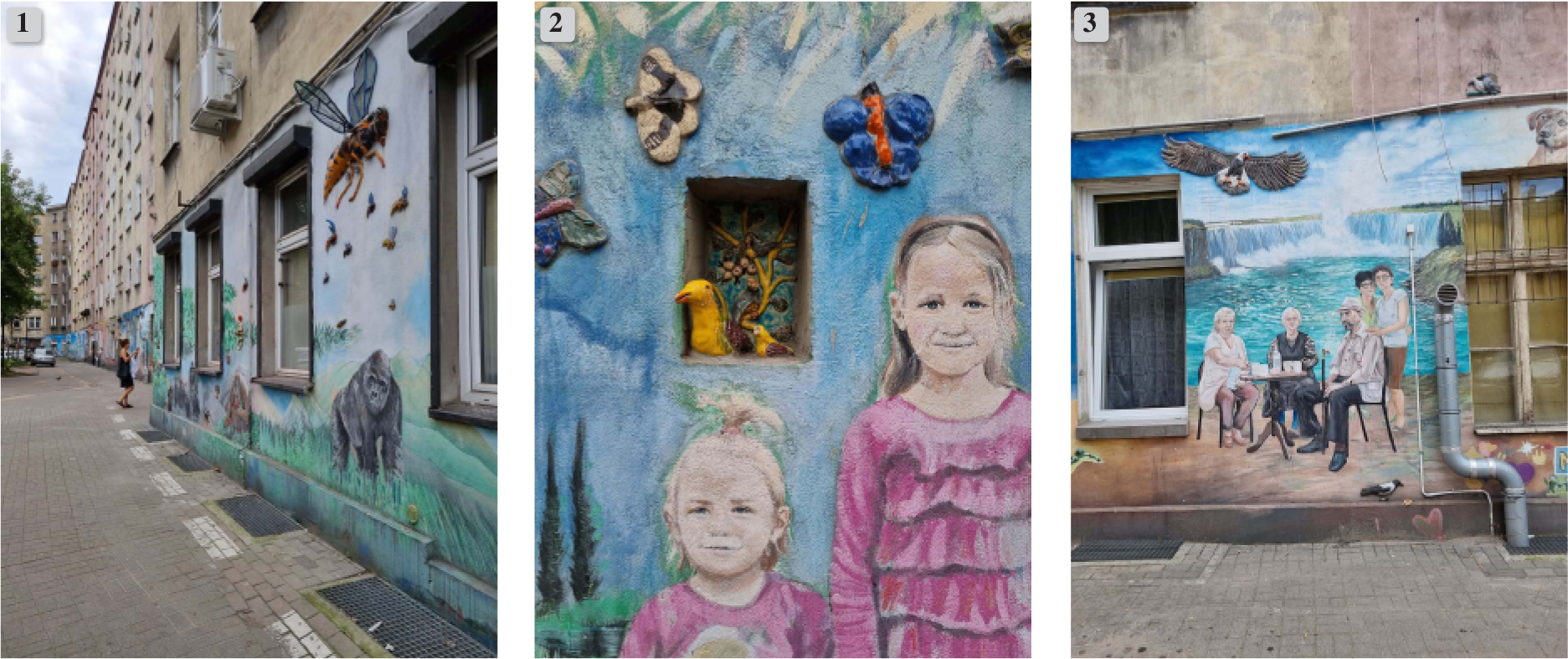
Figure 1, 2, 3.
Images of residents, photo: Joanna Zabawa-Krzypkowska
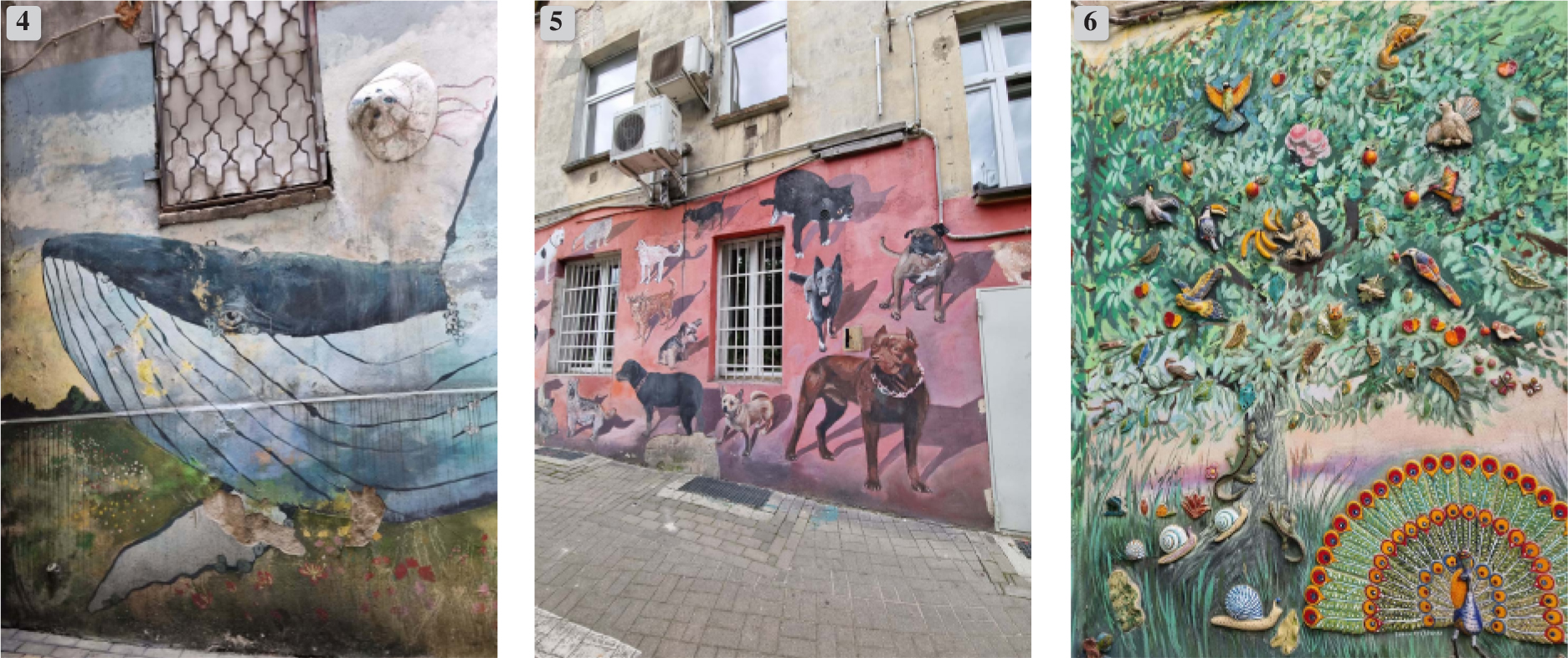
Figure 4, 5, 6.
Paintings of pets: dogs, cats and exotic animals and plants, photo: Joanna Zabawa-Krzypkowska
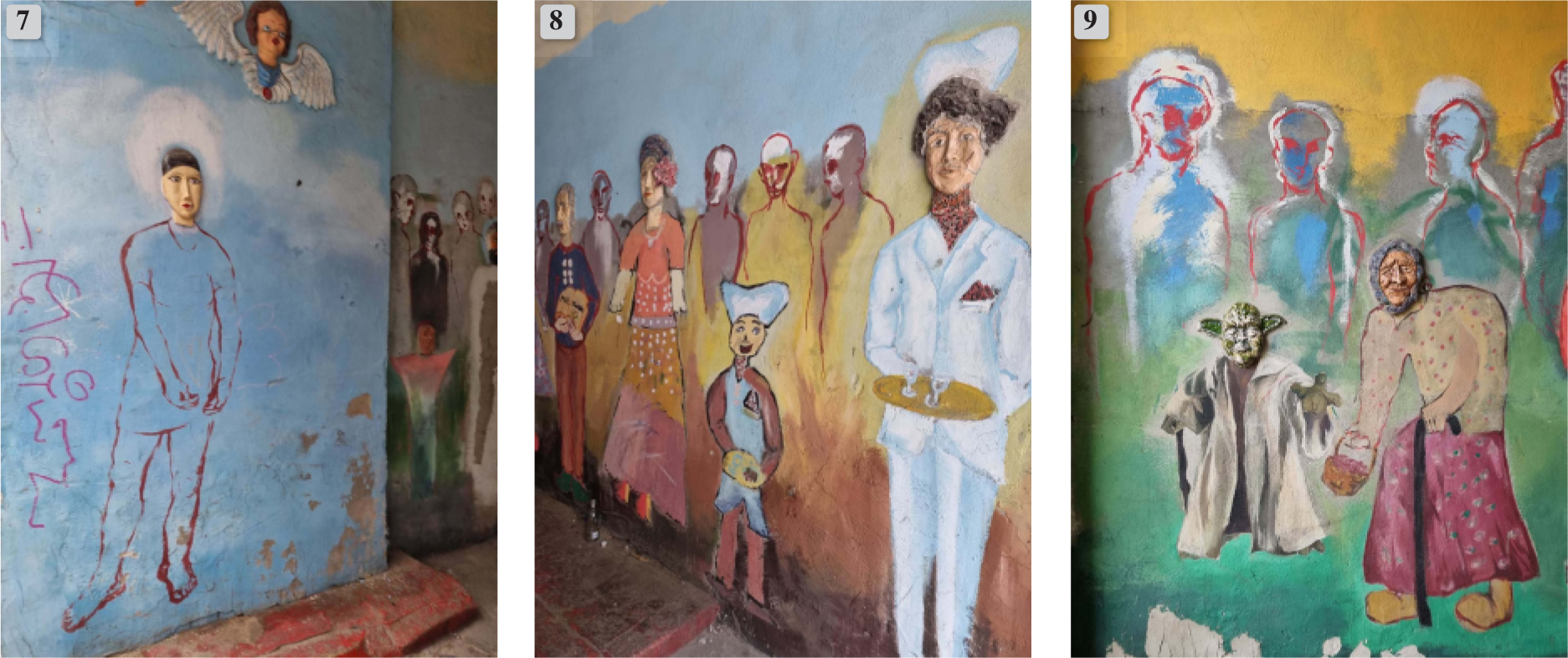
Figure 7, 8, 9.
Murals in the gateway, photo: Joanna Zabawa-Krzypkowska
WROCŁAW, Backyard at 15 Roosvelta Street
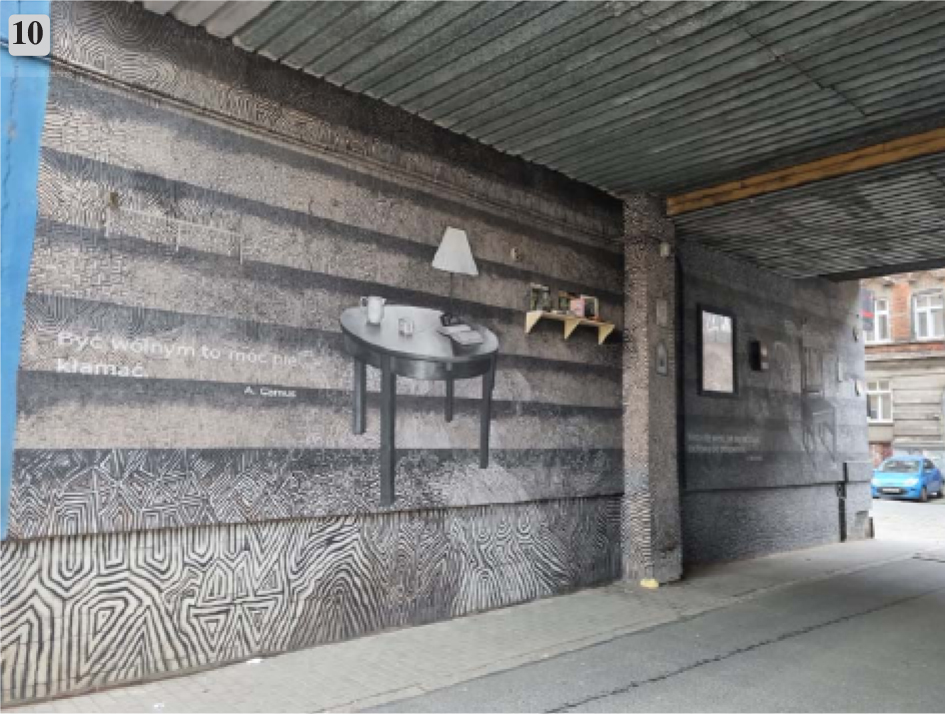
Figure 10.
Fragment of a passageway, gate leading into the courtyard photo: Joanna Zabawa-Krzypkowska
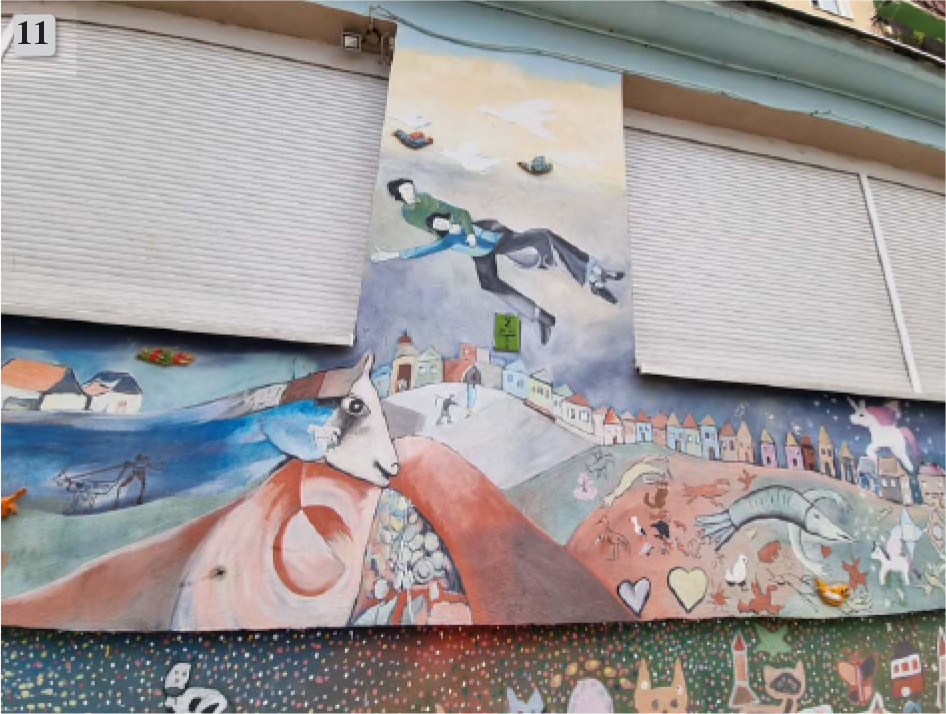
Figure 11.
Fairy tale mural in the backyard photo: Joanna Zabawa-Krzypkowska
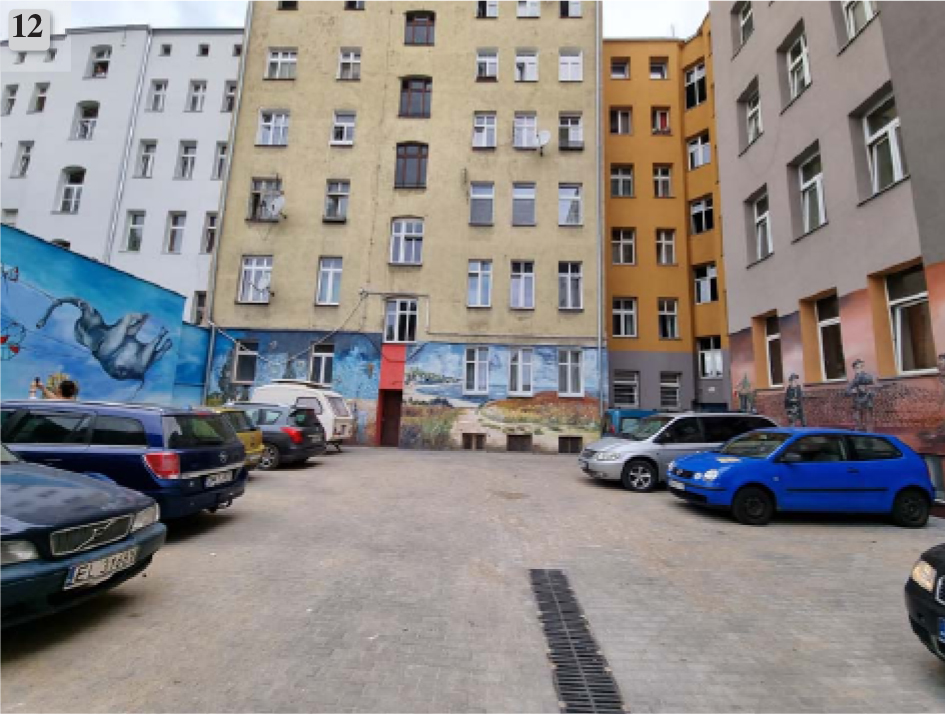
Figure 12.
General view of the backard, photo: Joanna Zabawa-Krzypkowska
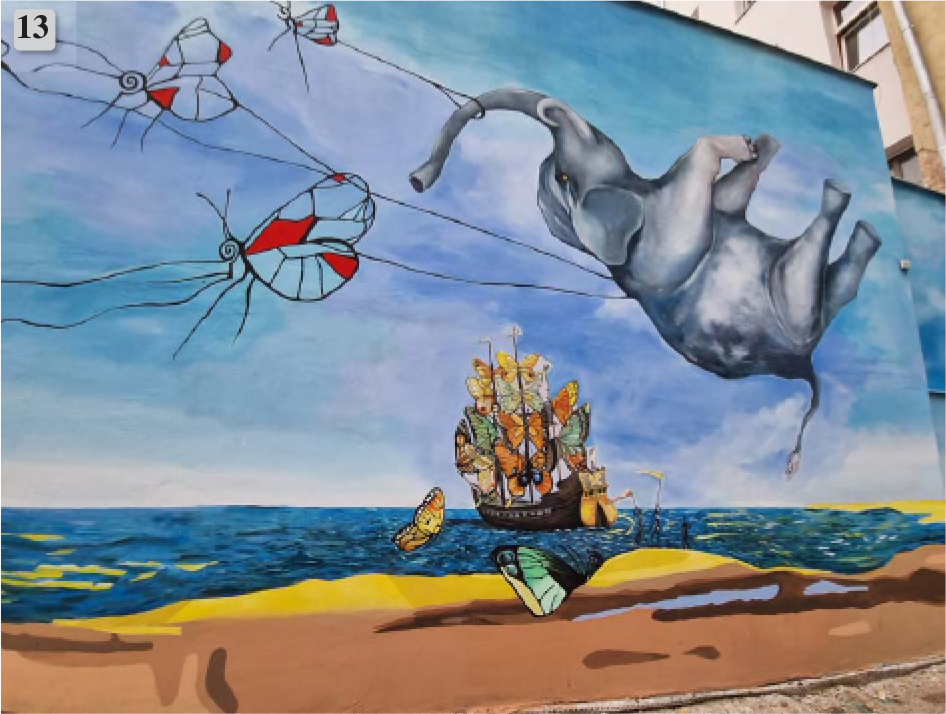
Figure 13.
fragment of one of the murals, photo: Joanna Zabawa-Krzypkowska
Table 1.
Analysis of examples: Wroclaw. Original work based on the literature, site visits, visual analysis, and photographic documentation
| WROCLAW | ||
|---|---|---|
| Type of space | Chosen murals | |
| Backyards Semi-privare space Compact buildings | Multicolored murals, covering a large part of the buildings of tenement houses and gates (mostly themes related to the place and its inhabitants), fairy tale themes, portraits of famous people, illustration of events | |
| SOCIAL DIMENSION | SPATIAL DIMENSION | AESTHETIC DIMENTION |
| • Element of identification of the space, identity of the space, (work co-created by residents) | • Increasing the prestige of a place | • Enrichment of the appearance of buildings and the whole environment |
| • Element of social integration of the inhabitants | • Visual element – sign, message, information in urban space | • Introduction of colour into the environment |
| Support for the city | Landmark | |
4.2. Back areas, back wall of the building – the case of Katowice
The back walls of buildings and streets are often unkempt, sad and grey. They often evoke a feeling of unease or even fear in passers-by. A positive example of how this situation has changed is Tylna Mariacka Street in Katowice. A neglected street has become a popular new part of the city. New eateries, such as Browar, have opened in the buildings along the street, and the drab walls of the buildings have become the backdrop for murals that cover the grey walls of the tenements. The murals on the walls vary in scale. There are large scale works, small colourful elements in parts of the courtyards and tiny works made with stencils. The first, shown below, is called Mural with an Egg and was made by the Spanish artist ARYZ. It shows an egg inside a hen divided into sections. The next two murals are the work of a well-known Belgian artist, ROA, whose works mainly depict animals. In Katowice, the artist has painted two birds: one with the inside visible, as if in crosssection, and the other in the traditional way. The large birds on the facades of buildings are visible from the windows of passing trains, forming a large urban gallery [24].
Mariacka Street has changed over time, with the recent construction of a hotel and a mural commemorating the famous Polish singer Zbigniew Wodecki. It is no coincidence that the mural commemorating the artist appeared in Katowice. The musician, known throughout Poland, began his long career in Katowice at the Variete Club on Korfantego Avenue.
4.3. Blocks of flats, housing estates – the case of Gdańsk
The capital of Polish mural art is undoubtedly the Trójmiasto, where the street art community has been flourishing since the mid-1990s. The Zaspa housing estate in Gdansk is one of the largest housing estates created according to the modernist principles of the ideal urban plan. The housing estate, which was intended to be a friendly and functional place, was for many years regarded as a grey, overcrowded block of flats. This changed when the walls of the buildings began to be covered with large-format paintings and the estate became a huge gallery of murals.The image of the neighbourhood changed dramatically when the Monumental Painting Festival was held here. The Monumental Painting Festival, which took place here in 1997, had a major impact on changing the image of the estate. At that time 8 monumental works were created by Polish and foreign artists. One of them was the mural “Colosseum” by Paweł Karczewski. The building depicted in the mural, although at first glance not associated with Gdansk or Zaspa, alludes to the monumentality of the estate. Since 2009, the festival has become a regular event in the district. Monumental Art activities are aimed at creating the largest gallery of monumental paintings in Europe. As part of the promotion of murals in Zaspa, the Gdañsk School of Murals was also established. The project, led by renowned artists Rafał Roskowiński and Jacek Zdybel, integrates the community of artists working on large-format murals.
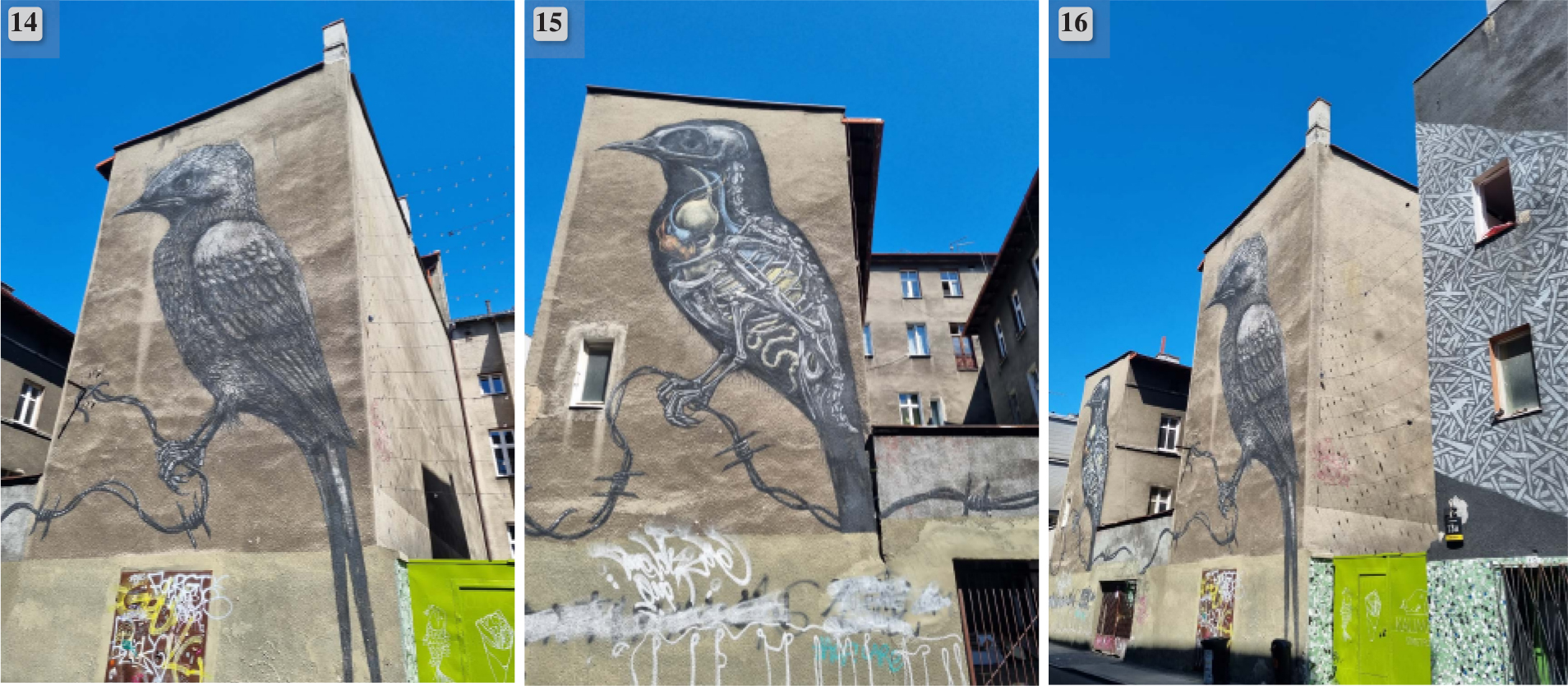
Fig. 14, 15, 16.
Katowice, ul. Mariacka Tylna, ROA, Birds mural cycle, photo. Joanna Zabawa-Krzypkowska
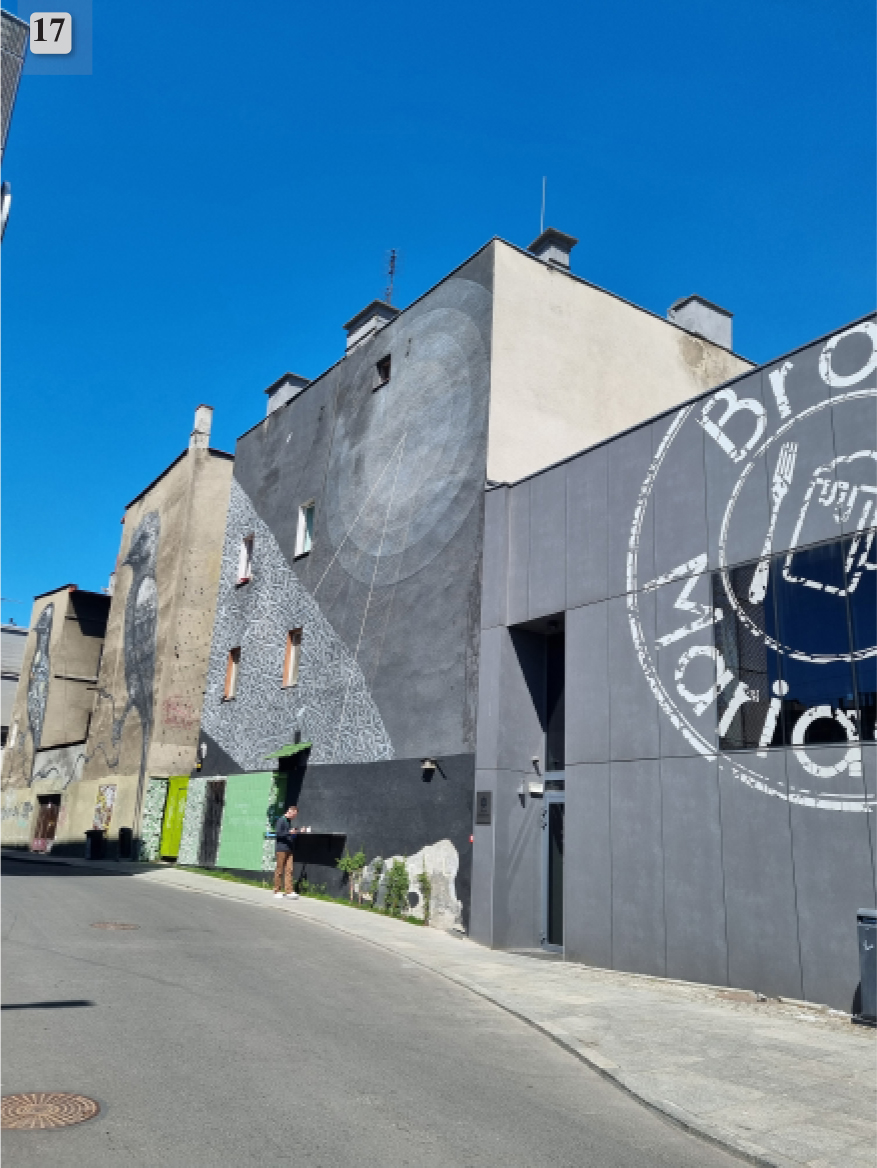
Figure 17.
View of the Mariacka Tylna street mural on the firstplan: year of creation 2012, Creators: two Italian artists Tellas and Teo Pirisi working under the name Moneyless. Unfortunately, it has already lost its intense black colour and it is hard to see the original perfectly geometric spirals on it. photo. Joanna Zabawa-Krzypkowska
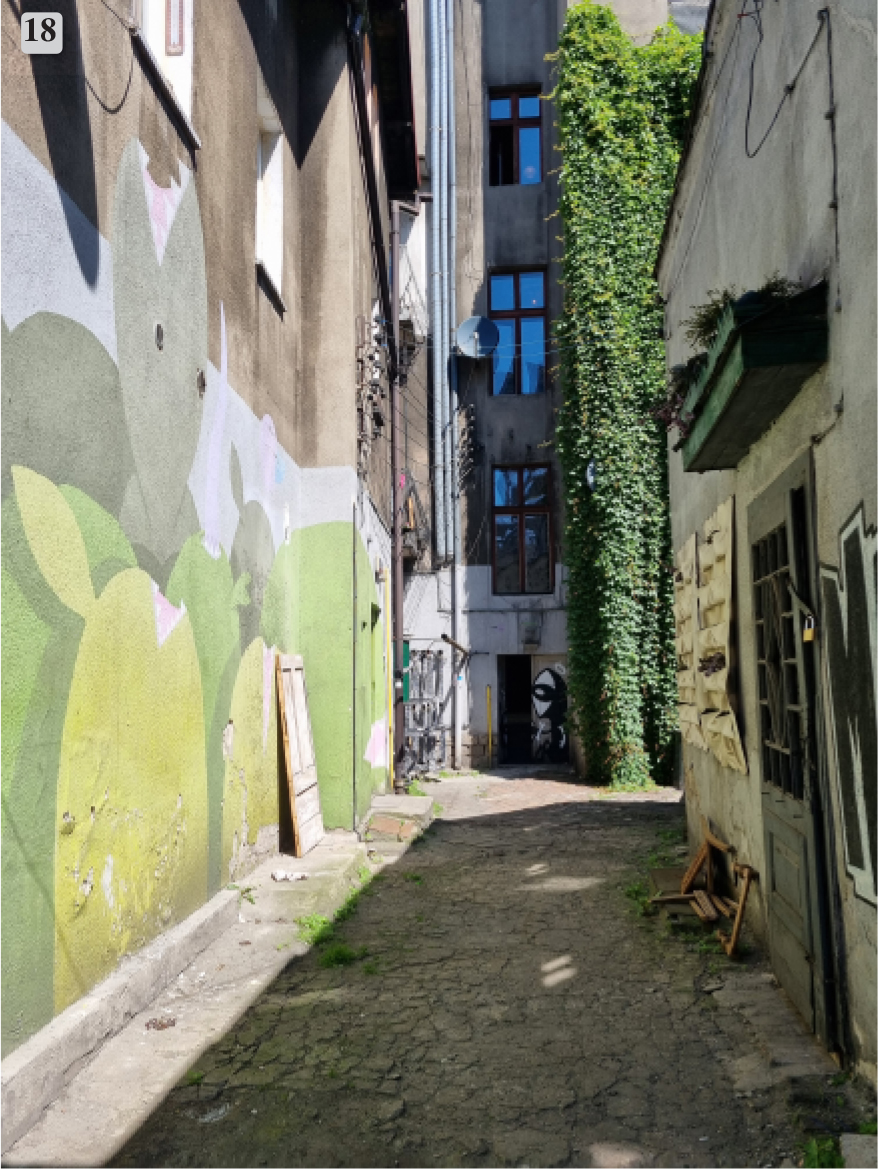
Figure 18.
Space between the buildings, photo. Joanna Zabawa-Krzypkowska
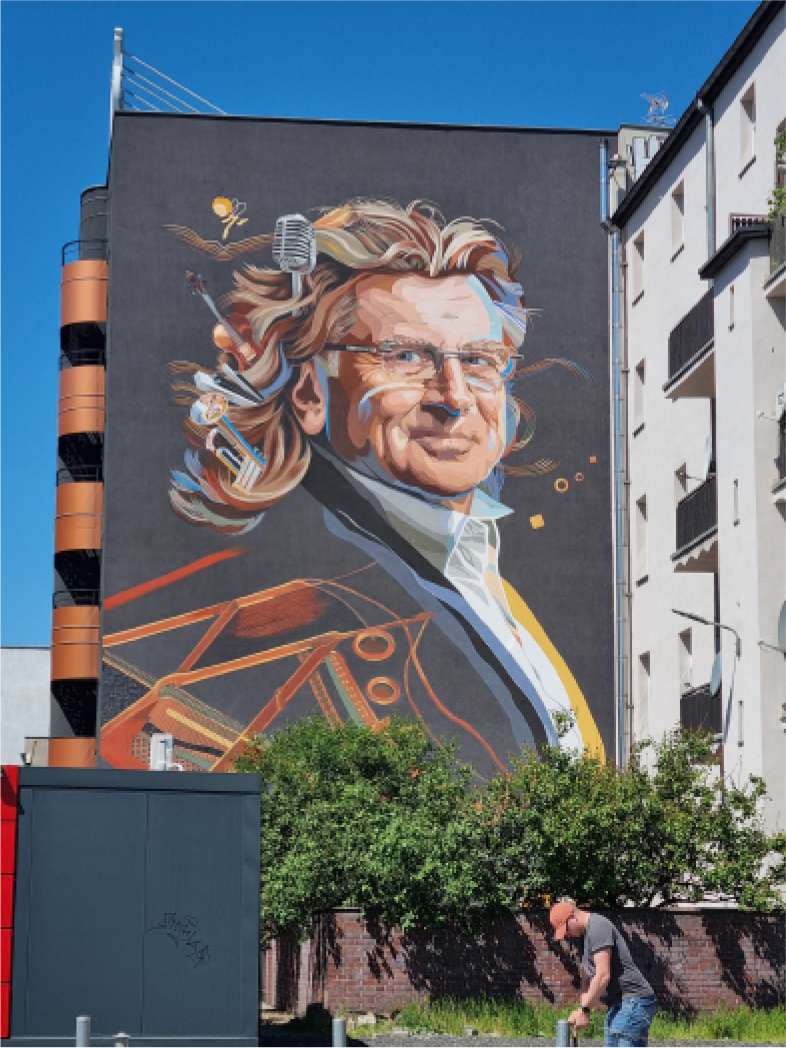
Figure 19.
Katowice, Mariacka Tylna 19, Zbigniew Wodecki, year of creation 2023, Creators: Czary -Mury: Marek Grela and Marta Piróg, photo. Joanna Zabawa-Krzypkowska
Walls of concrete buildings are covered with murals alluding to several important anniversaries, including the 70th anniversary of the outbreak of the Second World War, the anniversary of the Round Table Talks and the anniversary of the first rock and roll concert held in Gdansk. Due to the great interest in the murals, special guided tours are organised, during which visitors can learn about the paintings, their history and their creators. Currently, there is a collection of monumental paintings consisting of 59 large-format murals on the gables of apartment blocks and 19 arrangements of cage entrances [19]. The number of murals continues to grow, currently there are more than 60.
Currently, many Polish cities can boast a large collection of murals, including Łódź, Katowice, Wrocław, Poznań and Warsaw.
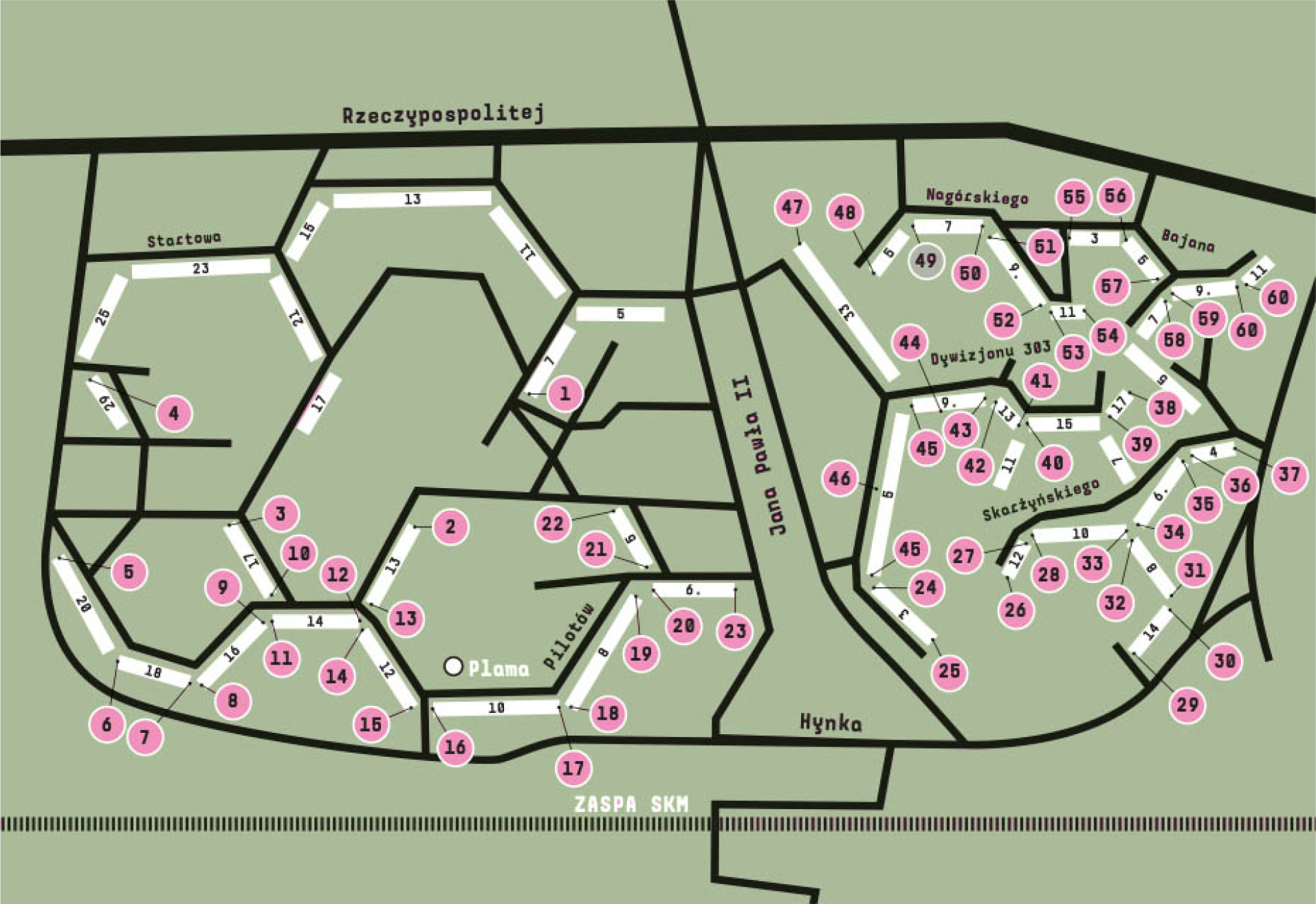
Figure 20.
Gdańsk, Map illustrating the location of the murals on the Zaspa housing estate.
Own drawing based on source: muralegdanskzaspa.pl
Table 2.
Analysis of examples: Katowice. Original work based on the literature, site visits, visual analysis, and photographic documentation
| KATOWICE | ||
|---|---|---|
| Type of space | Chosen murals | |
| Public space semi-private space compact buildings, back-up areas of the building | Multi-coloured, large-scale works As well as small-scale works in courtyard spaces. Diverse themes. | |
| SOCIAL DIMENSION | SPATIAL DIMENSION | AESTHETIC DIMENTION |
| • Element of identification of the space, identity of the place, (work co-created by residents) | • Increasing the prestige of a place | • Enrichment of the appearance of buildings and the whole environment |
| • Visual element - sign, message, information in urban space | • Introduction of colour into the environment | |
| • Support for the city • (urban attraction that attracts tourists) | Landmark | |
Table 3.
Analysis of examples: Gdańsk. Original work based on the literature, site visits, visual analysis, and photographic documentation
| GDAŃSK | ||
|---|---|---|
| Type of space | Chosen murals | |
| Public space semi-private space | Multicoloured, large-format works of varied subject matter and composition, located on individual blocks of the estate | |
| SOCIAL DIMENSION | SPATIAL DIMENSION | AESTHETIC DIMENTION |
| • Element of identification of the space, identity of the place, (work co-created by residents) | • Increasing the prestige of a place | • Enrichment of the appearance of buildings and the whole environment |
| • Visual element - sign, message, information in urban space | • Introduction of colour into the environment | |
| • Support for the city • (urban attraction that attracts tourists) | Landmark | |
5. SUMMARY
The examples presented above confirm that murals in space can be an important element in the process of revitalisation of, for example, cities, residential areas, backyards, blocks of flats, tenements. They are important visually, because they are a sign, a message, a piece of information in space, they make it possible to find one’s way, they are a point of orientation, they increase the prestige of a place. They are important for the aesthetics of a place, bringing colour and art into the urban space. Socially, they integrate residents and help to build the identity of a place.
All of the examples presented bring positive elements into the space that are relevant to both residents and passers-by - the users of the space. The first example concerning courtyards reveals the importance of the participation of artists with the residents, who by cocreating the work feel a greater bond both with their surroundings and with each other. The murals in Katowice, as well as those on the walls of blocks of flats in Gdansk’s Zaspa district, are an important element of the identification of a place, a sign and a landmark in space. Regardless of their subject, the way in which they are executed, they are an element of the urban gallery, accessible to all users of space. They also have an educational significance, as they often require a deeper reflection on the content of the image. All these examples have helped to raise the profile of the area in which they were created. They support the city by activating the space, as they are very popular with tourists.positive elements that are relevant to both residents and passers-by - the users of the space. The first example concerning courtyards reveals the importance of the participation of artists with the residents, who by co-creating the work feel a greater bond both with their surroundings and with each other. The murals in Katowice, as well as those on the walls of blocks of flats in Gdansk’s Zaspa district, are an important element of the identification of a place, a sign and a landmark in space. Regardless of their subject, the way in which they are executed, they are an element of the urban gallery, accessible to all users of space. They also have an educational significance, as they often require a deeper reflection on the content of the image. All these examples have helped to raise the profile of the area in which they were created. They support the city by activating the space, as they are very popular with tourists.
Table 4.
Summary of analysis exampless:Wrocław, Katowice, Gdańsk
| Examples of research projects | Wroclaw backyard | Katowice back-up areas of the building | Gdańsk blocks of flats | |
|---|---|---|---|---|
| Social dimension | Element of identification of the space, identity of the place,(work co-created by residents) | + | + | + |
| Element of social integration of the inhabitants | + | |||
| Support for the city (urban attraction that attracts tourists) | + | + | + | |
| Spatial dimension | Increasing the prestige of a place | + | + | + |
| Visual element – sign, message, information in urban space | + | + | + | |
| Aesthetic dimension | Enrichment of the appearance of buildings and the whole environment | + | + | + |
| Introduction of colour into the environment | + | + | + | |
Based on the analysed case studies, several practical conclusions can be drawn:
Community involvement is key – projects such as the Wrocław courtyards show that engaging residents in the design and execution of murals fosters a stronger sense of place and social cohesion. Municipal authorities should consider participatory design models when planning mural-based revitalisation.
Murals as spatial markers – in Katowice and Gdańsk, murals have become recognizable landmarks. Designers should strategically place murals in areas lacking identity or orientation cues to enhance legibility and wayfinding in the urban fabric.
Aesthetic transformation of neglected areas – the transformation of back alleys and grey facades into vibrant spaces demonstrates the potential of murals to uplift the visual quality of urban environments. Local governments could integrate mural programs into broader revitalisation policies, especially in post-industrial or socially degraded districts.
Tourism and economic activation – the Zaspa estate in Gdańsk illustrates how large-scale mural projects can attract tourism and stimulate local economies. Cities should consider murals not only as artistic interventions but also as tools for cultural branding and economic development.
Maintenance and durability – some murals (e.g., on Mariacka Tylna Street) have faded or deteriorated over time. It is recommended that mural projects include long-term maintenance plans and use durable materials suited to local climate conditions.
These findings suggest that murals, when thoughtfully implemented, can serve as multifunctional tools in urban regeneration strategies. Future projects should be guided by clear objectives, community engagement, and integration with broader spatial policies.