
Table 1.
Initial course schedule
| week | Stage | Contents / activity |
|---|---|---|
| 2 | Understanding Freeform Gridshell Structures | Form-finding methods workshop I (computational) |
| 3 | Form-finding methods workshop II (physical) | |
| 4 | Designing a freeform using gridshell structures | |
| 5 | Designing a Freeform Gridshell Structure | Design proposals: fabrication and disassembly issues |
| 6 | 3D model development (nodes, battens, organization) | |
| 7 | Design of nodes & battens | |
| 8 | Midterm Exam Week | Delivery: Design of all nodes / 3D printing setup |
| 9 | Making a Freeform Gridshell Structure | 3D printing / fabrication of battens |
| 10 | 3D printing / fabrication of battens | |
| 11 | Assembling of parts | |
| 12 | (Dis-) assembling a Freeform Gridshell Structure | Test Installation on campus |
| 13 | Disassemble / Re-assemble | |
| 14 | Final Installation | |
| 15 | Final Exam Week | Delivery: Report & digital archive |
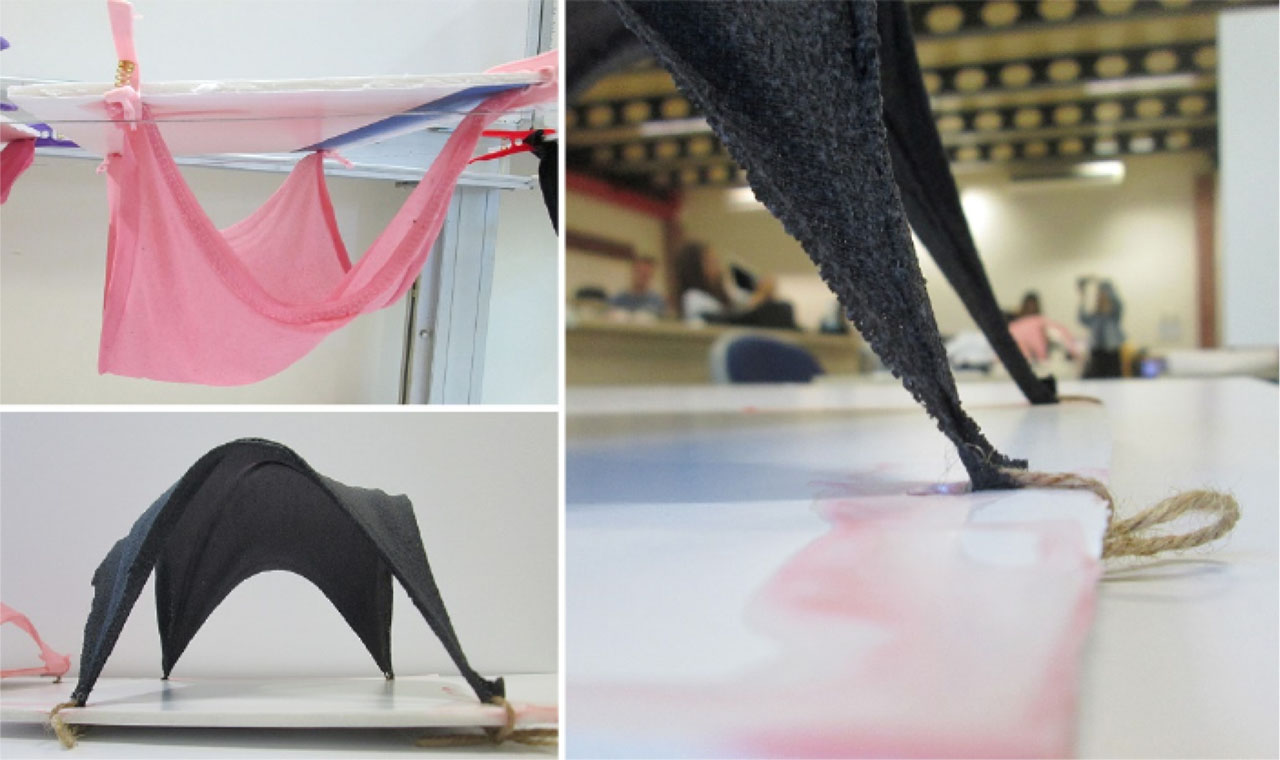
Figure 1.
Physical form-finding workshop: funicular membranes using fabric and candle wax
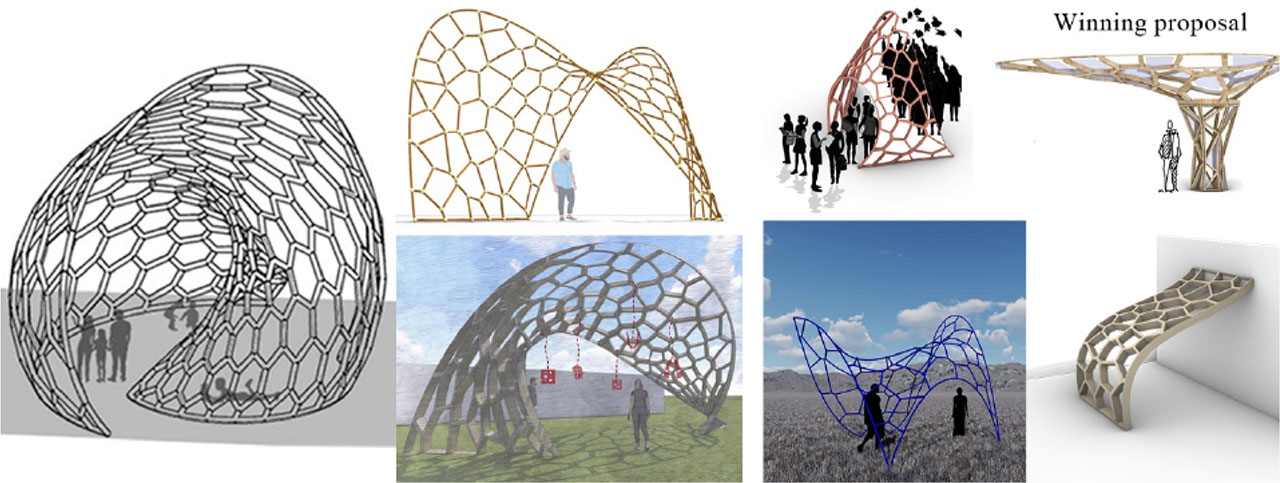
Figure 2.
The seven proposed designs (depicted at similar scale): three large gridshell structures on the left, smaller proposals – including the selected one – on the right
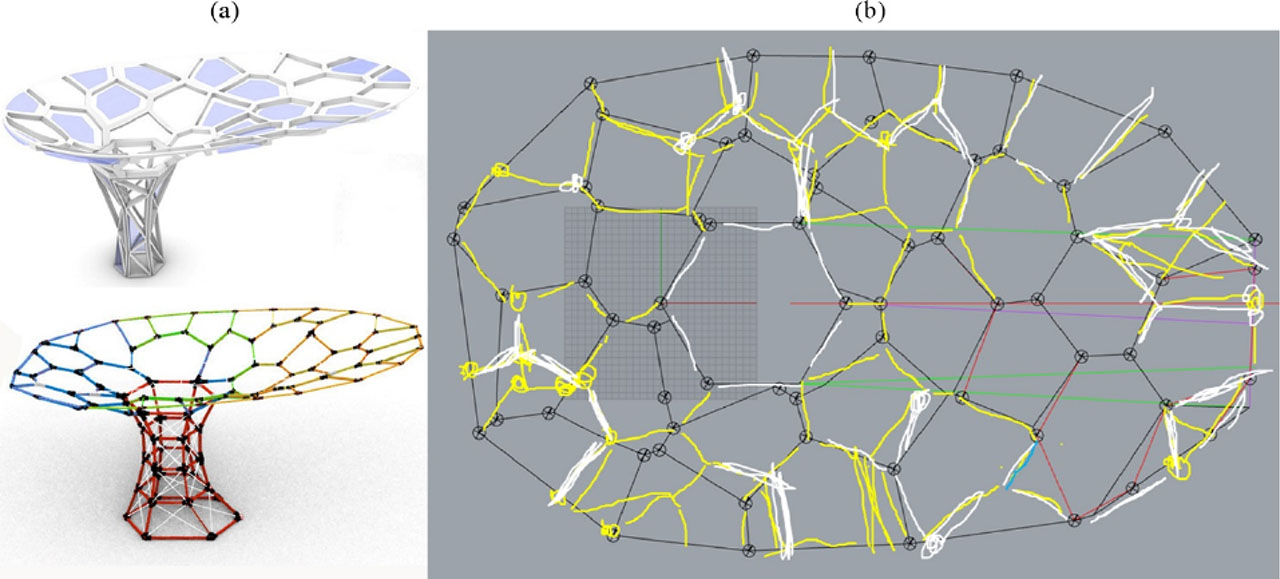
Figure 3.
(a) Pre- and post-revised versions of the prototype, and (b) sketch used during the discussion on the design of the canopy for structural enhancement
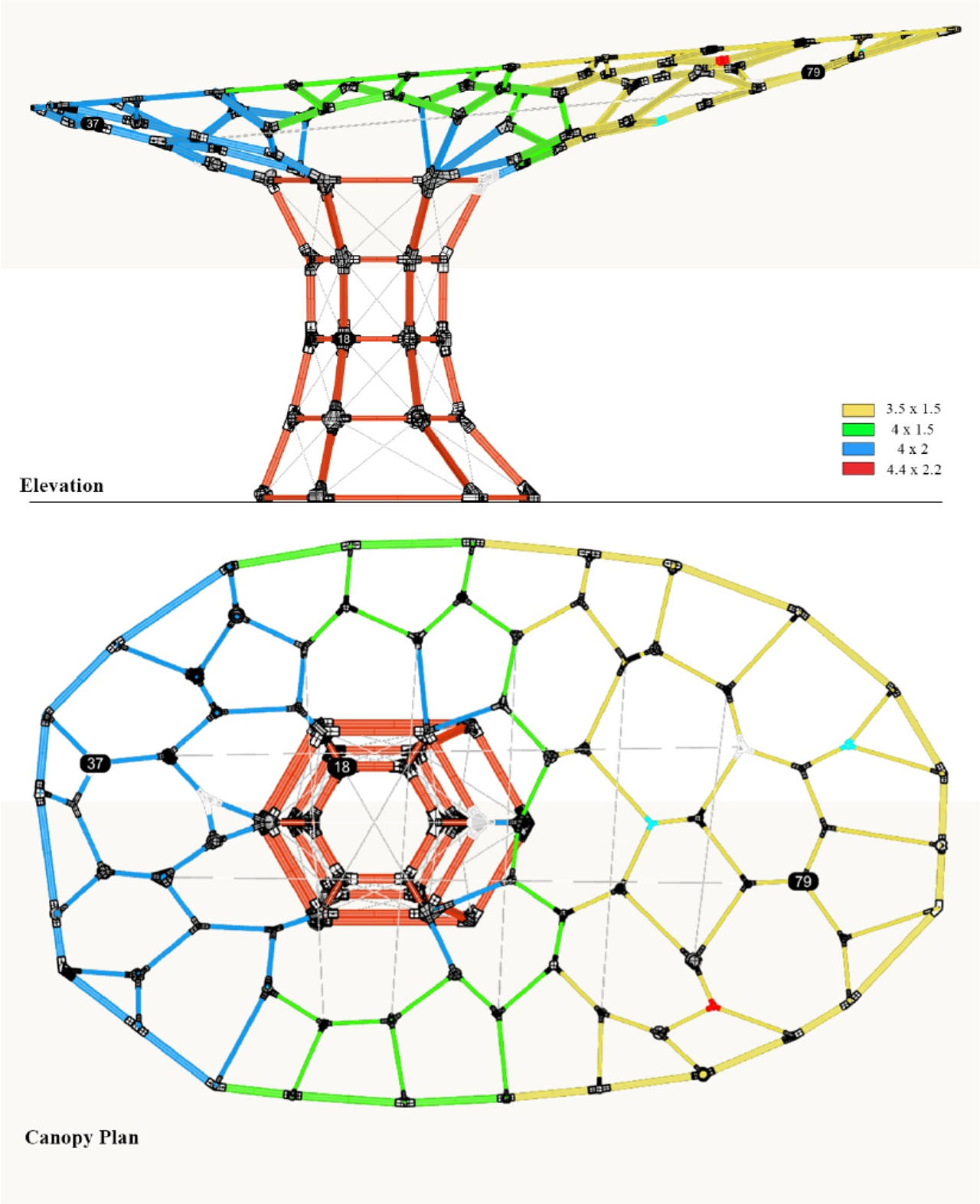
Figure 4.
Distribution of the 168 timber battens across the structure
Table 2.
Characteristics of the 168 timber battens
| Section | Quantity | Cross section (cm) | Average length (cm) | longest - shortest (cm) |
|---|---|---|---|---|
| Column | 54 | 4.4 × 2.4 | 49.1 | 94.3 − 32.6 |
| Canopy | 41 | 4 × 2 | 43.1 | 83.9 − 20.9 |
| 25 | 4 × 1.5 | 46.5 | 75.5 − 32.8 | |
| 48 | 3.5 × 1.5 | 49.4 | 83.1 − 19.8 |
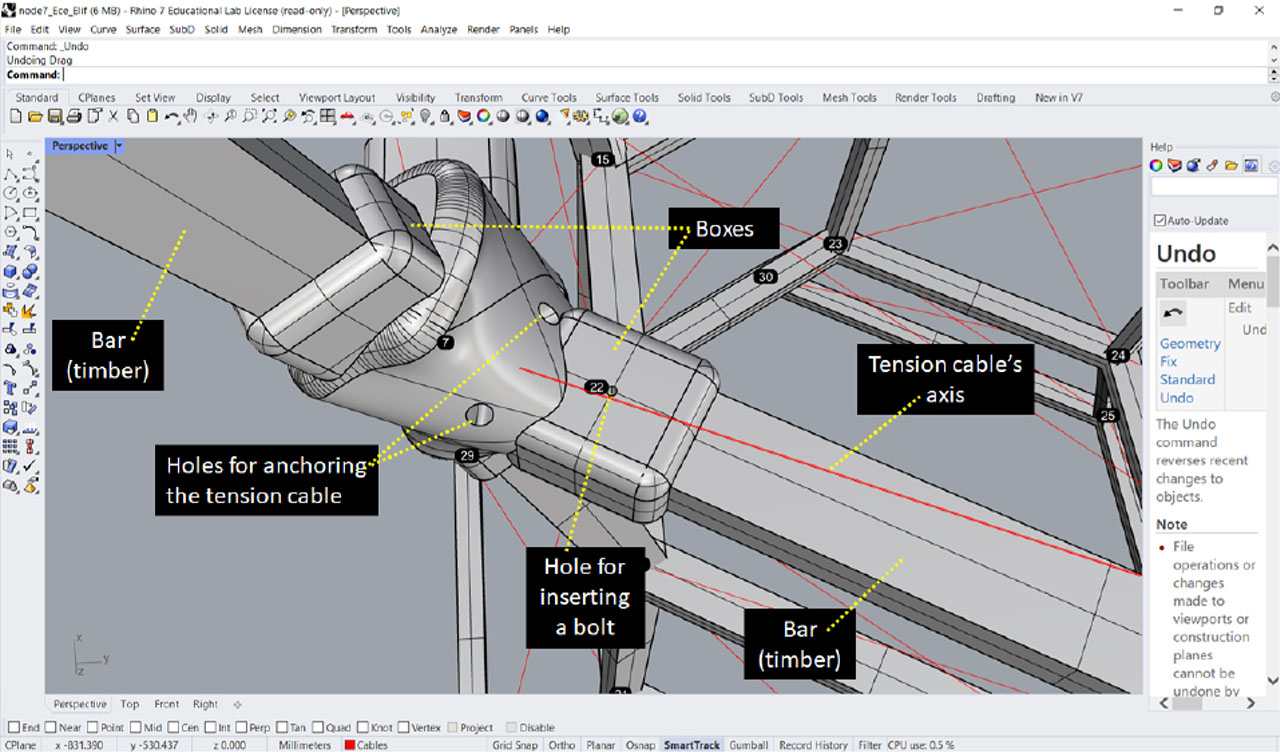
Figure 5.
Standard design components of a node
Table 3.
Characteristics of the 103 nodes
| Section | Quantity | wall thickness | Cross section (cm) | bolt diameter (mm) |
|---|---|---|---|---|
| Column | 54 | 7 mm | 4.4 × 2.4 | 5 |
| Canopy | 41 | 5 mm | 4 × 2 | 4 |
| 25 | 4 mm | 4 × 1.5 | 4 | |
| 48 | 3 mm | 3.5 × 1.5 | 3 |
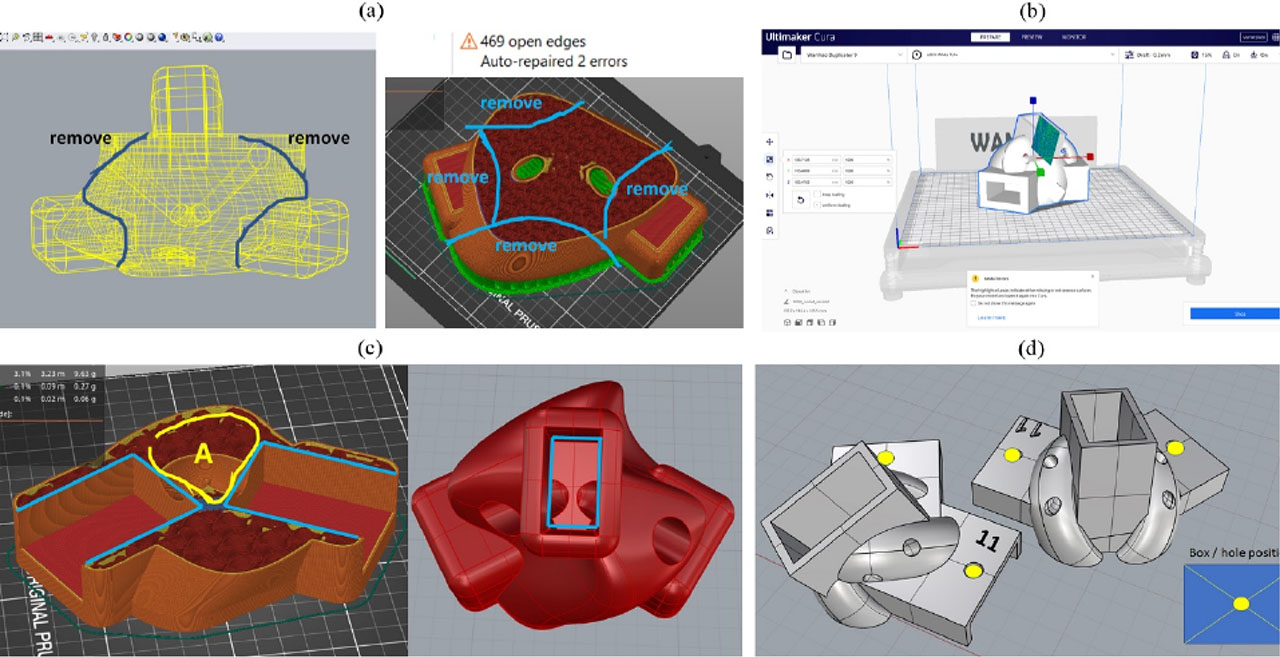
Figure 6.
Most common mistakes during the early design of the nodes: (a) excessive use of material, (b) open edges in the models, (c) cable holes interfering with timber battens, and (d) wrong positioning of the bolt holes
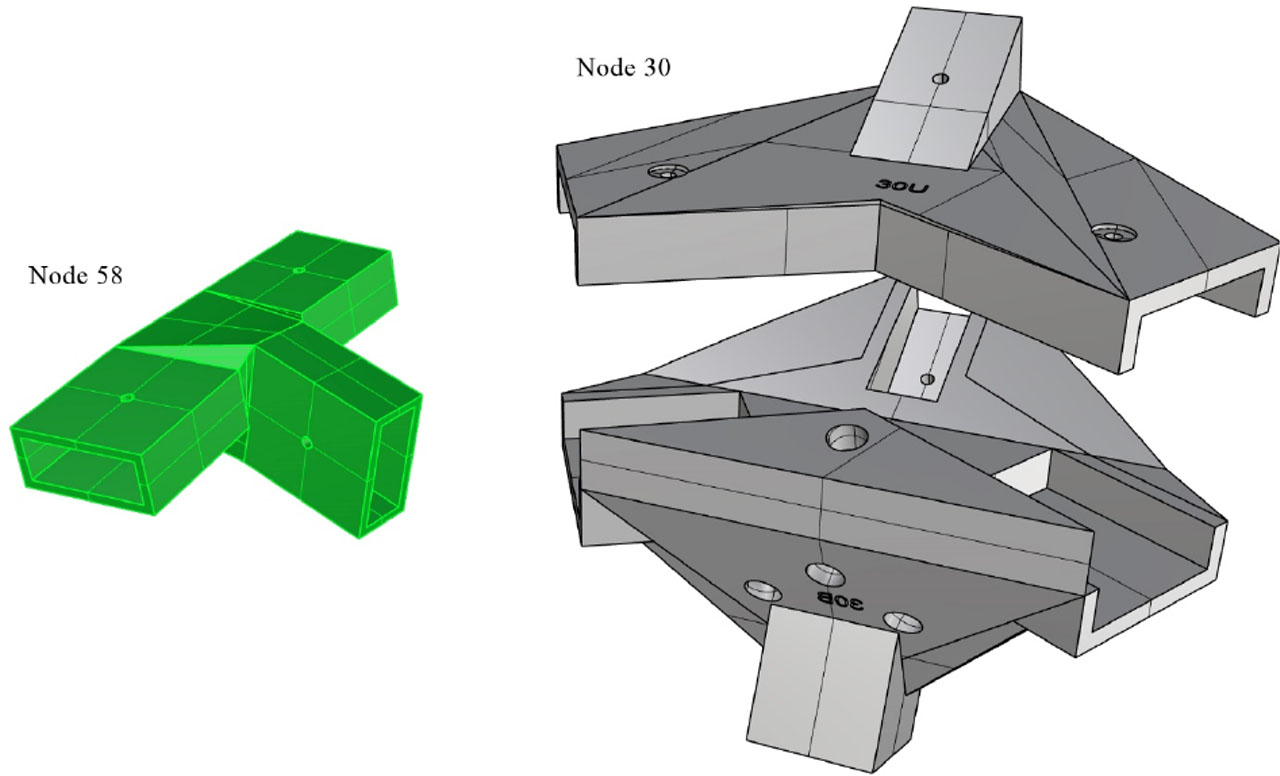
Figure 7.
Contrasting sizes and complexities of the nodes. Node 58 connects battens of the smallest cross-section (3.5 × 15 cm), while node 30 connects battens of the largest cross-section (4.4 × 2.2 cm), as well as the “column” and “canopy” sections. It also includes holes to anchor the tension cables. Since node 30 is split for assembly, the letters U and B are added after the node number to indicate the “upper” and “bottom” positions
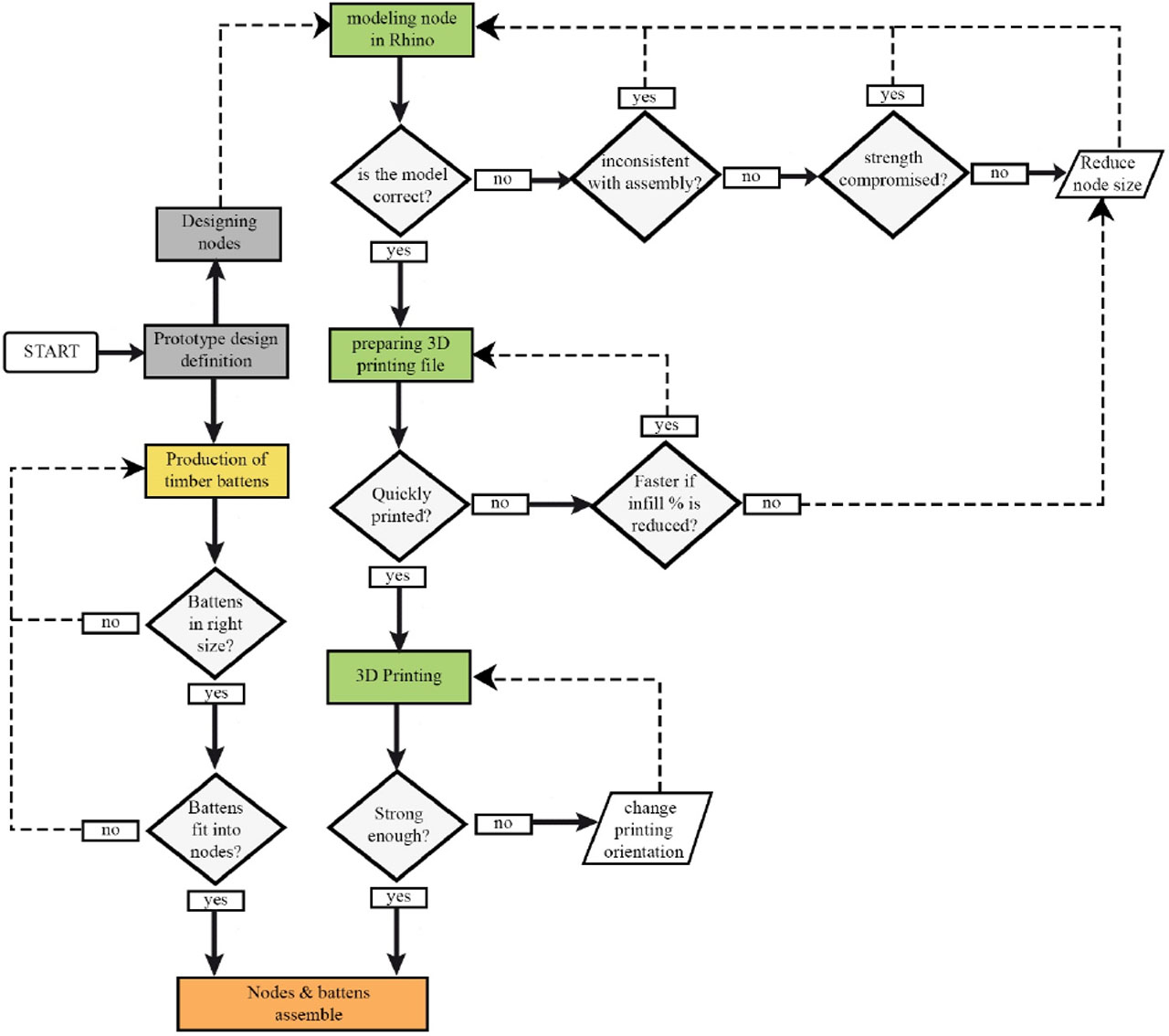
Figure 8.
Flowchart of the iterations in the design and production processes
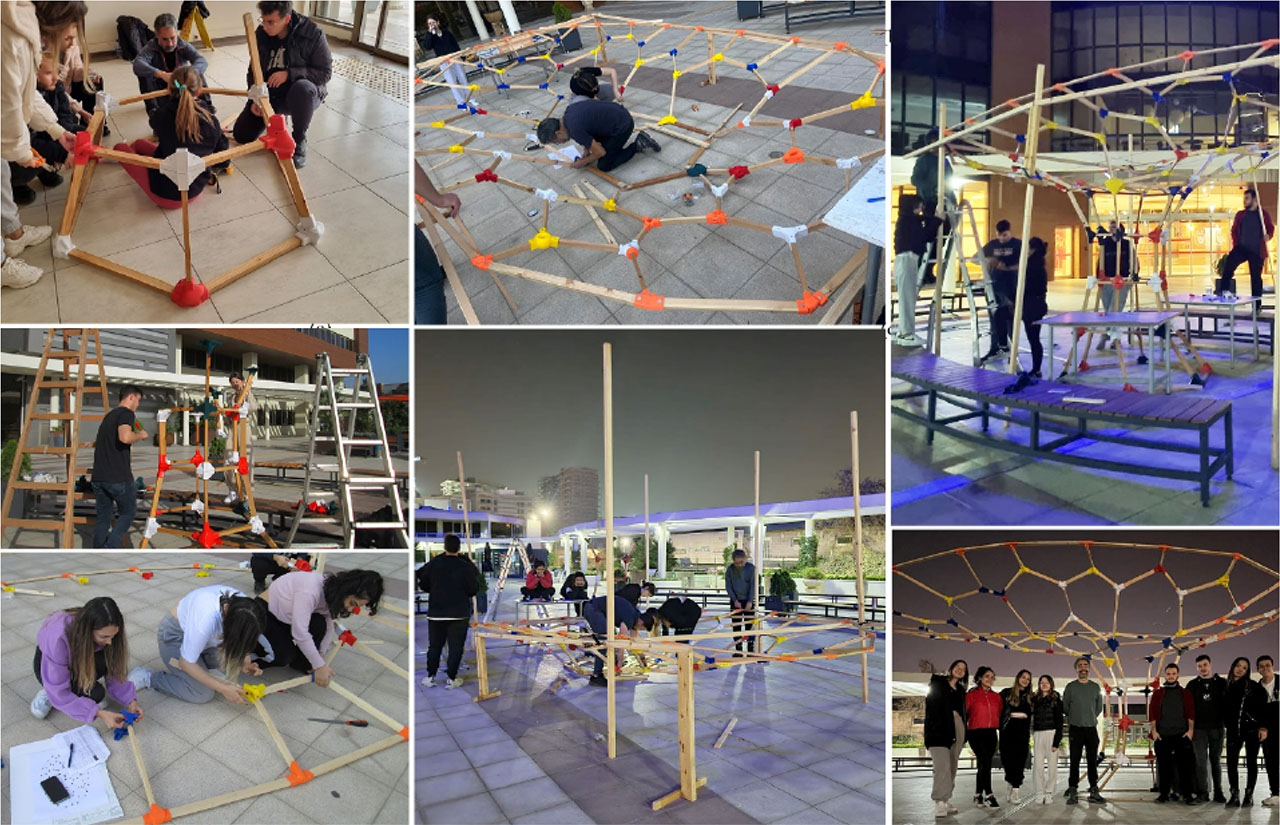
Figure 9.
Assembly process of the first prototype in an open area of the campus
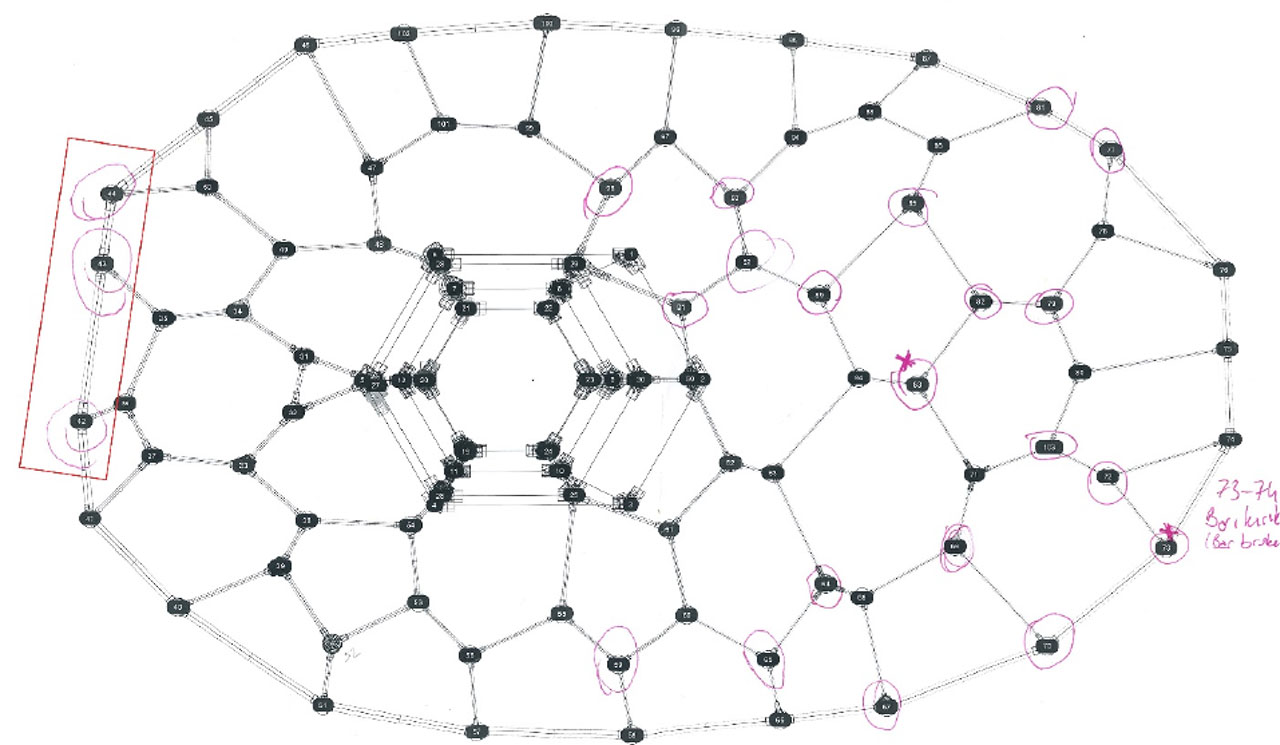
Figure 10.
Broken nodes in the canopy before redesign. The hand note says ‘broken bar’ and it refers to the only timber battens broken as a result of the collapse. The failure of the 3 highlighted nodes at the back was surprising
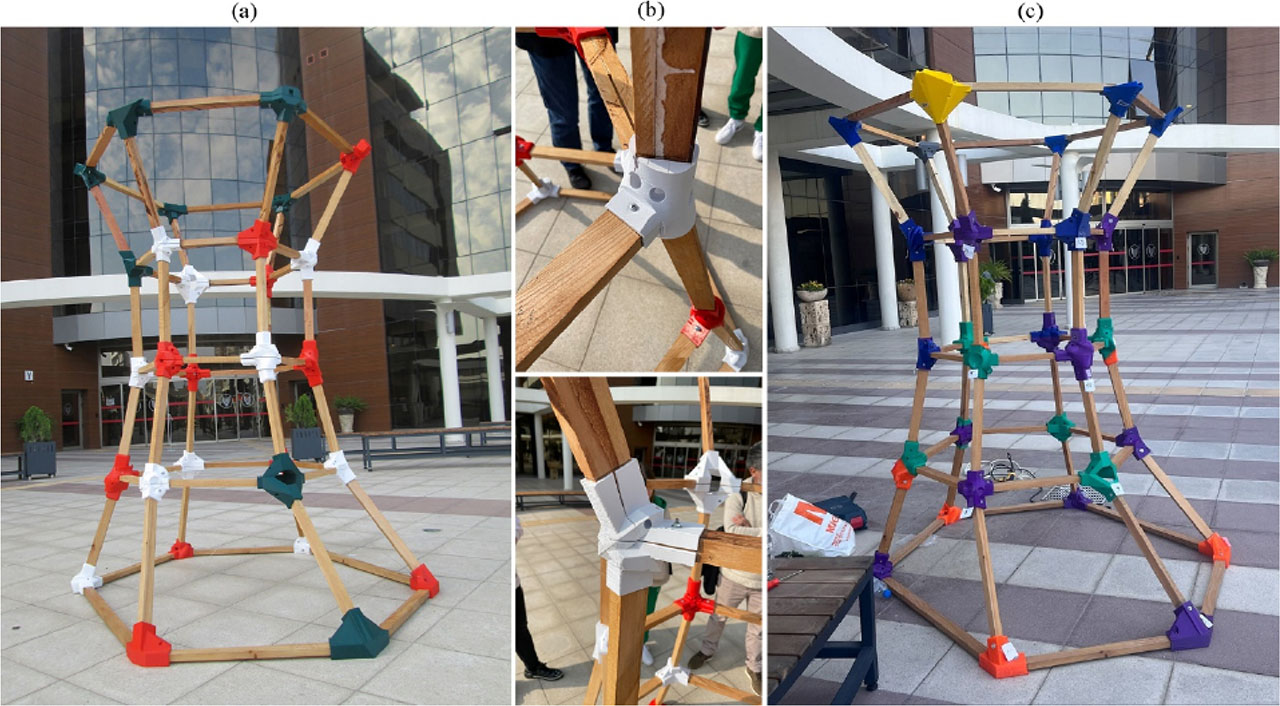
Figure 11.
View of the (a) original column; details of some nodes (b) with poor performance, and (c) revised version of the column in PETG nodes
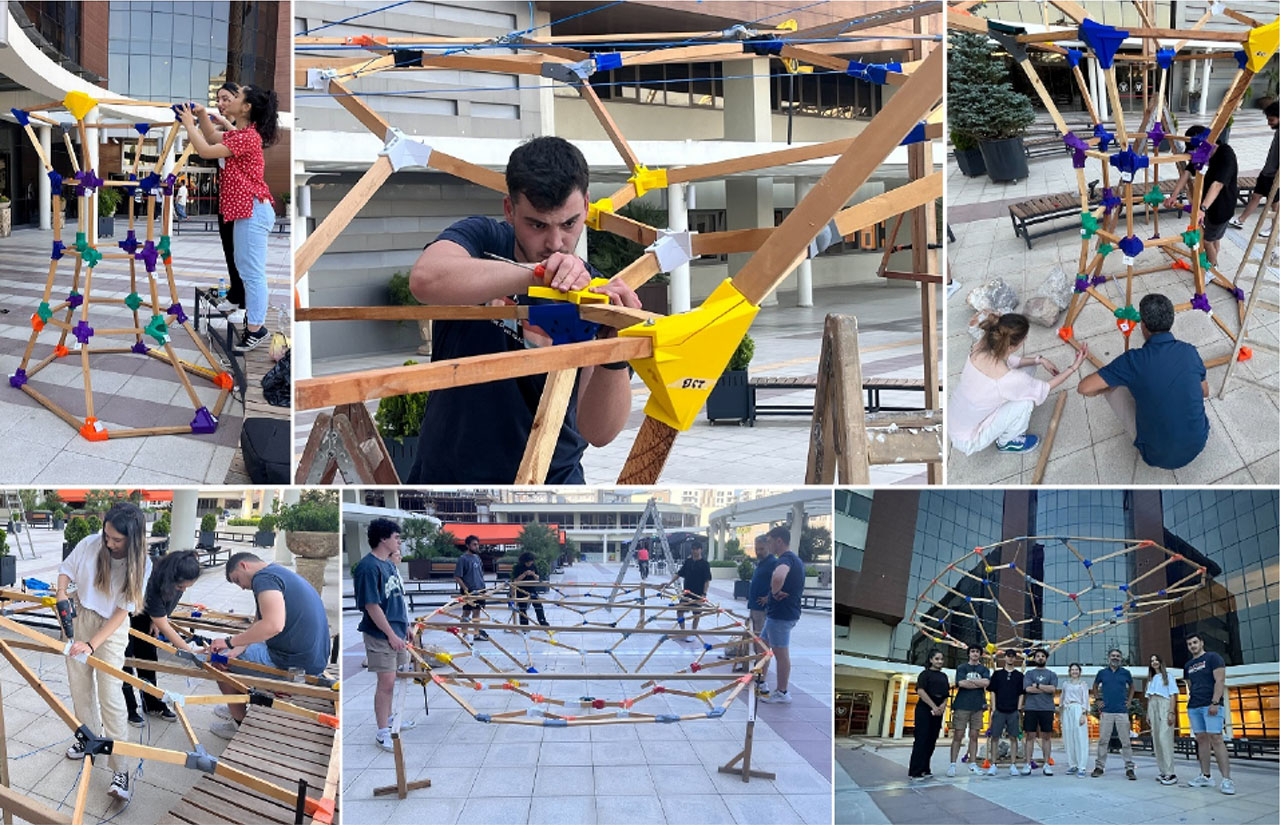
Figure 12.
Assembly process of the second prototype
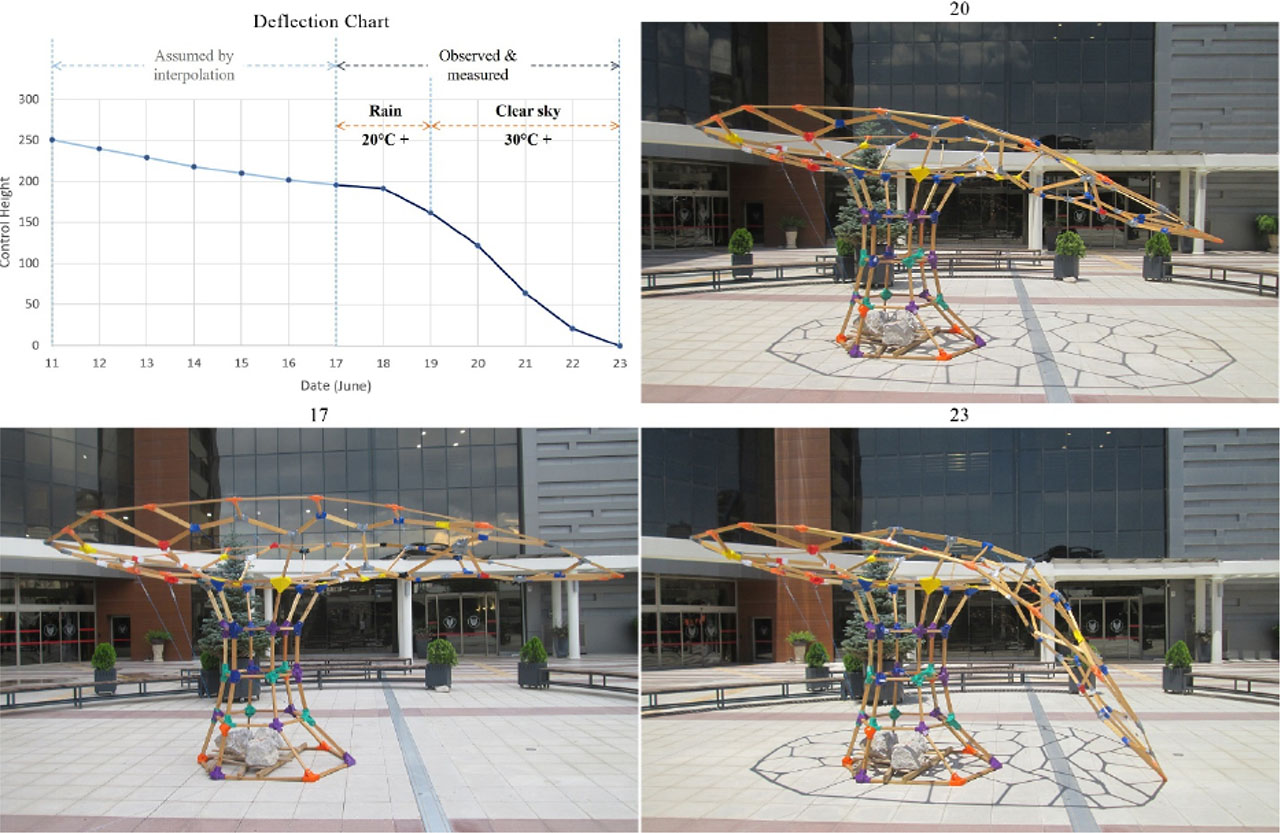
Figure 13.
Deflection of the canopy
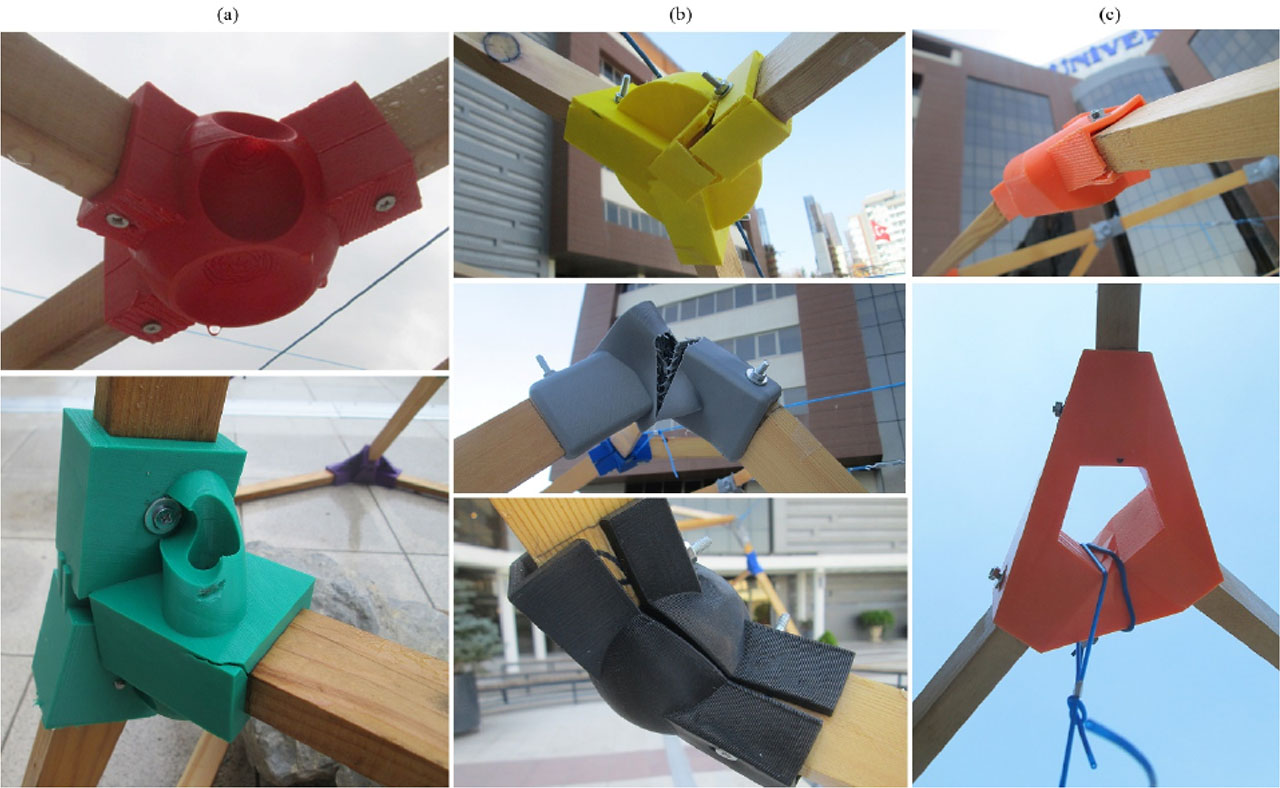
Figure 14.
Performance of the nodes during the extreme deformation of the canopy
Table 4.
Implemented schedule
| week | main activity | tools / equipment |
|---|---|---|
| 2 – 3 | lectures on form-finding methods & gridshell structures (principles) | none |
| 4 | workshop on funicular models & design competition explained | spare fabric & melted candle wax |
| 5 | Selection of proposal for prototyping | visualizations - Rhino / GH models |
| 6 | Redesign of the selected proposal & 3D model development | Rhino / GH models |
| 7 | Final design was ready / Column nodes are distributed among students for design | Rhino model |
| 8 | All column nodes were ready | Rhino model |
| 9 – 11 | Column: 3D printing (after G-codes are prepared) & preparation of timber battens; Canopy: design of nodes is developed | Rhino model, Prusa / Wanhao / Creality 3D printers, Prusa Slicer, Timber (@University's workshop) |
| 12 | Assembly test of the column | basic power tools |
| 13 – 15 | Canopy: All nodes are designed and 3D printed. Preparation of all timber battens. | Rhino model, Prusa / Wanhao / Creality 3D printers, Prusa Slicer, Timber (@University's workshop) |
| 16* | Full assembly of the first prototype | basic power tools, scaffolding |