
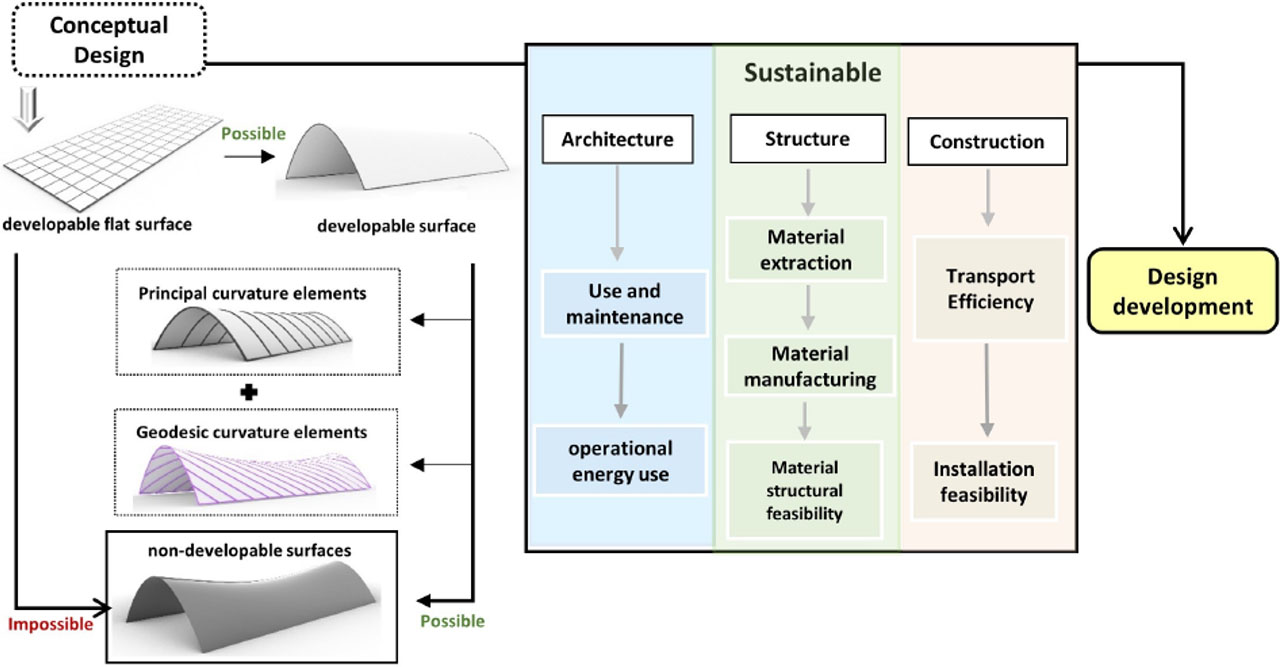
Figure 1.
Schematic of the structural concept design, and proposed aspects to be consider in the concept design of sustainable bending active structures
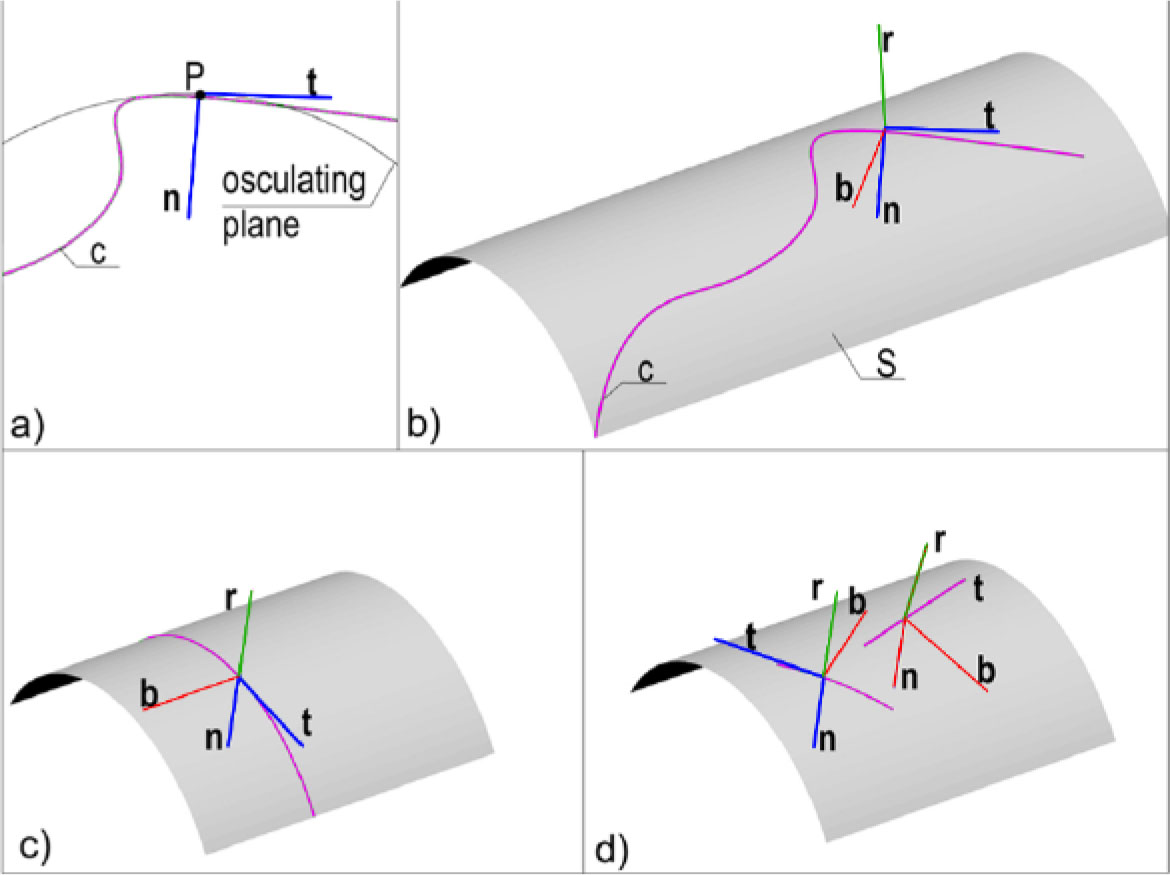
Figure 2.
Curvature of a curve on a surface. a) the curve and its curvature frame; b) the Darboux frame of a curve lying on a surface; c) a curve of zero geodesic torsion on a surface; d) a curve of zero geodesic curvature on a surface
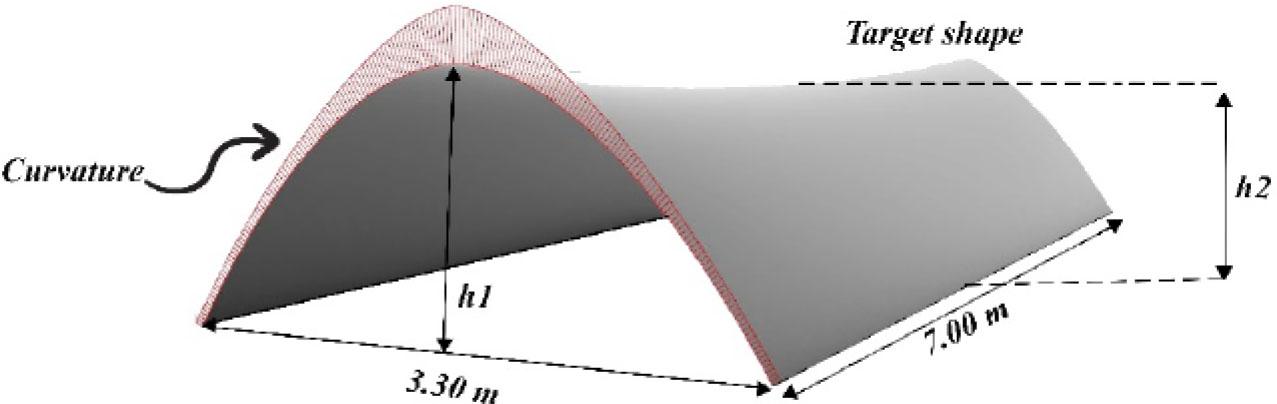
Figure 3.
Case study of a barrel shell with anticlastic surface and pointed arch cross section
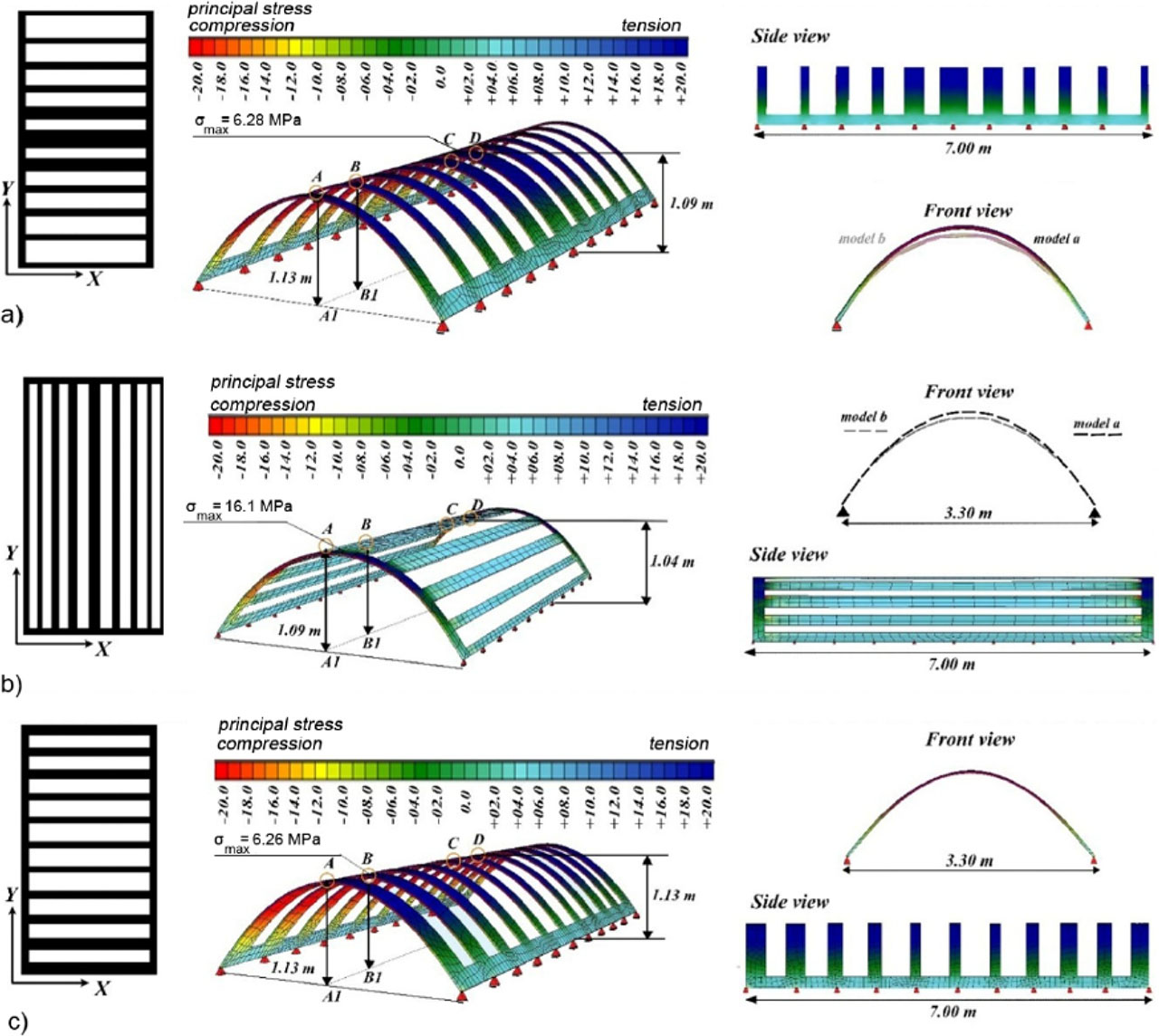
Figure 4.
Comparison between three bending active gridshells having the same bounding area but different designs. Considering the geometry moving from the edges of the structure to its centre: (a) a structure composed of transversal elements of progressively larger width; (b) a structure composed of longitudinal elements of progressively larger width; (c) a structure composed of transversal elements of progressively smaller width
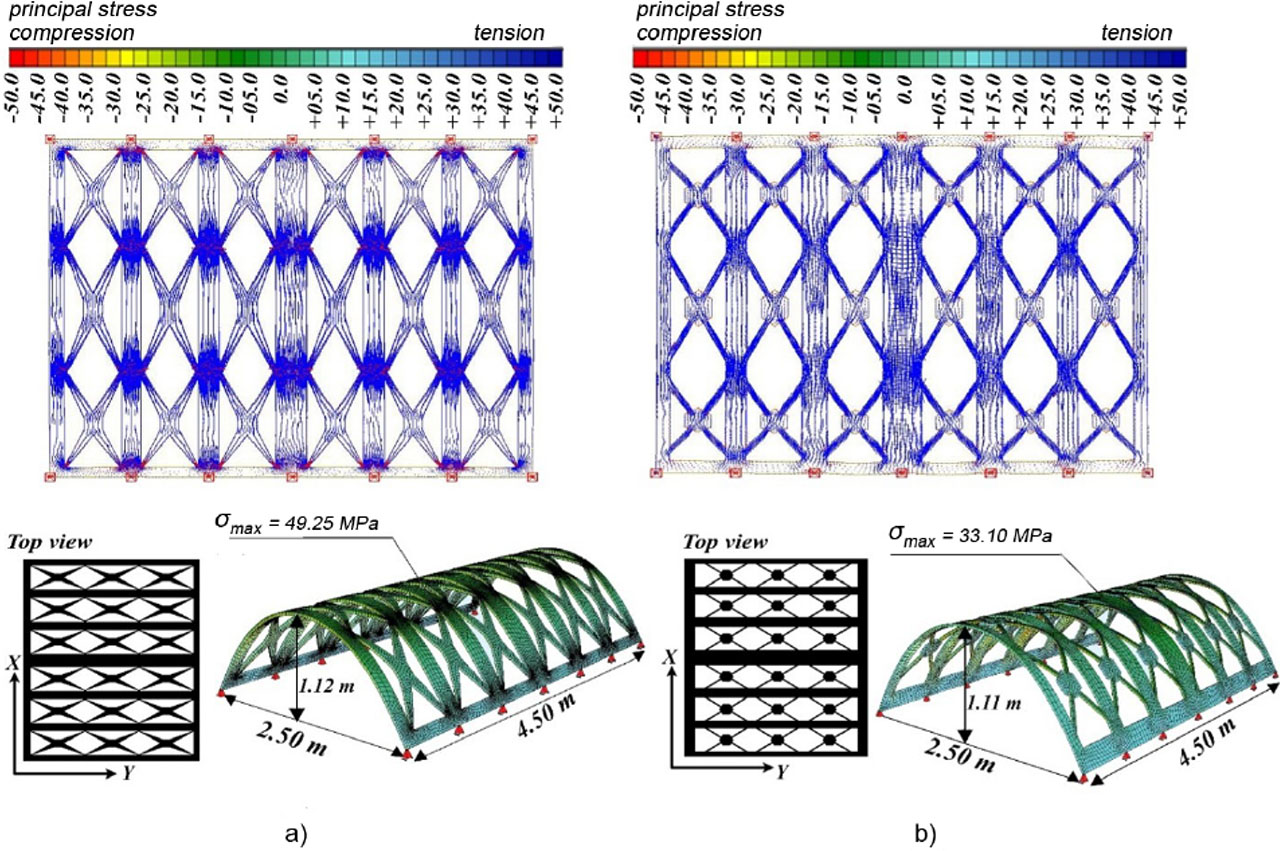
Figure 5.
Comparison of two bending active gridshells in the erection process, composed of the same main elements but having secondary elements of smoothly variable width (a) and of discontinuous width (b). Map of the principal stress (above), originally flat surface (bottom left) and deform
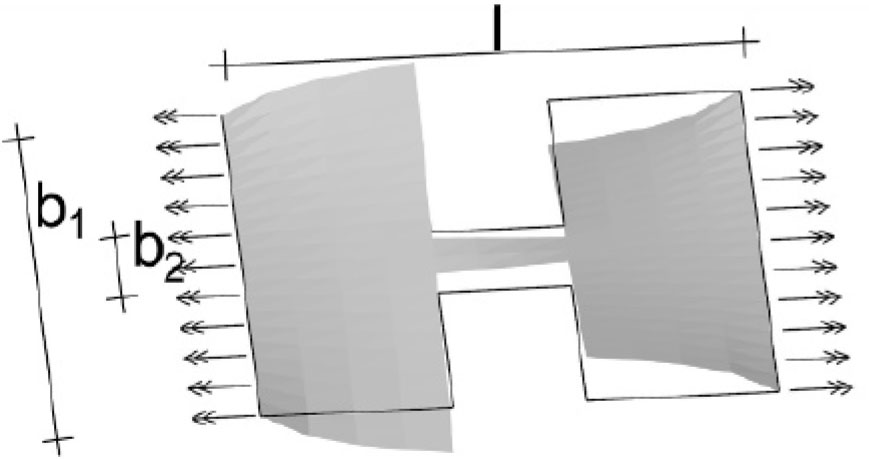
Figure 6.
Torsion deformation of a plate of variable width
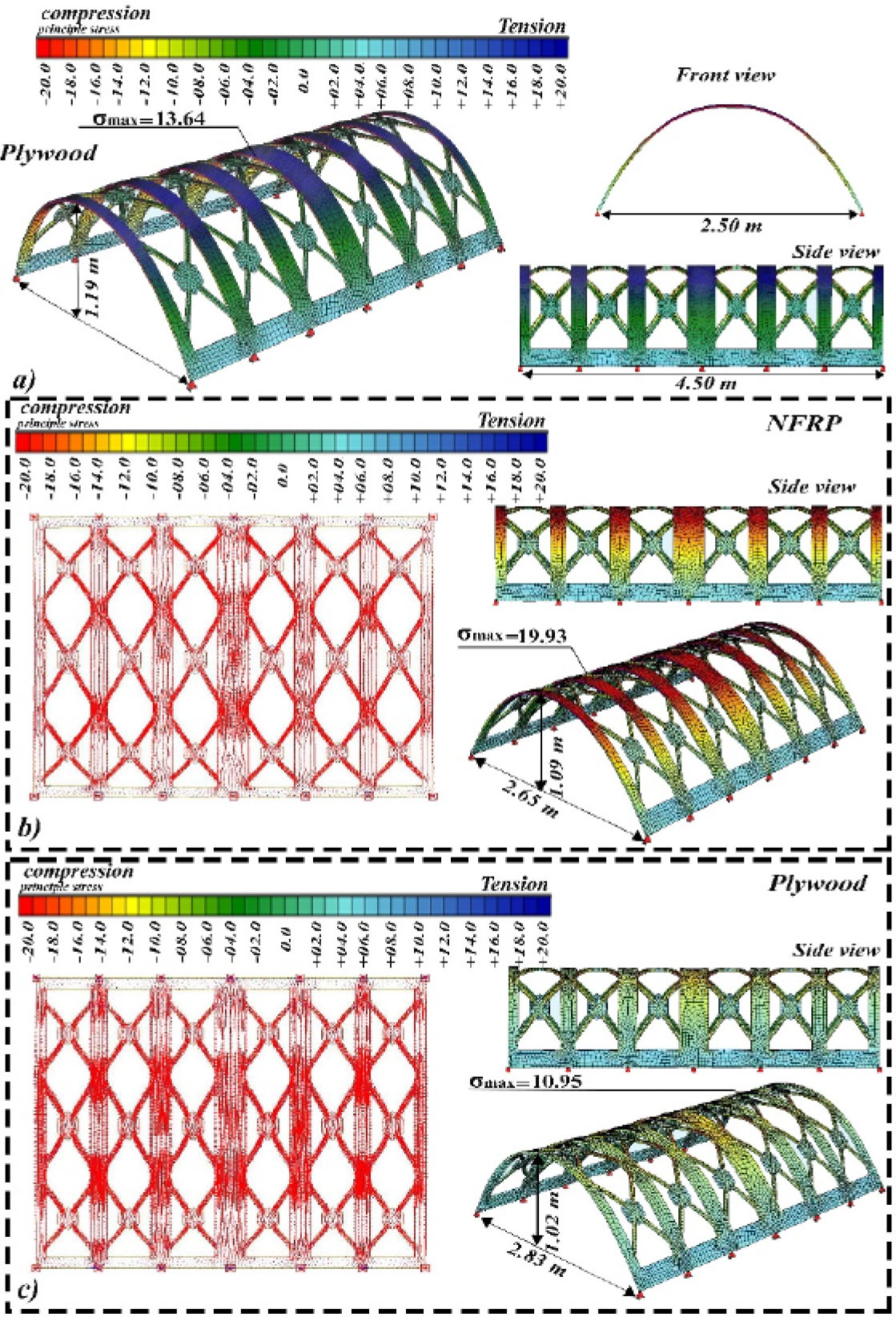
Figure 7.
(a) Active bending gridshell in the erection process when constructed in plywood made with the same design (b) Active bending grid-shell made of NFRP under a uniform distributed gravity load (c) gridshell system created with plywood under a uniform distributed gravity load
Table 2.
Material Properties and Environmental Impact
| Material | Flexural Strength/Modulus Ratio (MPa/GPa) | Manufacturing Techniques | Embodied Carbon (kgCO2e/kg) | Already employed in Bending-active Structures | Density (kg/m3) |
|---|---|---|---|---|---|
| NFRP | 10–50 | 3D Printing, CNC Drilling | Variable; lower than GFRP | Yes – furniture scale | 800 to 1500 |
| Plywood | 4–11.13 | CNC Cutting, Molding | 1.07 | yes | 500–800 |
| Glulam | 2.07–2.45 | Lamination CNC | 0.512 | yes | 400–700 |
| Timber, bamboo | 1–11 | Cutting, Shaping | 0.493 | yes | 400–700 |
| GFRP | 10–12.5 | CNC Cutting | 2.63 to 6.72 | yes | 1800 to 2100 |
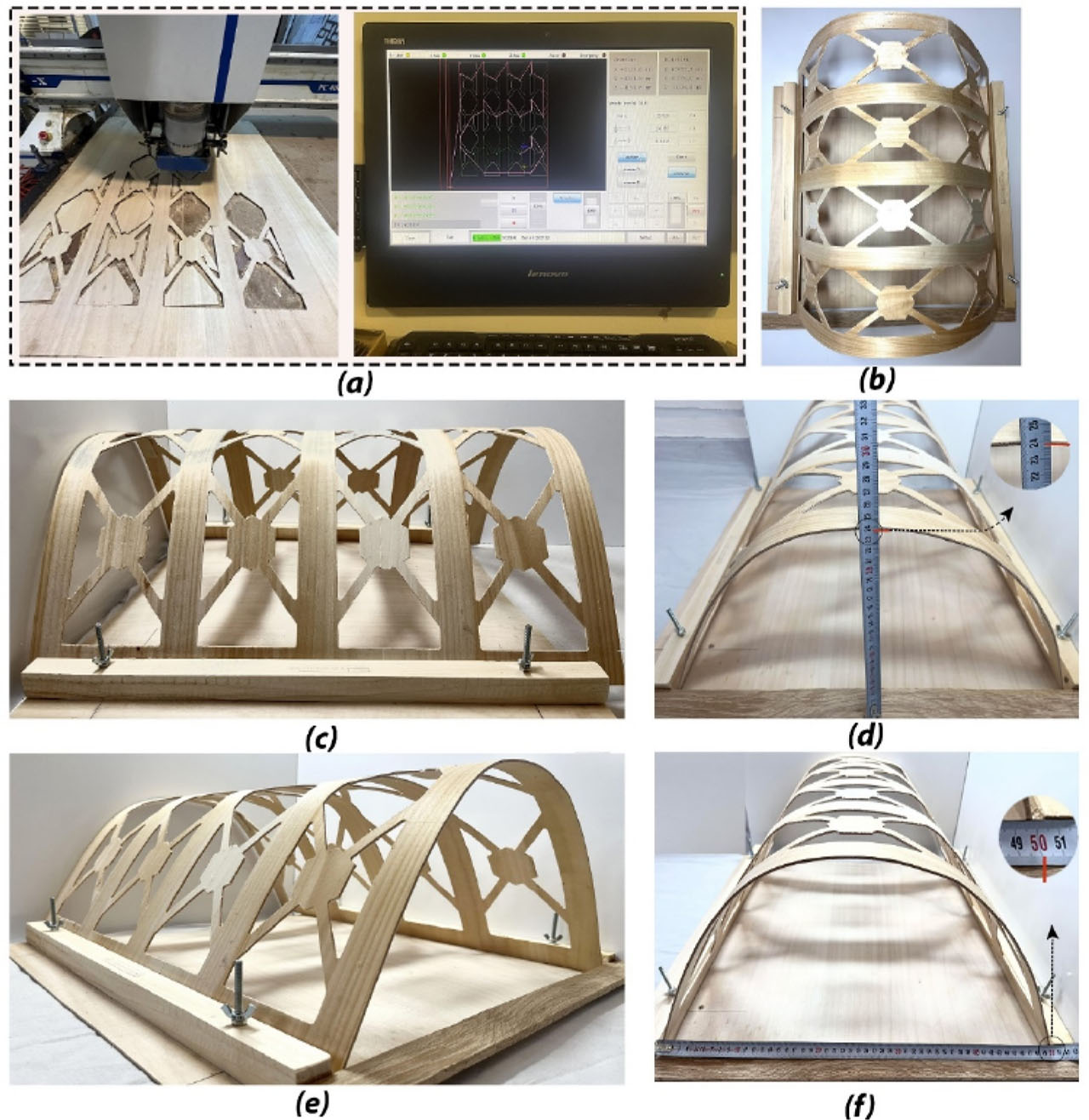
Figure 8.
A timber physical model was constructed at a 1:5 scale. (a) The CNC process utilized for the flat timber sheet, (b, c) the top view and side of the timber grid shell after the erection process, respectively, (d) The front view, highlighting the height in the middle of the span point (23.4 cm), (e) a perspective view of the timber model, and (f) the span of the model after the erection process measures 50 cm
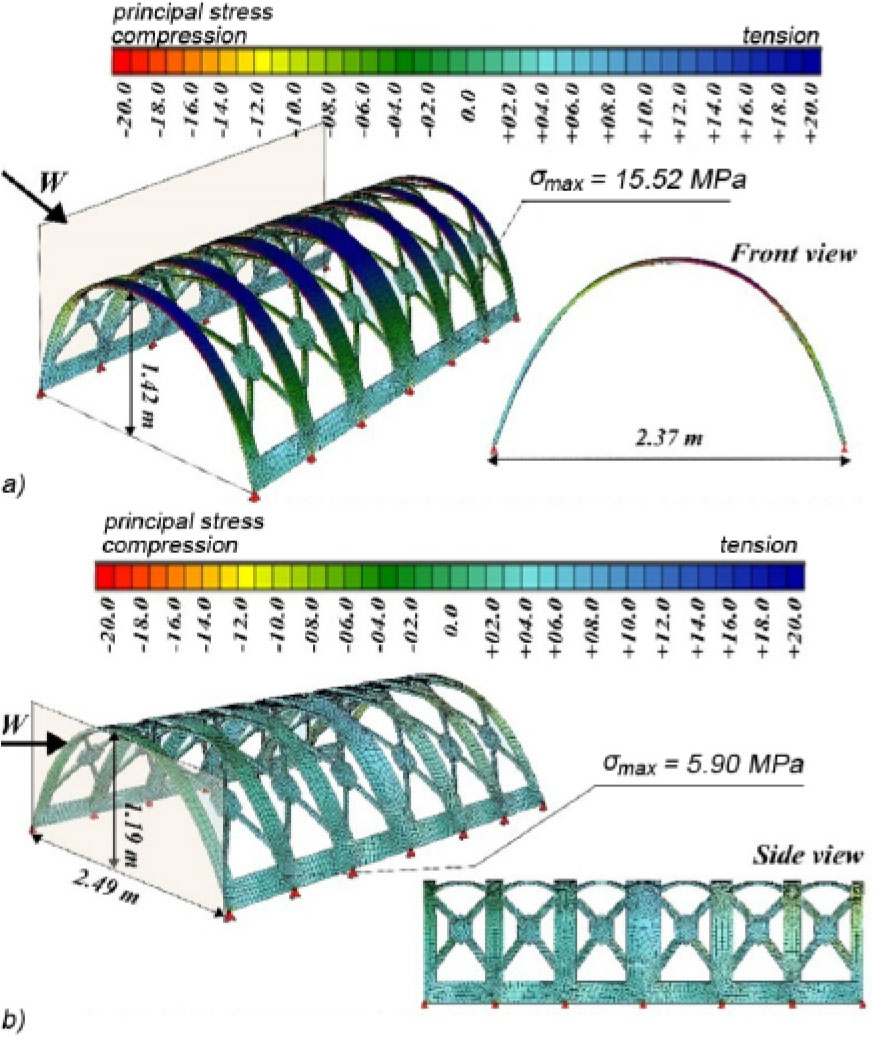
Figure 9.
Plywood grid shell under uniform horizontal loads, (a) uniform wind loads along the transversal direction, (b) uniform wind loads along the longitudinal loads
Table 3.
Results of the simulation of temporary and prolonged usage for the design already in Figures 7 and 9, made in plywood and NFRP
| Scenario | Plywood | NFRP |
|---|---|---|
| Temporary usage qh,t = 0.5 kN/m2 | ||
| Prolonged usage qv = 0.5 kN/m2 qh,p = 0.5 kN/m2 |
Table 4.
End of life options
| Material | Methods | Options | Cost | Barries | Markets drivers |
|---|---|---|---|---|---|
| NFRP | Mechanical | Recover | Low | Degraded mech. proprieties | Automotive industry, consumer goods, energy production |
| Thermal | Repurpose | Medium | Research uncertainties | Automotive components, industrial applications | |
| Plywood | Mechanical | Reuse, Repurpose, Recover | Low | Degradation from exposure | Construction industry, furniture manufacturing, energy production |
| Glulam | Mechanical | Reuse, Repurpose, Recover | Low Medium Low | Adhesives complicate separation | Building and construction, energy production |
| Timber, bamboo | Mechanical | Reuse, Repurpose, Recover | Low | Possible degraded mech. proprieties | Building and construction, consumer industry, energy production |
| GFRP | Mechanical | Reuse, Repurpose | Low | Possible degraded mech. proprieties Potential for harmful emissions | Construction industry, energy production, energy production |
| Thermal, Chemical | Repurpose, Recover | High | High energy consumption | Aerospace, automotive, sports equipment |
Table 5.
Installation Feasibility comparison-based rating of FPMBSs
| CRITERIUM | Plywood | NFRP |
|---|---|---|
| Material Ratio (R) | 9.09 | 13.25 |
| Manufacturing challenges | Production of waste | Fiber alignment sensitivity |
| Embodied Carbon (kgCO2) - temporary usage | 869 – 1390 | 1133 to 2124 |
| Embodied Carbon (kgCO2) - permanent usage | 1001–1602 | 1287 to 2413 |
| Erection challenges | Very slow erection process, especially for thick structures; risk of rupture | Succeeded at small scale and large curvature, no available data from architectural projects |
| Usage challenges | May require maintenance | Humidity, may require protection from agents |
| Recyclability | Mechanical | Mechanical or chemical (emerging) |