
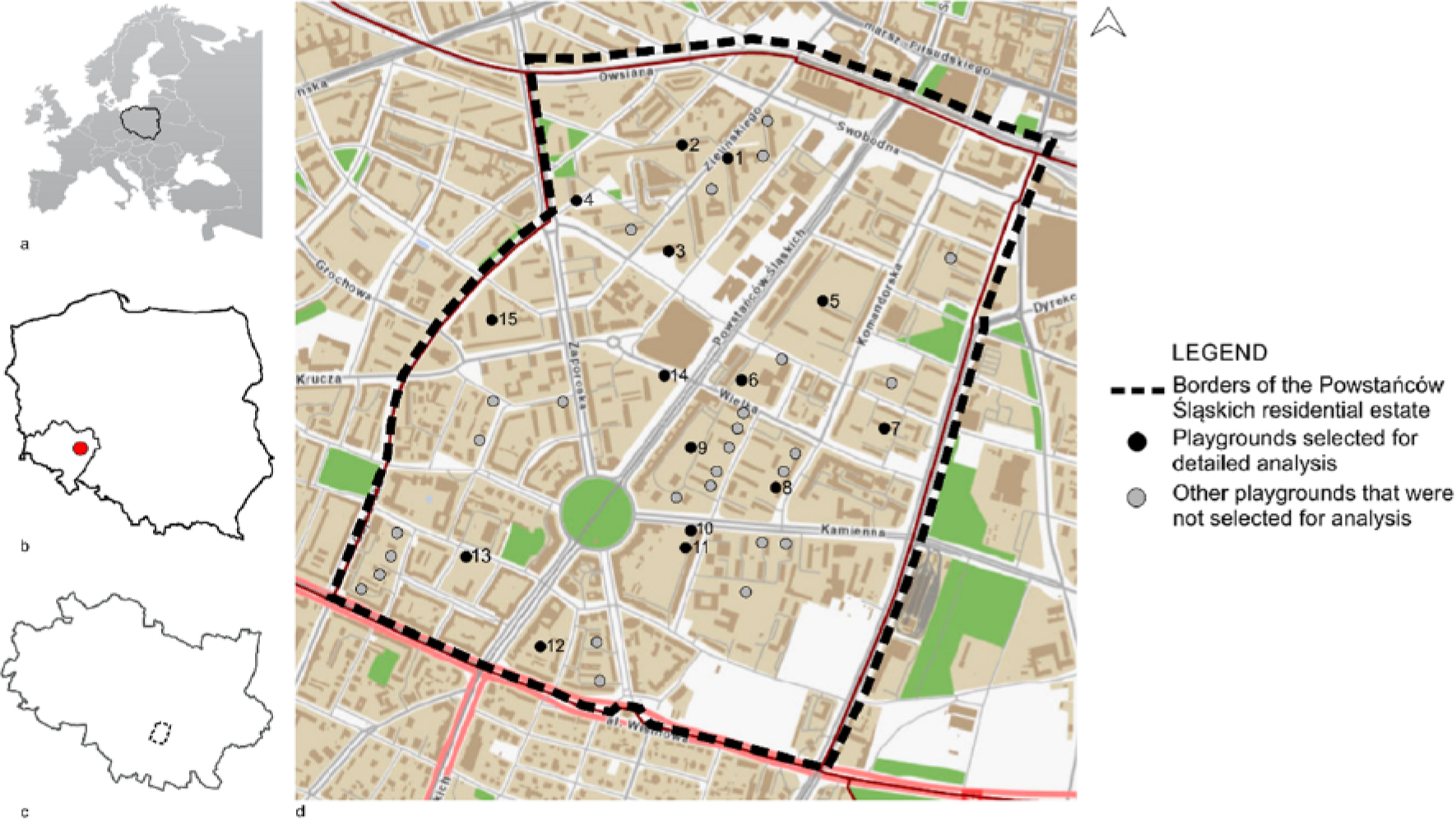
Figure 1.
Location: a – in Europe, b – in Poland, c – in Wroclaw, d – of the objects in the Powstańców Śląskich estate (own study)
Table 1.
List of facilities selected for further analyses (own study)
| Item | Address | Surface [m2] | Number of pieces of equipment | Type of accessibility | Surroundings |
|---|---|---|---|---|---|
| 1 | Tadeusza Zielińskiego Street, no. 38-54 | 2111 | 5 | Generally accessible area | Tall multi-family housing |
| 2 | Between Stysia Street and Tadeusza Zielińskiego Street | 730 | 9 | Generally accessible area | Tall multi-family housing and square |
| 3 | On the corner of Szczęśliwa Street and Gwiaździsta Street | 1652 | 8 | Generally accessible area | Tall multi-family housing and square |
| 4 | On the corner of Zaporowska Street and Gwiaździsta Street | 272 | 6 | Educational facility | Educational facility |
| 5 | Radosna Street, no. 24-36 | 321 | 8 | Generally accessible area | Tall multi-family housing and square |
| 6 | Powstańców Śląskich Street, no. 94 | 427 | 2 | Generally accessible area | Tall multi-family housing and educational facility |
| 7 | Wielka Street, no.15-26 | 2037 | 11 | Generally accessible area | Tall multi-family housing and educational facility |
| 8 | Between Komandorska Street and Drukarska Street | 1368 | 4 | Generally accessible area | Tall multi-family housing and educational facility |
| 9 | Powstańców Śląskich Street, no. 114 | 1853 | 9 | Generally accessible area | Tall multi-family housing and square |
| 10 | Drukarska Street, no. 33 | 478 | 3 | Generally accessible area | Tall multi-family housing and Allotment gardens |
| 11 | Drukarska Street, no. 33 | 478 | 5 | Generally accessible area | Tall multi-family housing and allotment gardens |
| 12 | Wiśniowa Street, no. 8 | 1116 | 5 | Generally accessible area | Tall multi-family housing and square |
| 13 | On the corner of Podchorążych Street and Sztabowa Street | 516 | 5 | Educational facility | low-rise multi-family housing and educational facility |
| 14 | On the corner of Powstańców Śląskich Street and Wielka Street | 479 | 6 | Generally accessible area | low-rise and tall multi-family housing and square |
| 15 | Krucza Street, no. 21 | 1086 | 6 | Generally accessible area | Tall multi-family housing |
Table 2.
Colour schemes in playgrounds (own study)
| Types of plants that exist in playgrounds | ||||||||
|---|---|---|---|---|---|---|---|---|
| Playground No. | Tall trees | Low trees | Perimeter plants | Barrier bushes | Perennials | Toxic species | Species with thorns | Allergens |
| 1 | + | + | + | + | + | |||
| 2 | ||||||||
| 3 | + | + | + | |||||
| 4 | ||||||||
| 5 | ||||||||
| 6 | + | + | + | |||||
| 7 | + | + | + | |||||
| 8 | + | |||||||
| 9 | + | + | ||||||
| 10 | + | |||||||
| 11 | ||||||||
| 12 | ||||||||
| 13 | + | |||||||
| 14 | ||||||||
| 15 | + | |||||||
Table 3.
Types of greenery growing on playgrounds (own study)
| Playground No. | Colour scheme for playgrounds | ||||||
|---|---|---|---|---|---|---|---|
| yellow | green | red | brown | blue | orange | grey | |
| 1 | + | + | + | + | |||
| 2 | + | + | + | + | |||
| 3 | + | + | + | + | + | + | |
| 4 | + | + | + | + | + | ||
| 5 | + | + | + | + | |||
| 6 | + | + | + | + | + | ||
| 7 | + | + | + | + | + | + | |
| 8 | + | + | + | + | |||
| 9 | + | + | + | + | + | ||
| 10 | + | + | + | ||||
| 11 | + | + | + | + | |||
| 12 | + | + | + | + | |||
| 13 | + | + | + | ||||
| 14 | + | + | + | + | |||
| 15 | + | + | + | + | + | ||
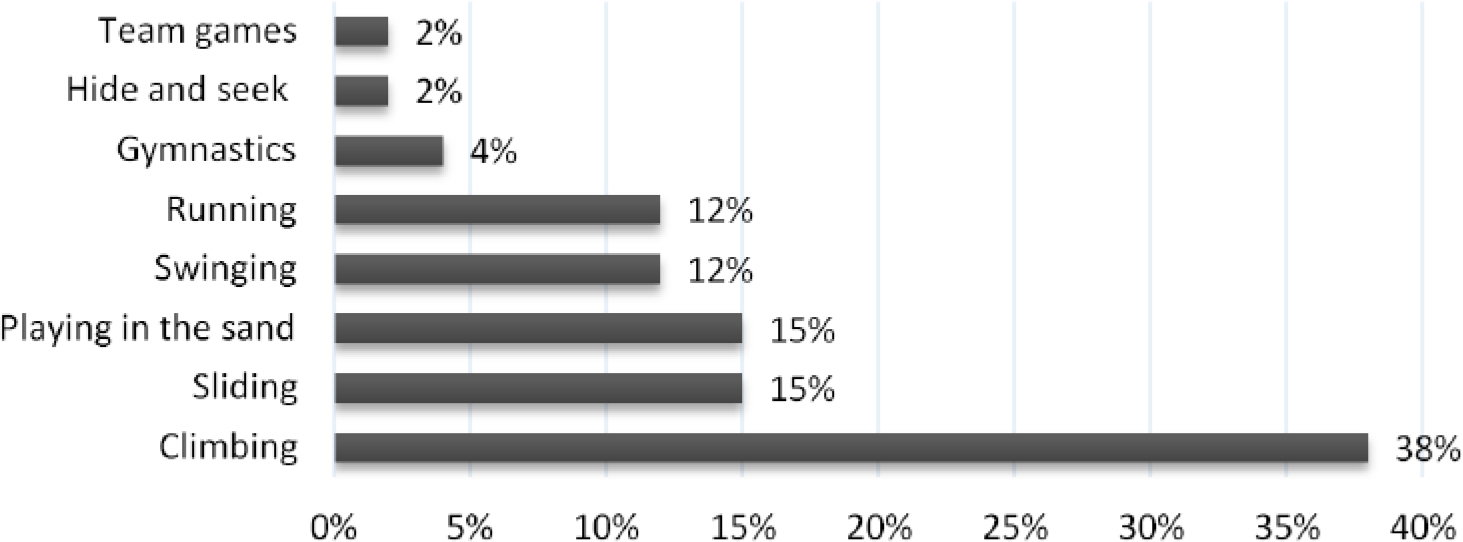
Figure 2.
Percentage distribution of the activities offered by the playgrounds in the Powstańców Śląskich residential estate (own study)
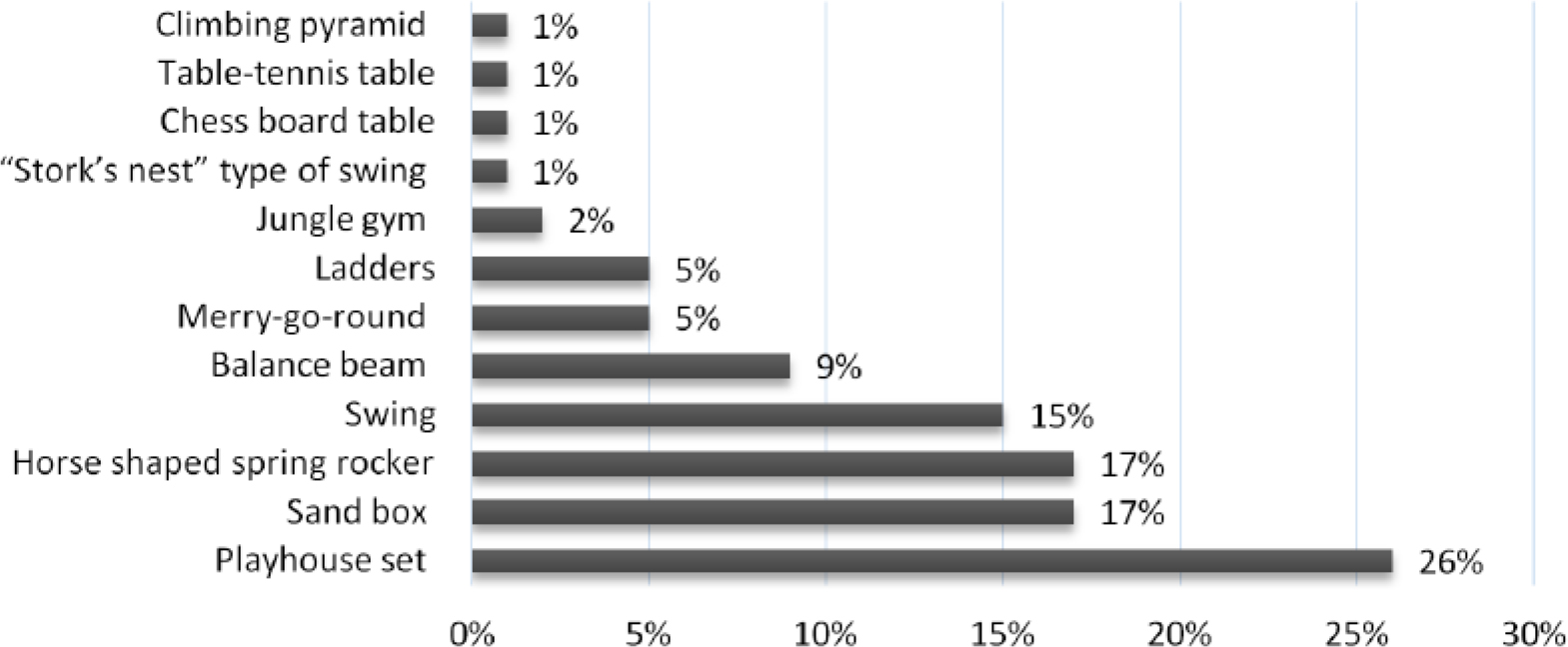
Figure 3
Percentage distribution of the most commonly used types of playground equipment (own study)
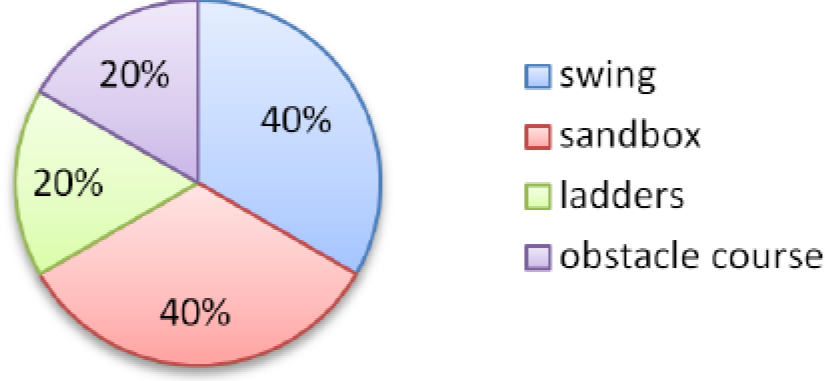
Figure 4.
Favourite pieces of equipment according to the youngest respondents (3-6 years old) (own study)
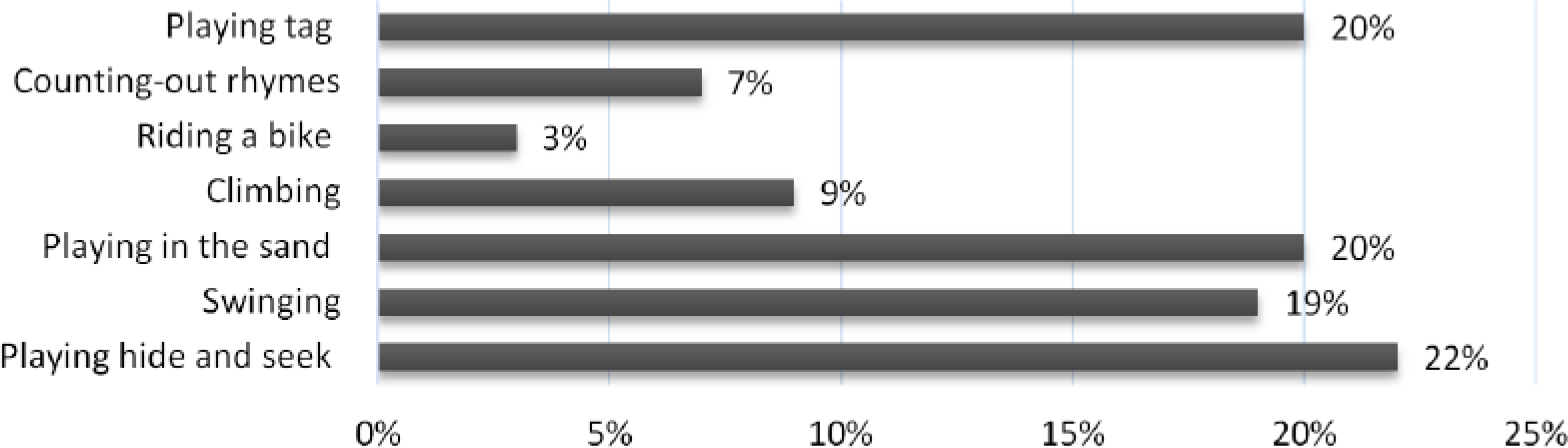
Figure 5.
Favourite forms of play according to the youngest users (3-6 years old) (own study)
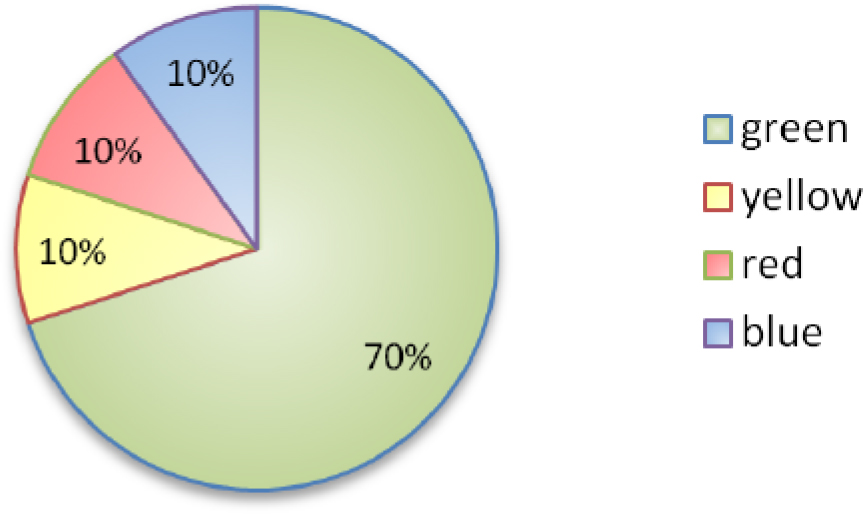
Figure 6.
Preferred colours according to the youngest users (3-6 years old) (own study)
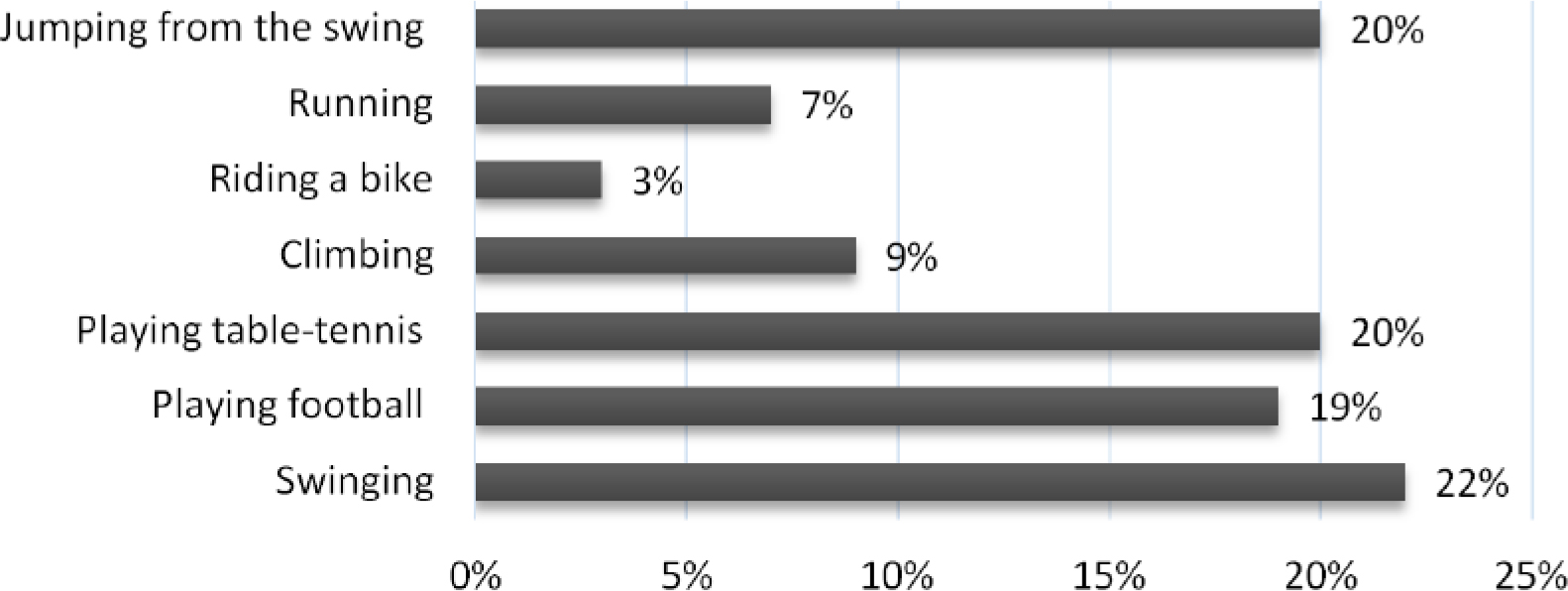
Figure 7.
Percentage distribution of the preferred forms of playing in the 7–12-year-old age group (own study)
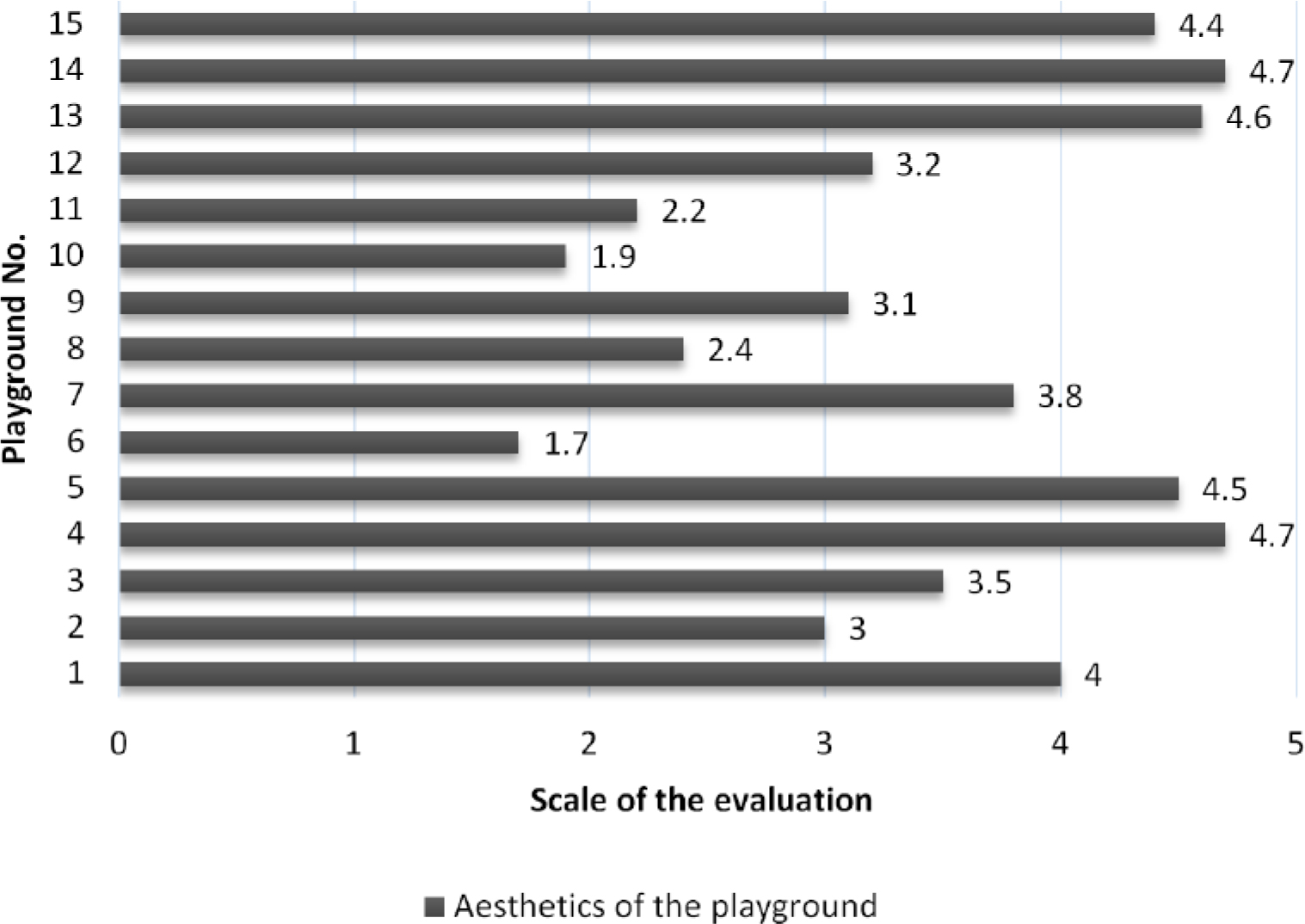
Figure 8.
The aesthetics of playgrounds according to children from the 7–12-year-old age group (own study)
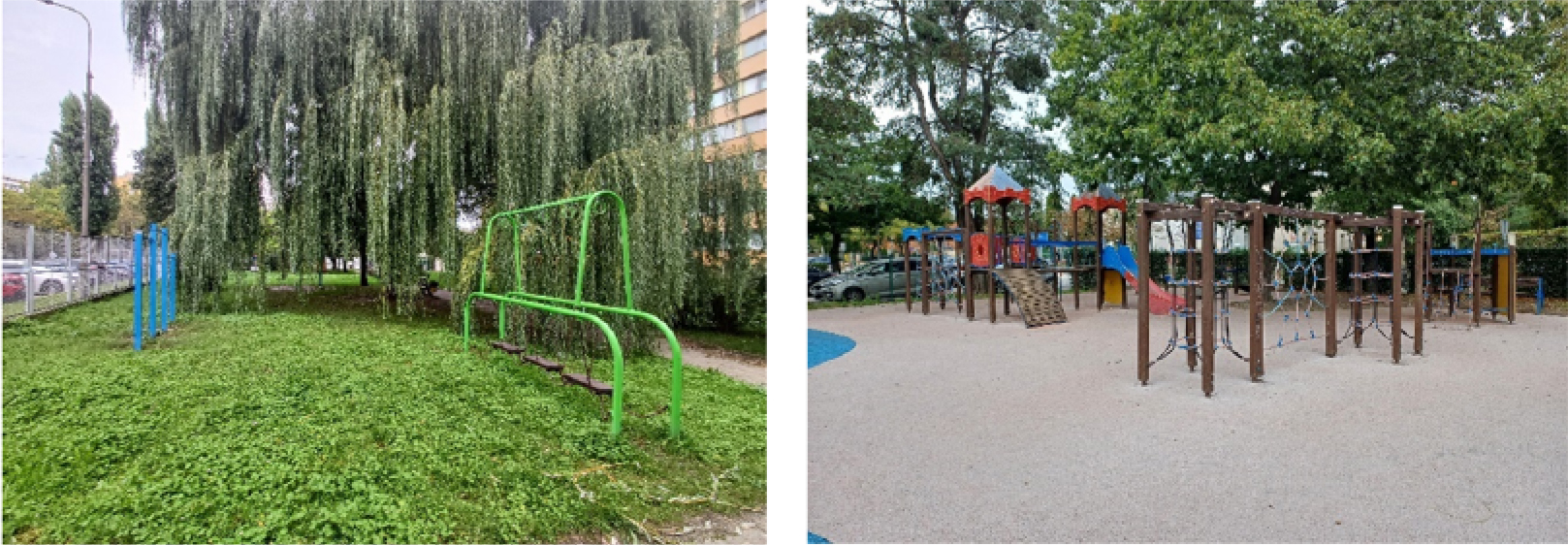
Figure 9.
Examples of playgrounds that were awarded the lowest (a) and highest (b) scores by children (own source)
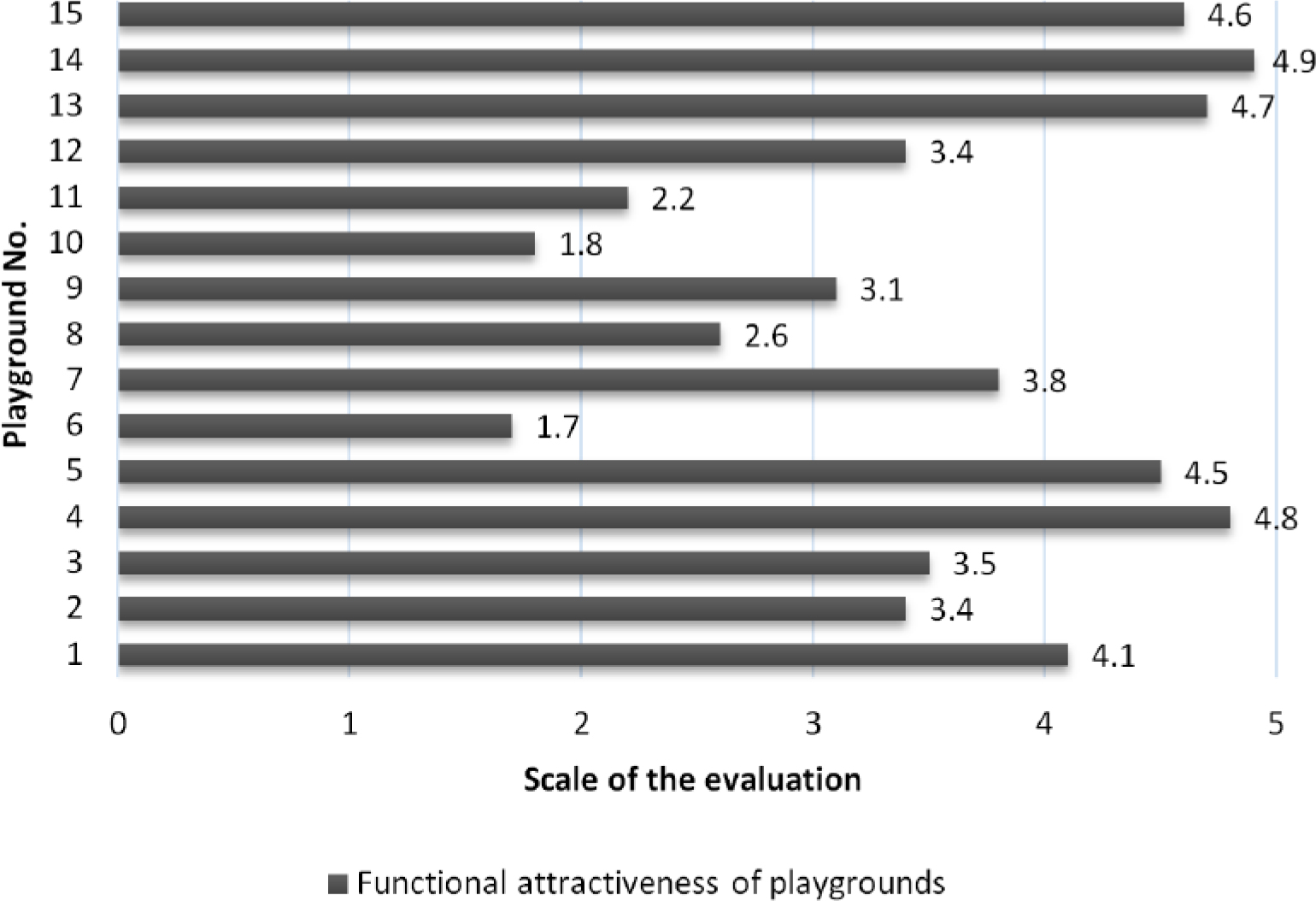
Figure 10
Functional attractiveness of playgrounds according to children from the 7–12-year-old age group (own study)
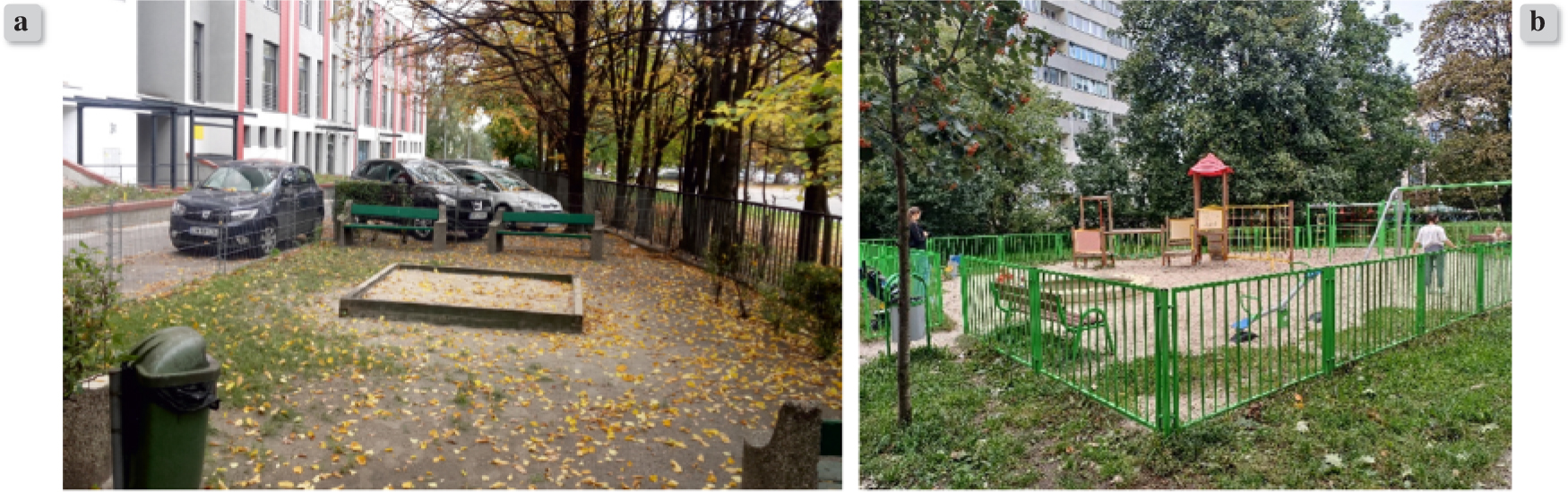
Figure 11.
Examples of playgrounds that were awarded the lowest (a) and highest (b) scores by professionals (own source)
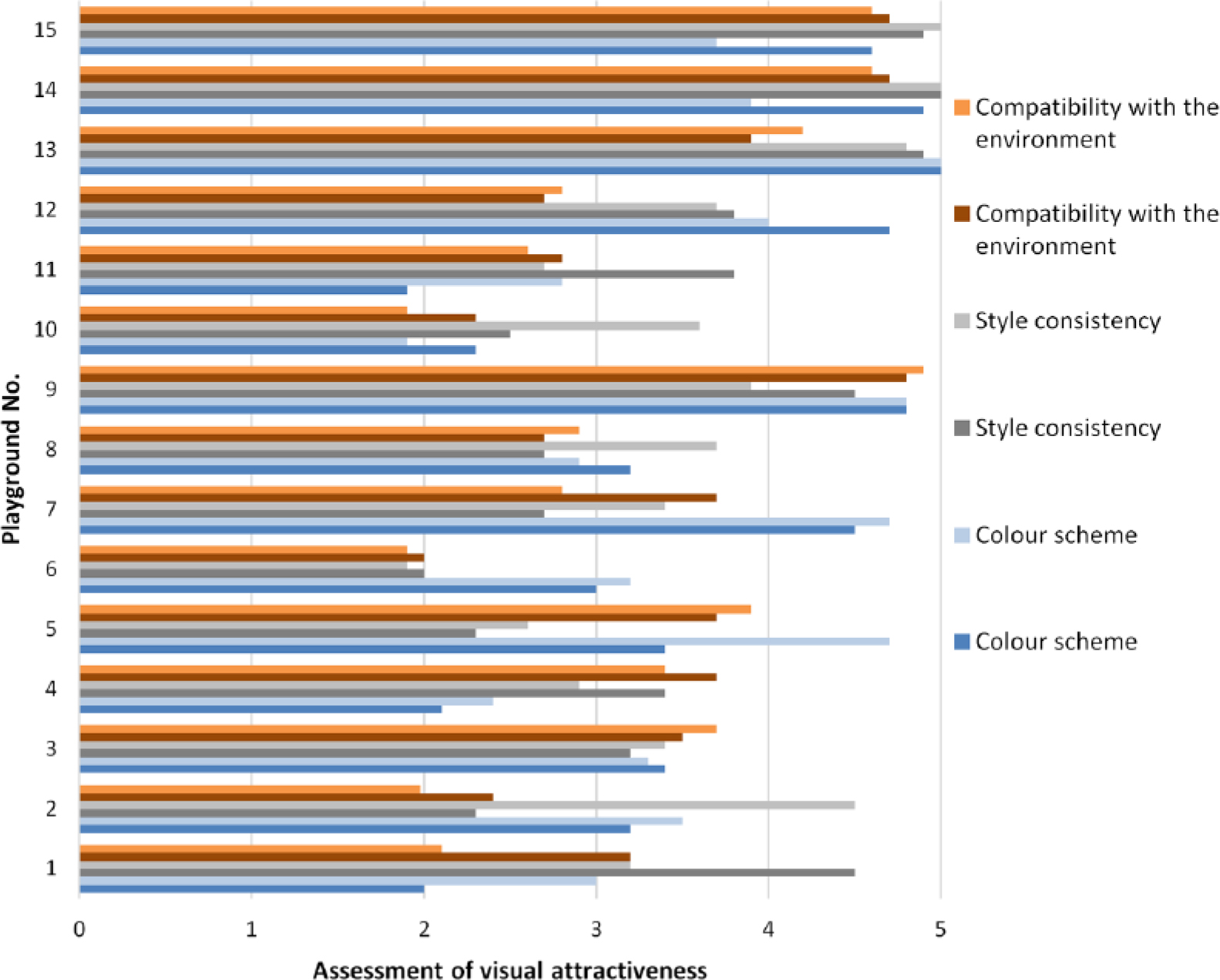
Figure 12.
Visual attractiveness assessed by women (W) and men (M) based on 3 criteria (own study)
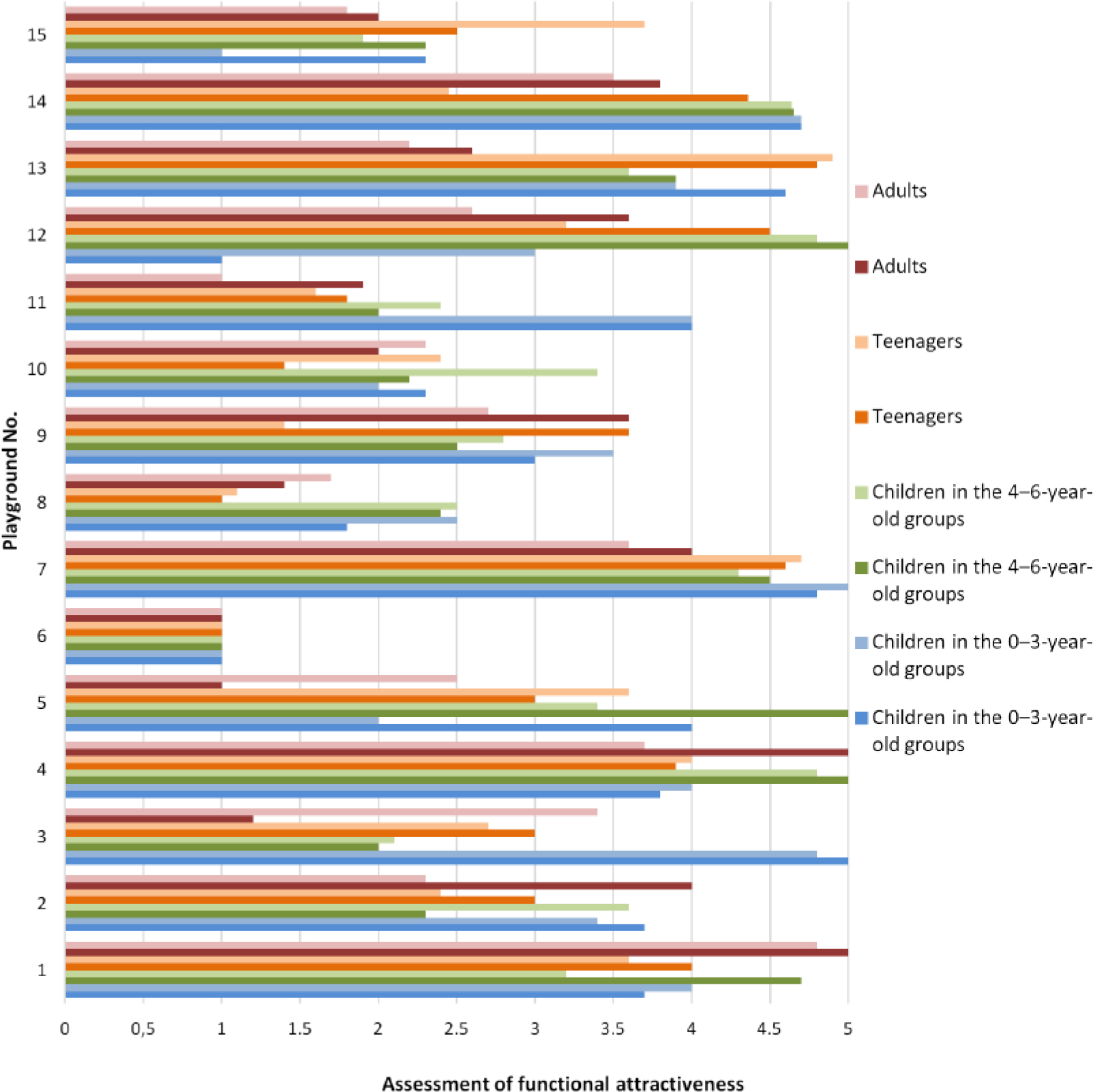
Figure 13.
Functional attractiveness of playgrounds for different age groups, assessed by women (W) and men (M) (own study)