
Table 1.
Classification of contemporary types of oncology-related healthcare facilities with schematic representation of differences in scale and height of facilities. Developed by the authors
| CONTEMPORARY TYPES OF CANCER CENTRES | |||||
| Name | Oncology bed ward | Day cancer care centre | Single-therapy day treatment centre | Daytime multi-therapeutic treatment centre | Multi-therapeutic day and long-stay treatment centre |
| Scheme | 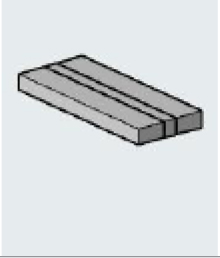 | 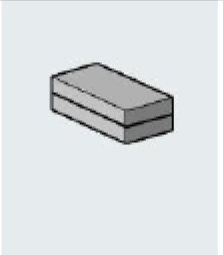 |  | 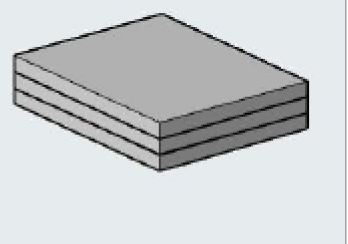 | 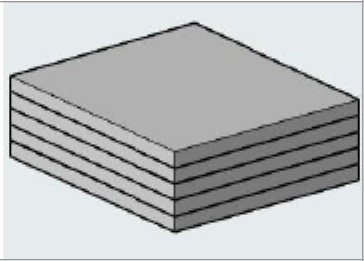 |
| Treatment methods | Many types of therapy offered at the facility that require a longterm stay | Multidisciplinary patient support (as an adjunct in the treatment process - holistic approach) | One type of therapy provided at the facility | Many types of therapy offered at the facility that do not require a long-term stay | The many types of therapy offered at the facility, both not requiring a long-term stay and requiring one |
| Invasive surgery with complementary therapies (e.g. chemotherapy etc.) | Multidisciplinary practical and social, lifestyle and emotional care (background to treatment methods) | Proton therapy or radiotherapy (mostly) | Day surgery, radiotherapy, chemotherapy, other therapies, multidisciplinary patients support | Invasive surgery, radiotherapy, chemotherapy, proton therapy, other therapies, multidisciplinary patients support | |
| Spatial characteristics | Part of a larger hospital with patient bed rooms. Treatment spaces include, for example, chemotherapy areas. Surgical procedures take place in the general operating theatre of the hospital. | A small facility located near a cancer hospital that provides spaces for patients and their relatives to learn about the diagnosis, receive multifaceted support. Providing a non-institutional environment in the treatment and recovery process. | Small or medium-sized facilities (depending on the number of treatment devices and additional areas), a large part of which is occupied by a technical area related to the treatment method offered - proton therapy or radiotherapy. | Small or medium-sized facilities (depending on the types of treatment offered and their specificities). Larger facilities have bunkers with radiotherapy, operating theatres and post-operative areas (same-day surgery) etc. | Much larger than other cancer centres because they have long-term care units. In addition, the size and form of the facility is influenced by the type of therapies offered, e.g. in the case of proton therapy, a special bunker and an extensive technical area, etc. |
Table 2.
List of oncology facilities included in the study and their general characteristics. Elaborated by the authors. Source: [33-44]
| No. | Name | Location | Designer | Treatment methods | Type of facility | Total area [m2] | Number of floors | Opening year |
|---|---|---|---|---|---|---|---|---|
| 1 | Chemotherapy Outside | Hilversum, The Netherlands | VANDERSALM-aim | Chemotherapy | Oncology ward | 196 | 1 | 2015 |
| 2 | Maggie’s Centre at the Royal Marsden | London, UK | Ab Rogers Design | Multidisciplinary patients support | Day cancer care centre | 468 | 2 | 2019 |
| 3 | Kálida Sant Pau Centre | Barcelona, Spain | Benedetta Tagliabue - EMBT | 400 | 2 | 2019 | ||
| 4 | Maggie’s Leeds Centre | Harehills, UK | Heatherwick Studio | 462 | 2 | 2020 | ||
| 5 | Ipo Porto – Radiotherapy Centre | Porto, Portugal | ACTIU | Radiotherapy | Singletherapy day treatment centre | 6000 | 1 | 2012 |
| 6 | Quironsalud Prothon Therapy Centre | Madrid, Spain | IDOM | Proton therapy | 2380 | 3 | 2014 | |
| 7 | Skandion Clinic | Uppsala, Sweden | LINK Arkitektur | 14300 | 7 | 2019 | ||
| 8 | UCH Macmillan Centre | London, UK | Hopkins Architects | Day surgery, radiotherapy, chemotherapy, other therapies, multidisciplinary patients support | Daytime multi-therapeutic treatment centre | 14000 | 9 | 2012 |
| 9 | Cancer Centre at Guy’s Hospital | London, UK | Roger Stirk Harbour + Partners | 20000 | 15 | 2016 | ||
| 10 | NGS Macmillan Unit | Chesterfield, UK | The Manser Practice | Chemotherapy, other therapies, multidisciplinary patients support | 2140 | 2 | 2017 | |
| 11 | Princess Máxima Center | Utrecht, The Netherlands | LIAG Architects | Invasive surgery, radiotherapy, chemotherapy, other therapies, multidisciplinary patients support | Multi-therapeutic day and long-stay treatment centre | 45000 | 6 | 2018 |
| 12 | Grafton Way Clinic | London, UK | Scott Tallon Walker Architects | Invasive surgery, radiotherapy, chemotherapy, proton therapy, other therapies, multidisciplinary patients support | 34500 | 11 | 2022 |
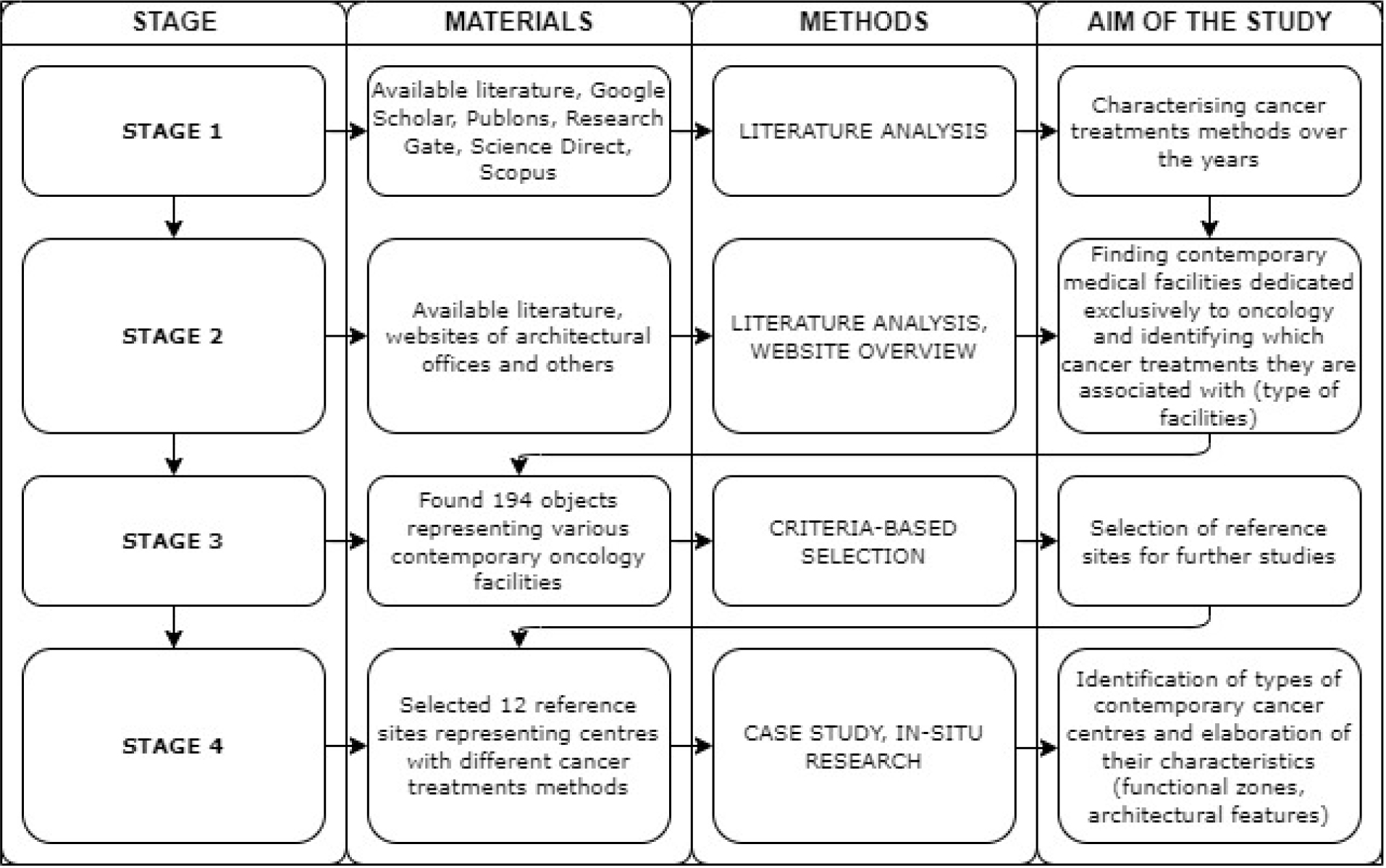
Figure 1.
Stages of research outlining the research material adopted, the research methods and their purpose. Elaborated by the authors
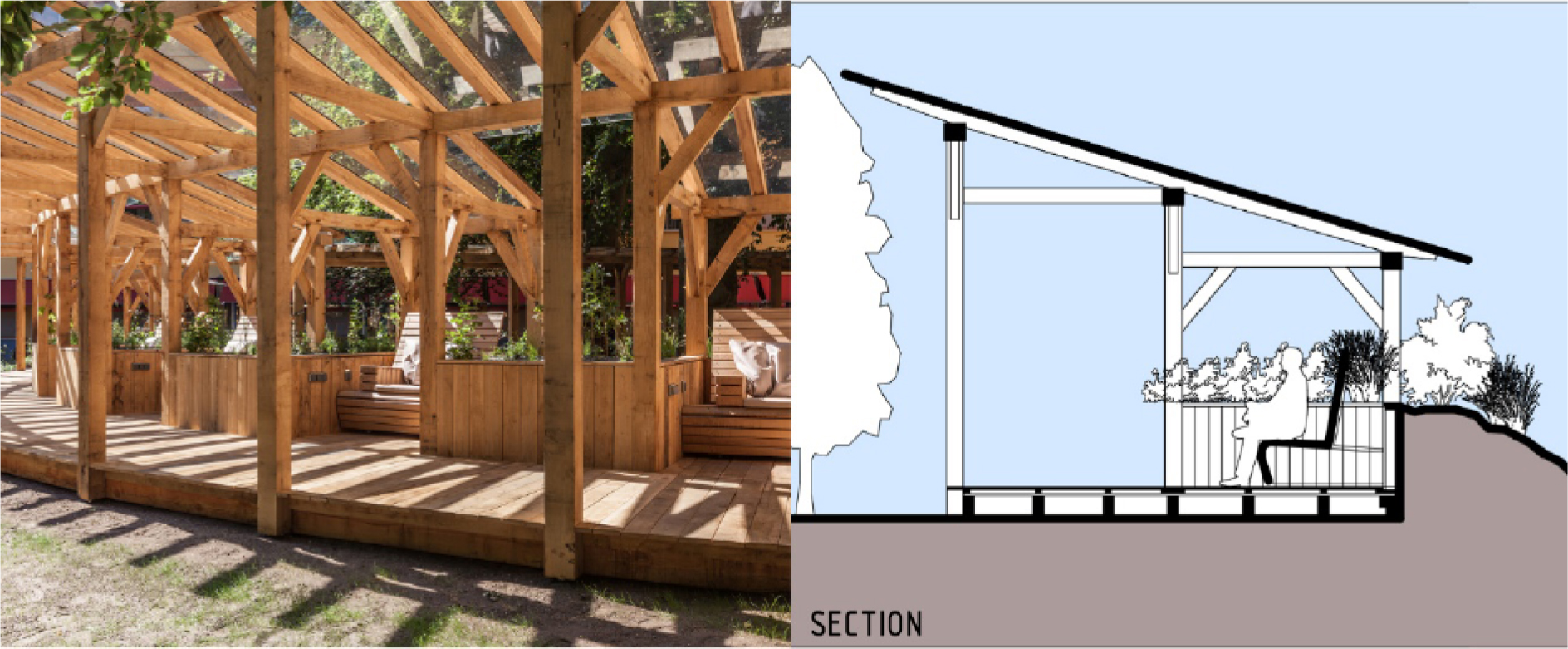
Figure 2.
View and cross-section of the chemotherapy space in Hilversum. Photo by Milad Pallesh. Drawings elaborated by the authors from online material available at vandersalm-aim.nl. Source: https://vandersalm-aim.nl/project/chemotuin-hilversum
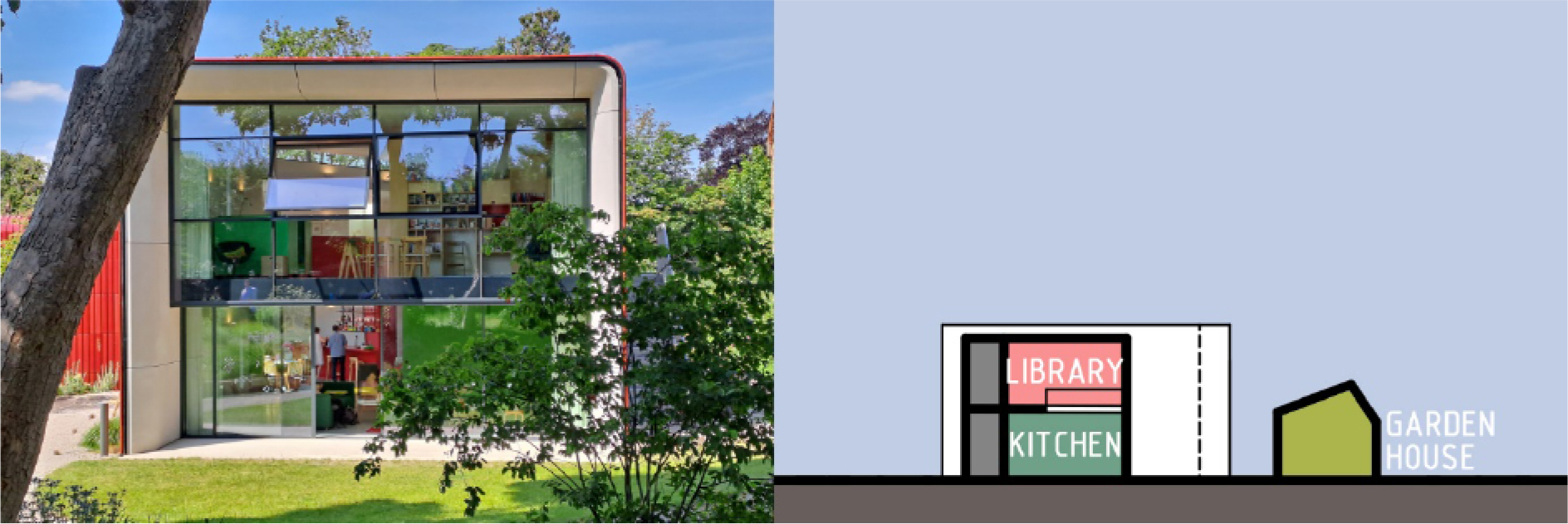
Figure 3.
Maggie’s Centre at the Royal Marsden, London – view of one of the elevations and a schematic cross-section through the building. Photo by Rafał Strojny. Drawings elaborated by the authors from online material available at the AB Rogers Design office. Source: https://www.abrogers.com/portfolio/maggies-at-the-royal-marsden/
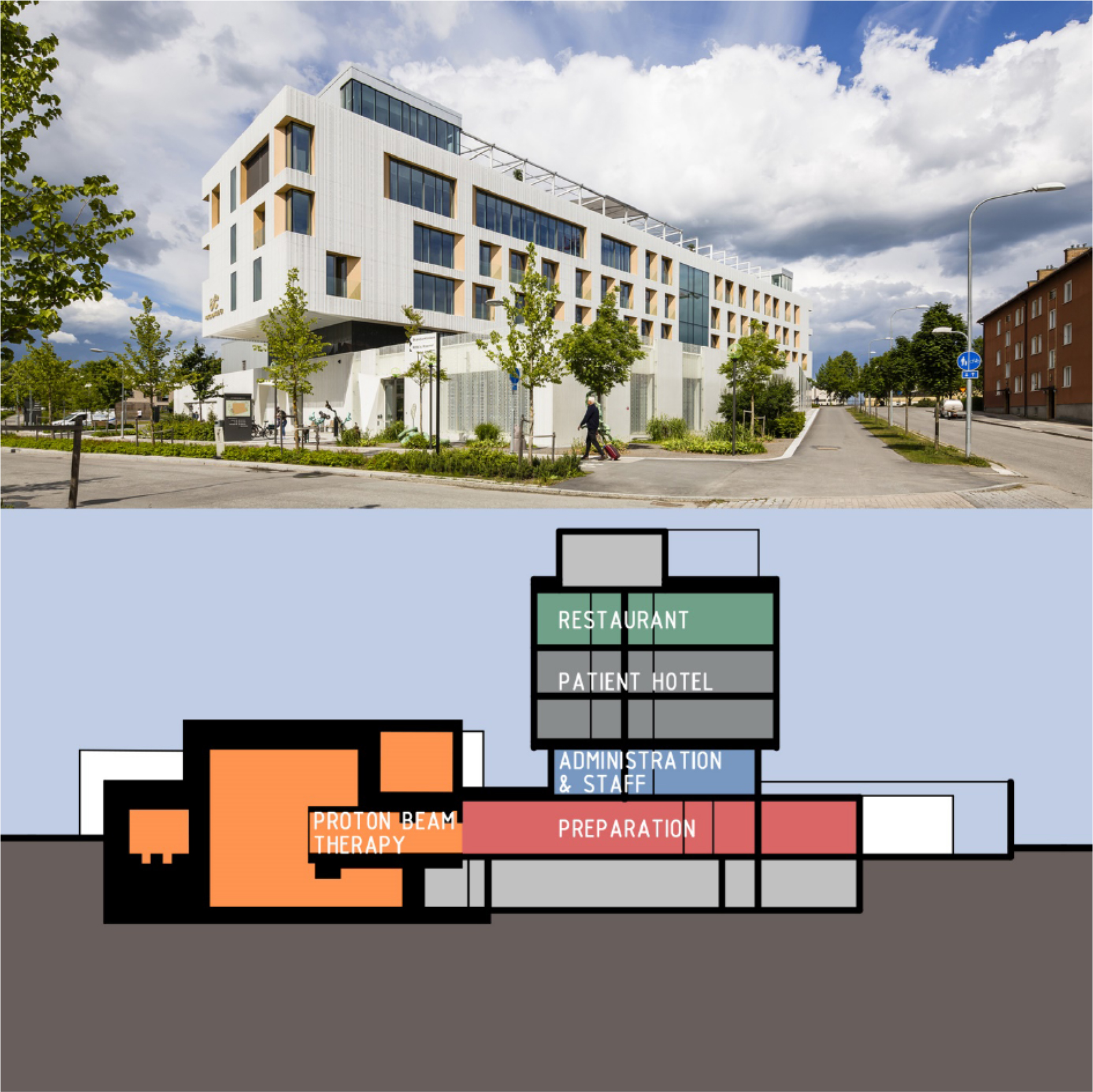
Figure 4.
Skandion Clinic, Uppsala (Sweden) – view of the building and schematic cross-section through the building. Photo by Hundven Clements Photography. Drawings elaborated by the authors from online material available at the LINK Arkitektur office and arch daily. Source: https://www.archdaily.com/804089/skandion-clinic-link-arkitektur
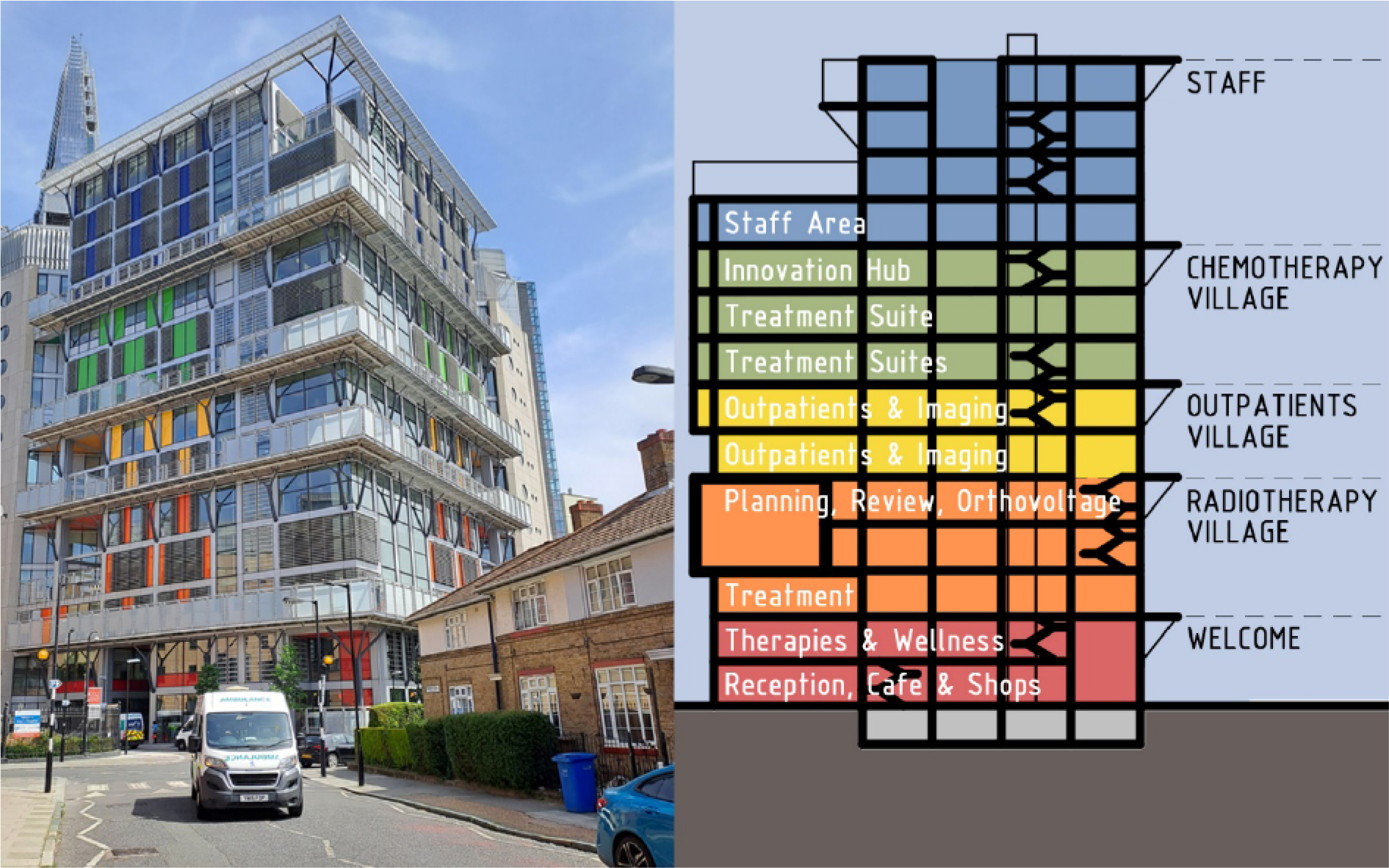
Figure 5.
Cancer Centre at the Guy’s Hospital, London – view of the building and schematic cross-section through the building. Photo by Rafał Strojny. Drawings elaborated by the authors from online material available at the RSHP office. Source: https://rshp.com/projects/health-and-science/cancer-centre-at-guys-hospital/
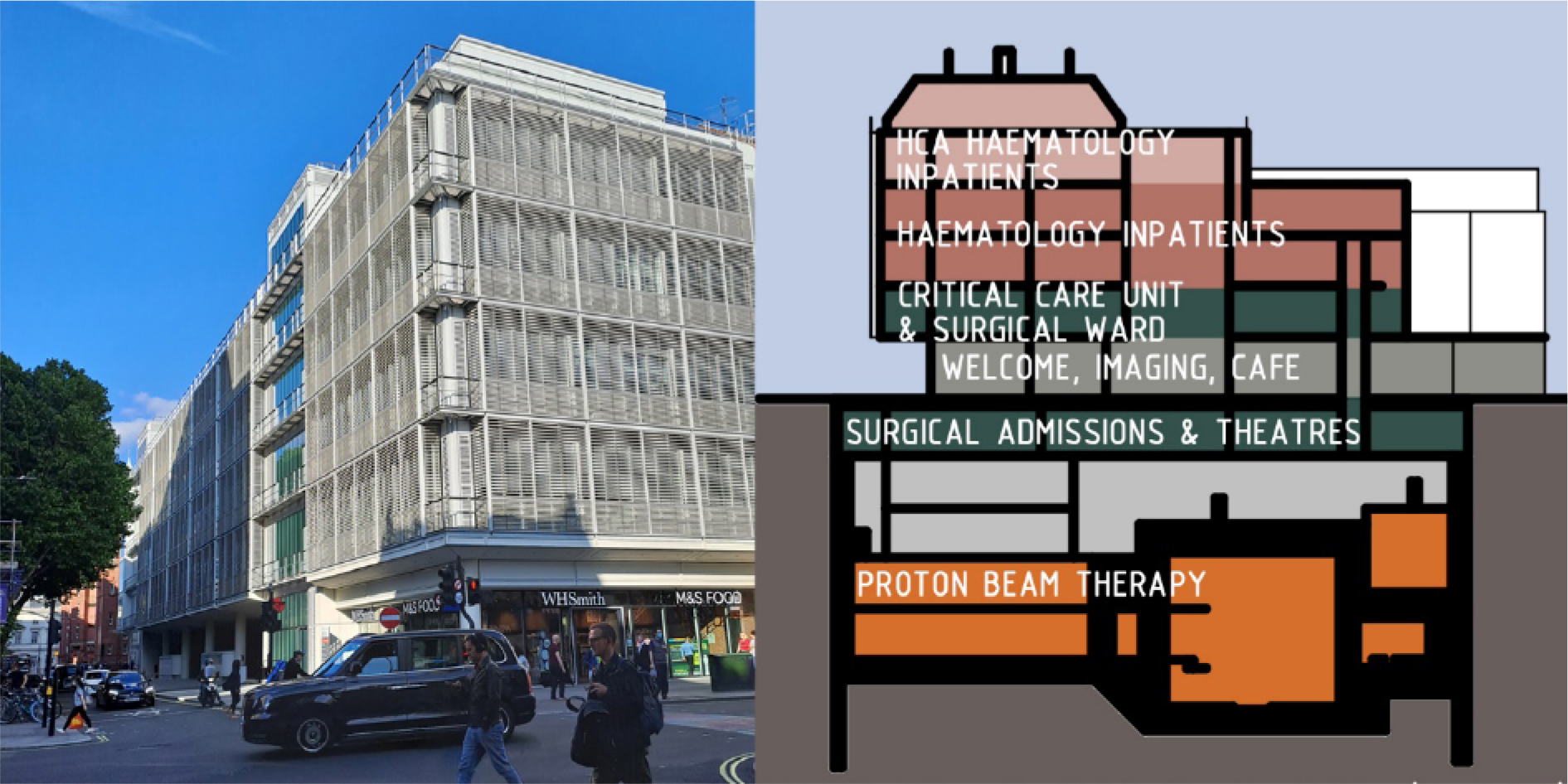
Figure 6.
University College Hospital Grafton Way Building, London – view of the building and schematic cross-section through the building. Photo by Rafał Strojny. Drawings elaborated by the authors from online material available at the Edward Williams Architects office. Source: https://www.edwardwilliamsarchitects.com/projects/view/uclh-phase-4-and-proton-beam-therapy-unit-london-uk
Table 3.
Matrix showing the zones occurring in each type of cancer centre (blue). The green colour indicates zones that may or may not occur. The x symbol indicates the absence of a given zone in the facility. Developed by the authors
| A | B | C | D | E | |
|---|---|---|---|---|---|
| Entrance area | |||||
| Administrative area | |||||
| Social area | |||||
| Diagnostic and consultation area | x | ||||
| Treatment area | x | ||||
| Technical area | x | ||||
| Staff area | x | ||||
| Research area | x | ||||
| Training area | x | ||||
| LEGEND | |||||
Table 4.
Selected spaces occurring in a given zone in contemporary cancer centres. Developed by the authors.
| ZONE NAME | SPACES IN THE ZONE |
|---|---|
| Entrance area | Lobby, reception, waiting area, hygiene and sanitary facilities, services (e.g. restaurant, shop) etc. |
| Administrative area | Office rooms, meeting rooms, conference rooms, archives, staff room, hygiene and sanitary facilities, etc. |
| Social area | Common spaces, recreation spaces, garden, support spaces, catering, services etc. |
| Diagnostic and consultation area | Consultation rooms (including counselling, advice), doctors’ surgeries, diagnostic rooms (surgeries, X-ray, MRI etc.). |
| Treatment area | Treatment rooms (in various forms – depending on the therapy), operating theatres with facilities (clean and dirty communication, washrooms, staff changing rooms, hygiene and sanitation rooms, clean and dirty rooms, staff rooms, patient sluices, etc.), preparation rooms, changing rooms, control rooms, recovery/observation rooms, bed unit etc. |
| Technical area | Technical rooms of various forms depending on the therapy – e.g. in proton therapy the cyclotron, maintenance rooms, storage rooms, server room etc. |
| Other zones | Staff area, research area, training area |