
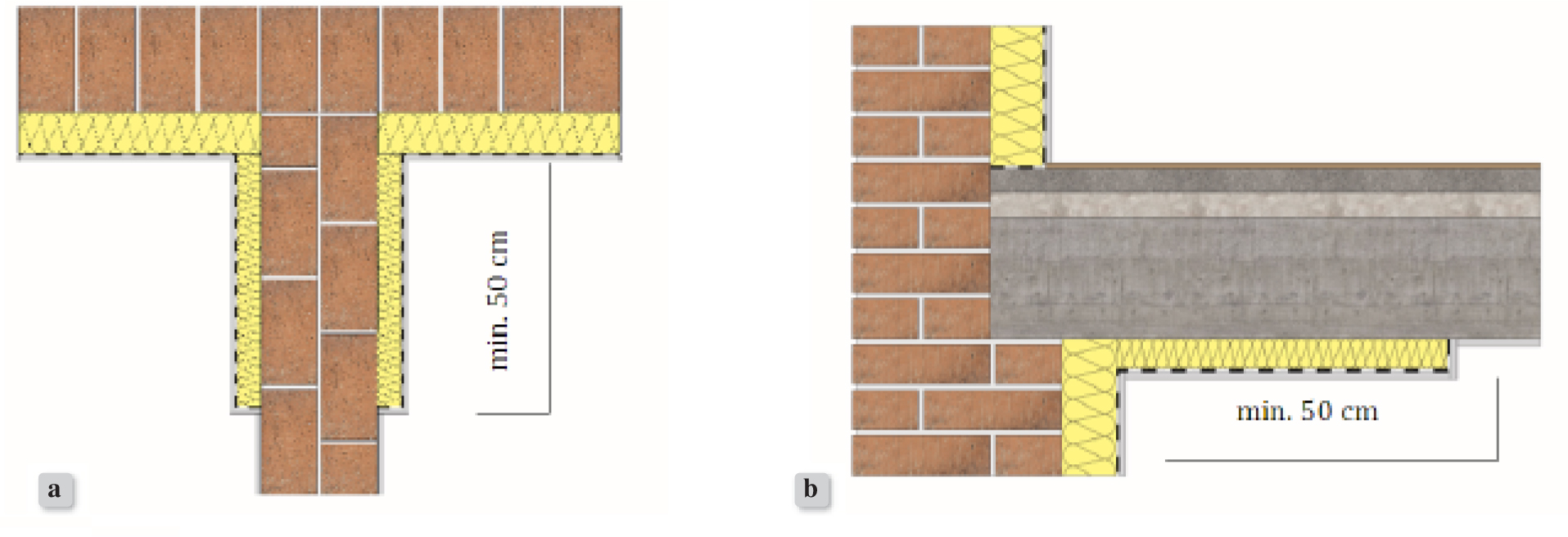
Figure 1.
Graphic solutions of nodes such as: a) connection of the external wall with the internal one, b) connection of the ceiling with the external wall [13, 34, 35]
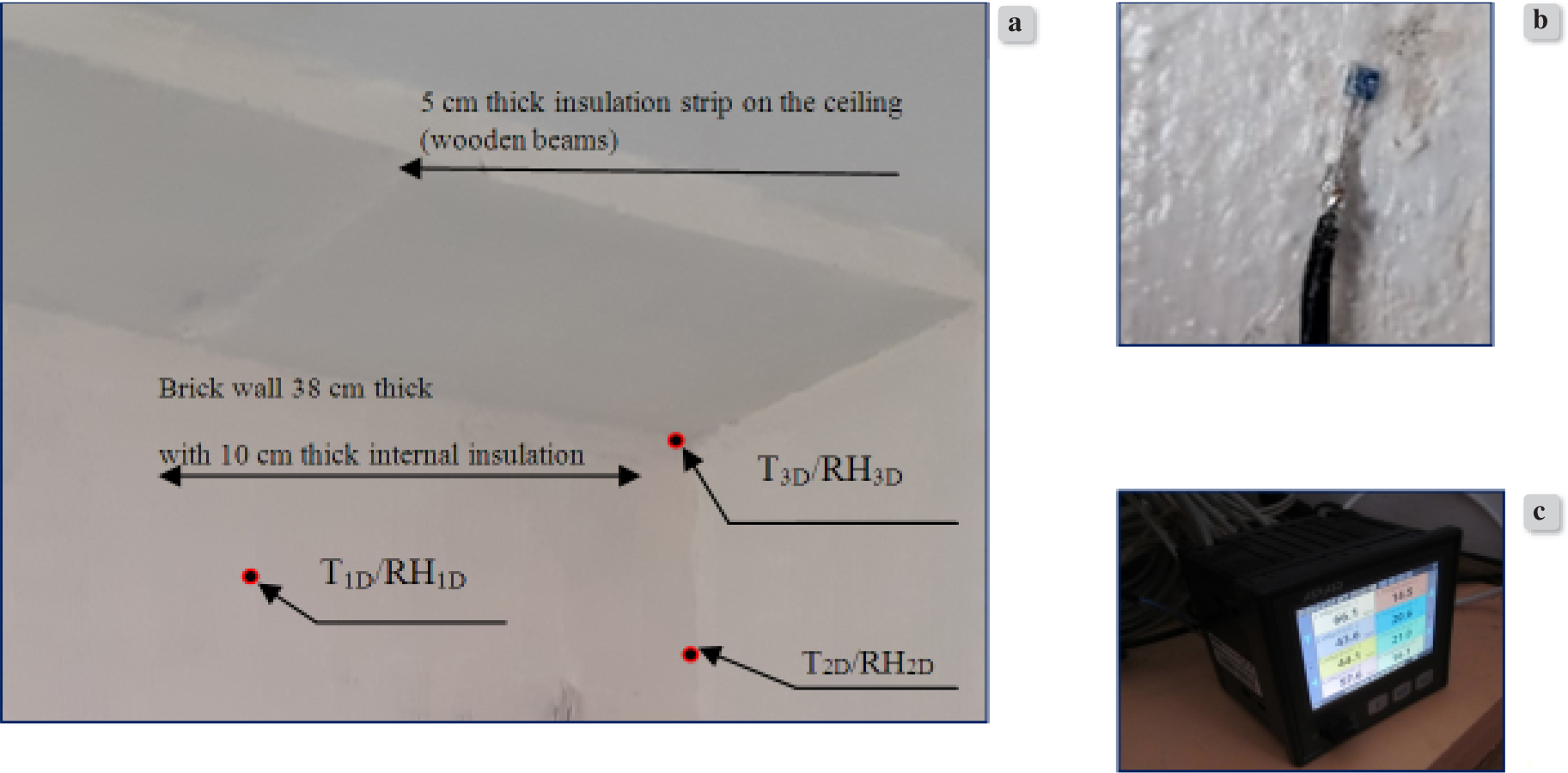
Figure 2.
Test stand: a) location of sensors’ installation, b) method of sensors’ installation on the surface, (c) data logger
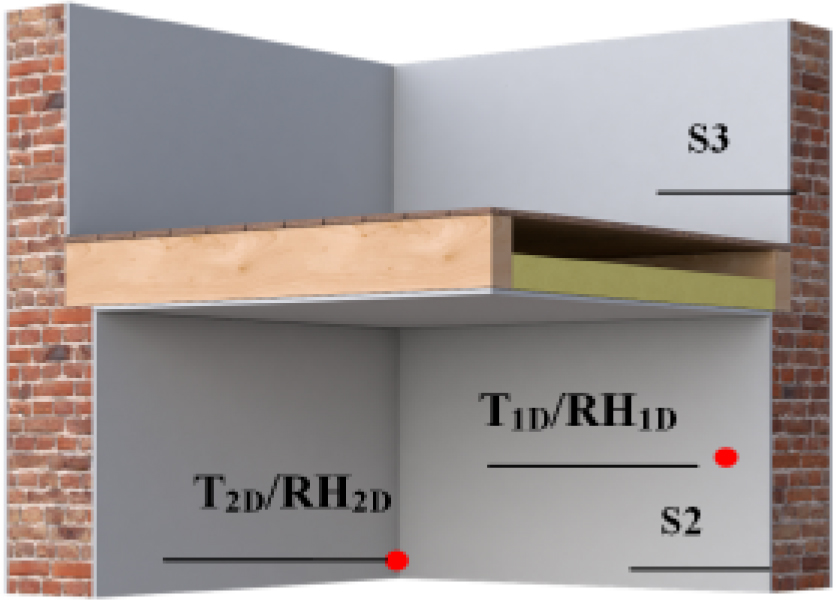
Figure 3.
Flat corner in the non-insulated variant – W1
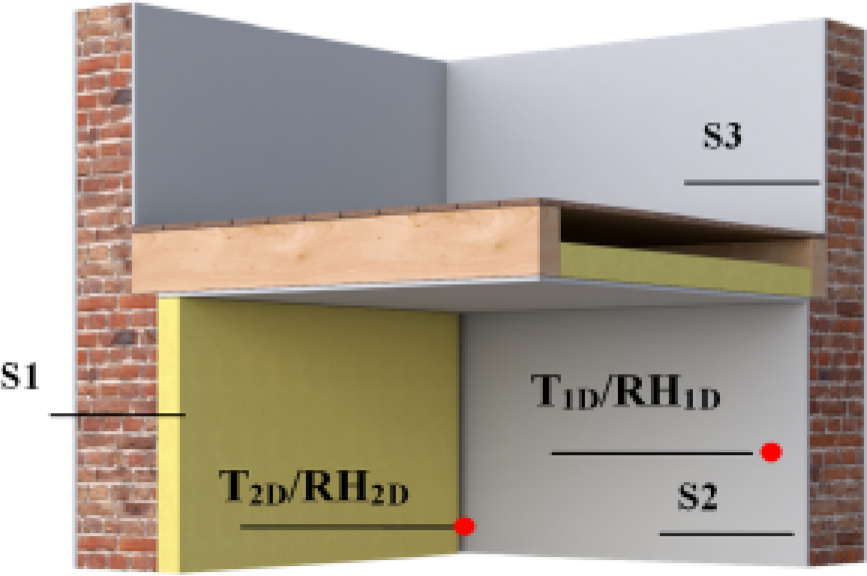
Figure 4.
Flat corner in the partially insulated variant – W2
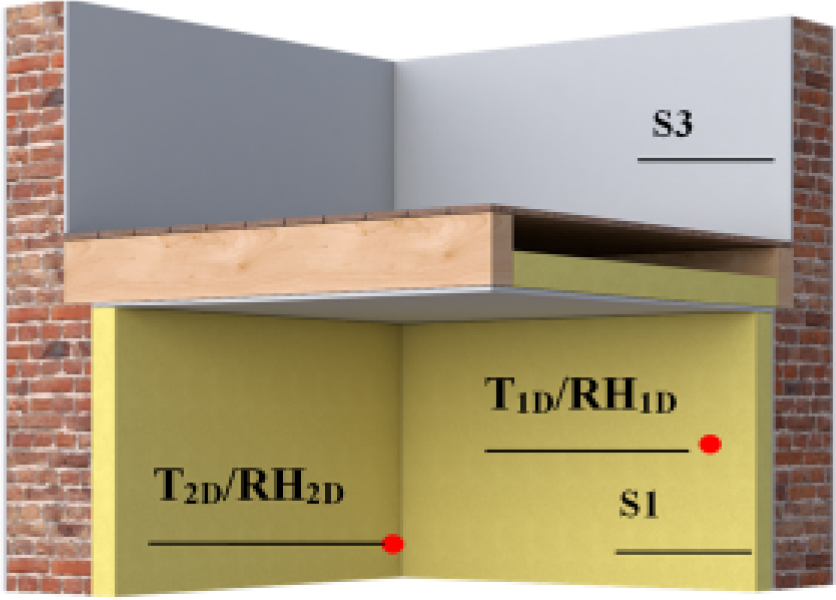
Figure 5.
Flat corner in the insulated variant without ceiling insulation the in the form of strips – variant W3
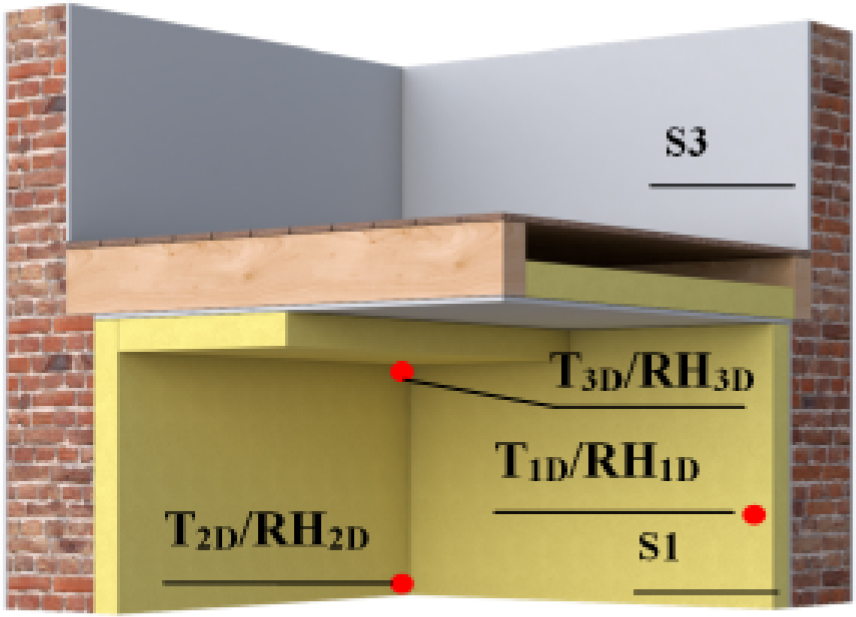
Figure 6.
Spatial corner – variant W4
Table 1.
List of thermal and moisture parameters for the wall S1
| No. | Layer | Thickness d[m] | Density [kg/m3] | Thermal conductivity index λ [W/(m·K)] | Diffusion resistance factor μ [–] |
|---|---|---|---|---|---|
| 1. | Solid brick on cement-lime mortar | 0.38 | 1800 | 0.60 | 15.0 |
| 2. | Leveling layer of cement-lime plaster | 0.015 | 1900 | 0.80 | 19.0 |
| 3. | System adhesive mortar | 0.01 | 833 | 0.015 | 15.1 |
| 4. | Lightweight cellular concrete slabs | 0.10 | 115 | 0.04 | 4.1 |
| 5. | System finishing layer | 0.01 | 833 | 0.015 | 15.1 |
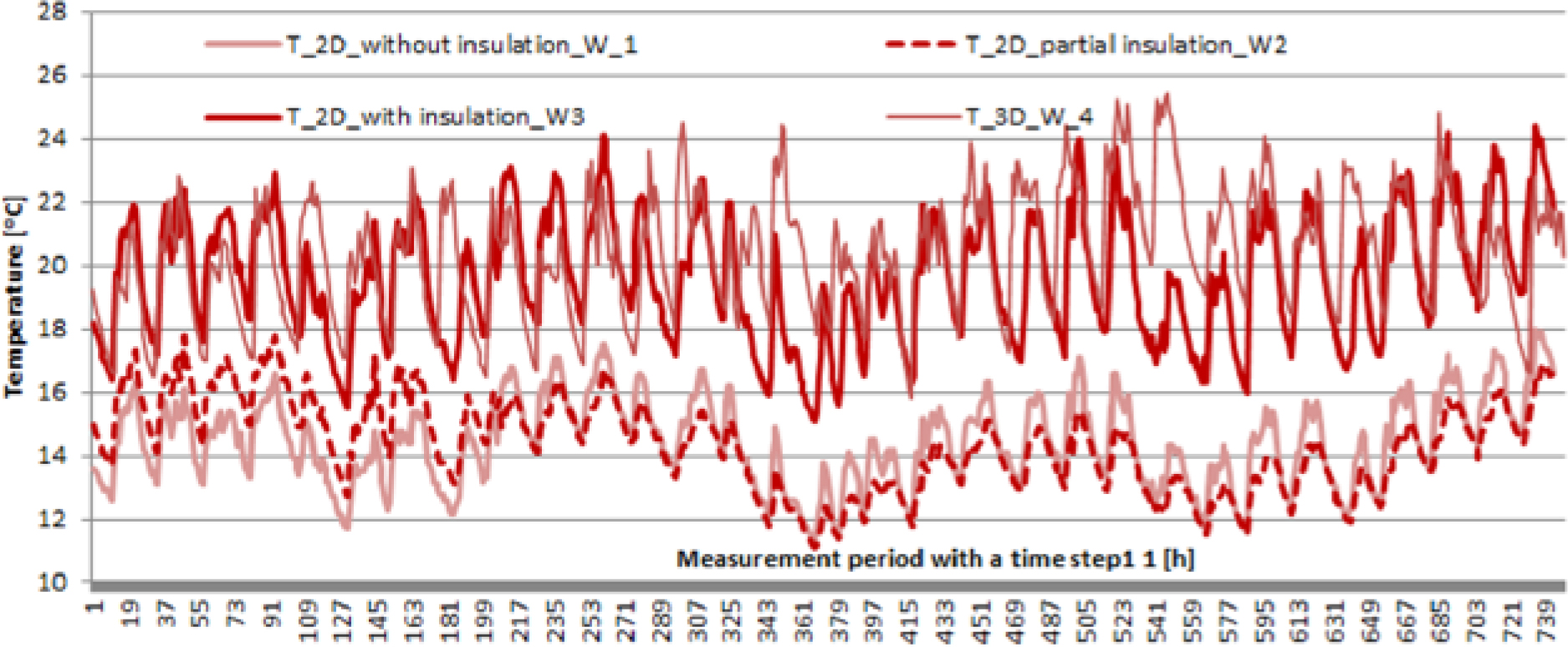
Figure 7.
Profiles of temperature changes on the surface of a flat and spatial corner in variant W1-W4
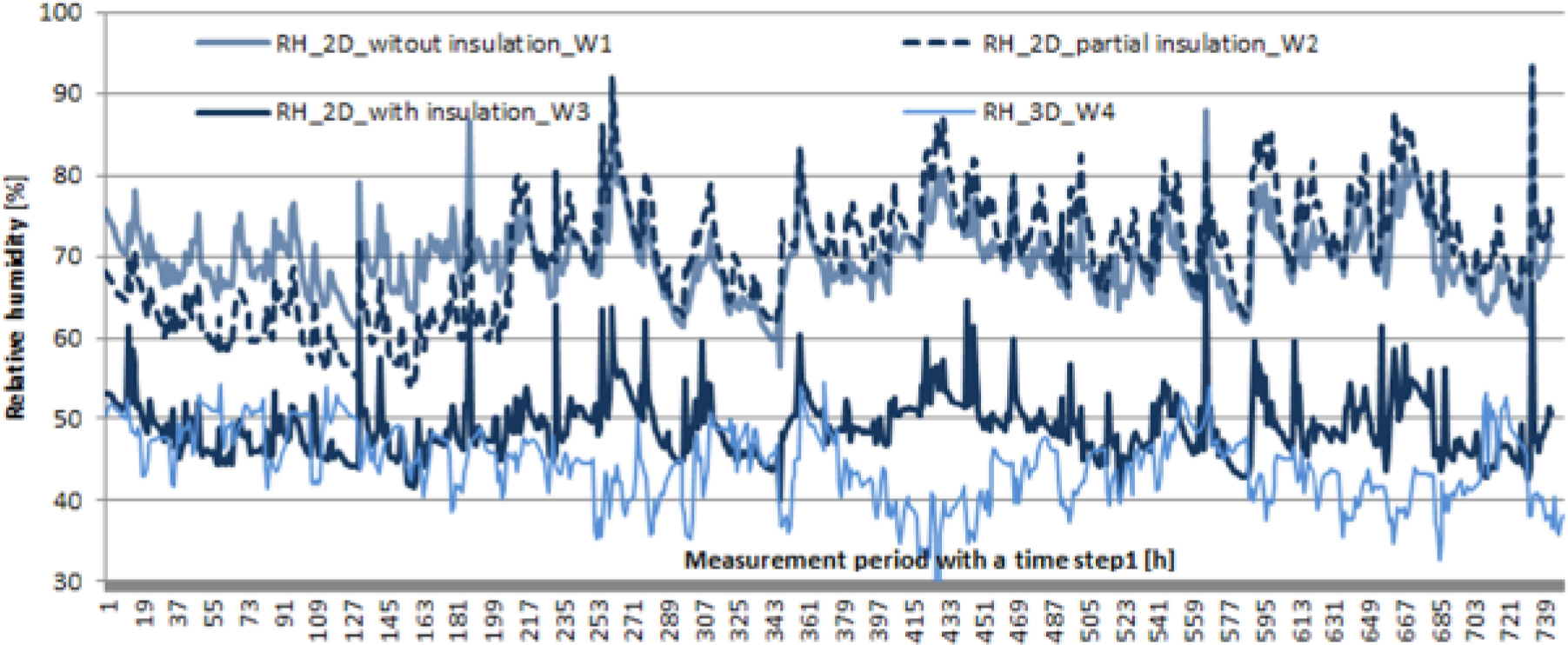
Figure 8.
Profiles of the changes in relative humidity on the surface of a flat and spatial corner
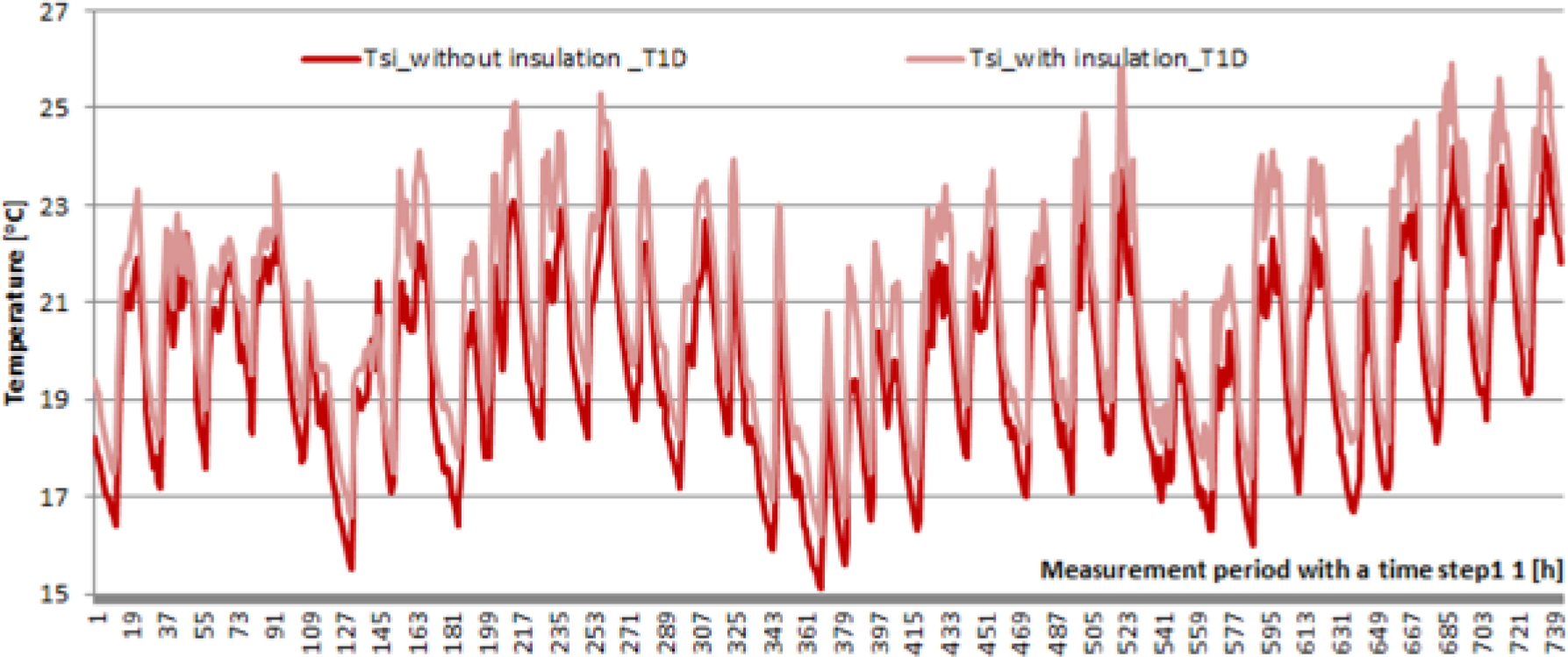
Figure 9.
Profiles of temperature changes on a flat surface
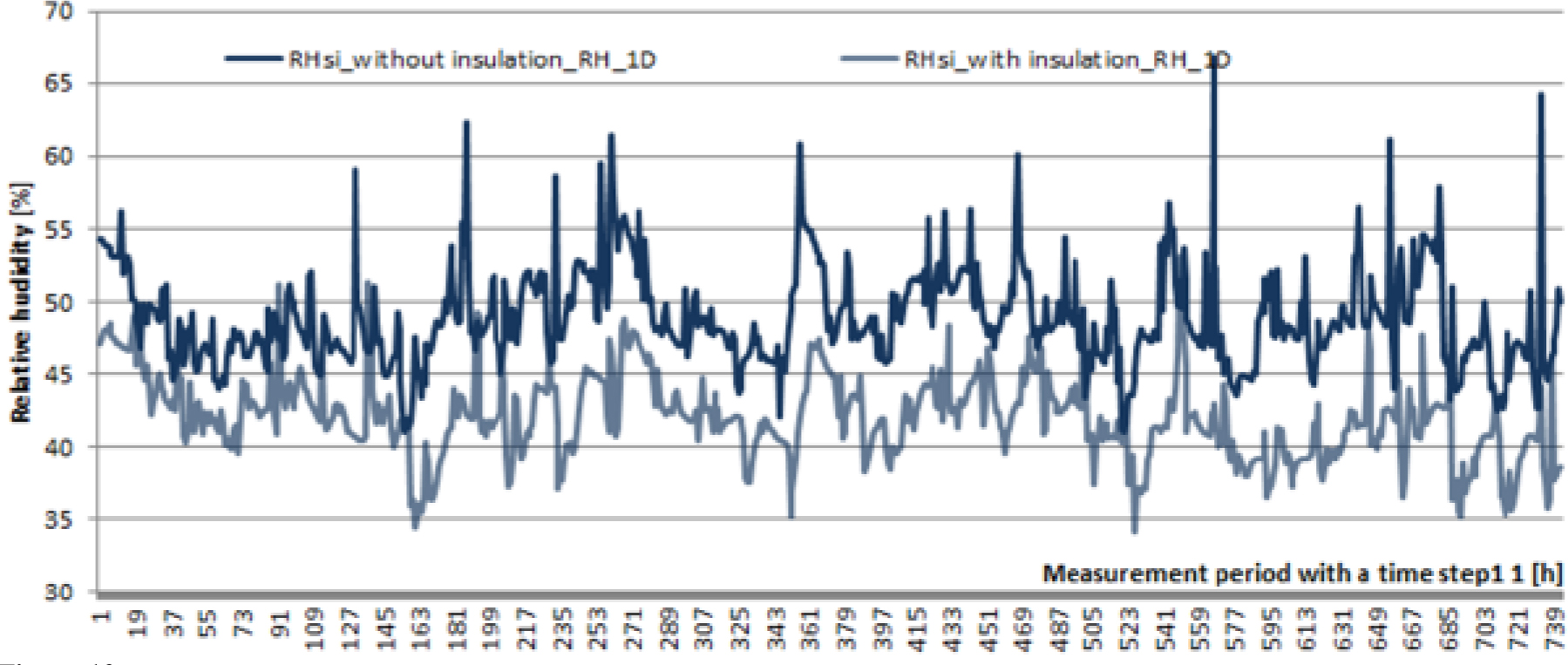
Figure 10.
Profiles of the changes in relative humidity on a flat surface
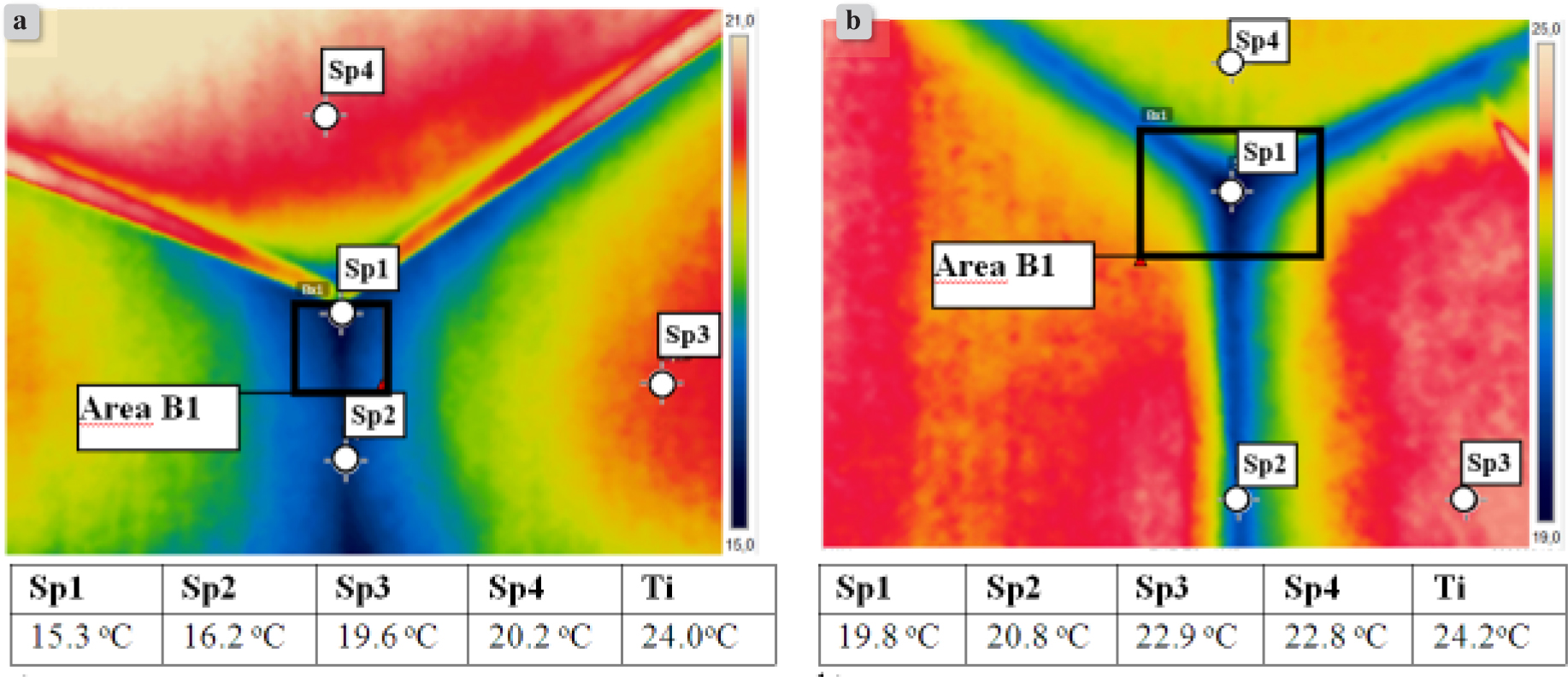
Figure 11.
Distribution of surface temperature field for the 3D/2D corner in a historical building: a) non-insulated (with a polystyrene strip minimizing the temperature drop on the edge), b) insulated (with an insulating strip on the ceiling)
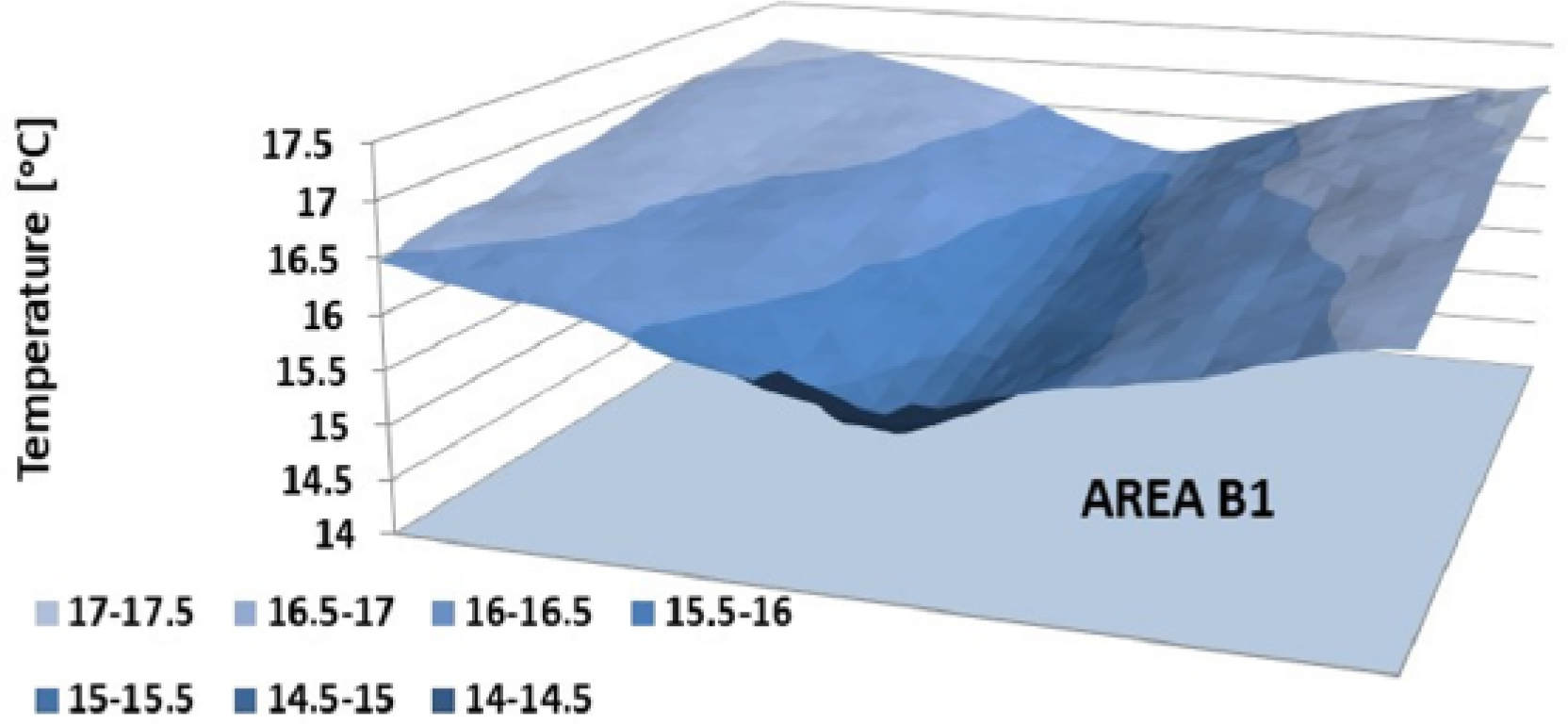
Figure 12.
Distribution of temperature field in the B1 area for the non-insulated 3D/2D corner in a historic building without insulation
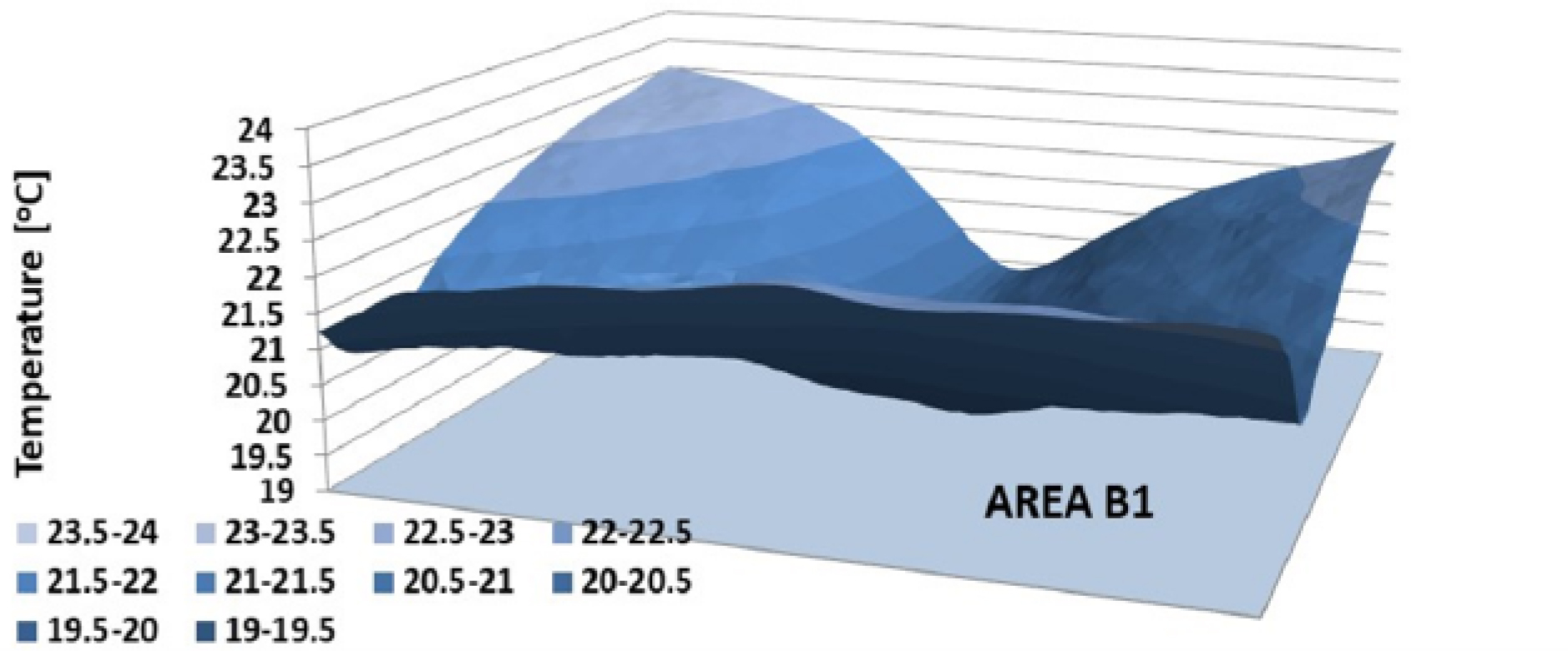
Figure 13.
Distribution of temperature field in the B1 area for the 2D/3D insulated corner in a historic building insulated from the inside
Table 2.
Differences in surface temperature values of the tested corner systems
| Surface temperature difference ΔT[°C] | |||
|---|---|---|---|
| Sp3–Sp1 | Sp3–Sp2 | Sp2–Sp1 | |
| Historic building | 4.3 | 3.4 | 0.9 |
| Historic building with thermal insulation of the envelopes | 4.7 | 3.1 | 1.6 |
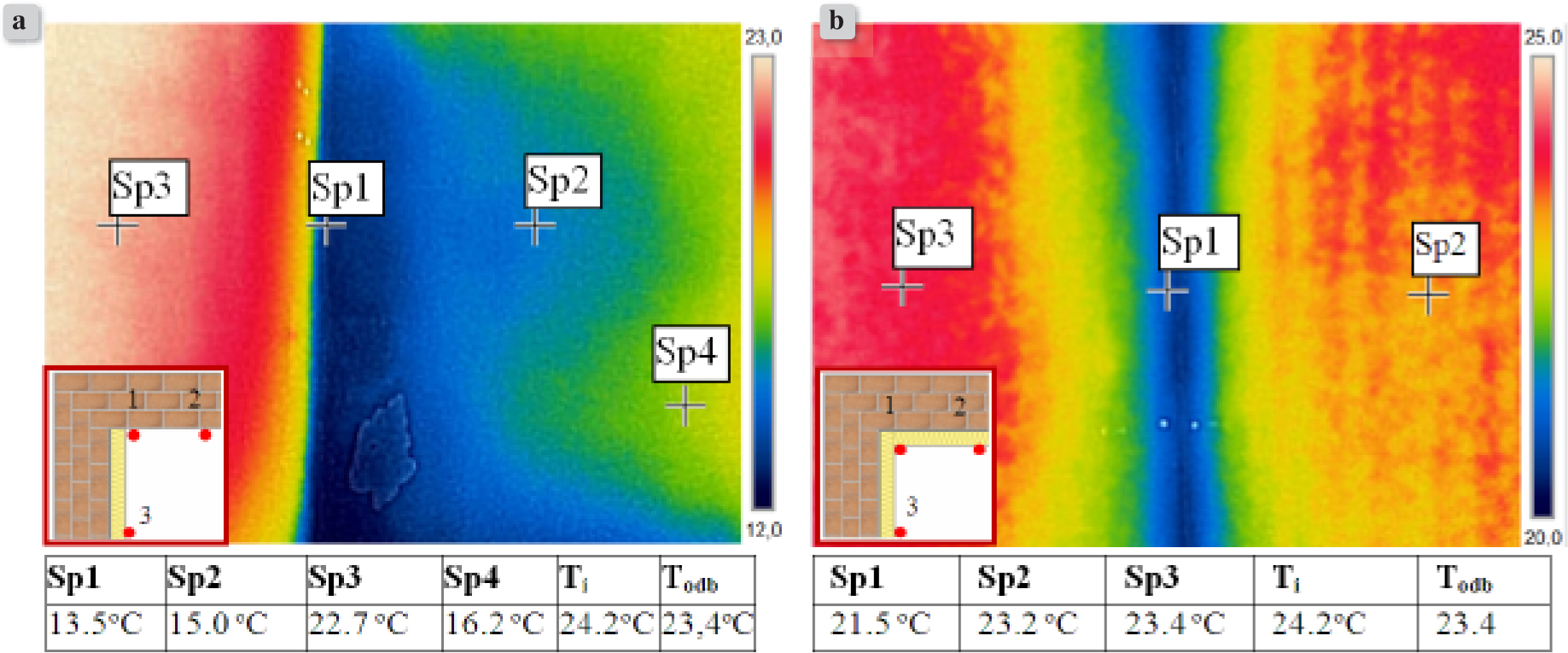
Figure 14.
Distribution of temperature field on the surface of: a) 2D partially insulated corner, b) 2D fully insulated corner [30]
Table 3.
Cumulative results of corner calculations
| Thermal resistance of insulation R [(m2·K)/W] | Thermal coupling coefficient Le2D [W/(m2·K)] | Linear thermal transmittance coefficient ψe[W/(m·K)] | ||
|---|---|---|---|---|
| Insulated corner | Partially insulated corner | Insulated corner | Partially insulated corner | |
| 0 | 2.952 | 2.952 | -0.578 | -0.578 |
| 0.5 | 1.672 | 2.230 | -0.460 | -0.634 |
| 1.0 | 1.201 | 2.015 | -0.385 | -0.599 |
| 1.5 | 0.932 | 1.882 | -0.330 | -0.471 |
| 2.0 | 0.758 | 1.787 | -0.290 | -0.459 |
| 2.5 | 0.626 | 1.707 | -0.270 | -0.464 |
| 3.0 | 0.552 | 1.655 | -0.230 | -0.458 |
Table 4.
Thermal conductivity of the materials used to build the model
| Brick wall | Plaster | Thermal insulation | Wooden beam | Plaster boardd | OSB plate | |
|---|---|---|---|---|---|---|
| λ | 0.77 | 1.00 | 0.04 | 0.16/0.13 | 0.32 | 0.13 |
| d [m] | 0.38/0.25 | 0.15 | 0.10 | 0.14×0.20 | 0.0125 | 0.02 |
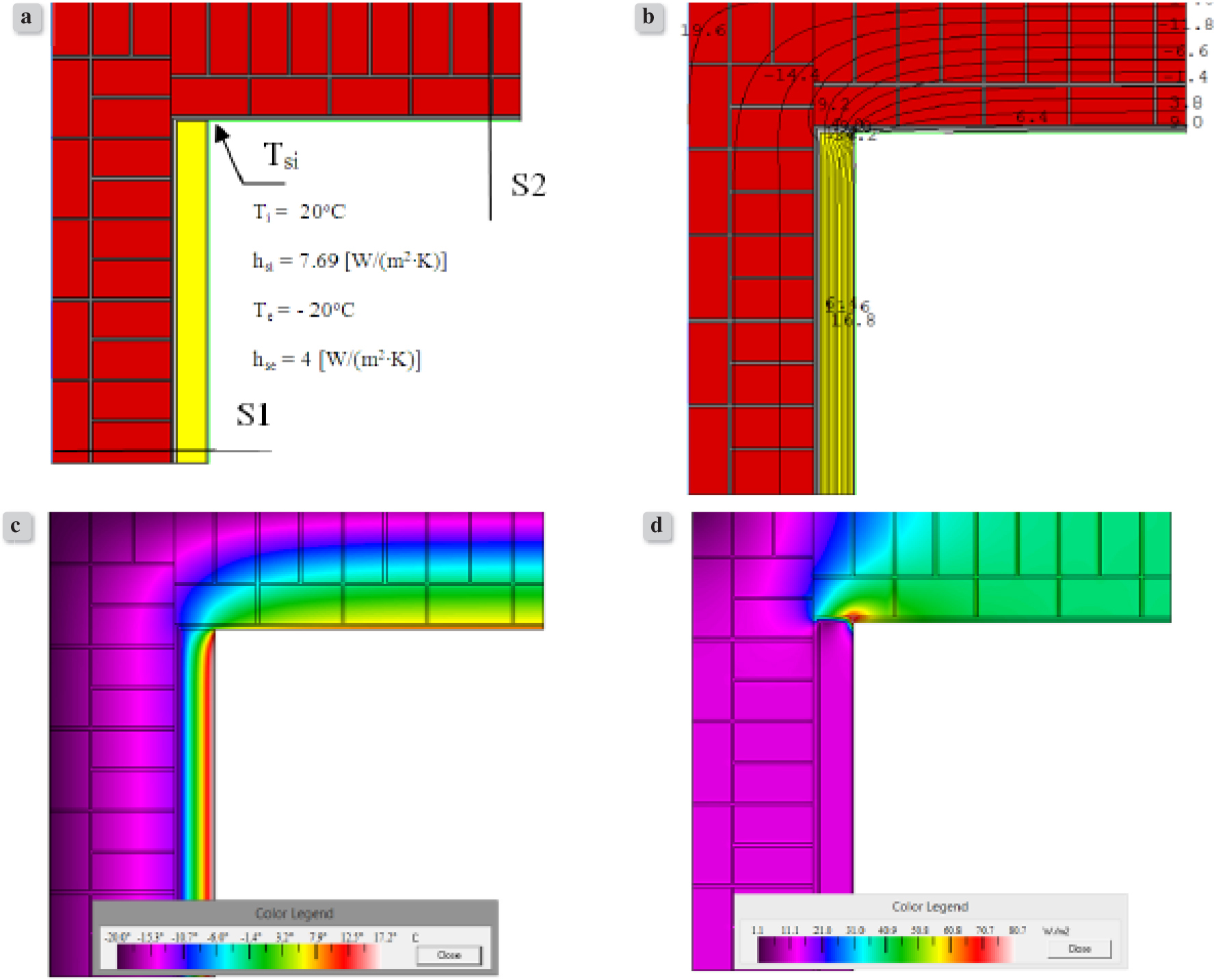
Figure 15.
Results of numerical calculations for the external corner, with partial insulation 10 cm thick: a) node model, b, c) distribution of isotherms, d) distribution of heat flux density
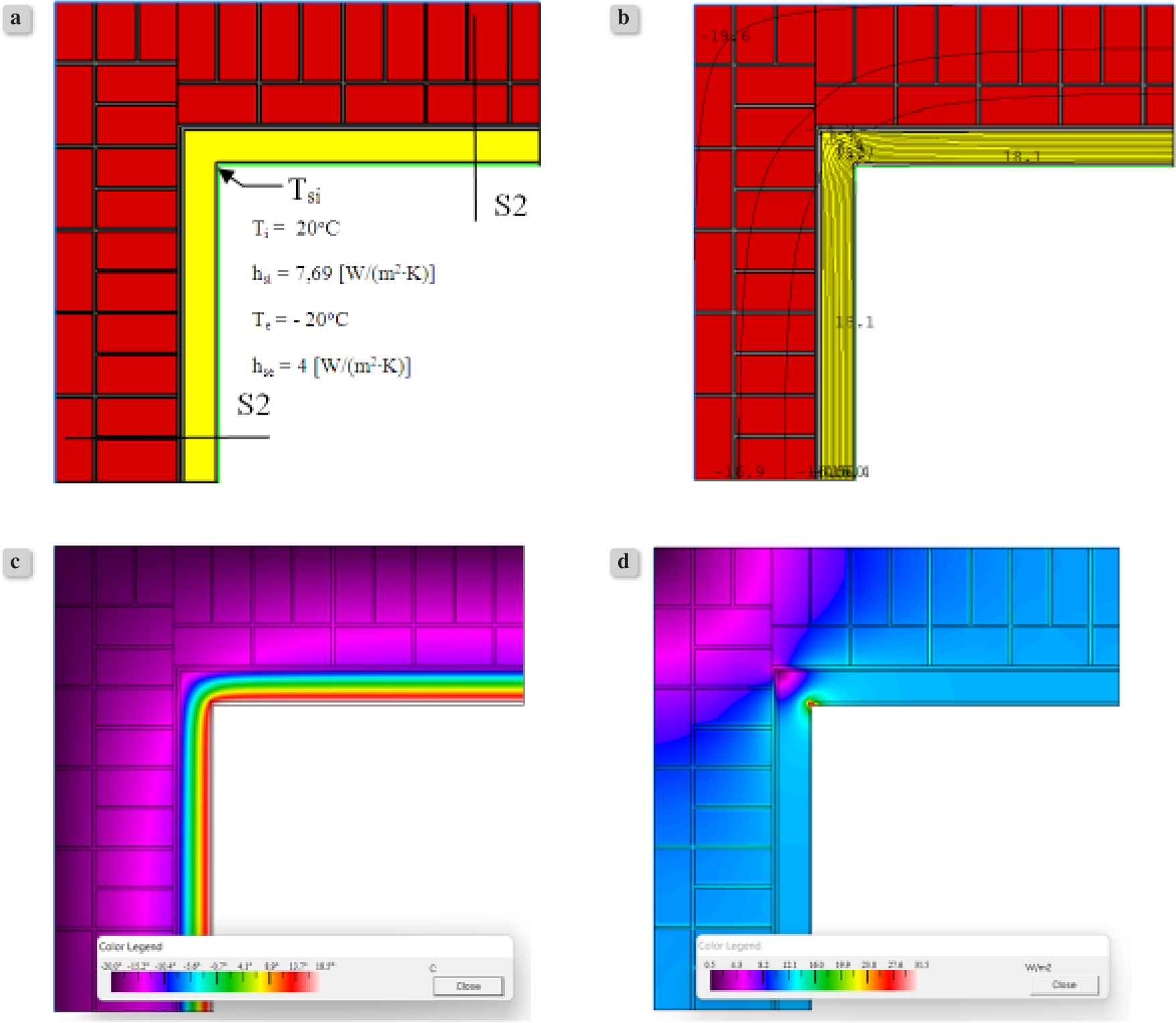
Figure 16.
Results of numerical calculations for the external corner, with comprehensive insulation 10 cm thick: a) node model, b, c) distribution of isotherms, d) distribution of heat flux density
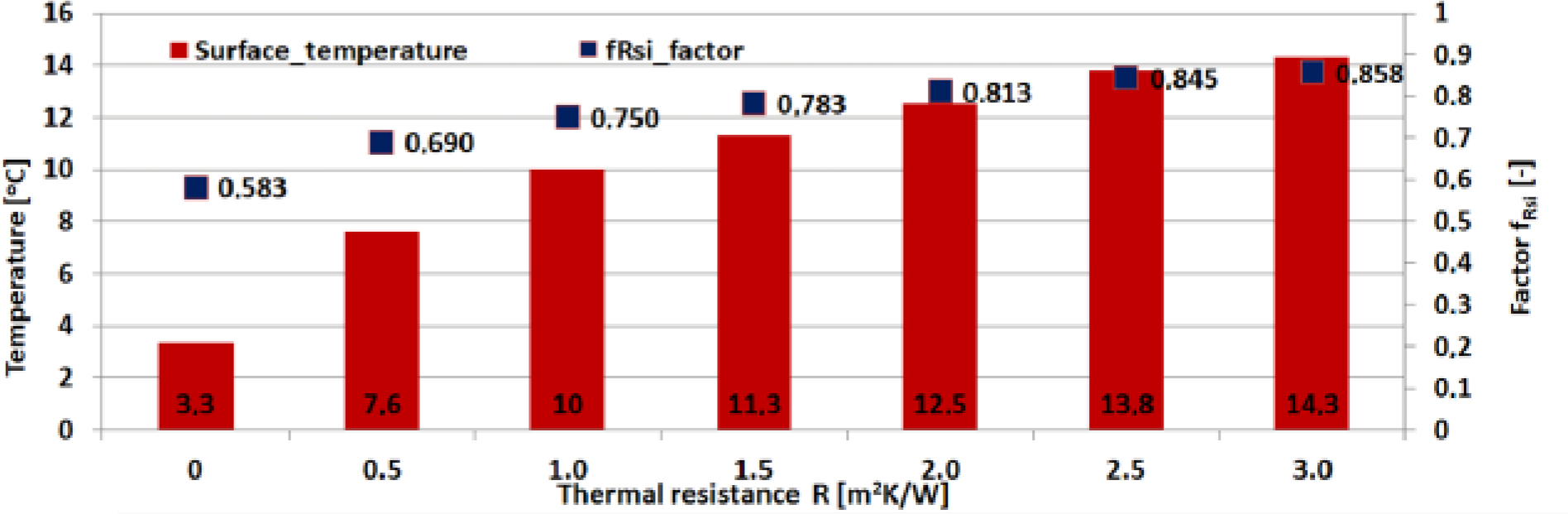
Figure 17.
Surface temperature changes and the effective value of the fRsi factor for insulated outer corner
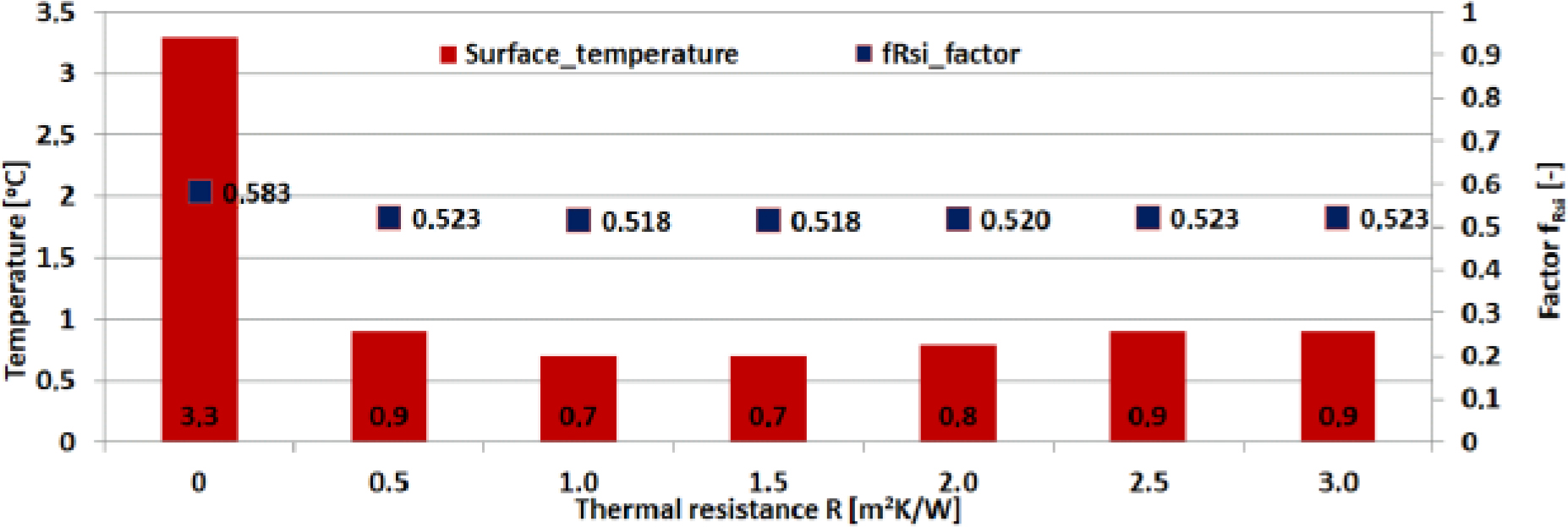
Figure 18.
Surface temperature changes and the effective value of the fRsi factor for a partially insulated outer corner
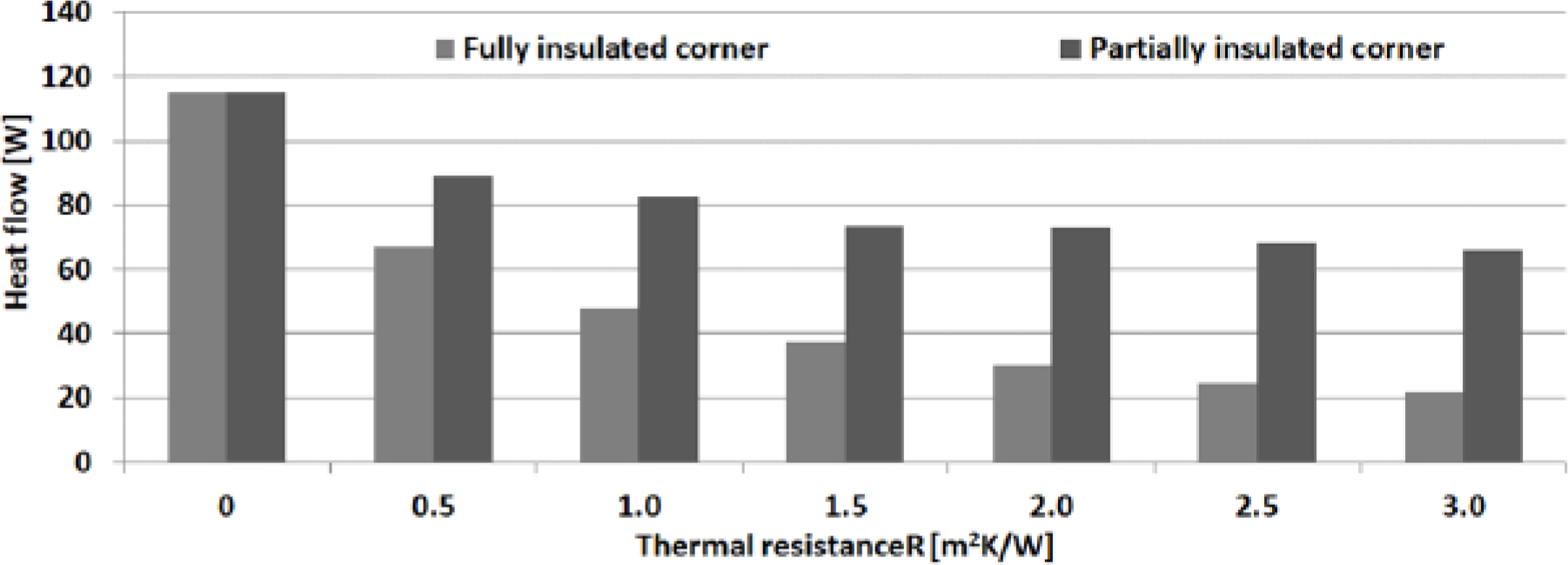
Figure 19.
Results of numerical calculations for the external corner, with partial insulation 10 cm thick: a) node model, b, c) distribution of isotherms, d) distribution of heat flux density
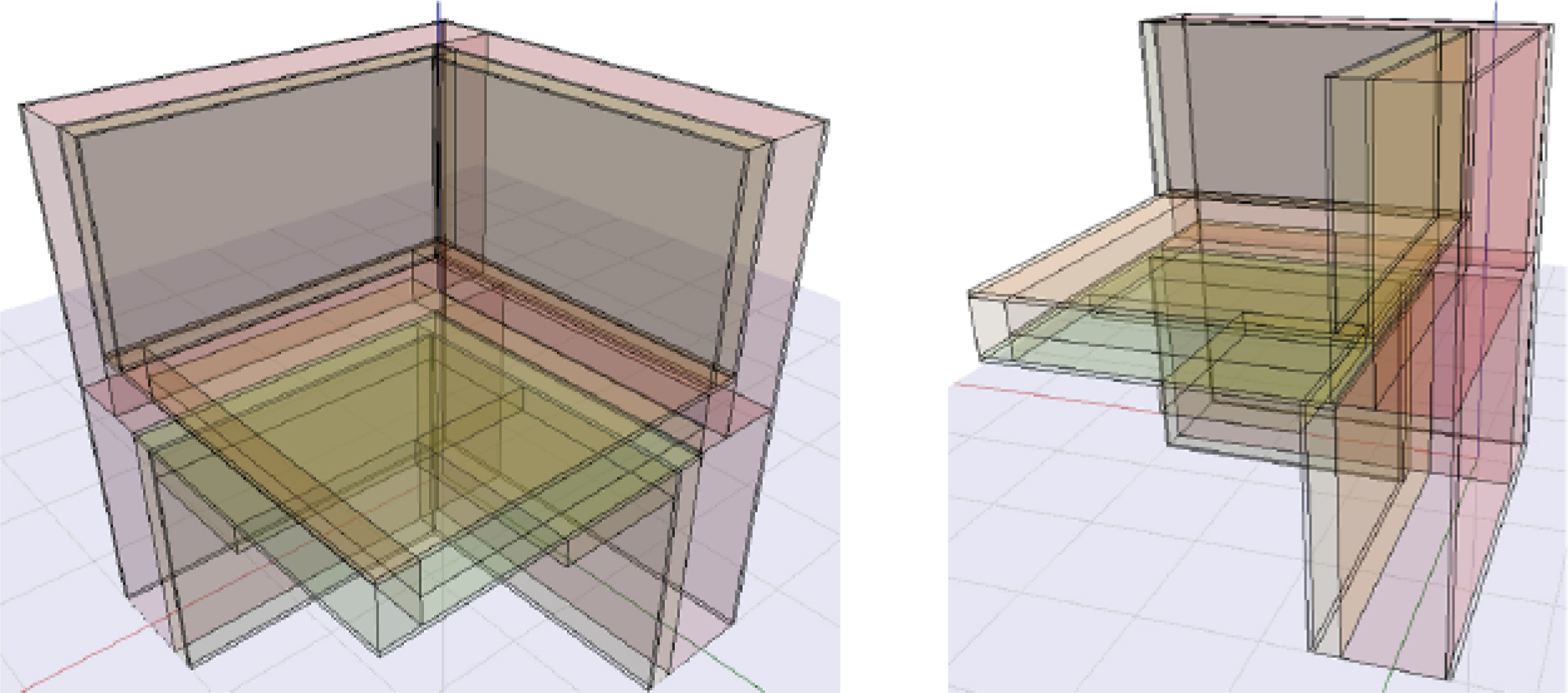
Figure 20.
Schematic of the model for variant W4
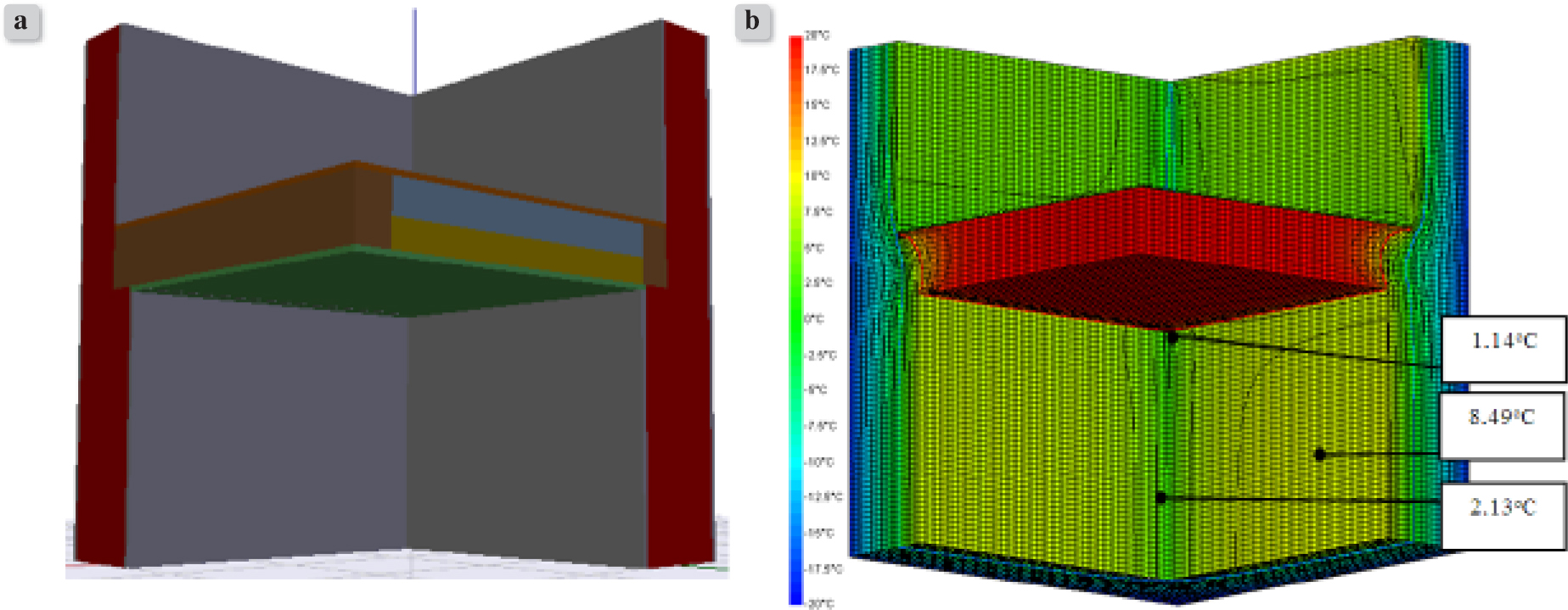
Figure 21.
Envelope model – non-insulated brick wall – W1. Distribution of isotherms in the node
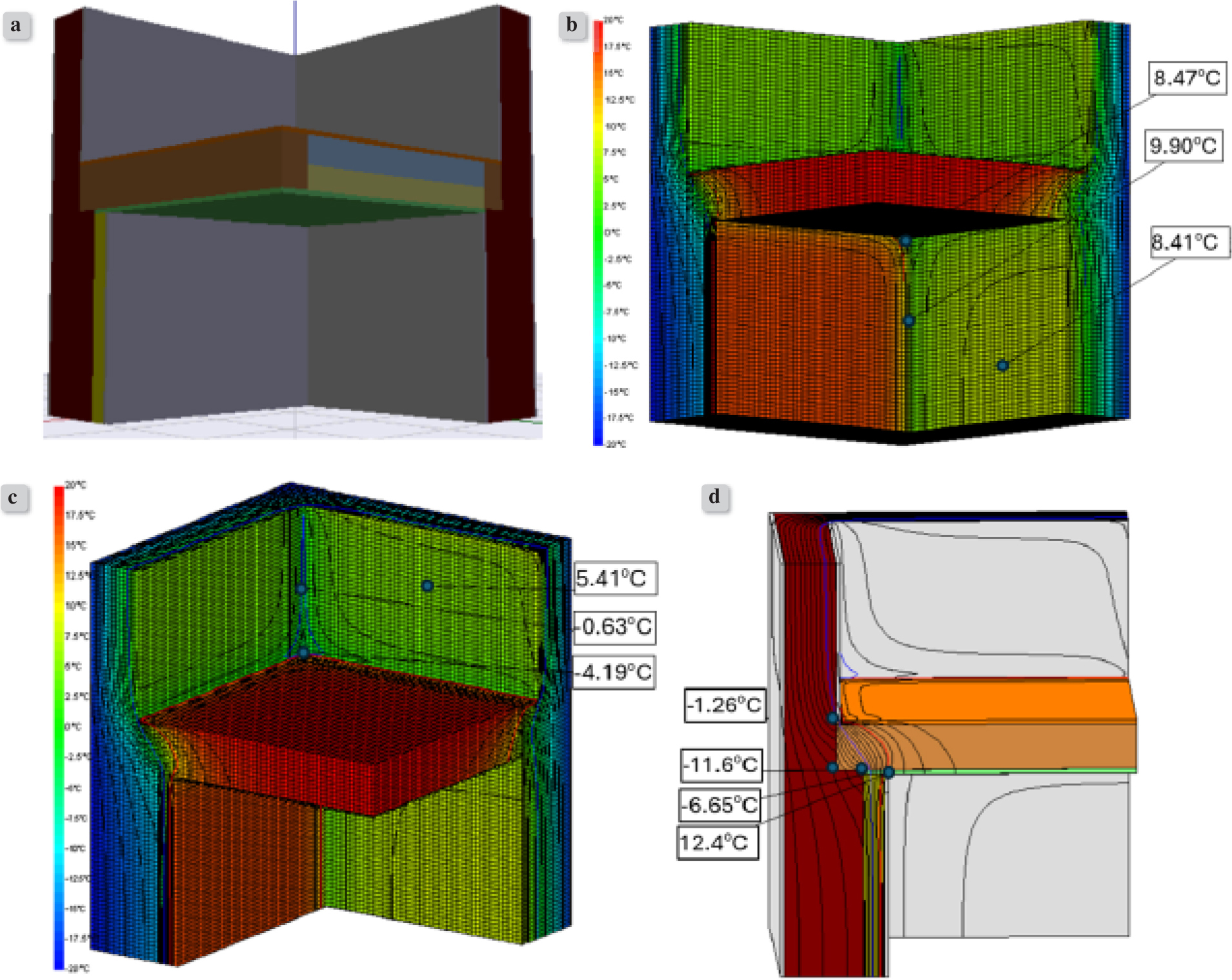
Figure 22.
Envelope model – insulated brick wall – W2. Distribution of isotherms in the node: a), b) top, c) bottom, d) cross-section
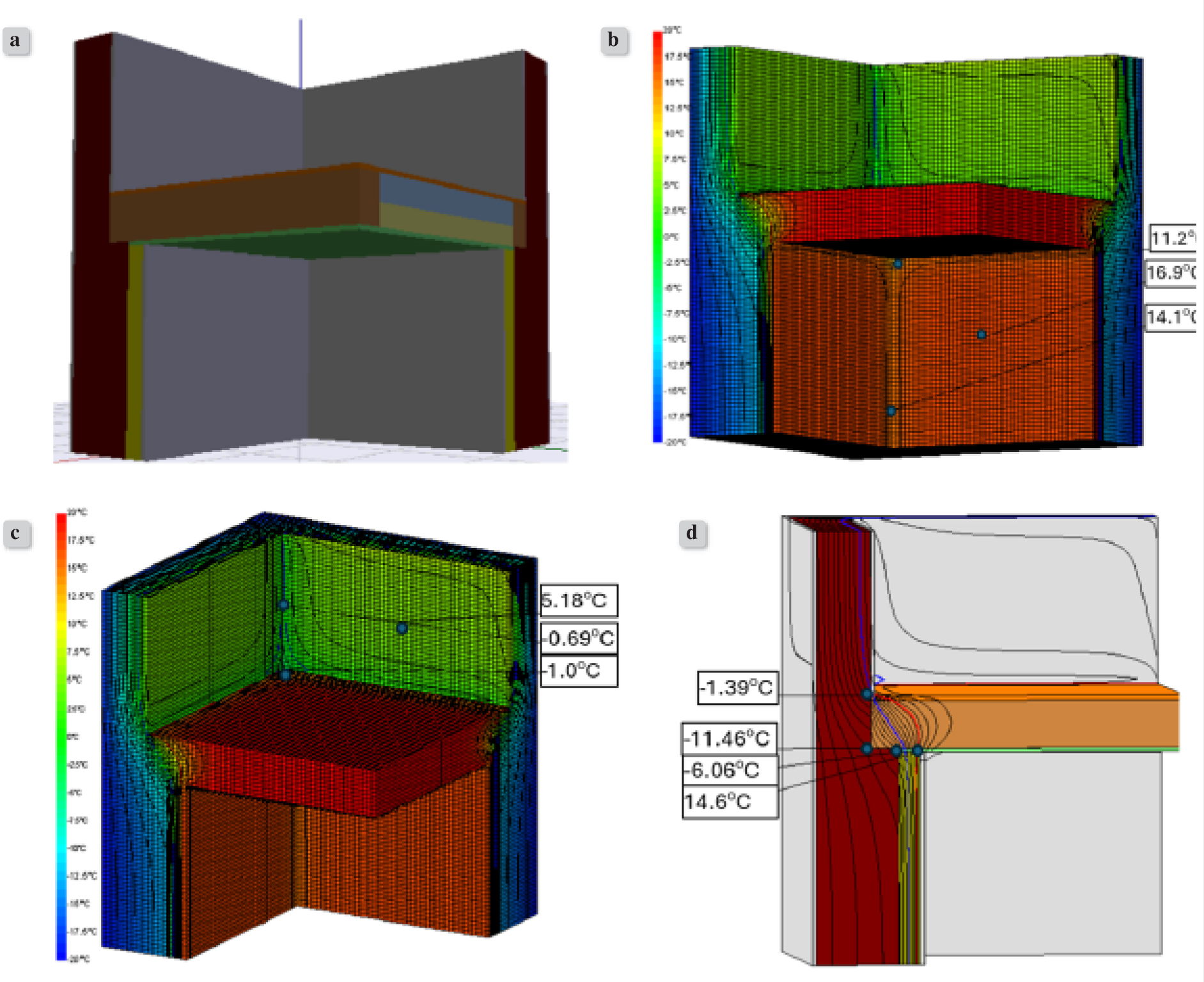
Figure 23.
Envelope model – insulated brick wall – W3. Distribution of isotherms in the node: a), b) top, c) bottom, d) cross-section
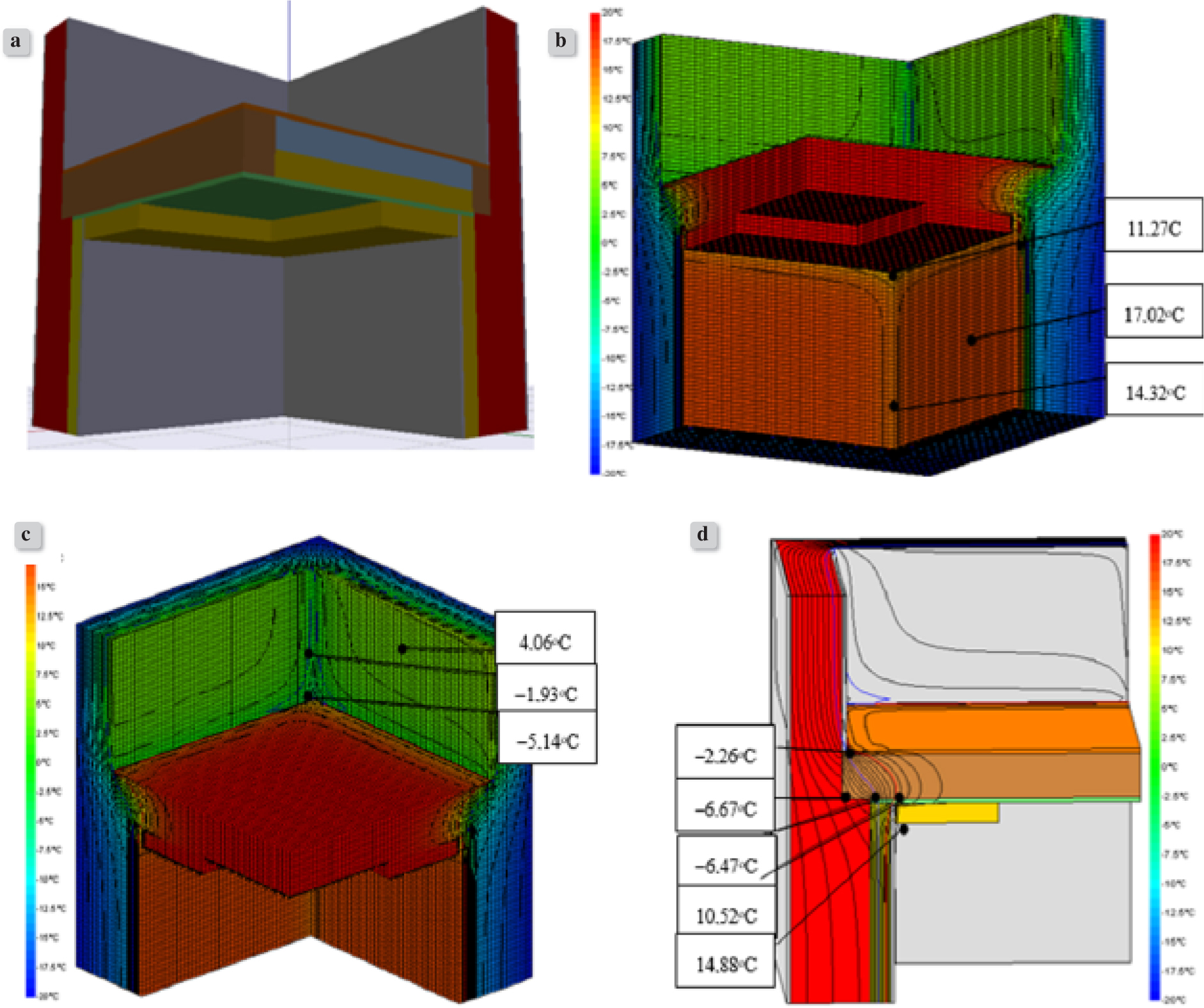
Figure 24.
Envelope model – insulated brick wall – W4. Distribution of isotherms in the node: a), b) top, c) bottom, d) cross-section
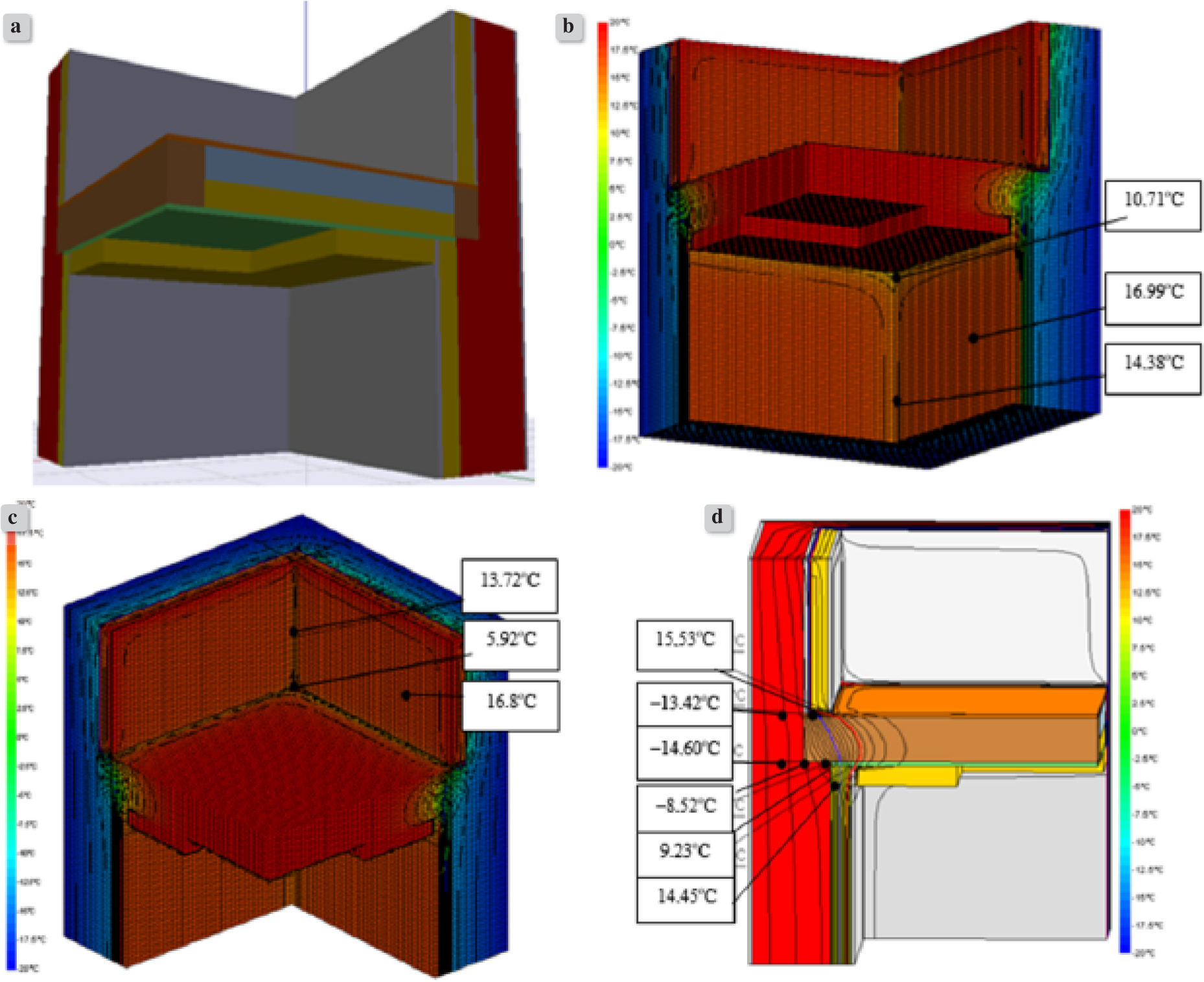
Figure 25.
Envelope model – insulated brick wall – W4_1. Distribution of isotherms in the node: a), b) top, c) bottom, d) cross-section
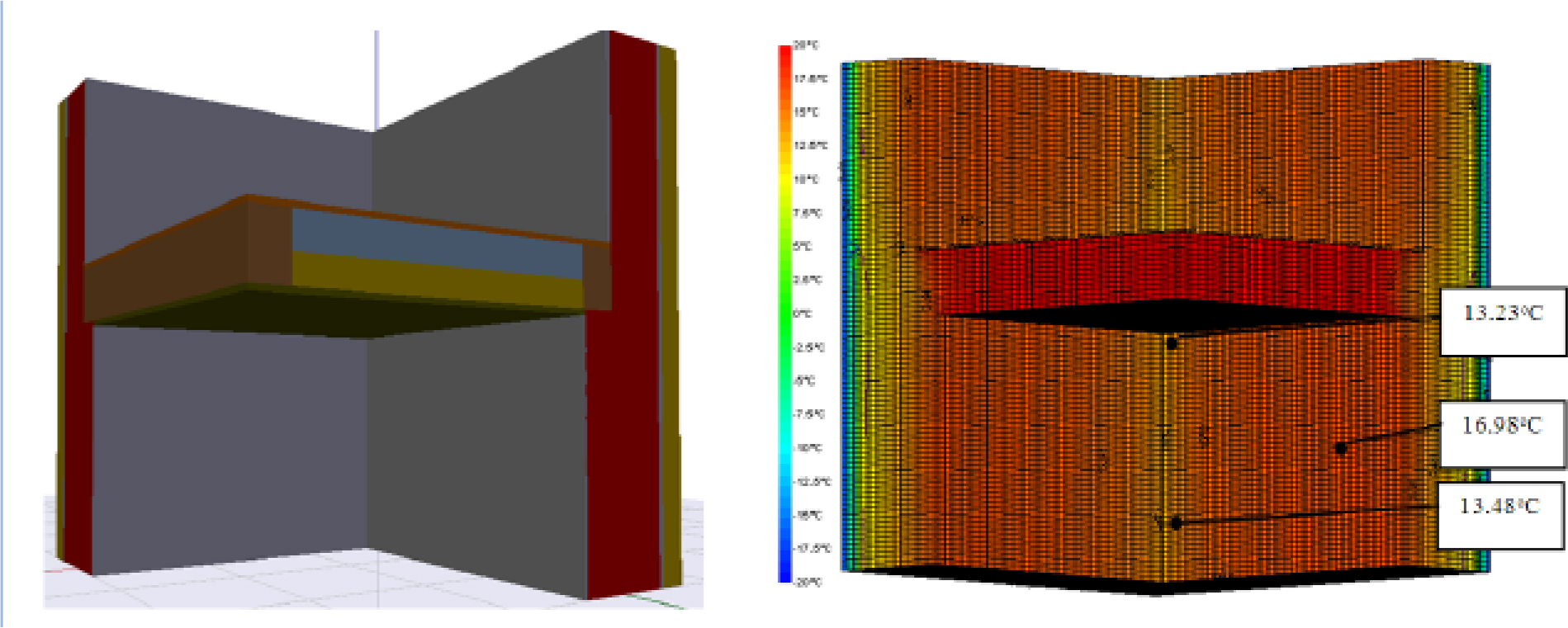
Figure 26.
Envelope model – insulated brick wall – W5. Distribution of isotherms in the node
Table 5.
Summary of surface temperature values and fRsi factor at places T1D/T2D/T3D for variants of the W1÷W5 system
| Temperature [°C] | Factor fRsi [–] | |||||||||
|---|---|---|---|---|---|---|---|---|---|---|
| W1 | W2 | W3 | W4 | W5 | W1 | W2 | W3 | W4 | W5 | |
| T1_g | 8.49 | 8.41 | 16.90 | 17.02 | 16.98 | 0.712 | 0.710 | 0.923 | 0.925 | 0.925 |
| T2_g | 2.13 | 9.90 | 14.10 | 14.32 | 13.48 | 0.553 | 0.748 | 0.853 | 0.858 | 0.837 |
| T3_g | 1.14 | 8.47 | 11.20 | 11.27 | 13.23 | 0.529 | 0.648 | 0.780 | 0.782 | 0.831 |
| T3_d | –4.21 | –4.19 | 0.00 | –5.14 | 11.69 | 0.395 | 0.442 | 0.475 | 0.372 | 0.792 |
Table 6.
Temperature values at the points W4 and W4.1 indicated on the details
| Location | Temperature at point [°C] | ||
|---|---|---|---|
| Variant W4_1 | Variant W4 | ||
| Beam support | T1 | –13.42 | –2.26 |
| T2 | –14.6 | –6.67 | |
| T3 | –8.52 | –6.47 | |
| T4 | 9.23 | 10.52 | |
| T5 | 15.53 | – | |
| T6 | 14.45 | 14.88 | |
| Node 3D_ (bottom) | T1 | 16.80 | 4.06 |
| T2 | 13.72 | –1.93 | |
| T3 | 5.92 | –5.14 | |
| Node 3D_ (top) | T1 | 16.99 | 17.02 |
| T2 | 14.38 | 14.32 | |
| T3 | 10.71 | 11.27 | |
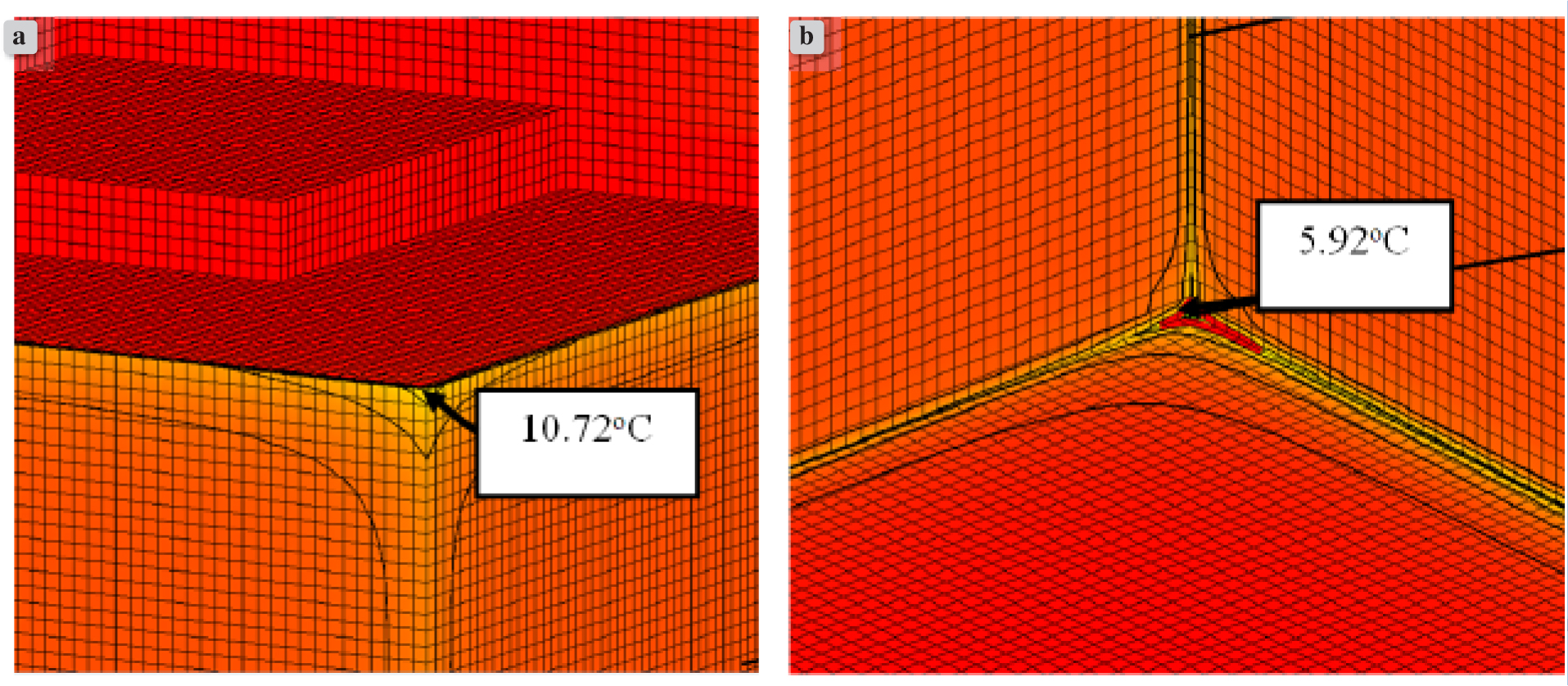
Figure 27.
Local changes in the temperature field for the detail W4_1, in the 3D node: a) top, b) bottom
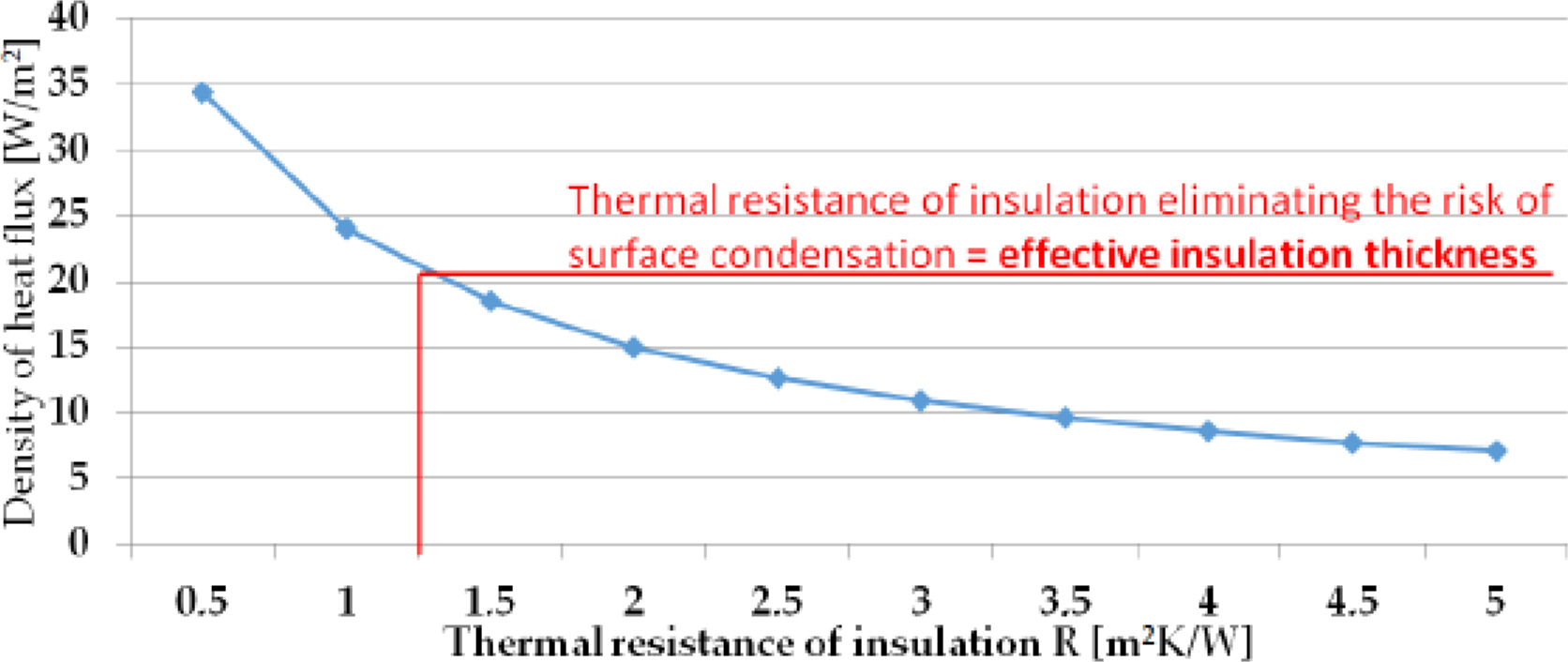
Figure 28.
Changes in heat flux density for a brick wall (38 cm) insulated with the material with thermal resistance of 0.5÷5.0 [m2 K/W]
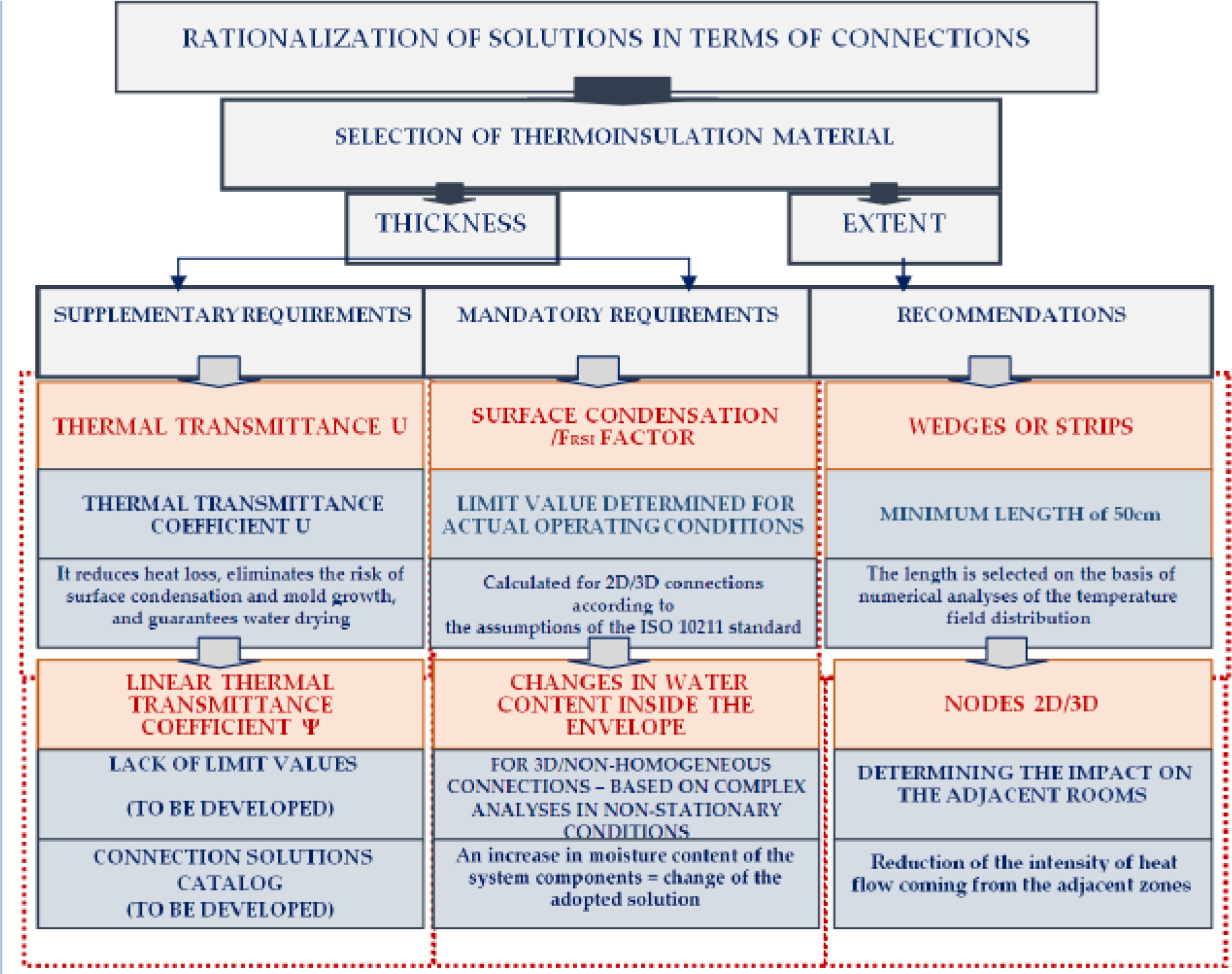
Figure 29.
Procedure for selecting the type and thickness of insulation at the connections in wall systems insulated from the inside