
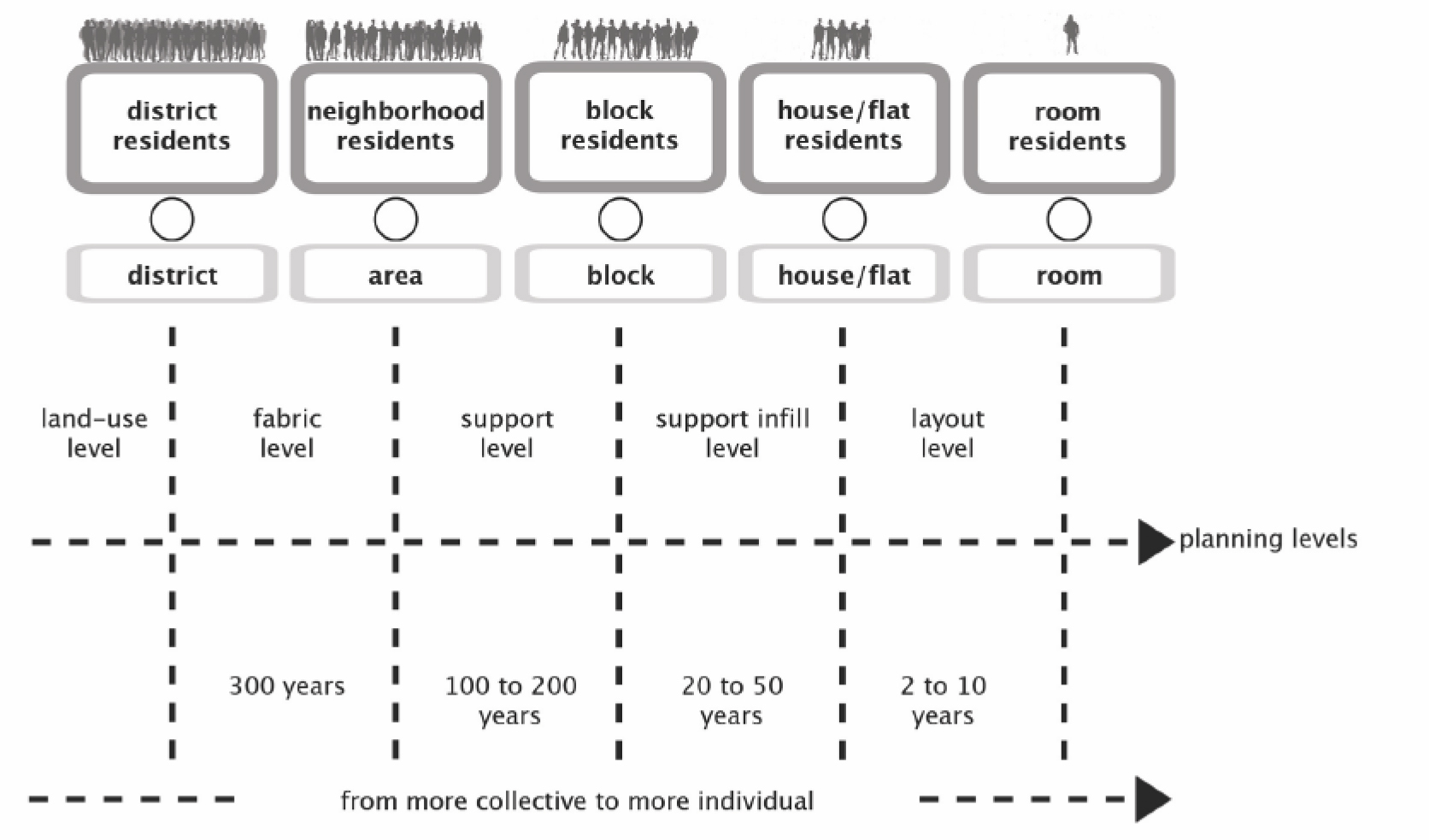
Figure 1.
Principle of Levels (Source: Authors. Adopted from Open Building Research Group, TU Delft, [50])
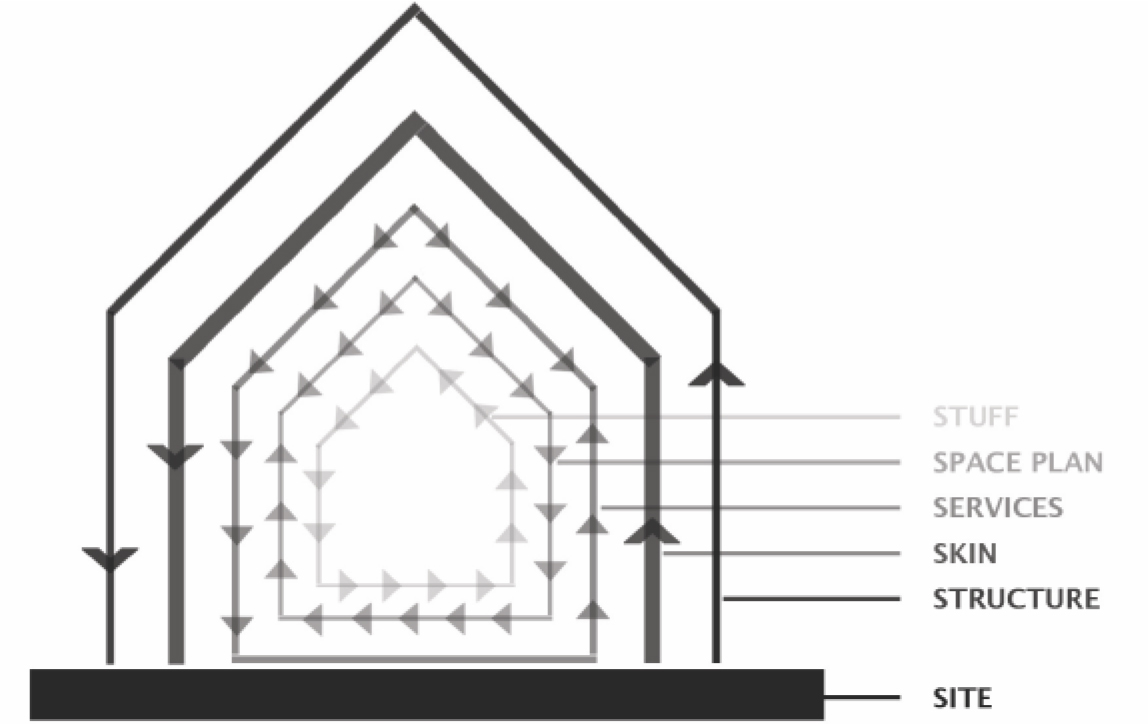
Figure 2.
The shearing layers approach (Source: Authors. Adopted from [46])
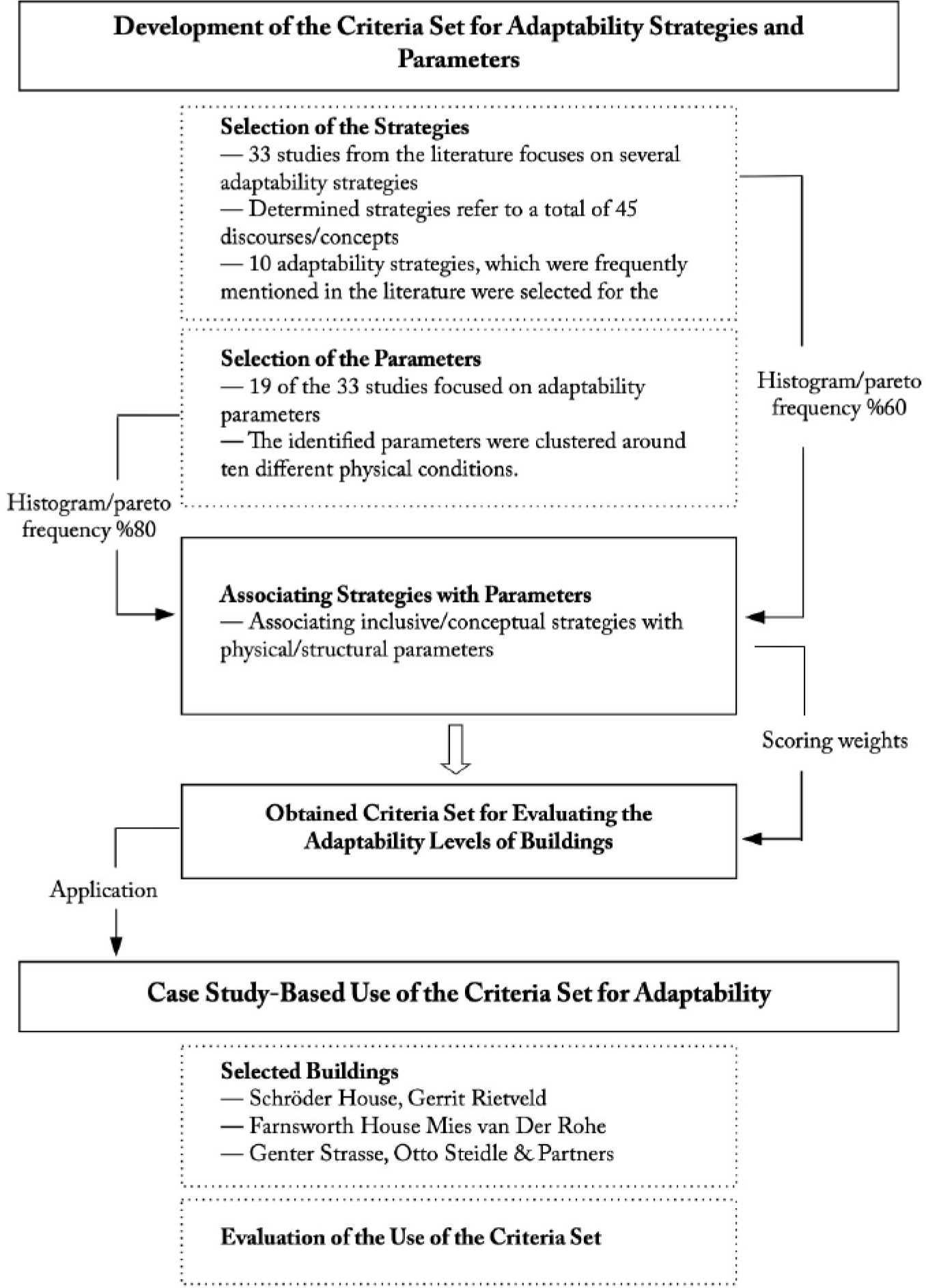
Figure 3.
The methodological framework of the study (Source: Authors)
Table 2.
Distribution of adaptability strategies across 33 studies based on [14]
| Sources | ||||||||||||||||||||||||||||||||||
|---|---|---|---|---|---|---|---|---|---|---|---|---|---|---|---|---|---|---|---|---|---|---|---|---|---|---|---|---|---|---|---|---|---|---|
| Strategies | [67] | [68] | [39] | [12] | [69] | [65] | [70] | [71] | [72] | [73] | [58] | [26] | [74] | [57] | [19] | [15] | [75] | [17] | [6] | [76] | [77] | [5] | [78] | [79] | [80] | [66] | [81] | [2] | [82] | [21] | [83] | [84] | [85] | Total |
| Generality | x | x | 2 | |||||||||||||||||||||||||||||||
| Flexibility/Versatility | x | x | x | x | x | x | x | x | x | x | x | x | x | x | x | x | x | x | x | x | x | 21 | ||||||||||||
| Expendability/Scalability | x | x | x | x | x | x | x | x | x | x | x | x | x | x | x | x | x | x | x | x | 19 | |||||||||||||
| Convertibility | x | x | x | x | x | x | x | x | x | 9 | ||||||||||||||||||||||||
| Dismantlability/Separability | x | x | x | x | x | x | x | x | x | x | x | x | x | x | 14 | |||||||||||||||||||
| Prefabrication/Standardization | x | x | x | x | x | 5 | ||||||||||||||||||||||||||||
| Overcapacity/Redundancy | x | x | x | x | x | x | x | x | x | x | x | 11 | ||||||||||||||||||||||
| Movability/Mobility | x | x | x | x | x | x | x | x | x | x | x | x | x | 13 | ||||||||||||||||||||
| Rearrangeable | x | x | x | x | 4 | |||||||||||||||||||||||||||||
| Reusable/Recyclable | x | x | x | x | x | x | x | x | x | x | 9 | |||||||||||||||||||||||
| Refitability | x | x | x | x | x | x | 6 | |||||||||||||||||||||||||||
| Multifunctionality | x | x | x | x | x | 5 | ||||||||||||||||||||||||||||
| Integratable | x | x | 2 | |||||||||||||||||||||||||||||||
| Universality | x | x | x | x | 4 | |||||||||||||||||||||||||||||
| Modularity | x | x | x | x | x | x | x | x | 8 | |||||||||||||||||||||||||
| Ejectable | x | x | x | 3 | ||||||||||||||||||||||||||||||
| Exchangeable | x | x | x | x | x | 5 | ||||||||||||||||||||||||||||
| Customization | x | x | 2 | |||||||||||||||||||||||||||||||
| Upgrading | x | x | x | x | 4 | |||||||||||||||||||||||||||||
| Variability/Variety | x | x | x | 3 | ||||||||||||||||||||||||||||||
| Zonable | x | x | 2 | |||||||||||||||||||||||||||||||
| Availability | x | x | x | 3 | ||||||||||||||||||||||||||||||
| Adjustability | x | x | x | x | 4 | |||||||||||||||||||||||||||||
| Durability/Robustness | x | x | x | x | 3 | |||||||||||||||||||||||||||||
| Accessibility | x | x | x | x | 4 | |||||||||||||||||||||||||||||
| Simplicity | x | x | 2 | |||||||||||||||||||||||||||||||
| Independence | x | x | x | x | x | x | x | x | 8 | |||||||||||||||||||||||||
| Collective-Individual | x | x | 2 | |||||||||||||||||||||||||||||||
| Central-Decentral | x | x | 2 | |||||||||||||||||||||||||||||||
| Shapeable | x | x | 2 | |||||||||||||||||||||||||||||||
| Automation | x | x | 2 | |||||||||||||||||||||||||||||||
| Alterable | x | x | 2 | |||||||||||||||||||||||||||||||
| Predictability | x | x | 2 | |||||||||||||||||||||||||||||||
| Affordability | x | 1 | ||||||||||||||||||||||||||||||||
| Segmentability | x | 1 | ||||||||||||||||||||||||||||||||
| Mendability | x | 1 | ||||||||||||||||||||||||||||||||
| Replaceability | x | 1 | ||||||||||||||||||||||||||||||||
| Inspectability | x | 1 | ||||||||||||||||||||||||||||||||
| Suitability | x | 1 | ||||||||||||||||||||||||||||||||
| Reliability | x | 1 | ||||||||||||||||||||||||||||||||
| Ductless | x | 1 | ||||||||||||||||||||||||||||||||
| Intelligent | x | 1 | ||||||||||||||||||||||||||||||||
| Responsiveness | x | 1 | ||||||||||||||||||||||||||||||||
| Commonality | x | 1 | ||||||||||||||||||||||||||||||||
| Malleability | x | 1 | ||||||||||||||||||||||||||||||||
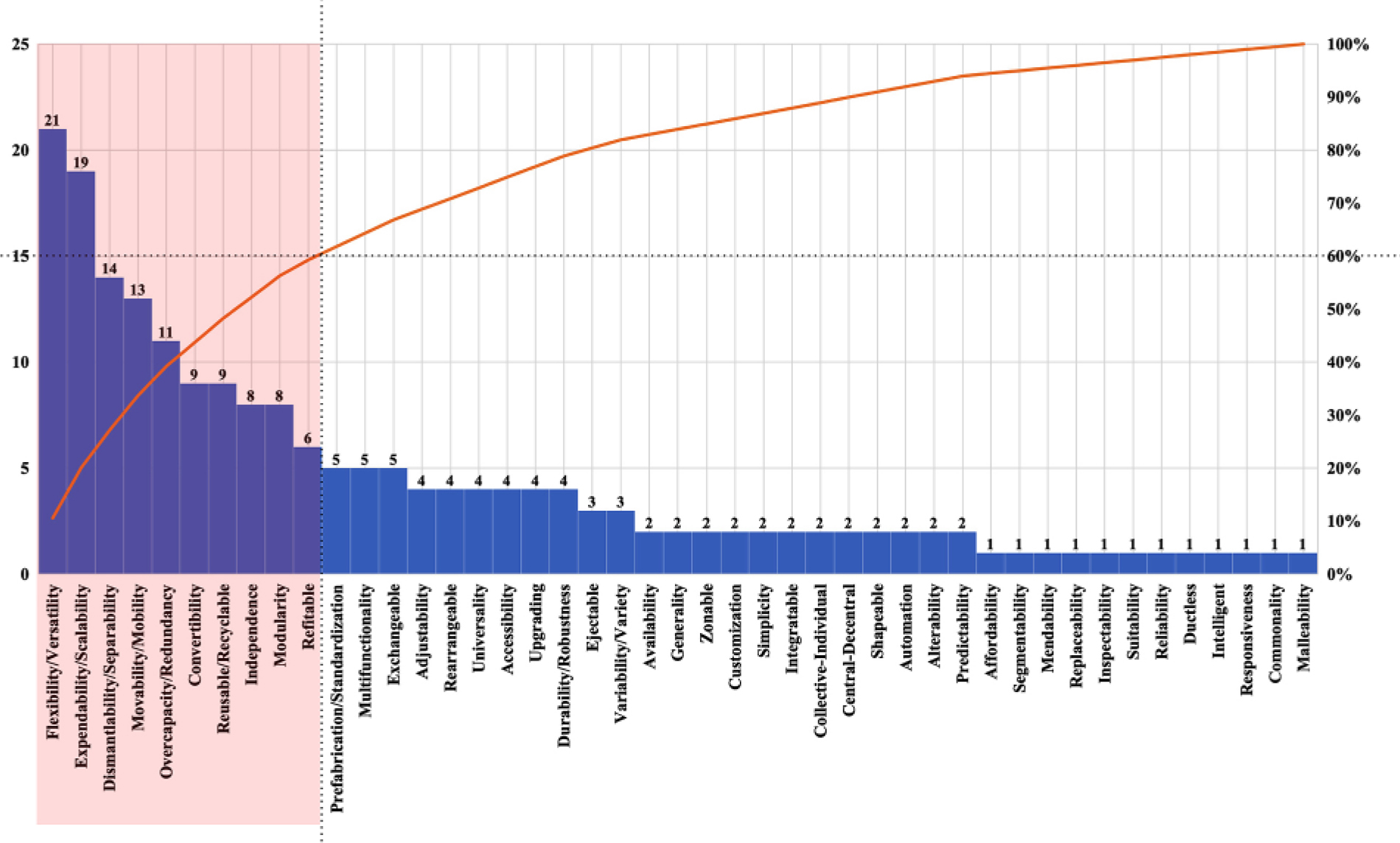
Figure 4.
Histogram/Pareto diagram for the frequency distribution of the identified adaptability strategies (Source: Authors)
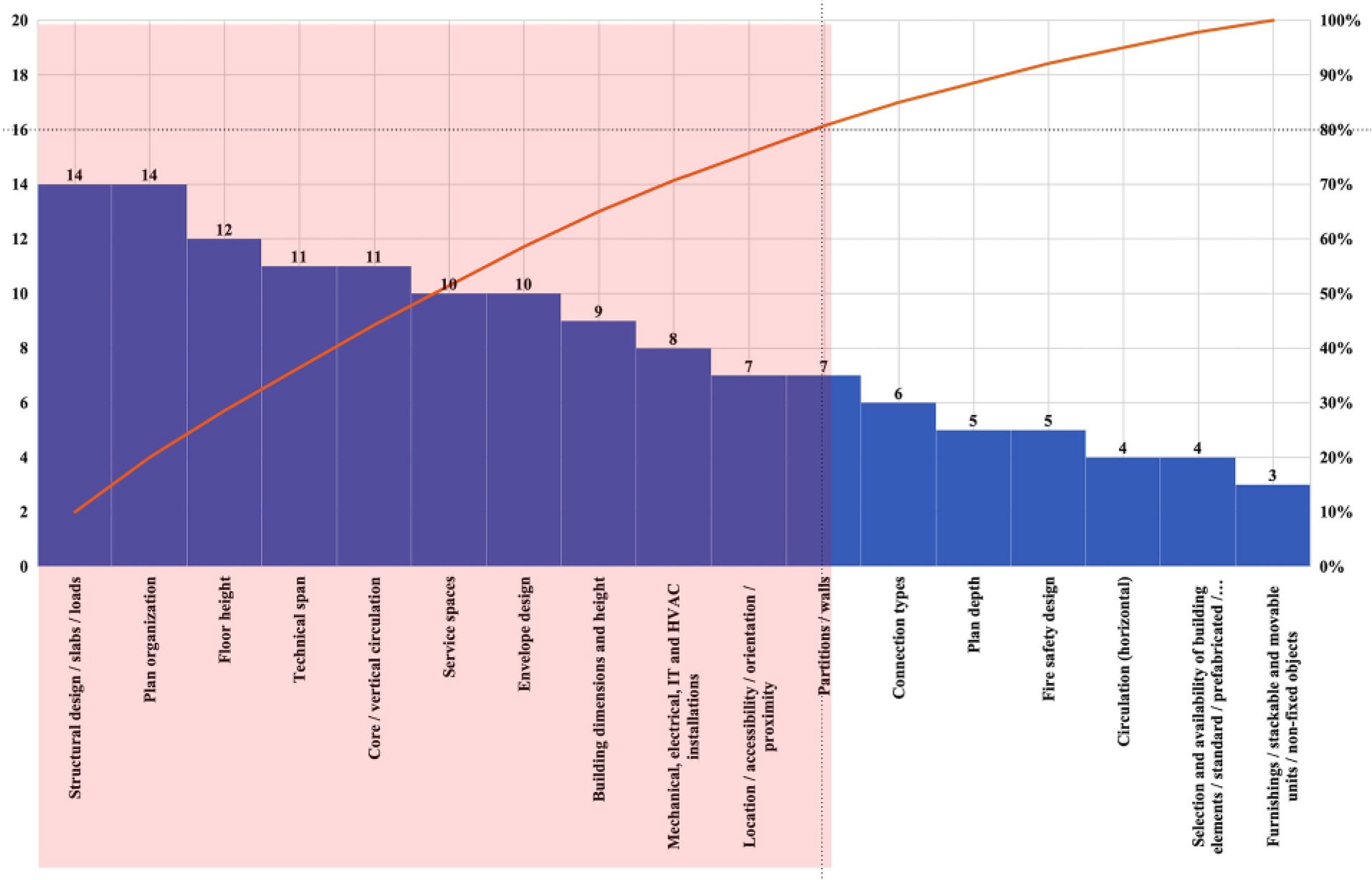
Figure 5.
Histogram/Pareto diagram for the frequency distribution of the identified adaptability parameters (Source: Authors)
Table 3.
Distribution of adaptability parameters across 19 studies, adopted from [14]
| Sources | |||||||||||||||||||||
|---|---|---|---|---|---|---|---|---|---|---|---|---|---|---|---|---|---|---|---|---|---|
| Layers | Parameters | [86] | [67] | [87] | [15] | [7] | [2] | [76] | [81] | [39] | [88] | [59] | [65] | [72] | [89] | [13] | [79] | [57] | [78] | [90] | Total |
| Location | Location/accessibility/orientation/proximity | x | x | x | x | x | x | x | 7 | ||||||||||||
| Structure | Building dimensions and height | x | x | x | x | x | x | x | x | x | 9 | ||||||||||
| Structural design/slabs/loads | x | x | x | x | x | x | x | x | x | x | x | x | x | x | 14 | ||||||
| Floor height | x | x | x | x | x | x | x | x | x | x | x | x | 12 | ||||||||
| Technical span | x | x | x | x | x | x | x | x | x | x | x | 11 | |||||||||
| Core/vertical circulation | x | x | x | x | x | x | x | x | x | x | x | 11 | |||||||||
| Layout | Plan organization | x | x | x | x | x | x | x | x | x | x | x | x | x | x | 14 | |||||
| Circulation (horizontal) | x | x | x | x | 4 | ||||||||||||||||
| Plan depth | x | x | x | x | x | 5 | |||||||||||||||
| Partitions/walls | x | x | x | x | x | x | x | 7 | |||||||||||||
| Services | Service spaces | x | x | x | x | x | x | x | x | x | x | 10 | |||||||||
| Mechanical, electrical, IT, and HVAC installations | x | x | x | x | x | x | x | x | 8 | ||||||||||||
| Fire safety design | x | x | x | x | x | 5 | |||||||||||||||
| Envelope | Envelope design | x | x | x | x | x | x | x | x | x | x | 10 | |||||||||
| Elements | Connection types | x | x | x | x | x | x | 6 | |||||||||||||
| Selection and availability of building elements/standard/prefabricated/product family/Plug-and-play construction elements | x | x | x | x | 4 | ||||||||||||||||
| Reinforcements | Furnishings/stackable and movable units/non-fixed objects | x | x | x | 3 | ||||||||||||||||
Table 4.
Weighted scores of the associated adaptability strategies and parameters (kstrategy x kparameter)
| Strategies | |||||||||||||
|---|---|---|---|---|---|---|---|---|---|---|---|---|---|
| Layers | Parameters | Physical Attributes | Flexibility/Versatility 1.06P] | Expandability/Scalability [0.95P] | Dismantlability/Separability [0.70P] | Movability/Mobility [0.65P] | Overcapacity/Redundancy [0.55P] | Convertibility [0.45P] | Reusable/Recyclable [0.45P] | Independence [0.40P] | Modularity [0.40P] | Refitability [0.30P] | Sub-parameter Score |
| Location | Location/accessibility/orientation/proximity [0.50P] | Low-density | 0.48 | 0.23 | 0.71 | ||||||||
| Structure | |||||||||||||
| Building dimensions and height [0.64P] | Low-rise | 0.29 | 0.29 | ||||||||||
| High-rise | 0.35 | 0.29 | 0.64 | ||||||||||
| Structural design/slabs/loads [1.00P] | Steel | 1.06 | 0.95 | 0.70 | 0.65 | 0.55 | 0.45 | 0.40 | 0.40 | 0.30 | 5.46 | ||
| Reinforced Concrete | 1.06 | 0.40 | 1.46 | ||||||||||
| Prefabricated Concrete | 1.06 | 0.70 | 0.65 | 0.45 | 0.40 | 0.40 | 0.30 | 3.96 | |||||
| Increased load-bearing capacity | 0.95 | 0.55 | 0.45 | 1.95 | |||||||||
| Dry connections | 0.95 | 0.70 | 0.45 | 0.40 | 0.30 | 2.80 | |||||||
| Floor height [0.86P] | fh < 3 m | 0.91 | 0.91 | ||||||||||
| 3 m fh < 5m | 0.91 | 0.39 | 1.30 | ||||||||||
| fh 5 m | 0.91 | 1.01 | 0.47 | 0.39 | 2.78 | ||||||||
| Technical span [0.79P] | ts < 6 m | 0.00 | |||||||||||
| ts 6 m | 0.84 | 0.75 | 0.43 | 0.36 | 2.38 | ||||||||
| Core/vertical circulation [0.79P] | Centralized | 0.84 | 0.75 | 0.36 | 1.95 | ||||||||
| Steel structure stairs | 0.84 | 0.55 | 0.51 | 0.36 | 0.32 | 0.32 | 0.24 | 3.14 | |||||
| Layout | Plan organization [1.00P] | Open plan | 1.06 | 0.45 | 0.40 | 1.91 | |||||||
| Modular organization | 1.06 | 0.95 | 0.45 | 0.40 | 2.86 | ||||||||
| Standard size | 1.06 | 0.95 | 0.45 | 0.40 | 2.86 | ||||||||
| Multifunctional spaces | 1.06 | 0.45 | 0.40 | 1.91 | |||||||||
| Spatial Overcapacity | 1.06 | 0.45 | 2.06 | ||||||||||
| Partitions/walls [0.50P] | Movable/Rearrangeable | 0.53 | 0.48 | 0.23 | 0.20 | 0.20 | 1.97 | ||||||
| Fixed | 0.53 | 0.48 | 0.23 | 0.20 | 0.15 | 1.59 | |||||||
| Services | Service spaces [0.71P] | Raised floors | 0.75 | 0.32 | 0.28 | 0.28 | 0.21 | 2.80 | |||||
| Suspended ceilings | 0.75 | 0.32 | 0.28 | 0.28 | 0.21 | 2.80 | |||||||
| Shafts | 0.75 | 0.67 | 0.32 | 0.28 | 0.21 | 2.62 | |||||||
| Mechanical. electrical. IT. and HVAC installations [0.57P] | Natural | 0.60 | 0.26 | 0.86 | |||||||||
| Mechanical | 0.60 | 0.26 | 0.86 | ||||||||||
| Hybrid | 0.60 | 0.54 | 0.26 | 1.40 | |||||||||
| Envelope | Envelope design [0.71P] | Double skin facades | 0.75 | 0.67 | 0.32 | 0.28 | 0.28 | 2.30 | |||||
| Modular/panel systems | 0.75 | 0.67 | 0.32 | 0.32 | 0.28 | 0.28 | 0.21 | 3.33 | |||||
| Independent | 0.75 | 0.32 | 0.32 | 0.28 | 0.21 | 2.38 | |||||||
| Universal | 0.75 | 0.32 | 0.32 | ||||||||||
| Irregular | 0.75 | 0.32 | 1.07 | ||||||||||
| TOTAL | 21.84 | 11.26 | 4.65 | 3.06 | 3.29 | 8.81 | 2.35 | 4.8 | 3.24 | 2.34 | 65.63 | ||
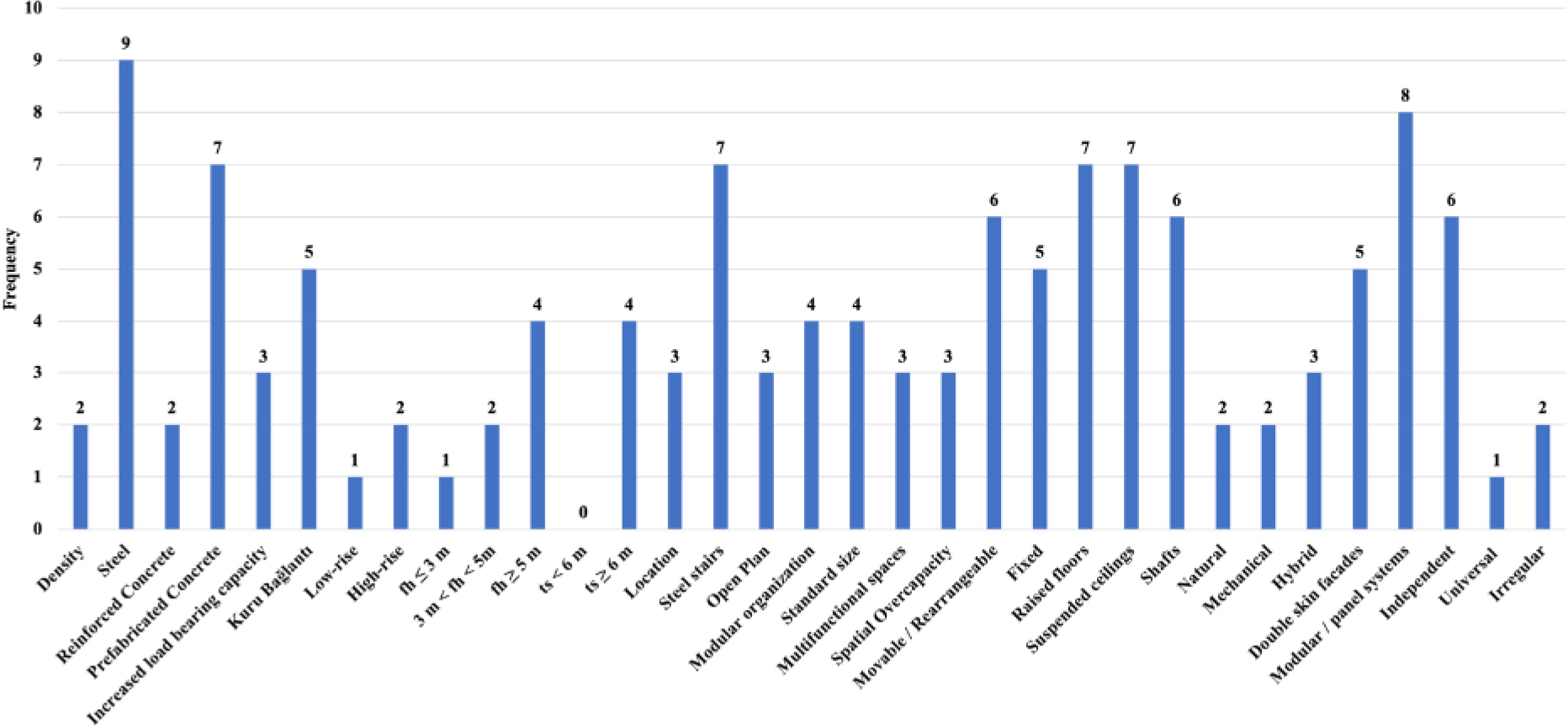
Figure 6.
Frequency of physical attributes of buildings within the scope of adaptability strategies (Source: Authors)
Table 5.
Scoring of the case studies based on the weighted adaptability strategies and parameters
| Layers | Parameters | Physical Attributes | The Scröder House Gerrit Rietveld 1925 | The Farnsworth House Mies van der Rohe 1951 | Genter Strasse Otto Steidle & Partner 1972 | Quinta Monroy Alejandro Aravena 2003 | Het SchetsBlok ANA Architecten 2018 |
|---|---|---|---|---|---|---|---|
| Location | Location/accessibility/orientation/proximity | Low-density | 0.71 | 0.71 | 0.71 | 0.71 | 0.71 |
| Structure | Building dimensions and height | Low-rise | 0.29 | 0.29 | 0.29 | 0.29 | |
| High-rise | 0.64 | ||||||
| Structural design/slabs/loads | Steel | 5.46 | 5.46 | ||||
| Reinforced Concrete | 1.46 | 1.46 | 1.46 | 1.46 | |||
| Prefabricated Concrete | 3.96 | ||||||
| Increased load-bearing capacity | 1.95 | 1.95 | 1.95 | ||||
| Dry connections | 2.80 | ||||||
| Floor height | fh < 3 m | 0.91 | |||||
| 3 m ≤ fh < 5m | 1.30 | 1.30 | 1.30 | 1.30 | |||
| fh ≥ 5 m | |||||||
| Technical span | ts < 6 m | 0.00 | 0.00 | ||||
| ts ≥ 6 m | 2.38 | 2.38 | 2.38 | ||||
| Core/vertical circulation | Centralized | 1.95 | 1.95 | 1.95 | 1.95 | ||
| Steel structure stairs | 3.14 | 3.14 | |||||
| Layout | Plan organization | Open plan | 1.91 | 1.91 | 1.91 | 1.91 | |
| Modular organization | 2.86 | 2.86 | 2.86 | 2.86 | |||
| Standard size | 2.86 | 2.86 | |||||
| Multifunctional spaces | 1.91 | 1.91 | 1.91 | ||||
| Spatial Overcapacity | 2.06 | 2.06 | 2.06 | ||||
| Partitions/walls | Movable/Rearrangeable | 1.97 | 1.97 | 1.97 | |||
| Fixed | 1.59 | 1.59 | 1.59 | 1.59 | 1.59 | ||
| Services | Service spaces | Raised floors | |||||
| Suspended ceilings | 2.80 | 2.80 | |||||
| Shafts | 2.62 | 2.62 | 2.62 | ||||
| Mechanical. electrical. IT. and HVAC installations | Natural | 0.86 | 0.86 | 0.86 | 0.86 | 0.86 | |
| Mechanical | |||||||
| Hybrid | |||||||
| Envelope | Envelope design | Double skin facades | 2.30 | ||||
| Modular/panel systems | 3.33 | 3.33 | 3.33 | ||||
| Independent | 2.38 | 2.38 | 2.38 | 2.38 | 2.38 | ||
| Universal | 0.32 | 0.32 | 0.32 | 0.32 | 0.32 | ||
| Irregular | 1.07 | 1.07 | 1.07 | ||||
| TOTAL | 33.24 | 26.23 | 33.67 | 30.20 | 31.71 |
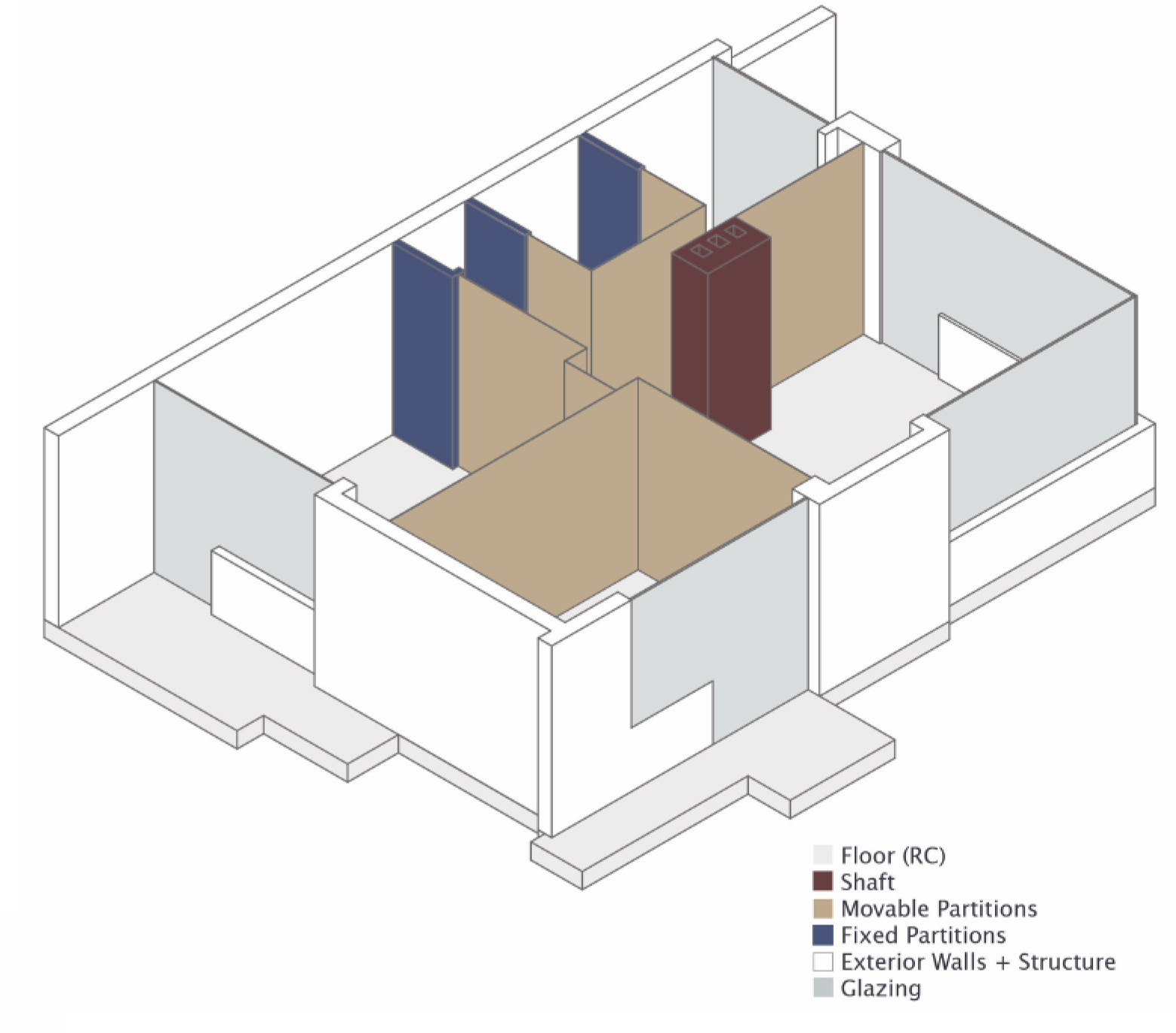
Figure 7.
The layers that augment the adaptability characteristics of the Schröder House (Source: Authors)
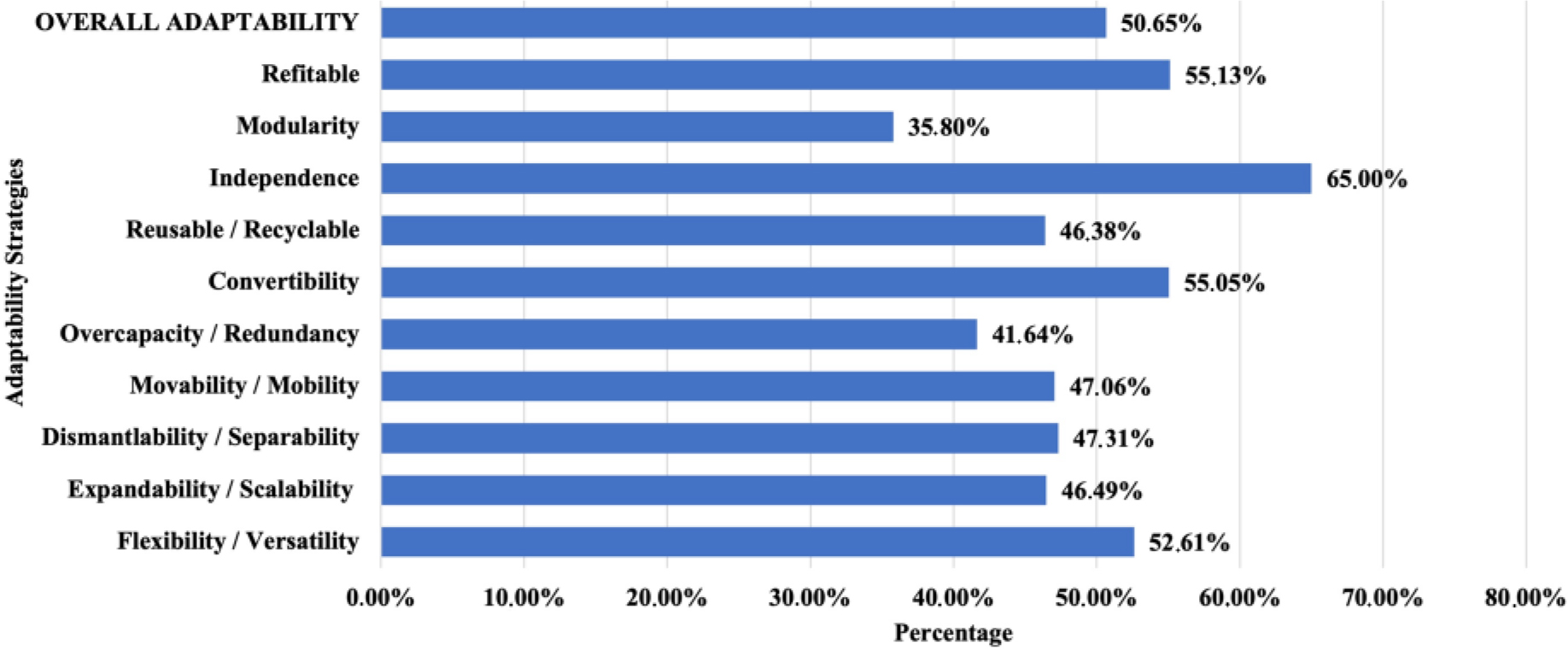
Figure 8.
The overall adaptability score and strategy scores of the Schröder House (Source: Authors)
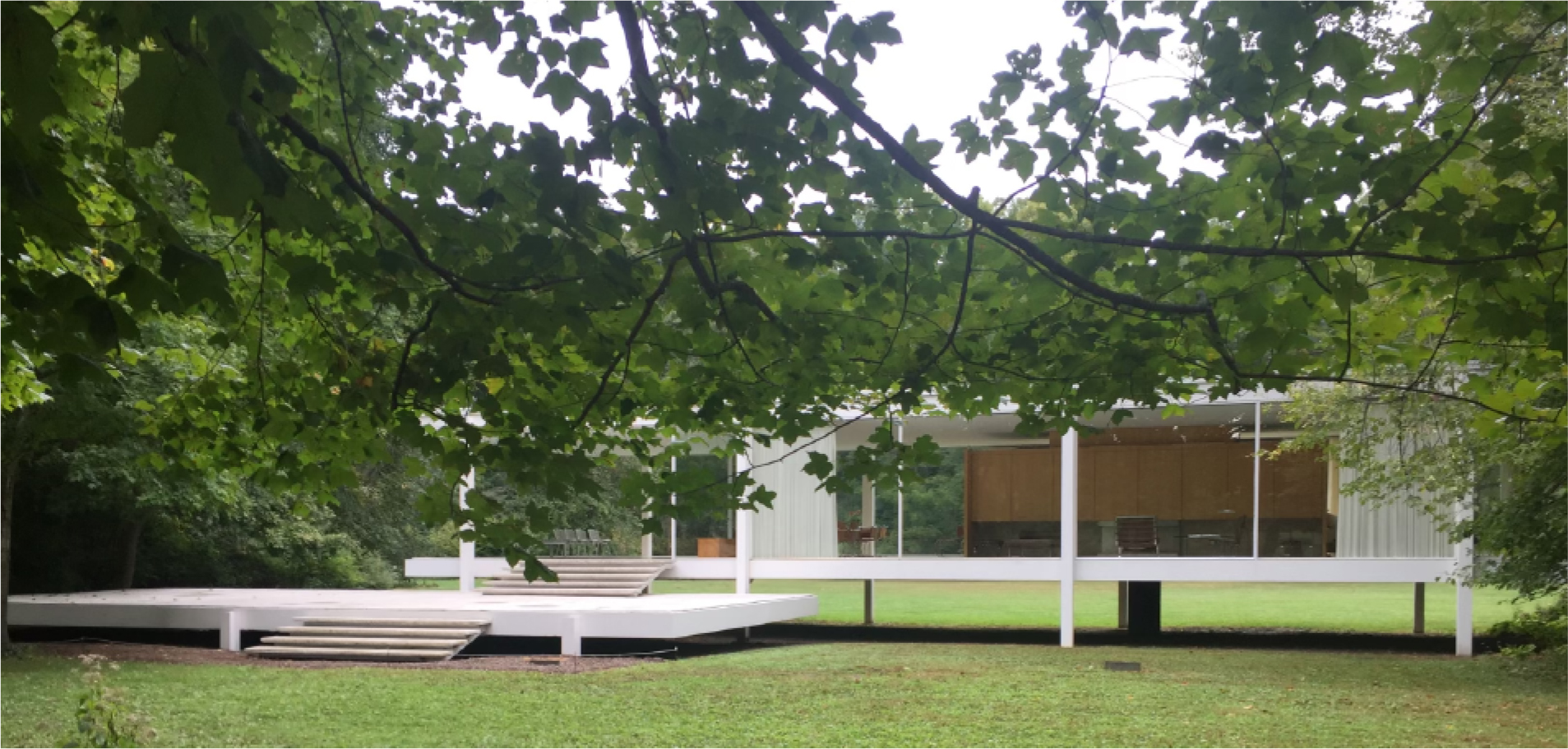
Figure 9.
The Farnsworth House (Source: Author, Basak Gucyeter)
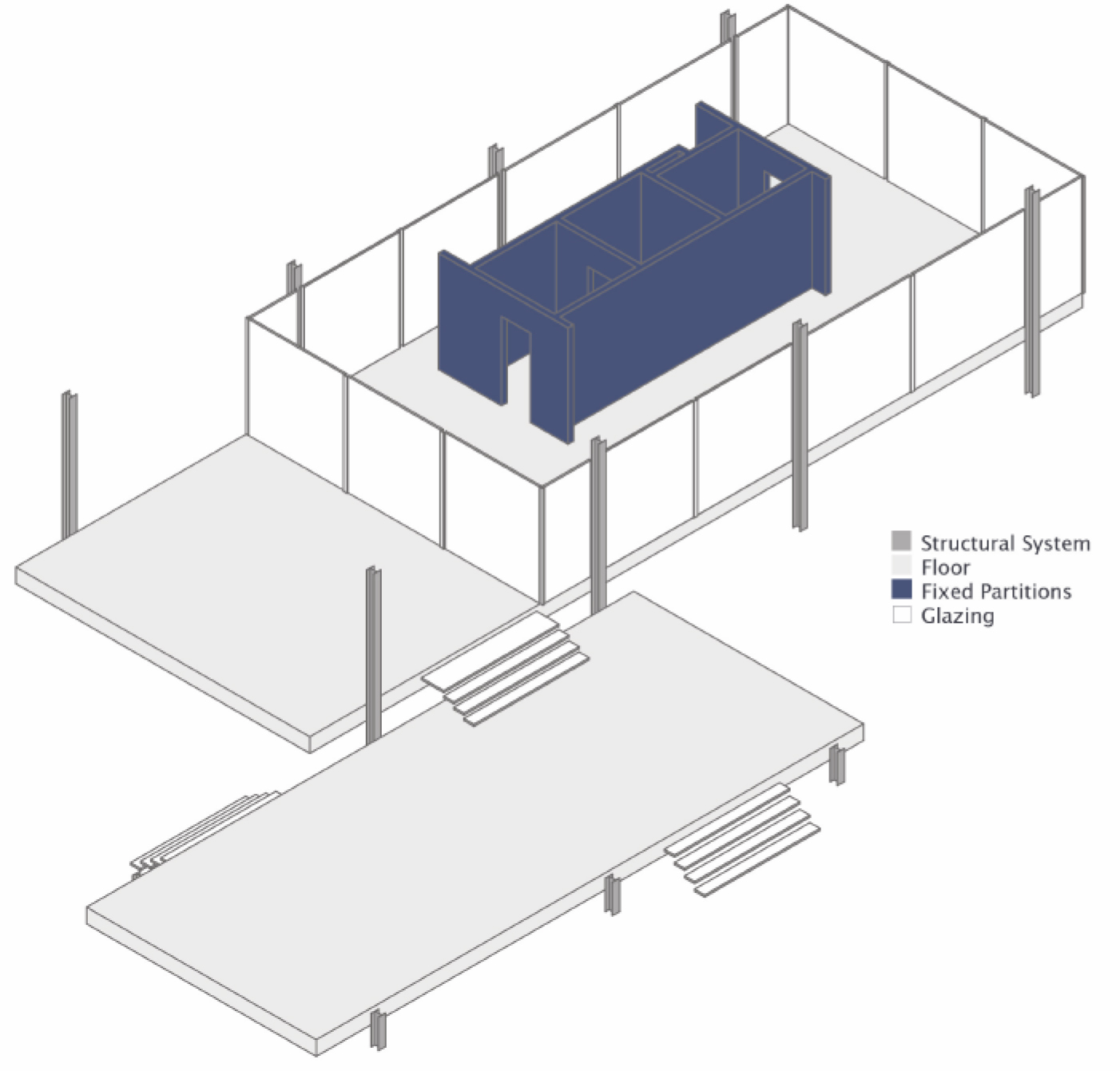
Figure 10.
The layers that augment the adaptability characteristics of the Farnsworth House (Source: Authors)
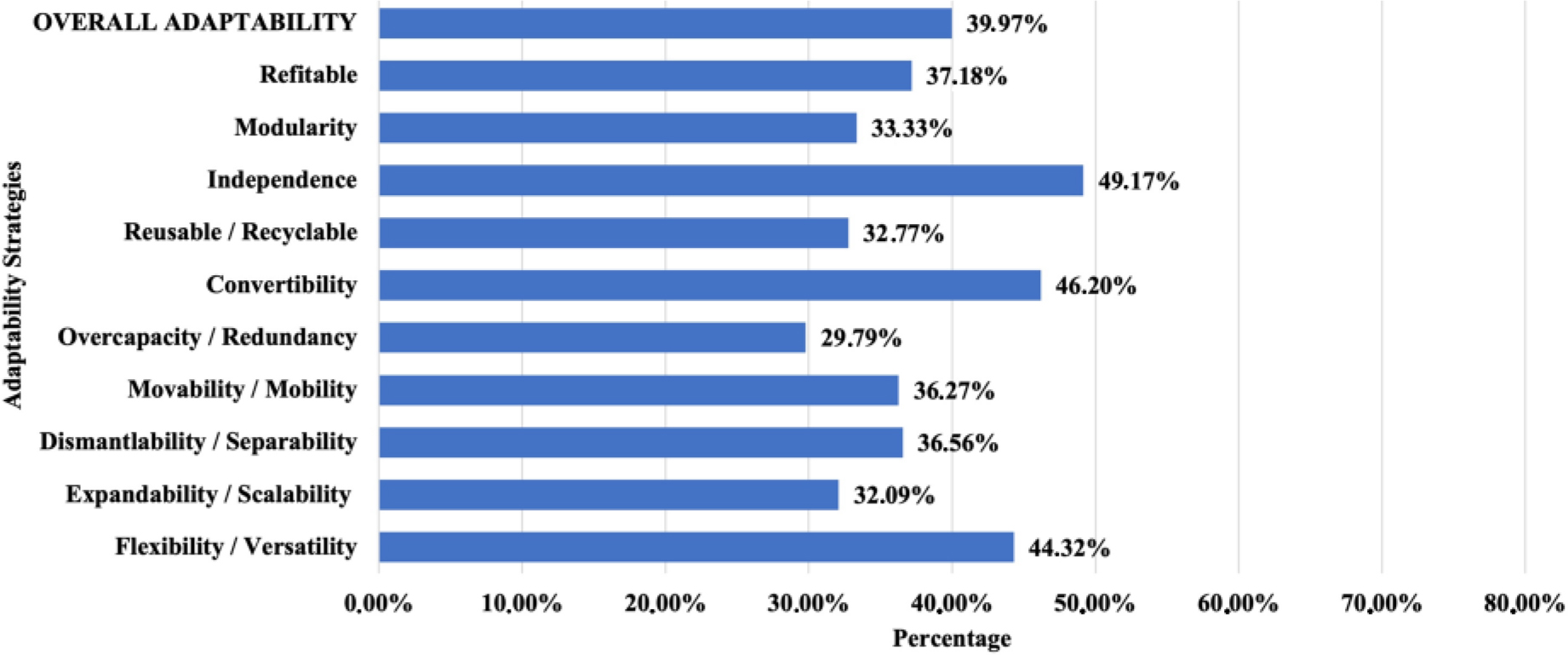
Figure 11.
The overall adaptability score and the adaptability strategy scores of the Farnsworth House (Source: Authors)
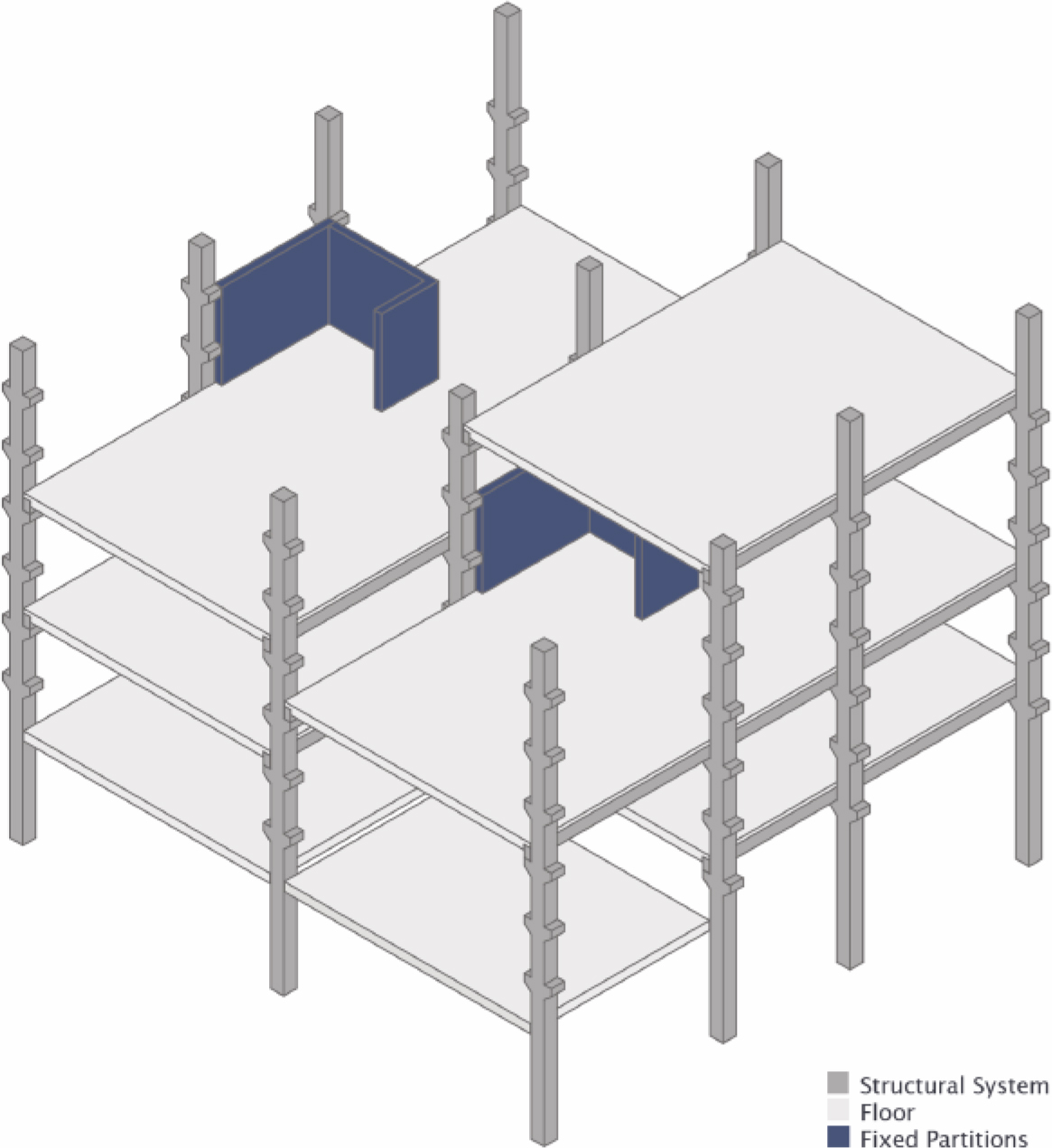
Figure 12.
Layers that augment the adaptability characteristics of the Genter Strasse (Source: Authors)
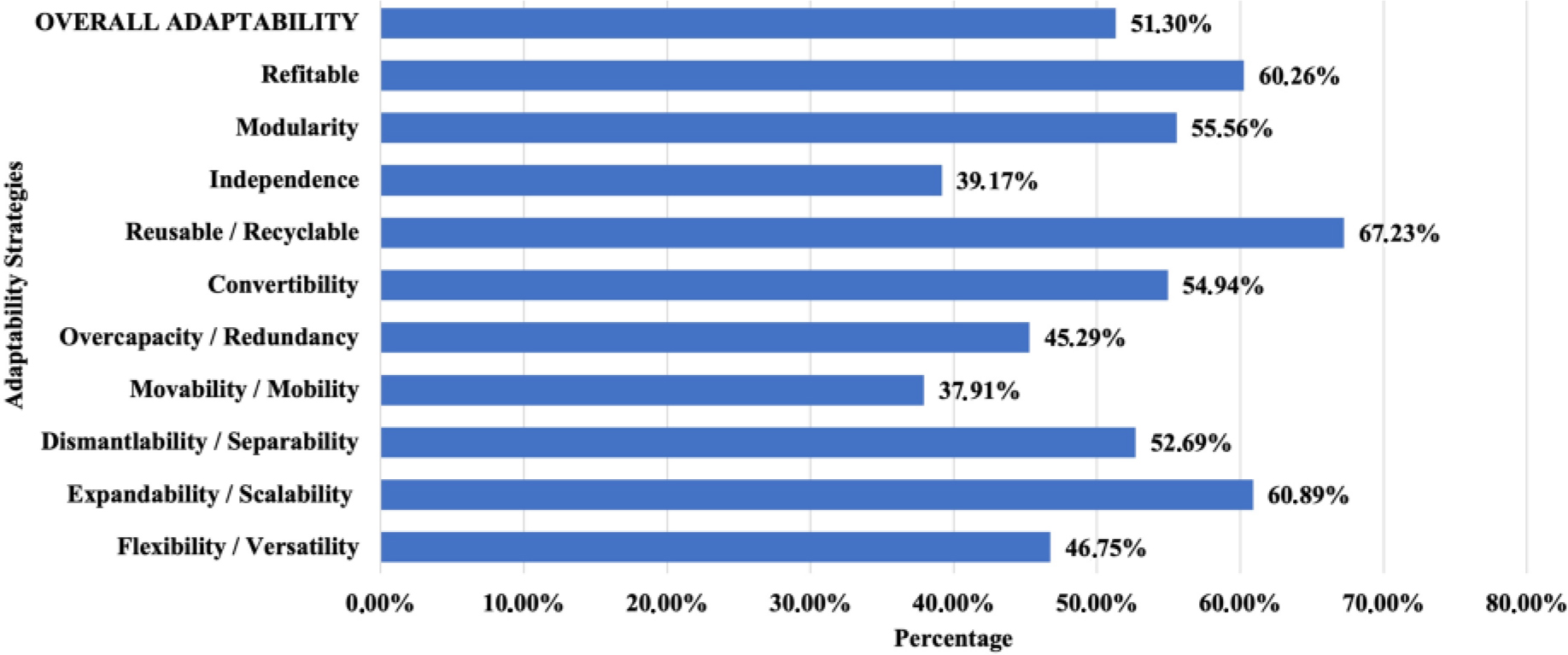
Figure 13.
The overall adaptability score and the adaptability strategy scores of the Genter Strasse houses (Source: Authors)
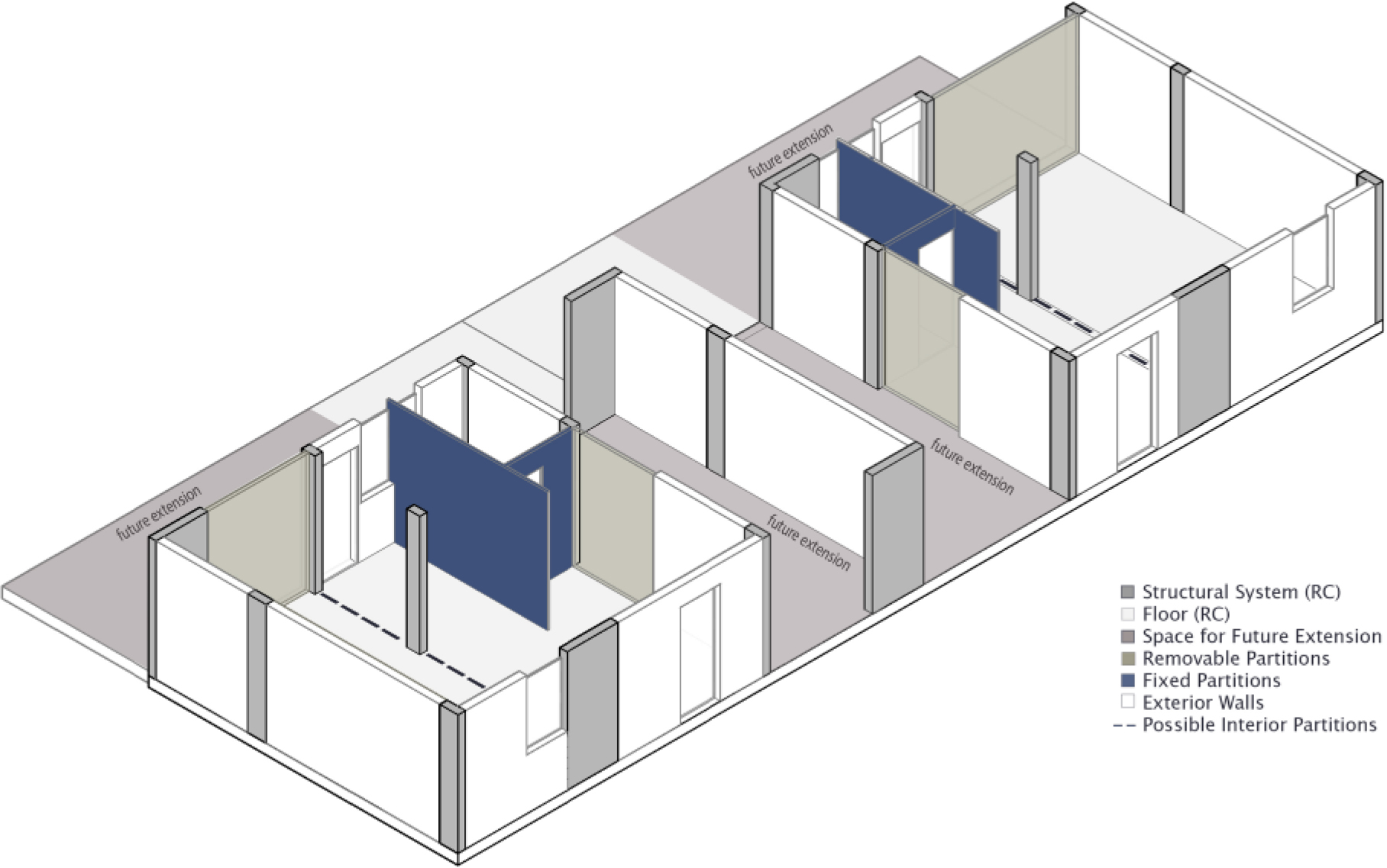
Figure 14.
Layers that augment the adaptability characteristics of the Quinta Monroy Housing (Source: Authors)
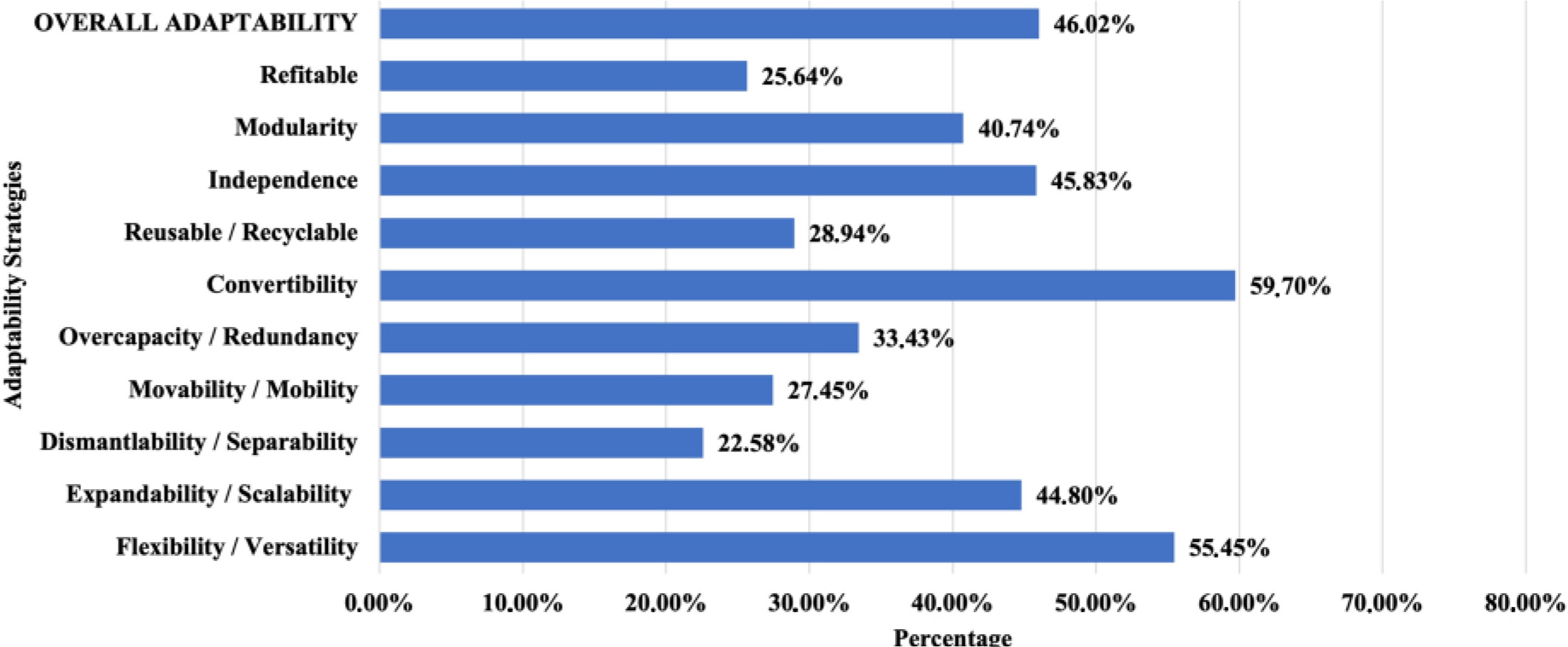
Figure 15.
The overall adaptability score and the strategy scores of the Quinta Monroy Housing (Source: Authors)
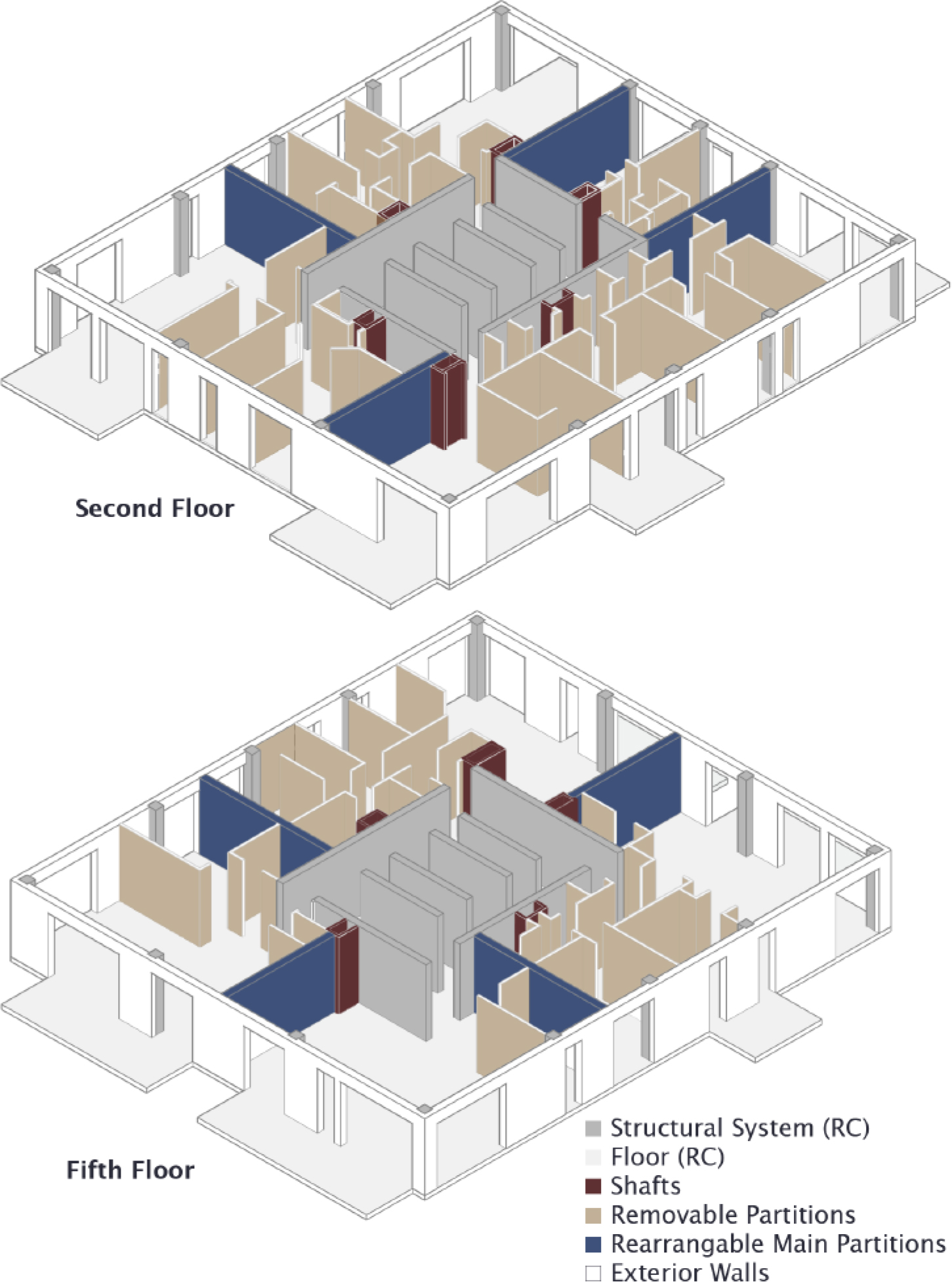
Figure 16.
Layers that augment the adaptability characteristics of Het SchetsBlok (Source: Authors)
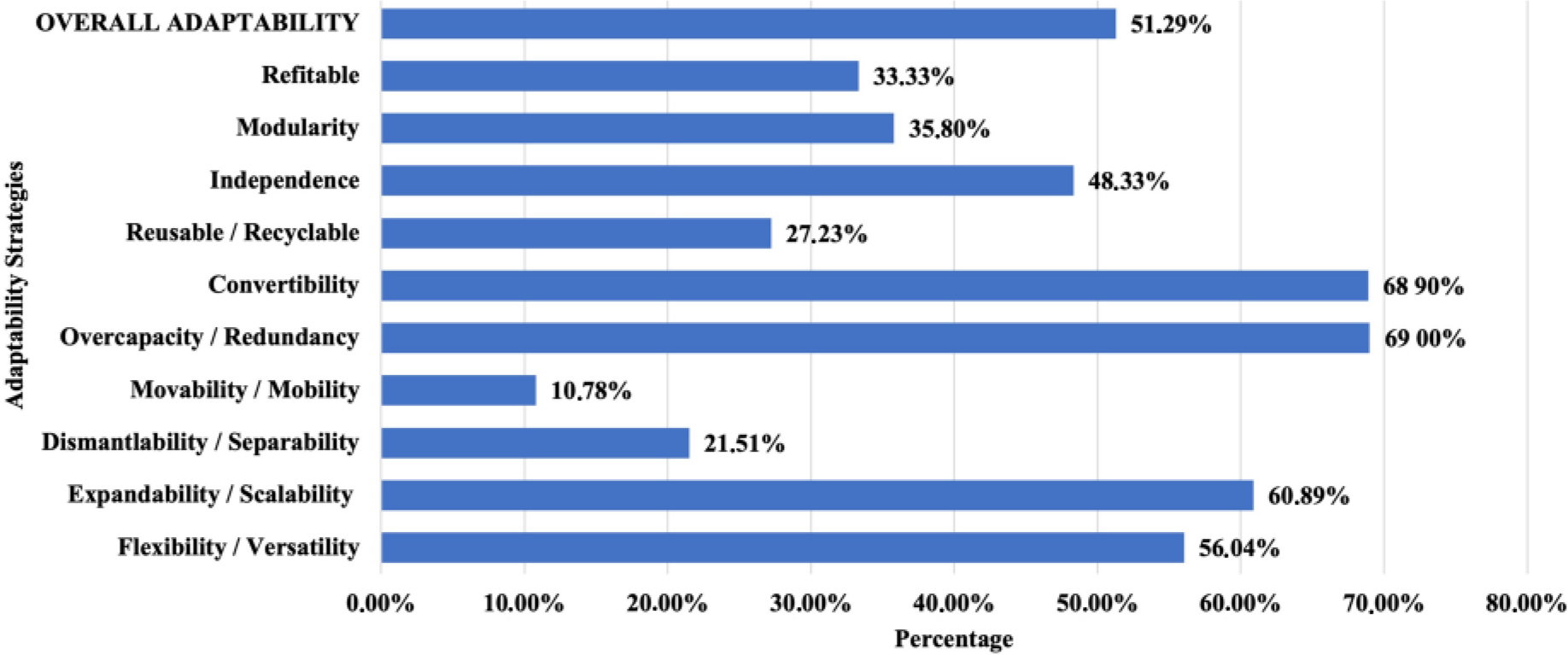
Figure 17.
The overall adaptability score and the strategy scores of the Het SchetsBlok (Source: Authors)
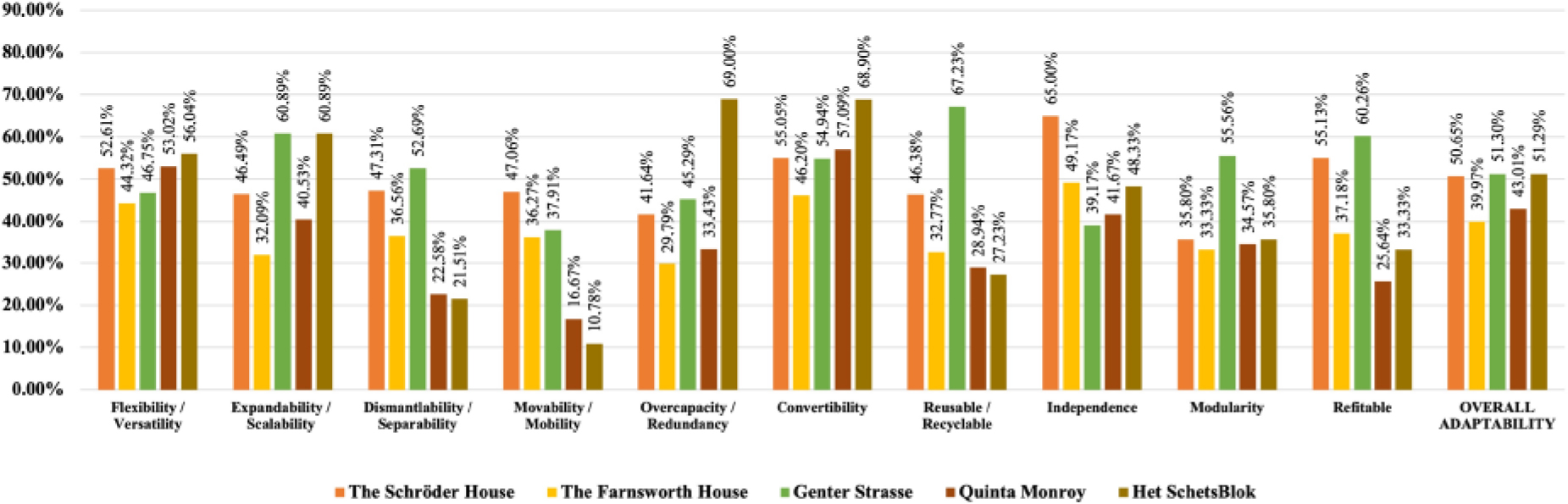
Figure 18.
Comparison of percentage scores of individual adaptability strategies and the overall adaptability scores (Source: Authors)