
1. INTRODUCTION
Only such technology can be considered ecologically safe, the use of which does not lead to environmental pollution with harmful residues. In the case of the formation of such residues, they must be converted into substances that are not harmful to the biosphere, and even better, they can be reused after additional processing in other technologies [1]. According to Directive 96/61/EC [2], in case of impossibility the recycling, the processing products must have a composition, which is similar to natural materials – such as minerals, which guarantees their safe disposal [3]. These requirements fully apply to the technologies of cleaning liquid and disposal of solid waste from galvanic industries. It is known that, in addition to spent concentrated electrolytes, a significant amount of liquid waste from electroplating processes is low-concentration wash waters after pickling and copper plating as a widespread independent and preparatory process before chromium, nickel and silver plating [4]. Such wastes are difficult to clean by the common reagent method to the standards of the MPC for safe discharge to city sewers or water bodies. In addition, the formed sediments contain poorly soluble hydroxy compounds of heavy metals and gypsum, which makes it impossible to dispose of iron- and coppercontaining electroplating sludges. The specified solid waste is dumped in landfills and landfills and pollutes the ground cover due to its unstable composition. Therefore, the development of an environmentally safe technology for the processing of galvanic production waste is relevant in view of the highly efficient treatment of wastewater and the effective use of solid waste from water treatment.
2. ANALYSIS OF PREVIOUS STUDIES
Ion exchange and sorption methods are distinguished by significant advantages compared to the reagent method of purification of wastewater from galvanic production from iron and copper ions. In particular, the use of sorbents such as activated carbon and zeolites makes it possible to achieve practically zero residual concentrations of heavy metals in purified water [5]. The main advantage of the sorption method is the ability of sorbents to effectively remove harmful pollutant ions from water at any concentration, including even low ones, when other cleaning methods may be ineffective. However, due to the high cost of absorbers, the sorption method should be used only in situations where deep cleaning of galvanic effluents is required, for example, when discharging into a reservoir adjacent to specially protected natural areas or into the industrial water supply system of wasteless enterprises. Also, the problem of disposal of spent sorbents remains incompletely solved, especially in the case of using activated carbon as an absorber of heavy metals.
The advantages of using the ion exchange method are the highly efficient purification of low-concentration washing waters with the creation of closed systems of industrial water supply and the undeniable return to production of working solutions (acids, alkalis, electrolytes) [6]. Different types of ion exchange materials can be used to remove copper and iron cations from acidic solutions. Materials based on sulfonated divinylbenzenesulfonates (DVB-C18-SO3H), carboxylates, and phosphonates are usually used. Low pH ensures effective binding of cations to the surface of the ion-exchange material, which proves the feasibility of using the ion-exchange method for cleaning electroplating [7].
The level of acidity of the environment has a significant effect on the efficiency of ion exchange extraction of iron. Depending on the pH of the solution, iron cations can be in different redox states (Fe2+ or Fe3+), which affects their interaction with the ion exchange material, therefore, determining the optimal level of acidity is important for each specific sorbent. Extraction of copper cations using the ion exchange process is an effective method of cleaning solutions from unwanted copper impurities, both independent pollution [8, 9] and in the presence of other metal cations [10]. However, for the development of an environmentally safe technology, a necessary process is the processing of regeneration solutions with a high concentration of heavy metals to obtain non-toxic and limited biodegradable substances, which are chemically close to natural minerals.
It is known that ferrite technologies are quite effectively used in the processes of cleaning highly concentrated wastewater from heavy metal ions [1] with the possibility of further use of the formed iron- and copper-containing ferritic sludge for environmental purposes as a valuable raw material for CO oxidation catalysts [11]. Another way of complex utilization of ferrite cleaning products is their use as part of alkaline cement for concrete products [12]. If we take into account that the application of the ferritic method ensures residual concentrations of iron ions in purified water corresponding to discharge standards and the safe burial of ferritic sludge sediments as an analogue of magnetite distributed in the earth’s crust, then further research in the direction of creating a “green” technology for the processing of galvanic production waste using a complex ion-exchange and ferrite methods is undoubtedly interesting and expedient in the direction of improving the environmental safety of the mechanical engineering industry.
The purpose of the study is to determine the possibility of ion exchange separate and simultaneous extraction of iron and copper ions from acidic solutions of pickling and copper electroplating for efficient production of ferrites.
3. MATERIALS AND METHODS
During the research, a strong acid cation exchange resin – styrene and divinyl-benzene sulfonated copolymer named Dowex HCR S/S in the H+ form, produced in the USA, is chosen as exchange resin. Its Ukrainian analogue – a strong acid cation exchange resin KU-2-8 does not produced this time. The sorption processes of iron (II) and copper (II) ions are carried out in dynamic conditions. During the research, we use the solution of Fe2+ ions with concentrations 1 and 5 g/dm3 and the solution of Cu2+ ions with concentrations 0.8 and 1 g/dm3. The above-mentioned solutions are used individually and in a mixture. The sulfuric acid concentration is varied in the range from 0 to 13 g/dm3. The composition and concentration of the initial solutions were chosen based on the actual composition of electroplating production effluents. Reagents for solutions were provided by TOV Khimlaborreaktiv LLC (Ukraine, Brovary).
The total exchangeable dynamic capacity (TEDC) of the ionite is determined by the formula:
where Cinit – the ions initial concentration in the solution, g-eq/dm3; Cn – ions concentration in the n-th sample after sorption, g-eq/dm3; Vn – sample volume, dm3; Vi – ionite volume, dm3.The ionite regeneration degree is determined by the formula:
where TEDCreg – the ionite total exchangeable dynamic capacity after regeneration, g-eq/dm3; TEDCinit – the initial ionite total exchangeable dynamic capacity, g-eq/dm3.Iron (II) and copper (II) ions were determined according to the standard method by the photocolorimetric method [13].
The size of the particles was determined by the photoelectric method [14].
4. RESULTS AND DISCUSSION
We choice the strongly acidic cationite in our study because this kind of cationites are able to easily lose hydrogen ions due to their displacement from the cationite matrix by other cations, presented at the solution. In addition, the main choosing criterion for type of ion exchange resin is a sulfuric acid high content in the solutions. The strongly acidic cations exchange capacity is almost independent on pH. Even at low pH values, the boarded exchange capacity values are reached, and they remain constant with a further increase in pH values.
Nevertheless, experimental studies showed that with an increase in the sulfuric acid concentration, the total exchangeable dynamic capacity of the cationite significantly decreases both during the iron ions sorption (Figure 1 and Figure 2) and during the copper ions sorption (Figure 3). For iron-containing solutions, TEDC drops from 1.39 g-eq/dm3 in case of the H2SO4 absence in the initial solution and decreases to 0.3–0.46 g-eq/dm3 at a sulfuric acid concentration of 1-3 g/dm3 (Figure 1). An increase in the iron (II) ions concentration leads to a significant increase in TEDC, even with a sulfuric acid concentration of 8–13 g/dm3, TEDC is at the level of 1.35 g-eq/dm3 (Figure 2), which corresponds to the level of diluted solutions sorption even in the acid absence.
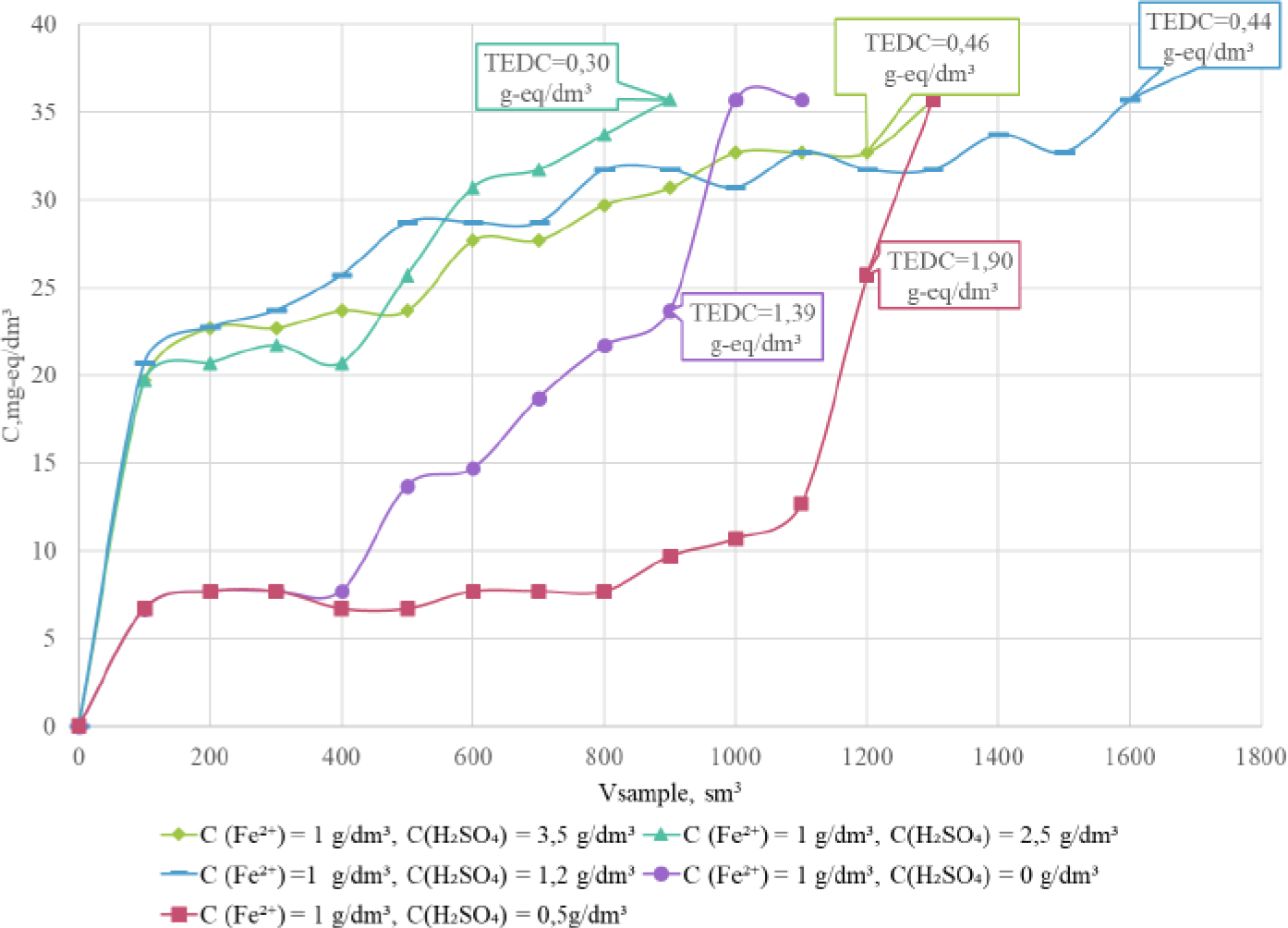
Figure 1.
Dependence the initial iron ions concentration on the initial solution composition, which is passed through Dowex HCR S/S cationite in H+ form
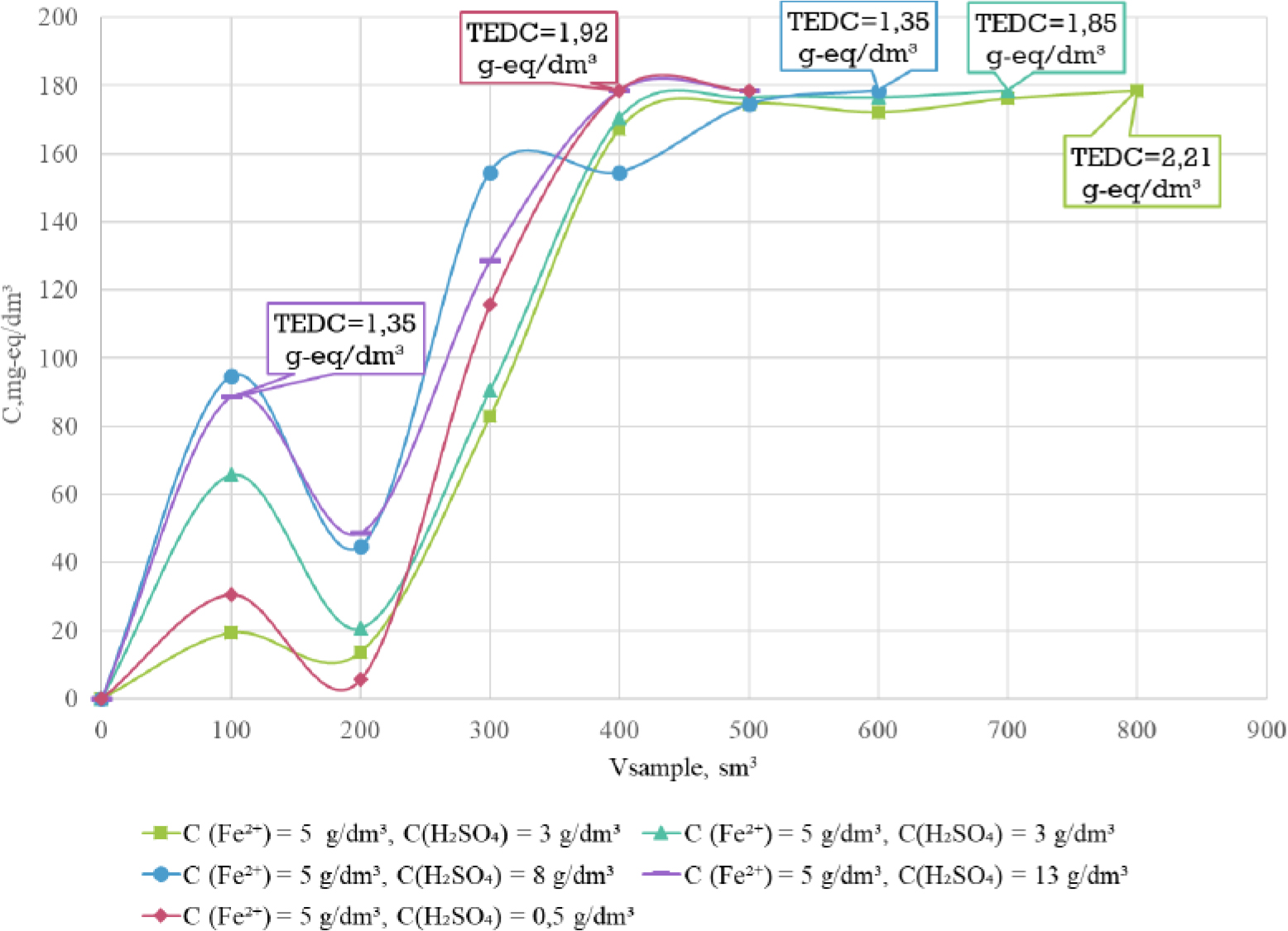
Figure 2.
Dependence the initial iron ions concentration on the initial solution composition, which is passed through Dowex HCR S/S cationite in H+ form
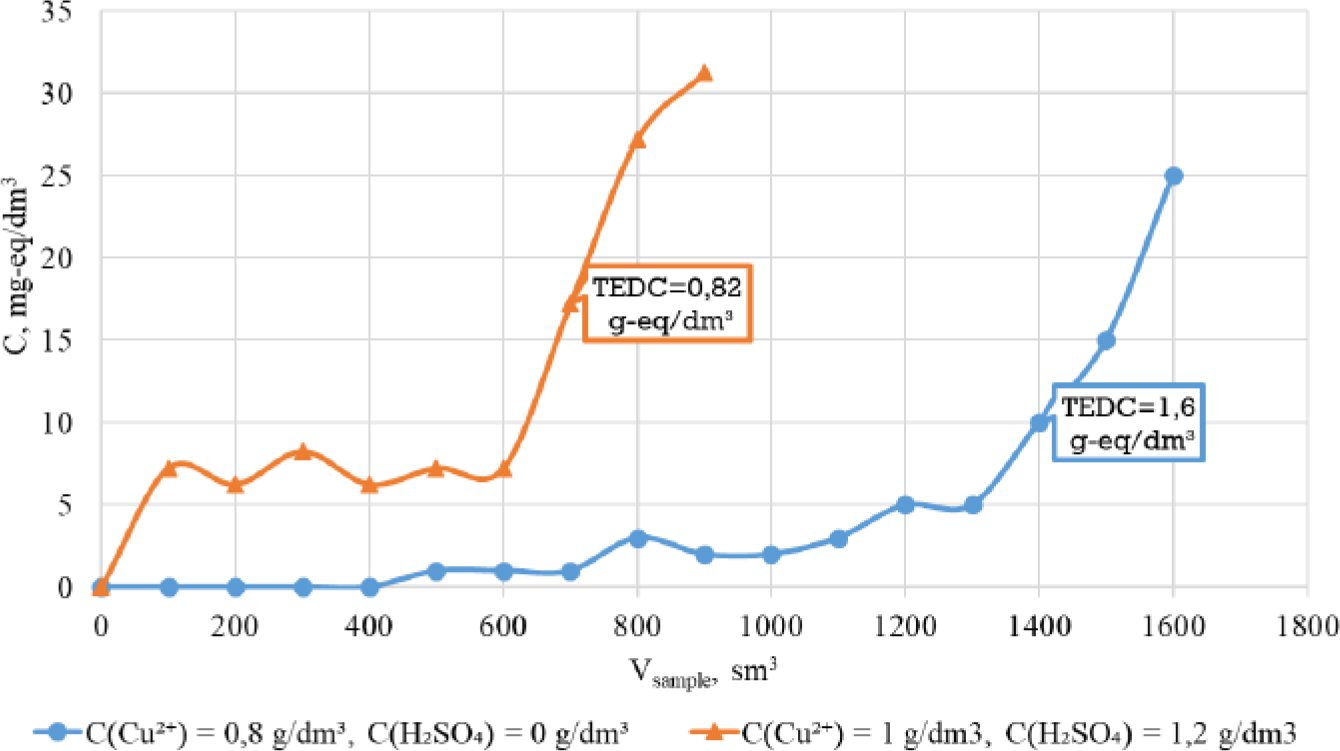
Figure 3.
Dependence the initial copper ions concentration on the initial solution composition, which is passed through Dowex HCR S/S cationite in H+ form
Similar results are obtained during the Cu2+ solutions sorption. The copper (II) ions have the same ionic radius as iron (II) ions. Therefore, with the simultaneous sorption of iron (II) and copper (II) ions (Figure 4), it is difficult to draw a conclusion about the ionite selectivity for certain metal ions. However, the total concentration shows that the metals sorption efficiency from acidic solutions remains high enough and increases with the increasing the initial sorbed ions total content. A decrease in the ionite TEDC is also recorded with an increase in the sulfuric acid content.
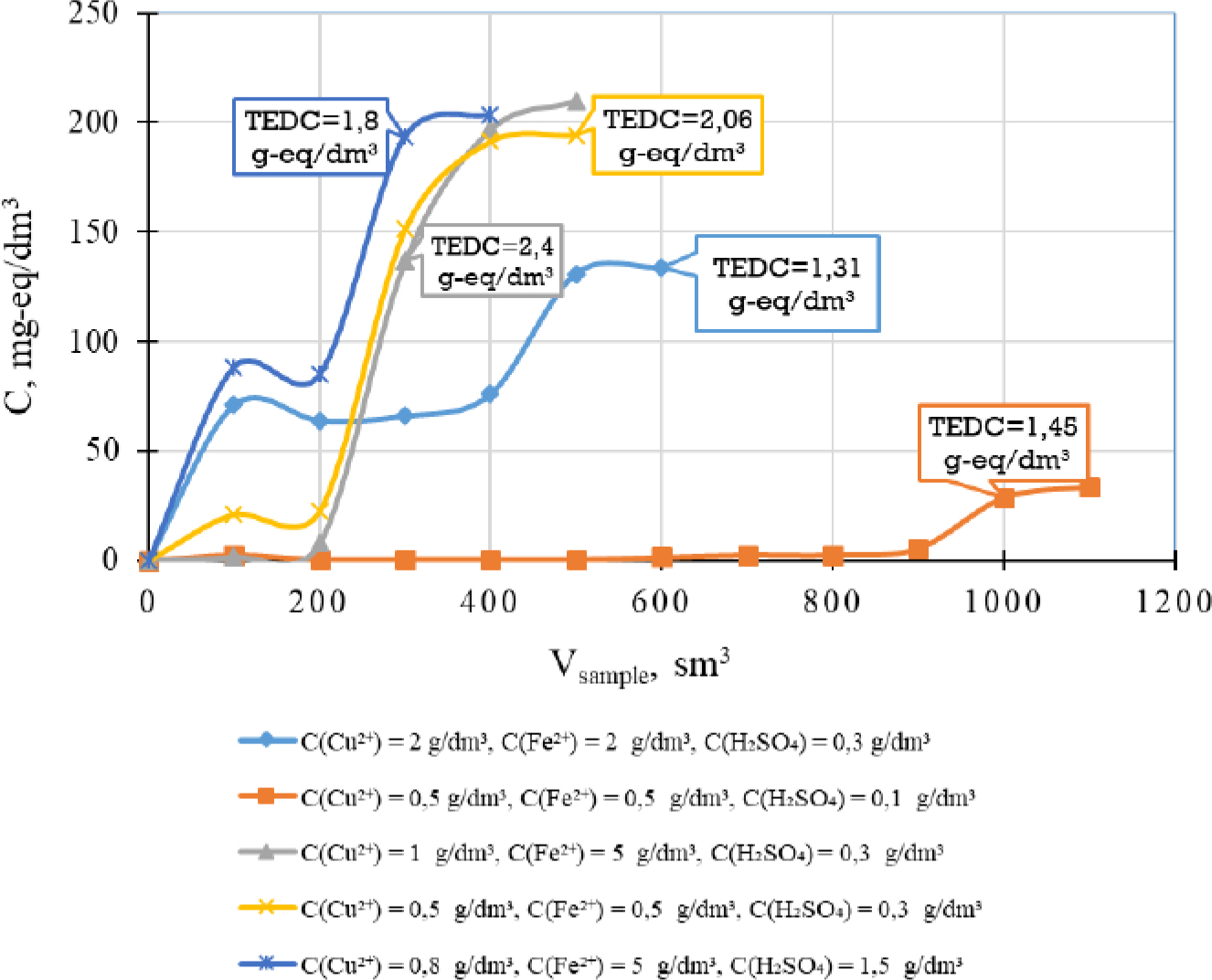
Figure 4.
Dependence the initial iron and copper concentration ions on the initial solution composition, which is passed through Dowex HCR S/S cationite in H+ form
The important indicator used for the ion exchange method choosing is the possibility of the cation exchange material effective regeneration (Table 1). In the research, the regeneration is carried out with 5% and 10% H2SO4 solutions. It case of using a 5% sulfuric acid solution even at the regeneration solution specific consumption, it is possible to achieve the regeneration degree at the level of 95–98%, and when using a 10% solution, the regeneration degree reached 100%.
Table 1.
Dependence the ionite regeneration degree on the regeneration and initial compositions solutions, and the regeneration solution specific consumption (qs)
| Regeneration solution composition | q*s, sm3/sm3 | Composition for sorption | Z, % | Composition after regeneration | |||||
|---|---|---|---|---|---|---|---|---|---|
| C(Cu2+), mg/dm3 | C(Fe2+), mg/dm3 | C(H2SO4), mg/dm3 | C(Fe2+), mg/dm3 | C(FeSO4), mg/dm3 | C(Cu2+), mg/dm3 | C(CuSO4), mg/dm3 | |||
| 5% H2SO4 | 5 | - | 1 000 | 0 | 99,0 | 7 772 | 28 690 | ||
| 5% H2SO4 | 5 | - | 1 000 | 500 | 95,5 | 14 610 | 56 200 | ||
| 5% H2SO4 | 5 | - | 1000 | 1 200 | 98,0 | 14 680 | 54 540 | ||
| 5% H2SO4 | 5 | - | 1 000 | 2 450 | 100,0 | 14 750 | 54 800 | ||
| 5% H2SO4 | 5 | - | 1000 | 3 500 | 100,0 | 5 560 | 20 800 | ||
| 10% H2SO4 | 5 | - | 5000 | 500 | 100,0 | 8 960 | 33 200 | ||
| 10% H2SO4 | 5 | - | 5 000 | 1 300 | 100,0 | 20 480 | 76 000 | ||
| 10% H2SO4 | 5 | - | 5 000 | 3 000 | 100,0 | 14 700 | 54 600 | ||
| 10% H2SO4 | 5 | - | 5 000 | 8 100 | 100,0 | 14 420 | 53 500 | ||
| 10% H2SO4 | 5 | - | 5 000 | 13 000 | 100,0 | 16 240 | 60 200 | ||
| 5% H2SO4 | 5 | 800 | - | - | 98,7 | 15 480 | 53 900 | ||
| 10% H2SO4 | 5 | 1 000 | - | 1 200 | 100,0 | 21 120 | 73 590 | ||
| 10% H2SO4 | 5 | 2 000 | 2 000 | 300 | 100,0 | 8 400 | 31 200 | 9 600 | 33 600 |
| 5% H2SO4 | 5 | 500 | 500 | 100 | 100,0 | 5 960 | 22 150 | 6 810 | 23 850 |
| 10% H2SO4 | 5 | 1 000 | 5 000 | 300 | 100,0 | 12 150 | 45 130 | 2 750 | 9 630 |
| 10% H2SO4 | 5 | 500 | 5 000 | 300 | 100,0 | 16 800 | 62 400 | 1 920 | 6 720 |
| 10% H2SO4 | 5 | 800 | 5 000 | 1500 | 100,0 | 4 500 | 16 740 | 800 | 2 800 |
As it is shown in the table 1, the obtained regeneration showers can contain 76 g/dm3 of iron sulphate (II) and 73.59 g/dm3 of copper sulphate (II), which undoubtedly guarantees the obtaining ferrite particles possibility with maximum magnetic properties.
For iron ions removal from concentrated iron-containing regeneration solutions by the ferrite method in order to obtain ferrite particles (magnetite) with maximum magnetic properties, a mixture of Fe (II) and Fe (III) ions is used with their concentration ratio K = [Fe2+]/[Fe3+] = 0.5, as a stable relationship between magnetic properties and sediment volume was noted. In case of maximum magnetic properties, the sediment volume is minimal, and vice versa. Therefore, using the sediments obtained with the ratio K < 0.1 and K > 2.4 is quite problematic because of the low magnetic properties and in connection with the complexity of the equipment for their extraction.
Obtaining high dispersion magnetic particles from a mixture of ferric sulphates (II) and (III) by precipitating them with NaOH during the heating allows to reduce the process duration significantly, simplify it, and increase the equipment productivity [1]. At the same time, there is also no need to control the reaction of the magnetic particles formation, since their characteristics are determined by the initial solutions composition and the deposition conditions. Currently, this method is most widely used in the magnetic fluids preparation technologies, where magnetite or ferrite particles are the main component. To obtain particles with maximum magnetic properties, the consumption of iron (II) is 0.5 mg per 1 mg of Fe3+ ions.
The deposition process is carried out with constant stirring and an excess of 10% sodium hydroxide solution. The magnetite formation process is described by the equation:
During the iron salts mixture precipitation with a 2N NaOH solution at a temperature of 20°C, magnetite is already formed at pH = 4, although the pH of complete magnetite precipitation reaches 9.5±1.5 [15]. Its formation takes place due to the presence of high local OHions concentrations. When the suspension is stirred, freshly formed magnetite turns into a-FeOOH. It is claimed that in the interval pH from 4 to 8 the magnetite formation takes place according to the equations:
The magnetic phase formation process in the described technologies is not instantaneous [1]. At the same time, the incubation period lasts 8–10 seconds. After this period, magnetite crystals with the minimum possible size of 38–40 A° are formed in the solution, and then eventually grow to the size of 70 A°. The particle formation processes and their growth are take place in the solution independently. About 10 min after deposition, the processes of formation and growth particle size practically stop, while the amorphous iron compounds degree transition into magnetite crystals approaches to the 100%. To obtain the copper ferrites magnetic particles from regeneration solutions by precipitation with alkali at normal temperatures, a constant concentration of Fe3+ ions must be maintained, and the ratio between the concentrations of Cu2+ and Fe2+ must be changed in accordance with the chemical formula:
where X = 0÷0.4. As it is shown in [1], at X = 0.01 the sediment has maximum magnetic properties. Its saturation magnetization is 1.1 times higher than that in case of “pure” magnetite. With an increase in the concentration of Cu2+ ions, the obtained sediments crystallization period and their acquisition of magnetic properties is increasing too. It means that if the iron (II) and copper (II) ions concentrations ratio in the initial solutions K1 = [Fe2+]/[Cu2+] = 3.15÷7.76 is observed, the obtained precipitates has a crystalline structure and magnetic properties. The particles obtained at K1 = 3.5 has the maximum magnetic susceptibility, while their composition corresponded to the formula CuFe(FeO2)3. The oxidation-reduction reaction between copper and iron ions can be described as follows [1]:
According to this formula, the stoichiometric ratio K1 = 3.53. In this case, the general equation of the deposition process have the form:
Thus, the presence of Fe2+ and Fe3+ ions makes the ferrite formation reaction possible. To obtain the particles with maximum magnetic properties, the consumption of copper (II) is 0.2÷0.33 mg per 1 mg of Fe2+ ions.
Basic technological scheme for ecologically safe galvanic waste processing is presented in Figure 5. The process carry out in such way. From receiving tank 1, iron- and/or copper-containing galvanic wastewater is fed separately or in combination to ion exchange filters with DOWEX HCR S/S cationite in H+ form, in which iron (II) and copper (II) ions are sorbed. Sulfuric acid, which is formed at the same time, is further after concentration used in the etching processes of galvanic production. As a result of cationite regeneration with a 5% or 10% solution of H2SO4, the iron- and/or copper-containing concentrates formed are mixed in the ferritizer reactor 8 and then mixed with a solution of iron sulfate (III) and sodium hydroxide at the electric stirrer 9 with the formation of a ferritic precipitate, which is removed in a magnetic separator 10. Further, the ferritic sludge is sent for drying in the apparatus 14, after which it is crushed to the required size in a ball mill 15. The obtained product can be used as a catalyst for the neutralization of carbon monoxide [16] or for safe disposal [11]. When the ferrite sludge separation processes are completed, the purified water can be poured into the sewer or reused in the electroplating process.
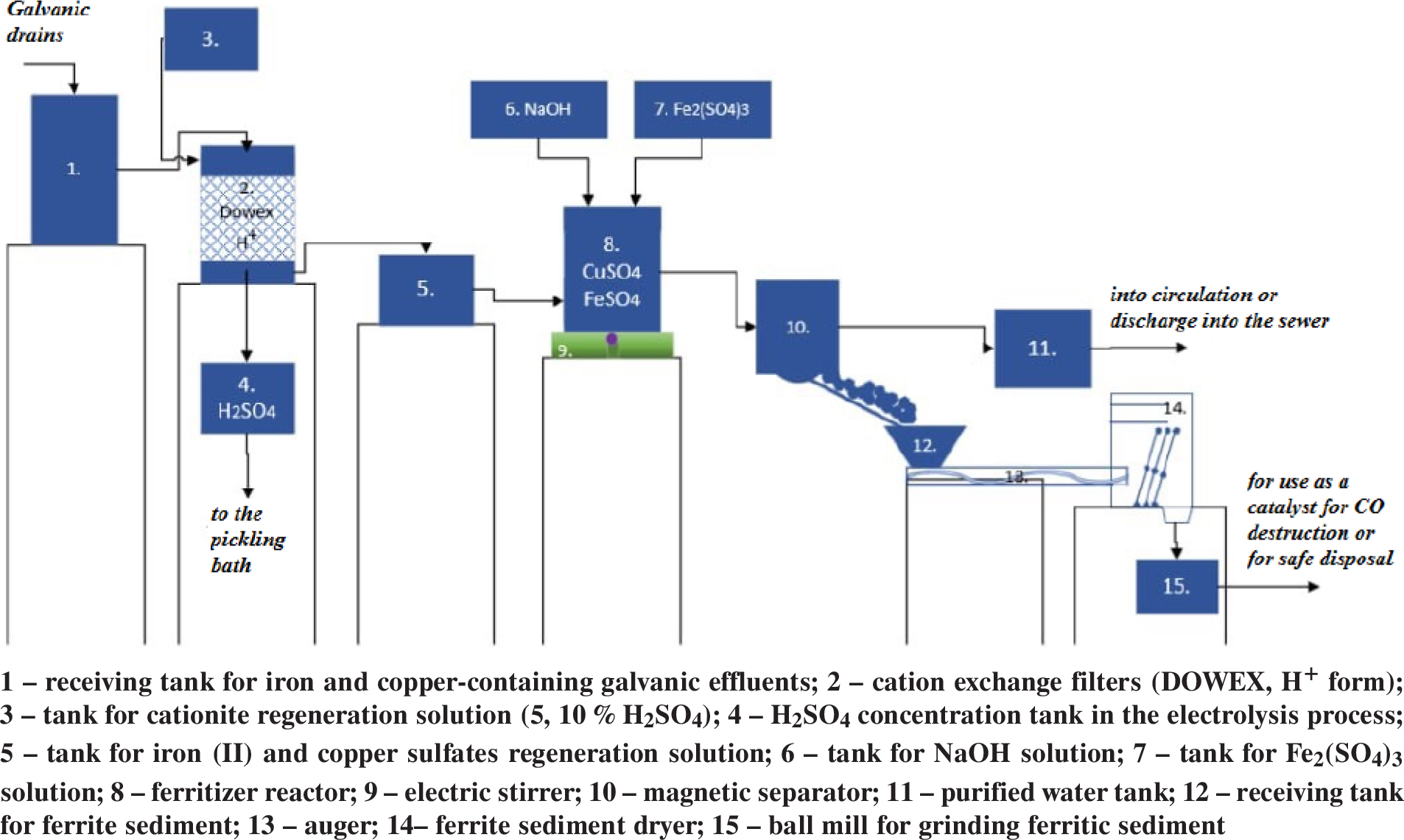
Figure 5.
Basic technological scheme for ecologically safe galvanic waste processing
5. CONCLUSIONS
Based on the obtained results, the application of ionexchange extraction of iron and copper ions from acidic solutions of galvanic production is expedient as the first stage of complex ecologically safe processing of galvanic wastes with the production of ferritic materials for industrial use.
In the future, research into the possibility of selective separation of metal ions contained in liquid wastes of electroplating production is planned. And it is also interesting to study the possibility of using ionexchange materials of other types and nature, namely weakly acidic, synthetic, natural ones.