
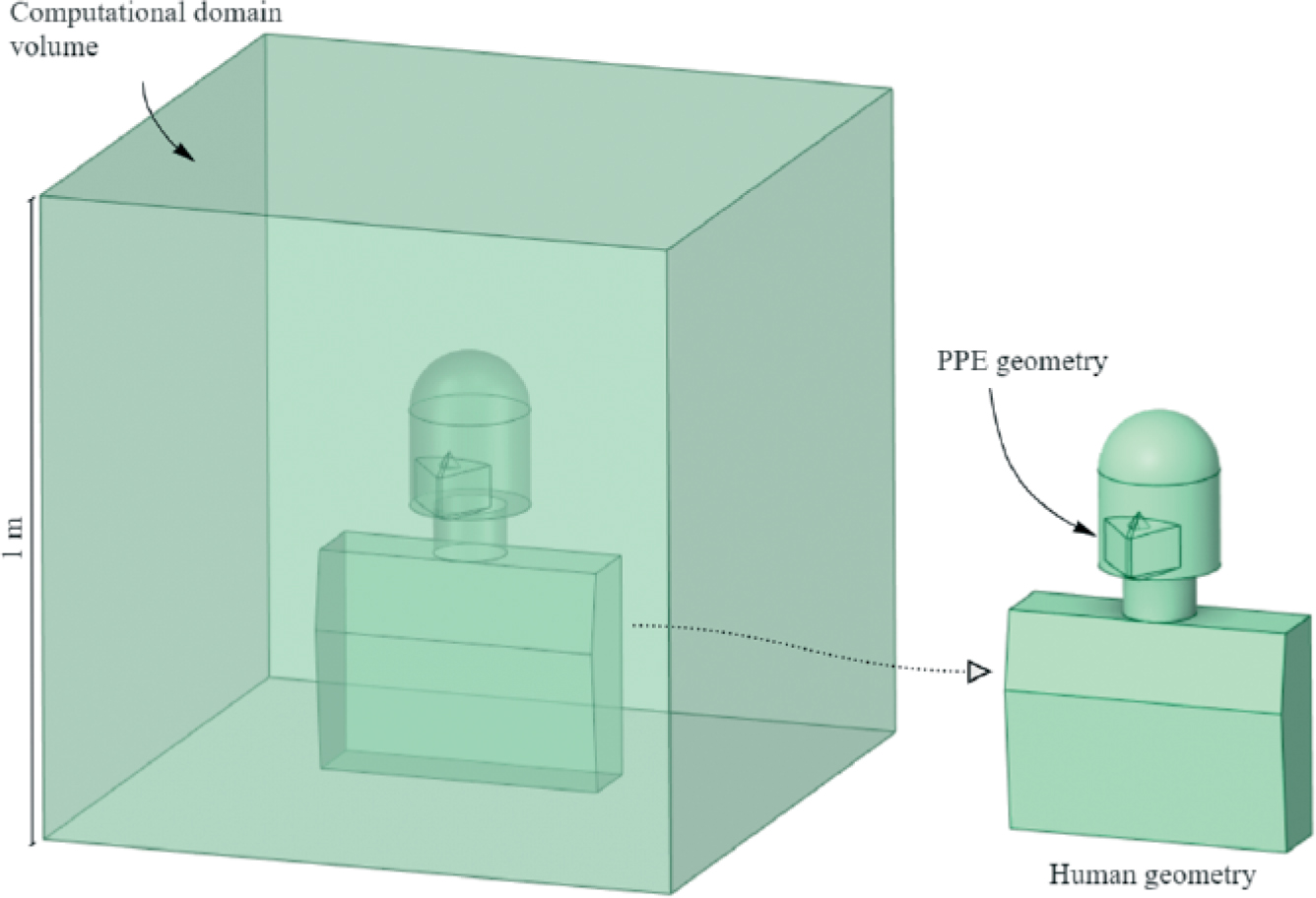
Figure 1.
Example of geometry showing the torso and head of a human with the fabric mask
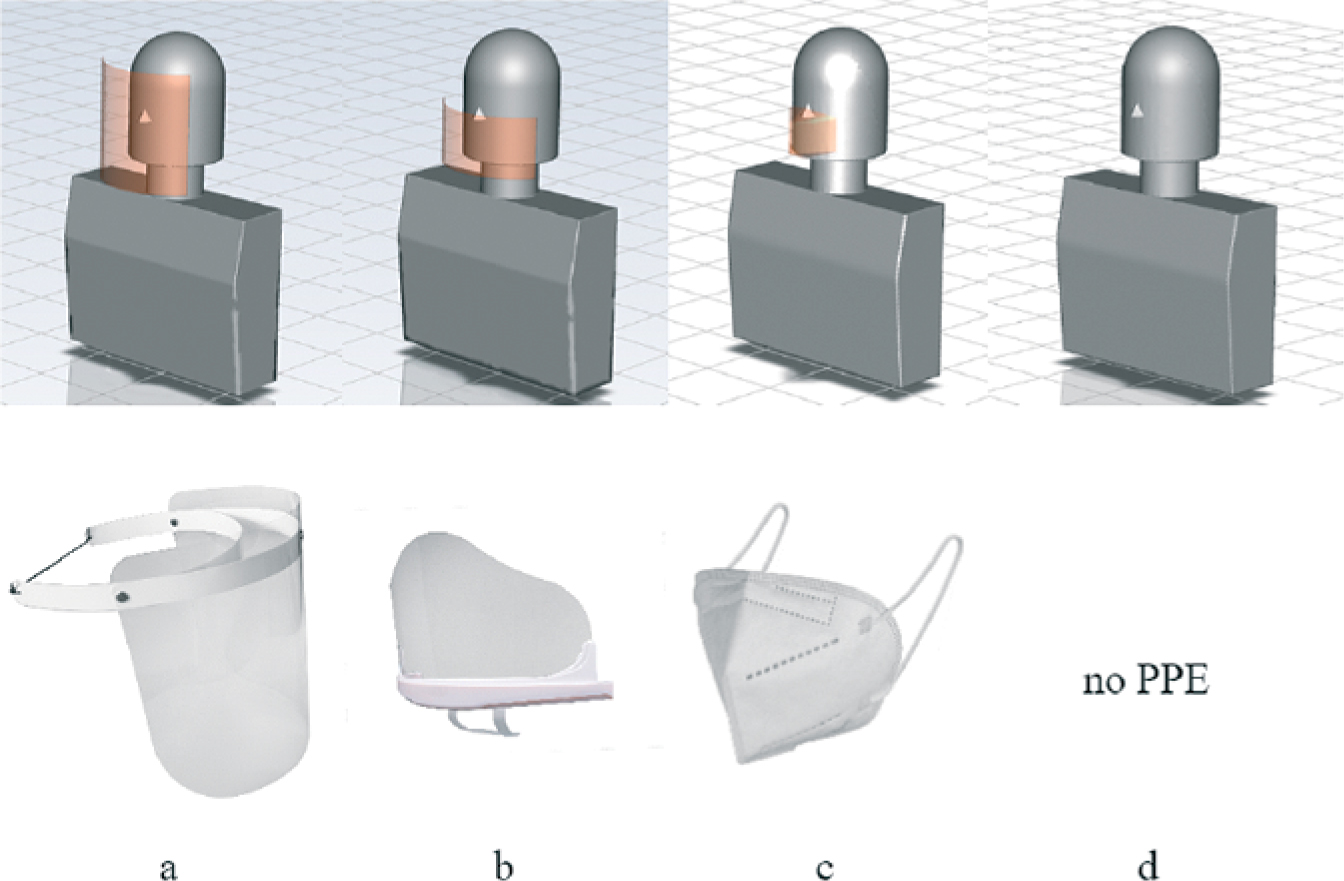
Figure 2.
Examples of Personal Protective Equipment used in research, A – full face shield, B – small face shield, C – material mask, D- no PPE
Table 1.
List of parameters describing the quality of meshes
| Model | Number of elements | Average skewness | Average orthogonal quality |
|---|---|---|---|
| Reference model without PPE | 2 485 096 | 0.181 | 0.817 |
| Model with shield covering nose and mouth | 2 637 907 | 0.183 | 0.814 |
| Model with face shield, 15 mm far from face | 2 779 952 | 0.185 | 0.812 |
| Model with face shield, 40 mm far from face | 2 811 042 | 0.186 | 0.811 |
| Model with a fabric mask | 907 944 | 0 (skewness parameter is not applicable for polyhedral mashes) | 0.96526 |
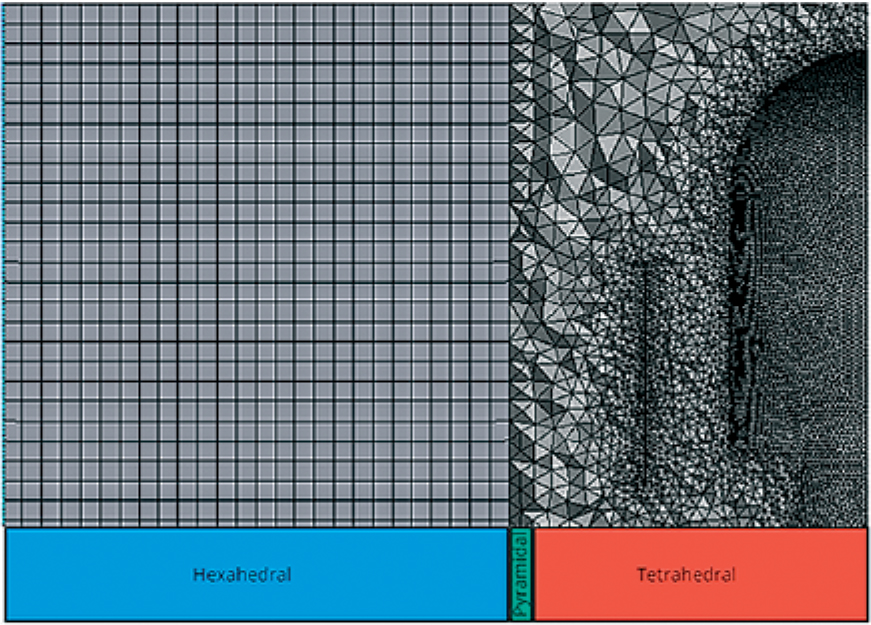
Figure 3.
Refined computational mesh on the cross-section of the numerical model. Geometry with a small face shield
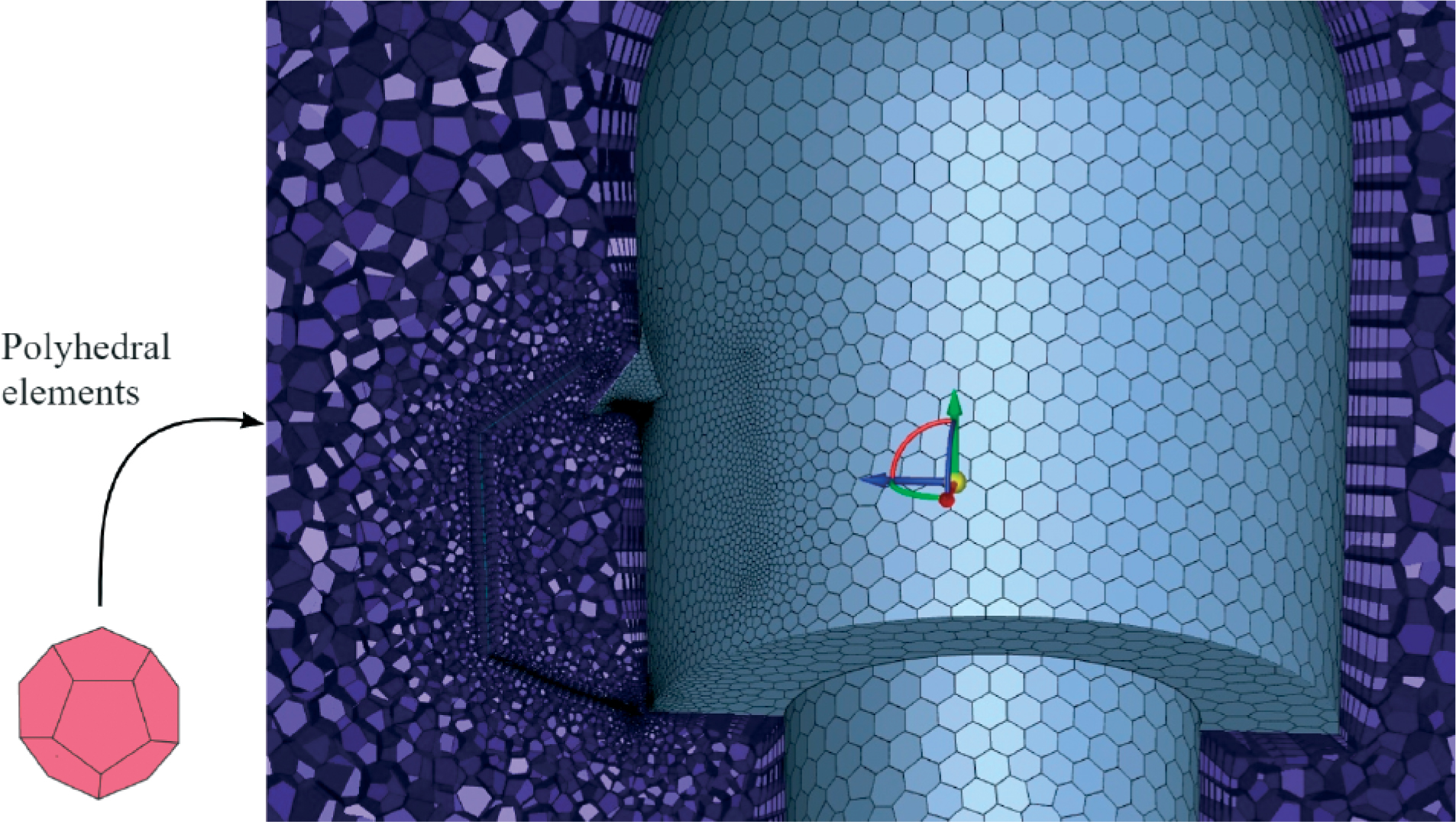
Figure 4.
Refined computational mesh on the cross-section of the numerical model. Geometry with a fabric mask
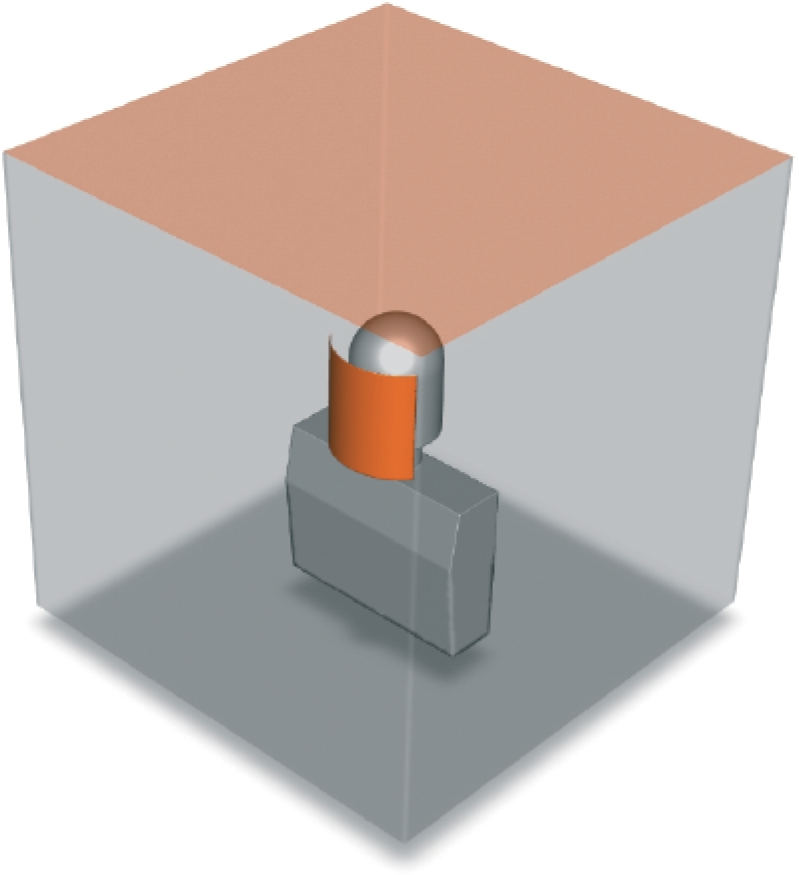
Figure 5.
Computing domain with marked location of the top surface
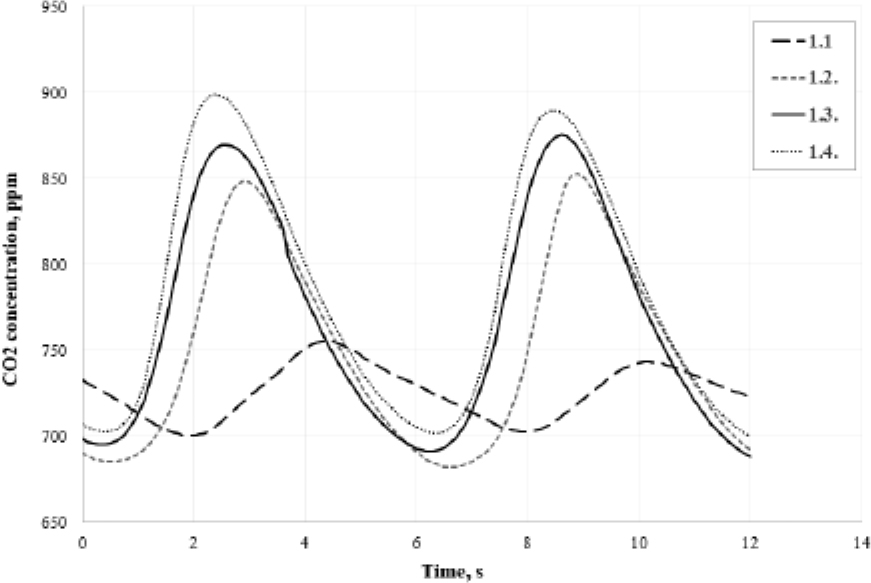
Figure 6.
Graph of CO2 concentration changes in time on the upper surface of the computational domain for 4 different numerical mesh for two breathing periods at pseudo-steady state
Table 2.
Grid parameters used for grid independence study
| Mesh: | 1.1 | 1.2 | 1.3 | 1.4 |
| Element Size [mm]: | 20 | 15.4 | 11.5 | 8.8 |
| Sizing [mm]: | 5 | 3.8 | 2.9 | 2.2 |
| Number of elements: | 887 932 | 1 643 675 | 2 886 498 | 5 251 038 |
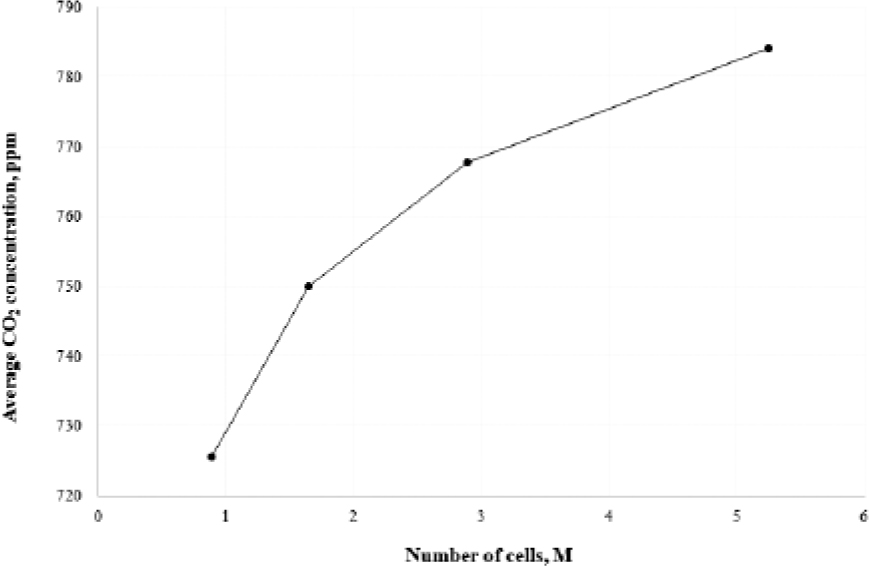
Figure 7.
Graph of average CO2 concentration at the top surface as a function of a number of mesh cells
Table 3.
Results of the mesh independence study
| Mesh | Number of cells, Millions | Mesh refinement ratio | Solution, ppm | Observed discretisation order | GCI |
|---|---|---|---|---|---|
| 1.1 | 0.888 | - | 725.5 | - | - |
| 1.2 | 1.644 | 0.81 | 750.0 | - | 0.123 |
| 1.3 | 2.886 | 0.83 | 767.7 | 1.63 | 0.086 |
| 1.4 | 5.251 | 0.82 | 784.0 | - | 0.077 |
Table 4.
List of boundary conditions with specifications
| Element: | Type of boundary conditions | Conditions related to the conservation of momentum | Thermal conditions |
|---|---|---|---|
| Nostrils | Mass-flow inlet | Mass flux defined by the user | Temperature defined by the user, T = 307 K |
| Face shield surface | Wall | Standard fixed walls | Zero heat flux |
| Fabric mask | Porous Jump | Porous material Thickness: 0.5 mm Face permeability: 9.8−10 m2 | Zero heat flux |
| Body surface | Wall | Standard fixed walls | Heat flux 40 W/m2 |
| The outer surface of the numerical domain | Pressure-outlet | Standard conditions | T = 293 K |
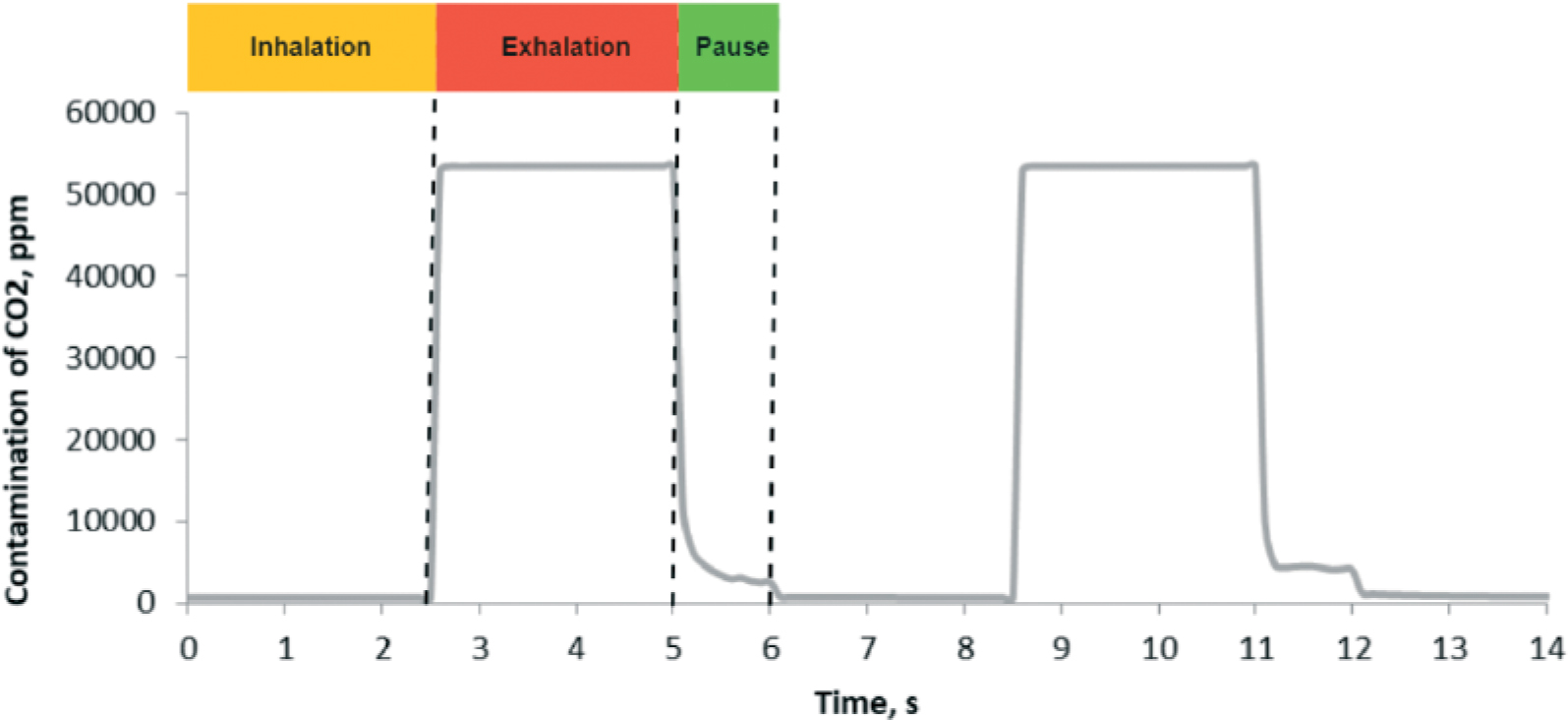
Figure 8.
Example of CO2 concentration changes in time at the surface of the nostrils, during breathing, as it is described by developed UDF
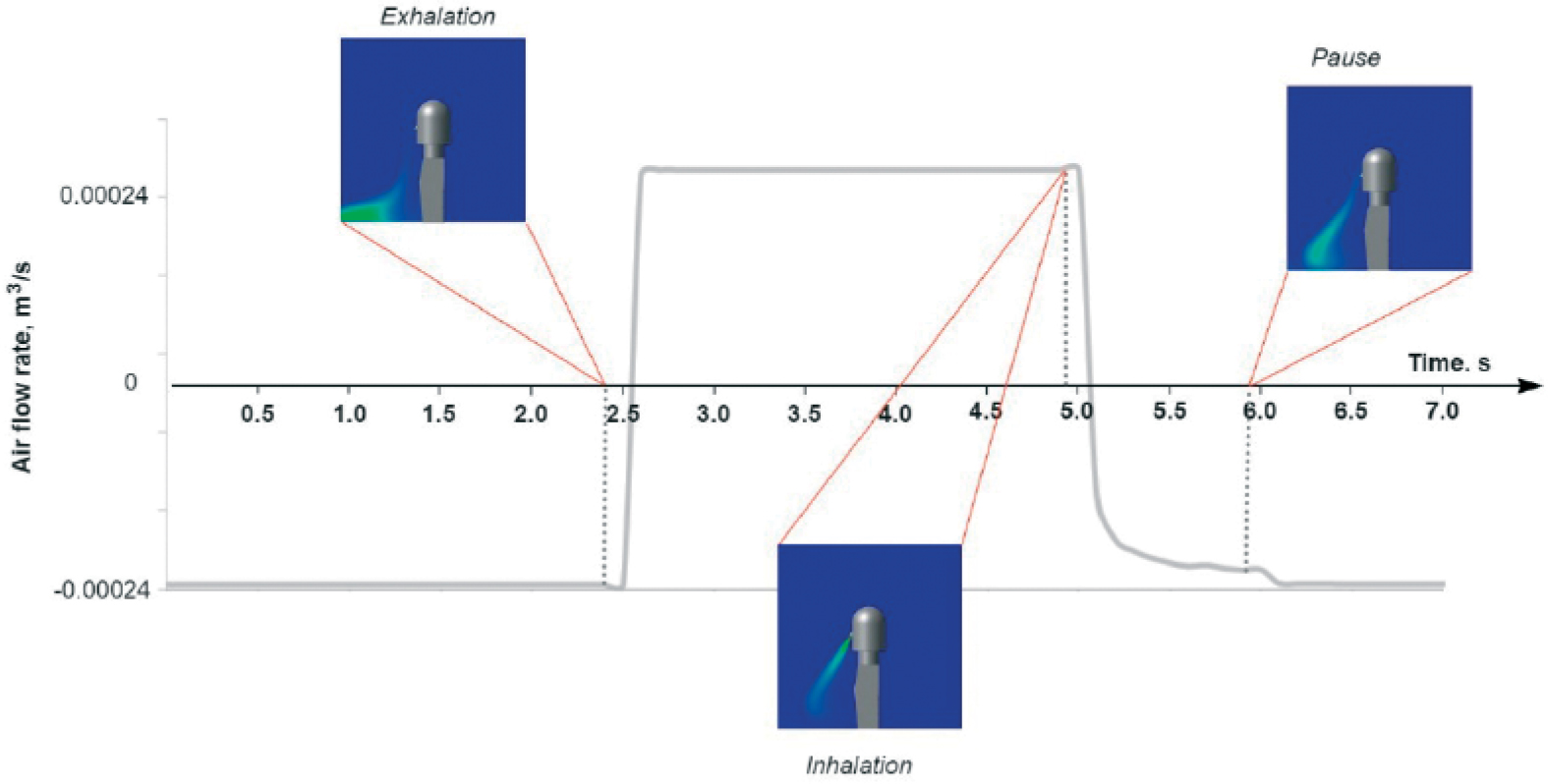
Figure 9.
Characteristic time points in the breathing cycle used in results analysis
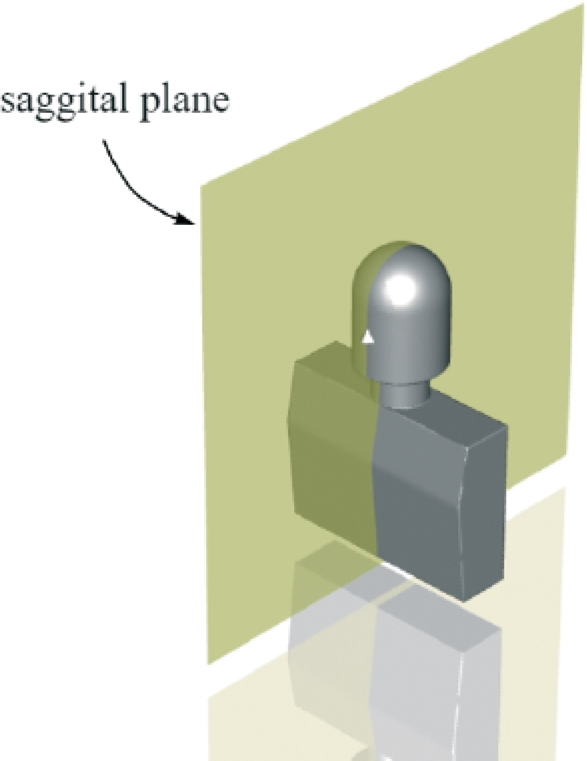
Figure 10.
Location of section plane for results visualization
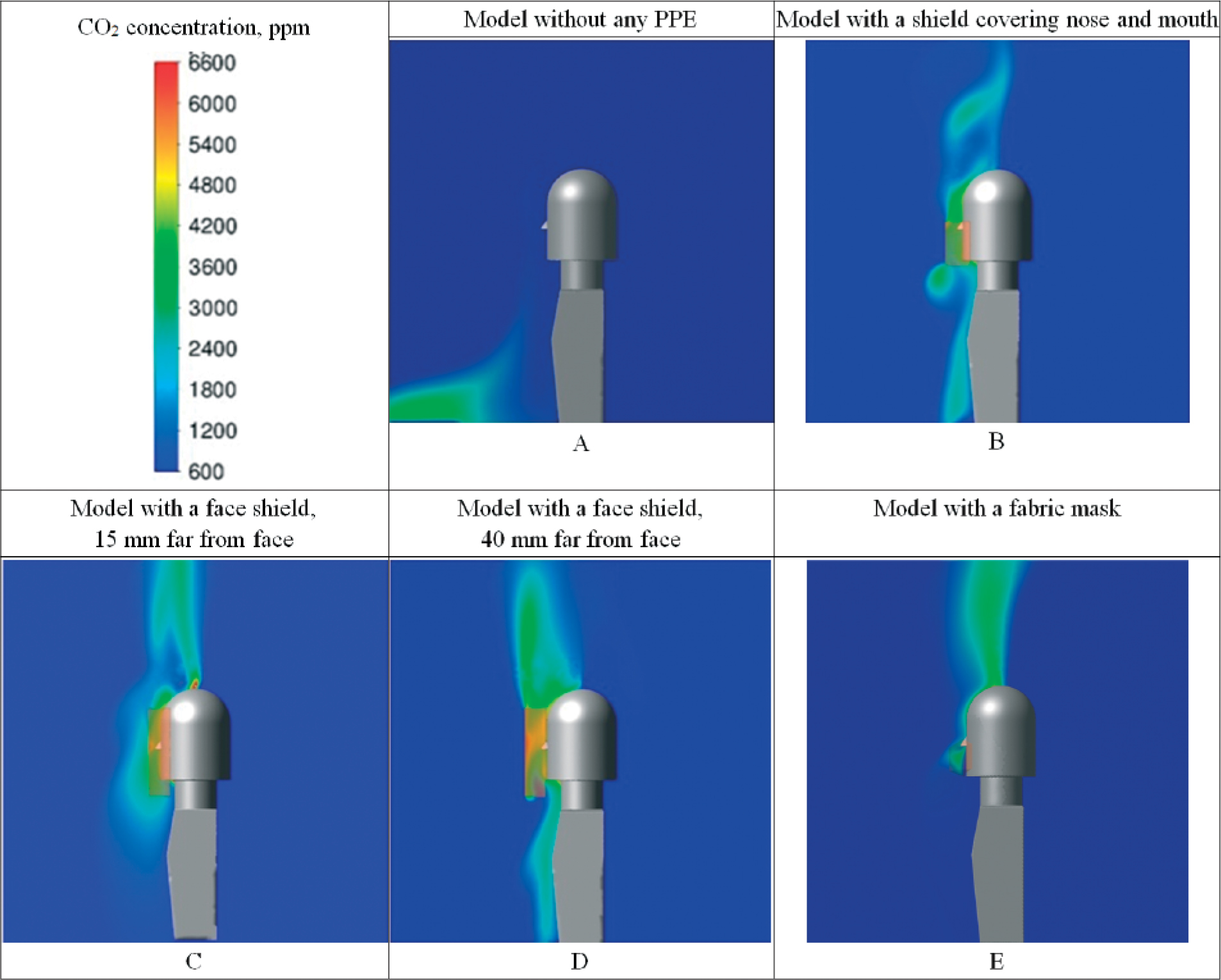
Figure 11.
Contours of CO2 concentration in the numerical domain during inhalation for the 21st breathing cycle
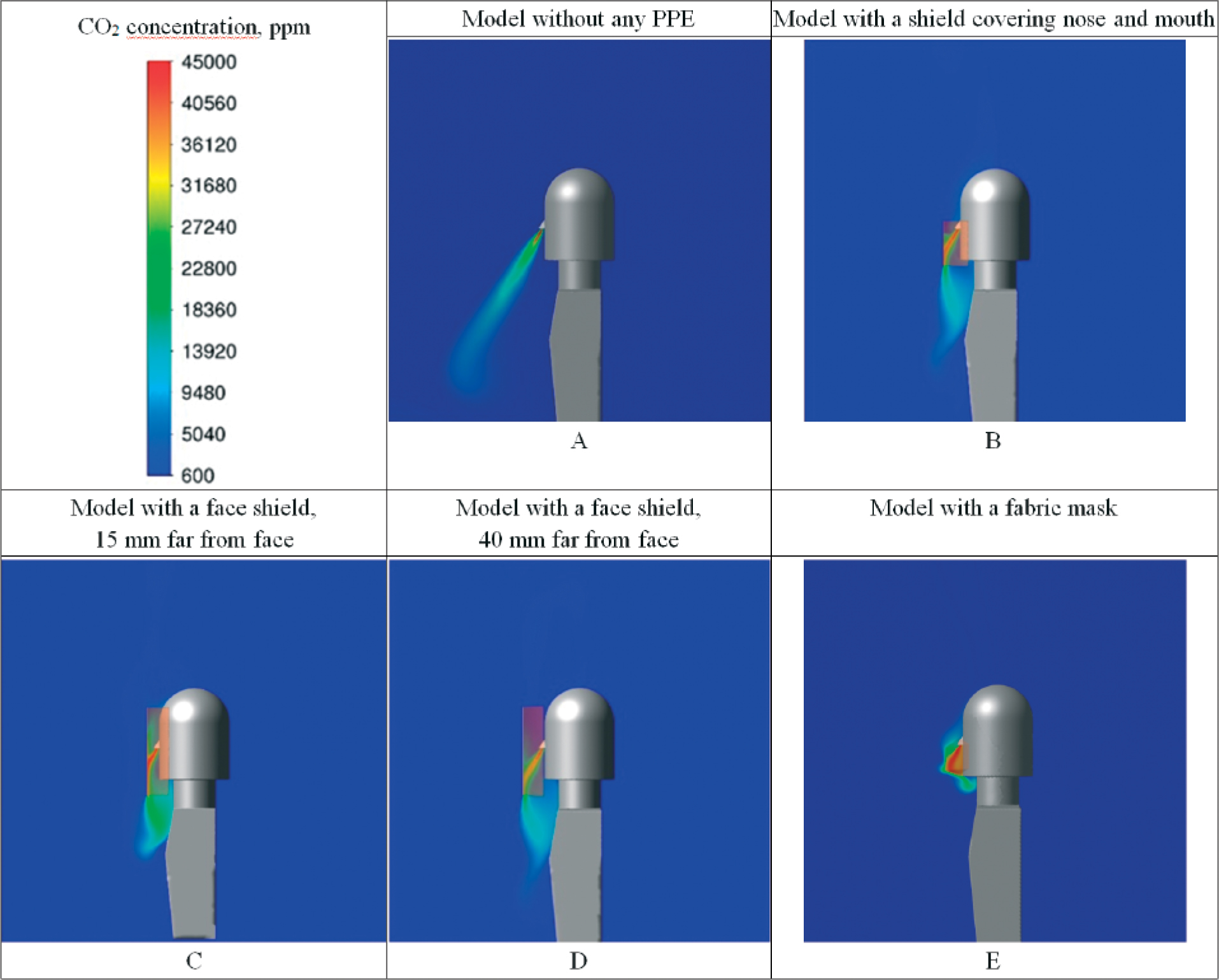
Figure 12.
Contours of CO2 concentration in the numerical domain during exhalation
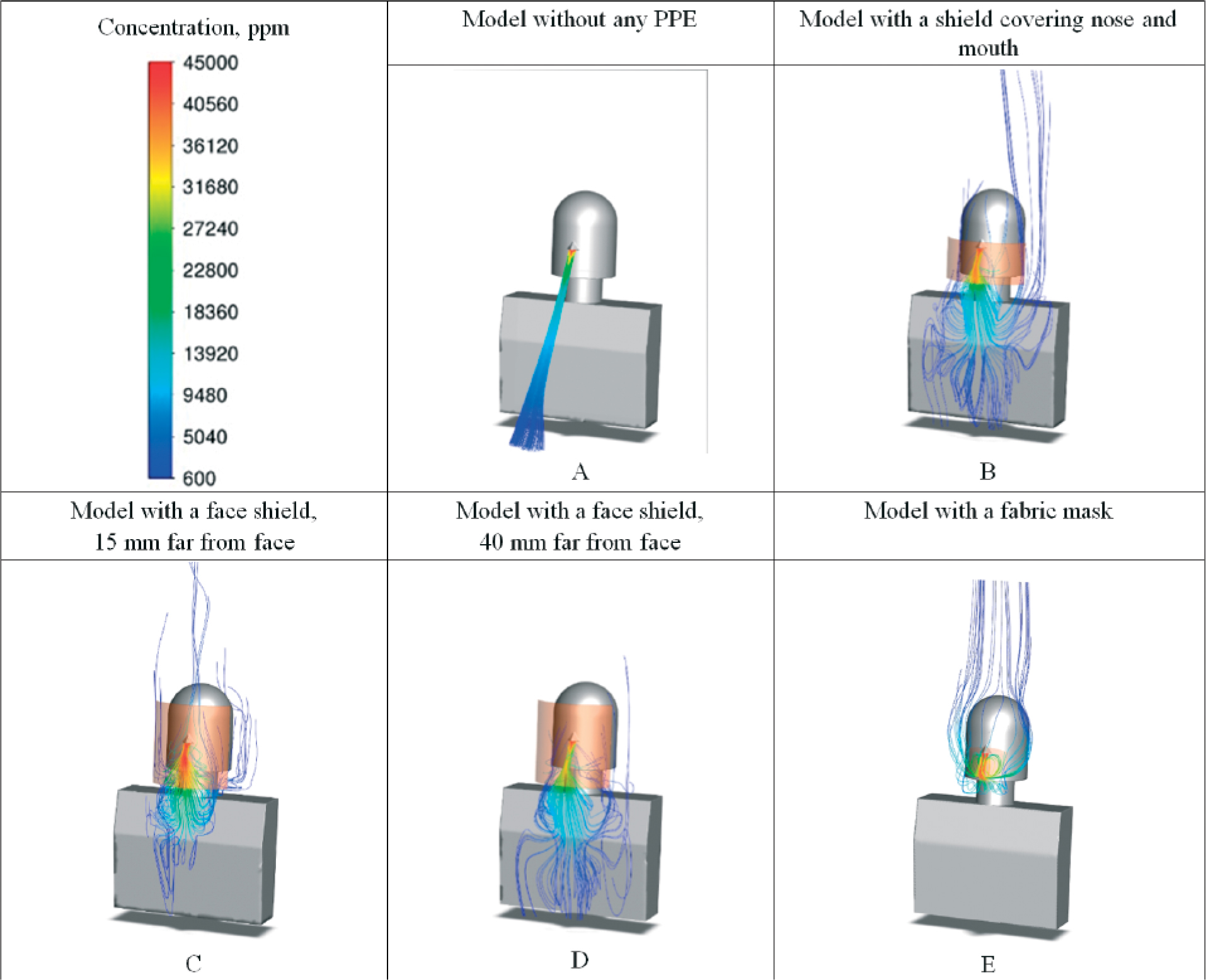
Figure 13.
Pathlines coloured with CO2 concentration in the numerical domain during exhalation
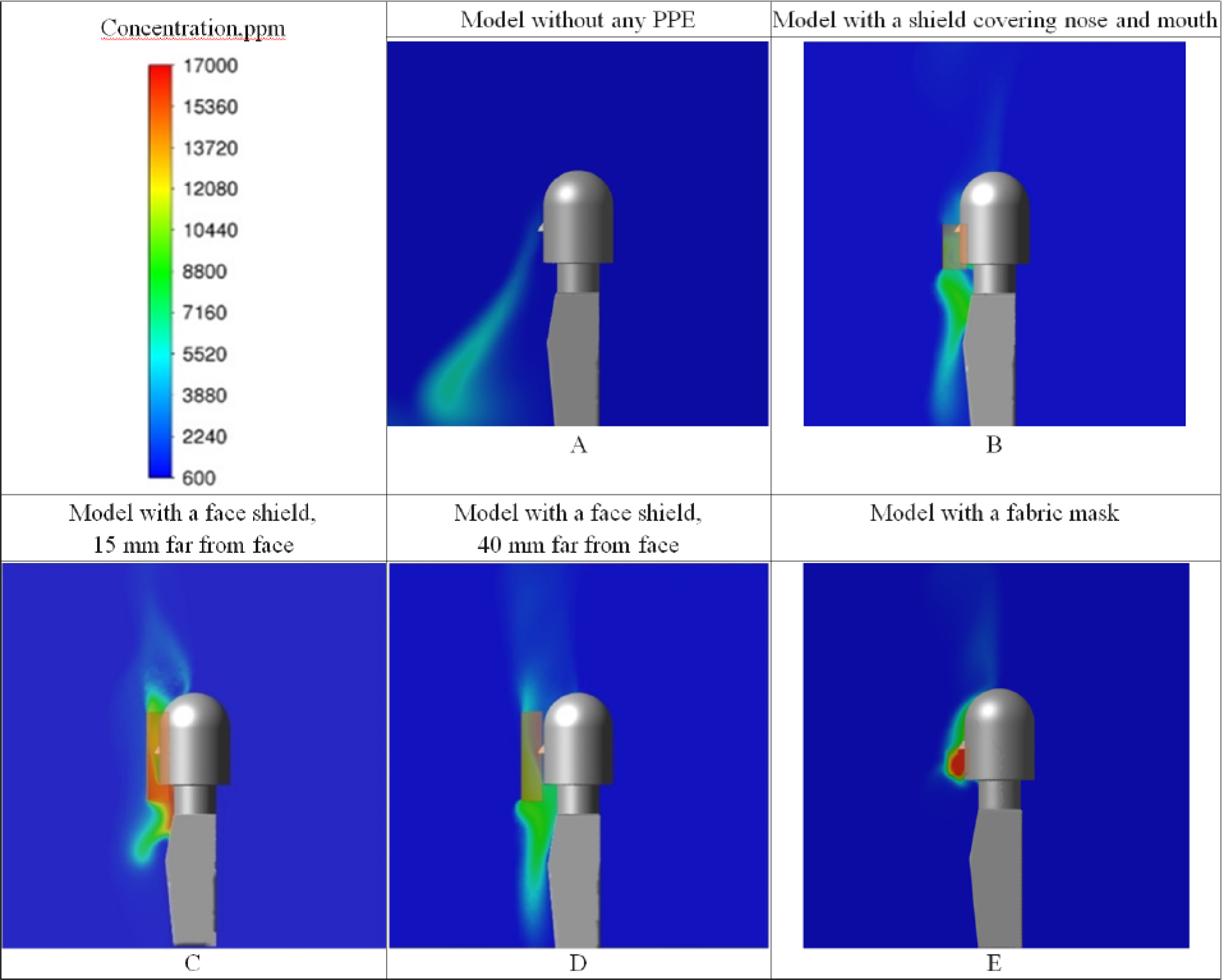
Figure 14.
Contours of CO2 concentration in the numerical domain during the pause between exhalation and inhalation
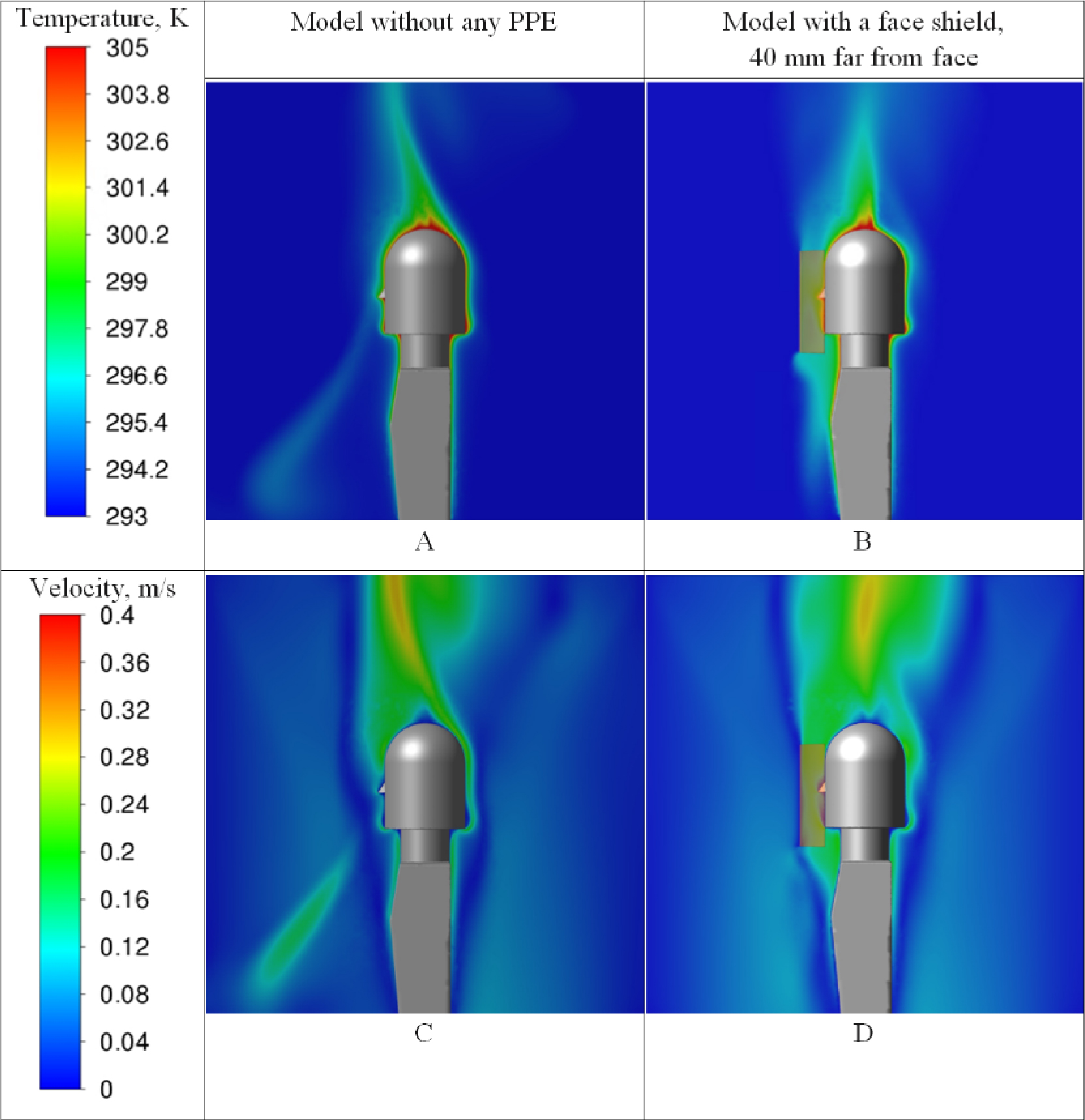
Figure 15.
Contours of temperature (K) and velocity (m/s) on the example of models without any PPE and with a face shield located 40 mm from the face, during the pause between exhalation and inhalation
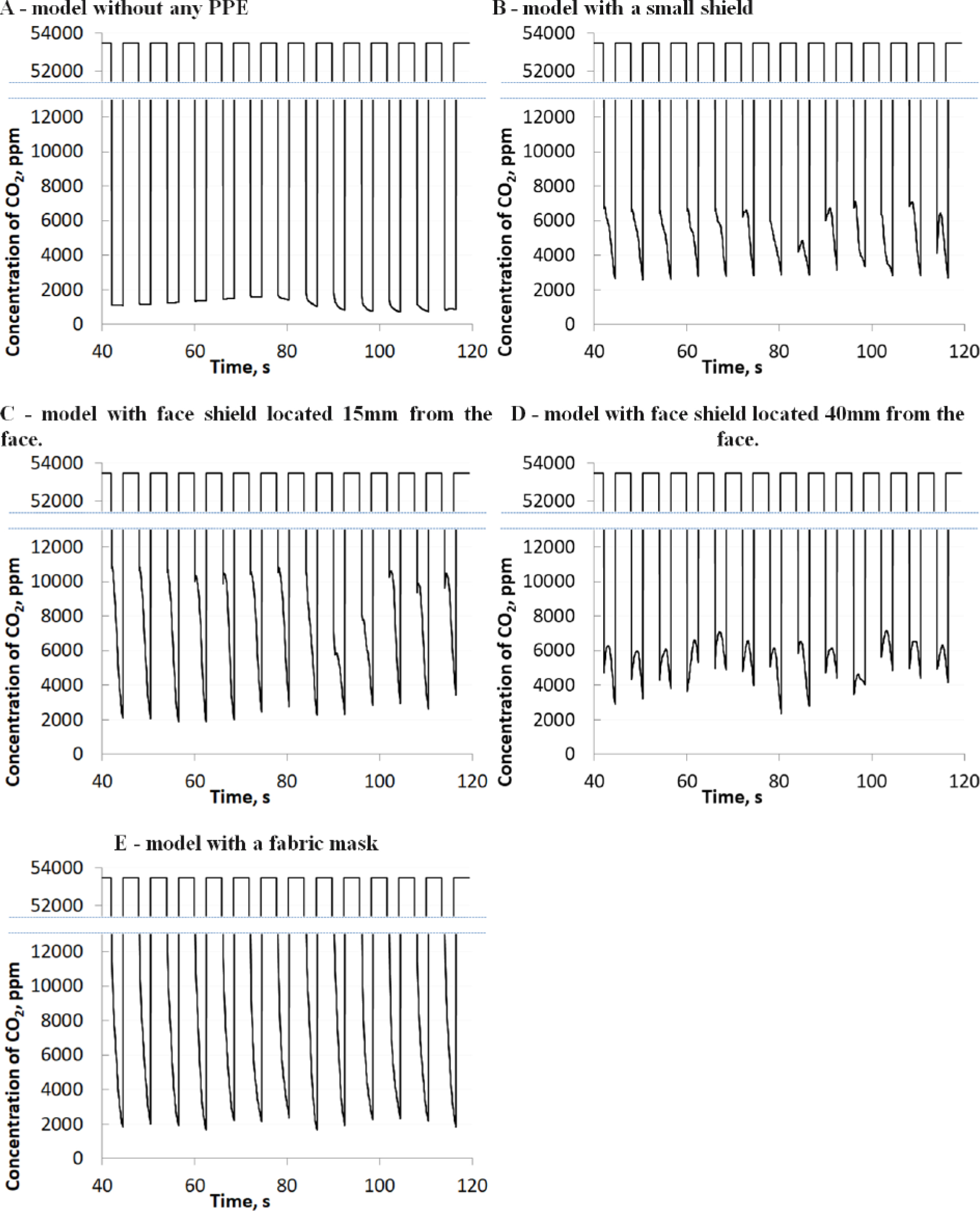
Figure 16.
Time-varying CO2 concentration monitored on the surface of the nostrils
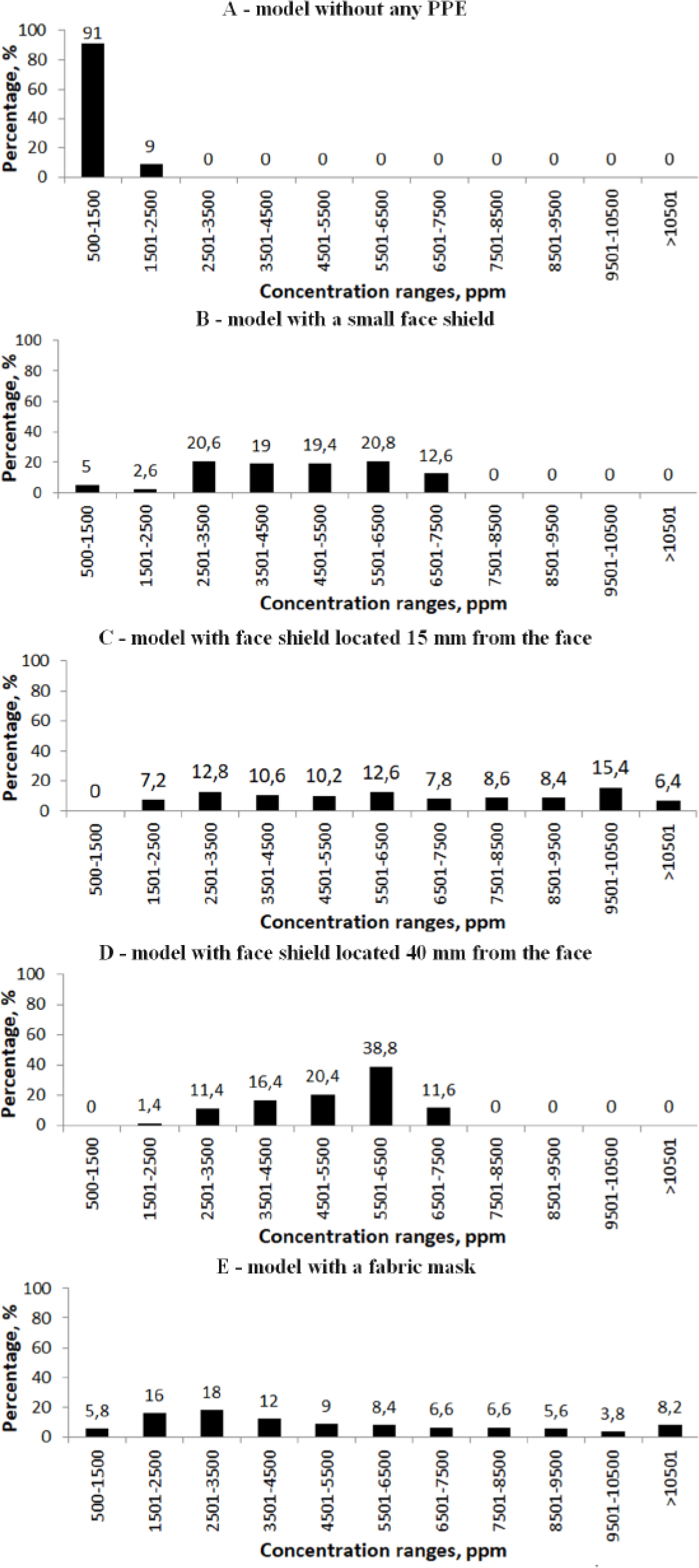
Figure 17.
Distributions of CO2 concentration ranges during the inhalation phase