
Table 1.
Socio-demographic characteristics of the study participants (n = 667)
| Variable | Number (%) |
|---|---|
| Gender | |
| Male | 209 (31.3) |
| Female | 458 (68.7) |
| Age (Mean 32.25, SD ± 1.28) | |
| 18-30 | 387 (58.1) |
| 31-60 | 280 (41.9) |
| Education status | |
| Primary | 72 (10.8) |
| Secondary | 82 (12.3) |
| University | 513 (76.9) |
| Marital status | |
| Single | 347 (52.1) |
| Married | 320 (47.9) |
| Smoking | |
| Ever | 596 (89.3) |
| Never | 71 (10.7) |
| Occupation | |
| Student | 27 (4.1) |
| Business | 89 (13.3) |
| Job | 551 (82.6) |
| Past medical or surgical history | |
| Yes | 204 (30.6) |
| No | 463 (69.4) |
| Body mass index (BMI) | |
| 25-29.9 | 487 (73.0) |
| >30 | 180 (27.0) |
Table 2.
Association of economic burden of obesity with sociodemographic characteristics among study participants (n = 667)
| Characteristics | High economic burden un-adjusted OR [95% CI] (P value) | High economic burden AOR [95% CI] (P value) |
|---|---|---|
| Age category (years) | ||
| 31-60 | 1 | 1 |
| 18-30 | 3.3 [2.5-4.4] (0.000) | 2.9 [2.2-4.0] (0.004) |
| Gender | ||
| Male | 1 | 1 |
| Female | 2.5 [2.0-3.2] (0.075) | 2.2 [1.7-2.8] (0.553) |
| Marital status | ||
| Single | 1 | 1 |
| Married | 3.5 [2.7-4.8] (0.000) | 2.6 [1.8-3.6] (0.172) |
| Education status | ||
| University | 1 | 1 |
| Secondary | 3.6 [2.1-8.0] (0.023) | 2.2 [1.1-3.8] (0.535) |
| Primary | 1.5 [0.3-2.0] (0.046) | 3.9 [2.0-9.2] (0.045) |
| Smoking status | ||
| Ever | 1 | 1 |
| Never | 2.9 [2.1-4.4] (0.023) | 2.3 [1.6-3.6] (0.427) |
| Occupation | ||
| Student | 1 | 1 |
| Business | 1.7 [1.2-3.4] (0.588) | 1.5 [1.0-2.7] (0.021) |
| Job | 2.3 [1.4-5.0] (0.598) | 2.0 [1.0-5.0] (0.983) |
| Past medical and surgical history | ||
| Yes | 1 | 1 |
| No | 4.2 [3.1-6.0] (0.000) | 3.8 [2.9-5.4] (0.000) |
| BMI | ||
| 25-29.9 | 1 | 1 |
| ≥30 | 2.4 [1.9-3.1] (0.162) | 3.0 [2.2-3.7] (0.996) |
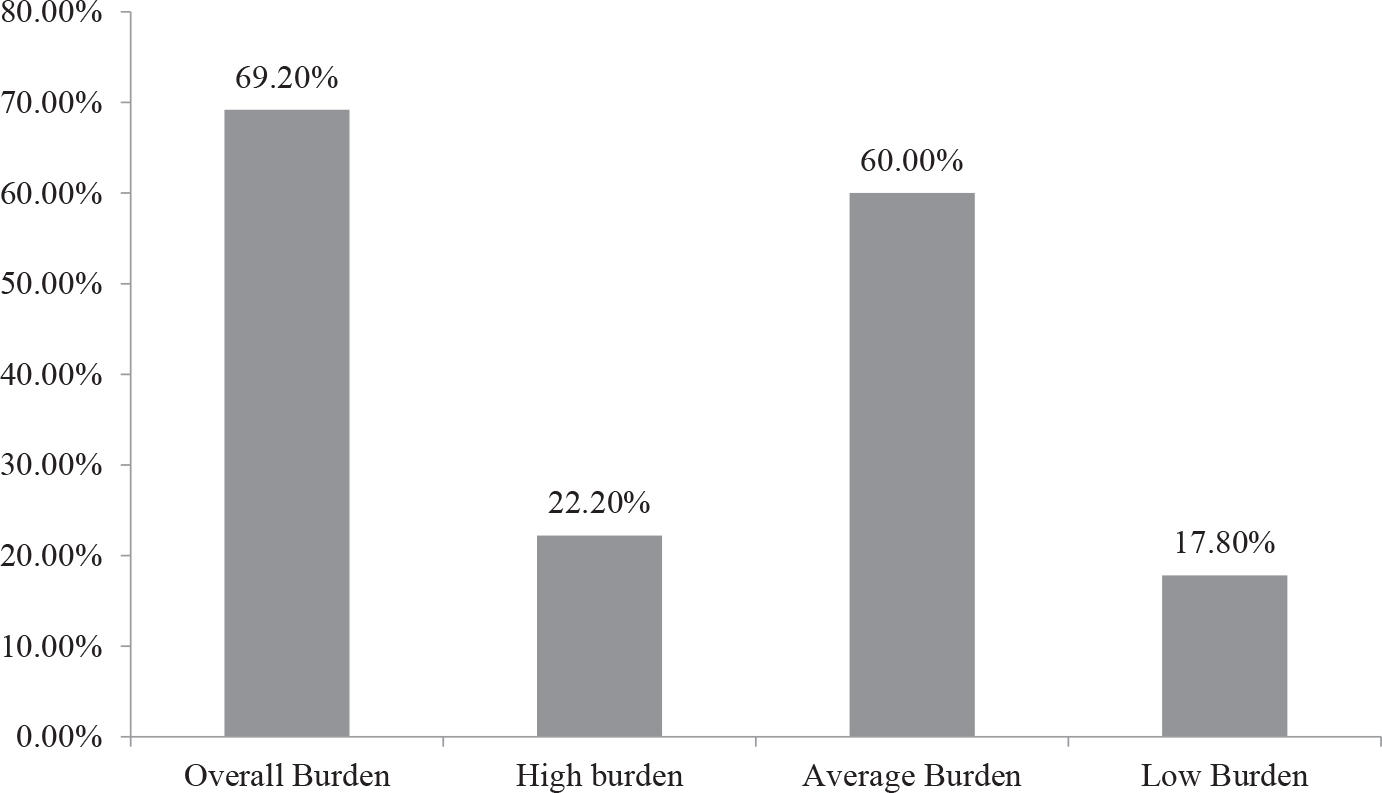
Figure 1.
Categories represent self-reported perceived economic burden due to obesity.
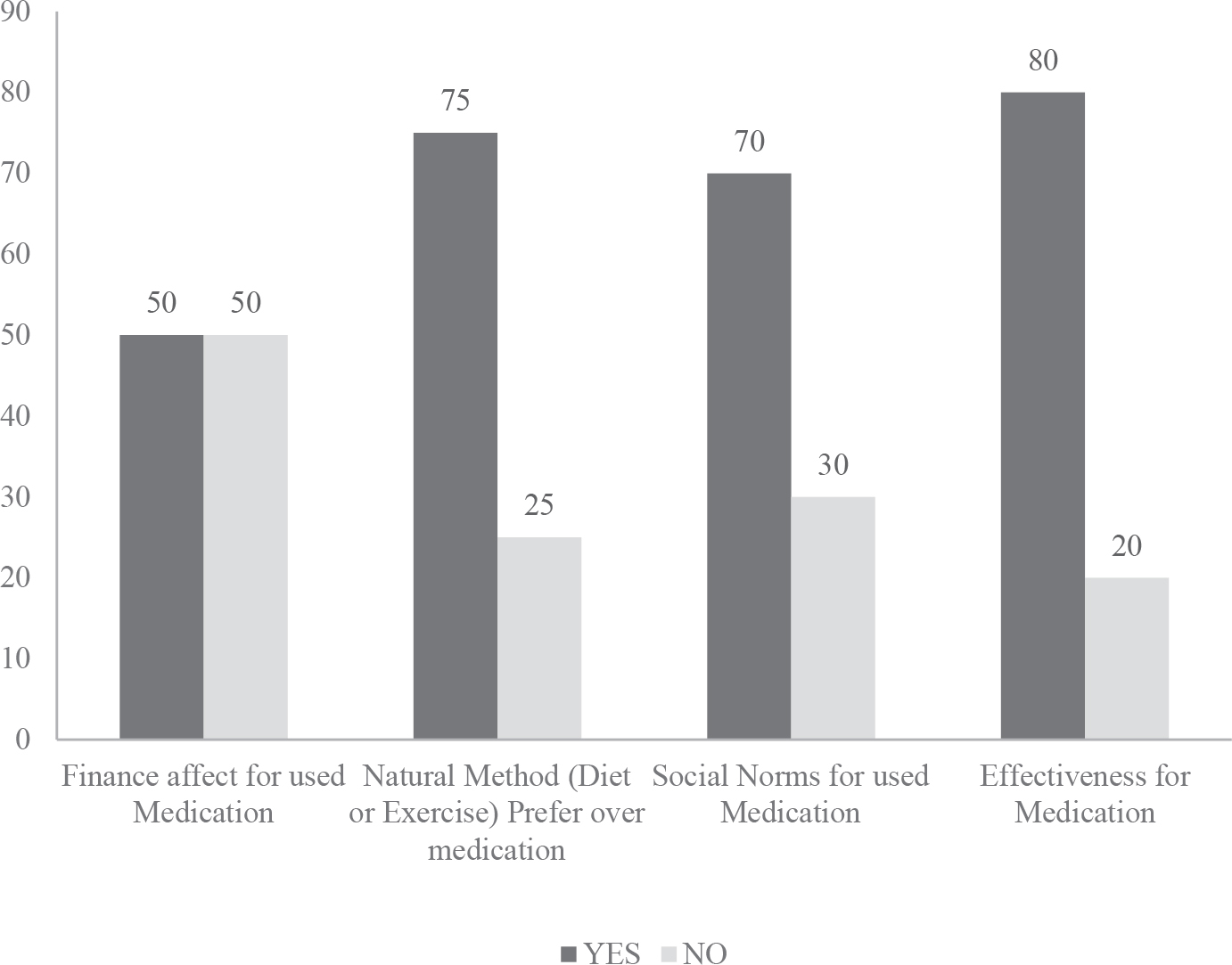
Figure 2.
Factors influencing medication used for obesity.