
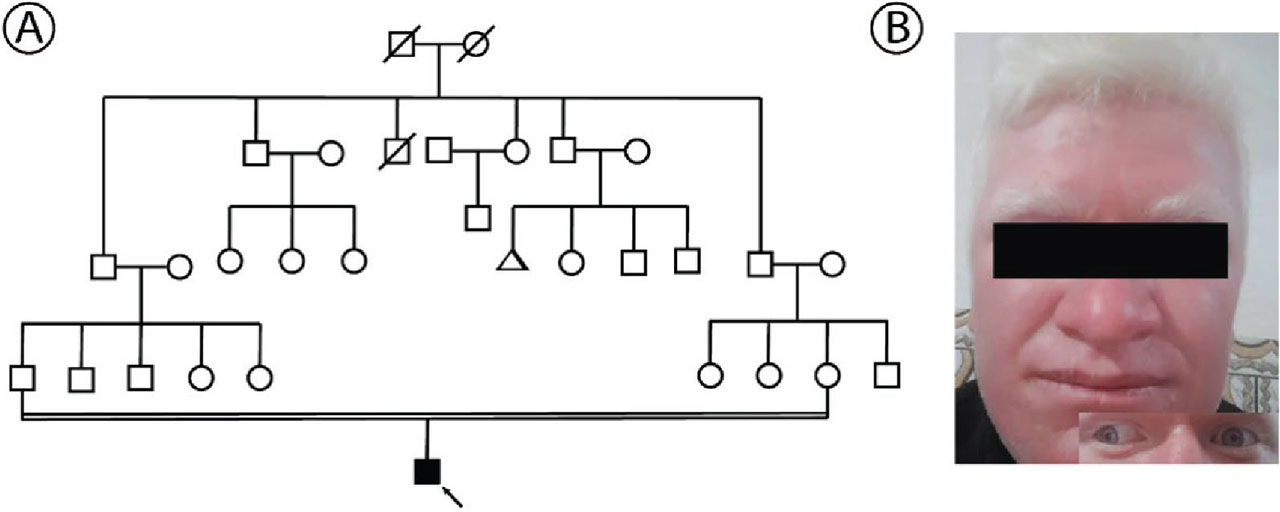
Figure 1.
(A) Pedigree of the family with albinism. Squares represent male individuals, circles represent female individuals, the black square represents the affected male patient, slashes indicate deceased individuals, and the arrow denotes the proband. Consanguineous marriage is indicated by double lines, suggesting a recessive inheritance pattern. (B) The proband with albinism shows characteristic features, including white hair, blue eyes, and right-eye deviation indicative of strabismus. Published with the patient’s written informed consent.
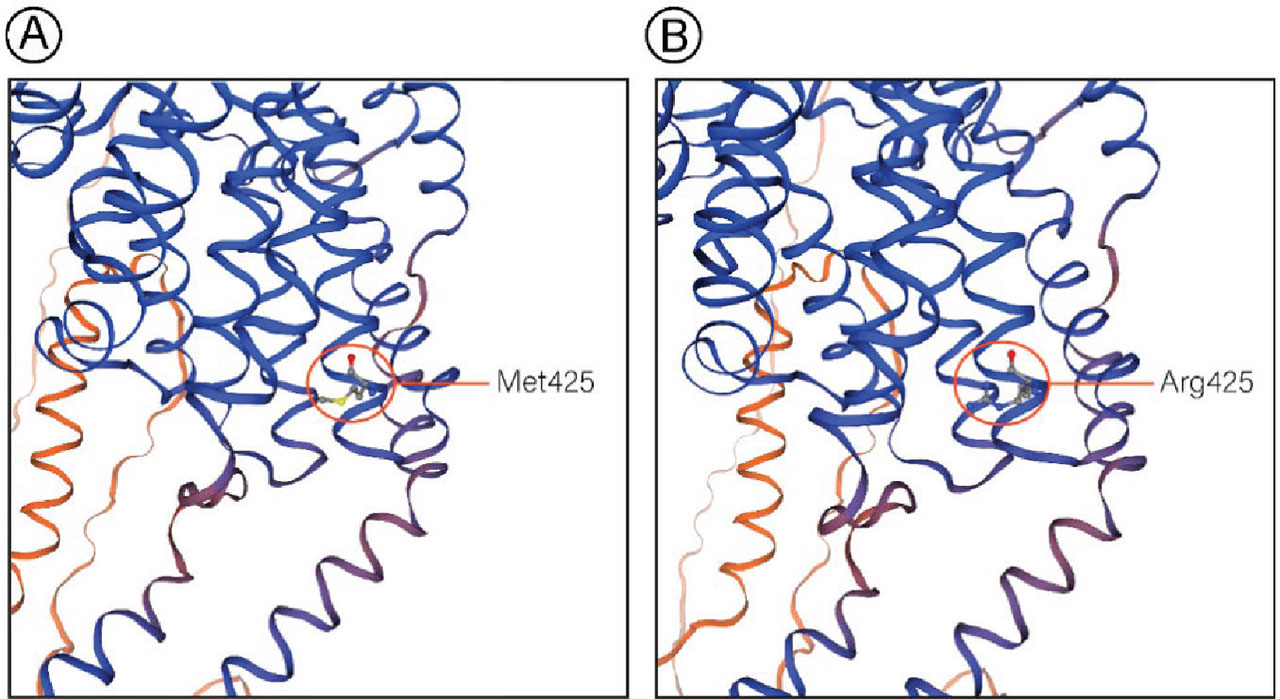
Figure 2.
Predicted 3D structures of the OCA2 protein: (A) Wild type (Met425) and (B) mutant (Arg425) variants, modeled using the Swiss Model server. OCA2, oculocutaneous albinism type 2.
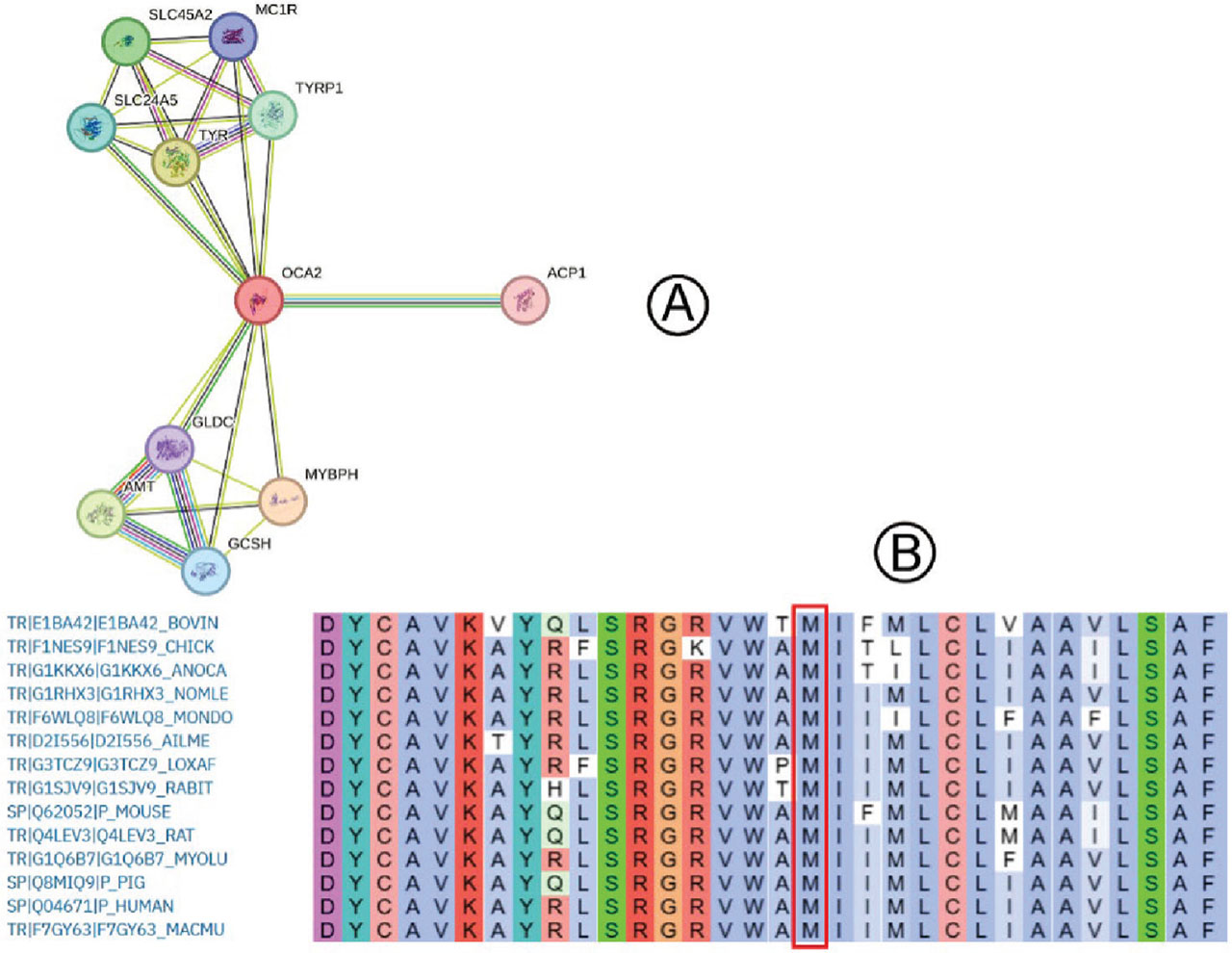
Figure 3.
(A) PPI network analysis for the OCA2 gene, illustrating interactions with genes involved in melanin synthesis and pigmentation processes. (B) Conservation analysis of the methionine residue at position 425 across 13 species, showing complete conservation, which highlights the functional importance of this amino acid in the OCA2 protein. OCA2, oculocutaneous albinism type 2; PPI, protein-protein interaction.
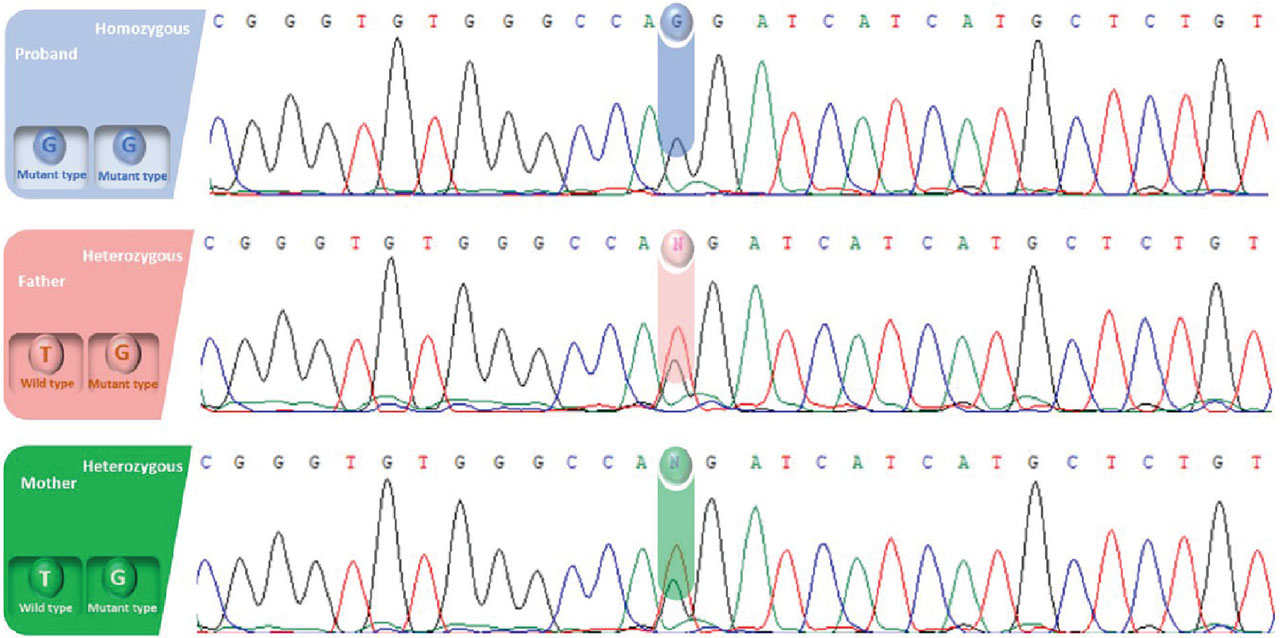
Figure 4.
Sanger sequencing chromatograms confirm the presence of a novel homozygous variant (c.1274T>G; p.Met425Arg) in the OCA2 gene in the proband. Both parents are heterozygous carriers, consistent with autosomal recessive inheritance.
Table 1.
Summary of reported OCA2 variants from previous studies
| No. | Variant(s) | Protein change(s) | Type of variant(s) | ACMG | Clinical findings | Population | Reference |
|---|---|---|---|---|---|---|---|
| 1 | c.593C>T, c.1426A>G | p.Pro198Leu, p.Asn476Asp | Missense, missense (compound heterozygous) | Pathogenic, likely pathogenic | Milky white skin, blond hair, green irises, nystagmus | Chinese | Wang et al. [21] |
| 2 | c.2458T>C | p.Ser820Pro | Missense (homozygous) | VUS | White hair, pale skin, nystagmus, photophobia, and foveal hypoplasia | Pakistani | Arshad et al. [20] |
| 3 | c.408_409delAA | p.Arg137Ilefs*83 | Frameshift (heterozygous) | Pathogenic | White hair, pale skin, nystagmus, photophobia, and foveal hypoplasia | Pakistani | Arshad et al. [20] |
| 4 | c.1762C>T | p.Arg588Trp | Missense (heterozygous) | Benign | White hair, pale skin, nystagmus, photophobia, and foveal hypoplasia | Pakistani | Arshad et al. [20] |
| 5 | c.1045-15T>G | — | Splicing (homozygous) | Likely pathogenic | White hair, pale skin, nystagmus, photophobia, and foveal hypoplasia | Pakistani | Arshad et al. [20] |
| 6 | c.2020C>G | p.Leu674Val | Missense (homozygous) | Likely pathogenic | White hair, pale skin, nystagmus, photophobia, and foveal hypoplasia | Pakistani | Arshad et al. [20]; Lee et al. [22] |
| 7 | c.1327G>A | p.Val443Ile | Missense (homozygous) | Likely pathogenic | White hair, pale skin, nystagmus, photophobia, and foveal hypoplasia | Pakistani | Arshad et al. [20]; Mondal et al. [23] |