
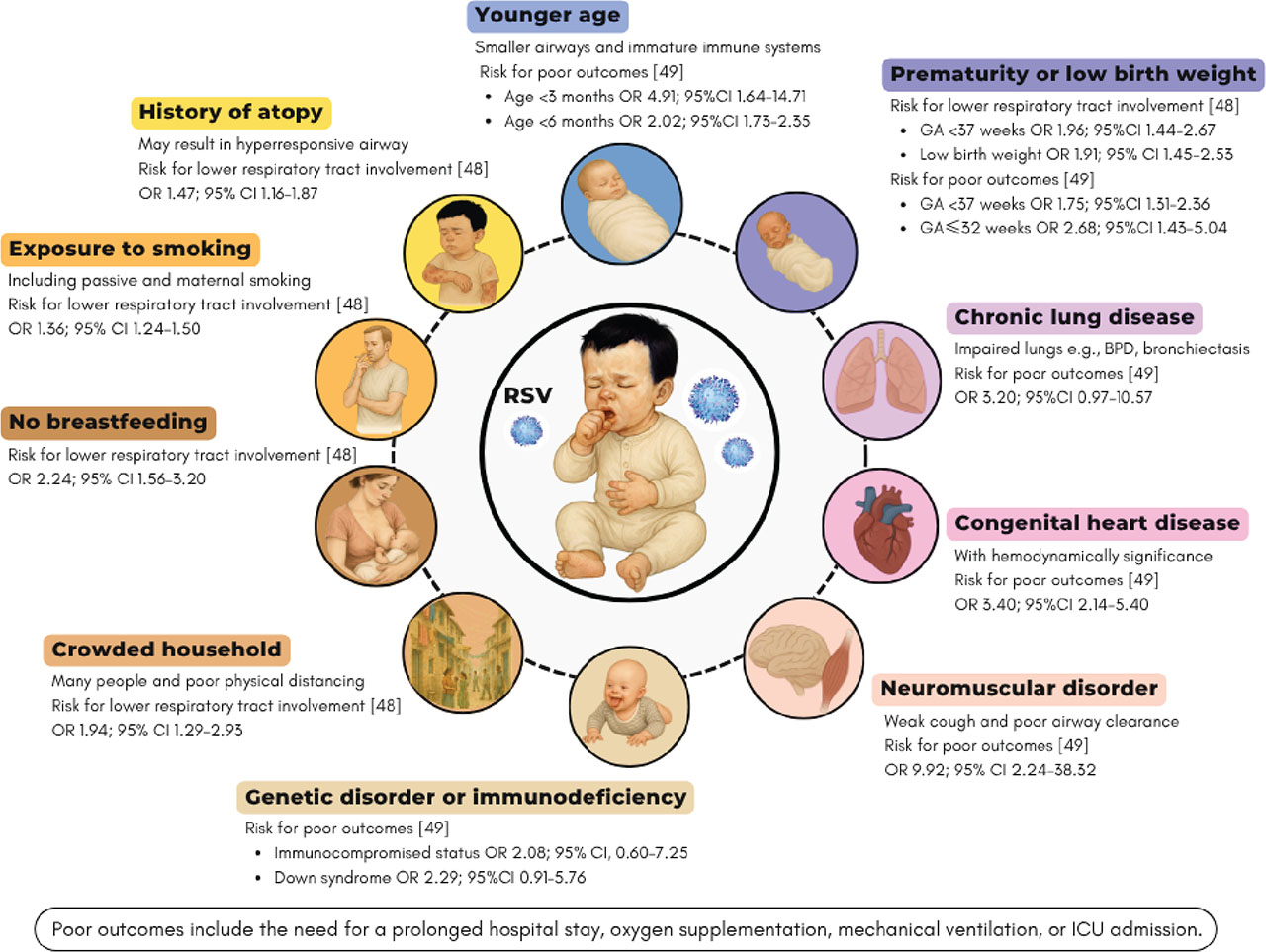
Figure 1.
Risk factors for severe RSV infection and its impacts including lower respiratory tract involvement and poor outcomes. CI, confidence interval; ICU, intensive care unit; OR, odds ratio; RSV, respiratory syncytial virus.
Table 1.
Comparison of RSV severity scoring systems in infants and children
| Scoring system | Assessment variables | Scoring method | Severity interpretation |
|---|---|---|---|
| MTS [56] |
| Each variable scored 0–3 |
|
| WBSS [57] |
| Each variable scored 0–3, except general appearance (0–3) |
|
| GRSS [58] | Age, respiratory rate, SpO2, retractions, wheezing, rales, cyanosis, nasal flaring, feeding difficulty | Continuous score from 0 to 10 based on logistic regression, requiring a software to calculate | Higher scores indicate more severe infection |
| PRESS [59] |
| Each variable scored 0 or 1 |
|
| RSV-CLASS [60] |
| Each variable scored 0 or 1 | Higher scores indicate more severe infection |
Table 2.
Vaccine efficacy of bivalent RSVPreF during pregnancy to prevent LRTI in infants from the MATISSE study [79]
| Outcomes | Vaccine efficacy % (95% or 97.58% CI) |
|---|---|
| Medically attended severe RSV-associated lower respiratory tract illness in infants | |
| • 90 days after birth | 81.8 (40.6–96.3) |
| • 120 days after birth | 73.9 (45.6–88.8) |
| • 150 days after birth | 70.9 (44.5–85.9) |
| • 180 days after birth | 69.4 (44.3–84.1) |
| Medically attended RSV-associated lower respiratory tract illness in infants | |
| • 90 days after birth | 57.1 (14.7–79.8) |
| • 120 days after birth | 56.8 (31.2–73.5) |
| • 150 days after birth | 52.5 (28.7–68.9) |
| • 180 days after birth | 51.3 (29.4–66.8) |
Table 3.
Recommendations for administering the bivalent RSVPreF vaccine in pregnant women in different countries [6, 78, 80,81,82]
| Country/organization | Gestational age (weeks) | Vaccination period |
|---|---|---|
| WHO | ≥28 | Year-round |
| United Kingdom | ≥28 | Year-round |
| IDAT | 24–36 | Year-round |
| Austria | 24–36 | For births between September and March |
| Belgium | 28–36 | For births between September and March |
| Australia | 28–36 | Year-round |
| United States | 32–36 | September to January |
| Canada | 32–36 | Before late autumn to early spring |
| France | 32–36 | September to January |
| Argentina | 32–36 | March to August |
Table 4.
Currently recommended vaccines for Thai pregnant women [80]
| Vaccine | Dosage and timing |
|---|---|
| Td toxoid | 0–3 doses, any trimester |
| Influenza vaccine | 1 dose, any trimester (prefer 12–20 weeks) |
| Acellular pertussis vaccine | 1 dose, ≥16 weeks (prefer 20–32 weeks) |
| COVID-19 vaccine | 1 dose, any trimester (prefer 12–20 weeks) |
| RSV vaccine | 1 dose, 24–36 weeks (prefer 28–32 weeks) |
Table 5.
| Feature | Palivizumab | Nirsevimab | Clesrovimab |
|---|---|---|---|
| Target site | Antigenic site II on the F protein | Antigenic site Ø on the prefusion F protein | Antigenic site IV of the F protein |
| Administration | Monthly intramuscular injection during RSV season (up to 5 doses) | Single intramuscular dose | Single intramuscular dose |
| Target population | High-risk (premature birth, BPD, CHD) infants and young children in subsequent seasons | All infants in their first season and high-risk children in subsequent seasons | All preterm and full-term infants in their first season, studied between 2 weeks and 8 months of age |
| Duration of protection | Monthly injections provide protection during the RSV season | Single injection provides protection for approximately 5 months | Extended half-life suggests potential for once-per-RSV season dosing |
| Efficacy | Reduces RSV hospitalization by 78% in premature infants, 39% in children with BPD, and 45% in children with CHD | Reduces RSV hospitalization by 62% in late premature and term infants, and 78% in premature infants (GA 29–35 weeks) | Reduces RSV-associated hospitalizations by 84% in infants |
| Safety profile | Generally safe, with similar adverse events to placebo. Some studies report slightly higher rates of fever and injection site reactions | Comparable to palivizumab, with no significant safety concerns | Generally well tolerated, with no treatment-related serious adverse events |
| Dosage | 15 mg/kg of body weight per dose | Single dose of 50 mg (for infants <5 kg) or 100 mg (for infants ≥5 kg) and 200 mg in subsequent season | Single dose of 105 mg for infants |
| Engineering for long-acting | Mean half-life of 20 days following intramuscular administration | Extended half-life of approximately 69 days | Extended half-life of approximately 45 days |