
Figure 1.
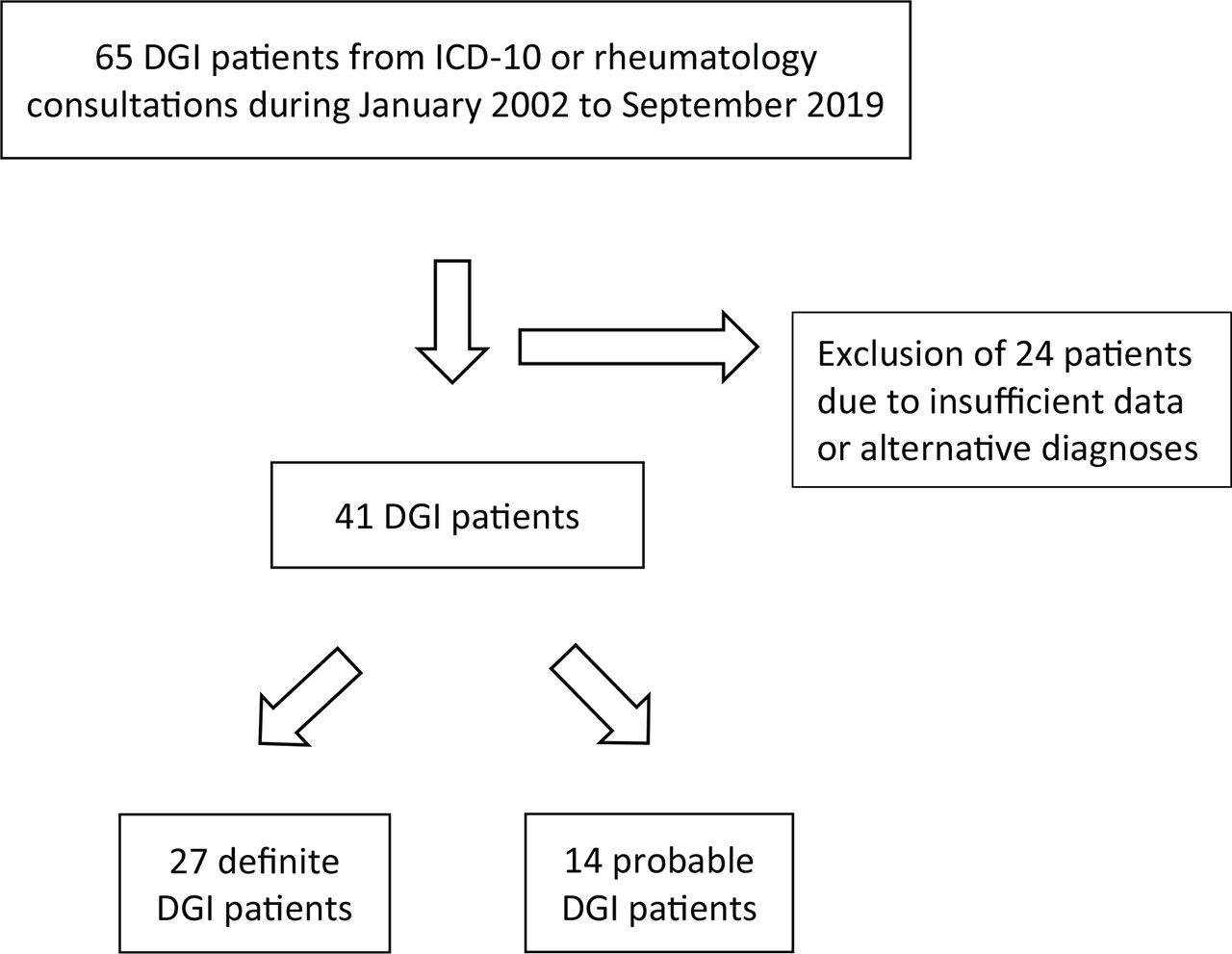
Flow chart of the recruitment of DGI patients. DGI, disseminated gonococcal infection.
The flowchart outlines the selection of patients diagnosed with disseminated gonococcal infection (DGI) from ICD-10 or rheumatology consultations between January 2002 and September 2019.
- Initially, 65 DGI patients were identified.
- 24 patients were excluded due to insufficient data or alternative diagnoses.
- 41 DGI patients remained after exclusions.
- These 41 patients were further divided into:
- 27 definite DGI patients.
- 14 probable DGI patients.
Table 1.
Demographic data of patients with DGI
This table presents the clinical features of DGI patients, comparing between definite and probable DGI groups. It includes symptoms such as fever, chills, joint pain, and genitourinary symptoms. The table also reports signs such as arthritis, tenosynovitis, and skin lesions. A notable finding is that tenosynovitis was significantly more common in the probable DGI group.
| Total patients (n = 41) | Definite DGI (n = 27) | Probable DGI (n = 14) | |
|---|---|---|---|
| Age at diagnosis | 30, 20–37, 16–81 | 33, 22–41, 16–81 | 22, 19–32, 16–42 |
| Median, IQR, range (years) | |||
| 15–30 | 22 (53.7%) | 12 (44.4%) | 10 (71.4%) |
| 31–40 | 10 (24.4%) | 8 (29.6%) | 2 (14.3%) |
| 41–50 | 5 (12.2%) | 3 (11.1%) | 2 (14.3%) |
| 51–60 | 1 (2.4%) | 1 (3.7%) | 0 |
| >60 | 3 (7.3%) | 3 (11.1%) | 0 |
| Sex | |||
| Male | 17 (41.5%) | 10 (37%) | 7 (50%) |
| Female | 24 (58.5%) | 17 (63%) | 7 (50%) |
Table 2.
Clinical data of the patients with DGI
Presents clinical symptoms and signs among DGI patients, including fever, joint pain, and skin lesions.
Significant differences in tenosynovitis between definite and probable DGI groups (p = 0.033).
| Total patients (n = 41) | Definite DGI (n = 27) | Probable DGI (n = 14) | P* | |
|---|---|---|---|---|
| Presenting symptoms | ||||
| Fever | 37 (90.2%) | 26 (96.3%) | 11 (78.6%) | 0.107 |
| Chills | 14 (34.1%) | 8 (29.6%) | 6 (42.9%) | 0.494 |
| Joint pain | 41 (100%) | 27 (100%) | 14 (100%) | – |
| Skin lesions | 11 (26.8%) | 7 (25.9%) | 4 (28.6%) | 1.000 |
| Genitourinary symptoms (dysuria or discharge) | 12 (29.3%) | 9 (33.3%) | 3 (21.4%) | 0.494 |
| Presenting signs | ||||
| Arthritis | 38 (92.7%) | 25 (92.6%) | 13 (92.9%) | 1.000 |
| Number | ||||
| Median, IQR, range | 2, 1–3, 1–14 | 2, 1–3, 1–14 | 2, 1–3, 1–7 | 1.000 |
| Distribution of joint involvement | 0.885 | |||
| Monoarthritis | 14 (36.8%) | 10 (40%) | 4 (30.8%) | |
| Oligoarthritis | 20 (52.6%) | 12 (48%) | 8 (61.5%) | |
| Polyarthritis | 4 (10.5%) | 3 (12%) | 1 (7.7%) | |
| Tenosynovitis | 26 (63.4%) | 14 (51.9%) | 12 (85.7%) | 0.033 |
| Skin lesion | 16 (39%) | 9 (33.3%) | 7 (50%) | 0.300 |
| Urethral discharge | ||||
| Yes | 7 (17.1%) | 5 (20.8%) | 2 (14.3%) | |
| No | 31 (75.6%) | 19 (79.2%) | 12 (85.7%) | 1.000 |
| Missing | 3 cases | 3 cases | - | |
Table 3.
The pattern of joint involvements
Describes joint involvement patterns: monoarthritis, oligoarthritis, and polyarthritis.
Wrists, ankles, and knees were the most commonly affected joints.
| Number (%) | |
|---|---|
| Number of joint involvements | |
| Monoarthritis | 14 (36.8) |
| Oligoarthritis | 20 (52.6) |
| Polyarthritis | 4 (10.5) |
| Site of joint involvements | |
| Wrist joint | 18 (47.4) |
| Ankle joint | 17 (44.7) |
| Knee joint | 14 (36.8) |
| Shoulder joint | 6 (15.8) |
| Metacarpophalangeal (MCP) joint | 6 (15.8) |
| Elbow joint | 5 (13.2) |
| Proximal interphalangeal (PIP) joint | 3 (7.9) |
| Hip joint | 2 (5.3) |
| Tarsometatarsal joint | 2 (5.3) |
| Sternoclavicular joint | 1 (2.6) |
| Axial and sacroiliac joint | 0 (0) |
| Temporomandibular joint | 0 (0) |
Table 4.
Microbiological data of the patients with DGI
Reports on the positivity of synovial fluid cultures, Gram stains, and PCR tests for N. gonorrhoeae.
Ceftriaxone susceptibility was confirmed in all cases, with resistance noted for ciprofloxacin and penicillin.
| Number of tested patients (%) | Number of positive specimens (%) | |
|---|---|---|
| Hemoculture | 32 (78.0) | 4 (12.5) |
| Synovial fluid for aerobic culture | 33 (80.5) | 10 (30.3) |
| Synovial fluid for Gram stain | 29 (70.7) | 11 (37.9) |
| Synovial fluid for PCR or 16s-rRNA amplification for N. gonorrhoeae | 3 (7.3) | 3 (100) |
| Specimen from mucosae for aerobic culture | ||
| Cervical swab | 15 (36.5) | 5 (33.3) |
| Urethral swab | 16 (39.0) | 3 (18.8) |
| Pharyngeal swab | 15 (36.5) | 2 (13.3) |
| Rectal swab | 11 (26.8) | 1 (9.1) |
| Pustule for aerobic culture | 1 (2.4) | 1 (100) |