
Table 1.
Differentiation of tremor from tremor mimics
| Tremor | Cortical myoclonus | EPC | |
|---|---|---|---|
| Movement | Oscillatory | Shock-like or jerky | Tonic/clonic |
| Single or repetitive | Repetitive | ||
| Rhythmicity | Regular but sometimes looks irregular in dystonic tremor syndromes or with some variability in amplitude of tremor | Irregular but can be rhythmic with repetitive myoclonus (8–18 Hz) | Regular and rhythmic (2–3 Hz) but can be irregular |
| Condition | Rest, postural, kinetic | Rest, postural, kinetic | Rest |
| Stimulus sensitivity | No reflex sensitivity | Can be triggered with sensory stimulation | No reflex sensitivity |
| Distribution | Bilateral or unilateral | Bilateral, symmetrical | Unilateral |
| Distal or proximal | Distal > proximal | Distal > proximal | |
| Upper limb > lower limb | Upper limb ~ lower limb | Upper limb > lower limb |
Table 2.
Step-by-step description of tremor examination
| Activation of tremor | Position/task | Provocation test/Specific observation | Associated examination |
|---|---|---|---|
| Rest tremor |
|
|
|
|
| ||
| Postural tremor |
| Putting a slip of paper on top of hands (visualize fine tremor) |
|
| Putting the weight on the dorsum of hands | |||
|
| ||
| *Listening to high frequency tremor with stethoscope* | |||
| Kinetic tremor |
|
|
|
|
| ||
| Specific signs for functional tremor | Keep the position that elicits tremor | ||
|
| ||
| *Observe co-activation sign* |

Figure 1.
The example of a spiral/line drawing and sentence writing in patients with EPT (A), ET (B), and writer’s cramp with DT (C). EPT and ET show bilateral tremors with spiral drawing with unilateral axis, while DT exhibits tremor on the affected side with multidirectional axis. DT, dystonic tremor; EPT, enhanced physiologic tremor; ET, essential tremor.
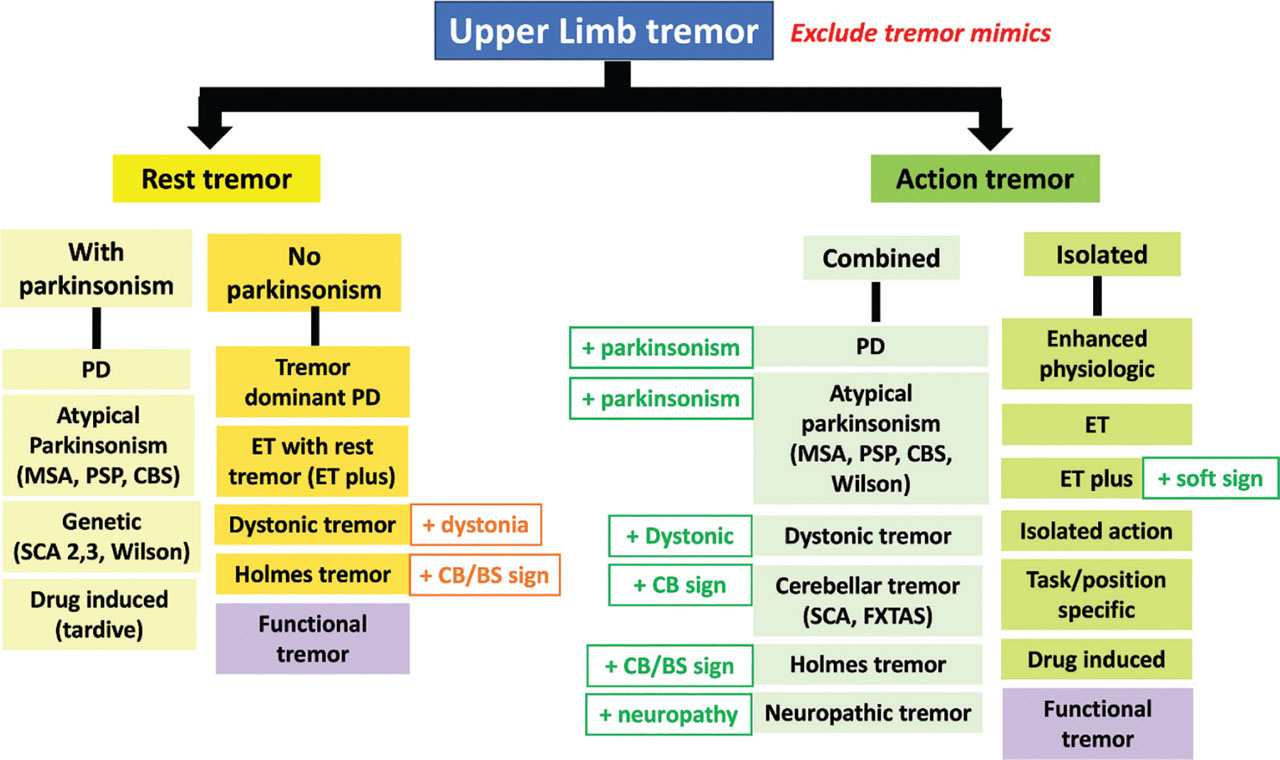
Figure 2.
Differential diagnosis of tremor syndromes in the category of action and rest tremor of the upper limb CB; cerebellar, BS; brainstem.
Table 3.
Clinical features of essential tremor and enhanced physiological tremor
| Essential tremor | Enhanced physiologic tremor | |
|---|---|---|
| Activation | Kinetic (intentional component) > postural | Postural or kinetic |
| (amplitude of kinetic > postural) | (amplitude of postural > kinetic) | |
| Rest (in severe cases with action tremor) | Intentional component uncommon | |
| Distribution | Hands (flexion/extension of wrist, bilateral) | Fingers > hands (+/− voice) |
| Head, voice, jaw (with hands) | NOT head, jaw | |
| Frequency | 4–10 Hz (decrease with age) | 8–12 Hz |
| Changes with different tasks and different body parts | ||
| Amplitude | Fine to large | Fine |
| Aggravating /relieving factors | Alcohol responsiveness | Increase with stress, exercise, fatigue, caffeine |
| Pathophysiology | Central oscillator in the cerebello-thalamo-cortical pathway | Sympathetic overactivity and increase sensitivity of peripheral components |
| Weighting | Similar frequency | Decrease frequency |
| Treatment | Beta-blocker, primidone, topiramate | Beta-blocker |
| Surgery (DBS, MRI FUS thalamotomy) | Decrease aggravating factors | |
| Assistive devices |
Table 4.
Clinical characteristics of Parkinson’s disease, dystonic tremor, and essential tremor
| Parkinson’s disease | Dystonic tremor | Essential tremor | |
|---|---|---|---|
| Symmetry | Asymmetry | Asymmetry | Symmetry (mostly) |
| Activation | R > P > K | P ~ K > R | K > P >>> rest |
| (Not intentional) | (Not intentional) | (Intentional) | |
| **Suppression of rest tremor with movements** | Rest (can be early) | Rest (in severe cases with action tremor) | |
| **Re-emergent tremor** | **position or task specific** | ||
| Distribution | Hands (pill-rolling, rotation of wrist, forearm) > jaw, tongue > leg > head | Head > Hands > jaw Isolated head, voice, jaw | Hands >> head > voice > jaw (with hands in severe cases) |
| Frequency | 4–7 Hz | 5–7 Hz | 4–10 Hz |
| Amplitude | Large, waxing & waning | Large, irregular, jerky | Fine to large |
| Association | Parkinsonism | Dystonic posture | Mild ataxia |
| Non-motor symptoms: RBD, anosmia, constipation, depression | Null point (head), overflow/mirror dystonia, sensory trick | Non-motor symptoms: anxiety, depression, cognitive impairment | |
| Family history | Usually absent in late onset | Sometimes present | Present in early onset |
| Treatment | Dopaminergic agent (response 50%) | Anticholinergics | Beta-blocker, primidone, topiramate |
| Anticholinergics | Botulinum toxin injection | Surgery (DBS, MRI FUS thalamotomy) | |
| Surgery (DBS, FUS) | Assistive devices |
[i] DBS; deep brain stimulation, FUS; focus ultrasound, MRI; magnetic resonance imaging, R; rest, P; postural, K; kinetic.

Figure 3.
Practical step-by-step algorithms of approaching tremor.