
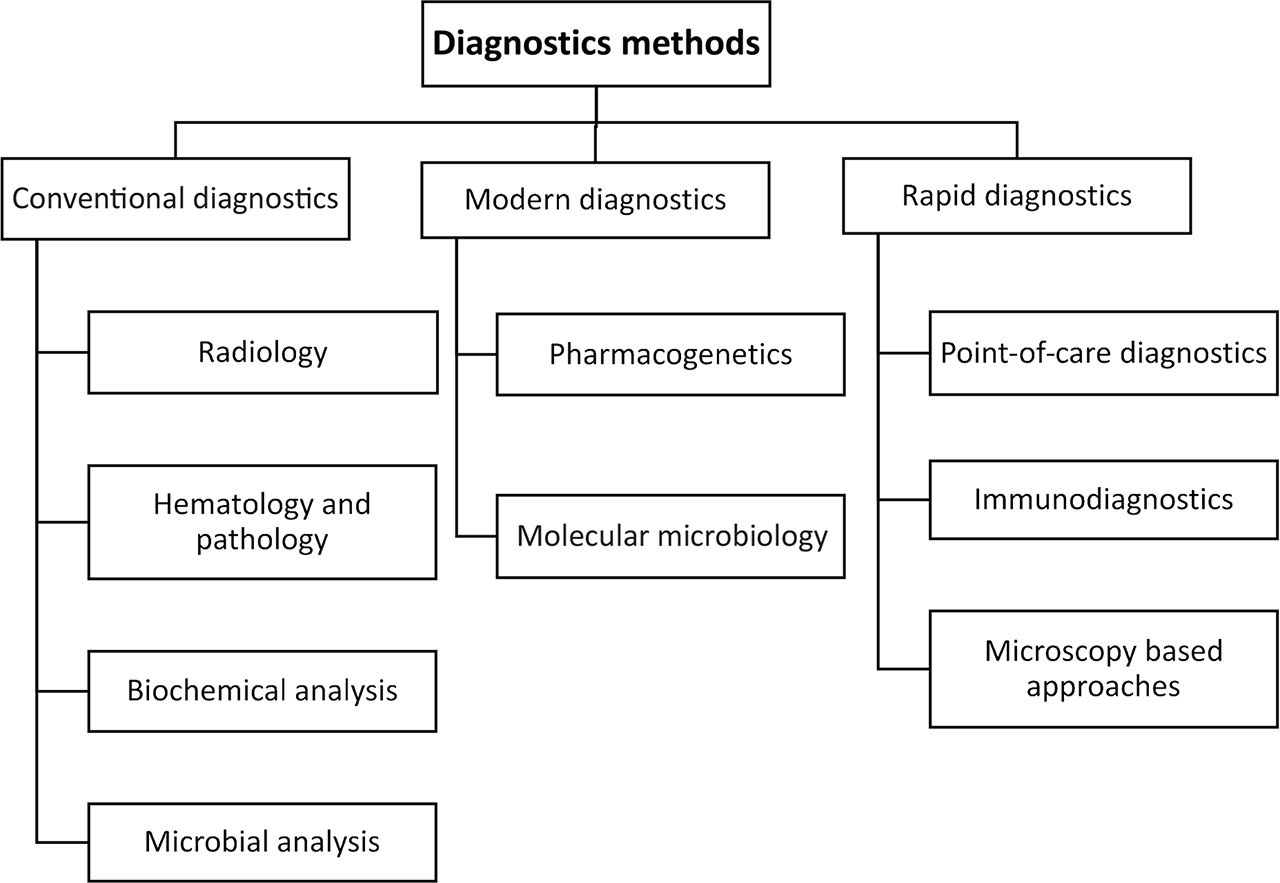
Figure 1.
Types of diagnostic methods.
Table 1.
Different properties of various POCT devices
| Types | Properties | References |
|---|---|---|
| Qualitative strip–based handheld POCT devices |
| [17, 18] |
| Quantitative strip or chip–based with unit use analyzers |
| |
| Bench top POCT analyzers |
| |
| Molecular biology–based/nucleic acid POCT devices |
|
[i] ICS, immunochromatographic strips; INR, international normalized ratio; LFDs, lateral flow devices; POC, point-of-care; POCT, point-of-care testing.
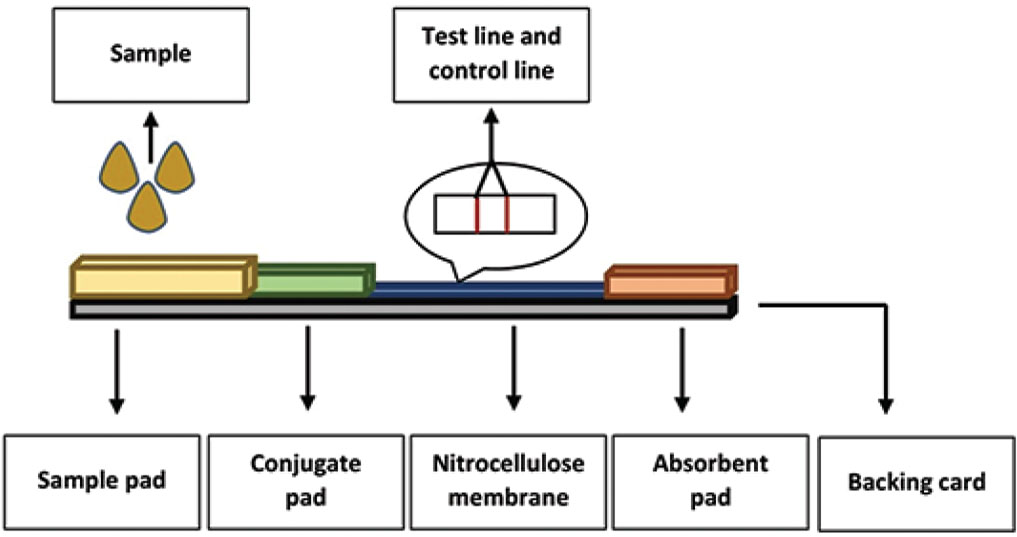
Figure 2.
Components of lateral flow assays.
Table 2.
Sensing modality, features, advantages, and disadvantages of various LFAs
| Sensing modality | Features | Advantages | Disadvantages | References |
|---|---|---|---|---|
| Optical | Colorimetric | Colorimetric changes help to make a visual observation for result interpretation | Sensitivity issues that lead to result inaccuracy | [53] |
| Fluorescence | Provides results with higher signal to noise ratio; higher sensitivity | Fluorescent labels are not visible at low concentration; requires external reader for specific analysis | [54] | |
| SERS | High sensitivity with very low detection limit; can be developed into ultiplex LFA for a wide range of detection | Expensive | [55] | |
| Chemiluminescence | High sensitivity when used together with metal nanoparticles; lower LOD; highly stable for immobilization | Requires addition of enzymatic substrate; low shelf-life | [56] | |
| Thermal | Thermal imaging | Improved LOD and high sensitivity; no photo bleaching or photo instability | The infrared image sensors are massive; expensive | [57] |
| Laser speckle imaging | Uses improved depth resolution reader that improves sensitivity | Expensive and not suitable at resource-limited settings | [58] | |
| PA imaging | PA imaging helps sample penetration deeper that improves the sensitivity of detection | Strips need to be dried before analysis since acoustic waves travelling through water-interface is a challenge | [44, 59] | |
| Magnetic | MPQ | Low detection limit and highly sensitive | Not suitable for multiplex detection when using high affinity variants | [52, 60] |
| Electrochemical | Amperometry, cyclic voltametric, impedimetric | The ratio of applied voltage can be adjusted to increase the sensitivity of the detection; nanoparticle integration to improve LOD | Requires expensive reagents and multistep procedure | [44, 61] |
[i] LFA, lateral flow assay; LOD, limit of detection; MPQ, magnetic particles quantification; PA, photoacoustic; SERS, surface enhanced Raman scattering.
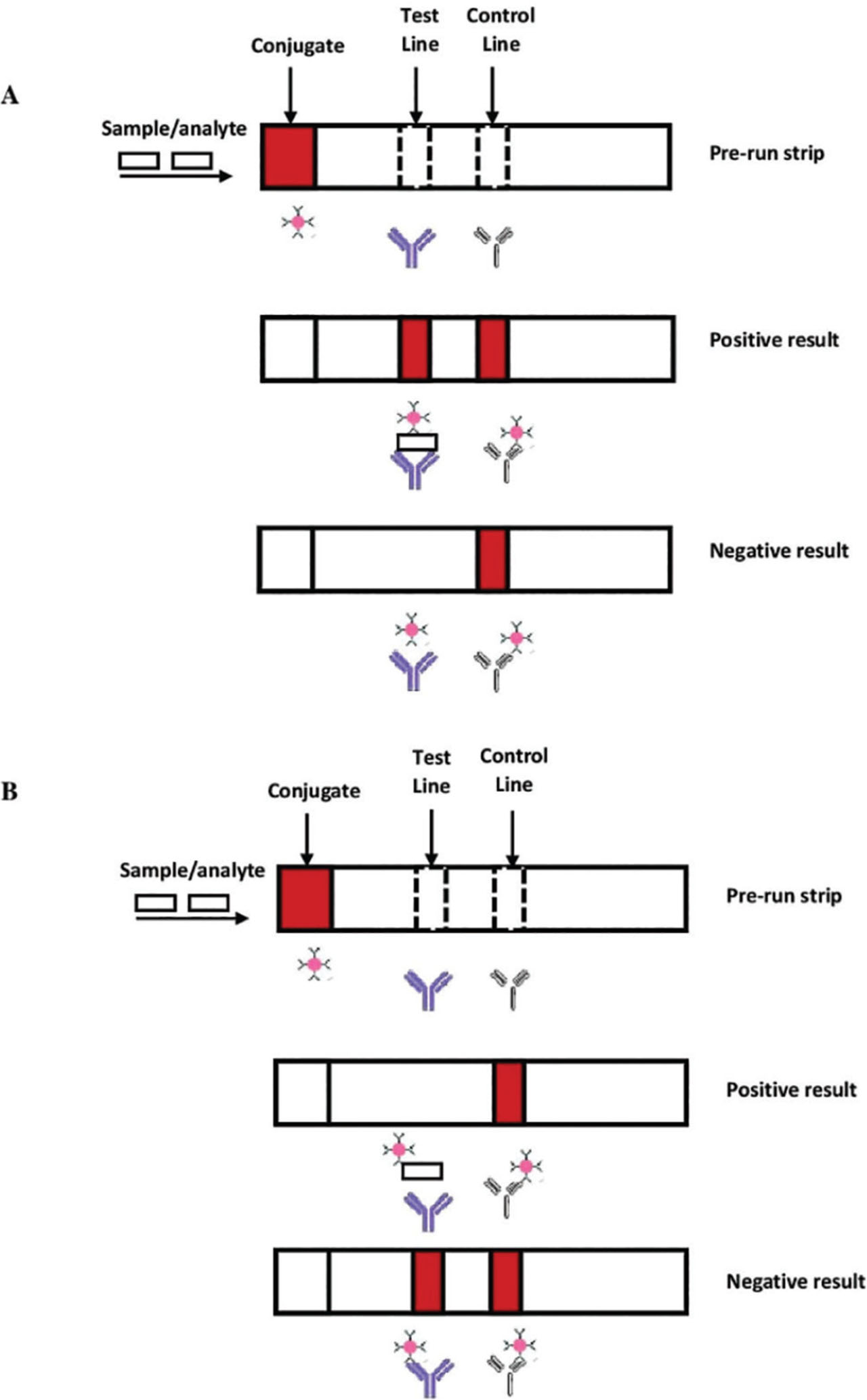
Figure 3.
Lateral flow assay designs. (A) Sandwich assay or not competitive assay: A visible signal produced at both the test line and control line indicates the positive result. The analyte is present in the sample and hybridized to the capturing molecule at the test line. The absence of analyte gave a negative result where the signal was only produced at the control line. The signal at the control line is a result of the hybridization of the capturing molecule at the control line region that is complementary to the free conjugate molecules. (B) Competitive assay: A visible signal only at the control line gave a positive result, indicating the competition of analytes with the capturing molecule and no aggregation of conjugated particles at the test line. However, the signal at both the test line and control line gave a negative result, indicating the absence of analytes in the sample and binding of conjugated particles to the capturing molecules at the test line.