
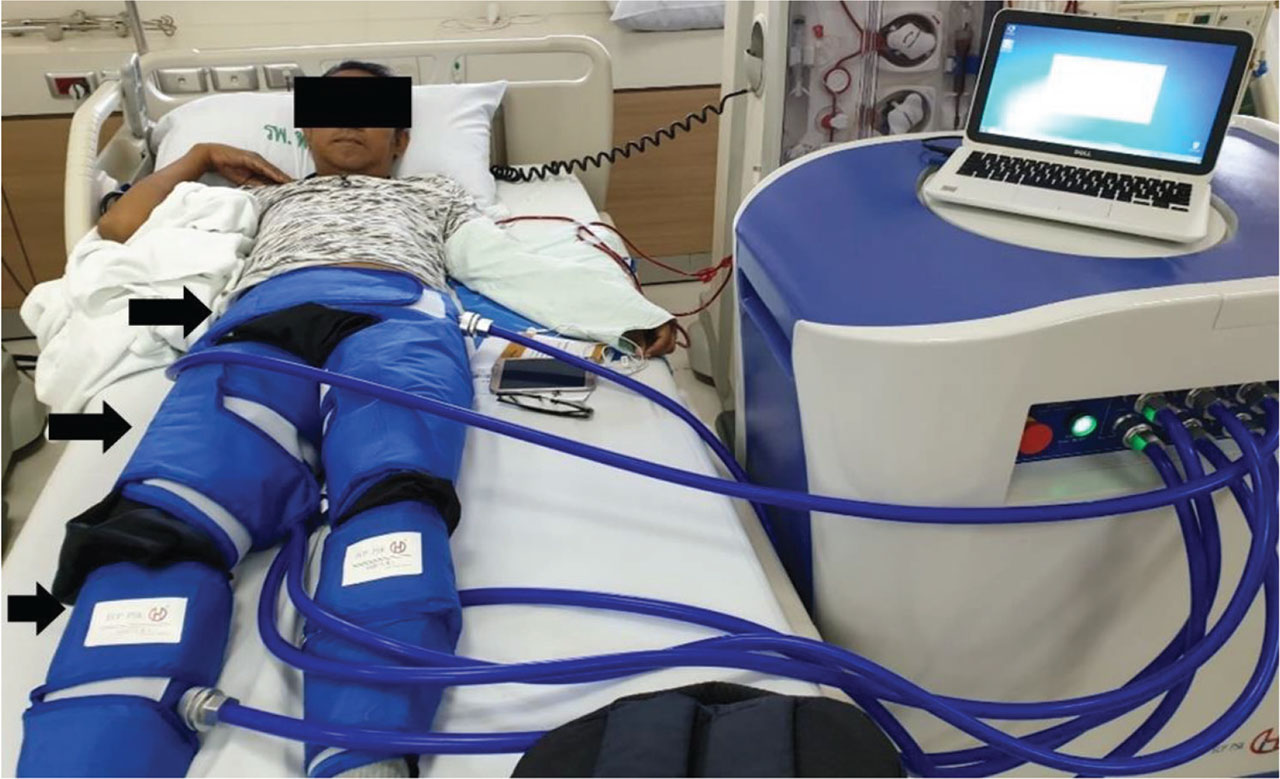
Figure 1.
Application of EECP in King Chulalongkorn Memorial Hospital. Each arrow represents the cuff component in a 3-cuff EECP system (with consent from the patient for publication). This is a novel utilization of the device during the hemodialysis session to improve intradialytic hemodynamics. EECP is traditionally applied in subjects not receiving dialysis. EECP, enhanced external counterpulsation.
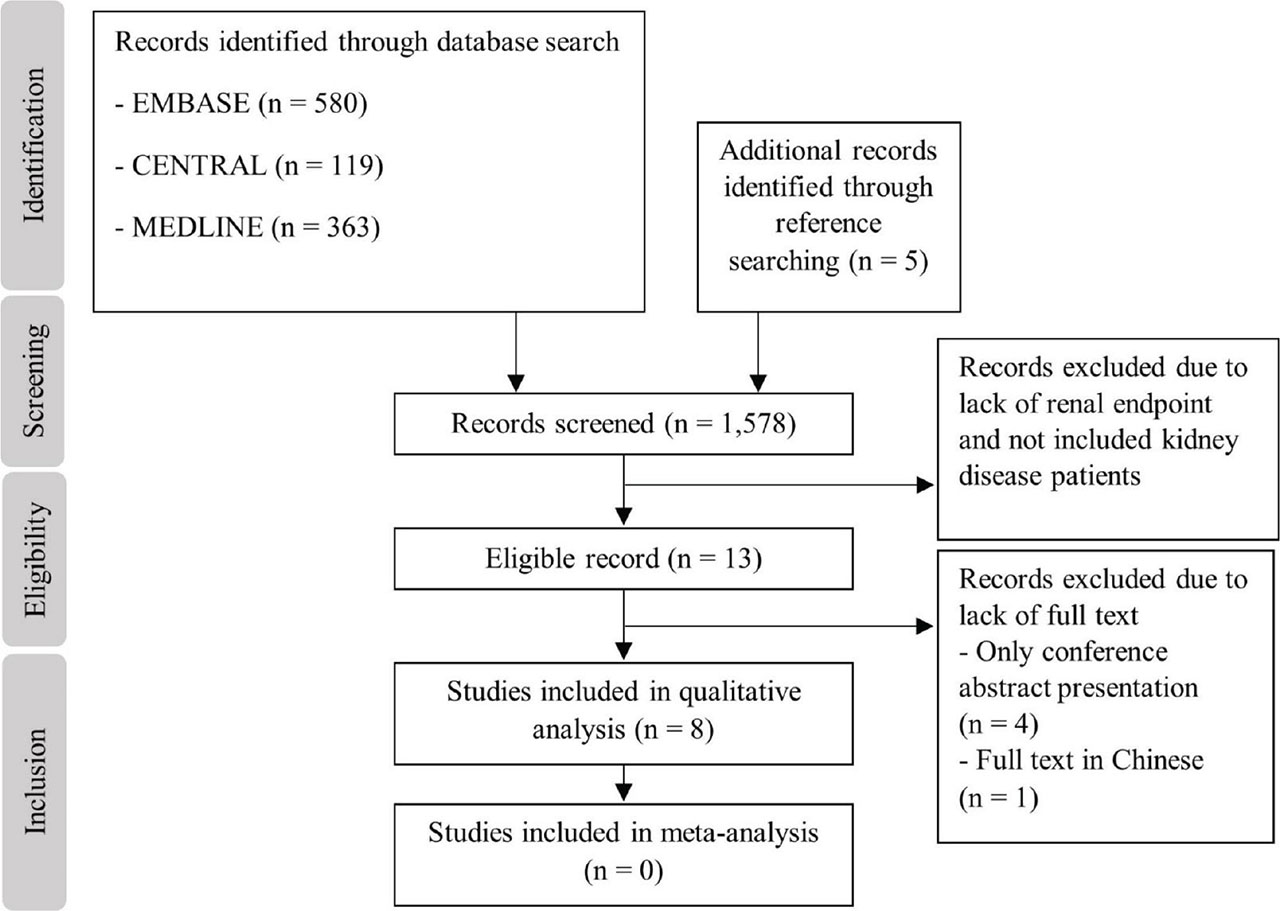
Figure 2.
Flowchart of study selection.
Table 1.
Characteristics of the included studies
| Study | Country | Design | Included patients | Sample size (n) | EECP therapy | Contraindication for EECP or exclusion criteria | Outcome and measurement |
|---|---|---|---|---|---|---|---|
| Applebaum et al. [17] | United States and India | Pre- and post-procedure comparison (no control group) | Atherosclerotic heart disease, age 55 ± 8 years | 18 (male, 78%) |
|
| Renal artery blood flow, measured every 5 minutes during and immediately after the counterpulsation with duplex ultrasonography (angle correction of ≤60°) |
| Werner et al. [18] | Germany | Pre- and post-procedure comparison (no control group) | Healthy volunteers, age 28 ± 4 years | 16 |
| No available data | Changes in flow volume in carotid, vertebral, hepatic, renal, and internal iliac arteries, measured by duplex ultrasonography |
| Werner et al. [19] | Germany | Pre- and post-procedure comparison in (1) cirrhotic patients and (2) healthy subjects |
| 16 cirrhotic patients and 12 healthy subjects (male, 50%) |
|
|
|
| Onuigbo [20] | United States | Case series | Hemodialysis patients with IDH and hypoalbuminemia refractory to conventional treatments | 3 | Using sequential compression device as a mini-EECP
| Not stated |
|
| Ruangkanchanasetr et al. [21] | Thailand | Longitudinal pre- and post-procedure comparison (no control group) | Age ≥18 years with chronic stable angina and/or heart failure | 30 (male, 76.7%, chronic angina 76.7%, heart failure 23.3%) |
|
|
|
| Wu et al. [22] | Taiwan | Longitudinal pre- and post-procedure comparison (no control group) | Hemodialysis patients with coronary artery disease and angina refractory to medical treatment and unable or unwilling for revascularization | 36 (male, 61.3%) |
|
|
|
| Zhang et al. [23] | China | Randomized, non-sham-controlled | Age >18 years undergoing a diagnostic contrast-enhanced computed tomography with estimated GFR using CKD-EPI of 60–89 mL/min/1.73 m2 | 121 (male, 62%, hypertension 56%, diabetes 27%) |
|
|
|
| Zeng et al. [24] | China | Prospective cohort, compared with active comparator (standard dose of 0.9% NaCl hydration) | Age ≥18 years with estimated GFR <60 mL/min/1.73 m2 not on dialysis; Receiving coronary angiography and percutaneous intervention | 230 (male, 76%, diabetes 36.1%, hypertension 77%, mean estimated GFR 42 mL/min/1.73 m2) | A once daily 1-h session of EECP therapy at 24 h before and 48–72 h after the intervention | (1) patients who had used iodinated contrast medium 30 d before inclusion, (2) patients with AKI due to other clear causes, (3) patients requesting withdrawal, (4) patients who failed to receive the re-examination of renal function indicators on time after surgery, (5) patients who underwent hemodialysis within 48 h after surgery, and (6) patients with uremia who received long-term hemodialysis. | Serum creatinine increase ≥0.3, ≥0.5 mg/dL or ≥25% relative to baseline value within 48–72 h after iodinated contrast exposure |
[i] ADH, antidiuretic hormone; ANP, atrial natriuretic peptide; CKD-EPI, Chronic Kidney Disease Epidemiology Collaboration equation; EECP, enhanced external counterpulsation; ELISA, Enzyme-Linked Immunosorbent Assay; GFR, glomerular filtration rate; IDH, intradialytic hypotension; INR, international normalized ratio; NT-proBNP, N-terminal pro b-type natriuretic peptide.
Table 2.
MINORS quality assessment of the included studies Enhanced external counterpulsation and kidney
| Applebaum 1997 | Werner 1999 | Werner 2005 | Onuigbo 2013 | Ruangkanchanasetr 2013 | Wu 2014 | Zeng 2022 | |
|---|---|---|---|---|---|---|---|
| A stated aim of the study | 2 | 2 | 2 | 2 | 2 | 2 | 2 |
| Inclusion of consecutive patients | 1 | 1 | 1 | 0 | 2 | 2 | 2 |
| Prospective collection of data | 2 | 2 | 2 | 2 | 2 | 2 | 0 |
| Endpoint appropriate to the study aim | 2 | 2 | 2 | 2 | 2 | 2 | 2 |
| Unbiased assessment of endpoints | 1 | 1 | 1 | 0 | 1 | 1 | 2 |
| Follow-up period appropriate to the major endpoint | 2 | 2 | 1 | 2 | 2 | 2 | 1 |
| Loss to follow-up not exceeding 5% | 2 | 2 | 2 | 2 | 2 | 0 | 2 |
| Prospective calculation of the study size | 0 | 0 | 0 | 0 | 2 | 0 | 1 |
| Total | 12 | 12 | 11 | 10 | 15 | 11 | 12 |
[i] The items are scored 0 (not reported), 1 (reported but inadequate), or 2 (reported and adequate).
[ii] MINORS, Methodological Index for Non-Randomized Studies.
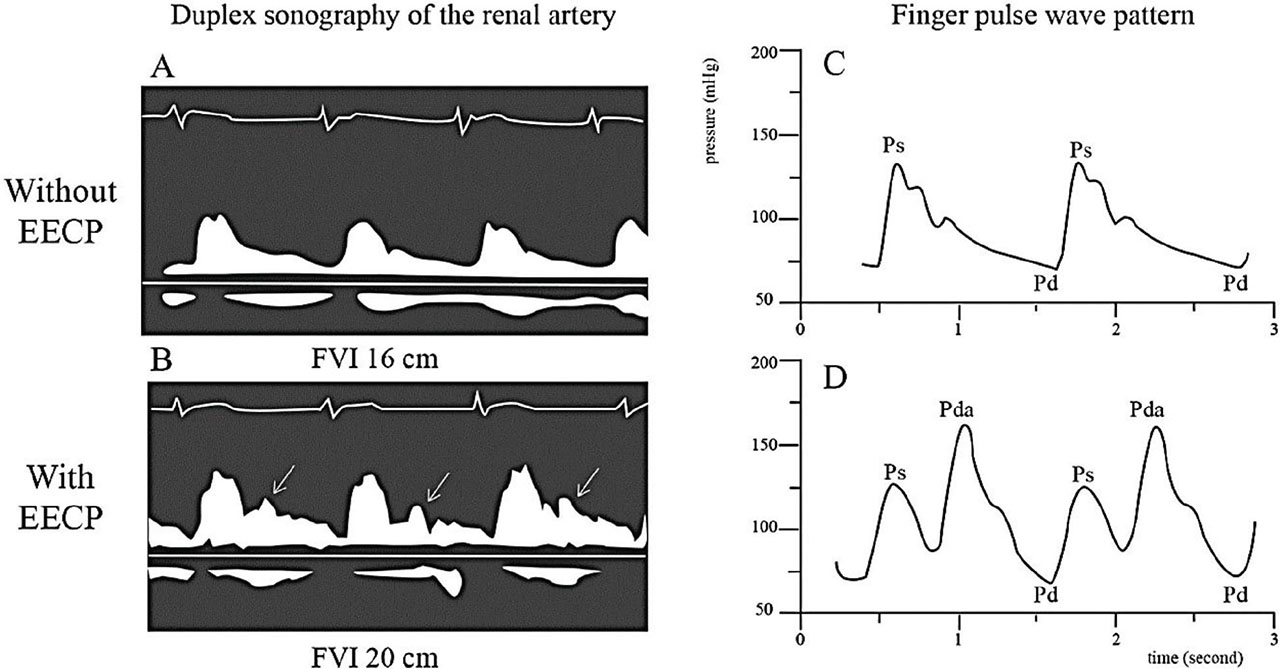
Figure 3.
Duplex sonography of the renal artery without EECP (A), compared with with EECP treatment (B) demonstrating augmented diastolic flow velocity (arrow), and finger pulse wave pattern without EECP (C), compared with with EECP treatment (D) systolic blood pressure (Ps), diastolic blood pressure (Pd), and augmented diastolic blood pressure (Pda). Systolic pressure reduces after EECP treatment and results in decreased cardiac oxygen demand. The FVI measured from duplex sonography also increases upon EECP therapy, reflecting increased blood flow to the artery. The finger plethysmography waveform during the therapy is similar to that from pulse wave analysis. The figure is based on results demonstrated by Applebaum et al. [17]. EECP, enhanced external counterpulsation; FVI, flow velocity integral.