
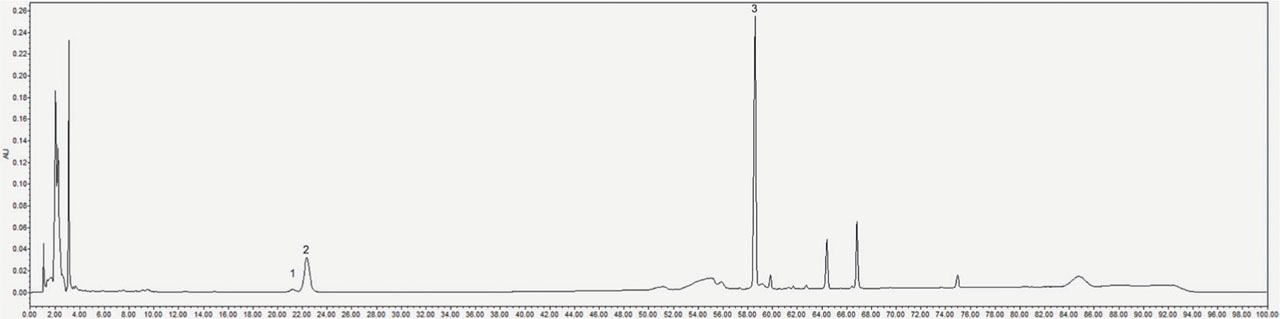
Figure 1.
The HPLC chromatogram of AGS. The total content of ginsenosides Rg1, Re, and Rb1 was measured as 2.3% using HPLC. According to the provisions of Chinese Pharmacopoeia 2015, the total amount of ginsenosides Rg1, Re, and Rb1 should not be less than 2.0%. The content was up to the standards, indicating that the samples were qualified: 1, ginsenoside Rg1; 2, ginsenoside Re; and 3, ginsenoside Rb1. AGS, American ginseng saponin.
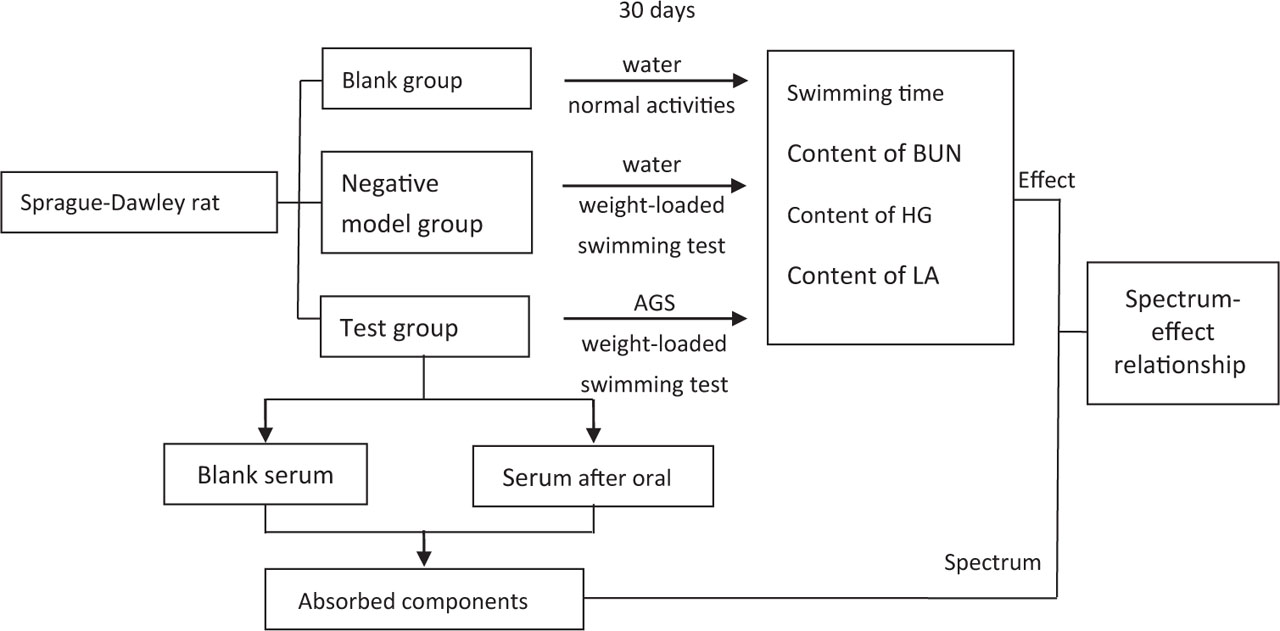
Figure 2.
The flow chart of the study. Rats were randomized into three groups: blank group, negative model group, and test group. The rats in the test group were orally administrated with AGS at a portion of 50 mg/kg once per day and successively for 30 d; meanwhile, the rats in the blank and negative model groups were given water instead. The anti-fatigue effect of AGS was measured based on the swimming time, as well as on the contents of BUN, HG, and LA in rats. Blood specimens were taken from the retinal venous plexus from the rats in the test group both before and after administration of AGS. To identify the components of AGS that had undergone absorption in serum, measurements were made after administration, and the measured values were compared with the corresponding values obtained before administration. The relationship between the peak area values from rat serum and pharmacodynamic parameters of AGS was established using PLSR and gray correlation method. AGS, American ginseng saponin; BUN, blood urea nitrogen; HG, hepatic glycogen; LA, lactic acid.
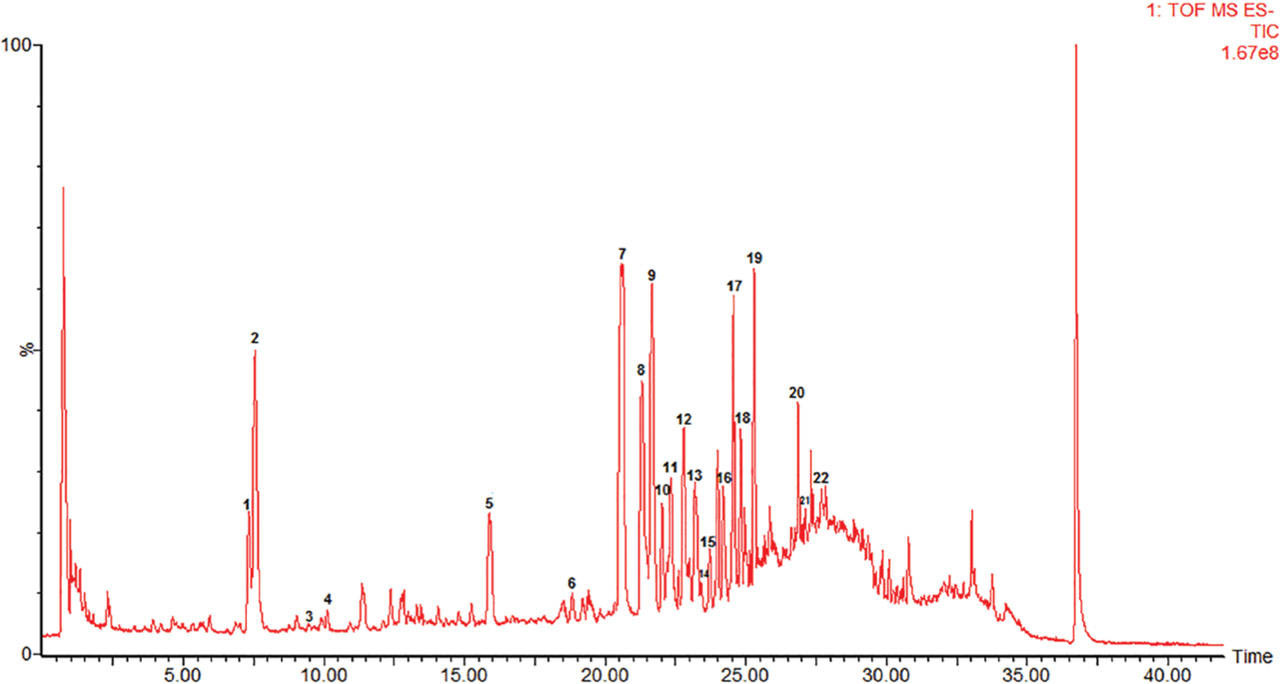
Figure 3.
TIC of AGS. UPLC-Q-TOF-MS in negative ESI mode was utilized to analyze the extract of AGS: 1, ginsenoside Rg1; 2, ginsenoside Re; 3, ginsenoside Malonyl-Rg1; 4, ginsenoside Malonyl-Re; 5, pseudoginsenoside-F11; 6, 20(S)-ginsenoside Rg2; 7, ginsenoside Rb1; 8, malonylginsenoside Rb1; 9, ginsenoside Rc; 10, malonylginsenoside Rb1 isomer; 11, malonylginsenoside Ra2; 12, ginsenoside Rb2; 13, ginsenoside Rb3; 14, malonylginsenoside Rb2 isomer; 15, malonylginsenoside Rb3 isomer; 16, Zingibroside R1; 17, ginsenoside Rd; 18, malonylginsenoside Rd; 19, gypenosid XVII; 20, 20(S)-ginsenoside Rg3; 21, Chikusetsu saponin IVa; 22, 20(R)-ginsenoside Rg3. AGS, American ginseng saponin.
Table 1.
Identification of composition of AGS using UPLC-Q-TOF-MS
| No. | tR/min | Molecular formula | Mean measured mass | Theoretical exact mass | δ | [M − H + HCOOH]− | Identity | Fragments |
|---|---|---|---|---|---|---|---|---|
| 1 | 7.33 | C42H72O14 | 799.4908 | 799.4849 | 7.38 | 845.5096 | Ginsenoside Rg1 | 637.4366 [M–Glc–H]− 475.3792 [M–2Glc–H]− |
| 2 | 7.55 | C48H82O18 | 945.5429 | 945.5428 | 0.11 | 991.5691 | Ginsenoside Re | 799.4850 [M–Rha–H]− 783.4913 [M–Glc–H]− 637.4314 [M–Rha–Glc–H]− |
| 3 | 9.48 | C45H74O17 | 885.4820 | 885.4853 | −3.72 | – | Ginsenoside Malonyl-Rg1 | 841.4949 [M–CO2–H]− |
| 4 | 10.14 | C51H84O21 | 1031.5400 | 1031.5432 | −3.10 | – | Ginsenoside Malonyl-Re | 987.5555 [M–CO2–H]− |
| 5 | 15.87 | C42H72O14 | 799.4850 | 799.4844 | 0.75 | 845.4918 | Pseudoginsenoside-F11 | 653.4298 [M–Rha–H]− |
| 6 | 18.80 | C42H72O13 | 783.4913 | 783.4900 | 1.66 | 829.4960 | 20 (S)-ginsenoside Rg2 | 637.4314 [M–Xyl–H]− 475.3792 [M–Xyl–Glc–H]− |
| 7 | 20.58 | C54H92O23 | 1107.5995 | 1107.5957 | 3.43 | 1153.6097 | Ginsenoside Rb1 | 945.5552 [M–Glc–H] − 783.4336 [M–2Glc–H]− |
| 8 | 21.32 | C57H94O26 | 1193.6053 | 1193.5961 | 7.71 | – | Malonylginsenoside Rb1 | 1149.6067 [M–CO2–H]− |
| 9 | 21.67 | C53H90O22 | 1077.5851 | 1077.5845 | 0.56 | 1123.5918 | Ginsenoside Rc | 945.5429 [M–Araf–H]− 783.4913 [M–Araf–Glc–H]− |
| 10 | 22.02 | C57H94O26 | 1193.5983 | 1193.5961 | 1.84 | – | Malonylginsenoside Rb1 isomer | 1149.6136 [M–CO2–H]− |
| 11 | 22.34 | C56H92O25 | 1163.5919 | 1163.5855 | 5.50 | – | Malonylginsenoside Ra2 | 1119.5933 [M–CO2–H]− |
| 12 | 22.79 | C53H90O22 | 1077.5851 | 1077.5845 | 0.56 | 1123.5918 | Ginsenoside Rb2 | 945.5429 [M–Arap–H]− 915.5326 [M–Glc–H]− 783.4913 [M–2Glc–H]− |
| 13 | 23.18 | C53H90O22 | 1077.5851 | 1077.5845 | 0.56 | 1123.5918 | Ginsenoside Rb3 | 945.5429 [M–Xyl–H]− 915.5326 [M–Glc–H]− 783.49133 [M–2Glc–H]− |
| 14 | 23.41 | C56H92O25 | 1163.5850 | 1163.5849 | 0.086 | – | Malonylginsenoside Rb2 isomer | 1119.6001 [M–CO2–H]− |
| 15 | 23.72 | C56H92O25 | 1163.5919 | 1163.5849 | 6.02 | – | Malonylginsenoside Rb3 isomer | 1119.6069 [M–CO2–H]− |
| 16 | 24.20 | C42H65O14 | 793.4396 | 793.4374 | 2.8 | – | Zingibroside R1 | 631.38606 [M–Glc–H]− |
| 17 | 24.56 | C48H82O18 | 945.5429 | 945.5428 | 0.11 | 991.5626 | Ginsenoside Rd | 783.4913 [M–Glc–H]− 621.4373 [M–2Glc–H]− |
| 18 | 24.81 | C51H84O21 | 1031.5466 | 1031.5432 | 0.58 | – | Malonylginsenoside Rd | 987.5684 [M–CO2–H]− |
| 19 | 25.29 | C48H82O18 | 945.5429 | 945.5423 | 0.63 | 991.5626 | Gypenosid XVII | 783.4913 [M–Glc–H]− 621.4373 [M–2Glc–H]− |
| 20 | 26.87 | C42H72O13 | 783.4913 | 783.4900 | 1.66 | 829.4960 | 20 (S)-ginsenoside Rg3 | 621.4375 [M–Glc–H]− 459.4088 [M–2Glc–H]− |
| 21 | 27.12 | C42H66O14 | 793.4396 | 793.4380 | 2.02 | – | Chikusetsu saponin IVa | 613.3718 [M–Glc–H]− |
| 22 | 27.69 | C42H72O13 | 783.4913 | 783.4900 | 1.66 | 829.5065 | 20 (R)-ginsenoside Rg3 | 621.4373 [M–Glc–H]− |
[i] AGS, American ginseng saponin.
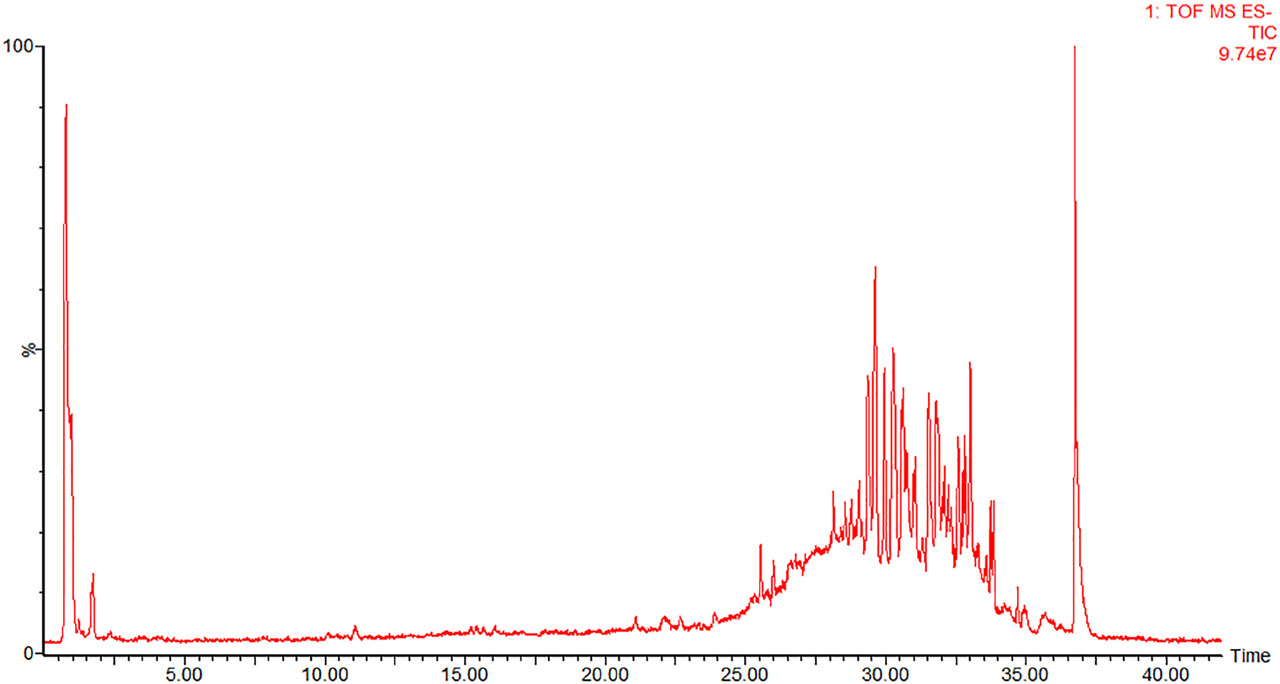
Figure 4.
TIC of blank serum. UPLC-Q-TOF-MS in negative ESI mode was utilized to analyze blank serum from rat before administration of AGS. AGS, American ginseng saponin.
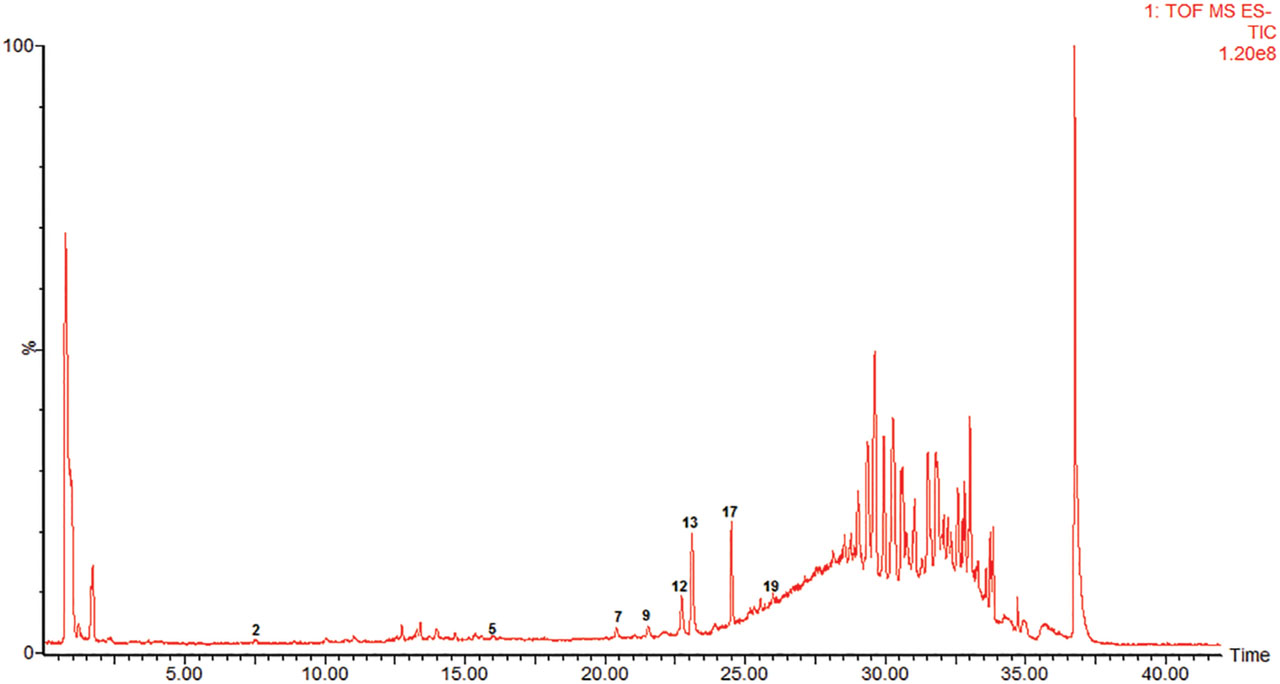
Figure 5.
TIC of serum containing drug. UPLC-Q-TOF-MS in negative ESI mode was utilized to analyze serum containing drug from rat after administration of AGS: 2, ginsenoside Re; 5, pseudoginsenoside-F11; 7, ginsenoside Rb1; 9, ginsenoside Rc; 12, ginsenoside Rb2; 13, ginsenoside Rb3; 17, ginsenoside Rd; and 19, gypenosid XVII. AGS, American ginseng saponin.
Table 2.
Anti-fatigue effect of AGS
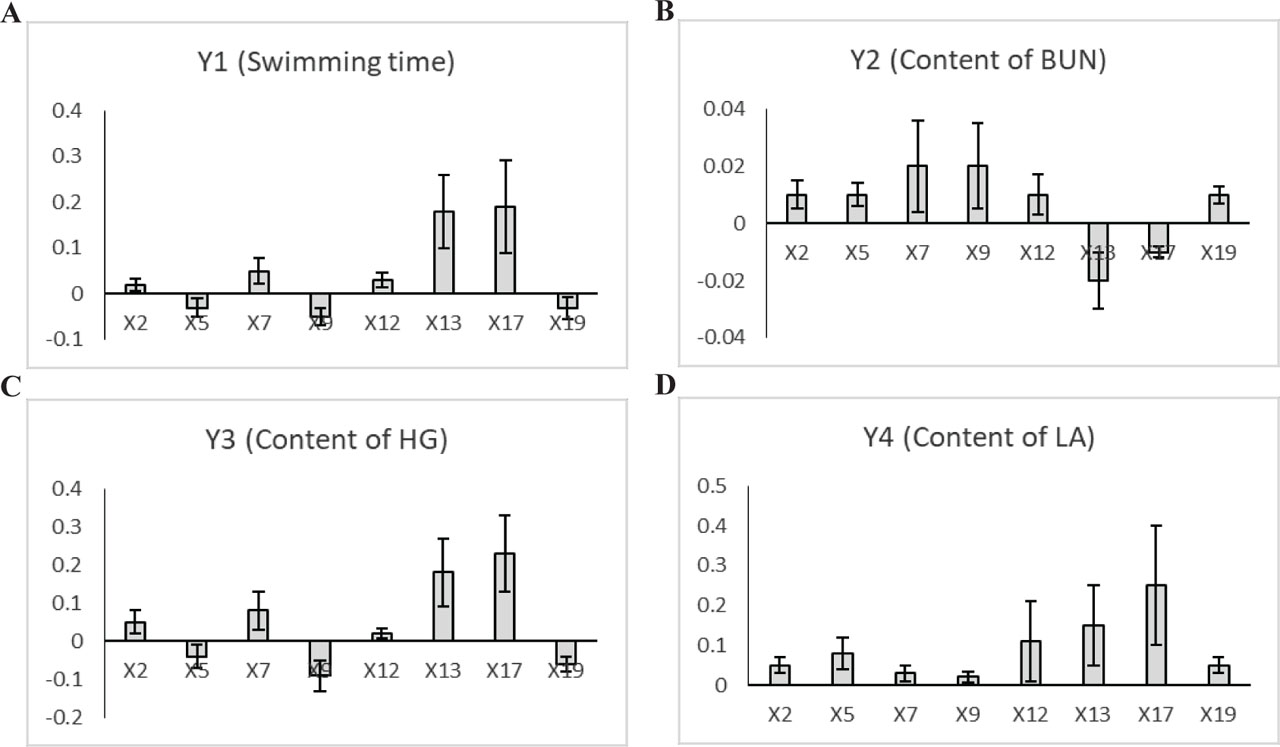
Figure 6.
The regression coefficients plot of pharmacological results. The coefficient value before X reflects the degree of contribution of X to Y. (A) Using the regression equation coefficients, the graphs of regression coefficients of swimming time have been drawn. (B) Using the regression equation coefficients, the graphs of regression coefficients of the content of BUN have been drawn. (C) Using the regression equation coefficients, the graphs of regression coefficients of the content of HG have been drawn. (D) Using the regression equation coefficients, the graphs of regression coefficients of the content of LA have been drawn. Values are shown as mean (n = 10); error bars indicate standard deviation. BUN, blood urea nitrogen; HG, hepatic glycogen; LA, lactic acid.
Table 3.
Correlation between 8 common peak areas and efficacy
| No. | Swimming time | Content of BUN | Content of HG | Content of LA |
|---|---|---|---|---|
| 2 | 0.91 ± 0.04† | 0.90 ± 0.06 | 0.94 ± 0.05 | 0.95 ± 0.04 |
| 5 | 0.70 ± 0.22 | 0.80 ± 0.13 | 0.70 ± 0.21 | 0.70 ± 0.21 |
| 7 | 0.95 ± 0.05 | 0.93 ± 0.05 | 0.95 ± 0.06 | 0.93 ± 0.06 |
| 9 | 0.64 ± 0.24 | 0.72 ± 0.17 | 0.63 ± 0.22 | 0.63 ± 0.22 |
| 12 | 0.86 ± 0.10 | 0.85 ± 0.11 | 0.89 ± 0.11 | 0.88 ± 0.12 |
| 13 | 0.86 ± 0.10 | 0.69 ± 0.22 | 0.89 ± 0.10 | 0.87 ± 0.11 |
| 17 | 0.83 ± 0.10 | 0.62 ± 0.22 | 0.85 ± 0.13 | 0.84 ± 0.13 |
| 19 | 0.75 ± 0.19 | 0.83 ± 0.10 | 0.74 ± 0.17 | 0.74 ± 0.17 |