
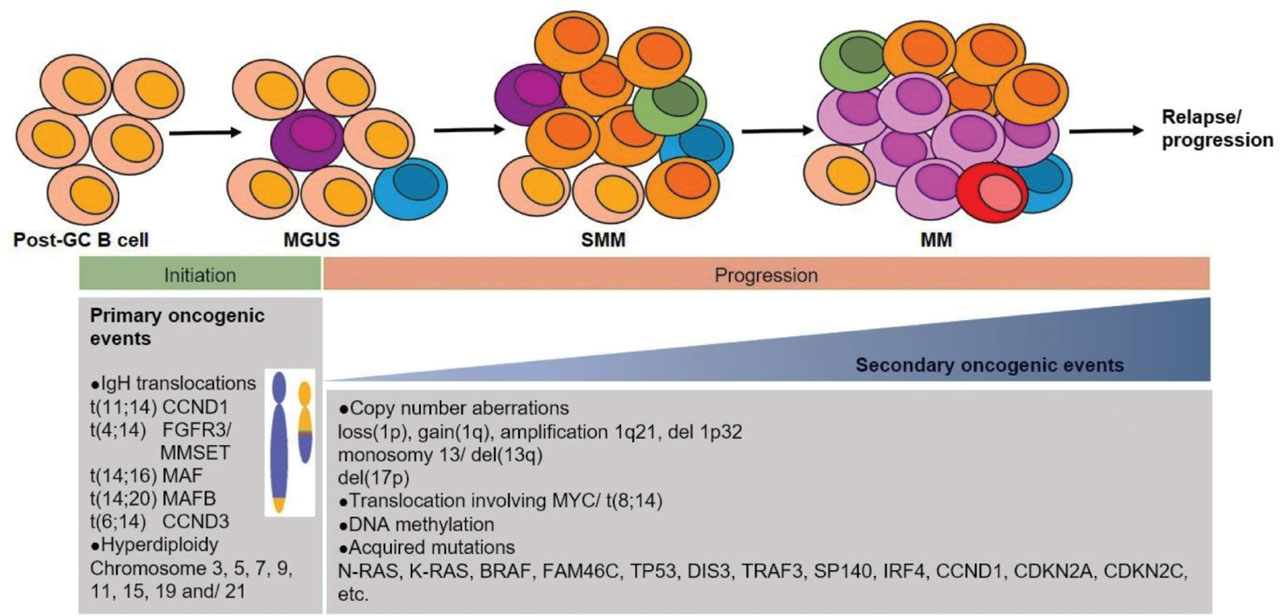
Figure 1.
Primary and secondary oncogenic events in the molecular pathogenesis of MM. MGUS, monoclonal gammopathy of undetermined significance; MM, multiple myeloma; SMM, smoldering multiple myeloma.
Table 1.
Common primary and secondary chromosomal abnormalities and their prognostic outcomes in MM
| Chromosomal abnormality | Genes/chromosomes affected | Frequency (%) | Risk stratification | Prognosis | Remarks | References |
|---|---|---|---|---|---|---|
| Primary oncogenic events | ||||||
| Hyperdiploidy | Trisomies of odd-numbered chromosomes | 50–60 | Standard risk | Favorable Positive impact on OS and PFS | Trisomy 21-negative impact on OS Trisomy 3 or 5-positive impact on OS | [12,13,14,15,16,17] |
| IgH translocations | 60 | Occur as early as the MGUS stage Caused by errors in CSR (90%) and SHM (10%) | [12, 18, 19] | |||
| t(4;14)(p16;q32) | FGFR3/ MMSET | 15 | High risk | Unfavorable/neutral Negative impact on OS and PFS | Commonly developed from errors in CSR Increases rate of relapse Co-occurrence with trisomy 3 or 5 might improve prognosis | [10, 17, 20,21,22,23,24,25] |
| t(14;16)(q32;q23) | c-MAF | 5–7 | High risk | Unfavorable | [14, 19, 20, 26] | |
| t(14;20)(q32;q11) | MAFB | 1–2 | High risk | Unfavorable | [14, 20, 27] | |
| t(11;14)(q13;q32) | CCND1 | 15–20 | Standard risk | Favorable/neutral | Commonly caused by SHM 40% RRMM response to Venetoclax High MCL1causes resistance to Venetoclax | [10, 28,29,30] |
| Others: | ||||||
| t(12;14)(p13;q32) | CCND2 | <1 | Standard risk | Favorable/neutral | [19] | |
| t(6;14)(p21;q32) | CCND3 | 2 | Standard risk | Favorable/neutral | ||
| t(8;14)(q24.3;q32) | MAFA | <1 | High risk | Unfavorable | ||
| Secondary oncogenic events | ||||||
| del(1p) | CDKN2C/ FAM46C/ FaF1 | 30 | High risk | Unfavorable Negative impact on OS and PFS | 1p21 and 1p32 are the most frequently deleted regions | [31,32,33] |
| Gain (1q21) | CKS1B/ PSMD4 | 40 | High risk | Unfavorable Negative impact on OS and PFS | Rarely found in MGUS Involves in disease progression Induces bortezomib resistance Worsens prognosis in cases with copy numbers ≥4 | [34,35,36,37] |
| Monosomy 13/ del(13q) | DIS3/ RB1 | 50 | Neutral | 85% are monosomy; 15% are partial deletion Responds well to first-line therapy | [8, 32, 38,39,40] | |
| del(17p) | TP53 | 5–10 NDMM 40 advanced MM | High risk | Unfavorable Negative impact on OS and PFS | Late event in pathogenesis Might be resistant to standard therapy | [11, 41, 42] |
| MYC translocation | MYC/ IgK/ IgL/ IgH/ FOXO3/ FAM46C/ TXNDC5/ BMP6 | 15 early-stage MM 50 advanced MM | Unfavorable/neutral Negative impact on OS and PFS | IgH/MYC or IgK/MYC are commonly associated with disease progression IgL/MYC adverse prognosis in NDMM Increases risk of progression from SMM to MM | [11, 12, 42,43,44,45,46,47,48,49] | |
| Others | ||||||
| del(11q) | BIRC2/3 | 7 | [12, 32, 50, 51] | |||
| del(16q) | WWOX/ CYLD | 35 | Unfavorable | |||
| del(14q) | TRAF3 | 38 | Unfavorable | |||
| del(12p) | CDKN1B | Unfavorable | ||||
| del(8p) | TRAIL | Unfavorable | ||||
[i] CSR, class-switch recombination; MGUS, monoclonal gammopathy of undetermined significance; MM, multiple myeloma; NDMM, newly diagnosed multiple myeloma; OS, overall survival; PFS, progression-free survival; RRMM, relapsed or refractory multiple myeloma; SHM, somatic hypermutation; SMM, smoldering multiple myeloma.
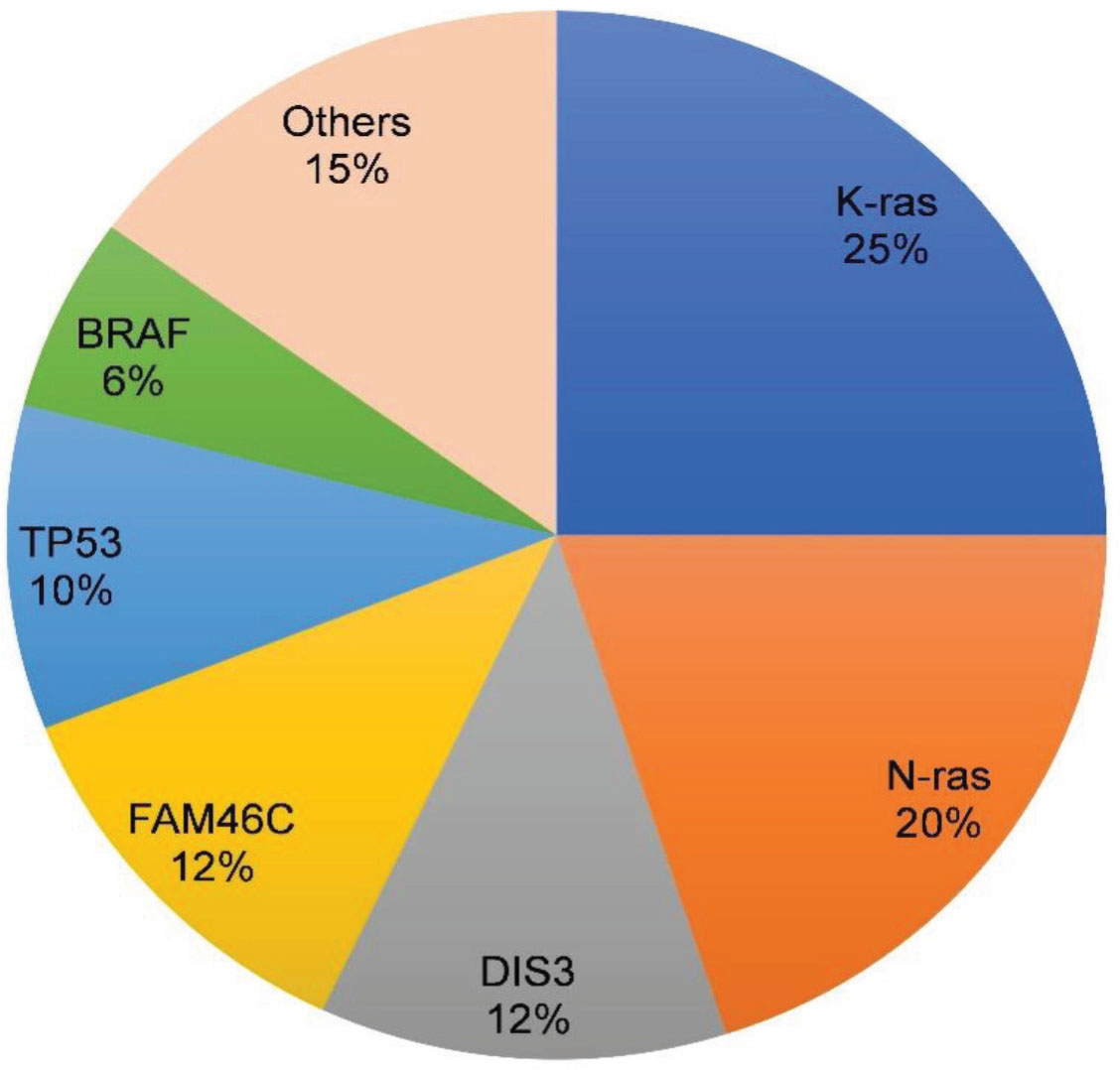
Figure 2.
Recurrent gene aberrations and their frequency in MM. MM, Multiple myeloma.
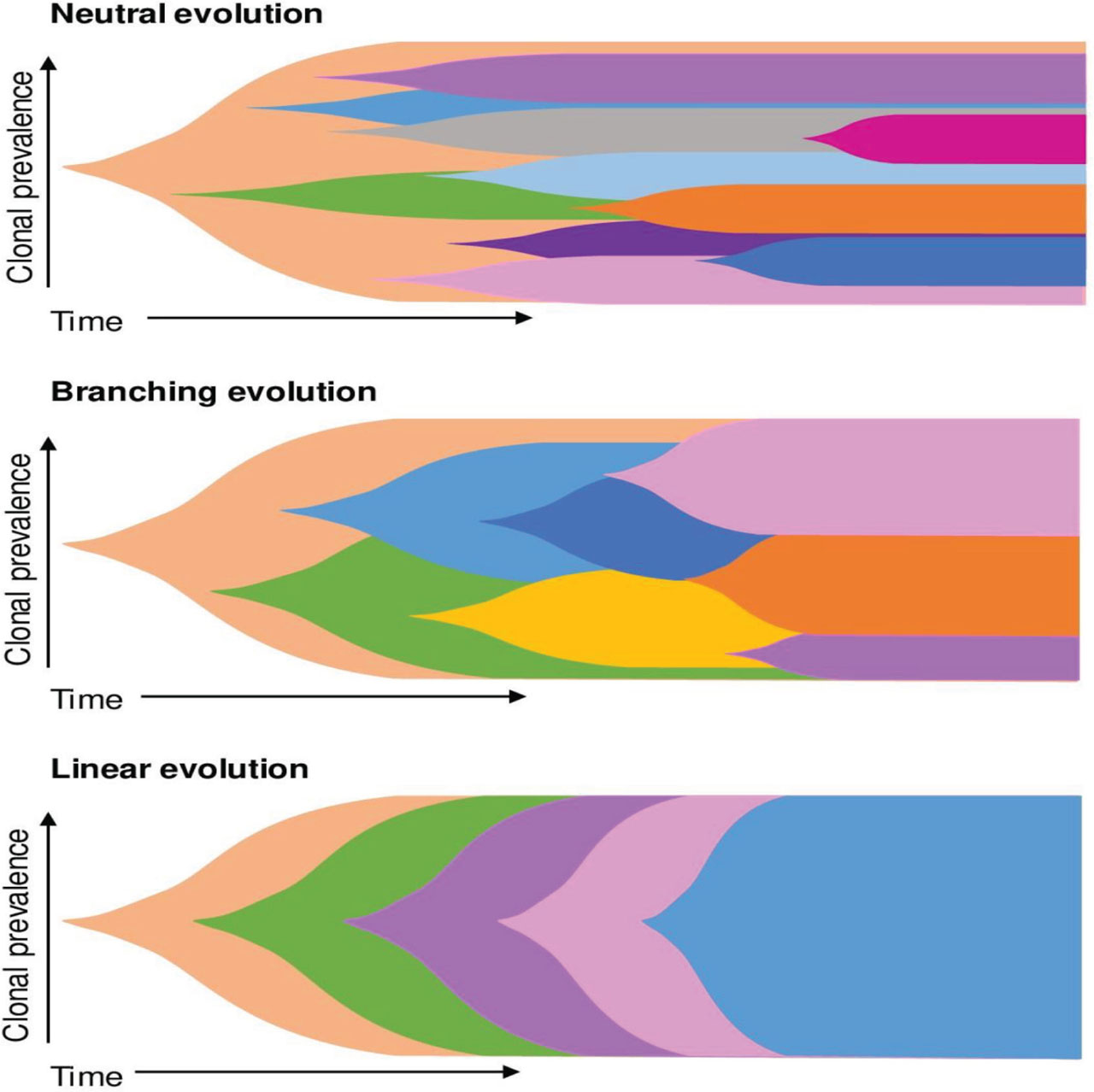
Figure 3.
Main clonal evolution models in multiple myeloma. Each color represents a single subclone.
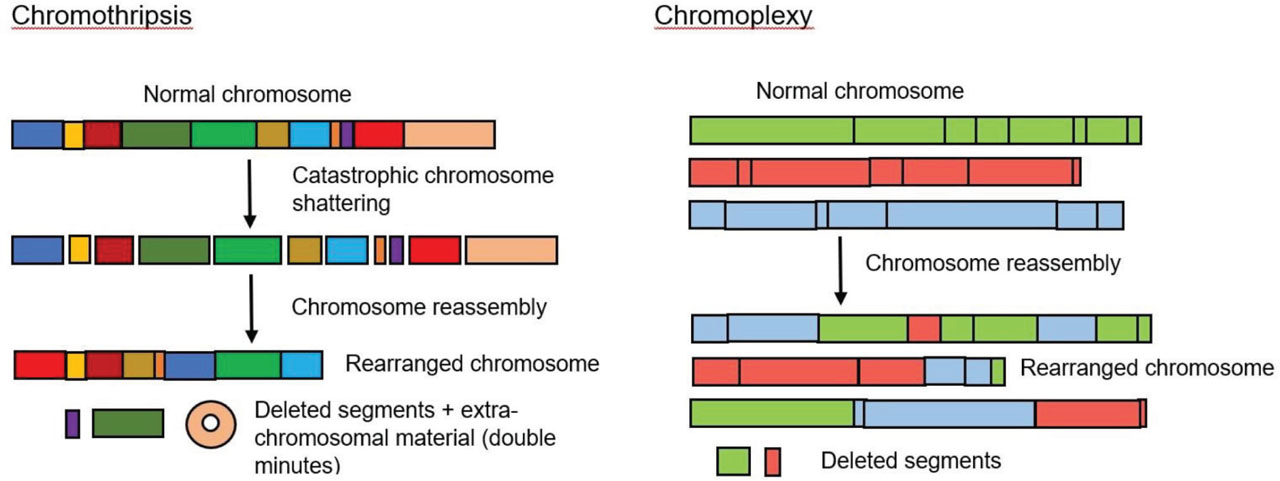
Figure 4.
Complex chromosomal rearrangements in multiple myeloma: chromothripsis and chromoplexy.