
Table 1.
Characteristics of patients with posterior circulation ischemic stroke
| Characteristics | N (%) |
|---|---|
| Age (y) (mean ± SD) | 60.3 ±13.5 |
| Gender | |
| Male | 12 (66.7) |
| Female | 6 (33.3) |
| Vascular risk factors | |
| Yes | 16 (88.9) |
| No | 2 (11.1) |
| Hypertension | 14 (77.8) |
| Diabetes mellitus | 6 (33.3) |
| Dyslipidaemia | 5 (27.8) |
| History of stroke | 3 (16.7) |
| Coronary atherosclerotic cardiomyopathy | 2 (11.1) |
| Atrial fibrillation | 2 (11.1) |
| Smoking | 5 (27.8) |
| Clinical characteristics | |
| Collateral flow | |
| Yes | 13 (72.2) |
| No | 5 (27.8) |
| Stroke subtype (TOAST) | |
| Large-artery atherosclerosis | 14 (77.7) |
| Cardioembolism | 1 (5.6) |
| Stroke of undetermined etiology | 1 (5.6) |
| Stroke of other determined etiology: Dissection | 2 (11.1) |
| Occlusion site | |
| Basilar or Basilar and Vertebral artery | 11 (61.1) |
| Vertebral artery | 7 (38.9) |
| Baseline NIHSS (median, IQR) | 10, 4.5–12 |
| Day 90 mRS (median, IQR) | 1.3, 2.3 |
| Time from onset to puncture (median, IQR) | 116.5, 48–205.75 |
| Day 90 NIHSS (median, IQR) | 4.6, 8 |
Table 2.
Operation and clinical prognosis
| Treatment and prognosis | N (%) |
|---|---|
| Operation | |
| Balloon predilution | 17 (94.4) |
| Thrombus extraction (Solitaire AB, Trevo, Aperio) | 9 (50.0) |
| Released stents | |
| Solitaire AB | 5 (26.3) |
| Winspan | 8 (42.1) |
| Apollo | 3 (15.8) |
| SD | 3 (15.8) |
| Successful recanalization | |
| Complete recanalization (mTICI, 3) | 14 (77.8) |
| Part recanalization (mTICI, 2b) | 4 (22.2) |
| Clinical symptoms | |
| Clinical symptom improvement | 15 (83.3) |
| Invalid | 1 (5.6) |
| Aggravation or death | 2 (11.1) |
Table 3.
Univariate analysis of clinical, radiological, and procedural variables affecting functional outcome 90 days after stroke
| Characteristics | mRS score ≤2 | mRS score >2 | P |
|---|---|---|---|
| Mean age (years) | 57.7 ± 15.4 | 61.5 ± 3.3 | 0.5640 |
| Gender, male/female | 9/3 | 2/2 | 0.3502 |
| Clinical characteristics | |||
| Baseline NIHSS (median, IQR) | 7.5, 4–10.5 | 13, 10–15.5 | 0.1040 |
| Time from onset to puncture | 104, 58.3–288.8 | 132.5, 36.5–146.5 | 0.7159 |
| Collateralization, yes/no | 9/3 | 3/1 | 1.0000 |
| Stroke subtype (TOAST) | |||
| Atherothrombosis | 9 | 4 | |
| Embolic | 1 | 0 | |
| Dissection | 2 | 0 | 1.0000 |
| Occlusion site | |||
| Basilar artery or basilar and vertebral artery | 5 | 4 | |
| Vertebral artery | 7 | 0 | 0.0884 |
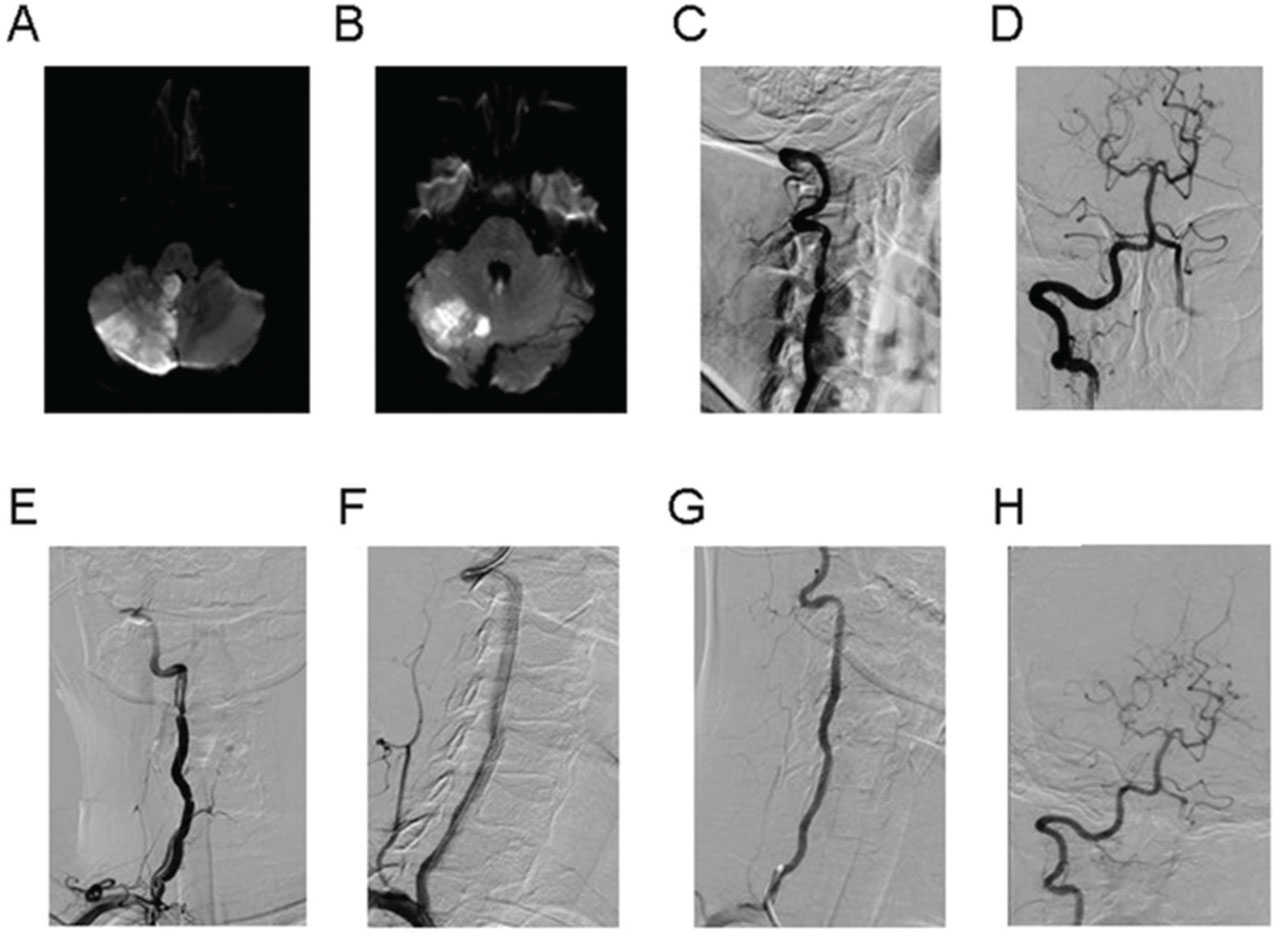
Figure 1.
A typical case who underwent emergency stent implantation after thrombectomy. (A, B). Skull MR showed subacute cerebral infarction in the right cerebellar hemisphere, cerebellar tonsil, and cerebellar vermis; (C). Angiography showed occlusion of the V2 segment of the right vertebral artery far away; (D). Thrombectomy was performed twice using an Aperio thrombectomy stent. The blood flow of the right vertebral artery was restored to an mTICI score of grade 3 after the dark red thrombus was aspirated; (E). When the guiding catheter was retracted to the right subclavian artery, angiography revealed blood vessel dissection in the V2 segment of the vertebral artery and severe stenosis in the local lumen of the V3 segment; (F). One SD stent (5*19 mm, Boston Science) was implanted in the dissection site of the V2 segment of the right vertebral artery, and 1 SD stent (4*19 mm, Boston Science) was implanted in the V3 segment of the right vertebral artery. The stent completely covered the vascular dissection with satisfactory angioplasty and an mTICI score of grade 3 of forward blood flow, without residual stenosis of the lumen; (G, H). Follow-up angiography after 3 months showed no stenosis in the stents, and the intracranial blood supply was good. mTICI, modified thrombolysis in cerebral infarction; SD, standard deviation.