
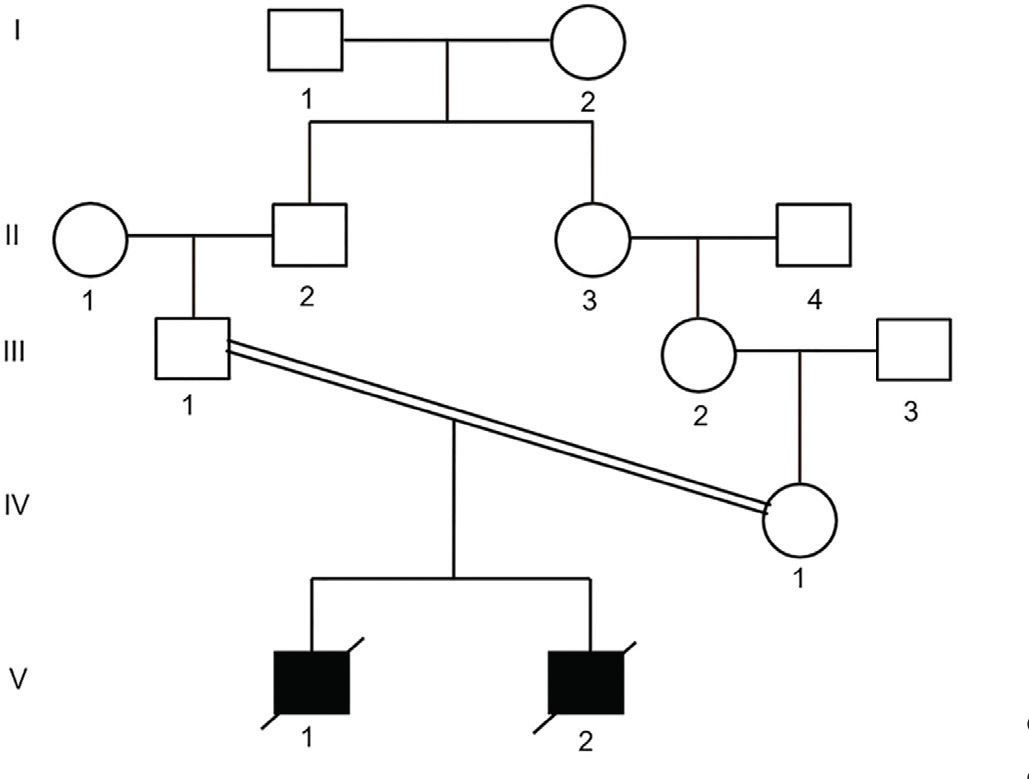
Figure 1.
Pedigree of the patients. Proband 1 (V:1) was born from consanguineous first cousins once removed parents (III:1 and IV:1) and was affected by MCA resembling VMS. His sibling, proband 2, (V:2) had a similar phenotype. Both deceased in the second month of life. Circle, female; Square, male; VMS, Van Maldergem syndrome.
Table 1.
Comparison of normal CSS, GT, in the intron 6 of FAT4 and its mutant, AT, by in silico splice prediction tools and two predicted cryptic donor sites
| Sequences exon/intron | Position in intron 6 | NNSPLICE | NetGene2 | SD-score | |
|---|---|---|---|---|---|
| Normal CSS | GATTCAG/GTAAGTCC | +1 | 1.00 | 1–0.83 | −2.074 |
| Mutant CSS | GATTCAG/ATAAGTCC | +1 | - | - | - |
| Predicted donor sites | CATGGTG/GTGCGTGC | +191 | 0.74 | 0–0.41 | −3.998 |
| GACATGG/GTGAGTGA | +683 | 0.99 | 1–0.00 | −2.277 |
[i] CSS, canonical splice site.
Table 2.
Table shows variants detected in three genes that parents are heterozygous carriers for them. They share common variants in PINK1 and PTPRQ genes, but they are carriers for different variants in MYO15A gene
| Gene/transcript | Variant | Loc. | Chr. pos. | Related phenotypes | OMIM number | Inh. | Class† |
|---|---|---|---|---|---|---|---|
| The couple both are heterozygous carriers for the same variants in PINK1 and PTPRQ genes | |||||||
| PINK1 NM_032409 | c.709A>G p.M237V | Exon 3 | Chr1: 20966418 | Early onset Parkinson disease 6 | 605909 | AR | VUS |
| PTPRQ‡ NM_001145026 | c.3446-5 dupT | Intron 21 | Chr12: 80542081 | Autosomal recessive deafness 84A | 613391 | AR | Benign |
| Autosomal dominant deafness-73 | 617663 | AD | |||||
| The couple are heterozygous carriers for different variants in MYO15A gene | |||||||
| MYO15A NM_016239 | c.3622C>T p.R1208C | Exon 3 | Chr17: 18027809 | Autosomal recessive deafness-3 | 600316 | AR | VUS |
| c.5230T>A P.S1744T | Exon 20 | Chr17: 18043849 | VUS | ||||
† Variants classification based on ACMG standards and guidelines for the interpretation of sequence variants, 2015.
‡ Exceptionally chromosomal position of PTPRQ gene is presented based on GRCh38 assembly because it has been presented this way in related databases.
Chr. Pos., Chromosomal position; Inh, Inheritance pattern; Loc., Location; VUS, variants with uncertain significance; ACMG, American College of Medical Genetics and Genomics; AD, autosomal dominant; AR, autosomal recessive; CNV, copy number variation; EGF, epidermal growth factor; GRCh38, Genome Reference Consortium Human Build 38; OMIM, Online Mendelian Inheritance in Man; PGD, Preimplantation Genetic Diagnosis; PND, Prenatal diagnosis.
Table 3.
Phenotypic comparison of P1 and P2 with HKLLS and VMLDS characteristics previously described in the literature [1, 4, 5, 24]
| Abnormalities | HS | VMS | P1 | P2 |
|---|---|---|---|---|
| Microcephaly | + | ++ | No | No |
| Large fontanelle | − | +++ | No | No |
| Blepharo-nasal malformation | +++ | +++ | Yes | Yes |
| Micrognathia and small mouth | +++ | +++ | Yes | Yes |
| Irregular dentition | +++ | +++ | NA | NA |
| Short stature | +++ | +++ | NA | NA |
| Hypertelorism | +++ | +++ | No | No |
| Epicanthic folds | +++ | +++ | Yes | Yes |
| Camptodactyly | ++ | +++ | No | Yes |
| Syndactyly | + | + | No | No |
| Clubfoot | + | + | Yes | No |
| Microtia | +++ | +++ | Yes | Yes |
| Conductive hearing loss | +* | +++ | Yes | Yes |
| Cardiac malformation | +* | + | No | Yes |
| Infantile hypotonia | +* | +++ | No | No |
| Developmental delay | +++ | +++ | NA | NA |
| Feeding difficulties | + | +++ | Yes | Yes |
| Choanal atresia/stenosis | − | ++ | No | No |
| Tracheal anomalies | − | +++ | Yes | Yes |
| Periventricular nodular heterotopia | − | ++ | Not performed | |
| Corpus callosum anomalies | − | ++ | Not performed | |
| Other brain anomalies | +* | + | ||
| Renal anomalies | − | +++ | No | Yes |
| Genital anomalies | edema | + | No | No |
| Lymphedema limb | +++ | +* | No | No |
| Primary intestinal lymphangiectasia | +++ | −* | No | No |
| Other lymphangiectasia | ++ | − | No | No |
[i] +++, common.
[ii] ++, around a half of patients.
[iii] +, less than half of patients.
[iv] +*, a few patients.
[v] −*, only one exception.
[vi] HKLLS, Hennekam lymphangiectasia-lymphedema syndrome; VMS: Van Maldergem syndrome; P1, proband 1; P2, proband 2; NA, not applicable.
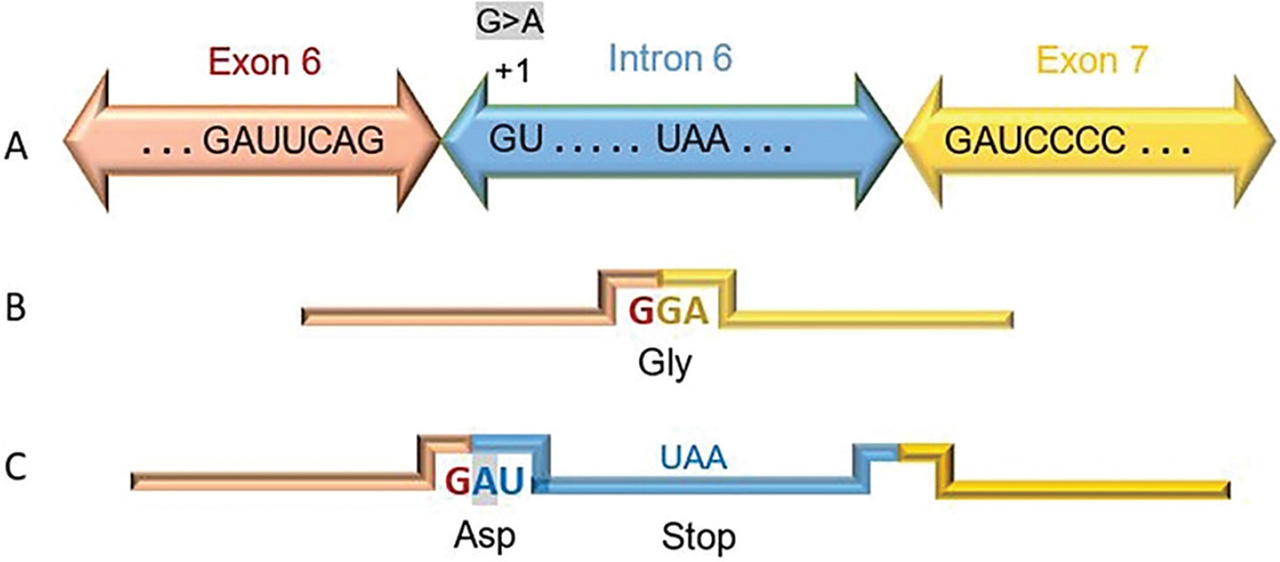
Figure 2.
Possible consequence of the variant c.7018+1G>A, NM_024582.6, on the transcript. (A) Normal splicing, using 5’ CSS, joins exon 6 to 7 and (B) the junction forms Glycine codon (GGA). (C) This variant can result in the loss of 5′ CSS and aberrant splicing. Theoretically, insertion of the fragment from intron 6 in the transcript creates the codon of Aspartic acid in junction and leads to frameshift creating a premature stop codon, UAA, in position +33 to +35.
CSS, canonical splice site; nts, nucleotides,