
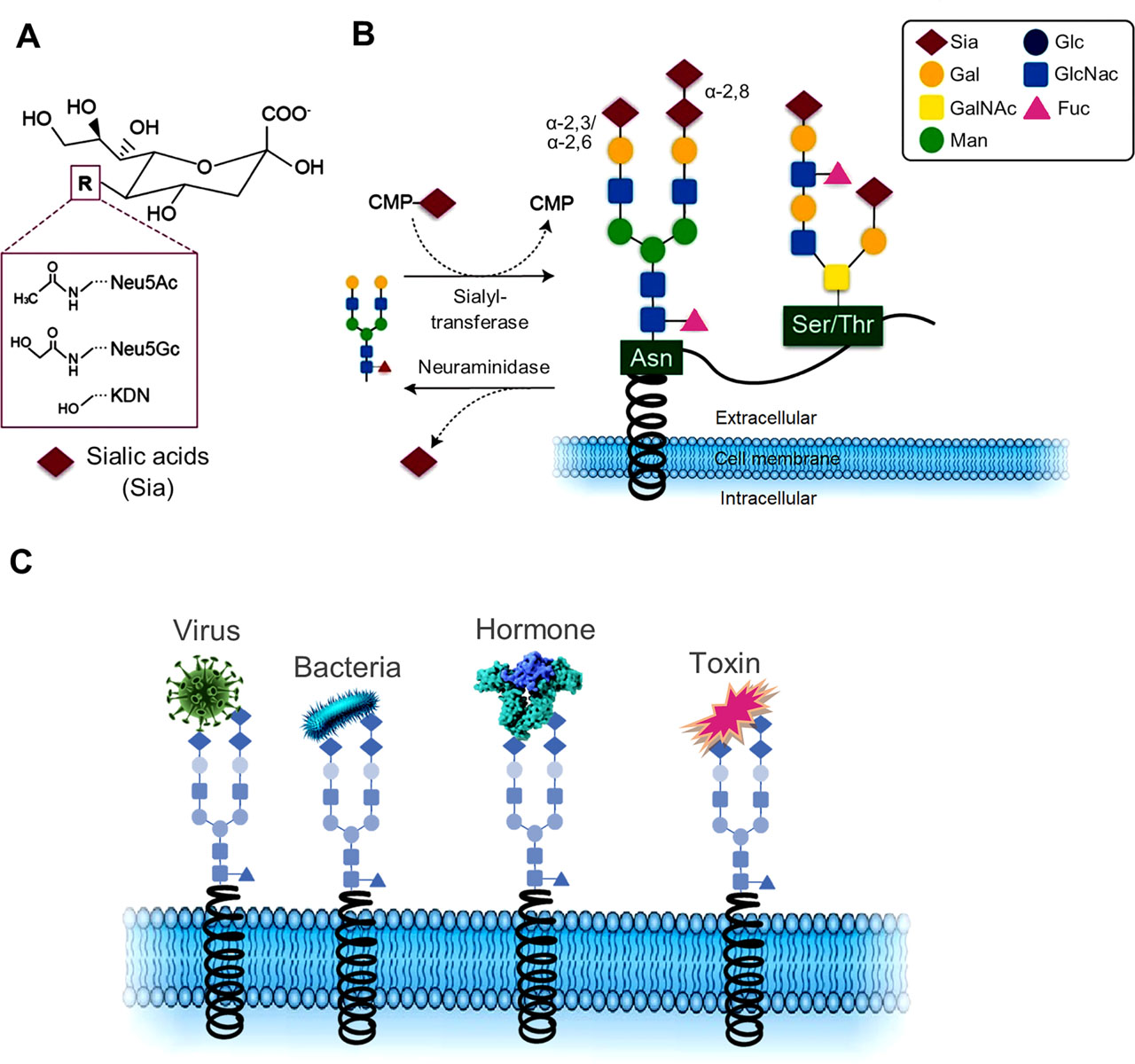
Figure 1
(A) Chemical structure of the 3 main sialic acids, N-acetylneuraminic acid (Neu5Ac), N-glycolylneuraminic acid (Neu5Gc), and deaminoneuraminic acid (KDN). (B) Sialic acids are transferred onto acceptor glycans via sialyl transferase enzymes that use the activated cytidine-5′-monophosphate-sialic acid (CMP-Sia) as a donor molecule. Sialyl residues may be added terminally to galactose residues in α-2,3 or α-2,6 linkage, or to sialic acid residues in α-2,8 connection. Such glycan chains may be attached to glycoproteins via asparagine (N-glycan) or serine or threonine residues (O-glycans). Sialic acids may be released via hydrolytic enzymes called neuraminidases. (C) Examples of pathobiological interactions involving sialic acids with viruses, bacteria, hormones, and toxins. Gal, galactose; GalNAc, N-acetylgalactosamine; Man, mannose; Glc, glucose; GlcNAc, N-acetylglucosamine; Fuc, fucose.
Table 1
Viruses with specific binding to sialic acid derivatives
| Virus name | Viral genus | Viral family | Genome type | Envelope | Sialic acid receptor | Viral attachment protein | Host(s) | Refs. |
|---|---|---|---|---|---|---|---|---|
| Influenza A virus | Alphainfluenza-virus | Orthomyxoviridae | ssRNA | Yes | Neu5Acα2-3/6Gal, Neu5Acα23/6GalNAc, Neu5Acα2-6GlcNAc | HA, NA | Birds and mammals | [8, 13,14,15, 95] |
| Influenza B virus | Betainfluenza-virus | Orthomyxoviridae | ssRNA | Yes | Neu5Acα2-3/6Gal, Neu5Acα23/6GalNAc, Neu5Acα2-6GlcNAc | HA, NA | Human and seals | [8, 13,14,15, 95] |
| Influenza C virus | Gammainfluenza-virus | Orthomyxoviridae | ssRNA | Yes | N-Acetyl-9-O-acetylneuraminic acid (Neu5,9Ac2) | HEF | Human | [95,96,97] |
| Salmon isavirus | Isa-virus | Orthomyxoviridae | ssRNA | Yes | 4-O-5-N-Acetylneuraminic acid (Neu4,5Ac2) | HE | Fish | [95, 98, 99] |
| TGEV | Alphacorona-virus | Coronaviridae | ssRNA | Yes | α2-3-linked N-glycolylneuraminic acid | HA | Pigs | [6, 100, 101] |
| BCoV, HCoVOC43 | Betacorona-virus | Coronaviridae | ssRNA | Yes | 9-O-Acetylated sialic acid | HE, S protein | Bovine and Human | [6, 102] |
| SARS-CoV-2 | Betacorona-virus | Coronaviridae | ssRNA | Yes | N-Acetylneuraminic acid | S protein | Human | [103] |
| IBV | Gammacorona-virus | Coronaviridae | ssRNA | Yes | α-2-3-Linked sialic acid | HA | Birds | [6, 104] |
| Bovine torovirus | Toro-virus | Coronaviridae | ssRNA | Yes | Neu5,9Ac2 and N-acetyl-7,9-O-acetylneuraminic acid | HE | Bovine | [6, 20] |
| HPIV1 | Respiro-virus | Paramyxoviridae | ssRNA | Yes | α-2-3-Linked sialic acid | HA, NA | Human | [6] |
| Murine norovirus | Noro-virus | Caliciviridae | ssRNA | No | Terminal sialic acid in GD1a | VP1 | Murine | [105, 106] |
| Enterovirus 70 | Entero-virus | Picornaviridae | ssRNA | No | O-Linked glycans containing sialic acid α2-3-linked to galactose | (DAF/CD55) | Human | [107, 108] |
| Human rotavirus | Rota-virus | Reoviridae | dsRNA | No | GM1 | VP4 | Human | [6] |
| Murine polyomavirus | Alphapolyoma-virus | Polyomaviridae | dsDNA | No | Neu5Acα2-3-Gal | VP1 | Murine | [6] |
[i] Neu5Ac, N-acetylneuraminic acid; Gal, galactose; GalNAc, N-acetyl galactose; GlcNAc, N-acetyl glucose, HA, hemagglutinin; NA, neuraminidase; HEF, hemagglutinin–esterase (acetylesterase)-fusion, HE, hemagglutinin–esterase (acetylesterase); TGEV, transmissible gastroenteritis virus; BCoV, bovine coronavirus; HCoVOC43, human coronavirus OC43; SARS-CoV-2, severe acute respiratory syndrome coronavirus 2; IBV, infectious bronchitis virus; HPIV1, human parainfluenza virus 1; VP1, viral protein 1; VP4, viral protein 4; DAF/CD55, complement regulatory protein decay-accelerating factor; GM1, monosialotetrahexosylganglioside; DAF, decay-accelerating factor.
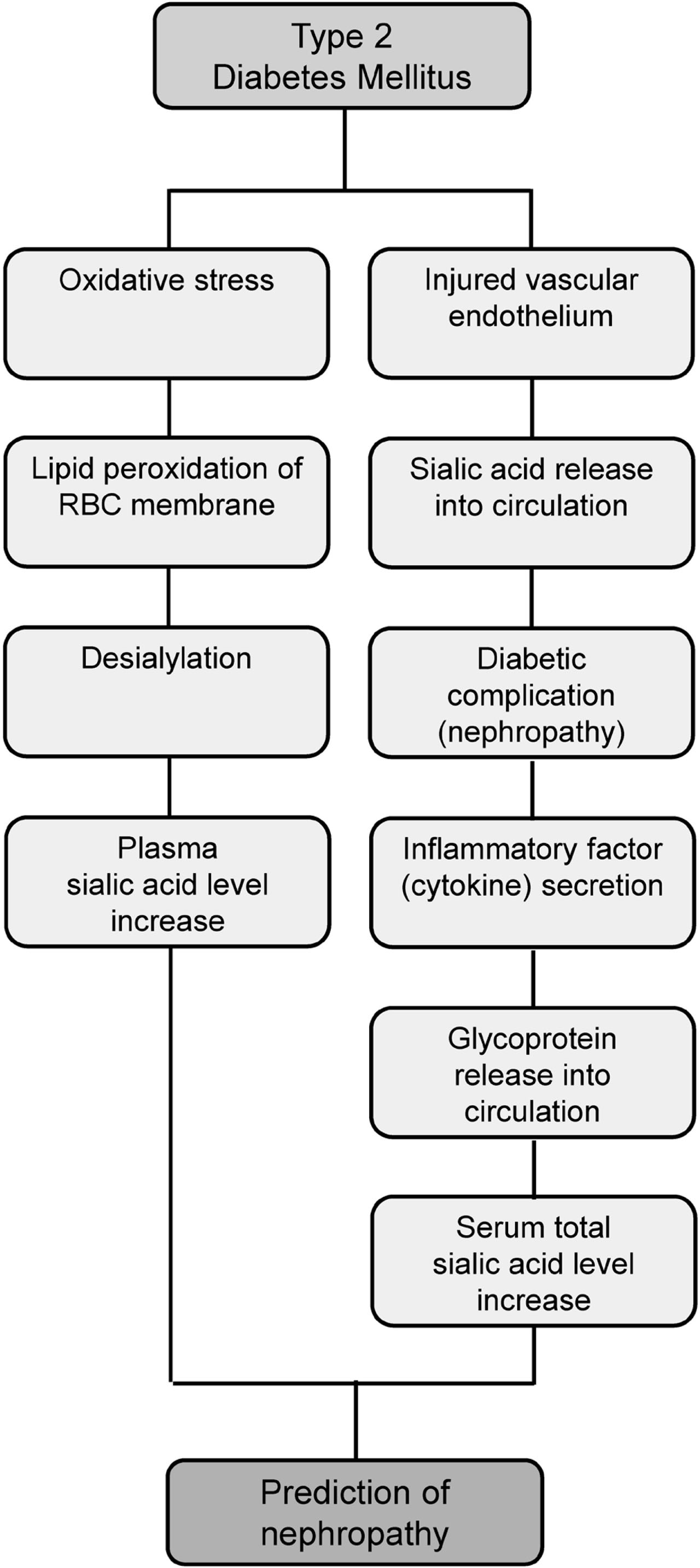
Figure 2
Flowchart showing that increased sialic acid level in plasma predicts diabetic nephropathy. RBC, red blood cell.
Table 2
Potential therapeutic targets and effects and mechanism of action of sialic acid in various diseases
| Disease | Drug or potential therapeutic target | Therapeutic effects | Mechanism of action | Refs. |
|---|---|---|---|---|
| Alzheimer disease | Human β-amyloid SA-binding lectin LFA | Decrease in amyloid plaque deposition in the brain, reducing neuroinflammation | Binding to gangliosides in neuronal lipid rafts and inhibiting the binding of amyloid peptides | [109] |
| CVD |
| Antioxidation, antiinflammation, cholesterol efflux, promotion of biomolecule protection, prevention of CAD progression | Antioxidant, antiatherosclerosis, decreased hydrogen peroxide, reduced expression of TNF-α, MCP-1, ICAM-1, VCAM-1, reducing Neu5Ac levels by inhibiting its regulatory enzyme (neuraminidase) | [90, 60] |
| Cancer |
| Inhibiting the evasion of the immune response, improvement of the tumor-targeting efficiency and antitumor activity, improvement in immune responses, enhancement of cell cytotoxicity, clearance of cancer cells by macrophages, localized blockade of tumor antigens |
| [41, 50, 52, 55, 110, 111] |
| Viral infection (chicken new castle, influenza virus, coronavirus, and rotavirus) |
| Antiviral activity |
| [93, 112] |
| Neurological Disorders |
| Neuroregeneration, increased neuroprotective capacity, providing substrate for sialic acid biosynthesis |
| [76, 113, 114] |
| Rheumatoid arthritis and comorbid tumors | Sialic acid-modified doxorubicin hydrochloride liposome (DOX-SAL) | Accumulation reduction of inflammatory neutrophils at the disease site | Induction of PBN apoptosis by binding to L-selectin | [115] |
[i] SA, sialic acid; LFA, Limacus flavus agglutinin; CAD, coronary artery disease; CVD, cardiovascular diseases; TNF-α, tumor necrosis factor-α; MCP-1, monocyte chemoattractant protein-1; ICAM-1, intercellular adhesion molecule-1; VCAM-1, vascular cell adhesion molecule-1; mPEG, methoxy polyethylene glycol; AuNPs, gold nanoparticles; EPI-SL, SA-stearic acid conjugates and epirubicin-loaded liposomes; N/Ms, neutrophils and monocytes; PSA-TPGS, polysialic acid and d-α-tocopheryl polyethylene glycol 1000 succinate conjugates; ABC, accelerated blood clearance; BS-NPs, biodegradable silica nanoparticles; GSH, glutathione; Siglec-10, sialic acid-binding immunoglobulin-type lectins; TNBC, triple-negative breast cancer; SAPPM, sialic acid-polyethylene glycolpoly (lactic-co-glycolic acid); DDS, drug-delivery system; SCI, spinal cord injury; Ac3ManNAc, 1,3,4-O-acetylated N-acetylmannosamine; ManNAc-6-P, N-acetylmannosamine 6-phosphate, PBN, peripheral blood neutrophil; HDI, histone deacetylase inhibitors.
Table 3
Various methods for sialic acid detection
| Method | Example | Advantages | Disadvantages | Refs. |
|---|---|---|---|---|
| Biochemical assay | Resorcinol assay | Assays bound and free SA | Considerable interferences by pentoses, hexoses, and uronic acids | [116] |
| Periodate–thiobarbituric acid assay | Assays free SA | Considerable interferences by 2-deoxyribose, unsaturated fatty acids, lactose, and maltose Bound SA not detected | [117] | |
| Roboz assay | Assays bound and free SA Eliminates interferences such as deoxyribose, fatty acids, and some neutral carbohydrates | Slight turbidity in the assay solution | [118] | |
| Periodic acid/MBTH | Assays total SA without release sialic acids by acid hydrolysis or neuraminidase treatment, | Considerable interferences | [119, 120] | |
| Acidic ninhydrin assay | Assays bound and free SA | Considerable interferences | [121, 122] | |
| Enzymatic and fluorometric assay | Measurement total | [123] | ||
| Neu5Ac | ||||
| Simple and convenient | ||||
| No significant cross-reactivity or interference | ||||
| Enzymatic and calorimetric assay | Measurement total | [123,124,125] | ||
| Neu5Ac | ||||
| Simple and convenient | ||||
| No significant cross-reactivity or interference | ||||
| HPLC fluorescent detection | High specificity | Expensive, research use only | [125] | |
| ELISA and calorimetric assay | High specificity | Research use only | [56] | |
[i] SA, sialic acid; MBTH, 3-methyl-2-benzothiazolone hydrazone assay, HPLC, high-performance liquid chromatography; ELISA, enzyme-linked immunosorbentassay.
Table 4
Diagnostic parameters for sialic acid
| Target disease | Detection methods for SA | Target tissue | Sensitivity (%) | Specificity (%) | Cut-off | AUC (%) | Refs. |
|---|---|---|---|---|---|---|---|
| Breast cancer | Surface-enhanced Raman spectroscopy | Saliva | 80 | 93 | 12 mg/dL | 95 | [127] |
| Breast cancer | Surface-enhanced Raman spectroscopy | Saliva | 80 | 100 | 15.5 mg/dL | 94.05 | [128] |
| Rheumatoid arthritis | HPLC | Serum | 84.2 | 92 | 766.70 μg/mL | 92.1 | [126] |
| Nasopharynx cancer | Enzymatic method | Serum | 30.95 | 83.33 | ≥650 mg/dL | 80.7 | [129] |
| COVID-19 and gastrointestinal tract | ELISA | Serum | 76.2 | 73.7 | 74.55 mg/dL | 84 | [130] |
| Oral squamous cell carcinoma | Spectrophotometric method | Saliva | 100 | 100 | >0.30 μg/mL | 100 | [131] |
| Blood | 93.33 | 100 | >4.23 μg/mL | 98.3 |
[i] SA, sialic acid; AUC, area under the receiver operating characteristic curve; HPLC, high-performance liquid chromatography; COVID-19; coronavirus disease 2019; ELISA, enzyme-linked immunosorbent assay.