
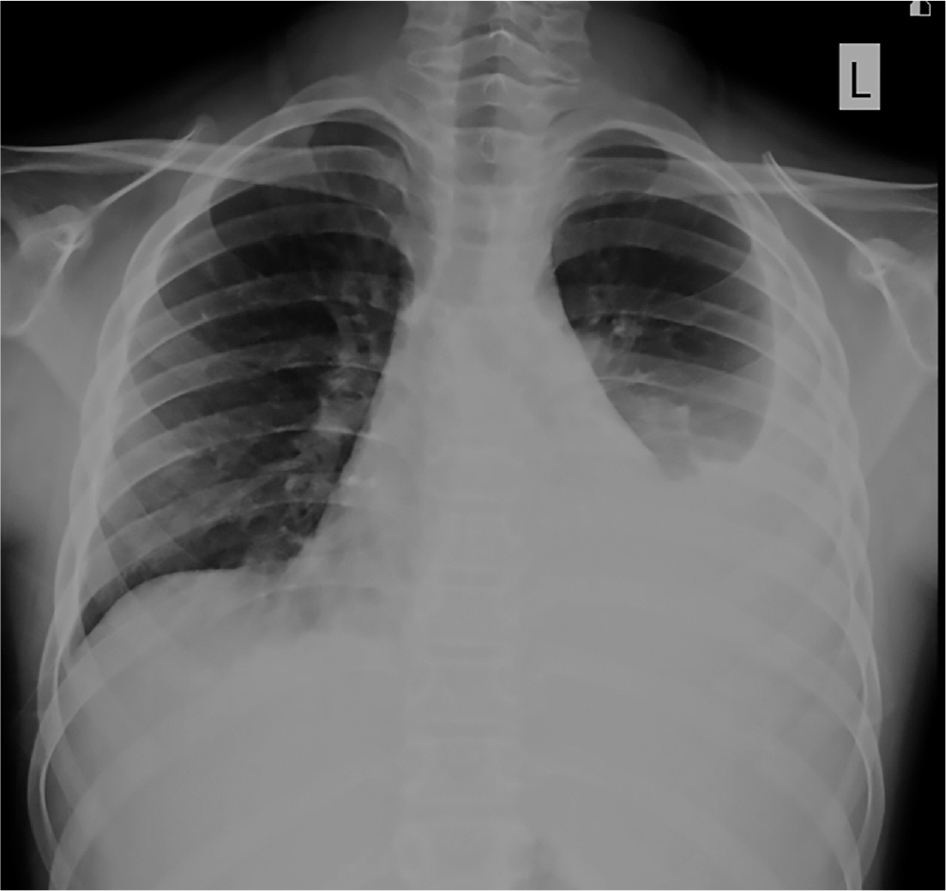
Figure 1
Chest radiograph in our patient showing massive left pleural effusion. The visualized upper abdomen appears unremarkable.
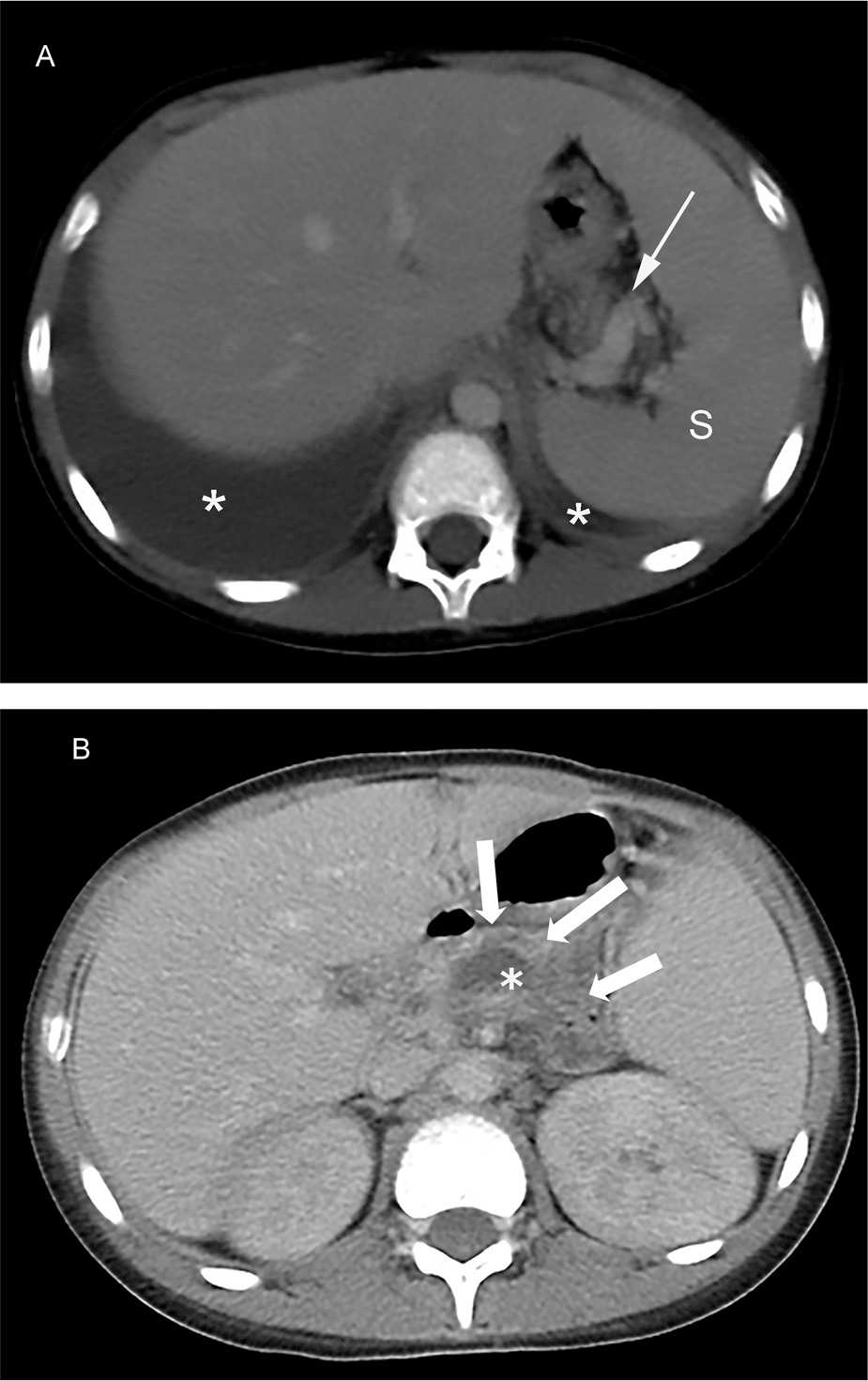
Figure 2
(A) An axial CT image in venous phase showing bilateral pleural effusions (asterisks). Splenomegaly (S) with splenic vein varices (arrow) is seen, indicating portal hypertension. However, no definite cause of portal hypertension was identified in this case. (B) The included upper abdominal part of the chest CT showing diffuse pancreatic atrophy and prominent pancreatic duct (arrows), consistent with chronic pancreatitis. A 2-cm-sized pseudocyst (asterisk) was observed, abutting the posterior aspect of the pancreatic body. No fistulous tract to the mediastinum is evident. CT, computed tomography.
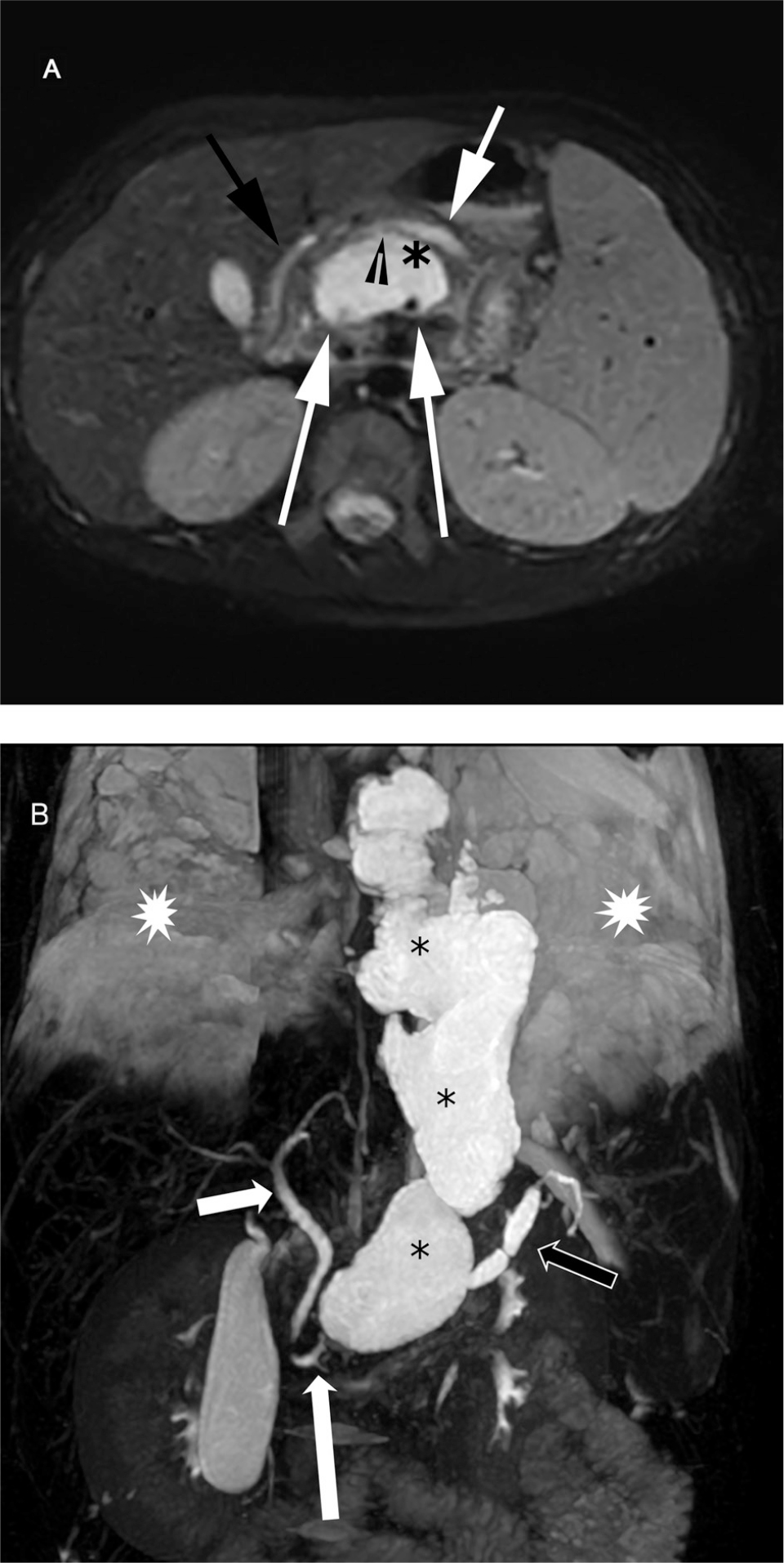
Figure 3
(A) An axial T2-weighted image with fat suppression showing thinning of the pancreatic parenchyma with a dilated upstream pancreatic duct (short white arrows), consistent with chronic pancreatitis. Disruption of the posterior aspect of the main (arrow head) can be seen, about 2 mm wide, connected with the pseudocyst (asterisk). A few stones (long white arrows) are observed within the pseudocyst. The downstream pancreatic duct (dark arrow) is narrower. (B) A 3-dimensional maximum intensity projection (MIP) image of MRCP showing a large pancreatic pseudocyst (asterisks) arising from the pancreatic genu-body junction and extending upward to the mediastinum. Disproportion of the non dilated downstream pancreatic duct (long white arrow) and the dilated upstream pancreatic duct (dark arrow) indicates pancreatic duct discontinuation. Massive bilateral pleural effusions (stars) can also be seen. The common bile duct (short white arrow) is not dilated. MIP, maximum intensity projection; MRCP, magnetic resonance cholangiopancreatography.
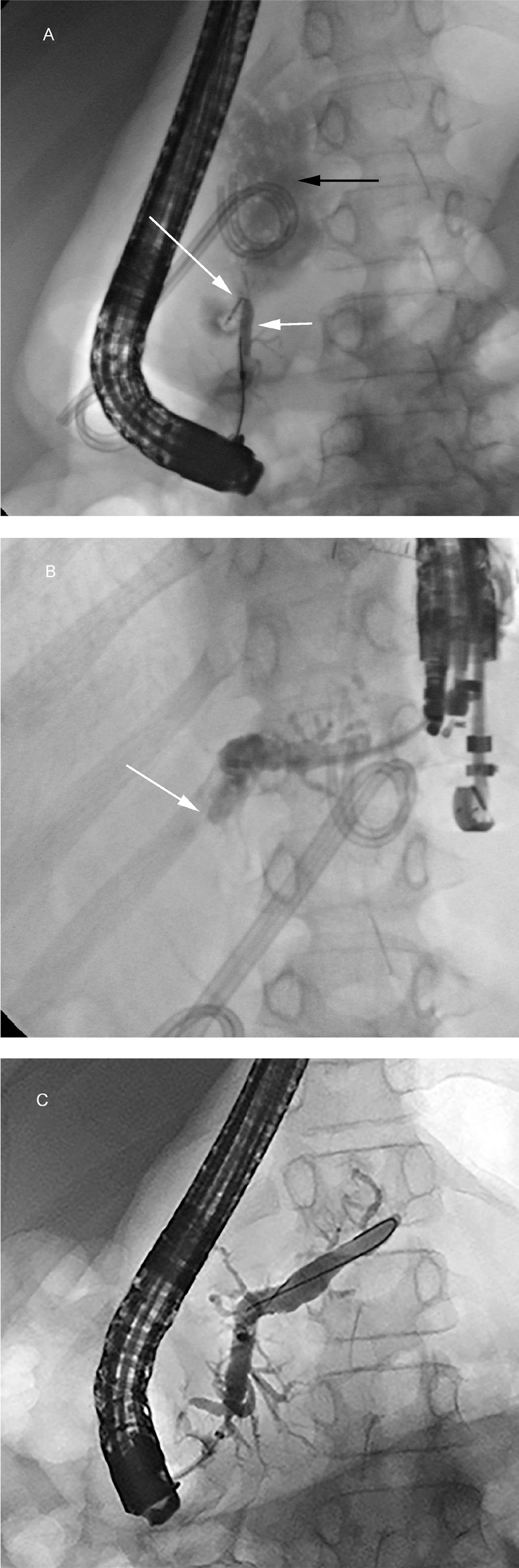
Figure 4
(A) ERCP showing opacification of contrast in the proximal pancreatic duct (short white arrow). Contrast leakage can be seen from the pancreatic duct at the genu-body junction of the pancreas (long white arrow) into the pseudocyst (dark arrow). No opacification of contrast in the distal part of pancreatic duct is evident. These findings are suggestive of complete disruption of the pancreatic duct (B) EUS-guided pancreatography showing opacification of contrast in the dilated upstream pancreatic duct only to the genu-body part of the pancreatic duct (arrow), with no further contrast filling in the more proximal pancreatic duct. These findings confirmed a diagnosis of disconnected pancreatic duct syndrome. (C) ERCP performed after 4 months with a retained pancreatic duct stent showing complete anatomical restoration of the pancreatic duct, representing successful endoscopic treatment. ERCP, endoscopic retrograde cholangiopancreatography; EUS, endoscopic ultrasound.
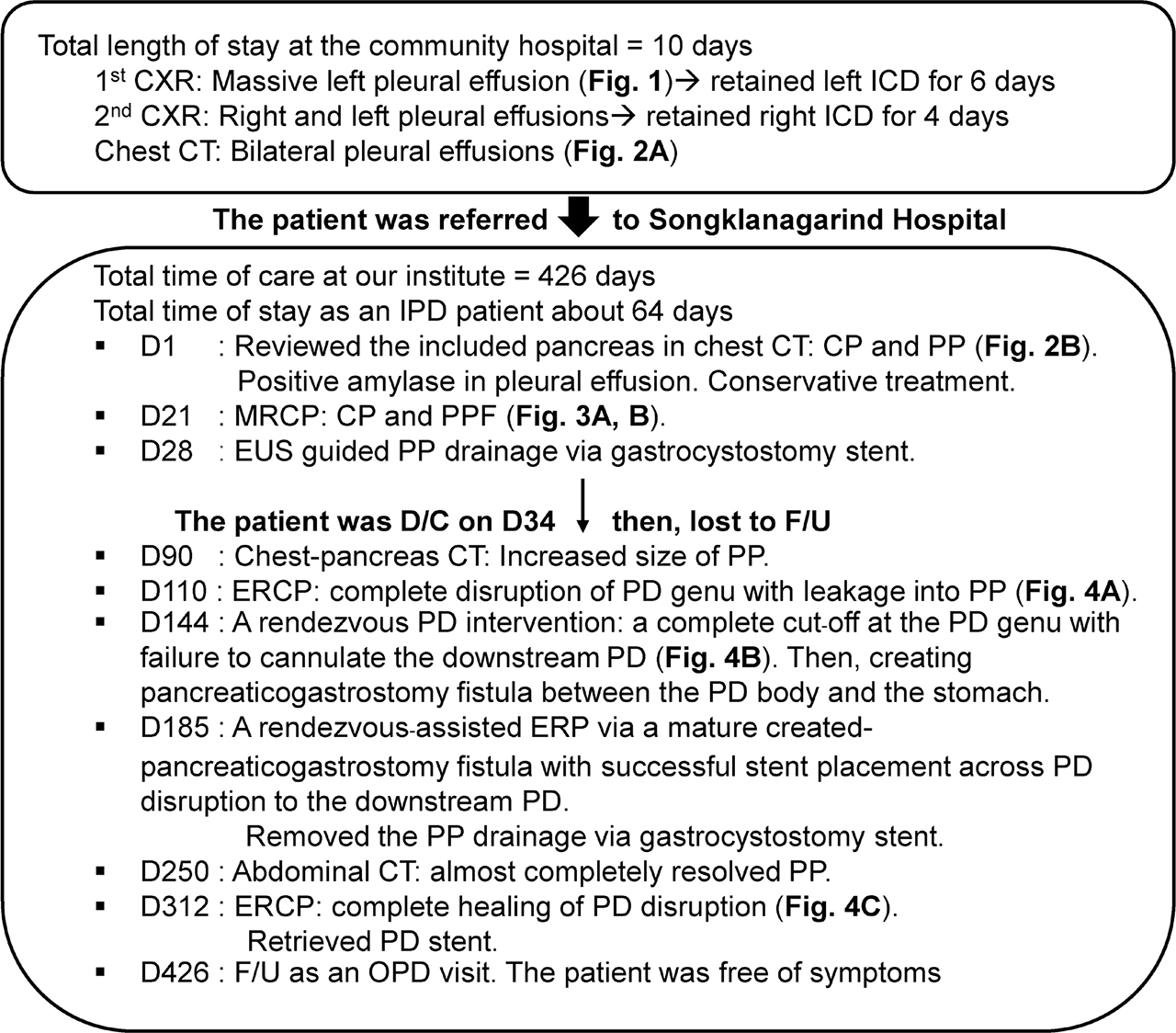
Figure 5
Summary of the episode of care in our case. CXR, chest radiograph; ICD, intercostal chest drain; CT, computed tomography; IPD, in-patient department; CP, chronic pancreatitis; PP, pancreatic pseudocyst; MRCP, magnetic resonance cholangiopancreatography; EUS, endoscopic ultrasound; D, day; D/C, discharged; F/U, follow up; ERCP, endoscopic retrograde cholangiopancreatography; PD, pancreatic duct; ERP, endoscopic retrograde pancreatography; OPD, out-patient department.
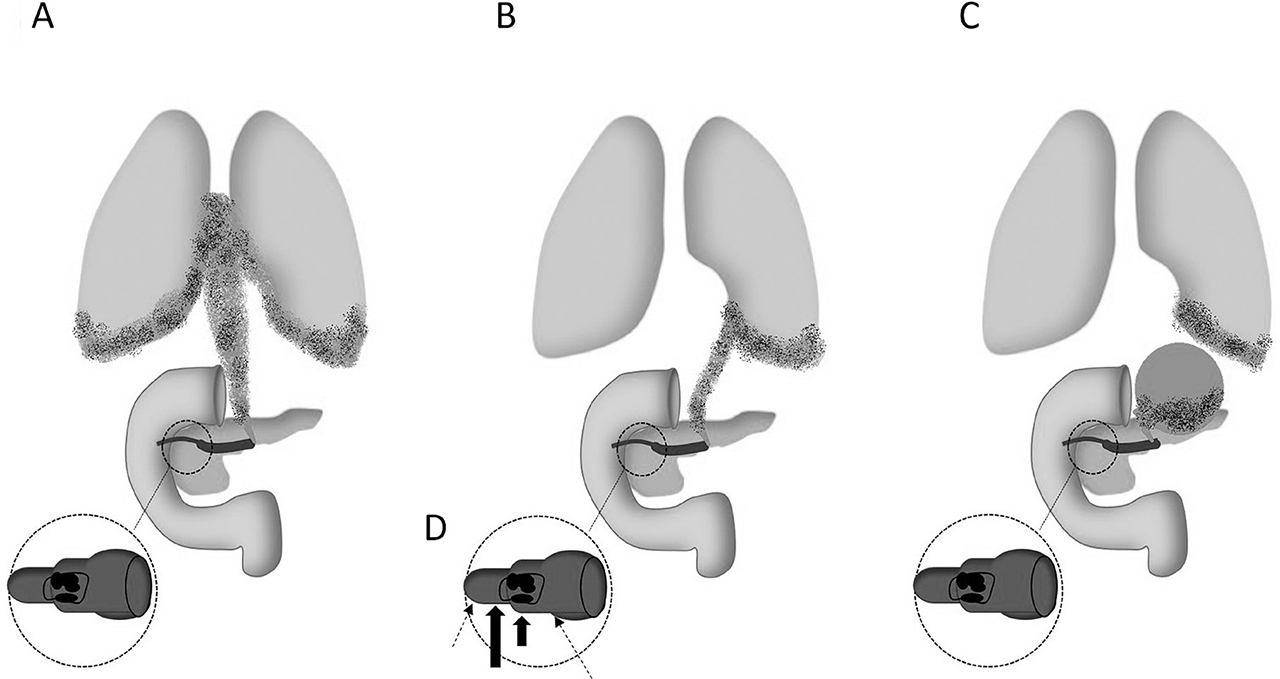
Figure 6
Patterns of a PPF (black–gray areas). (A) Mediastinal location: the pancreatic fluid leaks to the retroperitoneum and drains upwards to the mediastinum. Then the fluid leaks uni- or bilateral to one or both pleural cavities via hila or pleural fistula. (B) Diaphragmatic location: the pancreatic juice drains via the retroperitoneal space and erodes the diaphragm until the hiatus and to the pleural cavity. (C) A pseudocyst formed by anterior leakage from the pancreatic duct results in direct erosion of the diaphragm resulting in pleural effusion. (D) A magnified picture of the possible pathologies of the pancreatic duct in PPF: stricture of the focal downstream pancreatic duct (long arrow) causes dilatation of the upstream pancreatic duct (long dashed arrow) and pancreatic duct stone formation (short arrow). The undilated downstream pancreatic duct is also seen (short dashed arrow). PPF, pancreaticopleural fistula.
Table 1
Imaging details of the reported cases of PPF in children including our case. Total patients (n = 13) [1, 2, 8,9,10,11,12,13,14,15,16].
| Case | Etiology | Imaging modalities | Modalities detecting fistula | Location of fistula | Location of pseudocyst | Direct disruption of PD | Proximal stricture of PD | PD stones | Irregular dilatation of PD (CP) | Other pancreatic findings |
|---|---|---|---|---|---|---|---|---|---|---|
| Yang et al. [1] | CP | CT, MRCP, ERCP | MRCP | D | – | MRCP | – | ERCP | CT, MRCP | – |
| Zhang et al. [2] | CP | CT, MRCP, ERCP | MRCP, ERCP | D | Tail (CT, MRCP) | ERCP | ERCP | – | CT, MRCP | – |
| Gupta et al. [8] | AP | US, CT | – | – | Tail (US, CT) | – | – | – | – | AP-edema (CT) |
| Bishop et al. [9] | CP | MRCP, ERCP | ERCP | D | Head (MRCP) | ERCP | – | – | MRCP | – |
| Ranuh et al. [10] | CP | US, CT, ERCP | CT | M | – | CT | ERCP | – | – | CP-calcifications (US, CT) |
| Duncan et al. [11] | CP | US, CT | CT | M | Tail (US, CT) | – | – | – | US, CT | – |
| (2 cases) | CP | US, CT, IOC | CT, IOC | M | Head, tail (US, CT) | IOC | IOC | IOC | US, CT | CP-calcifications (US, CT) |
| Nacoti et al. [12] | CP | CT, MRCP, ERCP | CT, MRCP | M | Head (MRCP) | – | ERCP† | – | MRCP | Pancreas divisum (MRCP) |
| Ozbek et al. [13] | Trauma | US, CT | CT | D/M | Multiple (US, CT) | – | – | – | US, CT | – |
| Xiang and Zheng [14] | CP | US, CT | CT | M | Tail (US, CT) | – | – | – | – | – |
| Lee et al. [15] | CP | CT, MRCP, ERCP | MRCP | D | – | – | MRCP, ERCP | MRCP ERCP | CT, MRCP | – |
| Yu et al. [16] | CP | CT, MRCP, ERCP | MRCP, CT, ERCP | D | – | MRCP, CT, ERCP | – | ERCP | CT, MRCP | CP-calcifications (CT) |
| Present case | CP | CT, MRCP, ERCP | MRCP, ERCP | M | Body (CT, MRCP) | MRCP, ERCP | MRCP, ERCP | MRCP ERCP‡ | CT, MRCP | – |
–, not detected
CP, chronic pancreatitis; AP, acute pancreatitis; US, ultrasound; CT, computed tomography; MRCP, magnetic resonance cholangiopancreatography; ERCP, endoscopic retrograde cholangiopancreatography; IOC, intraoperative cholangiopancreatography; F, fistula; D, diaphragm; M, mediastinum; PD, pancreatic duct.
Table 2
Statistical summary of imaging findings of the reported cases of PPF in children including our case. Total patients (n = 13) [1, 2, 8,9,10,11,12,13,14,15,16].
| Features | Number of cases |
|---|---|
| Site of pleural effusion (right: left: bilateral) | 6: 4: 3 |
| Number of USs | 6 |
| Number of CTs | 12 |
| Number of MRCPs | 7 |
| Number of ERCPs or IOCs | ERCP 8, IOC 1 |
| Demonstrated fistulae | 12/13 |
| By US, CT, MRCP, ERCP or IOC | 0/6, 7/12, 6/7, 5/9 |
| Type of fistula | |
| Diaphragmatic | 5 |
| Mediastinal | 6 |
| Both diaphragmatic and mediastinal | 1 |
| Pseudocyst without direct fistula | 1 |
| PP detected by US, CT, MRCP | 4/6, 7/12, 3/7 |
| With fistulous tract by US, CT, MRCP | 0/6, 4/12, 3/7 |
| Without fistulous tract by US, CT, MRCP | 4/6, 3/12, 0/7 |
| Direct PD disruption | 7/13 |
| Detected by US, CT, MRCP, ERCP or IOC | 0/6, 2/12, 3/7, 5/9 |
| Proximal PD strictures | 6/13 |
| Visualized by US, CT, MRCP, ERCP or IOC | 0/6, 0/12, 2/7, 6/9 |
| PD stone | 5/14 |
| Visualized by US, CT, MRCP, ERCP or IOC | 0/0, 0/12, 2/7, 5/9 |
| PD irregular dilatation (CP) | 11/13 |
| Visualized by US, CT, MRCP | 3/6, 8/12, 7/7 |
| Pancreatic parenchymal calcifications by US, CT, MRCP | 2/6, 4/12, 0/7 |
| Pancreatic parenchymal edema by US, CT, MRCP | 0/6, 1/12, 0/7 |
| Pancreas divisum by MRCP, ERCP | 1/13 |
[i] US, ultrasound; CT, computed tomography; MRCP, magnetic resonance cholangiopancreatography; ERCP, endoscopic retrograde cholangiopancreatography; IOC, intraoperative cholangiopancreatography; PD, pancreatic duct; CP, chronic pancreatitis; PPF, pancreaticopleural fistula; PP, pancreatic pseudocyst.
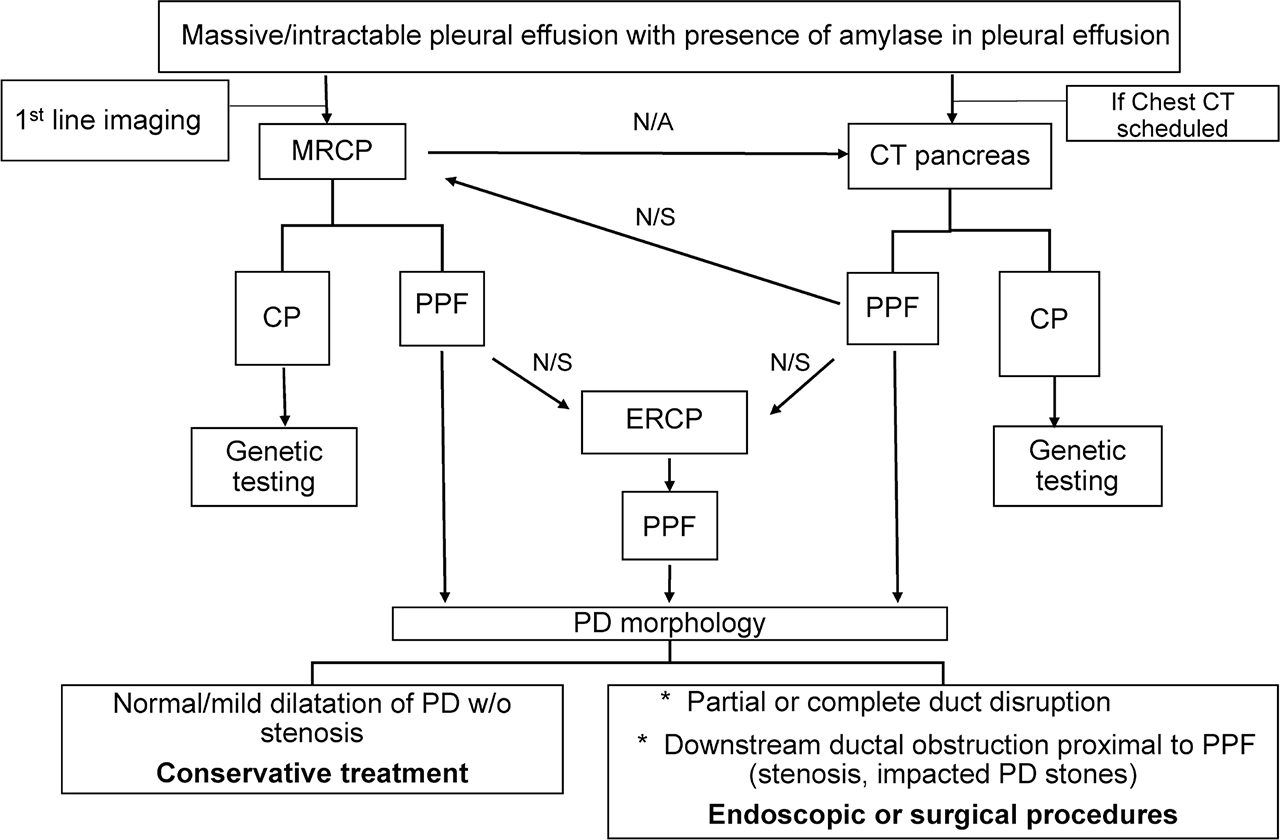
Figure 7
Flowchart of imaging and management guideline for cases of suspected PPF. MRCP, magnetic resonance cholangiopancreatography; CT, computed tomography; ERCP, endoscopic retrograde cholangiopancreatography; CP, chronic pancreatitis; PPF, pancreaticopleural fistula; PD, pancreatic duct; N/A, not available; N/S, not seen; w/o, without.