
Table 1
Characteristics of the participants
| AS (n = 40) [A] | OA (n = 40) [B] | Healthy controls (n = 40) [C] | P [A–B] | P [A–C] | |
|---|---|---|---|---|---|
| Age (years) | 44.5 ± 18.8 | 48.5 ± 8.6 | 46.2 ± 17.9 | 0.23 | 0.69 |
| Height (cm) | 164.7 ± 8.3 | 163.3 ± 7.4 | 165.7 ± 7.0 | 0.43 | 0.58 |
| Weight (kg) | 62.5 ± 6.5 | 62.5 ± 5.7 | 63.5 ± 7.0 | 0.96 | 0.53 |
| Male (%) | 40 | 20 | 35 | 0.051 | 0.64 |
| Disease duration (years) | 6.6 ± 6.7 | ||||
| HLA-B27 (%) | 100 | ||||
| ESR (<20 mm/h) | 49.3 ± 27.2 | ||||
| CRP (<8.0 mg/L) | 22.7 ± 16.8 | ||||
| BASDAI | 4.70 ± 0.69 | ||||
| BASFI | 4.75 ± 1.35 | ||||
| MASES | 2.70 ± 1.53 | ||||
| ASDAS | 3.27 ± 0.84 | ||||
| Night VAS score | 5.13 ± 1.74 | ||||
| Clinical presence of enthesitis (%) | 80 | ||||
| (MASES ≥1) Dactylitis (%) | 5 | ||||
| Peripheral arthritis (%) | 65 |
[i] One-way ANOVA with LSD post hoc multiple comparisons was used to examine continuous variables. A Fisher exact test or χ2 test was used to examine categorical variables.
[ii] ANOVA, analysis of variance; LSD, least-squares difference; AS, ankylosing spondylitis; OA, osteoarthritis; CRP, C-reactive protein; ESR, erythrocyte sedimentation rate; BASDAI, Bath Ankylosing Spondylitis Disease Activity Index; BASFI, Bath Ankylosing Spondylitis Functional Index; HLA-B27, human leukocyte antigen-B27; MASES, Maastricht Ankylosing Spondylitis Enthesitis Score; ASDAS, Ankylosing Spondylitis Disease Activity Score; VAS, visual analog scale.
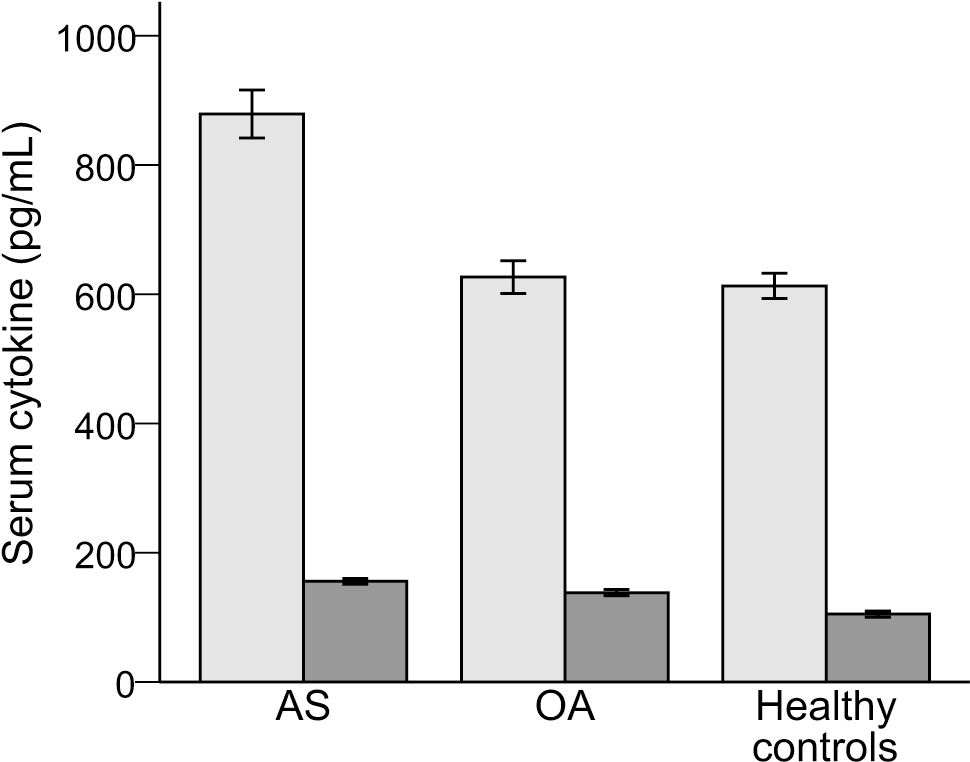
Figure 1
Serum levels of IL-34 and RANKL cytokines in AS, osteoarthritis, and healthy controls. IL-34, interleukin-34 (light-gray bars); RANKL, receptor activator of nuclear factor-κB (dark-gray bars); AS, ankylosing spondylitis; OA, osteoarthritis. Error bars indicate SD; SD, standard deviation.
Table 2
Serum levels of IL-34 and RANKL in AS, osteoarthritis, and healthy control groups
| Comparison | Variable | Univariable analysis | Multivariable analysis | ||||
|---|---|---|---|---|---|---|---|
| OR | 95% CI | P | OR | 95% CI | P | ||
| AS vs. OA | IL-34 | 1.04 | 1.01–1.14 | 0.016 | 0.93 | 0.88–0.99 | 0.016 |
| RANKL | 1.12 | 0.98–1.30 | 0.11 | 0.89 | 0.77–1.02 | 0.10 | |
| Weight | 0.43 | 0.12–1.58 | 0.20 | 0.67 | 0.63–8.57 | 0.20 | |
| Height | 1.17 | 0.57–2.37 | 0.68 | 0.86 | 0.42–1.74 | 0.67 | |
| Age | 0.88 | 0.88–1.00 | 0.06 | 1.14 | 0.999–1.30 | 0.052 | |
| Sex | 3.39 | 0.57–5.29 | 0.36 | 0.54 | 0.09–2.18 | 0.37 | |
| AS vs. Healthy controls | IL-34 | 1.24 | 0.80–1.32 | 0.11 | 0.92 | 0.87–0.98 | 0.007 |
| RANKL | 0.82 | 0.41–1.18 | 0.45 | 0.75 | 0.64–0.89 | 0.001 | |
| Weight | 3.02 | 0.77–5.62 | 0.71 | 1.95 | 0.51–7.49 | 0.33 | |
| Height | 0.69 | 0.23–1.83 | 0.55 | 0.94 | 0.44–2.04 | 0.88 | |
| Age | 0.97 | 0.59–1.21 | 0.11 | 1.17 | 1.01–1.34 | 0.03 | |
| Sex | 0.40 | 0.10–2.18 | 0.36 | 0.51 | 0.03–2.31 | 0.60 | |
[i] AS, ankylosing spondylitis; OA, osteoarthritis; IL-34, interleukin-34; RANKL, receptor activator of nuclear factor-κB; CI, confidence interval; OA, osteoarthritis; OR, odds ratio.
[ii] Multiple logistic regressions were performed to determine the associations between IL-34, RANKL, and disease parameters in patients with AS. Backward stepwise selection was applied to determine which variables were included in the final multivariable model. Various candidate predictors were selected for evaluation in the risk model, including IL-34, RANKL, weight, height, age, and sex.
Table 3
Serum IL-34 and RANKL in patients with AS across age groups
| Age (years) | IL-34 (pg/mL) | RANKL (pg/mL) |
|---|---|---|
| 10 to <20 | 874.9 ± 164.5 | 154.0 ± 15.1 |
| 20 to <30 | 977.3 ± 91.2 | 136.4 ± 1.6 |
| 30 to <40 | 841.6 ± 126.1 | 157.6 ± 17.2 |
| 40 to <50 | 887.7 ± 105.2 | 159.7 ± 7.3 |
| 50 to <60 | 861.5 ± 97.0 | 145.7 ± 1.4 |
| 60 to <70 | 893.1 ± 116.4 | 162.0 ± 10.7 |
| 70 to 80 | 829.6 ± 60.5 | 155.8 ± 14.8 |
[i] Mean ± standard deviation of serum levels of IL-34 and RANKL across age groups.
[ii] AS, ankylosing spondylitis; IL-34, interleukin-34; RANKL, receptor activator of nuclear factor-κB.
Table 4
Serum IL-34 and RANKL in patients with AS across weight categories
| Weight (kg) | IL-34 (pg/mL) | RANKL (pg/mL) |
|---|---|---|
| 40 to >50 | 984.5 ± 76.9 | 156.3 ± 13.6 |
| 50 to >60 | 881.3 ± 123.0 | 154.2 ± 15.5 |
| 60 to >70 | 846.5 ± 101.3 | 154.7 ± 12.7 |
| 70 to 80 | 990.0 ± 116.7 | 168.6 ± 4.2 |
[i] Mean ± standard deviation of serum IL-34 and RANKL across weight categories.
[ii] AS, ankylosing spondylitis; IL-34, interleukin-34; RANKL, receptor activator of nuclear factor-κB.
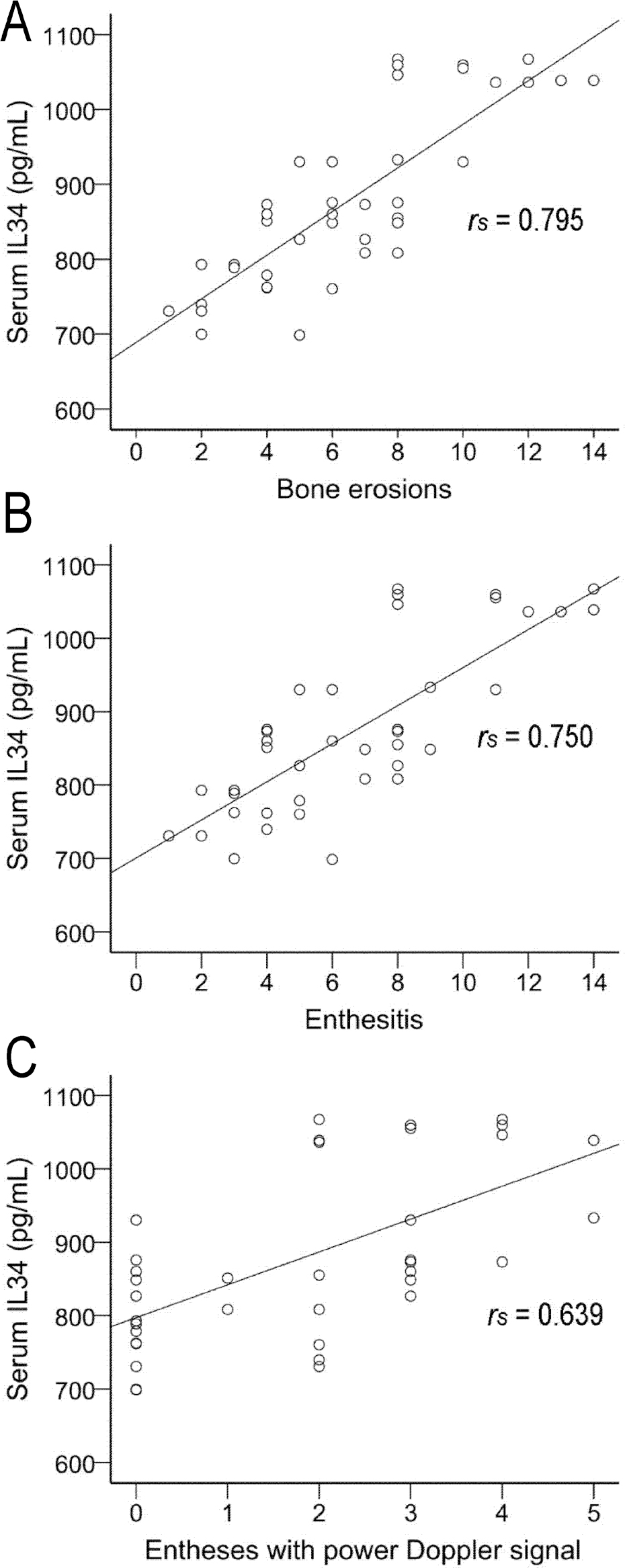
Figure 2
In patients with ankylosing spondylitis, the serum level of IL-34 was positively correlated with (A) the number of bone erosion, (B) the number of enthesitis, and (C) the number of entheses with a power Doppler signal. Spearman rank correlation coefficients between serum levels of IL-34 and clinical data were used to determine the relationship between the variables. IL-34, interleukin-34.
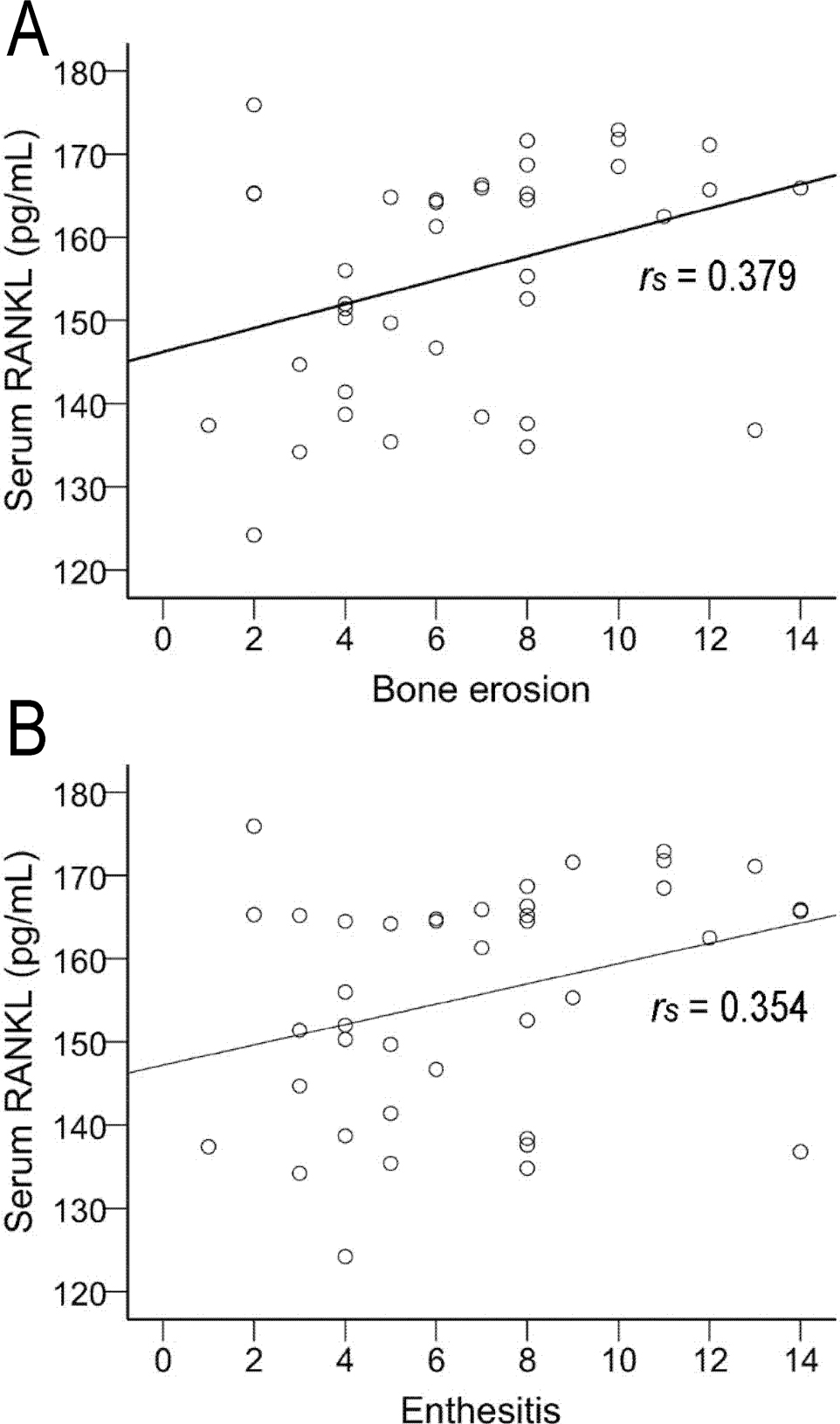
Figure 3
In patients with ankylosing spondylitis, the serum level of RANKL concentration was positively correlated with (A) the number of bone erosions and (B) the number of enthesitis. Spearman rank correlation coefficients between serum levels of IL-34 and clinical data were used to determine the relationship between the variables. RANKL, receptor activator of nuclear factor-κB.
Table 5
Correlation (rs) between IL-34, RANKL, and ultrasonography findings in 40 patients with AS
| Ultrasonography | IL-34 | RANKL | IL-34† | RANKL† |
|---|---|---|---|---|
| GUESS | 0.29 | 0.07 | 0.39* | 0.26 |
| Effusion | 0.10 | 0.21 | 0.13 | 0.27 |
| Bone erosion | 0.80** | 0.38* | 0.82** | 0.37* |
| Osteophyte | 0.30 | 0.15 | 0.37* | 0.13 |
| PD | 0.64** | 0.07 | 0.63** | 0.08 |
| Enthesitis | 0.75** | 0.35* | 0.80** | 0.35* |
Spearman rank correlation coefficients between serum levels of IL-34 or RANKL, and ultrasonography findings were used to determine the relationship between two variables.
AS, ankylosing spondylitis; PD, power Doppler signal; IL-34, interleukin-34; RANKL, receptor activator of nuclear factor-κB; GUESS, Glasgow Ultrasound Enthesitis Scoring System.
Table 6
Correlation (rs) between serum IL-34 and RANKL, and clinical data of 40 patients with AS
| Clinical data | IL-34 | RANKL | IL-34† | RANKL† |
|---|---|---|---|---|
| RANKL | 0.117 | — | 0.108 | — |
| ESR | −0.056 | 0.206 | −0.052 | 0.220 |
| CRP | 0.023 | 0.194 | 0.037 | 0.210 |
| BASDAI | −0.211 | 0.213 | −0.259 | 0.157 |
| BASFI | −0.294 | –0.089 | −0.285 | −0.149 |
| BASMI | −0.254 | 0.27 | −0.254 | −0.149 |
| MASES | 0.078 | −0.115 | −0.012 | −0.258 |
| ASDAS | −0.274 | 0.281 | −0.293 | 0.243 |
| Night VAS | −0.282 | 0.202 | −0.193 | 0.160 |
Spearman rank correlation coefficients between serum levels of IL-34 or RANKL, and clinical data were used to determine the relationship between two variables.
AS, ankylosing spondylitis; CRP, C-reactive protein; ESR, erythrocyte sedimentation rate; BASDAI, Bath Ankylosing Spondylitis Disease Activity Index; BASFI, Bath Ankylosing Spondylitis Functional Index; MASES, Maastricht Ankylosing Spondylitis Enthesitis Score; ASDAS, Ankylosing Spondylitis Disease Activity Score; VAS, visual analog scale; RANKL, receptor activator of nuclear factor-κB; BASMI, Bath Ankylosing Spondylitis Metrology Index; IL-34, interleukin-34.
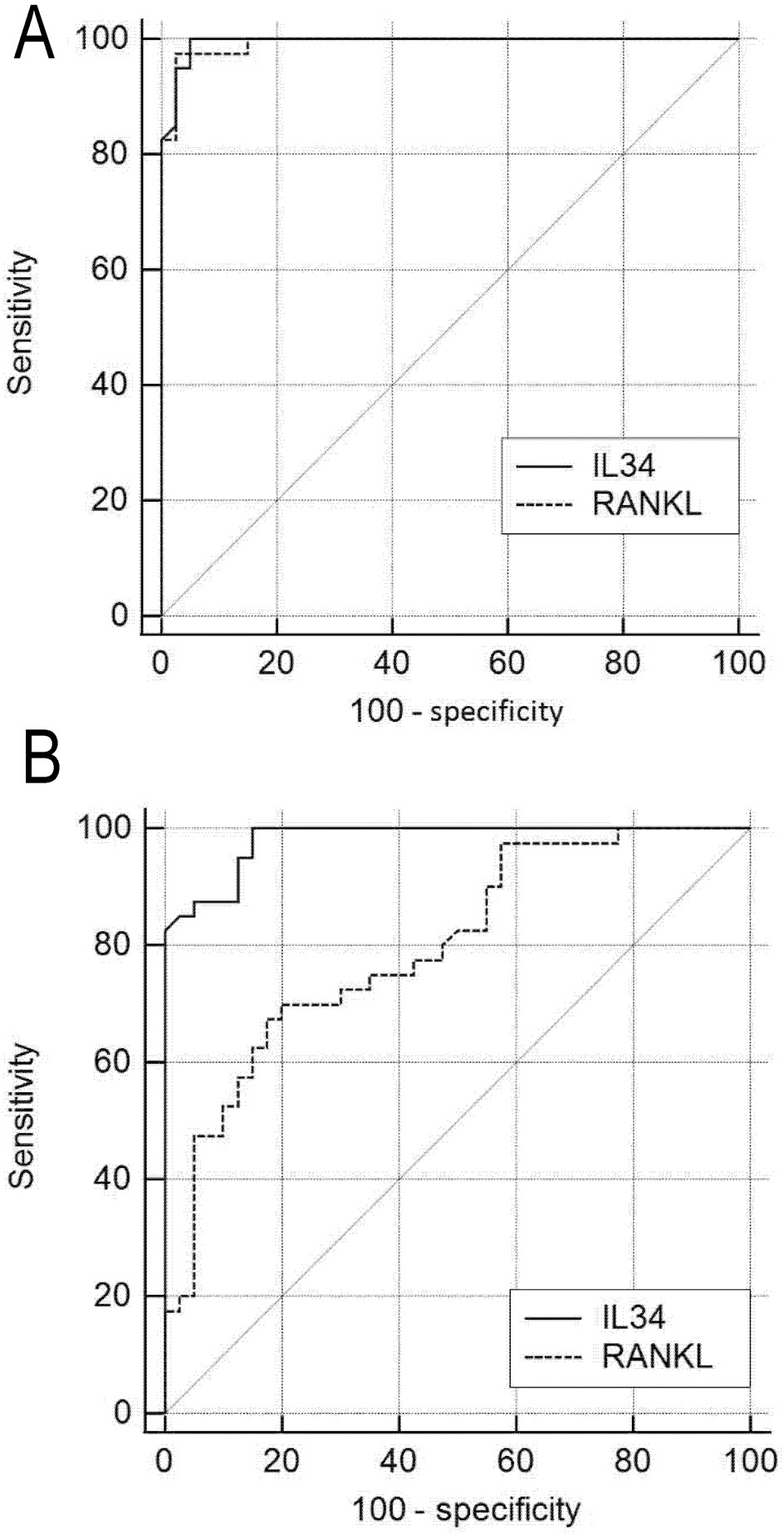
Figure 4
ROC curves for (A) serum level of IL-34 (solid line) and RANKL (dashed line) in the patients with AS and healthy individuals and (B) for serum level of IL-34 (solid line) and RANKL (dashed line) in patients with AS and those with osteoarthritis. ROC, receiver operating characteristics; IL-34, interleukin-34; RANKL, receptor activator of nuclear factor-κB; AS, ankylosing spondylitis; OA, osteoarthritis.