
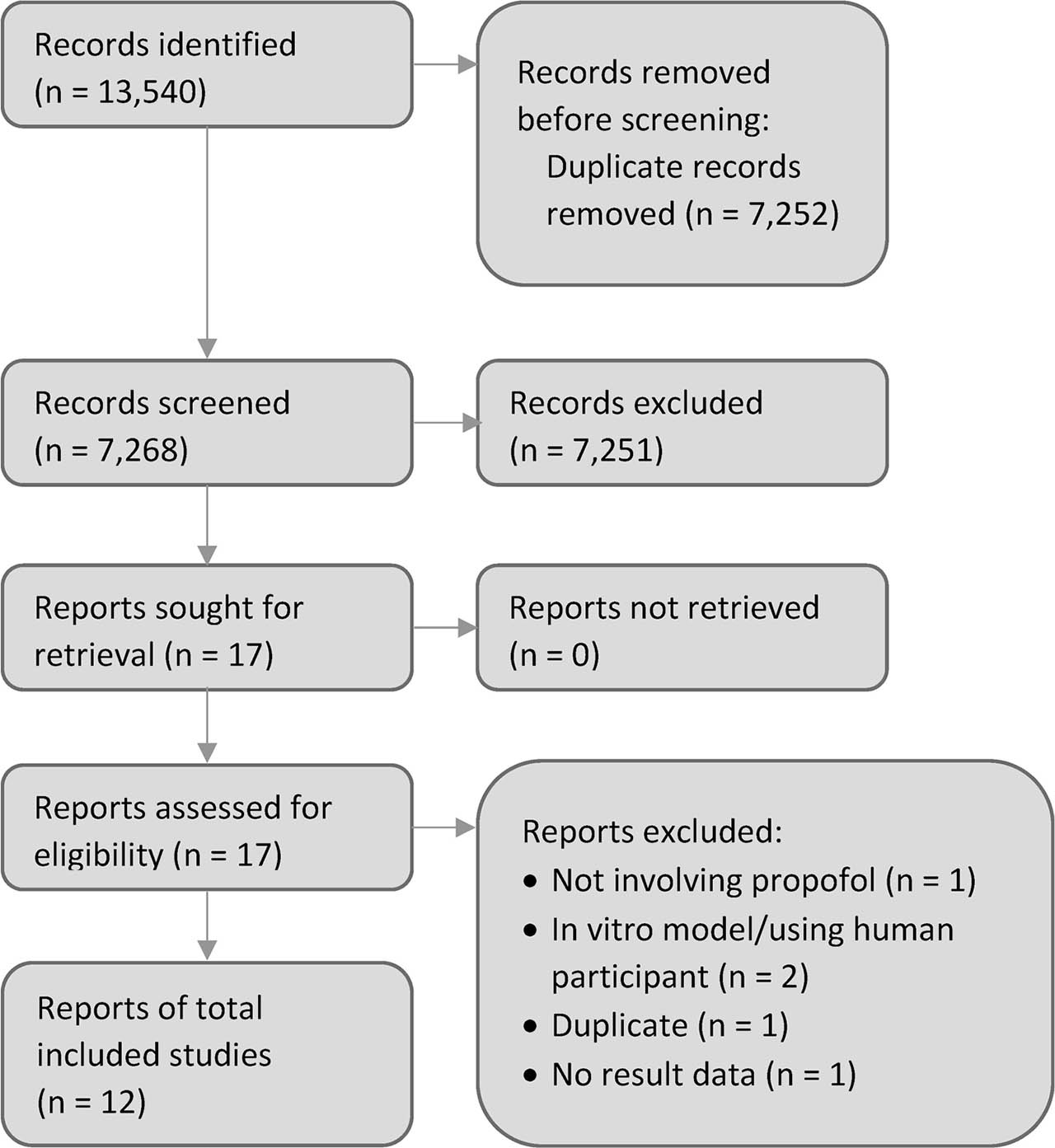
Figure 1
Flow diagram of the study selection process.
Table 1
Summary of study characteristics
| No. | Reference | Objectives | Animals/groupings | Type of injury | Analysis | Limitations/recommendations | Conclusion |
|---|---|---|---|---|---|---|---|
| 1 | Menku et al. [20] | Effect of propofol, propofol-citicoline combination on LP after head injury | 39 adult, male, Swiss Albino rats, 250–300 g Divided into 3 groups (n = 13 each):
| Moderate diffuse brain injury | Physiological parameters
SOD level GPx level | Combined use of therapeutic agents is more useful due to the synergetic effects | Effects of propofol on the activity of antioxidant enzyme system were stronger than its effect on LP |
| 2 | Ding et al. [17] | Therapeutic effects of propofol on brain edema following TBI and the modulating effect of propofol on AQP-4 expression | Male, Sprague Dawley rats, 250–300 g Divided into 4 groups:
| Weight-drop injury |
| Control of brain edema and reduced neuroinflammation following TBI. May prove clinically useful in managing acute TBI as a multifunctional neuroprotective agent. | Propofol treatment soon after TBI attenuates the development of edema and inhibits AQP-4 overexpression in rat models of TBI. Propofol modulates acute AQP-4 expression by attenuating IL-1β and TNF-α expression and inhibiting IL-1β and TNF-α-induced AQP4 expression |
| 3 | Ma et al. [21] | Role of NLRP3 and the effect of propofol to inhibit the NLRP3 inflammasome activation, which probably mediates the protective activity of propofol against the secondary injury following bTBI | Male SPF Sprague Dawley rats (220–300 g) Divided into 6 groups (n = 8 each):
| Blast-induced TBI (bTBI) | NLRP inflammasome mRNA expression TXNIP Caspase-1-p20 Cytokine level SOD MDA NSE | - | Overactivation of the NLRP3 inflammasome in the cerebral cortex may be involved in neuroinflammation during the secondary injury of bTBI in rats. Propofol might relieve the inflammatory response and attenuate brain injury by inhibiting ROS and reluctant depressing NLRP3 inflammasome activation and proinflammatory cytokine expression |
| 4 | Eberspächer et al. [16] | Effect of EEG-targeting low- and high-dose propofol infusion on acute histopathological damage in rats subjected to a moderate CCI | 39 male Sprague Dawley rats (400 ± 50 g) In 4 groups:
| CCI | Physiological evaluation
Glucose Core and pericranial temperature Lesion volume Eosinophilic cells Activated caspase-3 | Rupturing vessels during the impact that may lead to cortical and subcortical hemorrhage exacerbating the primary injury | EEG-targeted low- and high-dose propofol infusion for 6 h after CCI did not affect lesion volume or the number of eosinophilic cells in the hippocampus |
| 5 | Kahveci et al. [18] | Compared cerebral protective effects of isoflurane and propofol, when used in combination with moderatehypothermia (33–34 °C) in rats with TBI | 16 female Wistar rats (275–350 g) 2 groups (n = 8 each):
| Diffuse impact-acceleration | Physiological data
| Did not control the MAP during the study period. Investigation is needed to define the neuroprotective dose range of propofol in both experimental and human head injury | Propofol may be a better choice than isoflurane for use in combination with moderate hypothermia as treatment for head injury |
| 6 | Liu et al. [19] | Investigated the neuroprotective effects of propofol in rats following TBI, determined by neurological severity scores and expression of proinflammatory cytokines in the injured cortex | 212 adult male Sprague Dawley rats (200 ± 20 g) Divided into 4 groups (each group, n = 53):
| Weight-drop injury |
| - | Cytokines, IL-1β, IL-6 and TNF-α play key roles in the pathophysiology of neuroinflammation in the delayed phase of TBI, and propofol could reduce the neurological impairment induced by TBI via suppression of inflammatory reaction |
| 7 | Luo et al. [22] | Anti-inflammatory effects of propofol after lateral fluid percussion TBI | Adult male Sprague Dawley rats (300–340 g) Divided into 4 groups:
| Lateral fluid percussion trauma |
| General anesthetics before and during the delivery of TBI, which do not ideally reflect clinical situations | Effects of propofol on microglial activation substantial |
| 8 | Öztürk et al. [27] | Effects of propofol and erythropoietin (Epo) on brain injury caused by oxidative stress and antioxidant properties of these agents after CHI | 60-d-old female Wistar albino rats (200–250 g) Divided into 5 groups:
| CHI | Biochemical analysis
| Lack of functional outcome measures | Epo and propofol decreased oxidative stress by decreasing MDA and NO level in brain tissue after CHI. However, combination of Epo and propofol has no significant beneficial advantage over Epo or propofol alone |
| 9 | Sebastiani et al. [23] | Delayed single-bolus propofol applications at the peak of p75NTR p75expression after experimental TBI | 213 adult C57BL/6N and 15 NGFR–deficient mice 6 groups (propofol 6 h, propofol 24 h, vehicle 6 h, vehicle 24 h, NaCl 0.9% 6 h, NaCl 0.9% 24 h) | CCI |
| Not stated | Propofol sedation after acute brain lesion can have a deleterious impact and implicates a role for the pro-brain-derived neurotrophic factor-p75NTR p75 pathway. Propofol and other compounds with GABA receptor activity are frequently used in patients with acute brain pathologies to facilitate sedation or surgical and interventional procedures |
| 10 | Statler et al. [24] | Degree of neuroprotection provided by 7 anesthetics or sedatives (diazepam, fentanyl, isoflurane, ketamine, morphine, pentobarbital, and propofol) in a standard model of TBI | 81 adults, male Sprague Dawley rats (300–440 g) Divided into 9 groups of n = 9 (diazepam, fentanyl, isoflurane, ketamine, morphine, pentobarbital, propofol, none, and sham) | CCI |
| Compared various anesthetics/sedatives, does not allow precise assessment of the effects of individual anesthetics/sedatives when administered in the absence of isoflurane pretreatment (isoflurane may be neuroprotective). Difficulty comparing the potency of inhalational and intravenous anesthetics (equipotent doses, based on the traditional concept of MAC, may not have been achieved) | Medications commonly used in clinical TBI, narcotics and propofol, produced the poorest outcomes. By contrast, isoflurane, which is frequently used in experimental TBI, was associated with the best outcomes |
| 11 | Thal et al. [25] | To establish the influence of propofol on endogenous neurogenesis and functional recovery after TBI, rats were sedated with propofol (36 or 72 mg/kg/h) either during (0.5 h before until 1.5 h after CCI) or 2 h after TBI (3 h propofol sedation with 32 mg/kg/h (low dose (LD)) or 72 mg/kg/h (high dose (HD)) | 116 male Sprague Dawley rats (280–330 g) divided into 5 groups in study A and 5 groups in study B (various number of mice per group) Study A:
| CCI |
| Use of BrdU to label newly generated cells in rodents, proliferation induced by ischemia reaches a maximum after 7–11 d. Study only following the subject for 7 d, proliferation after day 7 following CCI will not be detected and is missed | Propofol infusion significantly attenuated post-traumatic neurogenesis, deteriorated neurofunctional recovery, and increased 28-d mortality. Potential negative effect of propofol after acute brain injury, especially when it is applied 2 h after CCI |
| 12 | Yu et al. [26] | Propofol could attenuate LP, calpain-induced CRMP2 degradation, and brain injury after TBI | 70 adult male Sprague Dawley rats (220–270 g) 7 groups of 9 rats (sham control, TBI, TBI + propofol 1 h, TBI + propofol 2 h, TBI + propofol 4 h, TBI + UE83836E, TBI + fat emulsion) | Unilateral moderate CCI injury |
| Propofol ameliorates oxidative stress, suppresses calpain activation and CRMP2 proteolysis and reduces apoptosis, propofol likely may interact with other signaling pathways that may or may not be involved in post-TBI peroxidation, calpain activation and CRMP2 degradation. The samples at 24 h following TBI: can only make conclusions regarding the transient neuroprotective effects of propofol postconditioning in TBI rats. Long-term and dose-dependent effects of propofol must be investigated further. Additional time points are also needed to determine the best therapeutic window for propofoladministration. Extrapolating the therapeutic regimen of propofol for TBI rats to patients with moderate TBI should be performed cautiously and requires further clinical research. | Propofol postconditioning alleviates calpain-mediated CRMP2 proteolysis and provides neuroprotective effects following moderate TBI potentially by counteracting LP and reducing calpain activation |
[i] AQP-4, aquaporin-4; BrdU, bromodeoxyuridine; bTBI, blast-induced traumatic brain injury; CAT, catalase; CHI, closed head injury; CRMP2, collapsin response mediator protein-2; CCI, controlled cortical impact; DMSO, dimethyl sulfoxide; EEG, electroencephalogram; GABA, γ-aminobutyric acid; GPx, glutathione peroxidase; HD, high-dose propofol; IL, interleukin; IL-1β, interleukin-1β; LP, lipid peroxidation; LD, low dose; MDA, malondialdehyde; MAP, mean atrial pressure; MAC, minimum alveolar concentration; MWM, Morris Water Maze; NGFR, nerve growth factor receptor; NSE, neuro-specific enolase; NO, nitric oxide; NLRP3, NOD-like receptor family pyrin domain containing 3; NFκB, nuclear factor kappa B; NSS, neurological severity score; p75NTR p75, neurotrophin receptor; PaCO2, partial pressure of carbon dioxide; PaO2, partial pressure oxygen; proBDNF, prodomain brain-derived neurotrophic factor; P, propofol; ROS, reactive oxygen species; SOD, superoxide dismutase; TXNIP, thioredoxin interacting protein; TBI, traumatic brain injury; TNF-α, tumor necrosis factor α; XO, xanthine oxidase.