
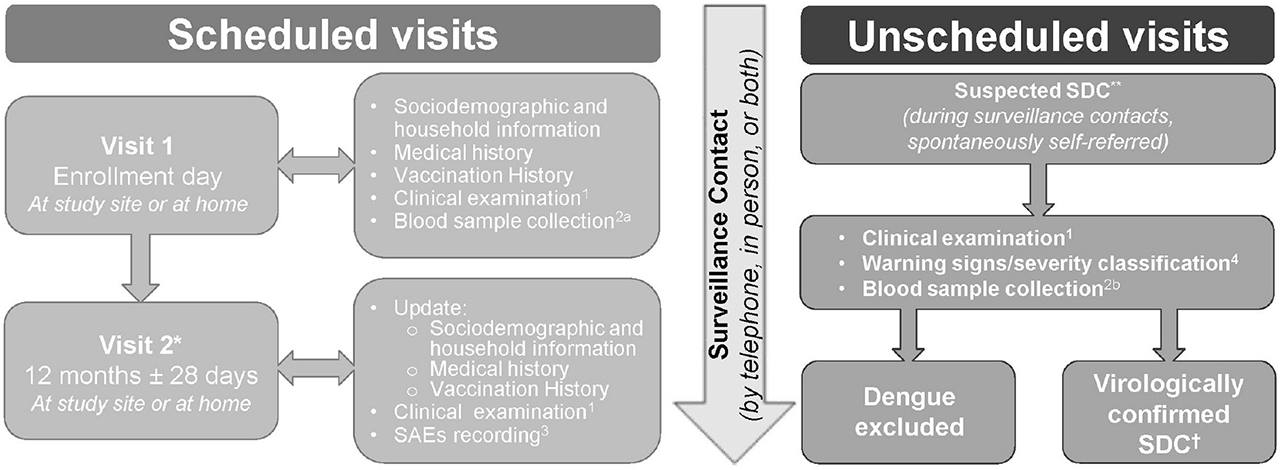
Figure 1
Schematic representation of the study design. *Blood samples were collected at Visit 2, but not analyzed due to early study termination. **Body temperature ≥ 38.0 °C within the past 8 days lasting from 36–48 h to 7 days, potentially accompanied by other signs of dengue that by the study investigator’s opinion could only be related to dengue; †SDCs confirmed by RT-qPCR or NS1. 1. Detailed clinical examination assessing the participant’s general condition, cardiac and respiratory rates, blood pressure, dengue-associated clinical signs, and symptoms. 2a. Used for ELISA to detect anti-DENV indirect IgG. 2b. Used for i. DENV RT-qPCR, ii. DENV isolation for sequencing purposes, iii. DENV sequence, iv. DENV NS1 rapid test (ICT) or ELISA, v. IgM/IgG rapid test (ICT) or SD Bioline Dengue Duo (dengue NS1 antigen and IgG/IgM). 3. Participants were advised to contact study investigators to report any sign or symptom they perceived as an SAE. All SAEs related to study procedures (blood collection) were recorded and evaluated by the study investigator along with related signs, symptoms, and relevant clinical information. 4. A. Warning signs. At least one of the following should be present: abdominal pain or tenderness, persistent vomiting, clinical fluid accumulation, mucosal bleeding, liver enlargement, increase in hematocrit concurrent with a rapid decrease in platelet count, lethargy, restlessness. B. Criteria for severe dengue. Dengue with at least one of the following: severe plasma leakage leading to shock, fluid accumulation with respiratory distress, severe bleeding, severe organ involvement, failure of heart and other organs. DENV, dengue virus; ELISA, enzyme-linked immunosorbent assay; ICT, immunochromatographic assay; IgG, immunoglobulin G; IgM, immunoglobulin M; NS1, nonstructural protein 1; RT-qPCR, reverse-transcriptase quantitative polymerase chain reaction; SAE, serious adverse event; SDC, suspected dengue case.
Table 1
Sociodemographic characteristics of the participants
| Characteristics | N = 500 |
|---|---|
| Households, number | 352 |
| Sex, female, n (%) | 272 (54.4) |
| Age (years) | |
| Mean (SD) | 15.6 (12.6) |
| Median | 12.0 |
| Range | 0.5–50 |
| Age groups, n (%) | |
| 6 months to <12 months | 12 (2.4) |
| 12 months–4 years | 75 (15.0) |
| 5–8 years | 88 (17.6) |
| 9–17 years | 175 (35.0) |
| 18–50 years | 150 (30.0) |
| Number of participants enrolled per household, n′ (%) | |
| 1 | 204 (58.0) |
| 2 | 148 (42.0) |
[i] N, number of participants; n, number of participants in a given category; n′, number of households in a given category; SD, standard deviation.
Table 2
Proportion of DENV IgG+ participants by ELISA at Visit 1
| n | Positive dengue (%) | Estimated GEE (%)* | 95%CI† | |
|---|---|---|---|---|
| Overall | 494 | 377 (76.3) | 76.2 | 71.9–80.0 |
| Age group | ||||
| 6 months to <12 months1 | 12 | 1 (8.3) | 8.3 | 1.2–41.3 |
| 12 months–4 years | 74 | 23 (31.1) | 31.2 | 21.7–42.7 |
| 5–8 years | 85 | 44 (51.8) | 51.5 | 40.8–62.0 |
| 9–17 years | 173 | 160 (92.5) | 92.0 | 86.4–95.4 |
| 18–50 years | 150 | 149 (99.3) | 99.3 | 95.4–99.99 |
n, number of participants with available results; CI, confidence interval; DENV, dengue virus; ELISA, enzyme-linked immunosorbent assay; GEE, generalized estimating equations; IgG, immunoglobulin G.
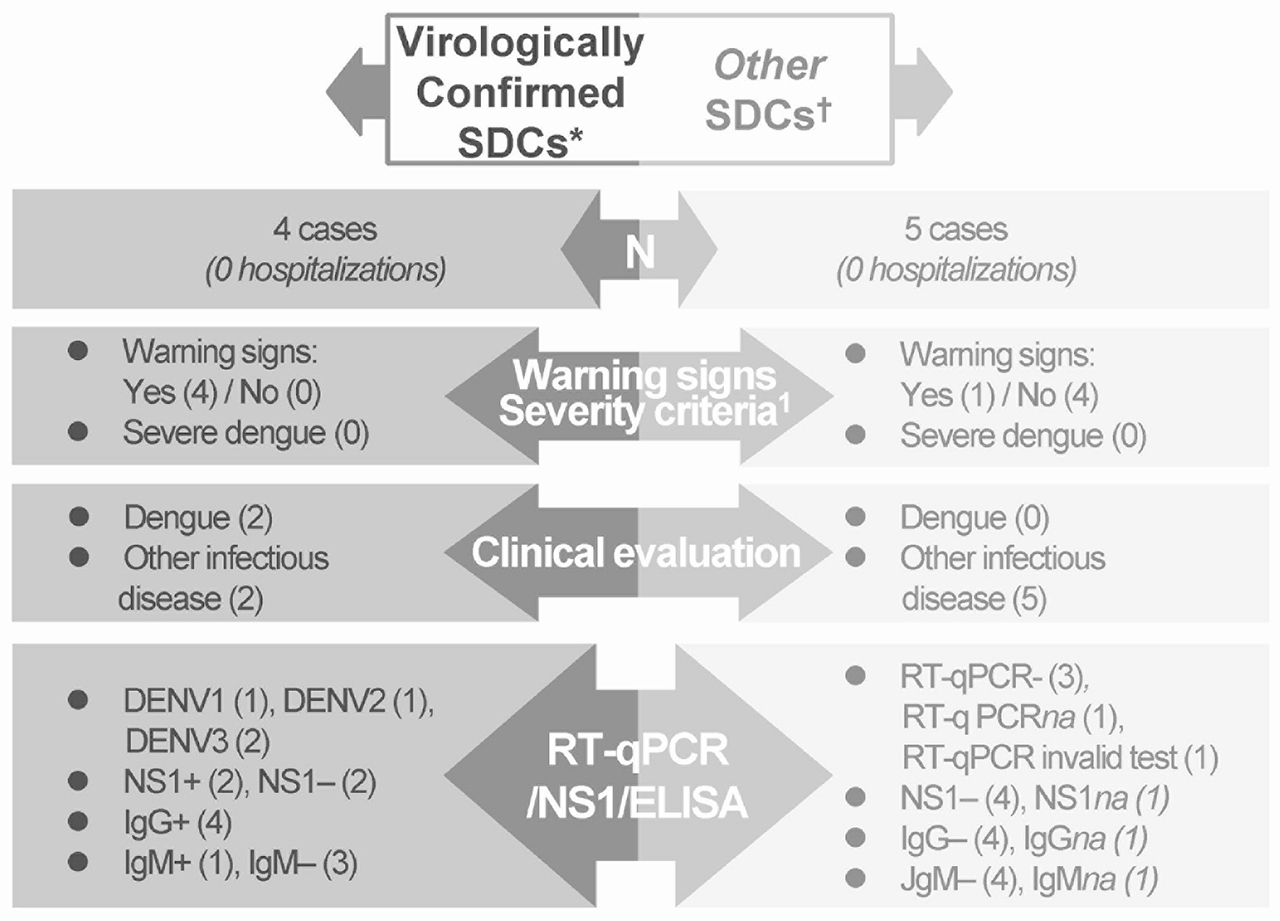
Figure 2
SDCs. *SDCs confirmed by RT-qPCR or NS1. To be classified with a SDC a study participant should have a body temperature of ≥38.0 °C within the past 8 days lasting from 36–48 h to 7 days, potentially accompanied by other signs of dengue that by the study investigator’s opinion could only be related to dengue; †SDCs not classified as confirmed virologically or probable. Warning signs. At least one of the following should be present: abdominal pain or tenderness, persistent vomiting, clinical fluid accumulation, mucosal bleeding, liver enlargement, increase in hematocrit concurrent with a rapid decrease in platelet count, lethargy, restlessness. Criteria for severe dengue. Dengue with at least one of the following: severe plasma leakage leading to shock, fluid accumulation with respiratory distress, severe bleeding, severe organ involvement, failure of heart and other organs. DENV, dengue virus; ELISA, enzyme-linked immunosorbent assay; ICT, immunochromatographic assay; IgG, immunoglobulin G; IgM, immunoglobulin M; na, not available; NS1, nonstructural protein 1; RT-qPCR, reverse-transcriptase quantitative polymerase chain reaction; SDC, suspected dengue case.
Table 3
Clinical evaluation of patients with cases of dengue confirmed virologically and other SDCs
| Clinical symptoms | Virologically confirmed dengue cases* n = 4 | Other SDC† n = 5 | Total n = 9 |
|---|---|---|---|
| At first visit for SDC | |||
| Axillary body temperature, n (°C) | |||
| <38.0 | 2 | 5 | 7 |
| ≥38.0 | 2 | 0 | 2 |
| Symptoms recorded during the SDC episode, n | |||
| Lasting fever‡ | 4 | 5 | 9 |
| Cough | 2 | 3 | 5 |
| Headache | 2 | 2 | 4 |
| Nausea or vomiting | 1 | 2 | 3 |
| Abdominal pain | 2 | 0 | 2 |
| Nasal congestion | 0 | 2 | 2 |
| Retroorbital pain (eye pain) | 1 | 0 | 1 |
| Sore throat | 1 | 0 | 1 |
| Petechia | 1 | 0 | 1 |
| Other | 3 | 2 | 5 |
n, number of cases; NS1, nonstructural protein 1; RT-qPCR, reverse-transcriptase quantitative polymerase chain reaction; SDC, suspected dengue case.
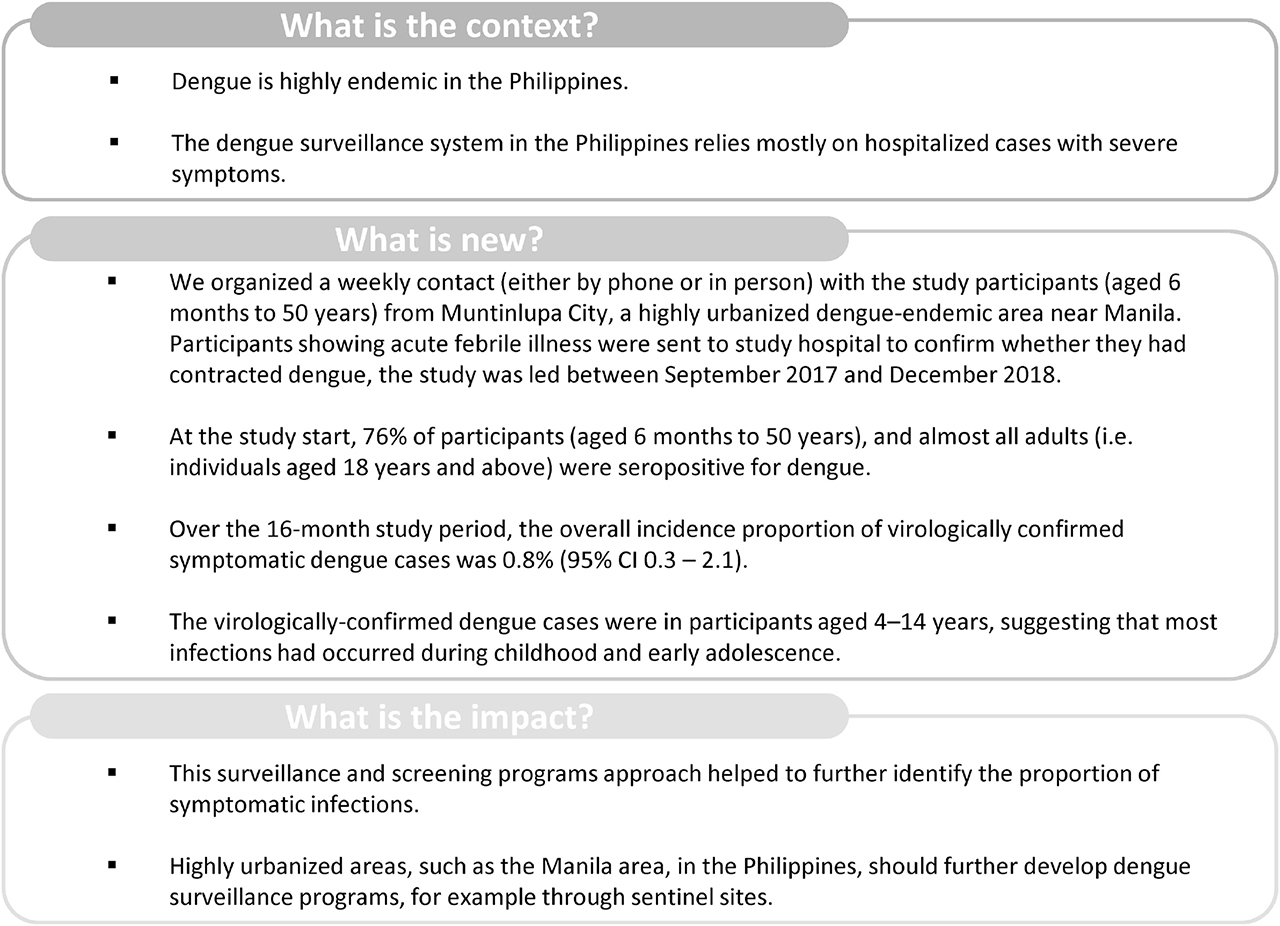
Figure 3
Plain language summary.