
Table 1
Patient demographic and clinical characteristics
| Demographic | n = 14 (%) |
|---|---|
| Age at diagnosis (years) | |
| Median (range) | 2.5 (0.25–15.6) |
| Mean ± SD | 5.1 ± 4.8 |
| Sex | |
| Female | 11 (79) |
| Male | 3 (21) |
| DI at diagnosis | 2 (14) |
| System involvement | |
| SS | 6 (43) |
| Skin only | 1 (17) |
| Single bone | 3 (50) |
| MFB | 2 (33) |
| MS | 8 (57) |
| Low risk | 3 (38) |
| High risk | 5 (63) |
| Follow-up (years) | |
| Median (range) | 6.8 (0.5–16.2) |
| Mean ± SD | 6.9 ± 5.7 |
[i] DI, diabetes insipidus; MFB, multifocal bone; MS, multisystem; SS, single system.
Table 2
Characteristics and outcomes of patients with LCH (n = 14)
| No | Age at diagnosis (years) | Sex | System involvement (SS vs. MS) | Organ/system involvement | Organ/system of risk involvement | DI at diagnosis | Treatment | CMT protocols | Disease status | Status at last follow-up | Follow-up (years) |
|---|---|---|---|---|---|---|---|---|---|---|---|
| 1 | 1.7 | Female | MS | Skin, bone | Liver, spleen, hematopoietic | No | CMT | Ara-C, Pred | Progressive | DWD | 1 |
| 2 | 0.25 | Female | MS | Lung, bone | Liver, spleen, hematopoietic | No | CMT | DAL-Hx83 | Remission | ANED | 16 |
| 3 | 1.2 | Female | MS | Bone, LN | Liver, spleen | No | CMT | LCH-III | Reactivation MFB | AWD | 8.6 |
| 4 | 15.6 | Male | MS | Lung, MFB (vertebrae) | Liver, spleen | No | CMT | LCH-IV | Reactivation | AWD | 2.7 |
| 5 | 1.3 | Female | MS | Skin, bone | Liver, spleen, hematopoietic | No | CMT | LCH-IV | Progressive | DWD | 0.6 |
| 6 | 9 | Female | SS | Bone | – | No | RT, CMT | CTX, VCR, Pred | Remission | ANED | 12 |
| 7 | 0.5 | Female | SS | Skin | – | No | Observation | – | Remission | ANED | 12 |
| 8 | 3 | Female | SS | Bone (CNS risk) | – | No | Curettage, CMT | LCH-III | Remission | ANED | 15 |
| 9 | 8 | Female | MS | MFB, pituitary | – | Yes | CMT | LCH-III | Remission | ANED | 3 |
| 10 | 7 | Female | SS | Bone | – | No | Surgery | – | Remission | ANED | 1 |
| 11 | 10 | Male | SS | MFB | – | No | CMT | LCH-III | Remission | ANED | 6 |
| 12 | 2 | Female | MS | Skin, pituitary, bone | – | Yes | CMT | LCH-III | Remission | ANED | 9 |
| 13 | 10.25 | Male | MS | Bone (vertebrae), LN | – | No | Surgery, CMT | LCH-III | Remission | ANED | 8 |
| 14 | 1.4 | Female | SS | MFB | – | No | CMT | LCH-IV | Remission | ANED | 0.5 |
[i] ANED, alive with no evidence of disease; Ara-C, cytosine arabinoside; AWD, alive with disease; CMT, chemotherapy; CNS, central nervous system; CTX, cyclophosphamide; DI, diabetes insipidus; DWD, died with disease; LCH, Langerhans cell histiocytosis; LN, lymph nodes; MFB, multifocal bone; MS, multisystem; Pred, prednisolone; RT, radiation; SS, single-system; VBL, vinblastine; VCR, vincristine.
Table 3
MS “risk” LCH (RO+ MS-LCH) characteristics of 5 patients
| No | Age at diagnosis (years) | Sex | Abnormal LFT | Organ/system of risk involvement | Other organ involvement | CMT regimen | Disease status | Status last follow-up | Follow-up (years) | BRAFV600E mutation |
|---|---|---|---|---|---|---|---|---|---|---|
| 1 | 1.7 | Female | TP 4.8 Alb 2.4 TB 13.7 DB 12.9 AST 56 ALT 47 ALP 451 | Liver, spleen, hematopoietic | Skin, bone | Ara-C, Pred | Progressive | DWD | 1 | Not done |
| 2 | 0.25 | Female | TP 8 Alb 4.8 TB 14 DB 0.5 AST 30 ALT 16 ALP 254 | Liver, spleen, hematopoietic | Lung, bone | DAL-Hx83: VBL, VP-16, 6-MP, MTX, Pred | Remission | ANED | 16 | Not done |
| 3 | 1.2 | Female | – | Liver, spleen | Bone, LN | LCH-III (High risk): MTX, VBL, Pred, 6-MP | Reactivation MFB | AWD | 8.6 | Not done |
| 4 | 15.6 | Male | – | Liver, spleen | Lung, bone (special site) | LCH-IV adapted: (High risk): VBL, Pred, 6-MP | Reactivation | AWD | 2.7 | Negative |
| 5 | 1.3 | Female | TP 6.27 Alb 2.73 TB 0.65 DB 0.28 AST 29.8 ALT 19.2 ALP 80 | Liver, spleen, hematopoietic | Skin, bone | LCH-IV adapted: (High risk): VBL, Pred, 6-MP | Progressive | DWD | 0.6 | Positive |
[i] 6-MP, 6-mercaptopurine; ANED, alive with no evidence of disease; Alb, albumin; ALP, alkaline phosphatase; ALT, alanine aminotransferase; Ara-C, cytosine arabinoside; AST, aspartate aminotransferase; AWD, alive with disease; CMT, chemotherapy; DB, direct bilirubin; DWD, died with disease; LCH, Langerhans cell histiocytosis; LFT, liver function test; LN, lymph nodes; MFB, multifocal bone; MS, multisystem; MTX, methotrexate; Pred, prednisolone; RO+, risk-organ involvement; TB, total bilirubin; TP, total protein; VBL, vinblastine; VP-16, etoposide.
Table 4
Radiology of patients with LCH (n = 14)
| Imaging | n = 14 (%) |
|---|---|
| Skull X-ray | |
| Normal | 3 (21) |
| Abnormal | 11 (79) |
| MR brain | 8 (73) |
| Normal | 1 (13) |
| Abnormal | 7 (88) |
| MR brain not done | 3 (27) |
| Tc-99m bone | |
| Done | 9 (64) |
| Not done | 5 (36) |
| FDG-PET-CT | |
| Done | 4 (29) |
| Not done | 10 (71) |
[i] CT, computed tomography; FDG, fluorodeoxyglucose; LCH, Langer-hans cell histiocytosis; MR, magnetic resonance; PET, positron emission tomography.
Table 5
Treatment and outcomes of patients with LCH (n = 14)
| Treatment | n = 14 (%) |
|---|---|
| Surgery | 3 (21) |
| Curettage | 1 (33) |
| Partial resection | 2 (67) |
| CMT | 12 (86) |
| SS | 4 (33) |
| Single bone | 2 (50) |
| MFB | 2 (50) |
| MS | 8 (67) |
| Low risk | 3 (38) |
| High risk | 5 (62) |
| RT | 1 (7) |
| Disease status | |
| Remission | 10 (71) |
| Reactivation/progressive | 4 (29) |
| On therapy | 3 (75) |
| Off therapy | 1 (25) |
| Status at last follow-up | |
| ANED | 10 (72) |
| AWD | 2 (14) |
| DWD | 2 (14) |
[i] ANED, alive with no evidence of disease; AWD, alive with disease; CMT, chemotherapy; DWD, died with disease; LCH, Langerhans cell histiocytosis; MFB, multifocal bone; MS, multisystem; RT, radiation therapy.
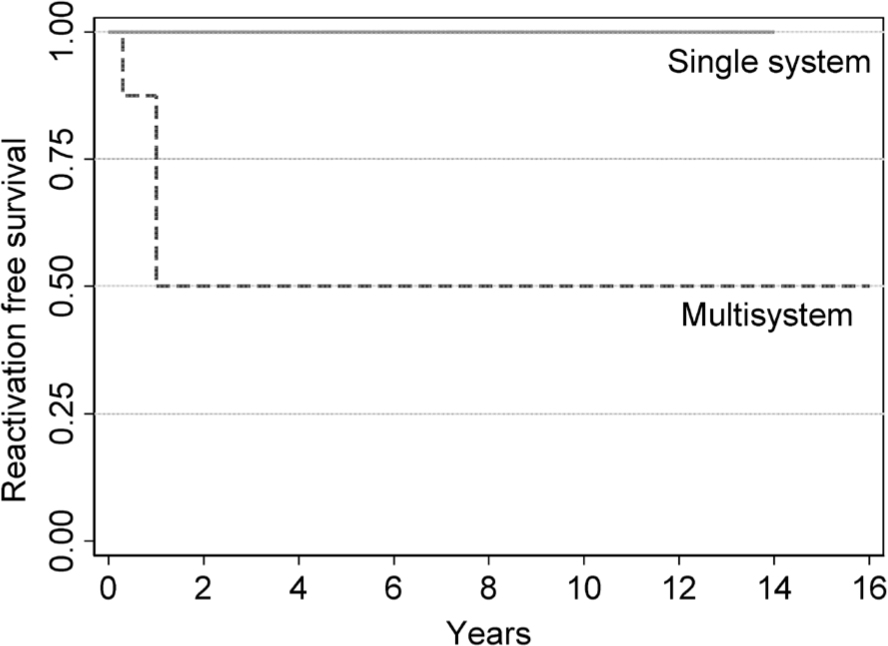
Figure 1
Five-year reactivation EFS for patients with LCH and SS (n = 6, solid line) and MS (n = 8, dashed line) involvement (P = 0.085). Survival was calculated using a Cox proportional hazard model. EFS, event-free survival; LCH, Langerhans cell histiocytosis; MS, multisystem; SS, single system.
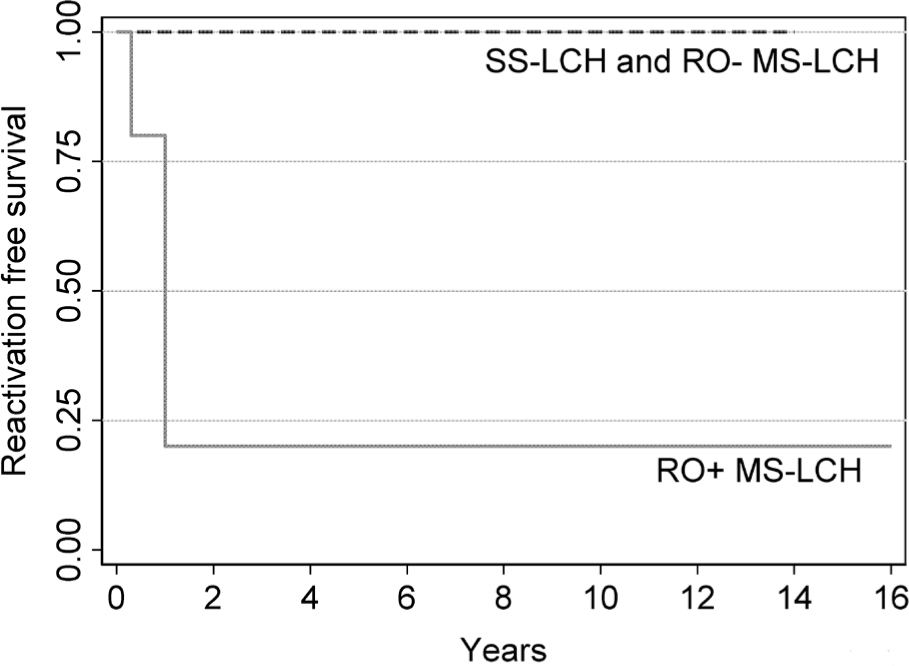
Figure 2
Five-year reactivation EFS for patients with LCH and RO+ (n = 5, solid line) and RO− (n = 9, dashed line) (P = 0.005). Survival was calculated using a Cox proportional hazard model. EFS, event-free survival; LCH, Langerhans cell histiocytosis; MS, multisystem; RO−, no risk-organ involvement; RO+, risk-organ involvement; SS, single system.
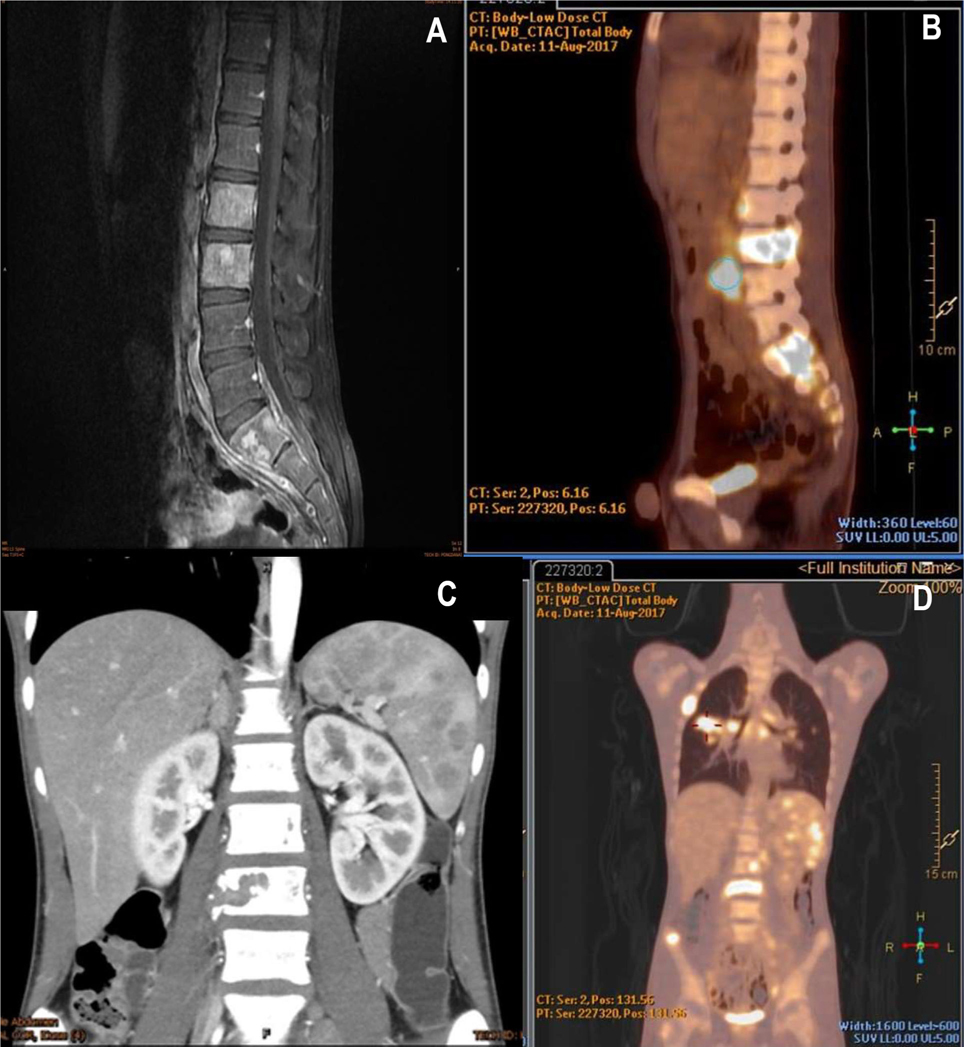
Figure 3
Comparison of CT/MRI and FDG-PET-CT scan from patient No. 4 in Table 2. (A) Sagittal T1 postcontrast MRI demonstrating abnormal marrow signal intensity involving L2, L3, S1–S2 vertebral bodies (B) paralleled with the FDG-PET-CT image. (C) Contrast enhanced CT image of the abdomen demonstrating hepatosplenomegaly with heterogenous contrast enhancement and scattered hypodense lesions in the spleen and a lytic lesion at the L3 vertebral body (D) corresponding FDG-PET-CT image confirming hypermetabolic activities at L2–L3 vertebral bodies and the spleen. Additional hypermetabolic activities are noted at the right sacral alar, right hilar lymph node, right middle lobe, and right-sided of second rib, which is suggestive of disease involvement. CT, computed tomography; FDG, fluorodeoxyglucose F18; MRI, magnetic resonance imaging; PET, positron emission tomography.