
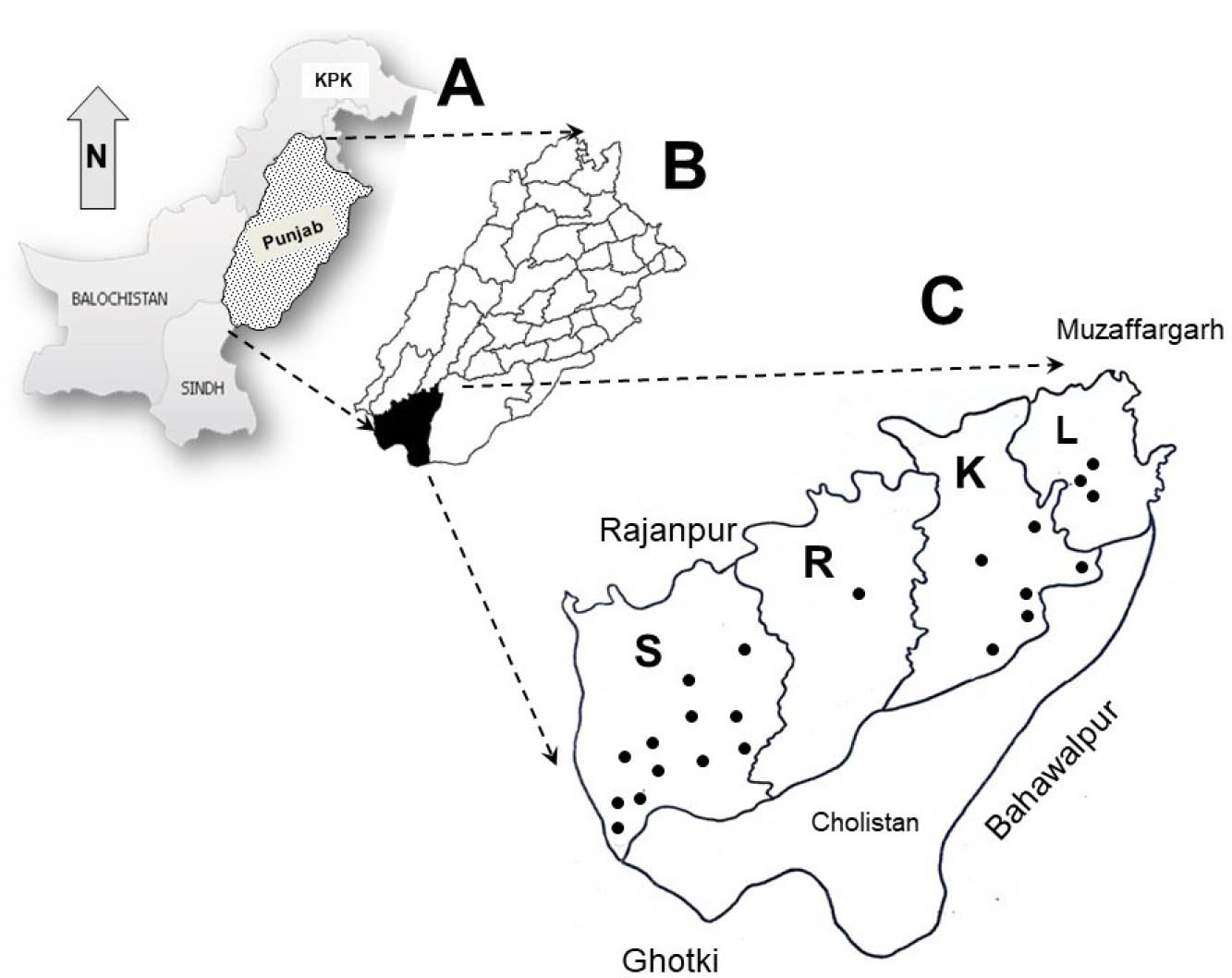
Figure 1
Map of Pakistan (A) with zoom-in view of Punjab province (B) highlighting RYK District in the far South (C) with 4 tehsils (S: Sadiq Abad; R: Rahim Yar Khan; K: Khanpur; L: Liaquatpur). Sampling sites (n = 22) are shown as black dots. Adapted from public domain source found at: http://www.freeworldmaps.net/asia/pakistan. RYK, Rahim Yar Khan; KPK, Khyber Pakhtunkhwa.
Table 1
Prevalence of limb anomalies in a married female population sample from Rahim Yar Khan District
| Limb anomaly | No. | Prevalence/1,000 | 95% CI | OMIM | ICD-10 |
|---|---|---|---|---|---|
| Polydactyly (all) | 5 | 2.27 | 0.72–5.31 | 603,596 | Q69 |
| Polydactyly (postaxial A) | 4 | 1.81 | 0.48–4.67 | 174,200 | Q69.0 |
| Polydactyly (preaxial) | 1 | 0.45 | <0.001–2.57 | 174,400 | Q69.1 |
| Brachydactyly (all) | 4 | 1.81 | 0.48–4.67 | ||
| Brachydactyly (brachymetatarsia IV) | 3 | 1.36 | 0.26–4.00 | 113,475 | |
| Brachydactyly type A4 | 1 | 0.45 | <0.001–2.57 | 112,800 | |
| Camptodactyly | 1 | 0.45 | <0.001–2.57 | 114,200 | M72.0 |
| Oligodactyly (thumb aplasia) | 1 | 0.45 | <0.001–2.57 | Q71.3 | |
| Total | 11 | 4.99 | 2.48–8.94 |
[i] CI, confidence interval; ICD-10, International Classification of Disease codes; OMIM, Online Mendelian Inheritance in Man.
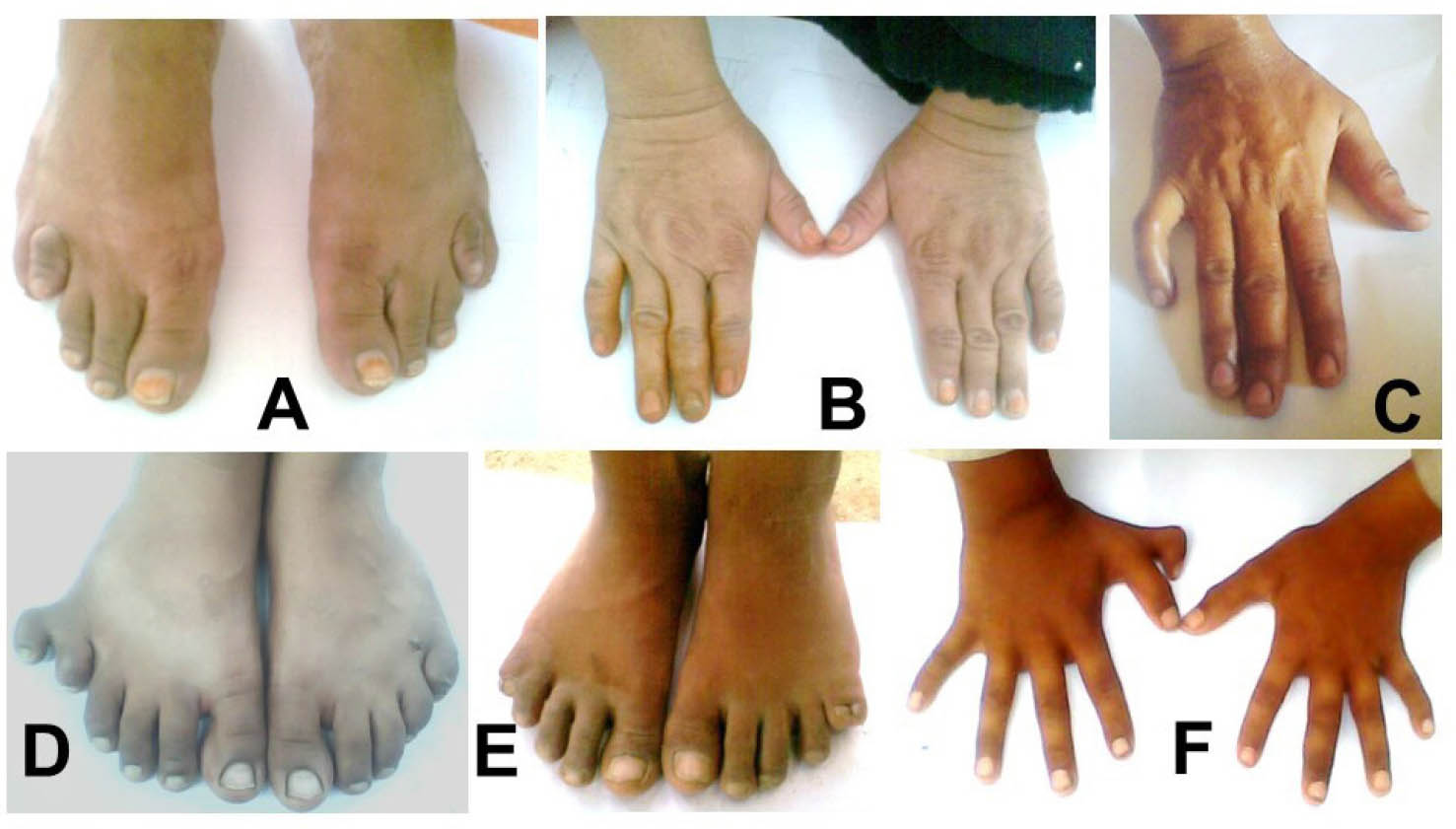
Figure 2
Phenotypic presentation of hereditary limb anomalies among the participants. (A) Bilateral brachymetatarsia of 4th toes. (B) Brachydactyly type A4 depicting bilaterally small 2nd and 5th fingers. (C) Camptodactyly of right 5th finger. (D) Postaxial polydactyly type A of right foot. (E) Bilateral postaxial polydactyly of 5th toes (polysyndactyly of 5th to 6th toes). (F) Preaxial polydactyly (hyperdactyly) of right hand marked by the presence of a supernumerary digit. With documented informed consent for publication from each participant or with their assent and consent from their husband or husband's first degree relative.
Table 2
Characteristics of limb anomalies in a married female population sample from Rahim Yar Khan District
| Features | Polydactyly (all) | Brachydactyly (all) | Camptodactyly | Oligodactyly | Total |
|---|---|---|---|---|---|
| No. of cases | 5 | 4 | 1 | 1 | 11 |
| Total affected in all families | 12 | 5 | 1 | 1 | 19 |
| Familial/sporadic nature | |||||
| Familial | 4 | 1 | 0 | 0 | 5 |
| Sporadic | 1 | 3 | 1 | 1 | 6 |
| Laterality | |||||
| Unilateral | 3 | 1 | 1 | 0 | 5 |
| Bilateral | 2 | 3 | 0 | 1 | 6 |
| Symmetry | |||||
| Symmetrical | 2 | 3 | 0 | 1 | 6 |
| Asymmetrical | 3 | 1 | 1 | 0 | 5 |
| Involvement of limb | |||||
| Upper right | 3 | 1 | 1 | 1 | 6 |
| Upper left | 1 | 1 | 0 | 1 | 3 |
| Lower right | 2 | 2 | 0 | 0 | 4 |
| Lower left | 1 | 3 | 0 | 0 | 4 |
| Total limbs involved | 7 | 7 | 1 | 2 | 17 |
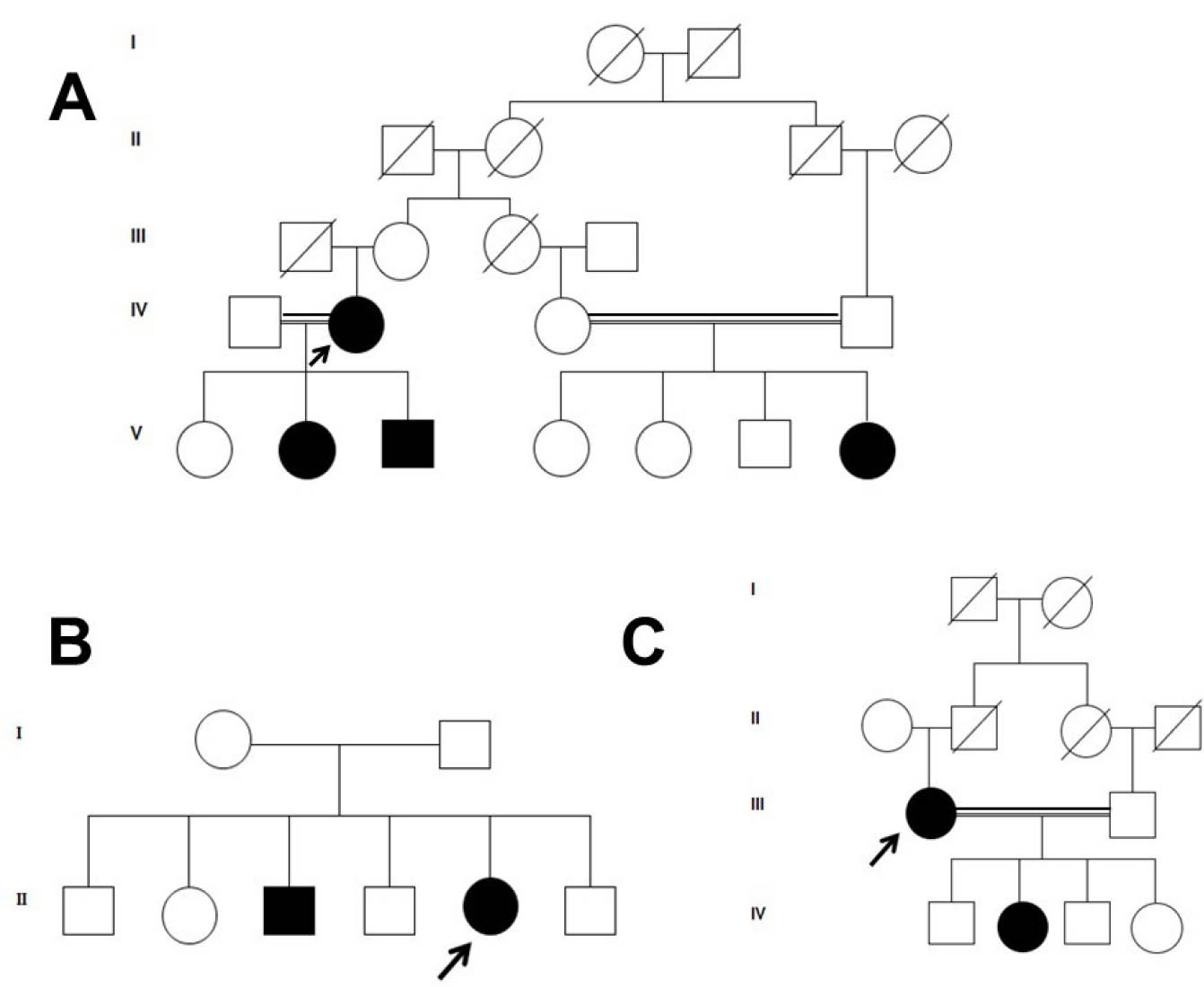
Figure 3
Representative pedigrees of familial cases. (A) Five generation pedigree showing the transmission of polydactyly in 2 independent sibships. In both sibships there were consanguineous marriages. (B) Two generation pedigree showing 2 affected sibs with brachydactyly. (C) Four generation kindred exhibiting the transmission of polydactyly in 2 generations. With informed consent for publication from each participant or with their assent and consent from their husband or a first degree relative.
Table 3
Association of limb anomalies in sociodemographic attributes of participants
| Variable | Affected | Unaffected | Prevalence/1,000 | OR | 95% CI |
|---|---|---|---|---|---|
| Tehsil | |||||
| Rahim Yar Khan | 2 | 599 | 3.32 | Reference | |
| Khanpur | 4 | 583 | 6.81 | 2.05 | 0.37–11.27 |
| Sadiqabad | 5 | 959 | 5.20 | 1.56 | 0.30–8.08 |
| Liaquatpur | 0 | 52 | 0.0 | ||
| Total | 11 | 2193 | 4.99 | ||
| Native dialect | |||||
| Punjabi | 7 | 1105 | 6.29 | 2.01 | 0.52–7.81 |
| Saraiki | 3 | 953 | 3.14 | Reference | |
| Other | 1 | 135 | 7.35 | 2.35 | 0.24–22.80 |
| Place of residence | |||||
| Rural | 7 | 1409 | 4.94 | Reference | |
| Urban | 4 | 784 | 5.08 | 1.03 | 0.30–3.52 |
| Family structure | |||||
| Nuclear family | 9 | 1210 | 7.38 | 3.35 | 0.79–16.97 |
| Extended Family | 2 | 983 | 2.03 | Reference | |
| Parental marriage | |||||
| Consanguineous | 8 | 1290 | 6.16 | 1.87 | 0.49–7.06 |
| Nonconsanguineous | 3 | 903 | 3.31 | Reference | |
| Education | |||||
| Illiterate | 7 | 1464 | 4.76 | Reference | |
| Literate | 4 | 729 | 5.46 | 1.15 | 0.33–3.93 |
| Age group (years) | |||||
| 29 | 5 | 1075 | 4.63 | Reference | |
| >29 | 12 | 1118 | 10.62 | 2.31 | 0.81–6.57 |
[i] Contingency test-statistics were nonsignificant for all variables.
[ii] CI, confidence interval; OR, odds ratio