
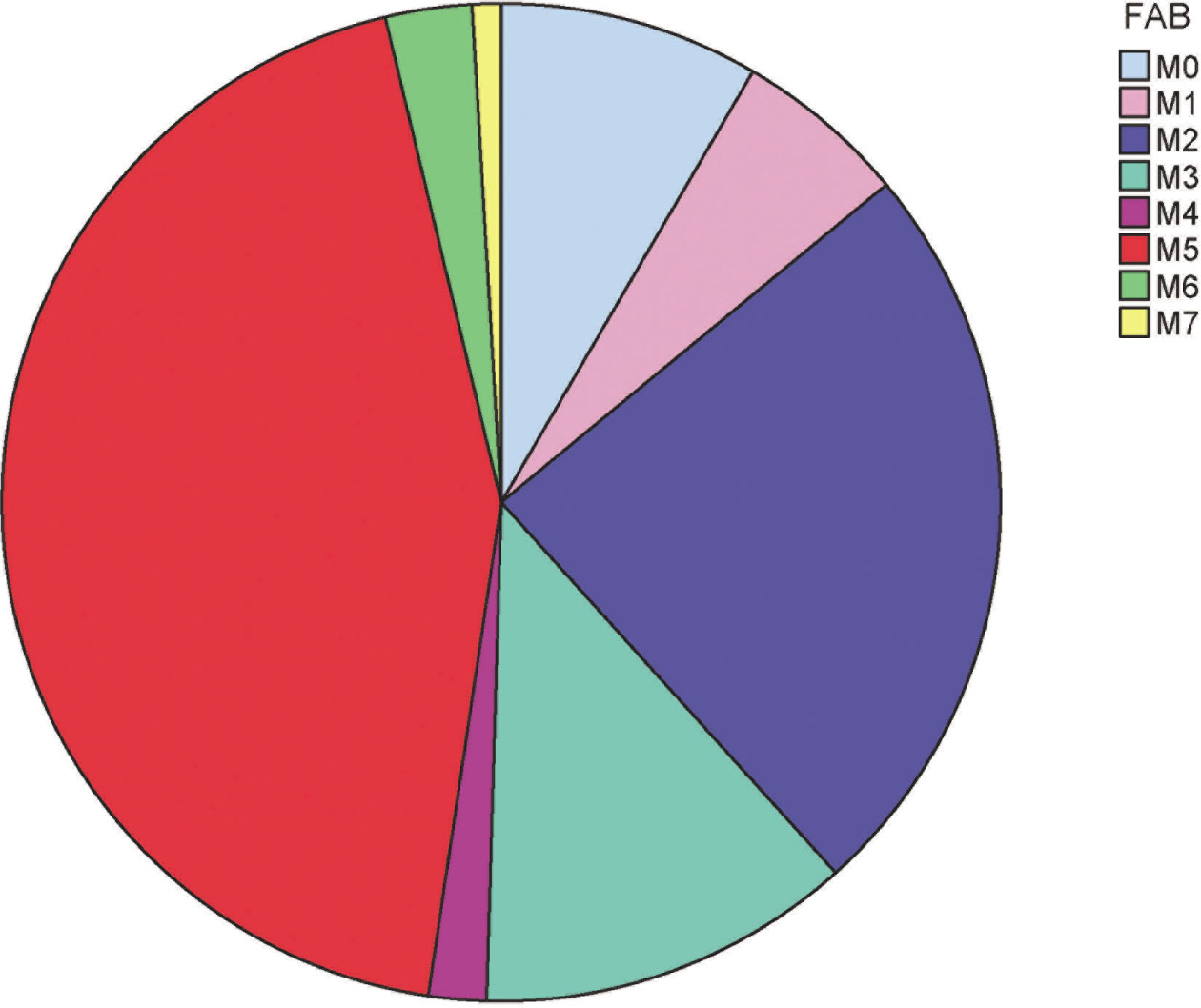
Figure 1
FAB cooperative group subtype classification of the 107 cases of AML in childhood. AML, acute myeloid leukemia; FAB, French-American-British.
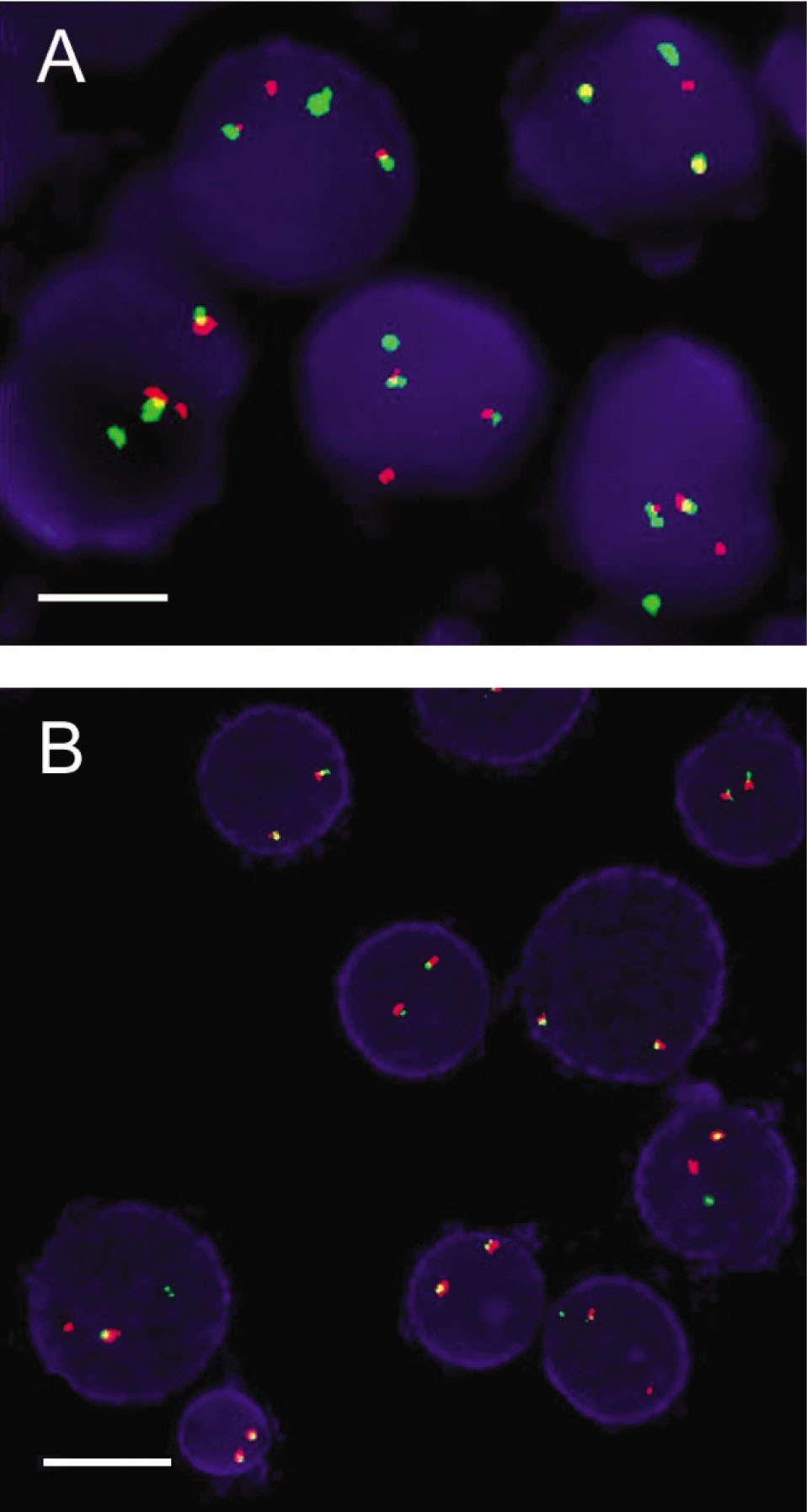
Figure 2
FISH results. A. RUNX1-RUNX1T1 fusion, 2Y1R1G, ×1000, B. MLL breakage, 1Y1R1G, ×1000. When gene fusion occurred, two yellow fusion signals are produced by the proximity or superposition of green and red chromosomes, one red and one green (2Y1R1G) signal are presented. If not, two red and two green signals were presented (2R2G). When gene breakage occurred, one yellow chromosome breaks apart as one red and one green (1R1G) signal, and one yellow signal is presented (1Y1R1G). If not, two yellow signals are presented (2Y). Scale bars indicate 10 μm. FISH, fluorescence in situ hybridization.
Table 1
Relationship between cytogenetic abnormalities and FAB subtypes.
| Cytogenetic abnormalities | FAB subtype (case) | Detection of fusion gene | |
|---|---|---|---|
| FISH | RT-qPCR | ||
| t(15;17) | APL (13) | + (all)† | + (all)† |
| t(8;21) | M2 (3), M5 (5) | + (all) | + (all) |
| t(8;21), −X/Y | M2 (7), M5 (3) | + (all) | + (all) |
| inv(16)/t(16;16) | M4 (2) | + (all)‡ | + (all)‡ |
| Complex karyotypes | M0 (2), M1 (2), M2 (7), M5 (11), M6 (2), M7 (1) | − (all) | − (all) |
| −7 | M0 (1) | − (all) | − (all) |
| Normal karyotypes | M0 (2), M2 (2), M5 (10), M6 (1) | + (3)§ | + (3)§ |
| Others | M0 (3), M5 (4) | − (all) | − (all) |
| No split phase | M0 (1), M1 (4), M2 (7), M5 (14) | + (8)§ | + (8)§ |
Complex karyotypes were defined as karyotypes involving 3 or more chromosomal abnormalities; others abnormality include 1 case of t(6;17), 1 case of t(11;12), 4 cases of +8, 1 case of +3. The leukemia fusion genes including PML-RARA, RUNX1-RUNX1T1, and CBFB-MYH11 were detected by fluorescence in situ hybridization or quantitative real-time polymerase chain reaction.
− fusion gene negative,
+ fusion gene positive,
FAB, French-American-British cooperative group; FISH, fluorescence in situ hybridization; RT-qPCR, quantitative real-time polymerase chain reaction.
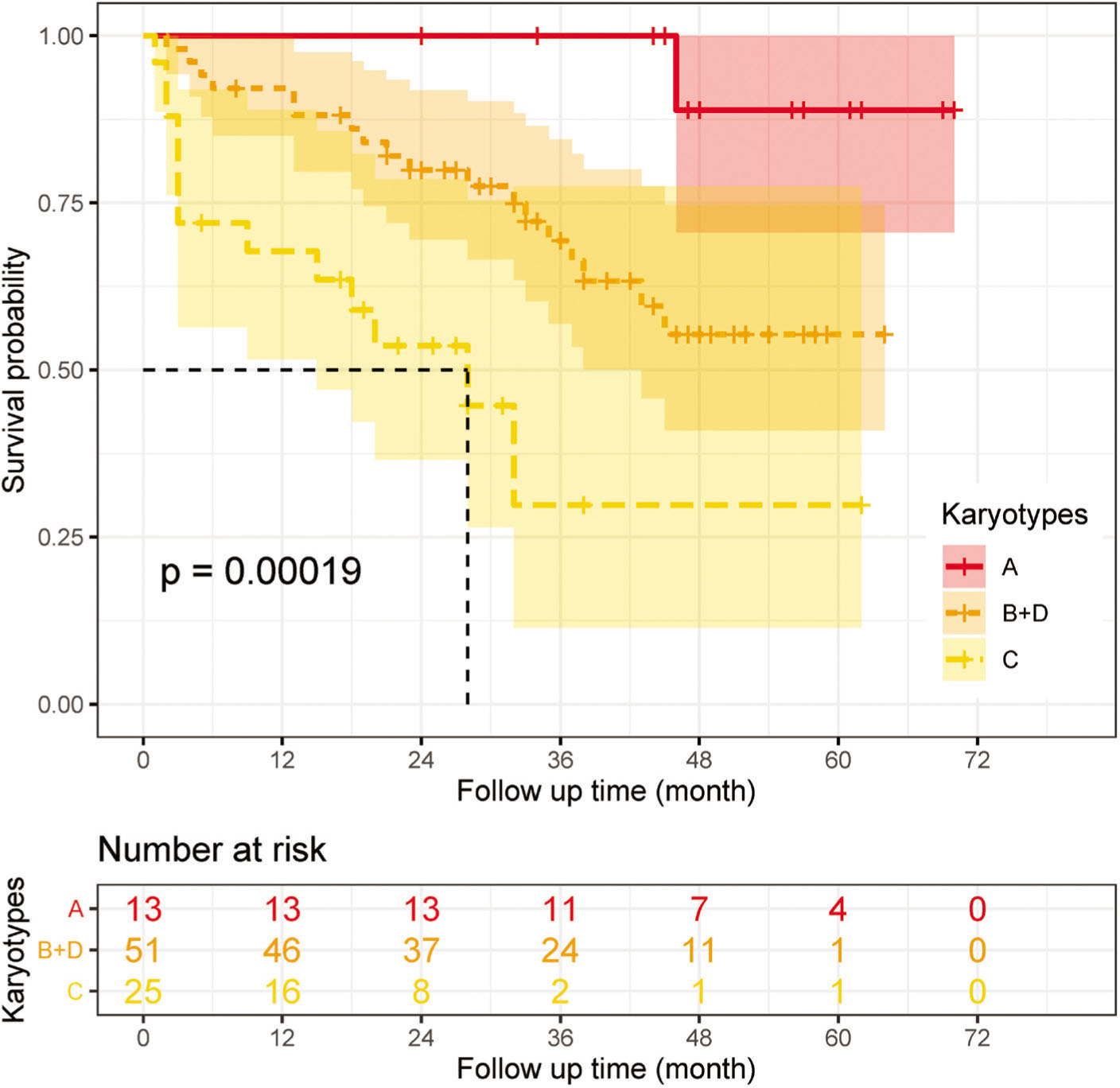
Figure 3
The OS curves are shown for the 4 groups of childhood AML. Group A, AML with t(15;17)/PML-RARA; Group B, AML with t(8;21)/RUNX1-RUNX1T1 or inv(16) and t(16;16)/CBFB-MYH11; Group C, AML with -7 or complex karyotypes; Group D, AML with normal or other cytogenetic changes. AML, acute myeloid leukemia; OS, overall survival.
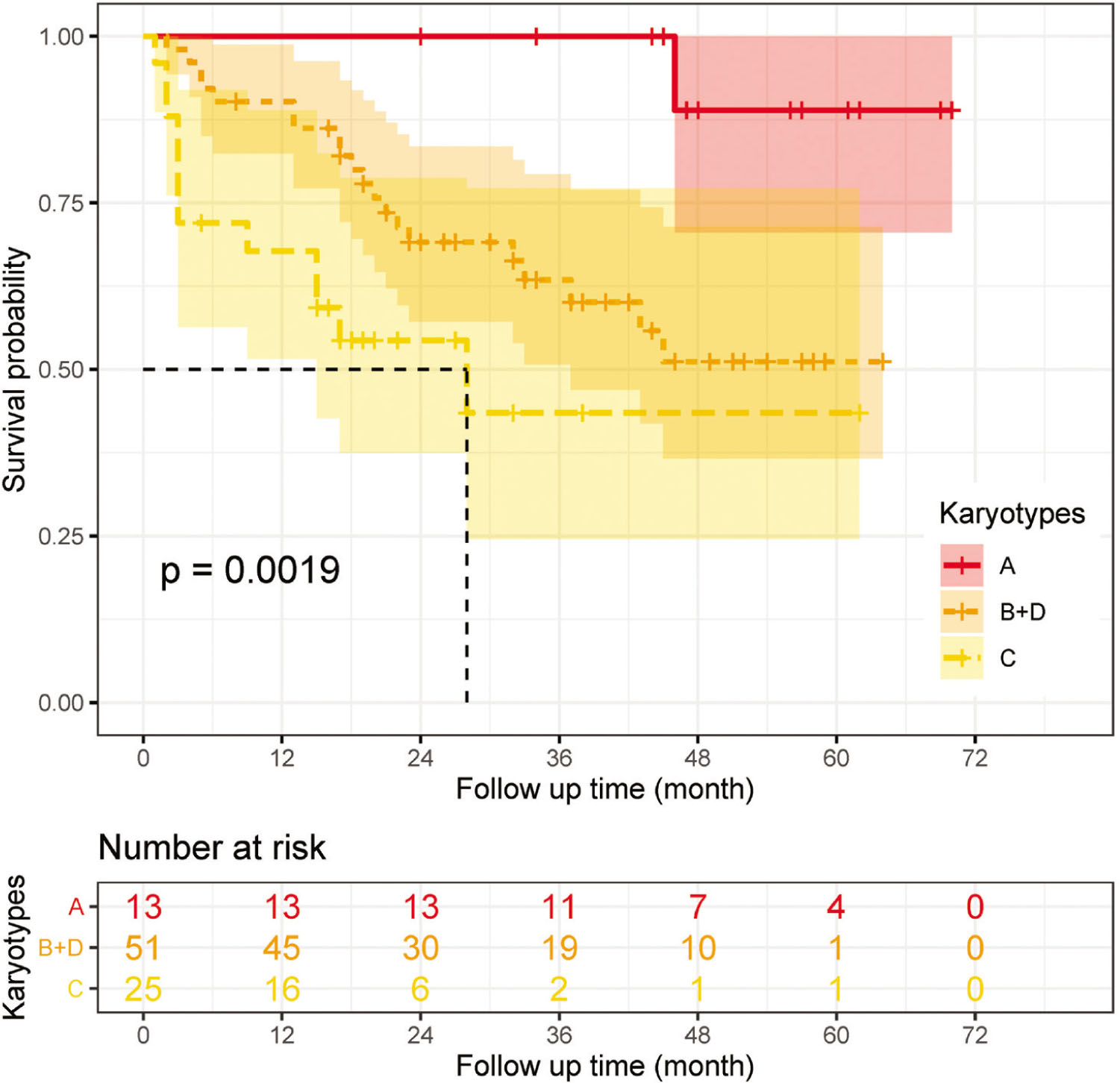
Figure 4
The EFS curves are shown for the 4 groups of childhood AML. Group A, AML with t(15;17)/PML-RARA; Group B, AML with t(8;21)/RUNX1-RUNX1T1 or inv(16) and t(16;16)/CBFB-MYH11; Group C, AML with −7 or complex karyotypes; Group D, AML with normal or other cytogenetic changes. AML, acute myeloid leukemia; EFS, event-free survival.
Table 2
Clinical characteristics of 92 patients with AML cytogenetic abnormality
| Group | Case | Male/female | P | Median age in months (range) | P | WBC (×109/L) | P | Morphological CR rate in first course (%) | P |
|---|---|---|---|---|---|---|---|---|---|
| A | 13 | 7/6 | 0.54† 0.93‡ 0.45§ | 62.4 (36–168) | 0.32† 0.84‡ 0.86§ | 10.1 ± 13.5 | 0.21† 0.33‡ 0.55§ | 92 | 0.046†, * 0.017‡, * 0.10§ |
| B | 31 | 16/15 | 0.53|| 0.10¶ | 78.0 (32–166) | 0.15|| 0.18¶ | 43.0 ± 62.2 | 0.93|| 0.68¶ | 80 | 0.55|| 0.83¶ |
| C | 25 | 15/10 | 0.31†† | 71.0 (20–158) | 0.99†† | 25.8 ± 28.8 | 0.92†† | 68 | 0.47†† |
| D | 23 | 17/6 | / | 66.0 (10–168) | / | 35.3 ± 41.5 | / | 58 | / |
AML, acute myeloid leukemia; CR, cure rate; WBC, white blood cell count.
Group A, AML with t(15;17)/PML-RARA; Group B, AML with t(8;21)/RUNX1-RUNX1T1 or inv(16) and t(16;16)/CBFB-MYH11; Group C, AML with −7 or complex karyotypes; Group D, AML with normal or other cytogenetic changes.
Table 3
Univariate and multivariate Cox regression analyses for overall survival
| Univariate analysis | Multivariate analysis | |||
|---|---|---|---|---|
| HR (95% CI) | P | HR (95% CI) | P | |
| Karyotype | ||||
| A | 1.0 | 1.0 | ||
| B | 6.52 (0.84–50.60) | 0.07 | 7.27 (0.91–58.11) | 0.06 |
| C | 20.26 (2.57–159.75) | 0.004* | 22.65 (2.73–187.84) | 0.004* |
| D | 7.44 (0.91–61.16) | 0.06 | 5.72 (0.65–50.78) | 0.12 |
| Sex | ||||
| Male | 1.0 | 1.0 | ||
| Female | 0.88 (0.43–1.81) | 0.73 | 0.26 (0.31–1.39) | 0.26 |
| Age (month) | ||||
| <12 | 1.0 | 1.0 | ||
| ≥12 | 0.22 (0.05–0.93) | 0.25 | 0.11 (0.02–0.60) | 0.19 |
| WBC (×109/L) | ||||
| <100 | 1.0 | 1.0 | ||
| ≥100 | 1.87 (0.65–5.32) | 0.04* | 2.06 (0.69–6.08) | 0.011* |
| Morphological CR in first course | ||||
| Not CR | 1.0 | 1.0 | ||
| CR | 0.89 (0.26–1.12) | 0.10 | 0.69 (0.32–1.46) | 0.33 |
| Marrow transplantation | ||||
| Yes | 1.0 | 1.0 | ||
| No | 1.70 (0.41–7.13) | 0.47 | 2.44 (0.56–10.63) | 0.24 |
AML, acute myeloid leukemia; CI, confidence interval; CR, cure rate; HR, hazard ratio; WBC, white blood cell count.
Group A, AML with t(15;17)/PML-RARA; Group B, AML with t(8;21)/RUNX1-RUNX1T1 or inv(16) and t(16;16)/CBFB-MYH11; Group C, AML with −7 or complex karyotypes; Group D, AML with normal or other cytogenetic changes.
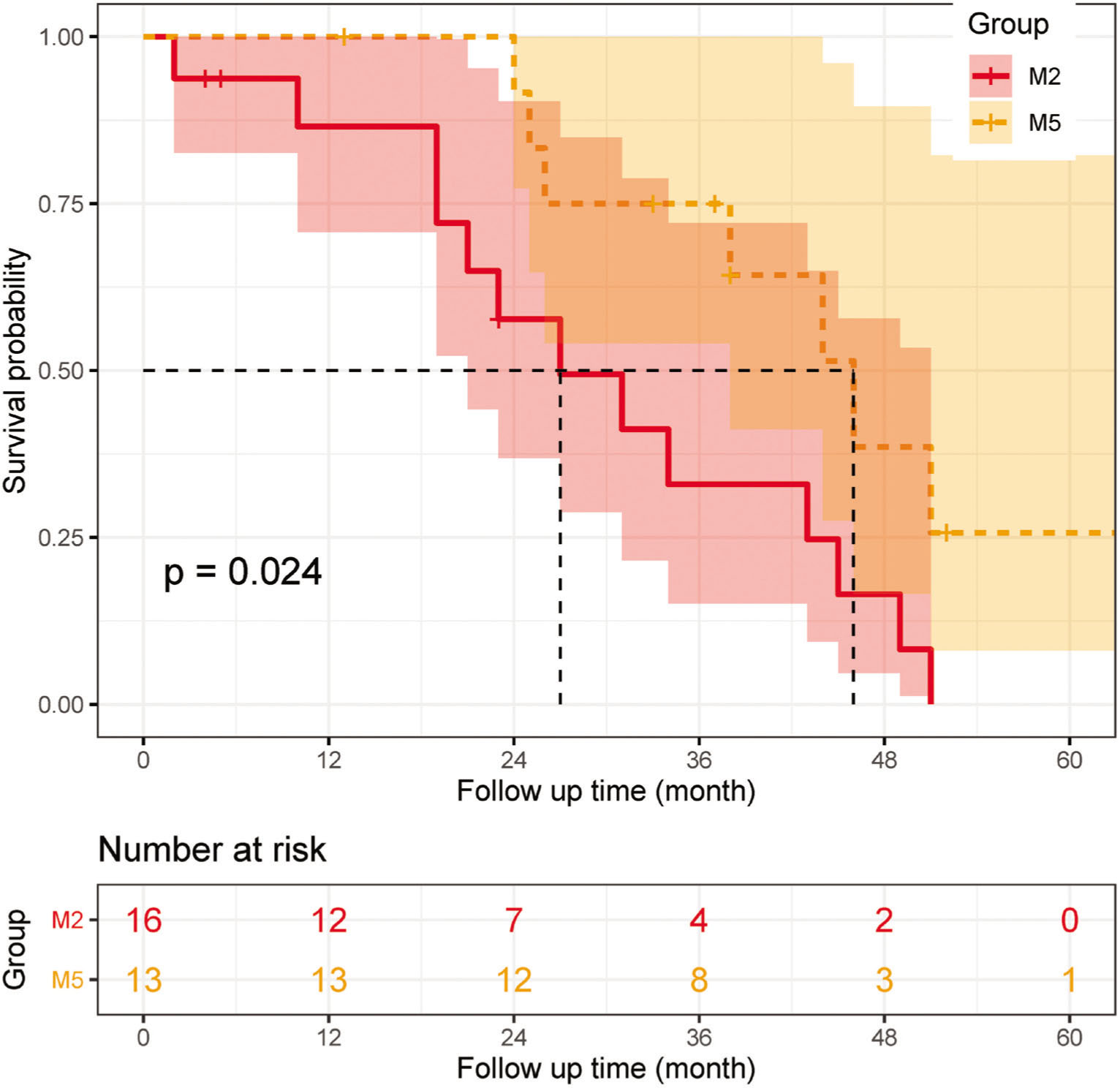
Figure 5
Comparison of overall survival in FAB-M5/M2 with t(8;21)/RUNX1-RUNX1T1. FAB, French-American-British. AQ1