Introduction
Externalising disorders refer to a class of psychiatric disorders characterised by antisocial behaviour, aggression, rule-breaking, impulsivity, and overactivity (1-3) and typically include conduct disorder, oppositional defiant disorder, ADHD, antisocial personality disorder, psychopathy, and features of borderline personality disorder (BPD). Interpersonal difficulties form a core feature of most externalising disorders. An important target for the conceptualization, identification, and treatment of psychiatric disorders with interpersonal impairment, such as externalising disorders, is interpersonal trust (hereon referred to as trust) which can be measured through behavioural decision making (4). Research investigating the association between behavioural trust and externalising disorders, however, has been scarce.
Historically, a leading approach for understanding interpersonal problems associated with externalising disorders in children and adolescents has been to examine the social-cognitive deficits and distortions associated with these disorders. These studies have been guided by either the social information processing (SIP) or theory of mind (ToM) approaches (5). While the impact of the SIP and ToM has been substantial in elucidating the deficits and distortions underlying social decision making in child and adolescent externalising disorders, there are theoretical and methodological limitations to these approaches (6). Both are based on the theoretical assumption that social cognition is a property of the person and not the relationship or the interaction between two or more people. This approach ignores the stochastic (online) nature of social interaction, which is intrinsically dynamic with one’s thoughts and actions depending upon moment-to-moment changes in others’ actions (and mental states) (7). Conceptualising social cognition as a person-characteristic results in utilisation of tasks that are typically “off-line” by virtue of reliance on hypothetical scenarios thereby limiting participant investment. Tasks are not administered in real time, do not sample actual social interactions, and are unlikely to elicit full emotional and behavioural engagement. Most social-cognitive tasks are also characterised by an over-reliance on self-report, thereby “pulling for thinking” and eliciting socially desirable responses (8).
To address some of these limitations, there has been a steady increase in the use of behavioural economic tasks to provide more ecologically valid paradigms for examining social decision making in externalising disorders (6). These paradigms allow for the mathematical parameterisation of constructs such as trust, fairness, reciprocity, social discounting and so on. All of these constructs and their associated experimental paradigms have mostly been developed from game theory, such that games consist of a set of real or imagined players who have a series of options or strategies to choose from in order to maximise pay-off. By varying task characteristics, seemingly simple games can be adapted to probe a remarkable range of social phenomena including social influence, prosocial behaviour, trust, social norm violations, social-cognitive biases, and higher-order social cognition (9).
In the context of behavioural economics, trust is defined as an exchange between two players in which cooperation and defection can be parametrically encoded as the amount of money designated for the partner. The basic one-shot trust game was initially proposed by Camerer and Weigelt (10) and further developed by Berg et al. (11). One player (the Investor) is endowed with a certain amount of money (or points as proxies for money). The Investor can keep all the money or decide to “invest” some amount with the partner (the Trustee). The amount invested is tripled in value as it is sent to the Trustee, who then decides what portion to return to the Investor.
The trust game has been used in several studies of healthy children and adolescents (e.g., ages 8 through 17+) (12-14). In the first study to use the trust game to study externalising behaviour problem in youth (15), two groups of boys (externalising vs. non-externalising; ages 8–18) recruited from the community played a one-shot (single round) trust game under two conditions: an anonymous version where the identity of the trust game partner was not known and a “known identity” version where identities were revealed prior to the game. Results showed that boys with externalising problems exhibited similar trust behaviour (mean investments) compared to non-externalising boys regardless of condition. While this study is informative, a community sample of boys was recruited thereby limiting generalisations to clinical populations and the disease mechanisms associated with externalising behaviour. Moreover, the one-shot nature of the game utilised does not fully exploit the fact that models (representations) of interaction partners build over time and multiple rounds (16).
An additional consideration stems from the fact that since heightened risk taking is characteristic of externalising disorders (17, 18), it is therefore important to distinguish in which context(s), specifically, risk taking is elevated. The multi-trial trust task developed by Kosfeld et al. (19) offers a useful opportunity to do just that by providing the means to examine sensitivity to social risk taking versus risk taking in general. This task was utilized by Unoka et al. (20) with adult participants who were asked to invest money in an internet game where the pay-off depended on the intention of another person (trust game) or on luck (risk “lottery” condition). Interestingly, adults with BPD in this study showed a non-linear increase in investments across trials in the lottery condition, without similar investment increase in the trust game, whereas healthy control comparison adults showed a linear increase in investments regardless of condition. In other words, individuals with BPD exhibited different investment strategies over time as a function of game condition.
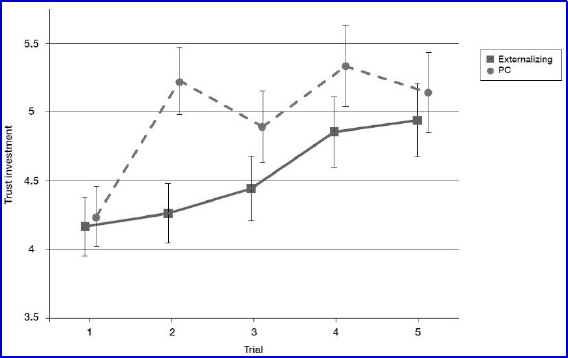
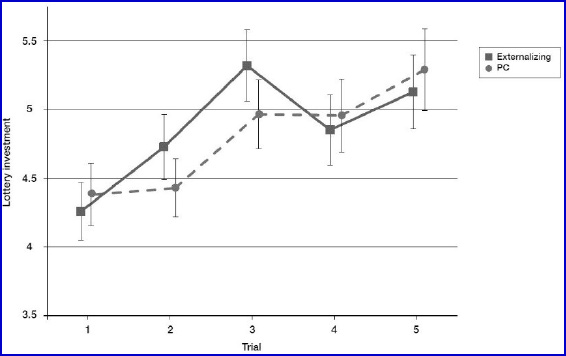
Against this background, the current study had two aims. The first aim was to use a multi-round trust task (19) in a clinical sample of adolescents to examine trust behaviour in relation to externalising problems. Given our prior work (15) demonstrating a non-significant association between externalising problems and trust, we did not expect a main effect for externalising problems such that those above cut-off on externalising problems would invest similar to non-externalising adolescents in the trust game. We did, however, expect that adolescents with externalising problems would be insensitive to task type compared to non-externalising subjects who would show differential investments as a function of game condition (trust versus lottery), exhibiting a linear increase when playing with a person (versus the lottery). Therefore, we expected a significant three-way interaction effect between group, task type (trust versus lottery), and trials. Such an interaction effect would fit with our prior research demonstrating a general insensitivity to normative social exchange for externalising problems (15, 21) and other disorders with externalising features like BPD (22). Hypotheses were tested only after considering the potential confounding effects of age (14) and sex (23) as both variables associate with adolescent trust game investment.
Methods
Participants
Participants were recruited from the acute adolescent inpatient psychiatric unit of a county hospital serving the indigent population of a large metropolitan area in the USA. Inclusion criteria required participants to be between 12 and 17 years old and possess English fluency. Participants were excluded if the attending psychiatrist determined s/he did not have adequate capacity to participate in the study, which included the presence of mental retardation, active psychosis, or posing physical risk to research staff. The inpatient setting did not allow for structured intelligence assessments; however, participants were excluded if s/he repeated one or more academic grade which served as a proxy for intellectual/cognitive functioning. It was important to exclude any potentially low-functioning adolescents as it was critical that s/he fully understand the experimental task and instructions for gameplay.
A total of 345 adolescent inpatients were recruited for the present study. However, 37 participants providing consent/assent were excluded for repeating one or more school years, 25 were not administered the experimental task, 16 did not complete psychopathology self-report measures, two did not complete both the task and self-reports, and two provided consent but were unavailable to participate due to assessment scheduling difficulty. Thus, a remaining sample of 263 adolescents was included in analyses. In total, 141 adolescents (53.6%) met inclusion criteria for externalising problems and 122 (46.4%) did not, which designated them as psychiatric controls. The average participant age was 14.75 years (SD = 1.50) and 67.7% were female. The racial/ethnic breakdown of the total sample was 34.6% Hispanic, 26.6% African– American, 30.4% white, and 5.4% multiracial with 3% self-identifying as other.
Measures
Experimental task
Unoka et al.’s (20) modified trust game was played under two counterbalanced conditions, each consisting of five consecutive trials. One condition (social condition) assessed interpersonal trust exchanges between the participant and an anonymous (fictional) peer co-player. A fully anonymous co-player was used as anonymity begets generalised trust, which underlies all social interactions (14, 24). In each round, the participant, always acting as the investor, allocated anywhere between 0 and 12 monetary units (MUs) to their co-player (the trustee). As MUs were sent, they were tripled along the way. Participants were told that the trustee would then decide how many MUs to send back to the investor for each trial. In the second condition (nonsocial condition), the structure of the game was identical though instead of a co-player a computerised lottery system randomly determined repayment. The amount of MUs invested by the participant indicated the degree of trust in the other player or degree of general risk taking in the lottery condition. During both conditions, subjects did not receive feedback after each trial regarding the amount of repayment of investments. The absence of feedback creates uncertainty in the outcome of the decision making therefore ensuring risk taking (19).
Task administration
Games were explained to participants via PowerPoint presentation, and participants were informed that the objective of each game was to earn as many MUs as possible and that MUs were equally valuable to both players, but that they would not be told of their cumulative earnings until afterwards. Players were informed that the order of games would be randomly determined. Participants’ demonstration of understanding of game rules was required prior to administration. The assessor then pretended to make contact with a co-administrator via cell phone to ensure that the (fictional) trustee was “logged on” to play. Games were designed to mimic an online computer game and were played on Inquisit 2.0 software (25). Participants were first presented with a screen that confirmed they were being connected to the game (i.e. “Please wait while the other player logs on…”). After each trial investment, participants were told to please wait while the other player (or lottery) determined how many points were sent back. Given that deception was used (there was no trustee and cumulative points were not calculated), players were debriefed immediately following administration, in compliance with ethical standards (26). S/he was specifically asked not to share details about the experimental task with other patients to avoid contamination. High turnover rates on the unit further protected against contamination. No adolescent reported any negative feelings about the deception or the experiment.
Psychopathology
The Youth Self Report (YSR) (27) is a well-established evidence-based assessment instrument that assesses global and specific psychopathology over the preceding six months among youth ages 11 to 18 years. The YSR consists of 112 problem items rated 0 (Not true), 1 (Somewhat or Sometimes true), or 2 (Very true or Often true). Relevant sample items, among others, include “I disobey my parents,” “I steal at home,” “I drink alcohol without my parents approval,” and “I run away from home.” For the present study, the externalising problems scale (includes rule-breaking behaviour and aggressive behaviour subscales) was used in order to explore broadband, rather than disorder specific, relations with trust behaviour in keeping with the focus of the study on externalising problems as a broader category of psychopathology. The recommended cut-off for clinical threshold (t-score ≥ 65) was used to delineate adolescents with and without externalising problems (27). Internal consistency for the externalising problems scale, as measured by Cronbach’sα, was 0.88 in the current study.
Procedures
The study was approved by the appropriate institutional review board. Adolescents admitted to the 16-bed adolescent acute inpatient unit psychiatric unit at a county hospital where the average length of stay is three–four days were approached on the day of admission about participating in this study. Parents were asked to provide consent, and, if given, adolescents were approached for assent. Assessments on the unit were routinely completed within two–three days of admission in quiet, private rooms well removed from the unit’s community area. Clinical psychology graduate students (or other research staff) conducted assessments only after completing training under supervision of the principal investigator. Participation was completely voluntary and withdrawal was permitted without justification. Gift cards to a popular nation-wide retail department store chain were provided as compensation.
Data analytic strategy
χ2 tests of independence and independent samplest-tests compared groups on sociodemographic and clinical variables with effect sizes reported in Cohen’sdand CramerVstatistics, respectively. Game order effects (a potential result of counterbalancing) were tested prior to conducting primary analyses. A three-way full-factorial repeated measures ANCOVA, with group as the between-subjects factor and game type and trials as within-subject factors, was then performed for primary analyses with effect sizes reported in partial-eta squared (η2). Effect sizes forη2were considered small, medium, or large at values of 0.01, 0.06, and 0.14, respectively (28). In addition to Bonferronni-correctedpost hoctests, within-group paired-samplest-tests were conducted to tease apart significant interactions. The identification of age and sex as covariates was a priori and objective (29).
Results
Sample characteristics
See Table1for sample sociodemographic characteristics, externalising problems, and mean investments per game condition.
TABLE 1.
Sample characteristics and group comparison results
| Externalizing problems (n = 141) | Psychiatric controls (n = 1.22) | t/χ2 | p | d | |
|---|---|---|---|---|---|
| Age (in years) | 14.78 (1.43) | 14.70 (1.58) | 0.164 | 0.686 | 0.053 |
| Sex (% female) | 68.80 | 66.40 | 0.172 | 0.678 | 0.026 |
| YSR externalizing | 71.54 (5.97) | 54.66 (7.25) | 429.159 | < 0.001 | 2.542 |
| Mean Trust investment | 4.56 (2.32) | 4.95 (2.39) | 1.736 | 0.189 | 0.166 |
| Lottery investment | 4.87 (2.40) | 4.82 (2.13) | 0.037 | 0.847 | 0.022 |
| Race | 6.56 | 0.341 | 0.163 | ||
| African-American | 40 (28.40%) | 30 (24.60%) | |||
| Caucasian | 42 (29.80%) | 38 (31.10%) | |||
| Hispanic | 44 (31.20%) | 47 (38.50%) | |||
| Multiracial | 10 (7.10%) | 4 (3.30%) | |||
| Other | 5 (3.50%) | 3 (2.50%) |