
Table I
A list of the strains collected, their origin and place of isolation.
| Strain no. | Host | Lesions/Material | Place of origin |
|---|---|---|---|
| 1 | human | wound infection | Kraków (Poland) |
| 2 | human | cyst | Kraków (Poland) |
| 3 | human | wound infection | Kraków (Poland) |
| 4 | human | wound infection | Kraków (Poland) |
| 5 | human | wound infection | Kraków (Poland) |
| 6 | human | wound infection | Gdansk (Poland) |
| 7 | human | wound infection | Gdansk (Poland) |
| 8 | human | boil | Gdansk (Poland) |
| 9 | human | boil | Gdansk (Poland) |
| 10 | human | boil | Gdansk (Poland) |
| 11 | human | throat | Gdansk (Poland) |
| 12 | human | pus | Gdansk (Poland) |
| 13 | human | throat | Gdansk (Poland) |
| 14 | human | throat | Pescara (Italy) |
| 15 | human | skin infection | Pescara (Italy) |
| 16 | human | blood | Pescara (Italy) |
| 17 | human | skin infection | Pescara (Italy) |
| 18 | human | nose swab | Gdansk (Poland) |
| 19 | human | ulcer | Gdansk (Poland) |
| 20 | human | ulcer | Gdansk (Poland) |
| 21 | human | wound infection | Kraków (Poland) |
| 22 | human | wound infection | Kraków (Poland) |
| 23 | human | conjunctivitis | Kraków (Poland) |
| 24 | human | conjunctivitis | Kraków (Poland) |
| 25 | human | wound infection | Kraków (Poland) |
| 26 | human | nose swab | Kraków (Poland) |
| 27 | animal | eczema | Gdansk (Poland) |
| 28 | animal | eye | Gdansk (Poland) |
| 29 | animal | eye | Gdansk (Poland) |
| 30 | animal | throat | Gdansk (Poland) |
| 31 | animal | skin infection | Wroclaw (Poland) |
| 32 | animal | mastitis | Košice (Slovakia) |
| 33 | animal | mastitis | Košice (Slovakia) |
| 34 | animal | mastitis | Košice (Slovakia) |
| 35 | animal | mastitis | Košice (Slovakia) |
| 36 | animal | mastitis | Košice (Slovakia) |
| 37 | animal | mastitis | Košice (Slovakia) |
| 38 | animal | mastitis | Košice (Slovakia) |
| 39 | animal | mastitis | Leczna (Poland) |
| 40 | animal | mastitis | Leczna (Poland) |
| 41 | animal | mastitis | Lubartów (Poland) |
| 42 | animal | mastitis | Leczna (Poland) |
| 43 | animal | mastitis | Leczna (Poland) |
| 44 | animal | mastitis | Luków (Poland) |
| 45 | animal | mastitis | Luków (Poland) |
| 46 | animal | mastitis | Gawrolin (Poland) |
| 47 | animal | mastitis | Swidnik (Poland) |
| 48 | animal | mastitis | Swidnik (Poland) |
| 49 | animal | mastitis | Swidnik (Poland) |
| 50 | animal | mastitis | Tomaszów Lubelski (Poland) |
| 51 | animal | mastitis | Tomaszów Lubelski (Poland) |
| 52 | animal | mastitis | Tomaszów Lubelski (Poland) |
| 53 | animal | mastitis | Tomaszów Lubelski (Poland) |
Table II
Antibiotic susceptibility of S. aureus strains. MRSA strains are bolded in text.
| Antibiotic | Number of strains | ||
|---|---|---|---|
| Human (%) n = 26 | Animal (%) n = 27 | All (%) n = 53 | |
| Resistant to all antibiotics tested | 0 (0) | 0 (0) | 0 (0) |
| Multi-resistant | 1 (4) | 7 (26) | 8 (15) |
| BEN | 17 (65) | 16 (59) | 33 (62) |
| AMC | 2 (8) | 7 (26) | 9 (17) |
| FOX | 2 (8) | 7 (26) | 9 (17) |
| SXT | 0 (0) | 0 (0) | 0 (0) |
| CHL | 1 (4) | 1 (4) | 2 (4) |
| DOX | 3 (12) | 1 (4) | 4 (8) |
| ERY | 6 (23) | 8 (30) | 14 (26) |
| CLI | 0 (0) | 7 (26) | 7 (13) |
| AMI | 2 (8) | 2 (7) | 4 (8) |
| GEN | 2 (8) | 0 (0) | 2 (4) |
| CIP | 0 (0) | 4 (15) | 4 (8) |
| NOR | 0 (0) | 4 (15) | 4 (8) |
| Susceptible to all antibiotics tested | 5 (19) | 10 (37) | 15 (28) |
1 BEN: benzylpenicillin, AMC: amoxicillin with clavulanic acid, FOX: cefoxitin, SXT: trimethoprim/sulfamethoxazole, CHL: chloramphenicol, DOX: doxycycline, ERY: erythromycin, CLI: clindamycin, AMI: amikacin, GEN: gentamicin, CIP: ciprofloxacin, NOR: norfloxacin. Multi-resistant – resistant to more than three antibiotics.
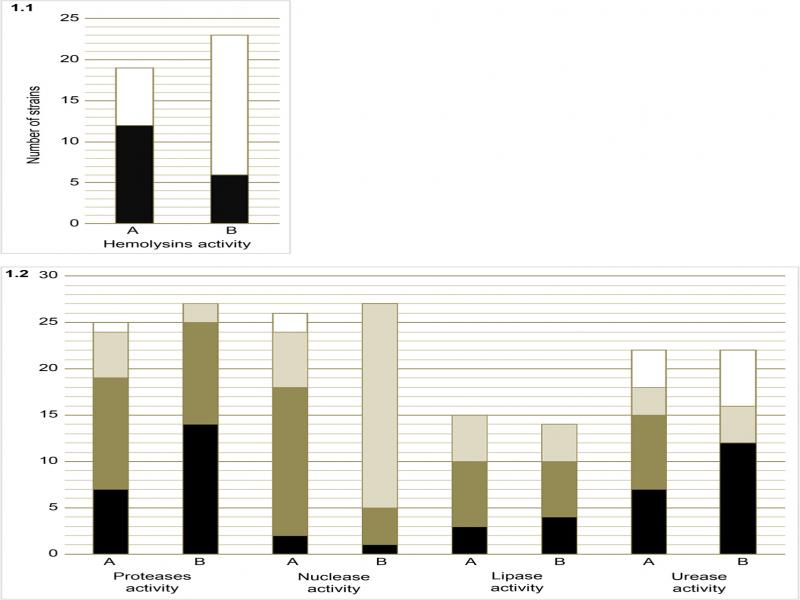
Fig. 1.
Positive results of phenotypic tests.
Columns A: human strains, B: animal strains. 1.1. Total number of positive results for hemolysins activity. Black: double-zone β-hemolysis; white: single-zone β-hemolysis. 1.2. Total number of positive results for proteases, nuclease, lipase and urease activity. Black, low activity. Dark grey, moderate activity. Grey, high activity. White, very high activity.
Table III
The results of the spa typing. Bacterial isolates were assigned to spa types and clonal complexes (CCs).
| Strain number | spa types | Sequence type (ST)* | Clonal complex | Resistance and virulence genes |
|---|---|---|---|---|
| 26 | t008 | ST-8, ST-427, ST-250, ST-254 | spa-CC 008.051 | Human strains: 26/23 Resistance: blaZ/I/R (+/-), tetEfflux, fosB Enterotoxins: sea(-/+), sed(+/-), seg(+/-), sej(+/-), ser(+/-) Enzymes within hemolysins: sak, hla, hlb, lukM/luk F(+/-), hlgA, lukD, lukE, lukX, Proteases: aur, splA, splB, splE Adhesion and biofilm formation: bbp, fnbB, map, sdrC, sdrD, sasG |
| 23 | t051 | ST-250, ST-254 | ||
| 4 | t015 | ST-45 | spa-CC 015.031 | Human strains: 4/21 Resistance: mecA(+/-), blaZ/I/R, erm(A)(-/+), tetEfflux Enterotoxins: seb(-/+), sec, seg, sej(+/-), sel(-/+), sei, sem, sen, seo, seu, egc-cluster Enzymes within hemolysins: sak, hla, hlgA, lukX, Proteases: aur Adhesion and biofilm formation: bbp, cna, fnbB, map(+/-), sdrC, sdrD |
| 21 | t031 | ST-45 | ||
| 25 | t017 | nd | spa-CC 017 | Human strains: 25/5/ animal strain: 31 Resistance: blaZ/I/R(-/+/+), erm(A) (-/+/-), tet(K)(-/-/+), tetEfflux, fosB Enterotoxins: seg, sei, sem, sen, seo, seu, egc-cluster Enzymes within hemolysins: sak(+/+/-), hla, hlb, hlgA, lukX(+/-/-), lukX(-/-/+) Proteases: aur, splE Adhesion and biofilm formation: bbp, cna, fnbB(+/+/-), map(-/+/+), sdrC, sdrD |
| 5 | t021 | ST-30, ST33, ST-55 | ||
| 16, 31 | t018 | ST-30, ST36, ST-38 | ||
| 15 | t026 | ST-45, ST-47 | spa-CC 026.2642 | Human strains: 15/2 Resistance: mecA(-/+), erm(C)(-/+), addD(-/+), mupR(-/+), tetEfflux, fosB(+/-), cat(-/+) Enterotoxins: sec, seg, sei, sel(+/-), sem, sen, seo, seu, egc-cluster Enzymes within hemolysins: sak, hla, hlgA, lukX(-/+) Proteases: aur Adhesion and biofilm formation: bbp(-/+), cna(+/-), fnbB, map, sdrC, sdrD(-/+) |
| 2 | t2642 | nd | ||
| 50, 51, 52, 53 | t14395 | nd | spa-CC 14395.14396 | Animal strains: 50/51/52/53 Resistance: tetEfflux, fosB Enterotoxins: seg, sei, sem, sen, seo, seu, egc-cluster Enzymes within hemolysins: hla, hlb, hlgA, lukX Proteases: aur Adhesion and biofilm formation: bbp, fnbB, map, sdrC, sdrD(51, 53: +, 50, 52: -) |
| 32, 34 | t002 | ST-5, ST-231 | spa-CC 045 | Animal strains: 32/34/33/35 Resistance: mecA,blaZ/I/R(strain no. 34: -), erm(A)(strains no. 34, 35: +), addD, tetEfflux, cat(strain no. 35: +), fosB Enterotoxins: sea(strains no. 33, 35: +), sed(strain no. 34: -), seg, sei, sej(strain no. 34: -), sem, sen, seo, ser(strain no. 34: -), seu, egc-cluster Enzymes within hemolysins: sak, hla, hlb, hlgA, lukD, lukE, lukX Proteases: aur, splA, splB Adhesion and biofilm formation: bbp, fnbB(strains no. 33, 35: +), map, sdrC, sdrD, sasG |
| 33 | t003 | ST-5, ST-225 | ||
| 33 | t003 | ST-5, ST-225 | ||
| 47, 48, 49 | t010 | ST-5 | Animal strains: 47/48/49 Resistance: blaZ/I/R, tetEfflux, fosB Enterotoxins: seg, sei, sem, sen, seo, seu, egc-cluster Enzymes within hemolysins: hla, hlb, hlgA, lukD, lukE, lukX Proteases: aur, splA, splB Adhesion and biofilm formation: bbp, map, sdrC, sdrD, sasG | |
| 1, 7, 10, 11, 12, 18, 19 | t084 | ST-15, ST-18 | spa-CC084 | Human strains: 1/7/10/11/12/18/19/8/20 Animal strain: 28 Resistance: blaZ/I/R(strains no. 12, 18: -), tet(K)(strains no. 7, 12, 19, 20: +), tetEfflux, fosB(strain no. 7: -) Enterotoxins: - Enzymes within hemolysins: sak(strain no. 28: +), hla(strains no. 10, 28: -), lukM/lukF (strains no. 19, 20: +), hlgA(strains no. 10, 28: -), lukD(strain no. 10: -), lukE(strains no. 18, 19: +), lukF(strain no. 20: +), lukX(strains no. 18, 19, 20: +) Proteases: aur(strains no. 10, 11, 28: -), splA, splB, splE(strains no. 10, 28: -) Adhesion and biofilm formation: bbp(strains no. 10, 8: -), fnbB(strain no. 11: -), map, sdrC, sdrD, sasG |
| 8,9 | t9490 | nd | ||
| 28 | t144 | nd | ||
| 20 | t491 | nd | ||
| 38 | t2393 | nd | spa-CC 2393.5163 | Animal strains: 38/36/37 Resistance: mecA, blaZ/I/R, erm(C), tet(K), tetEfflux Enterotoxins: sea Enzymes within Hemolysins: sak, hla, hlb, hlgA, lukD, lukE, lukX Proteases: aur, splA, splB Adhesion and biofilm formation: bbp, fnbB, map, sdrC, sdrD, sasG |
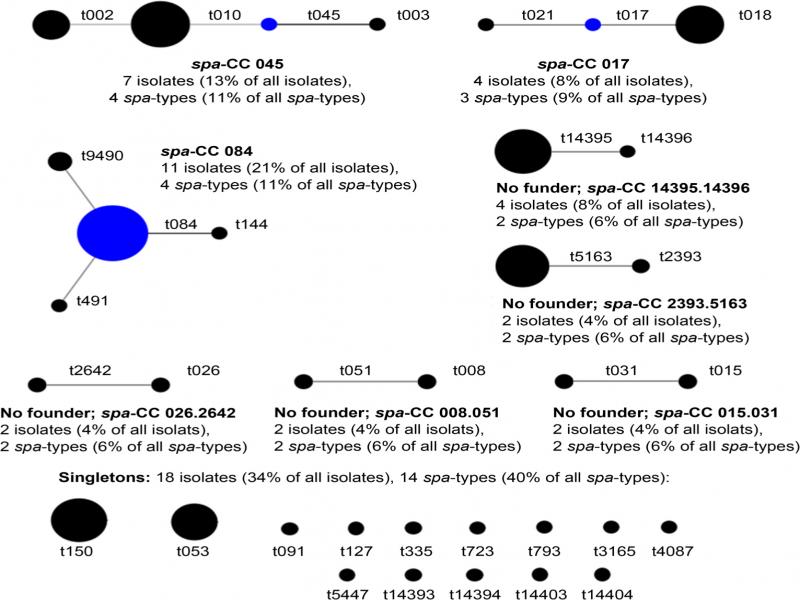
Fig. 2.
The results of BURP analysis. The 20 spa types were assigned to proper clonal complexes. Eighteen singletons were found among the 53 strains analyzed. Black circles represent the spa types assigned to the proper clonal complexes, and the blue circles represent the ancestor within the clonal complex.