
Table I
Strains and plasmids used in this study.
| Strain | Description | Source |
|---|---|---|
| PIC3611 | Wild-type Serratia marcescens | Presque Isle Cultures |
| CMS1687 | PIC3611 crp-Δ4 mutant | (Kalivoda et al. 2010) |
| CMS2097 | PIC3611 eepR mutant | (Stella et al. 2015) |
| CMS2922 | PIC3611 hexS mutant | (Shanks et al. 2013) |
| CMS4891 | PIC3611 pigB::tn-lux pigment operon reporter | this study |
| CMS4892 | PIC3611 pigF::tn-lux pigment operon reporter | this study |
| Plasmid | Relevant information | Source |
| pMQ99 | Plac-hcred shuttle vector | this study |
| pMQ132 | pBBR1-based shuttle vector | (Shanks et al. 2009) |
| pMQ200 | oriR6K-based suicide plasmid with PBAD | (Shanks et al. 2009) |
| pMQ221 | pMQ132 with pigP gene | (Shanks et al. 2013) |
| pMQ262 | pMQ200 with pigAB’ | (Kadouri and Shanks, 2013) |
| pMQ364 | pMQ132 with eepR gene | (Stella et al. 2015) |
| pMQ690 | promoterless-luxCDABE transposon delivery plasmid | this study |
| pMQ713 | pig promoter-luxCDABE transcriptional fusion | this study |
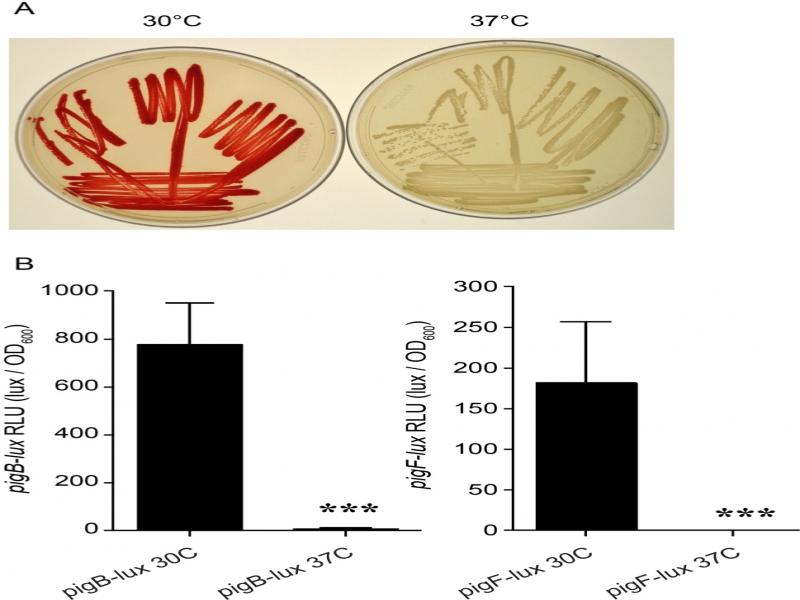
Fig. 1.
Thermoregulation of pigmentation by S. marcescens is controlled at the transcriptional level.
A. Pigment production of the wild-type strain PIC3611 grown for 18 h at 30°C and 37°C streaked for single colonies on an LB agar plate. B. Thermoregulation of pig expression as measured by transposon-borne luxCDABE reporters integrated in pigB and pigF genes. Asterisks indicate a significant difference by Student’s T-test (p < 0.001, n = 6). Means and standard deviations are shown.
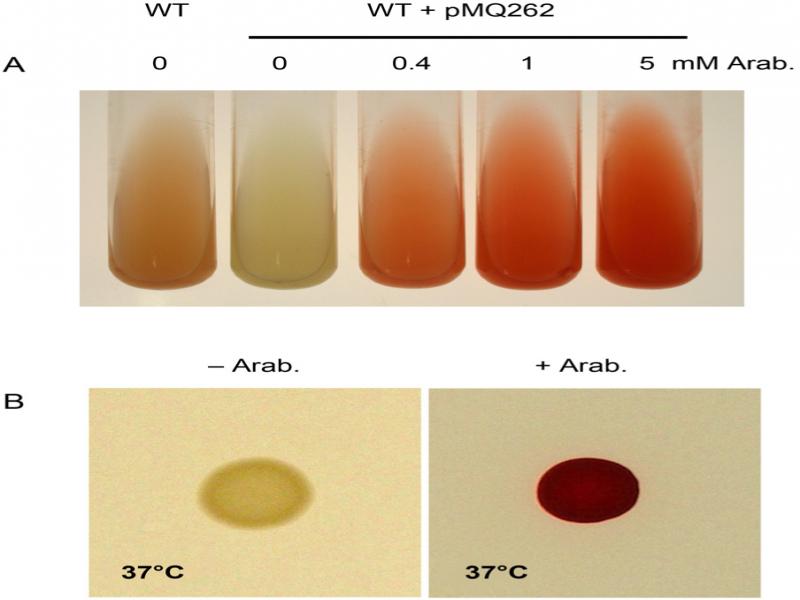
Fig. 2.
Induction of pig operon at 37°C enables prodigiosin production.
A. Pigment production at 30°C in liquid culture after 18 h of growth at 30°C. The wild-type strain was modified by recombination of pMQ262 through which an L-arabinose-inducible promoter replaces the pig promoter. B. Induced expression of pig at 37°C enabled expression of prodigiosin demonstrates that prodigiosin can be made at 37°C when the pig operon is expressed using pMQ262. Images show representative macrocolonies (see materials and methods).
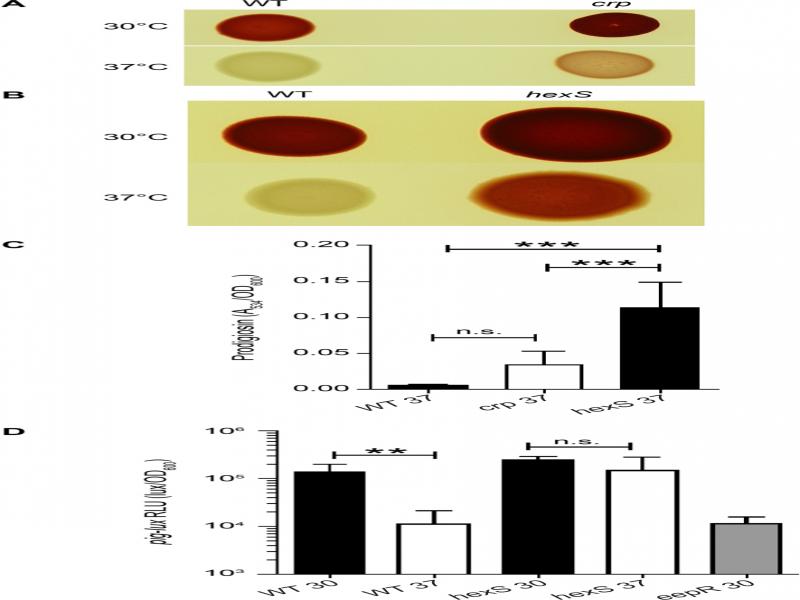
Fig. 3.
The hexS gene contributes to pigment suppression at 37°C.
A and B. Pigment production at 30°C and 37°C after 18 h of growth at 30°C. The hexS mutant retains the ability to produce pigment at 37°C. The increased colony size of the hexS mutant reflects elevated serrawettin production. Images depict macrocolonies resulting from spotting broth from liquid culture onto an LB agar plate. C. Prodigiosin measured from macrocolonies grown at 37°C for 24 hours, normalized by OD600. D. A plasmid-borne luxCDABE reporter for pig transcription was used to measure the importance of the hexS gene in temperature regulation. Unlike the WT, the hexS mutant was largely unaffected by growth at 37°C. The eepR mutant served as a control for low levels of pig transcription. Asterisks indicate significant differences by ANOVA with Tukey’s post-test (** – p < 0.01, *** – p < 0.001, n = 8). n.s. indicates not significant.
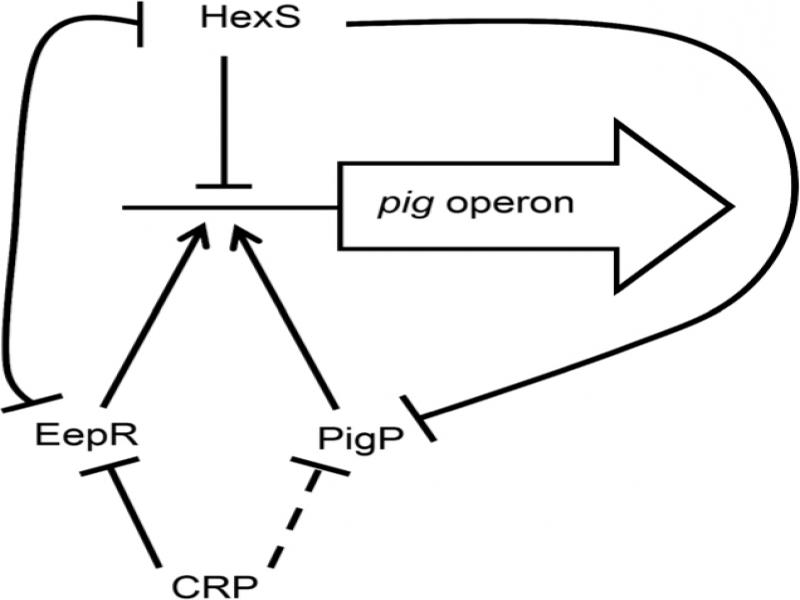
Fig. 4.
Model genetic circuit used in this study. In this regulatory circuit, the role of several transcriptional regulators in control of the pig operon promoter and each other is depicted. Arrows indicate positive regulation and bars indicate negative regulation of transcription. All interactions have been shown to be direct except CRP inhibition of pigP expression (dotted line). Evidence from this study suggests that HexS inhibition of pig operon expression is a major reason for lack of S. marcescens pigmentation at 37°C.
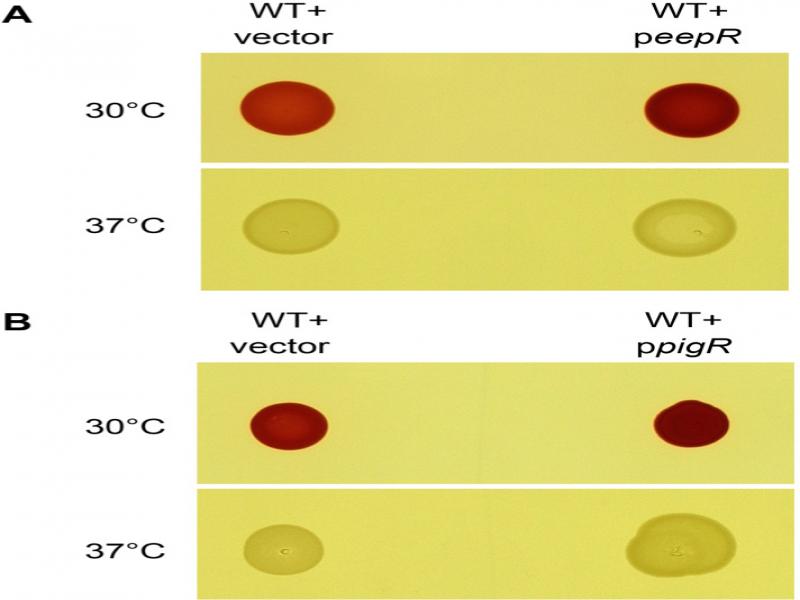
Fig. 5.
Multicopy expression of eepR and pigP does not restore pigmentation at 37°C. Bacteria were plated on LB medium, incubated at 30 and 37°C for 18 hours and photographed. Multicopy expression of eepR (A) and pigP (B), increased pigmentation at 30°C, but not 37°C. Vector – pMQ132; peepR – pMQ364; ppigP – pMQ221. Images show macrocolonies resulting from spotting broth from liquid culture onto LB agar plates.