
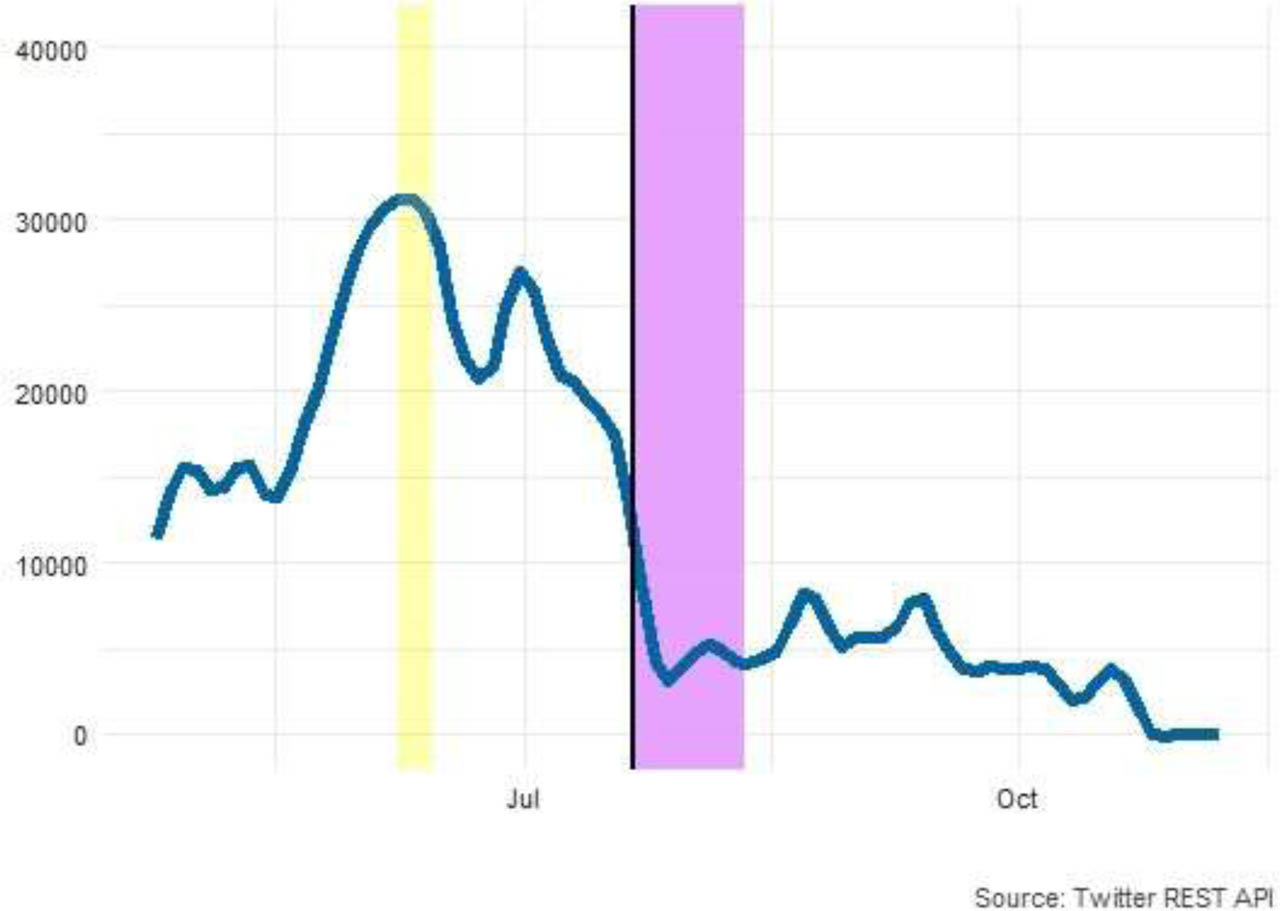
Figure 1
Tweets About #QAnon: Daily Aggregated #QAnon Status Counts
Table 1
Data Summary
| Period | Tweets | Tweets with URL | Tweets with Social Media URL | Tweets with External Social Media URL |
|---|---|---|---|---|
| April – November | 2,330,581 | 451,490 (19.4%) | 166,392 (7.1%) | 78,439 (3.4%) |
| Peak (July 11th – 14th) | 124,670 | 30,966 (24.8%) | 12,374 (9.9%) | 5,938 (4.8%) |
| Post (July 21st – August 11th) | 115,882 | 17,459 (15.1%) | 7,355 (6.3%) | 4,420 (3.8%) |
Table 2
Peak Period URL Statistics
| Rank | Platform | Unique Links | Tweets | Users | % Users |
|---|---|---|---|---|---|
| 1 | YouTube | 1,311 | 4,980 | 3,408 | 24.5 |
| 2 | 66 | 85 | 62 | 0.4 | |
| 3 | PeriscopeTV | 62 | 39 | 31 | 0.2 |
| 4 | 56 | 29 | 24 | 0.2 | |
| 5 | Bitchute | 31 | 42 | 27 | 0.2 |
| 6 | Pastebin | 13 | 21 | 8 | 0.0 |
| 7 | TikTok | 8 | 8 | 5 | 0.0 |
| 8 | Spotify | 7 | 8 | 6 | 0.0 |
| 9 | Telegram | 6 | 4 | 4 | 0.0 |
| 10 | Soundcloud | 6 | 4 | 4 | 0.0 |
[i] Note: Percentage of users calculated based on all users (13,908) who shared any type of URL
Table 3
Post Period URL Statistics
| Rank | Platform | Unique Links | Tweets | Users | % Users |
|---|---|---|---|---|---|
| 1 | YouTube | 1,550 | 3,162 | 2,122 | 21.0 |
| 2 | 362 | 208 | 139 | 1.4 | |
| 3 | PeriscopeTV | 138 | 88 | 49 | 0.5 |
| 4 | 97 | 117 | 97 | 1.0 | |
| 5 | Bitchute | 39 | 343 | 324 | 3.2 |
| 6 | TikTok | 24 | 31 | 24 | 0.2 |
| 7 | Etsy | 15 | 30 | 24 | 0.2 |
| 8 | Tumblr | 13 | 12 | 8 | 0.1 |
| 9 | 13 | 11 | 10 | 0.1 | |
| 10 | Soundcloud | 12 | 16 | 14 | 0.1 |
[i] Note: Percentage of users calculated based on all users (10,128) who shared any type of URL
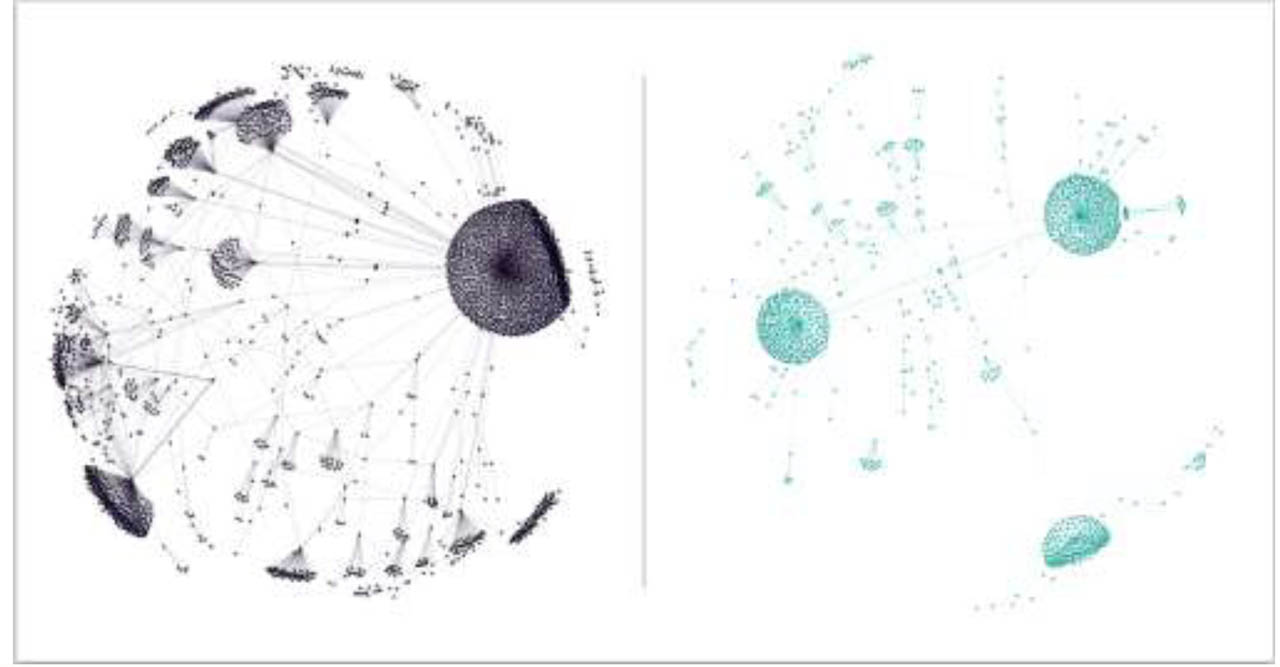
Figure 2
Main (Weak) Components of Peak (Left) and Post (Right) Retweet Networks
Table 4
Topographical and Girvan-Newman Clustering Metrics of Peak and Post Networks
| Metric | Retweet Network | |
|---|---|---|
| Peak | Post | |
| Size | 3,130 | 1,985 |
| Size (Largest Component) | 2,566 | 988 |
| Density | < 0.001 | < 0.001 |
| Average Degree | 1.988 | 1.747 |
| Transitivity | < 0.001 | < .0010 |
| Reciprocity | 0.000 | 0.000 |
| Degree Centralization | 0.341 | 0.159 |
| Betweenness Centralization | 0.586 | 0.149 |
| Diameter | 15 | 14 |
| Average Path Length | 4.416 | 4.670 |
| Number of Groups | 217 | 301 |
| Modularity | 0.821 | 0.905 |
| Normalized Modularity | 0.824 | 0.908 |
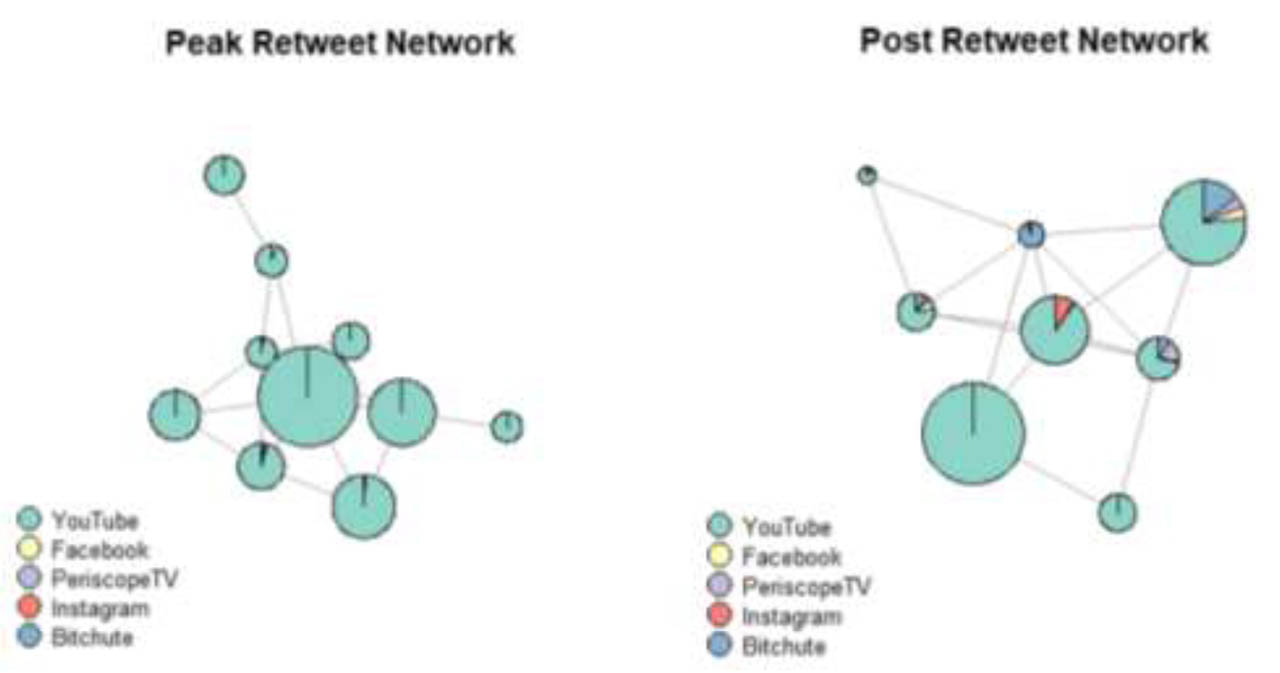
Figure 3
Main (Weak) Component Collapsed by Girvan-Newman Subgroups
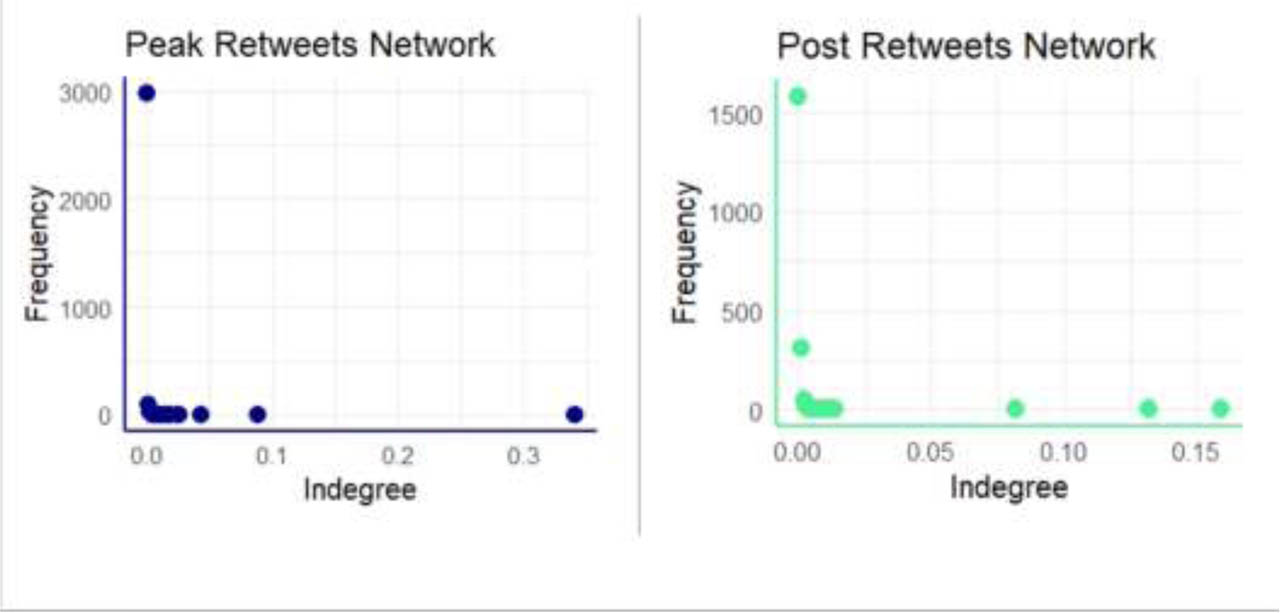
Figure 4
Indegree Distribution, Peak and Post Retweets Network
Table 5
Peak Network Correlations Between Key Centrality Metrics and User Account Attributes
Table 6
Post Network Correlations Between Key Centrality Metrics and User Account Attributes
Table 7
Summary of Hypotheses and Results
| Hypotheses | Result | Comments |
|---|---|---|
| H1. A handful of actors will account for most of the link-sharing of external social media sites. | + | New central actors emerged after the crackdown to diffuse external content. |
| H2. Reliable actors will be central before and after Twitter's July 2020 crackdown, even if they are different users in each period. | + | |
| H3. Both networks will exhibit relatively high levels of clustering. | + | |
| H4: Both networks will be moderately to highly centralized. | +/− | See H8 below. |
| H5: The retweet networks will be scale-free. | + | See H9 below. |
| H6: Both networks will exhibit low levels of reciprocity. | + | |
| H7: Both networks will be sparse and exhibit low levels of transitivity. | + | Unsurprisingly, the post network was smaller and sparser than the peak network. |
| H8: The network will become less centralized after Twitter's crackdown in July 2020. | + | |
| H9: The network will become less scale-free after Twitter's crackdown in July 2020. | − | The post network was more strongly scale-free than the peak network. |