
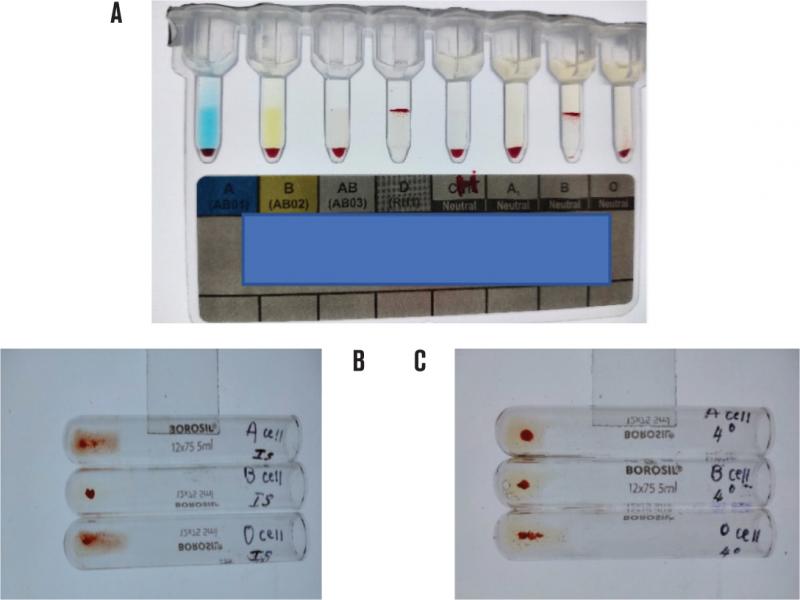
Fig. 1
(A) Blood group discrepancy using gel cards (Matrix Octoplus Forward and Reverse Grouping Card with Sub Grouping; Tulip Diagnostics [P] Ltd.). (B) Serum grouping by tube method (by in-house prepared pooled red blood cells) at room temperature. (C) Serum grouping by tube method (by in-house prepared pooled red blood cells) at 4°C.
Table 1.
Results of forward and reverse typing in gel card and standard test tube method
| Forward typing | Reverse typing | |||||||
|---|---|---|---|---|---|---|---|---|
| Method | Anti-A | Anti-B | Anti-D | Anti-AB | Anti-H | O RBCs | A RBCs | B RBCs |
| Matrix gel system * | 0 | 0 | 4+ | 0 | 0 | 1+ | 0 | 4+ |
| Test tube method (RT) | 0 | 0 | 4+ | 0 | 0 | 1+ | 1+ | 4+ |
| Test tube method (4°C) | 0 | 0 | 4+ | 0 | 0 | 3+ | 4+ | 4+ |
Table 2.
Results of reactivity pattern of cold antibodies with different RBCs
| Serum reactivity observed with: | At RT | At 4°C |
|---|---|---|
| Group O adult RBCs (O I) | 1+ | 3+ |
| Group O cord RBCs (O i) | 0 | 0 |
| Group A1 adult RBCs (A1 I) | 1+ | 4+ |
| Enzyme-treated group O RBCs | 1+ | 3+ |
| Bombay (Oh) RBCs | 0 | 0 |
| Autologous RBCs | 0 | 0 to weak |
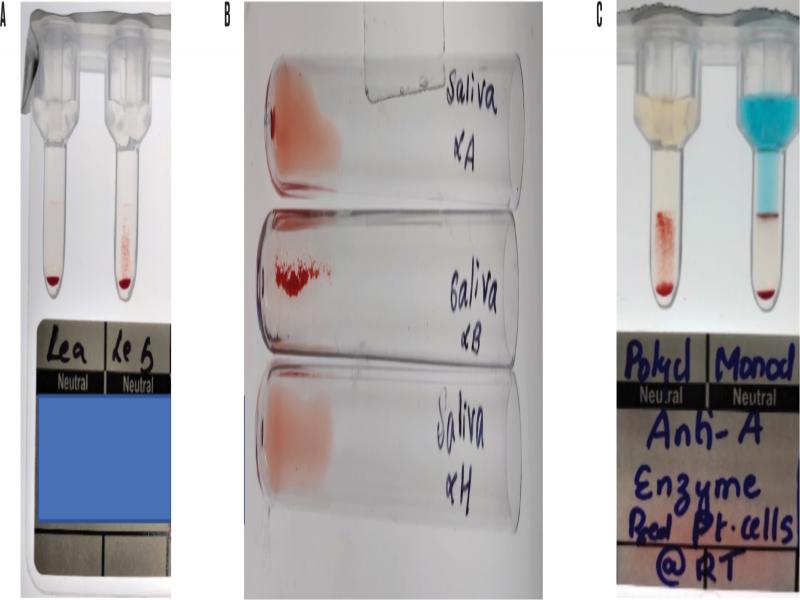
Fig. 2
(A) Le(a–b+) phenotype (secretor). (B) Saliva secretor status showed secretion of A and H substances. (C) Enzyme-treated patient red blood cells (Papain, LIQUIPAP; Tulip Diagnostics [P] Ltd.) showed reactivity with anti-A.
Table 3.
Immunohematologic (serology) workup to distinguish Bombay and para-Bombay phenotypes
| Characteristic | Bombay | para-Bombay |
|---|---|---|
| Forward typing | No reactivity with anti-A or anti-B | No or weak reactivity with anti-A and/or anti-B |
| Reverse typing | Strong reactivity with group O, group A, and group B RBCs | Weak reactivity with group O, group A, and/or group B RBCs |
| Reactivity with anti-H lectin | No reactivity | Weak reactivity |
| Reactivity with group O icord RBCs | Strong reactivity | No reactivity |
| Saliva secretor status | Nonsecretor of H, A, and B substances | Usually secretor of H, A, and/or B substances |
| Leb phenotype (indication for secretor status) | Le(b–) | Le(b–) or Le(b+) |
| Antibody testing with panel RBCs | Panreactivity: equal strength | Panreactivity: differential strength |
| Adsorption elution studies for H, A, and/or B antigens | Negative | May be negative or weakly positive |