
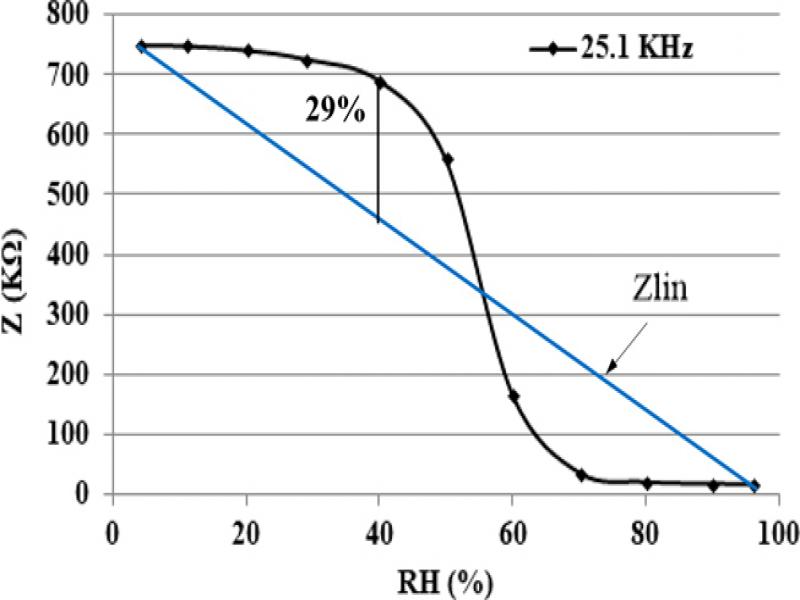
Figure 1:
Nonlinear impedance response of a ceramic humidity sensor (Islam et al., 2014a).
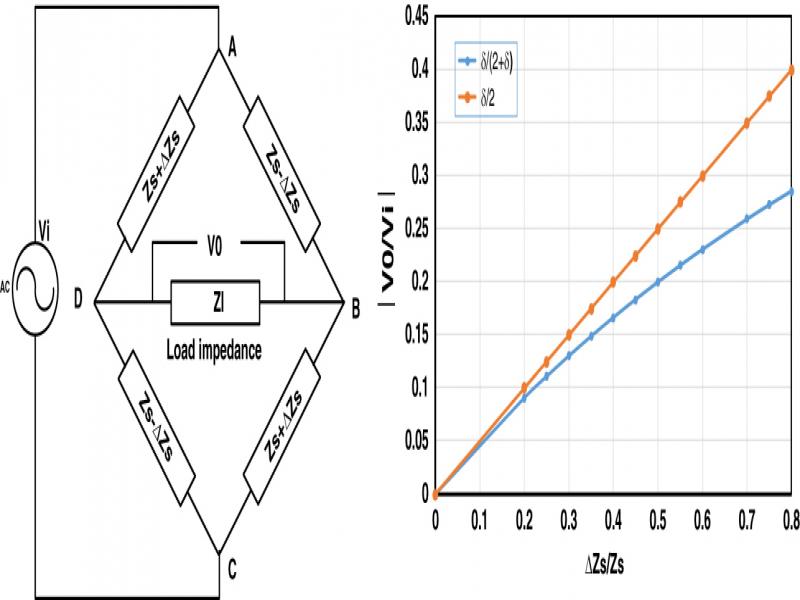
Figure 2:
(A) Symmetrical bridge configuration; (B) its transfer curve (de Graaf and Wolffenbuttel, 2006).
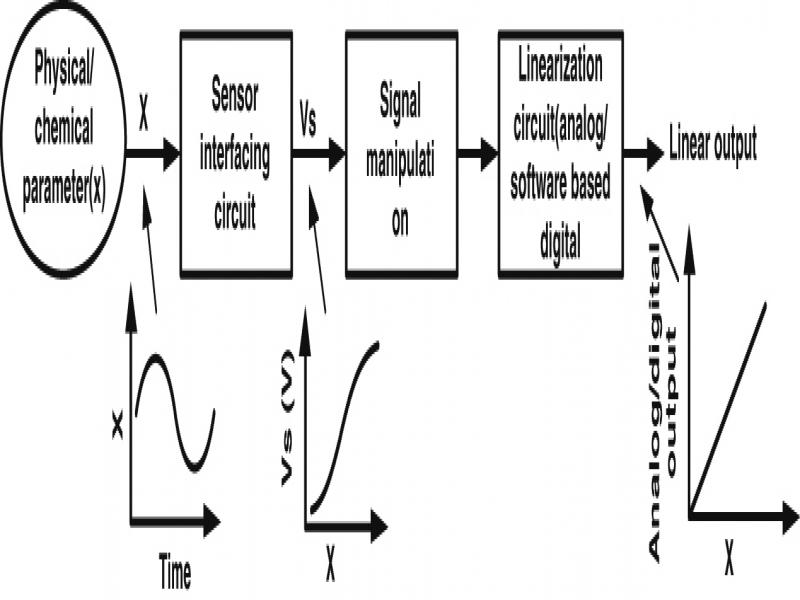
Figure 3:
A general block diagram of the linearization unit.
Table 1.
Analog schemes of linearization of thermistors, thermocouples, and giant magneto resistive sensors (GMR).
| Method | Range | Accuracy (%) | Complexity |
|---|---|---|---|
| (Nenova and Nenov, 2009) Timer-based oscillator circuit | 0–120 | ±1 | Low but SPR has low range and low sensitivity |
| (Stanković and Kyriacou, 2012) Quarter Wheatstone bridge | 10–39 0–100 | ±1.5°C | Low, limited range |
| Series parallel resistance (SPR) | 0.1°C | Low, low sensitivity | |
| (Kaliyugavaradan et al., 1993) Inverting amplifier with thermistor at input | 27–113 | ±1 | Low |
| (Bandyopadhyay et al., 2016) Timer-based oscillator | 23–110 | 0.2°K | High, low reliability |
| (Fraden, 2003) One-bit sigma–delta modulator | na | ±0.01 | High, but accurate |
| (Mondal et al., 2009) Op-amp logarithm amplifier | T: 0–400°C | ±0.1 | Simulation results |
| For TC | J: 0–760°C | ||
| (Lucaa et al., 2015) CMOS thermal diode with two driving currents | 80–1,080 K | ±0.6 | High not flexible |
| (Sanyal et al., 2006) Op Amp based log amp | 20–48 m/s | >±0.1 K | Simulation only |
| (Pappas et al., 2011) Current conveyer | NA | 0.84 | simulation only |
| (Bera and Marick, 2012) Diodes-based bridge circuit for flow rate | 1–10 Kg/min | 0.3 | Low |
| (de Graaf and Wolffenbuttel, 2006) Trans impedance amplifier bridge | ±20% | ±0.2 | Low, simulation only |
| (Maundy and Gift, 2013) Strain gauge amplifier circuits | na | 0.4 | Medium |
| (Bera et al., 2012) Opto-isolator-based analog circuit | na | ±1.67 | Medium |
| (Sen et al., 2017) Feedback compensation | 0.5–3.5 mT | 0.7 | Low, GMR inherent nonlinearity |
| (Jedlicska et al., 2010) Minimizing hysteresis | 2.8% | 074 | High, long time, not accurate |
| (Munoz et al., 2008) Impedance converter as current source for GMR sensor | na | na | High, more drift |
| (Li and Dixon, 2016) A close loop feedback analog circuit | 0–0.3 mT | na | Complex circuit, magnetic sensors |
| (Chavan and Anoop, 2016) Dual slope ADC (digital output) | 0.5–3.5 mT | 1.5 | Precise resistance, large conversion time |
| (Sen et al., 2018) Feedback circuit | na | Accuracy not mentioned | Low but magnetic sensor |
| (Ghallab and Badawy, 2006) Current mode Wheatstone bridge consisting three operational floating current convey | 0.5–3.5 mT | 0.6 | Medium |
| (Azhari and Kaabi, 2000) Operational floating current conveyer | na | na | High |
| (Farshidi, 2011) Current mode Wheatstone bridge using CMOS transistor |
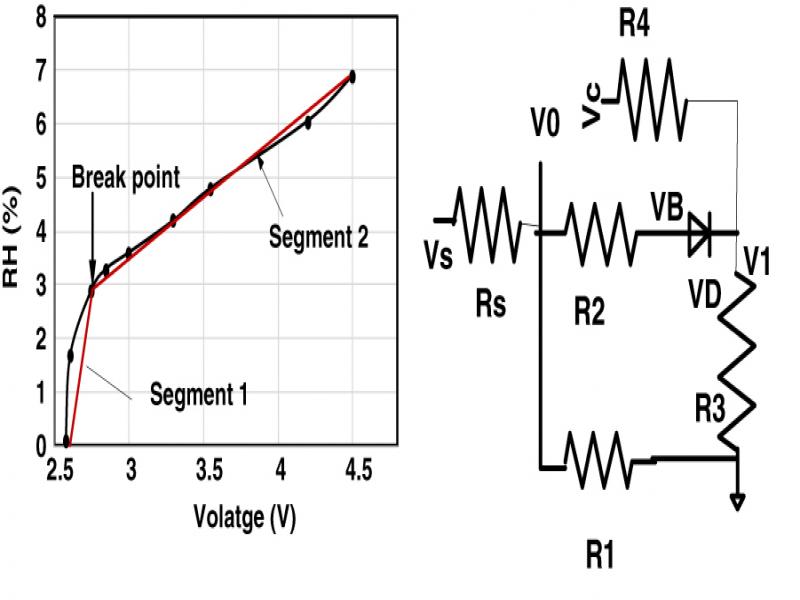
Figure 4:
(A) Inverse response of the humidity sensor; (B) linearization circuit.
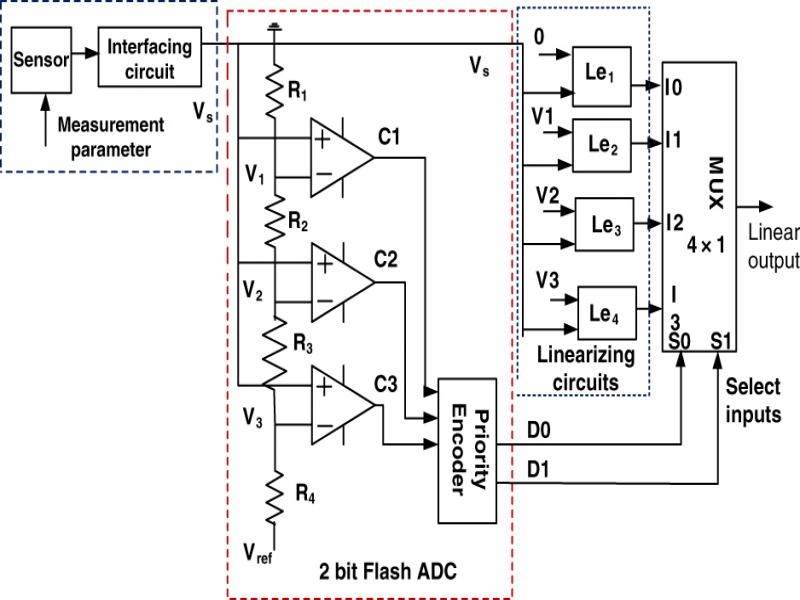
Figure 5:
A mixed signal conditioning circuit for piecewise linearization (Mahaseth et al., 2018).
Table 2.
Linearization by direct digital linearization and software-based algorithms.
| Method | Accuracy/range | Complexity | Applications |
|---|---|---|---|
| (Eshrat Alahi et al., 2017) Non-linear ADC with piecewise linear input-output characteristics | 1%,/30 to 90%RH accuracy depends on pieces | Medium | Humidity sensor, smart sensors, flash ADC (3 bit and 11-bit ADCs) |
| (Žorić et al., 2006) Nonlinear ADC for moisture sensor | na | Medium | Humidity sensor |
| (Islam et al., 2006; Dias Pereira et al., 2009; Rahili et al., 2012) Direct interface to µC for half, full Wheatstone bridge | 0.3%/0 to 1), 11-bit resolution (10%) (quarter bridge) | Low, lead error, bridge nonlinearity compensation only digital output | Resistive sensors, 8-bit AVR ARDUINO board |
| (Scheiblhofer et al., 2006) Dual slope ADC for direct interface to µC with logarithm amplifier | ±0.3°C, 0-120°C | Low, digital output | Thermistor, implementation by LabVIEW |
| (Fericean et al., 2009b) Feedback compensation scheme | 0.03% (100% range) | Low, implementation by analog circuit | Nonlinearity of Wheatstone bridge |
| (Ramadoss and George, 2015) Microcontroller-based direct interface | 0.3% low | digital output, no ADC | Diff. variable inductive sensors |
| (Nagarajan et al., 2017) Dual slope ADC for direct interface to µC (quarter/half bridge resistive sensors) | <0.09%,/100% | Digital output, only bridge nonlinearity compensation | resistive sensors, LabVIEW and NI ELVIS-II board, Hall effect sensor |
| (Sreekantan and George, 2014) Dual slope ADC for direct interface to µC converter (diff. third order polynomial | <0.7% | Low, digital output | Differential second- and third-order sensor, tested for inductive sensor |
| (Islam et al., 2013) Oscillator-based resistance to frequency conversion | <1% | Medium, quasi digital output, frequency conversion temperature error compensation no sensor nonlinearity compensation | Resistive sensors, humidity sensor |
| (Murmu and Munshi, 2018) Software algorithm for TC | ±1.4%, 45-100°C | High, costly solution | Thermocouple |
| (Flammini et al., 1997; Flammini et al., 1999; Flammini and Taroni, 1999; Catunda et al., 2003; Erdem, 2010; Islam et al., 2014b) Simple Look-up table for different nonlinear sensors | ±1% moisture, accuracy depends on memory size | Medium | Nonlinear sensors |
| (Erdem, 2010) Look-up table PWLE for infrared distance sensor. Look-up table_ | 0.03% | Medium memory than simple Look-up table. Medium, reduced memory. | Nonlinear sensor |
| PWLI for infrared distance sensor | 0.032% | ||
| (Teodorescu) Look-up table PGA | 0.023% | Medium, memory Low | nonlinear sensor |
| (Rivera et al., 2009) Progressive polynomial software method (PPC)for sensors | <1% (max 36%) | Medium, less data points | Resistive nonlinear sensor |
| (Dias Pereira et al., 2009) Adaptive self-calibration algorithm to determine polynomial equation, based on probability density function | na | Medium, low computation, small memory | Smart sensors air flow sensor |
| (Rahili et al., 2012) Modified PPC: intelligent selection of calibration points to determine polynomial function | 0.83% | Reduced calibration data, small memory locations | Smart sensor nonlinearity for thermistor |
| (Xinwang et al., 2011) Recursive B-spline least square method | 0.01% (6.34%), 0.35% (51% for NTC) | High low data points | Thermocouple NTC Thermistor |
| (Optimized Sensor Linearization for Thermocouple, 2015) Thermocouple by software algorithm | ±0.02 (−270°C-1372°C) | Low memory | Thermocouple |
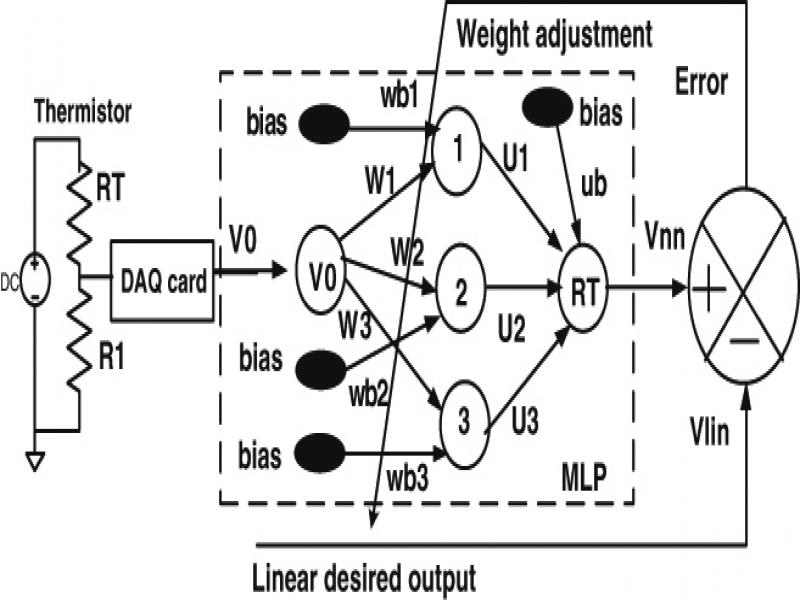
Figure 6:
Linearization using multilayer perceptron neural network resistance.
Table 3.
Fuzzy rules for sensor linearization.
| IF V < V1 (slightly low), then RH is the lowest |
| IF V1 ⩽ V < V2 (low), then RH is low |
| IF V2 ⩽ V < V3 (average), then RH is middle |
| IF V3 ⩽ V < V4 (slightly high), then RH is slightly high |
| IF V4 ⩽ V (high), then RH is high |
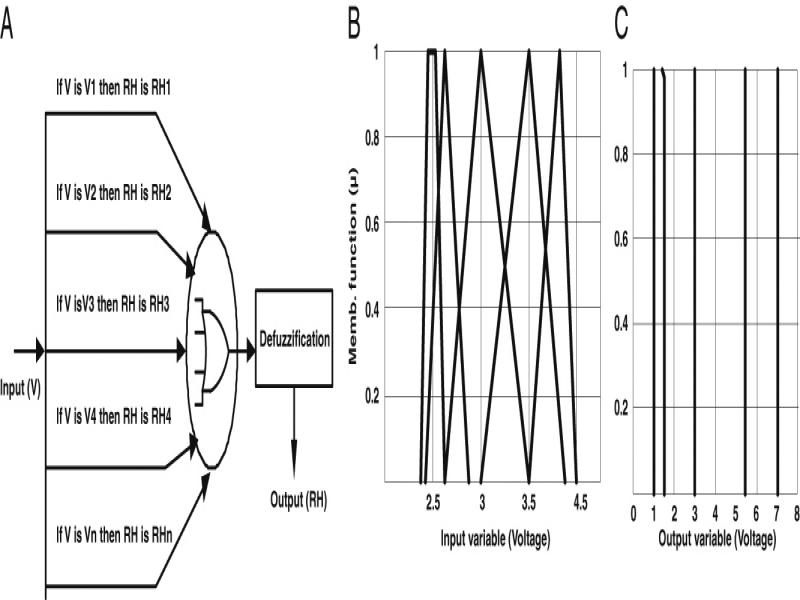
Figure 7:
Fuzzy logic-based linearization of the humidity sensor response (4(A)).
Table 4.
Linearization by software-based intelligent methods.
| Technique | Accuracy | Complexity | Implementation |
|---|---|---|---|
| (Nenov and Ivanov, 2007) ANN technique for humidity sensor | ~1% | High, large memory | Desktop PC |
| (Medrano-Marques et al., 2001) MLP for piecewise linearization of thermistor | <0.5% | High, large memory size depends on data points | µC (16-bit ADC) no hardware results |
| (Islam et al., 2006) Adaptive NN, determine coefficient of polynomial (ADALINE) | 2.7% | Low, can be more for higher-order polynomial | Op-amp based circuit |
| (Erdem, 2010) ANN for infrared distance | 0.017% | High, large memory | PIC18F452 µC (10-bit ADC) ST52F510 (10-bit resolution) |
| (Khan et al., 2003) MLP-based inverse ANN model for thermistor | <0.5% | High, low memory Optimized data points | PIC16F870 µC (10-bit ADC) |
| (Kumar et al., 2015) Two stages linearization (i) optimizing the parallel form of RNTC and fixed resistance and (ii) MLP | ±0.2% | High, medium memory | µC with AVR studio for coding various sensors with drift compensation |
| (Patra et al., 2008) Efficient learning machine (ELM) for the pressure sensor with temperature error | ±1.5% | Medium | Xilinx Virtex-II FPGA board (12-bit ADC) |
| (Patra et al., 2008) Chebyshev neural network pressure sensor | ±1% | High, computationally efficient basic MLP | Only simulation results |
| (Cotton and Wilamowski, 2011) Fully connected cascade NN | <1% | High, computationally efficient | µC with 8-bit ADC |
| (Teodorescu) Fuzzy logic | 0.07% | High, large memory | Simulation results for different nonlinearity |
| (Bouhedda, 2013) Neuro-fuzzy | 0.03°C (high) | Medium, high memory less hardware than LUT | Xilinx Spartan-3A DSP 1800A FPGA board, MAX1132 ADC (16 bit) |
| (Xiaodong, 2008) software support vector machine humidity sensor | <0.05 | Better than MLP fuzzy logic | MATLAB Neural Network Toolbox |