Falls are a major health concern for older people (Clarke et al. 2015), with a third of those over the age of 65 years likely to experience a fall each year (Campbell et al. 1990). Older people with vision impairment are at a higher risk of falls estimated as eight times more likely to experience a fall, as well as a fall that results in a fracture (Ivers et al. 2002). This demographic are at a higher risk of falls because of difficulty detecting hazards (Legood et al. 2002), but it is also likely that impaired strength and balance (Lamoureux et al. 2004; Chen et al. 2011), sedentary lifestyle (Loprin zi et al. 2014) and exercise avoidance (Clemson et al. 2008) contribute to risk. With an ever-increasing population of older people with vision impairment (Taylor et al. 2005), the need for effective fall prevention strategies has never been so crucial.
The 2012 Cochrane Review on interventions for preventing falls in community-dwelling older people (Gillespie et al. 2012) concluded that group and home-based exercise programs, as well as home safety and medication management, reduce the rate and risk of falling in older people. Furthermore, exercise programs that include the optimal dose and include exercises that provide a high challenge to balance can reduce the rate of falls by around 30% to 40% (Sherrington et al. 2011). However, of the 159 included trials, few trails included participants with vision impairment, and only one trial included participants with severe vision impairment (Gillespie et al. 2012). Consequently, it remains unclear how these findings can be generalized to older people with vision impairment.
Results of a meta-analysis within a recent systemic review by Gleeson et al. (2014) found that multimodal exercise positively impacts on physical functioning in residential-dwelling older people with vision impairment. However, although the Otago Exercise Programme has been shown to reduce falls by up to 35% in the general population (Thomas et al. 2010), one trial in the systematic review found no significant effect on risk of falls for those with vision impairment after completion of the program (Campbell et al. 2005). Only one of the four trials included in the systematic review was completed in community-dwelling people, and none of the trials measured the attitudes of participants in order to help explain their findings.
An individual’s attitude toward the benefits and disadvantages of exercise has been demonstrated to influence intention to participate (Yardley et al. 2007). However, few studies have investigated how the attitudes of community-dwelling older people with vision impairment influence adherence to fall prevention programs. The current study aimed to investigate attitudes towards fall prevention interventions in community-dwelling older people with vision impairment. A qualitative approach (Vaismoradi et al. 2013) was used to examine the ways that two types of exercise-based fall prevention programs (The Otago Programme and Tai Chi), as well as home modifications, would be considered acceptable to people in this vulnerable demographic. To our knowledge, this is the first study which has focused on the attitudes of community-dwelling older people with vision impairment to fall prevention strategies.
Method
Study participants
Older people with vision impairment were recruited through convenience sampling. Flyers were placed on community noticeboards, via organizations and support groups which assist people with vision impairment (i.e., Guide Dogs NSW/ACT, senior citizen centres, churches, Probus groups and gardening groups) in the south-western suburbs of Sydney, Australia. People interested in participating registered their interest with the facilitator through a phone call, email or filled out their contact details on a sign-up sheet attached to the flyer. Eligible participants were 60 years of age or older with reduced functional vision or legal blindness. To ensure participants were able to contribute to discussions, participants were excluded if they could not speak conversational English.
The study was approved by the University of Sydney Human Research Ethics Committee (Reference number 14111). The study is reported in line with the COREQ statement (Tong et al. 2007), supporting transparency in the reporting of qualitative research.
Data collection
Focus groups were used to explore the acceptability of different fall prevention programs from the perspectives of older people with vision impairment. Due to the high likelihood of mobility restrictions within the population of interest, semi-structured interviews in participant homes were also offered to increase the scope of participant inclusion. Both focus groups and interviews are robust methods of obtaining comprehensive qualitative information and have been used many times to explore the opinions of people in fall prevention research (McMahon et al. 2011).
Each focus group and semi-structured interview was led by an orientation and mobility (O&M) specialist (facilitator) from Guide Dogs NSW/ACT, a non-government organization providing community-based support for people with vision impairment. Participants provided written, informed consent and completed a baseline data collection form that included demographic information, diagnosis of vision and comorbidities and mobility details. To ensure consistency between the focus groups and interviews, an open-ended and semi-structured script was used on each occasion (Table 1). The facilitator began discussions with an “ice-breaker” question and would refer back to the script for prompts to facilitate further conversation around the discussion topics. To confirm correct interpretation of the salient themes, the facilitator reviewed these with the participants at the end of each discussion. Each focus group and semi-structured interview was recorded and lasted between 1 and 2 hr.
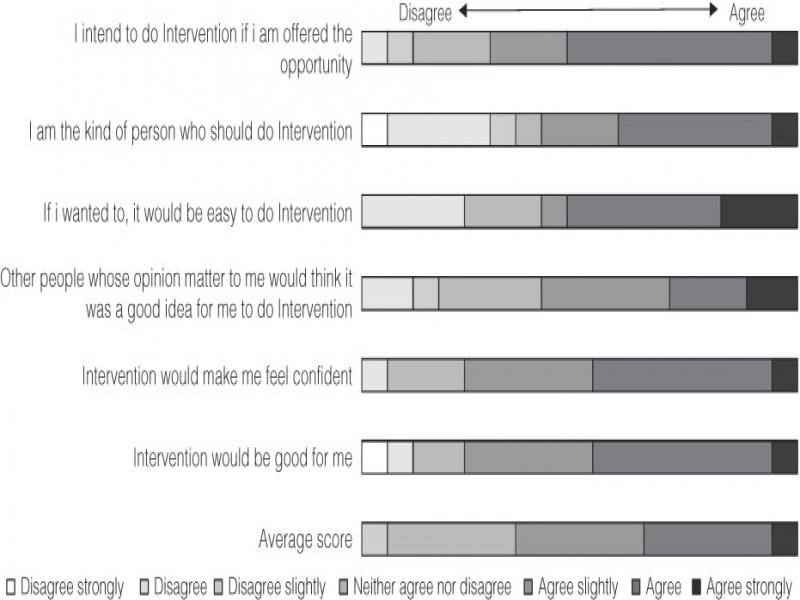
After completion of each focus group and semi-structured interview, participants were asked to complete the attitudes to falls-related interventions scale (AFRIS). The AFRIS is used to measure why a participant would accept or reject a falls-related intervention. A home-based strength and balance training program was described, after which, participants rated each of the six questions from “disagree strongly” to “agree strongly” on a seven-point Likert scale. Questions included “intervention would be good for me” and “I am the kind of person who should do intervention” (Yardley et al. 2007).
Table 1
The script used in each focus group and semi-structured interview, including ice-breaker question, areas of discussion and associated prompts.
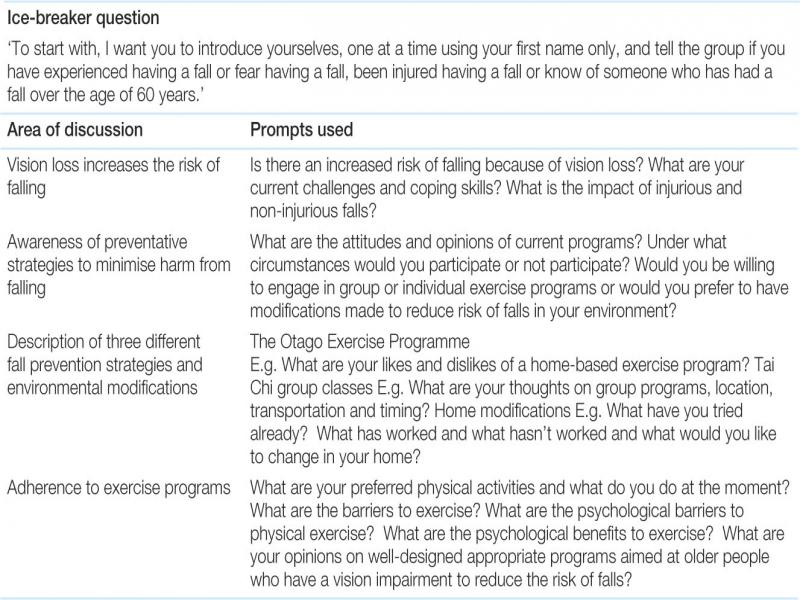
| Ice-breaker question | |||
| ‘To start with, I want you to introduce yourselves, one at a time using your first name only, and tell the group if you have experienced having a fall or fear having a fall, been injured having a fall or know of someone who has had a fall over the age of 60 years.’ | |||
| Area of discussion | Prompts used | ||
| Vision loss increases the risk of falling | Is there an increased risk of falling because of vision loss? What are your current challenges and coping skills? What is the impact of injurious and non-injurious falls? | ||
| Awareness of preventative strategies to minimise harm from falling | What are the attitudes and opinions of current programs? Under what circumstances would you participate or not participate? Would you be willing to engage in group or individual exercise programs or would you prefer to have modifications made to reduce risk of falls in your environment? | ||
| Description of three different fall prevention strategies and environmental modifications | The Otago Exercise Programme E.g. What are your likes and dislikes of a home-based exercise program? Tai Chi group classes E.g. What are your thoughts on group programs, location, transportation and timing? Home modifications E.g. What have you tried already? What has worked and what hasn’t worked and what would you like to change in your home? | ||
| Adherence to exercise programs | What are your preferred physical activities and what do you do at the moment? What are the barriers to exercise? What are the psychological barriers to physical exercise? What are the psychological benefits to exercise? What are your opinions on well-designed appropriate programs aimed at older people who have a vision impairment to reduce the risk of falls? | ||
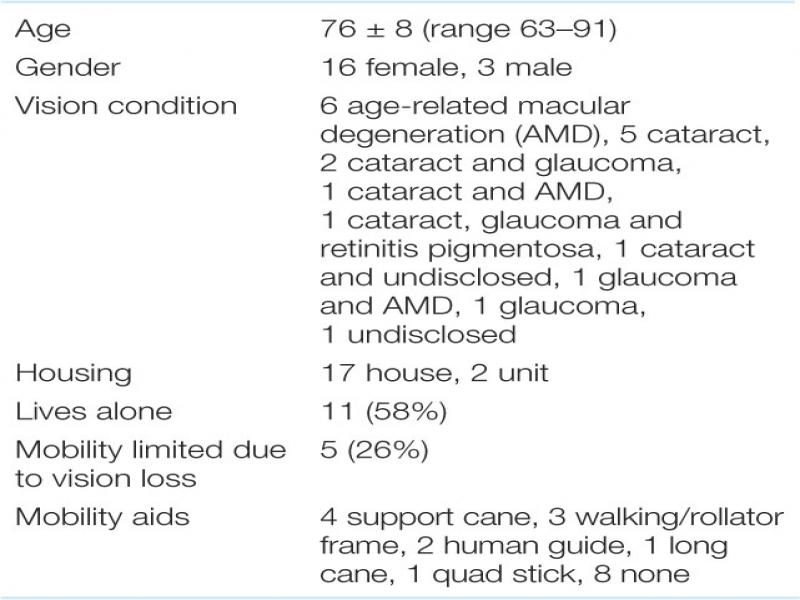
| Age | 76 ± 8 (range 63–;91) | ||
| Gender | 16 female, 3 male | ||
| Vision condition | 6 age-related macular degeneration (AMD), 5 cataract, 2 cataract and glaucoma, 1 cataract and AMD, 1 cataract, glaucoma and retinitis pigmentosa, 1 cataract and undisclosed, 1 glaucoma and AMD, 1 glaucoma, 1 undisclosed | ||
| Housing | 17 house, 2 unit | ||
| Lives alone | 11 (58%) | ||
| Mobility limited due to vision loss | 5 (26%) | ||
| Mobility aids | 4 support cane, 3 walking/rollator frame, 2 human guide, 1 long cane, 1 quad stick, 8 none |
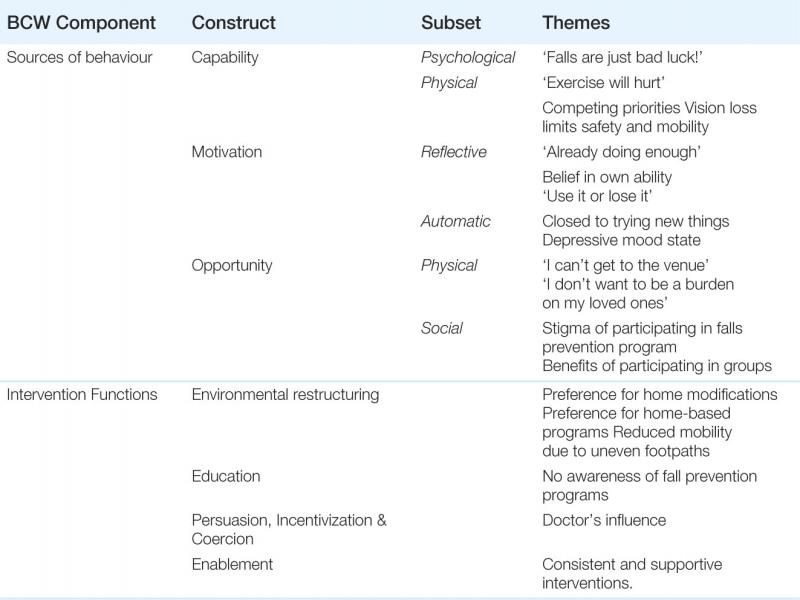
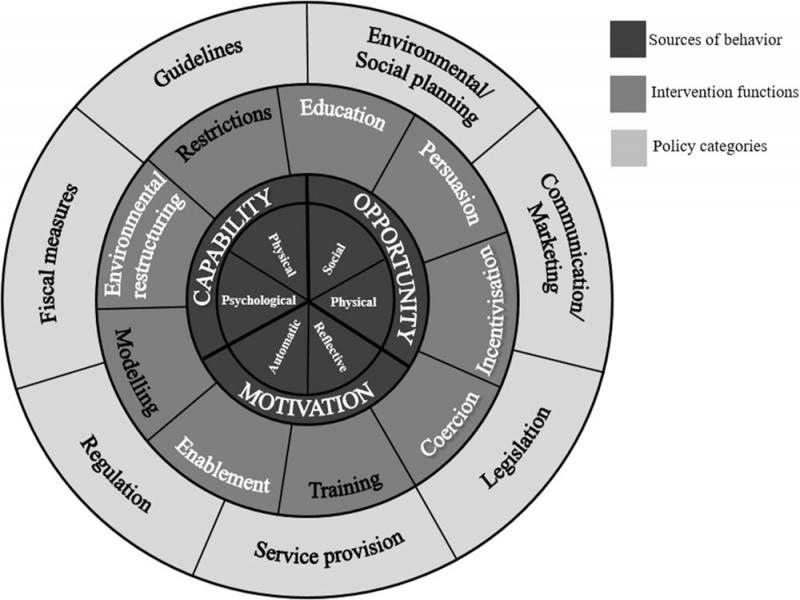
| BCW Component | Construct | Subset | Themes |
|---|---|---|---|
| Sources of behaviour | Capability | Psychological | ‘Falls are just bad luck!’ |
| Physical | ‘Exercise will hurt’ | ||
| Competing priorities Vision loss limits safety and mobility | |||
| Motivation | Reflective | ‘Already doing enough’ | |
| Belief in own ability ‘Use it or lose it’ | |||
| Automatic | Closed to trying new things Depressive mood state | ||
| Opportunity | Physical | ‘I can’t get to the venue’ ‘I don’t want to be a burden on my loved ones’ | |
| Social | Stigma of participating in falls prevention program Benefits of participating in groups | ||
| Intervention Functions | Environmental restructuring | Preference for home modifications Preference for home-based programs Reduced mobility due to uneven footpaths | |
| Education | No awareness of fall prevention programs | ||
| Persuasion, Incentivization & Coercion | Doctor’s influence | ||
| Enablement | Consistent and supportive interventions. |