
Table 1
Summary of adult adventitious vision conditions and functional vision considerations for orientation and mobility.
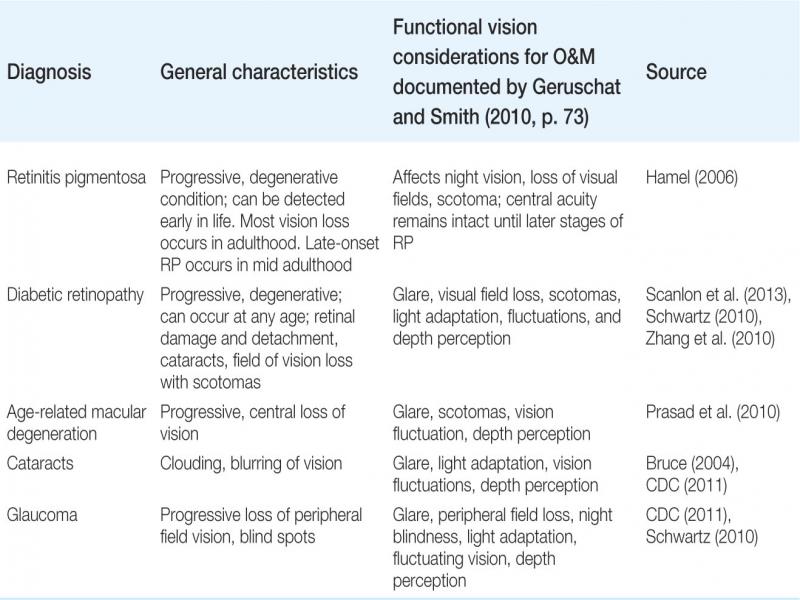
| Diagnosis | General characteristics | Functional vision considerations for O&M documented by Geruschat and Smith (2010, p. 73) | Source |
|---|---|---|---|
| Retinitis pigmentosa | Progressive, degenerative condition; can be detected early in life. Most vision loss occurs in adulthood. Late-onset RP occurs in mid adulthood | Affects night vision, loss of visual fields, scotoma; central acuity remains intact until later stages of RP | Hamel (2006) |
| Diabetic retinopathy | Progressive, degenerative; can occur at any age; retinal damage and detachment, cataracts, field of vision loss with scotomas | Glare, visual field loss, scotomas, light adaptation, fluctuations, and depth perception | Scanlon et al. (2013), Schwartz (2010), Zhang et al. (2010) |
| Age-related macular degeneration | Progressive, central loss of vision | Glare, scotomas, vision fluctuation, depth perception | Prasad et al. (2010) |
| Cataracts | Clouding, blurring of vision | Glare, light adaptation, vision fluctuations, depth perception | Bruce (2004), CDC (2011) |
| Glaucoma | Progressive loss of peripheral field vision, blind spots | Glare, peripheral field loss, night blindness, light adaptation, fluctuating vision, depth perception | CDC (2011), Schwartz (2010) |
Table 2
Participant-reported Orientation and Mobility (O&M) services and pedestrian travel.
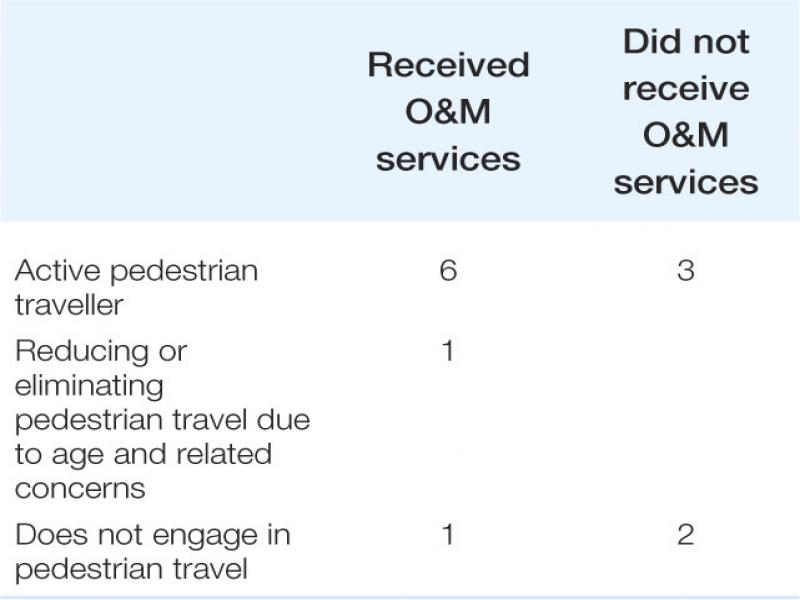
| Received O&M services | Did not receive O&M services | |
|---|---|---|
| Active pedestrian traveller | 6 | 3 |
| Reducing or eliminating pedestrian travel due to age and related concerns | 1 | |
| Does not engage in pedestrian travel | 1 | 2 |
Table 3
Description of characteristics that affect functional vision among nine participants with useable eyesight.
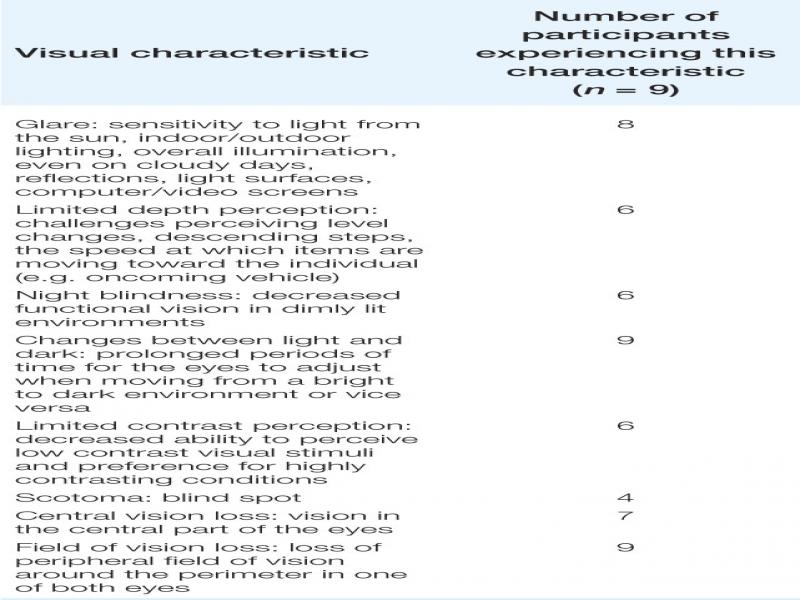
| Visual characteristic | Number of participants experiencing this characteristic (n = 9) |
|---|---|
| Glare: sensitivity to light from the sun, indoor/outdoor lighting, overall illumination, even on cloudy days, reflections, light surfaces, computer/video screens | 8 |
| Limited depth perception: challenges perceiving level changes, descending steps, the speed at which items are moving toward the individual (e.g. oncoming vehicle) | 6 |
| 6 | |
| Night blindness: decreased functional vision in dimly lit environments | |
| Changes between light and dark: prolonged periods of time for the eyes to adjust when moving from a bright to dark environment or vice versa | 9 |
| Limited contrast perception: decreased ability to perceive low contrast visual stimuli and preference for highly contrasting conditions | 6 |
| Scotoma: blind spot | 4 |
| Central vision loss: vision in the central part of the eyes | 7 |
| Field of vision loss: loss of peripheral field of vision around the perimeter in one of both eyes | 9 |
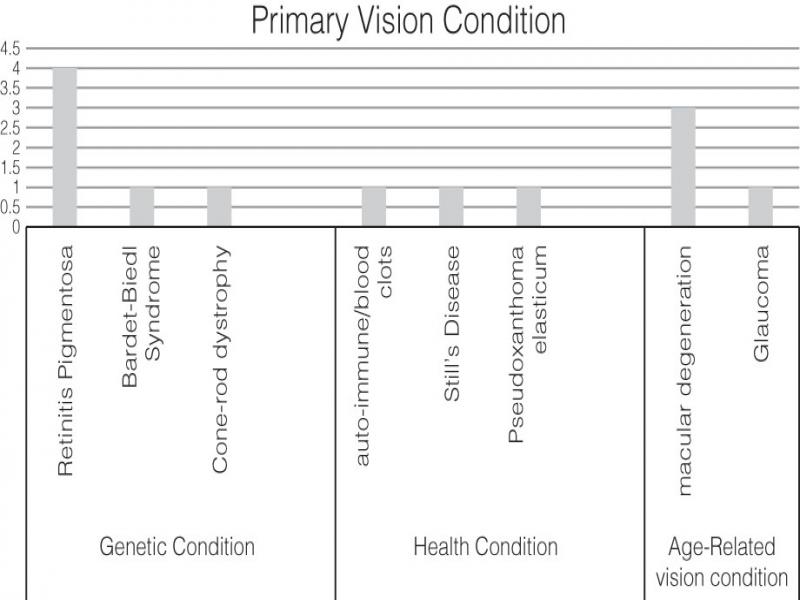
Figure 1
Participant-reported primary vision conditions.
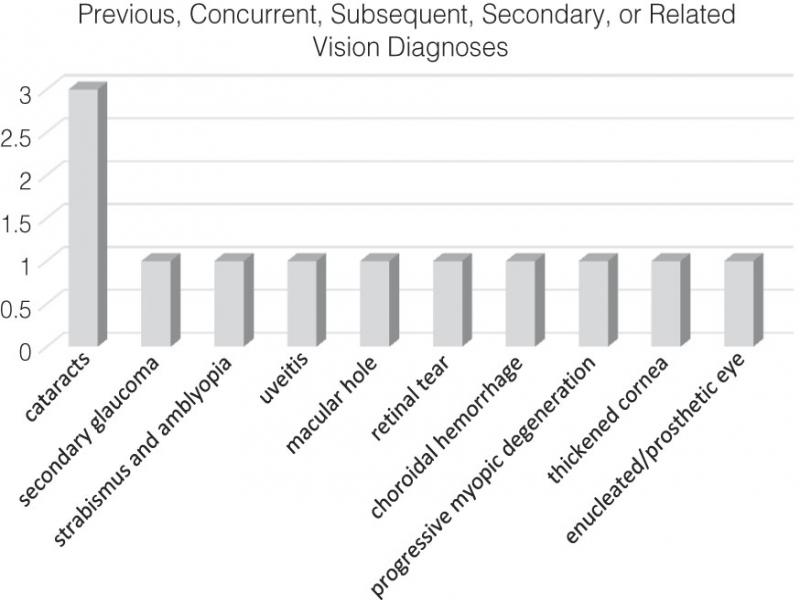
Figure 2
Participant-reported previous, concurrent, subsequent, secondary, or related vision diagnoses.
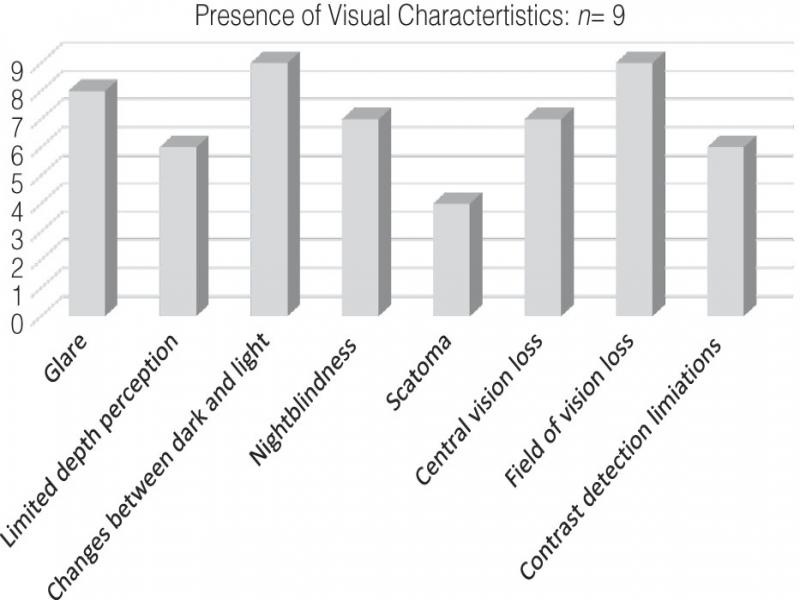
Figure 3
Visual characteristics present among the nine participants who reported functional vision.