
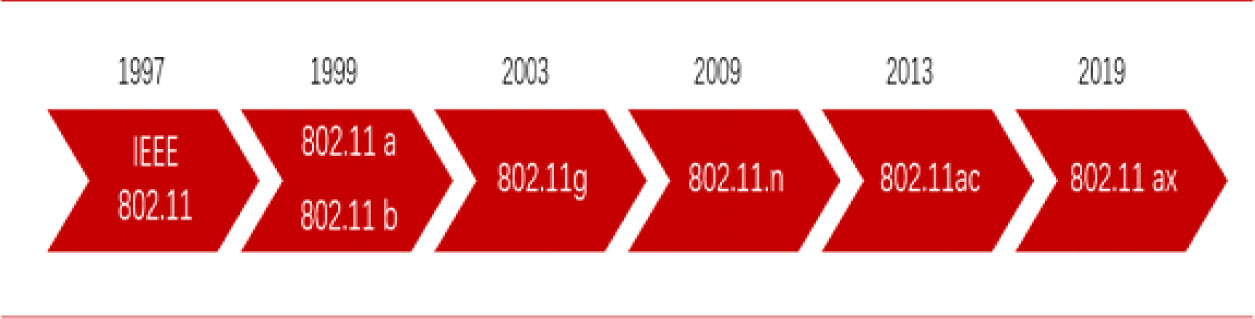
Figure 1
Important development history of 802.11 protocol
Table I
IEEE802.11 protocol of each generation
| Protocol Code | Frequency (Ghz) | Signal | Release Time | Performance Evolution |
|---|---|---|---|---|
| 802.11 | 2.4 | FHSS/DSSS | 1997 | It is one of the first generation wireless LAN standards |
| 802.11a | 5 | OFDM | 1999 | Teee802.11a provides higher speed in the whole coverage range, and the specified frequency point is 5GHz. At present, the frequency band is not used much, and there is less interference and signal contention. 802.11a also adopts CSMA / Ca protocol. However, in the physical layer, 802.11a adopts orthogonal frequency division multiplexing |
| 802.11b | 2.4 | HR-DSSS | 1999 | It can be used not only as a supplement to the wired network, but also as an independent network, so that network users can get rid of the constraints of network cables and realize real mobile applications. One of the key technologies of IEEE 802.11b is the use of compensation code keying CCK modulation technology, which can realize dynamic rate conversion. |
| 8002.11g | 2.4 | OFDM | 2003 | The mission is to give consideration to 802.11a and 802.11b and pave the road and bridge for the transition from 802.11b to 802.11a. The modulation modes specified in 802.11g include OFDM used in 802.11a and CCK used in 802.11b. By specifying two modulation modes, it not only achieves the data transmission speed of IEEE802.11a 54mbit / s with 2.4GHz frequency band, but also ensures the compatibility with IEEE 802.11b products. |
| 802.11n | 2.4/5 | OFDM | 2009 | The theoretical rate can be up to 600mbps. 802.11n can work in two frequency bands of 2.4GHz and 5GHz. |
| 802.11ac | 5 | OFDM | 2013 | 802.11ac is the successor of 802.11n. It adopts and extends the air interface concept derived from 802.11n, including wider RF bandwidth (up to 160MHz), more MIMO spatial streams (up to 8), multi-user MIMO and higher-order modulation (up to 256qam) |
| 802.11ax | 2.4/5 | OFDMA | 2019 | Orthogonal frequency division multiple access, multiuser multiple input multiple output, high-order modulation, target wake-up time |
Table II
Comparison of various specifications of Wi-Fi 4-Wi-Fi 6
| Wi-Fi 4 | Wi-Fi 5 | Wi-Fi 6 | ||
|---|---|---|---|---|
| Agreement | 802.11n | 205.11ac | 802.11ax | |
| Wave 1 | Wave 2 | |||
| Operating frequency band | 2.4/5GHz | 5GHz | 2.4/5GHz | |
| Maximum bandwidth | 40MHz | 80MHz | 160MHz | 160MHz |
| Maximum modulation | 64QAM | 256QAM | 1024QAM | |
| Single stream bandwidth | 150Mbps | 433Mbps | 867Mbps | 1201Mbps |
| Maximum spatial flow | 4X4 | 8X8 | 8X8 | |
| MU-MIMO | N/A | N/A | down | Up/down |
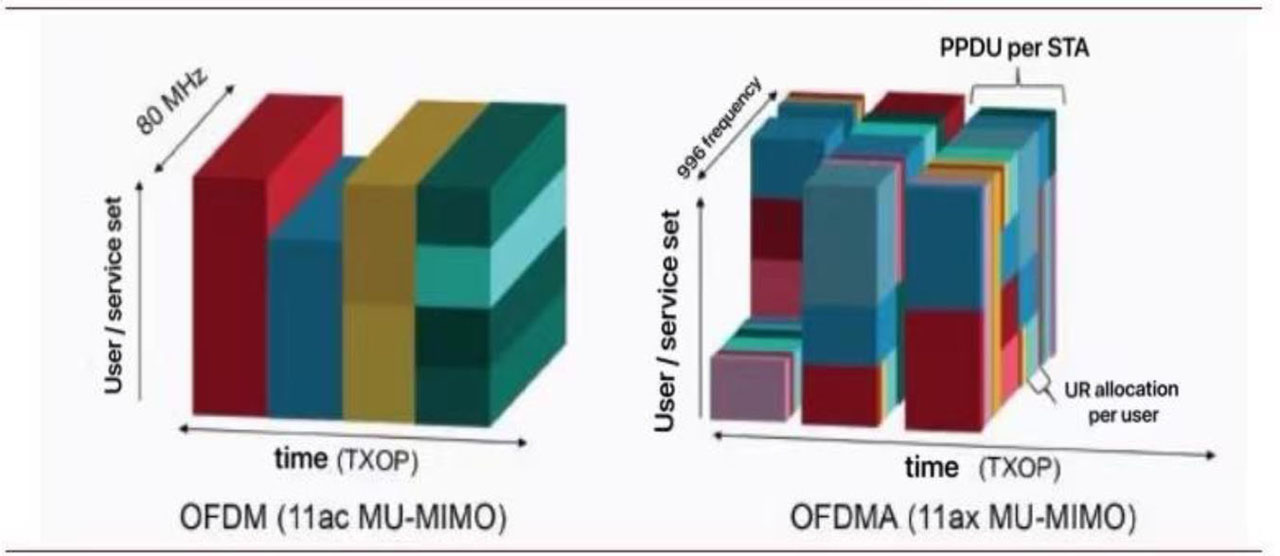
Figure 2
Comparison between OFDM and OFDMA
Table III
Comparison of OFDMA and MU-MIMO technologies
| OFDMA | MU-MOMO |
|---|---|
| Improve efficiency | Increase capacity |
| Reduce delay | Higher single user rate |
| Best for low bandwidth applications | Best for high bandwidth applications |
| Most suitable for small packet message transmission | Most suitable for large packet message transmission |
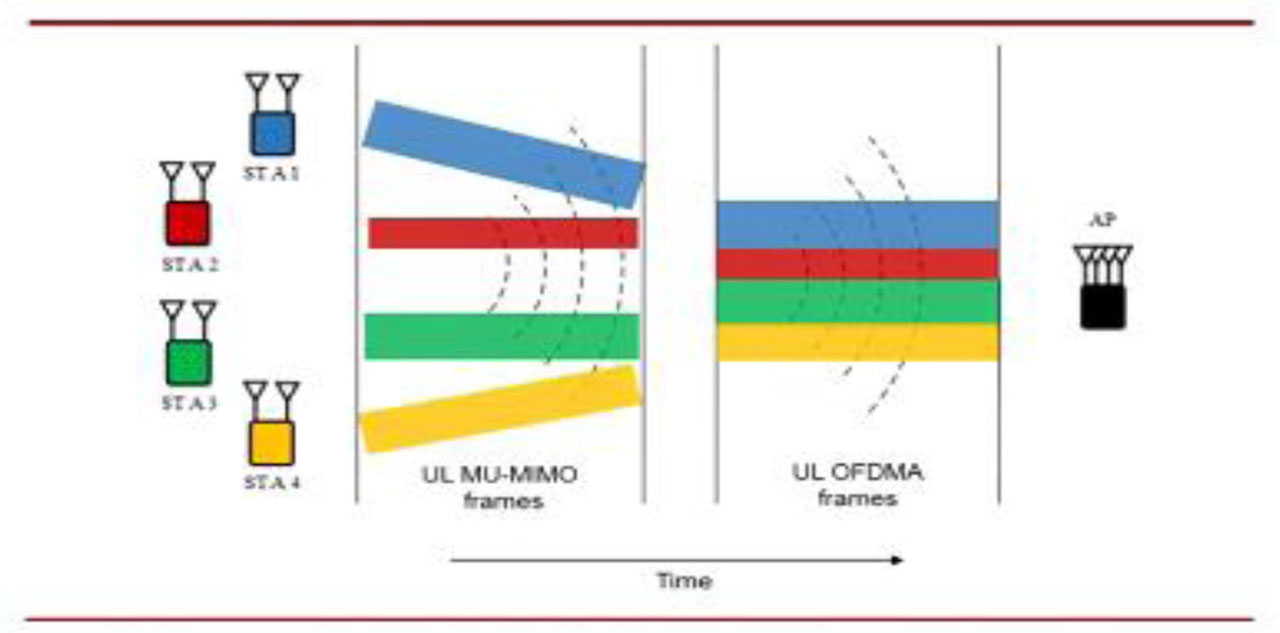
Figure 3
Multi user mode uplink scheduling sequence
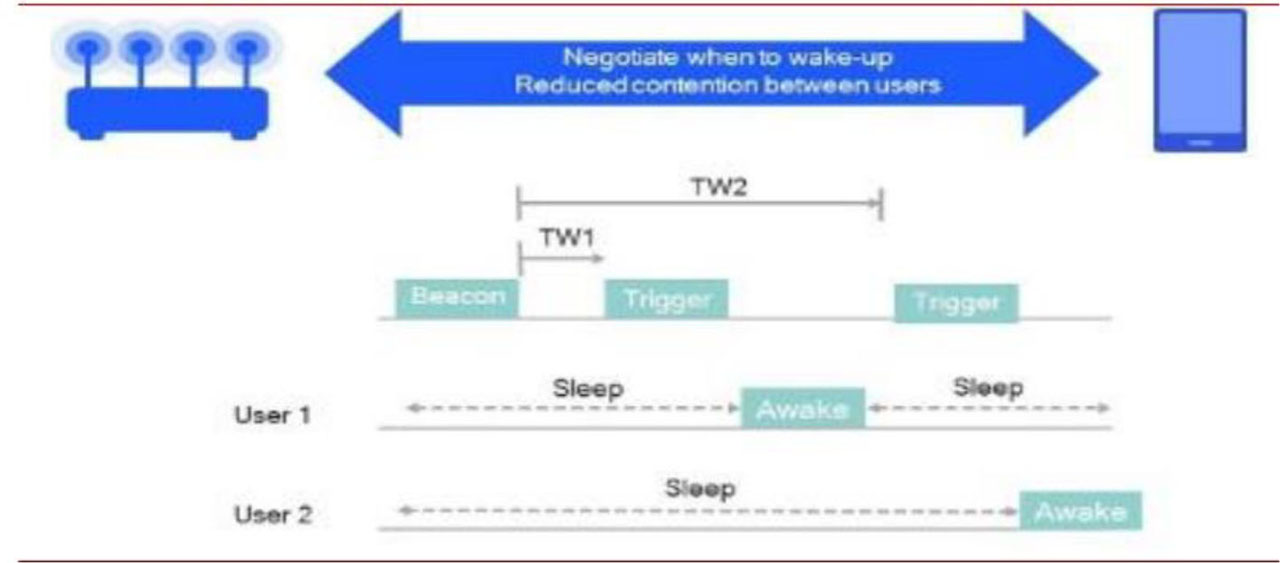
Figure 4
TWS Technology Exhibition
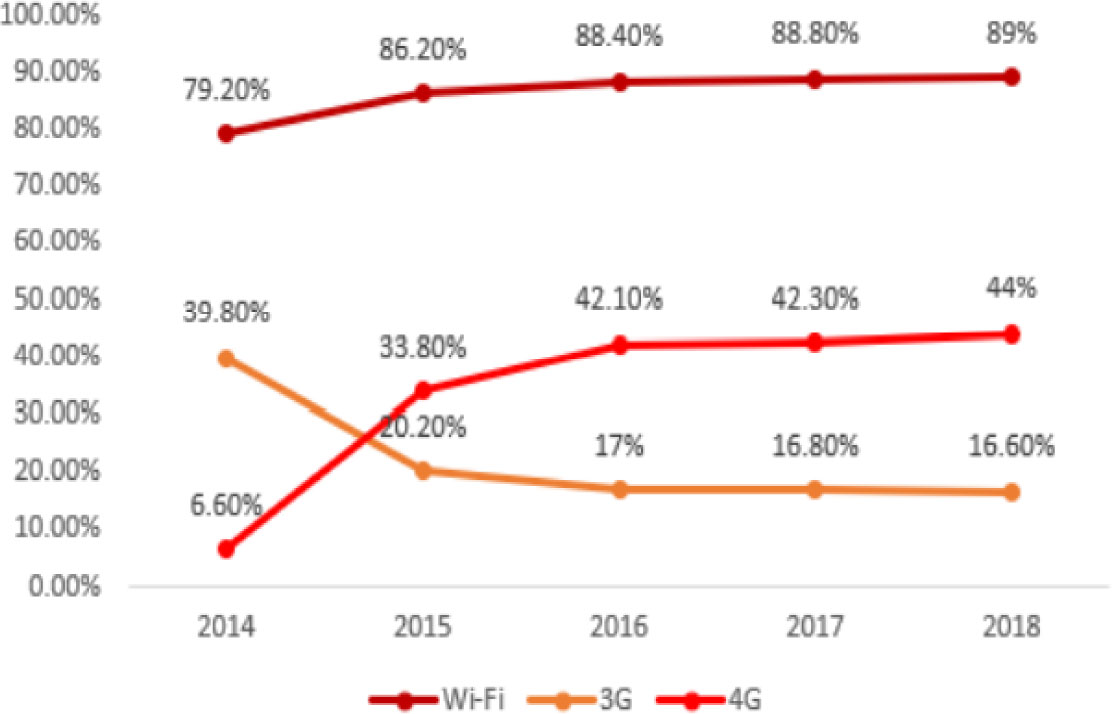
Figure 5
Penetration of mobile Internet users in different network environments;
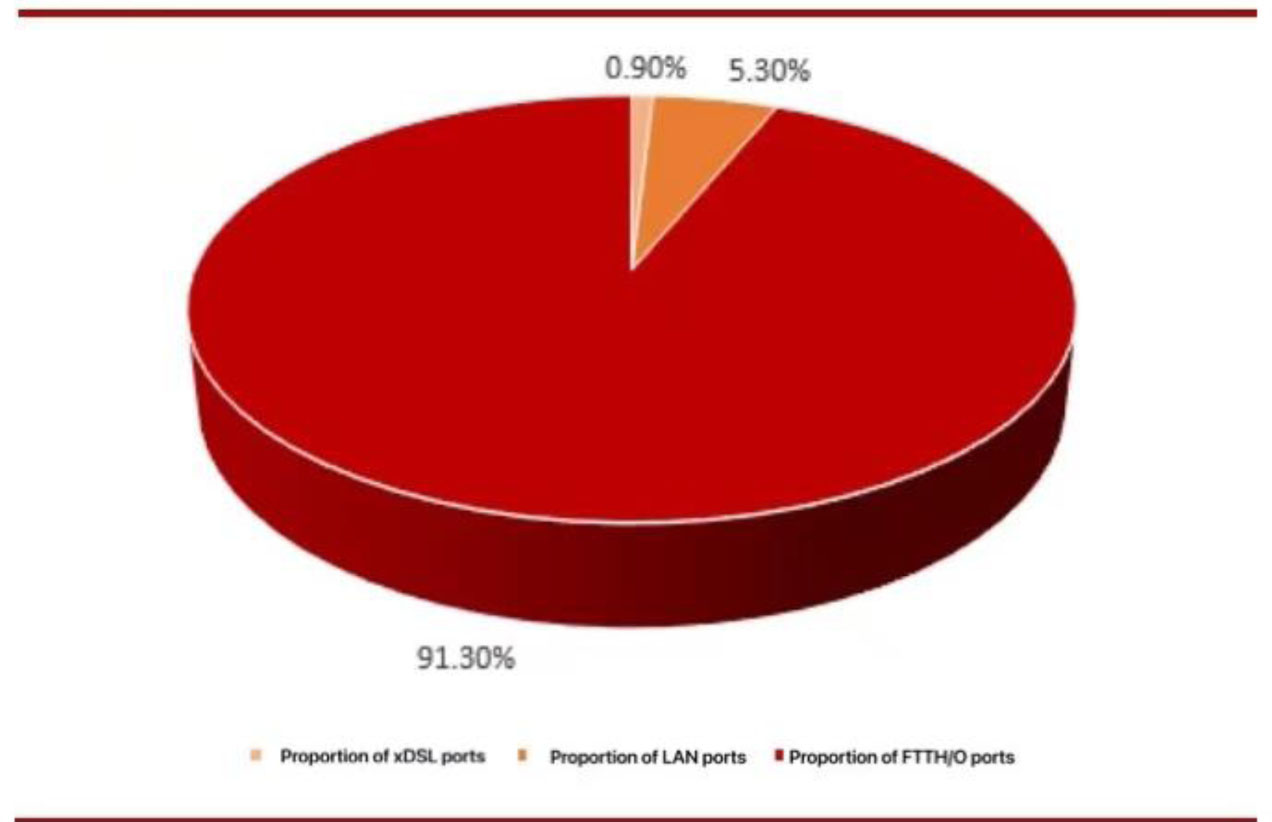
Figure 6
Proportion of Internet broadband access ports in China 2019
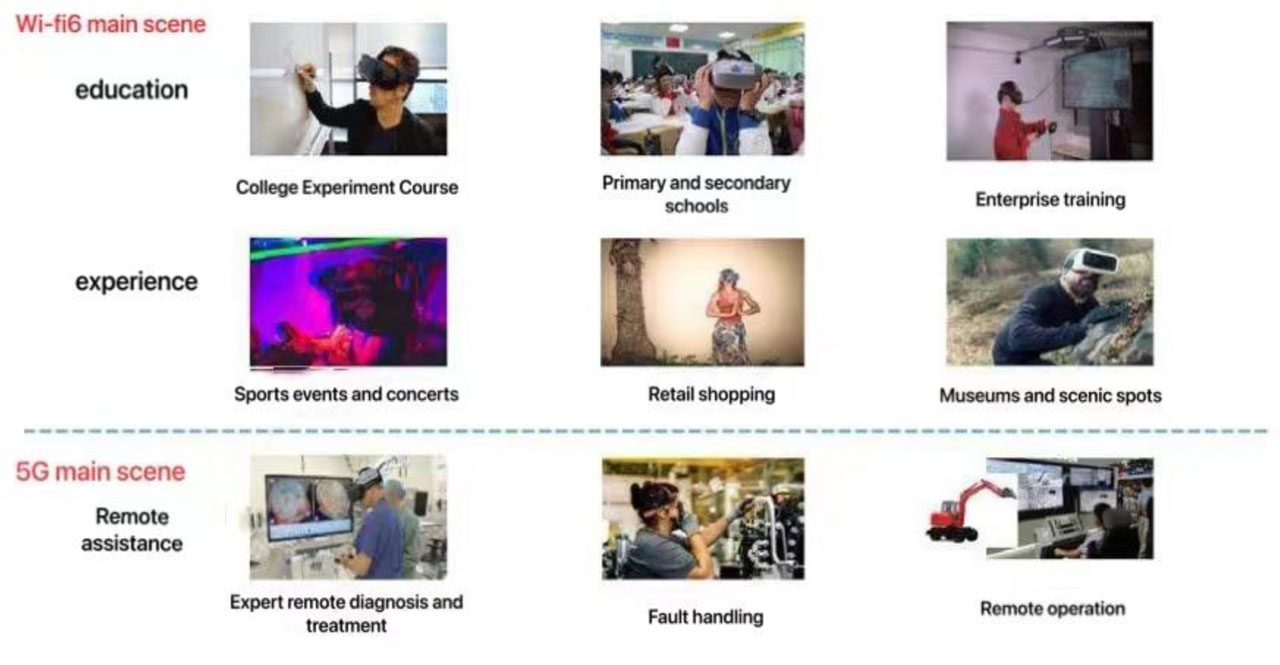
Figure 7
5G and Wi-Fi-6 usage scenarios
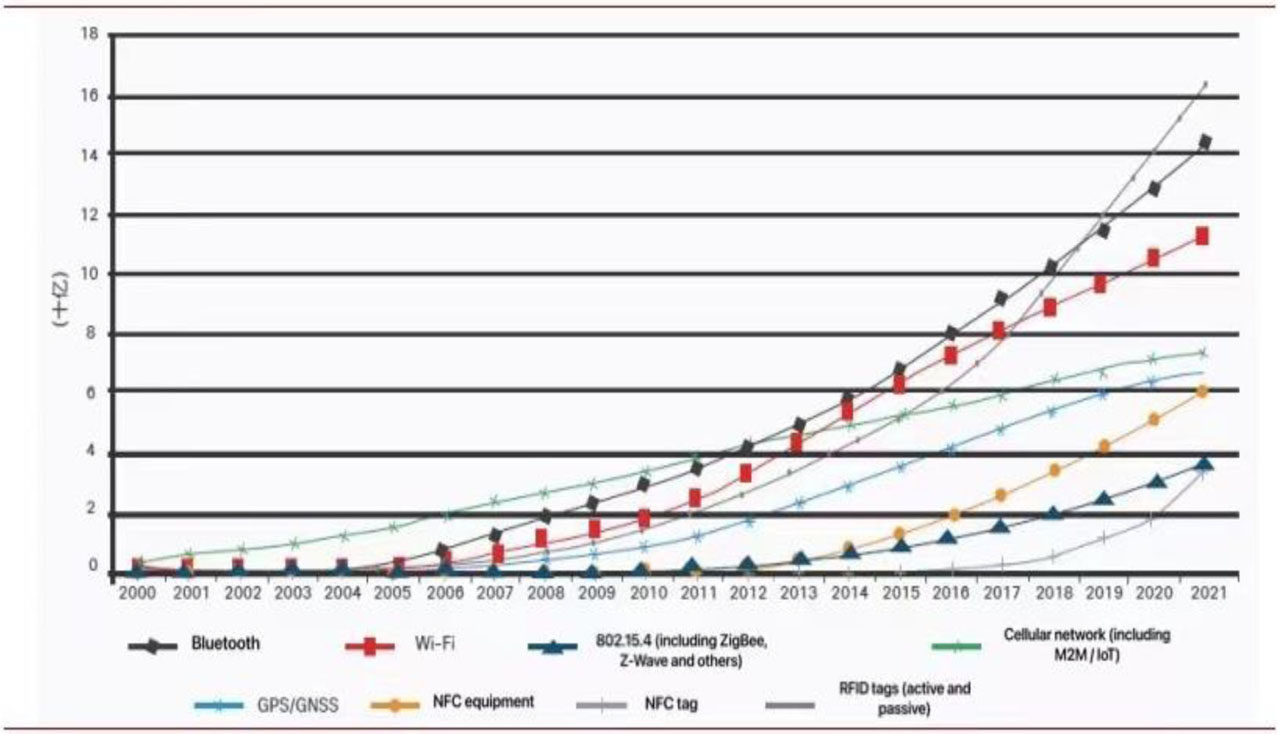
Figure 8
Internet of things trends
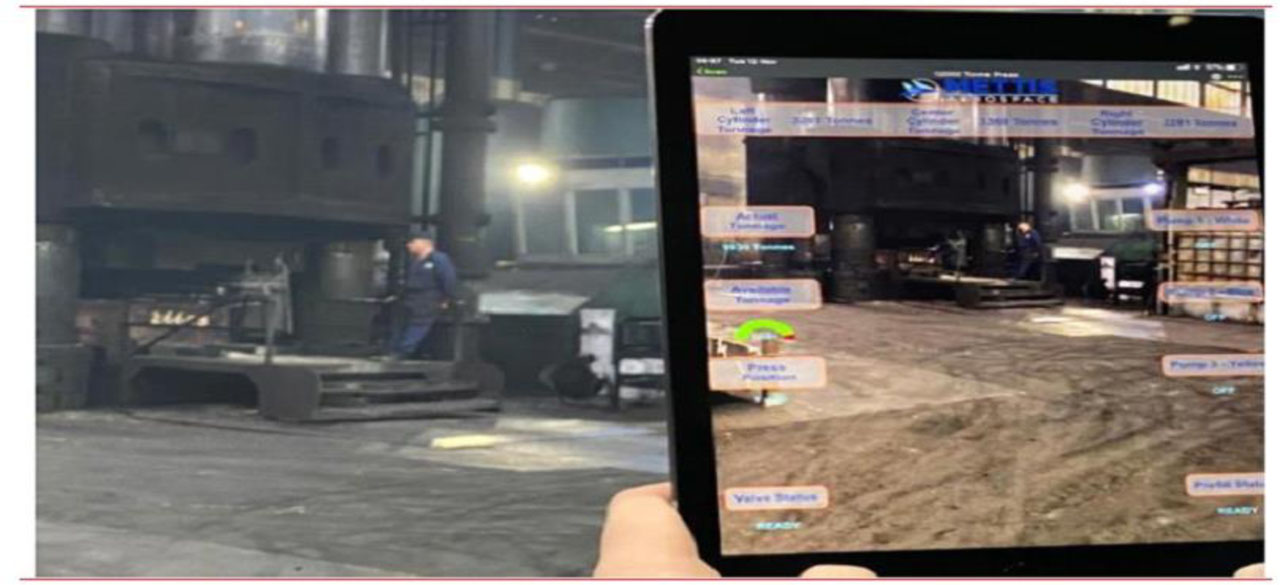
Figure 9
The use of wifi6 was tested in the factory
Table IV
Comparison of three Internet of things protocols
| Bluetooth | Wi-Fi | ZigBee | |
|---|---|---|---|
| Network organization | Dot communication network | Star Communication Network | Mesh communication network |
| Maximum transmission rate | 2 Mpbs | 300 Mpbs | 250Mpbs |
| Transmission range | 10–100m | 100–300m | 50–300m |
| Power consumption | low power consumption | High power consumption | secondary |
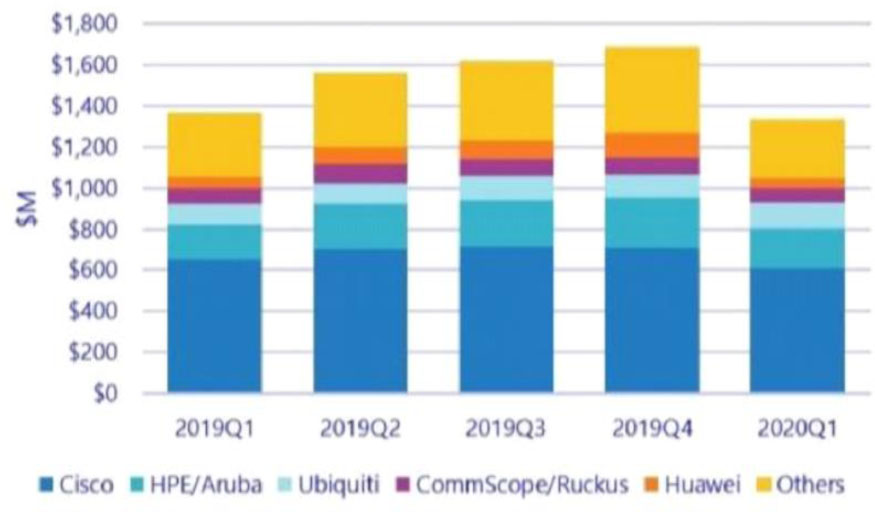
Figure 10
2019Q1–2020Q1 enterprise router market share
Table V
Q2 Tablet PC shipments in 2020
| Vender(company) | Q2 2020 Shipments | Q2 2020 Marker Share | Q2 2019 Shipments | Q2 2019 Marker Share | Annual Growth |
|---|---|---|---|---|---|
| Apple | 14,249,000 | 38.0% | 11,894,000 | 40.0% | 19.8% |
| Samsung | 7,024,000 | 18.7% | 5,048,000 | 17.0% | 39.2% |
| Huawei | 4,770,000 | 12.7% | 3,300,000 | 11.1% | 44.5% |
| Amazon | 3,164,000 | 8.4% | 2,308,000 | 7.8% | 37.1% |
| Lenovo | 2,810,000 | 7.5% | 1,838,000 | 6.2% | 52.9% |
| Others | 5,525,000 | 14.7% | 5,379,000 | 18.1% | 2.7% |
| Total | 37,542,000 | 100.0% | 29,767,000 | 100.0% | 26.1% |
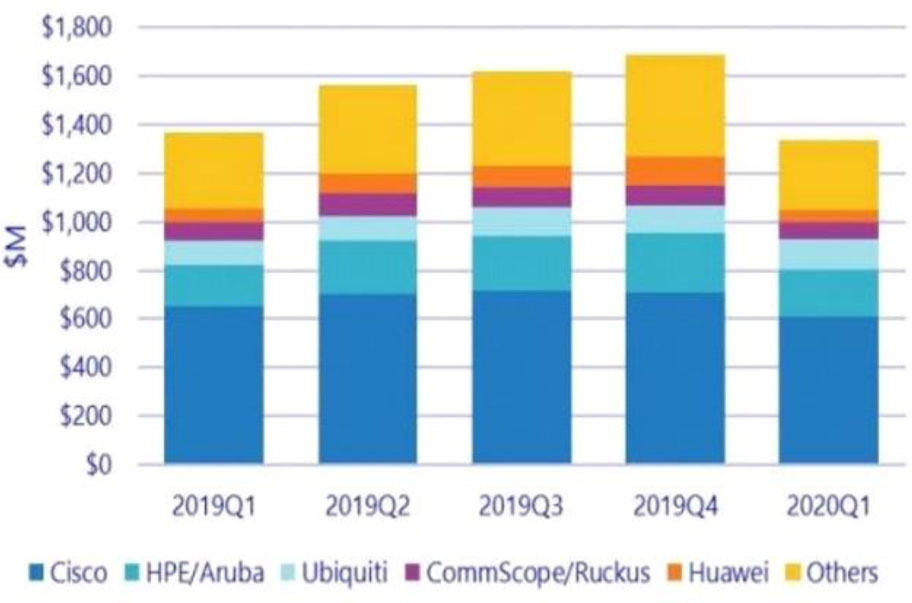
Figure 11
2019Q1–2020Q1 enterprise router market share
Table VI
Some WiFi 6 chip suppliers and their products
| Manufacturer | Model | Framework | Process Nm | Dominant Frequency | Representative Model |
|---|---|---|---|---|---|
| HiSilicon | Hi5651L | Cortex-A53 | 28 | Binuclear 1.2GHz | HuaweiAX3 |
| Hi5651T | Cortex-A53 | 28 | Tetranuclear 1.4GHz | HuaweiAX3 Pro | |
| MTK | MT7621DAT | MIPS32 1004Kc | 28 | Binuclear 880MHz | TL-XDR1860 |
| MT7622B | Cortex-A53 | 28 | Binuclear 1.35GHz | TL-XDR3230 | |
| Broadcom | BCM6750 | Cortex-A7 | 28 | Trinuclear 1.5GHz | ASUS AX3000 |
| BCM6755 | Cortex-A7 | 28 | Tetranuclear 1.5GHz | ASUS AX56U | |
| BCM4906 | Cortex-A53 | 28 | Binuclear 1.8GHz | ASUS AX92U | |
| BCM4908 | Cortex-A53 | 28 | Tetranuclear 1.8GHz | ASUS AX88U | |
| Qual comm | IPQ6000 | Cortex-A53 | 28 | Tetranuclear 1.2GHz | XIAOMI AX1800 |
| IPQ8071A | Cortex-A53 | 14 | Tetranuclear 1GHz | XIAOMI AX3600 | |
| IPQ8072A | Cortex-A53 | 14 | Tetranuclear 2GHz | ASUS AX89X | |
| IPQ8074(A) | Cortex-A53 | 14 | |||
| Intel | GRX350 | MIPS32 34Kc | 40 | Binuclear 800MHz | NETGEAR RAX40 |