I. Introduction
As the main means of transportation for travel, cars provide great convenience to our lives, but the problem of safe driving of cars on the road comes with it. According to the National Statistical Yearbook, a total of 247,646 road traffic accidents occurred nationwide in 2019, causing more than 310,000 casualties and property losses of 1,346.1 million yuan. In order to reduce the occurrence of such problems and improve driving safety, object detection technology has been gradually applied to the field of car assisted driving [1]. It can provide vehicles with the perception information of the surrounding environment and automatically detect road obstacles to improve the road. The purpose of driving safety.
In recent years, scholars at home and abroad have gradually applied deep learning technology to obstacle object detection [2]. Prabhakar [3] and others have developed a set of deep learning systems on assisted driving for the detection and classification of road obstacles such as vehicles, pedestrians, animals, etc., suitable for autonomous driving [4] cars driving on highways. Tang Bowen [5] and others used the YOLO v3 algorithm to complete the UAV obstacle detection. The speed is fast but the accuracy of identifying the position of the object is poor. Guo Jishun [6] and others introduced the dynamic residual network to solve the problem of deep network and poor generalization in object detection, which solved the degradation of deep neural network well, but did not completely solve the performance problem caused by network deepening. The detection speed and accuracy of the above methods need to be improved. In this paper, YOLO v4 [7] of the YOLO series is used for object detection. Compared with YOLO v3, this algorithm lowers the training threshold and uses a single GPU for training more effective. More importantly, it has a significant improvement in detection speed.
Although the yolo v4 algorithm is considerable in terms of accuracy and detection speed, it still has some shortcomings, such as the random initial clustering center of the anchor box a priori box generated by the Kmeans method, resulting in inaccurate clustering results; The too high coincidence of urban environment makes it difficult to predict coordinates, which leads to the low accuracy of the detection results.
In order to solve such problems, this paper proposes an improved YOLO V4 object detection algorithm. By improving the network structure of the algorithm, improving the Kmeans clustering and optimizing the coordinate prediction loss function, the improved algorithm is more suitable for object detection of road obstacles.
II. YOLO v4 algorithm principle
YOLO (YouOnlyLookOnce) [8] network is a kind of object detection algorithm based on regression. Its main idea is to divide the image into multiple grids, then use the depth neural network to judge whether the network has a object or not, and then predict the category and position of the object. The network structure of YOLO v4 is shown in Figure 1. Keeping the Head part of YOLO v3, the CSPDarknet53 module selected by the backbone network, introduces spatial pyramid pooling (SPP) as an additional module of the Neck part to expand the receptive field, and PANet’s path aggregation module is used as a part of the Neck. Among them, Darknet53 contains 5 residual blocks, and the number of small residual units contained in the residual blocks are 1, 2, 8, 8, and 4 respectively. CSPDarknet53 modifies Darknet53. Each large residual block is added with a CSPNet module and integrated into the feature map through gradient descent. Part of the feature map is convolved, and the other part is combined with the previous convolution result. CSP can improve the ability of convolutional neural networks to extract features and improve computational efficiency. PANet (Path Aggregation Network) makes full use of feature fusion. YOLO v4 also changes the fusion method from addition to multiplication, so that the network can get accurate detection results. YOLO v4 introduces Mosaic data augmentation and SAT for data enhancement, genetic algorithm selects hyperparameters, uses cross-small batch normalization, and uses DropBlock [9] regularization. They lowered the training threshold, allowing the model to get fast and accurate detection results under ordinary GPU conditions.
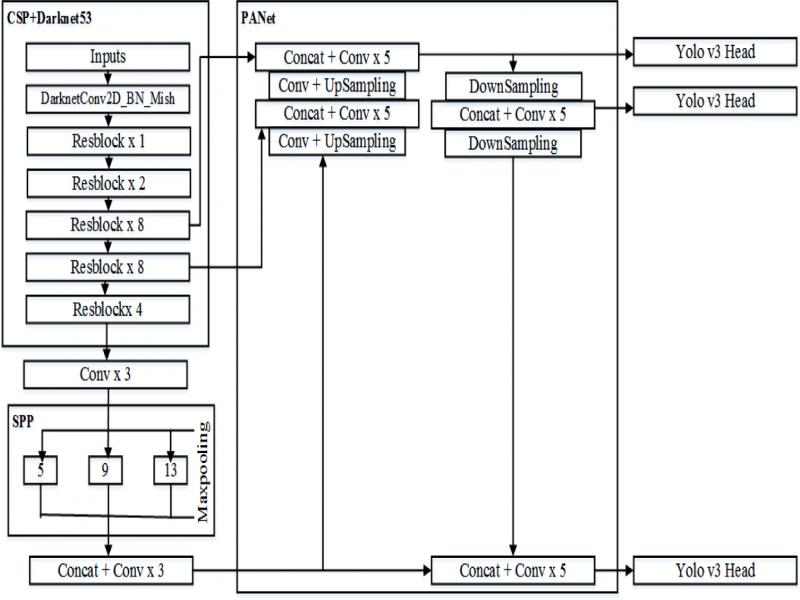
Figure 1.
Network structure of YOLO v4 algorithm
Although the YOLO v4 algorithm has excellent accuracy and detection speed, there are two problems:
1) The anchor box value (anchor box is a priori box) generated by the Kmeans method, random initial aggregation, the clustering result is not necessarily accurate due to the cluster center, thus affecting the accuracy of the detection result.
2) When the coincidence degree of the object is relatively high, a good coordinate prediction loss function is required to obtain the actual position of the object.
III. Improved YOLO v4 algorithm design
In response to the above problems, this article has improved the YOLO v4 algorithm. The main work includes:
1) Kmeans++ is selected for the generation of anchor box;
2) The coordinate prediction loss function uses CIoU.
A. Generate anchor box with Kmeans++
The YOLO v4 algorithm originally used the Kmeans clustering algorithm to generate the anchor box. Since the initial clustering center of the Kmeans algorithm is randomly selected, the classification results may not be accurate. The selection of the clustering center must be as far away as possible. Therefore, this paper uses the Kmeans++ clustering algorithm to analyze the data set and generate suitable anchor box values. The Kmeans++ algorithm ensures that the latest cluster center is as far away as possible from the previous center. In order to reduce the error caused by the size of the anchor box itself, Intersection over Union (IoU) is selected as the measurement standard, and the calculation formula is shown in formula (1). Among them, box is the object truth box, centroid is the obtained a priori box, and IoU (box, centroid) represents the intersection ratio of the a priori box and the truth box. It can be seen that the smaller the distance d, the larger the intersection ratio, the more the a priori box and the truth box overlap, and the better the clustering effect.
Based on the three output scales, three types of anchor boxes are set, and 9 types of anchor boxes are clustered in this paper. The anchor box values are (54, 56), (93, 89), (207, 161), (60, 109), (133, 125), (145, 257), (85, 167), (254, 188) and (293, 286).
B. Choose CIoU as the loss function of coordinate prediction
In object detection, the method for the model to evaluate the distance between the predicted frame and the true value frame usually adopts IoU, GIoU and DIoU. However, there are the following problems: IoU is a ratio, which is not sensitive to the size of the object, and cannot directly optimize the non-coincident range; GIoU can detect the non-coincident range but does not consider the center distance; DIOU considers the bounding box coincidence and center distance problems but does not Consider the scale ratio. In response to the above problems, this paper uses Complete Intersection over Union (CIoU) as the coordinate loss function, which takes into account the overlap area, center distance and scale ratio, so it can more reasonably evaluate the degree of overlap between the prediction box and the true value box.
CIoU adds an influence factor on the basis of the penalty item of DIoU, and considers the fitting degree of the aspect ratio of the predicted frame to the aspect ratio of the real frame as the consideration range, as shown in formula (2). Where υ is a parameter used to measure the consistency of the aspect ratio, α is the trade-off parameter, b represents the center of the prediction box, represents the center of the real box, p2() represents the square of the Euclidean distance, and c represents the minimum diagonal distance between the prediction box and the real box in the bounding box. The specific calculation methods of and are shown in formulas (2) and (4), and the loss function of CIoU is shown in formula (5).
CIoU has scale invariance. When the object frame overlaps and contains, the normalized distance between the predicted frame and the real frame is minimized, thereby speeding up the convergence speed, making the regression process more stable, and avoiding divergence problems during the training process.
IV. Experiment and result analysis
In this article the experiment is carried out under the Linux system, and the
The experiment in this article is carried out under the Linux system, and the experiment environment is shown in Table 1. In order to reduce the training time of the deep neural network model and increase the calculation speed, the Nvidia TITAN XP12G graphics card is used, and CUDA9.0 and cuDNN7.0 are configured to call the GPU for acceleration. The deep learning framework chosen is Tensorflow.
TABLE I.
Environment configuration
| Hardware environment | processor Graphics card | Intel(R) XEON W-2133 Nvidia TITAN XP 12G | ||||
|---|---|---|---|---|---|---|
| Software Environment | operating system | Ubuntu 16.04 | ||||
| Deep learning framework | Tensorflow-gpu | |||||
| Programming language | Python | |||||
| translater | Pycharm2019.1 |
| Parameter | Value | Parameter | Value | |||
|---|---|---|---|---|---|---|
| LEARN_RATE_INIT | 1e-4 | MOVING_AVE_DECAY | 0.9999 | |||
| LEARN_RATE_END | 1e-6 | STAGE_EPOCHS | 100 |
| AP(%) | Car | Bus | Person | Motorbike | Bicycle | mAP(%) |
|---|---|---|---|---|---|---|
| yolo v4 | 0.98 | 0.93 | 0.92 | 0.81 | 0.51 | 82.95 |
| Improved yolo v4 | 0.99 | 0.93 | 0.92 | 0.81 | 0.58 | 84.98 |