
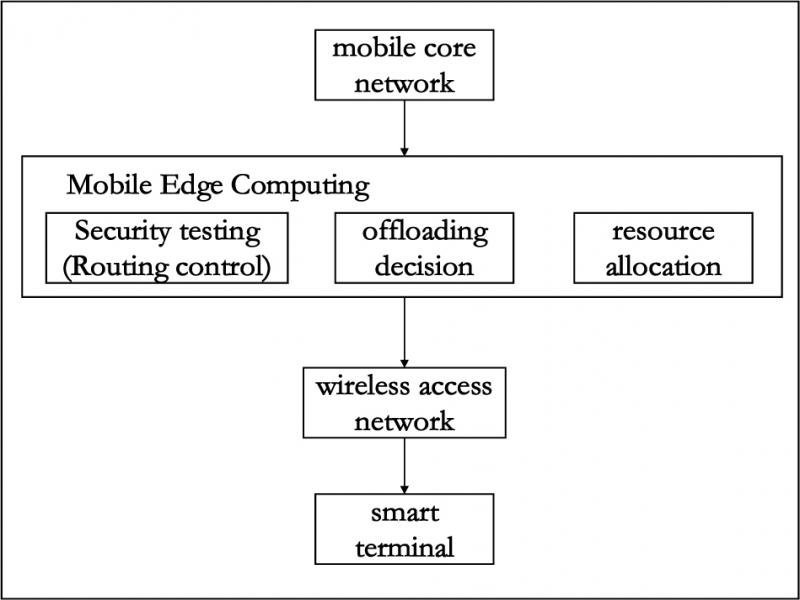
Figure 1.
Security-based mobile edge computing network architecture
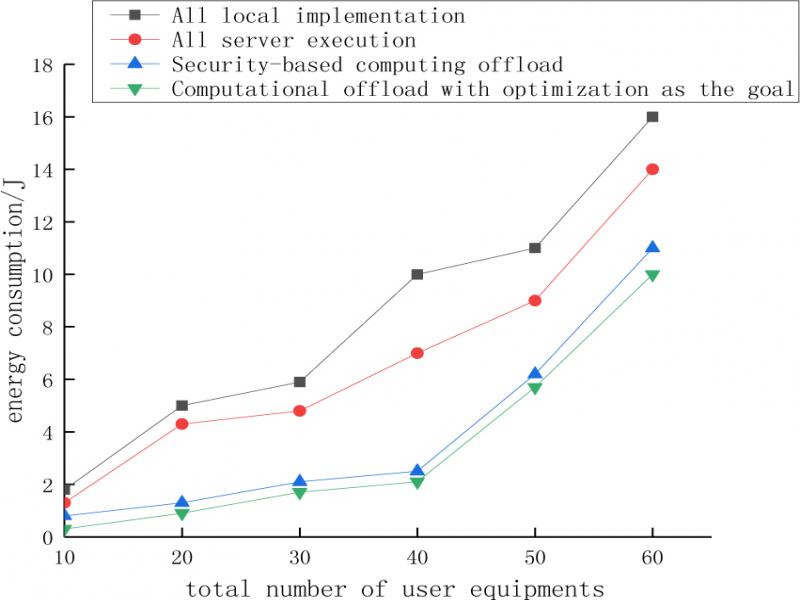
Figure 2.
Relationship between offloading delay and total number of user equipments in different ways
Algorithm 1:
A computational offloading algorithm based on MHQEA
| begin |
| The current iteration number t = 0, and the maximum iteration number is set to M |
| Initialize the offload decision matrix An(t) |
| Find the optimal solution matrix Pn(t) by observing the state of An(t) through the make subroutine |
| Correction of Pn(t) by reparation subroutine |
| Evaluate the total energy consumption of the system and find the optimal solution B(t) |
| while(t<M)do |
| begin |
| Number of current iterations t plus 1 |
| An(t-1) is observed by the make subalgorithm to determine the Pn(t) |
| Evaluate Pn(t) for the minimum total system energy consumption |
| Updating An(t) through the update subroutine |
| Find the optimal solution in Pn(t) and B(t-1) to b |
| if(Current number of iterations meets migration conditions)then Migration b to B(t) |
| end if |
| end |
| end |
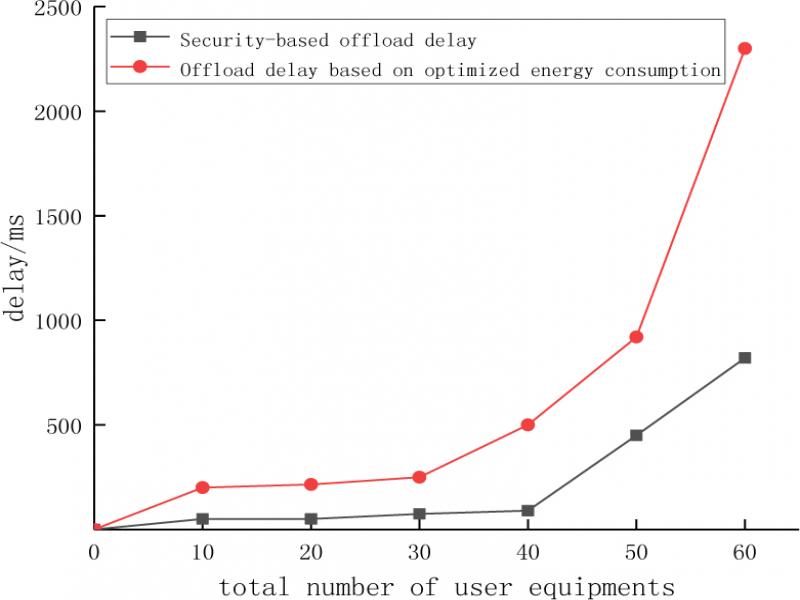
Figure 3.
Relationship between different ways of offloading energy consumption and total number of user equipments