
Table 1
Obesity-related community features included in network analysis.
| Variable identifier | Feature |
|---|---|
| C-1 | Violent crime per 100,000 population |
| C-2 | Crimes against person per 100,000 pop |
| C-3 | Crimes against property per 100,000 pop |
| F-1 | Grocery stores and supermarkets per square mile |
| F-2 | Gas stations and convenience stores per square mile |
| F-3 | Snack stores (donuts, pretzels, ice cream) per square mile |
| F-4 | All food establishments per square mile |
| F-5 | Fast food chain restaurants, count |
| F-6 | All retail food establishments per square mile |
| F-7 | All food service establishments per square mile |
| F-8 | Diversity of food establishments in 9 categories |
| F-9 | Limited service restaurants per capita |
| F-10 | Full service restaurants per capita |
| F-11 | Bars and taverns per capita |
| F-12 | Health food and gourmet stores per capita |
| F-13 | Fruit and vegetable stores and stalls per sqare mile |
| F-14 | Discount stores per square mile |
| L-1 | Average block length |
| L-2 | Household density |
| L-3 | Road intersection density |
| L-4 | Road segment length diversity |
| P-1 | Diversity of physical activity establishments in 6 categories |
| P-2 | Indoor recreational centers per square mile |
| P-3 | Outdoor recreational centers per square mile |
| P-4 | Public outdoor parks and recreational spaces per street mile |
| P-5 | All physical activity establishments per square mile |
| P-6 | Indoor fitness and recreational facilities per street miles |
| P-7 | Outdoor fitness & recreational facilities per capita |
| P-8 | Indoor recreational clubs and organizations per square mile |
| P-9 | Outdoor recreational clubs and organizations per square mile |
| T-1 | Vehicle miles traveled on main roads (total) |
| T-2 | Vehicle miles traveled on main roads per capita |
Table 2
Network modularity and average network degree in the overall network and by quartile of prevalence of childhood obesity.
| Quartiles of prevalence of childhood obesity | |||||
|---|---|---|---|---|---|
| Quartile 1 | Quartile 2 | Quartile 3 | Quartile 4 | Overall network | |
| Network modularity | 0.1891 | 0.2681 | 0.1181 | 0.0982 | 0.1496 |
| Average network degree | 0.3318 | 0.3533 | 0.3584 | 0.3623 | 0.3507 |
2 Note: Quartile 1 represents communities with the lowest prevalence of child overweight and obesity, and quartile 4 represents communities with the highest prevalence of child overweight and obesity. Higher modularity indicates a network with high within-module connectivity and low between-module connectivity. Average network degree is the mean of all pairwise correlations.
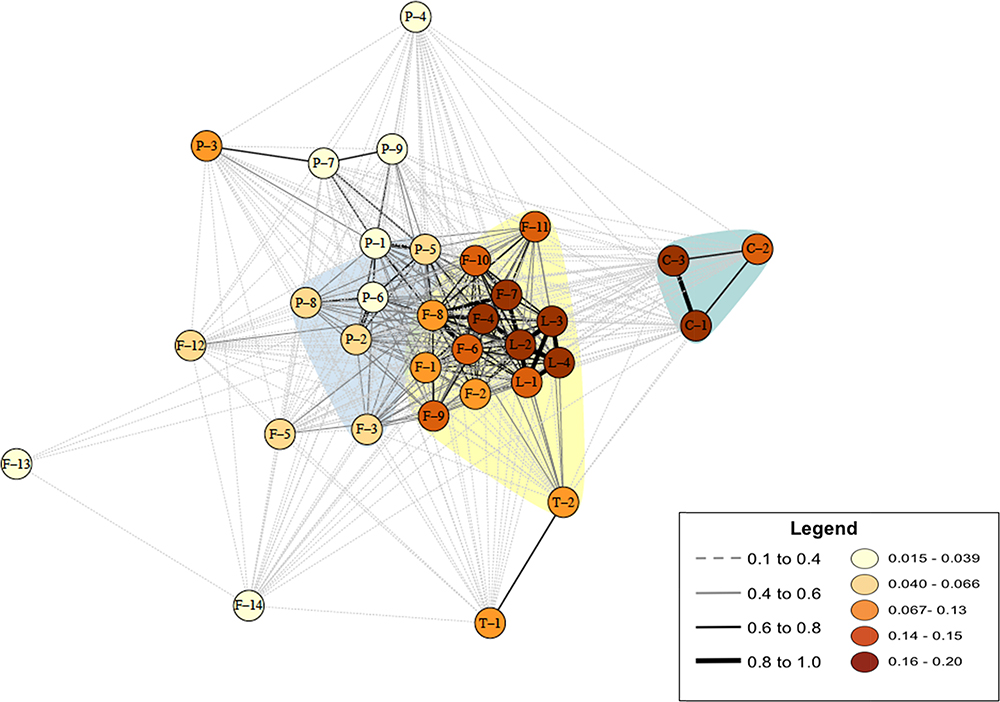
Fig. 1
Network graph for 1,288 communities in Pennsylvania. This shows a graph of the network of connections between attributes of communities in 1,288 communities in Pennsylvania. Each node in the network represents one feature of the communities, and the edges in the network are absolute values of Spearman correlation coefficients. The bivariate correlation between each variable and average body mass index (BMI) z-score is shown by the shading of each node, with darker colors representing stronger absolute correlation with average community BMI z-score. The strength of absolute correlation between two nodes is represented by the darkness and thickness of the lines connecting the variables. A thick, dark line may represent either a strong positive or a strong negative correlation. Modules of highly connected variables were created using the walktrap method.
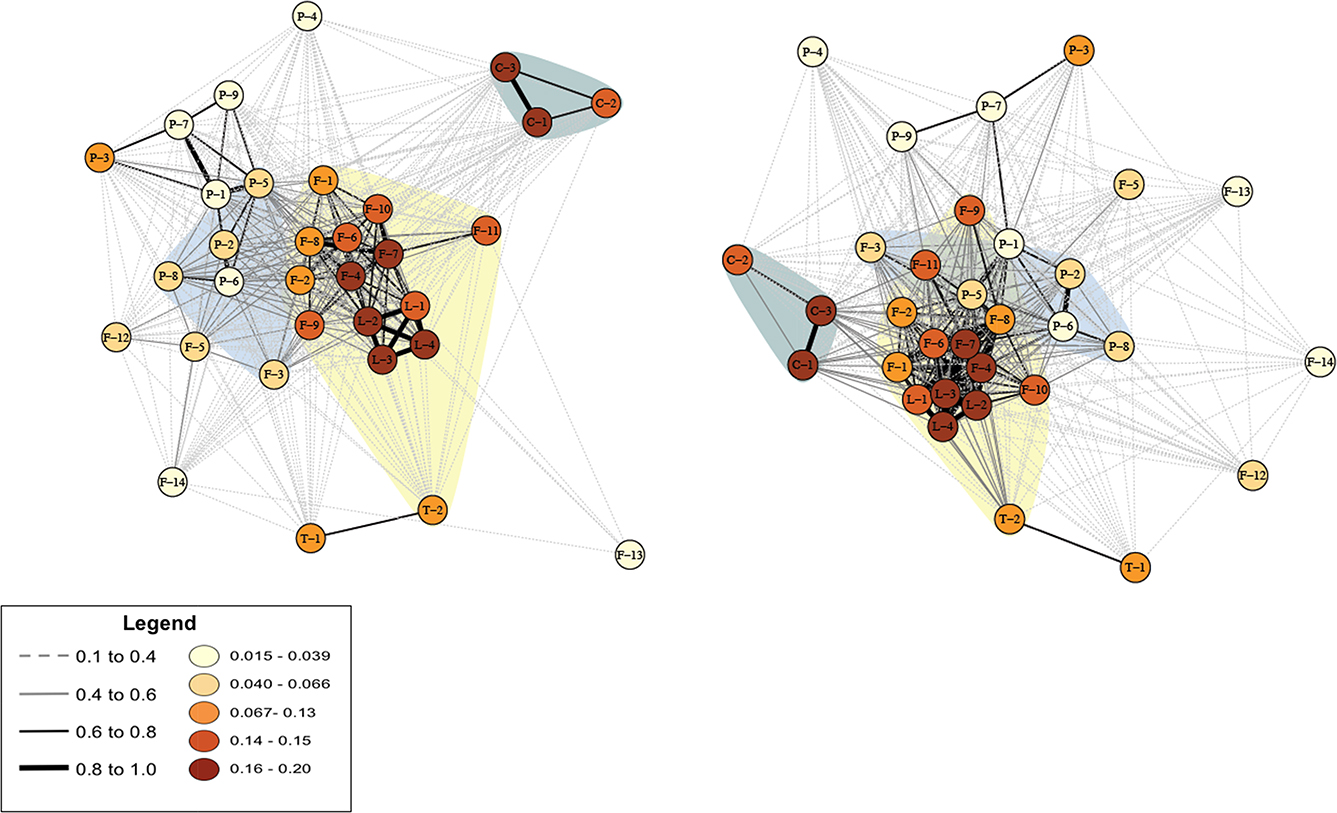
Fig. 2
Network graphs for 1288 communities in Pennsylvania, by quartile of percent of children at or above the 85th percentile of BMIz. In communities in the lowest quartile of percent of children who are overweight or obese (A: left), community features appear to be less tightly clustered, i.e., co-occur less often, than in communities in the highest quartile of community BMIz (B: right).
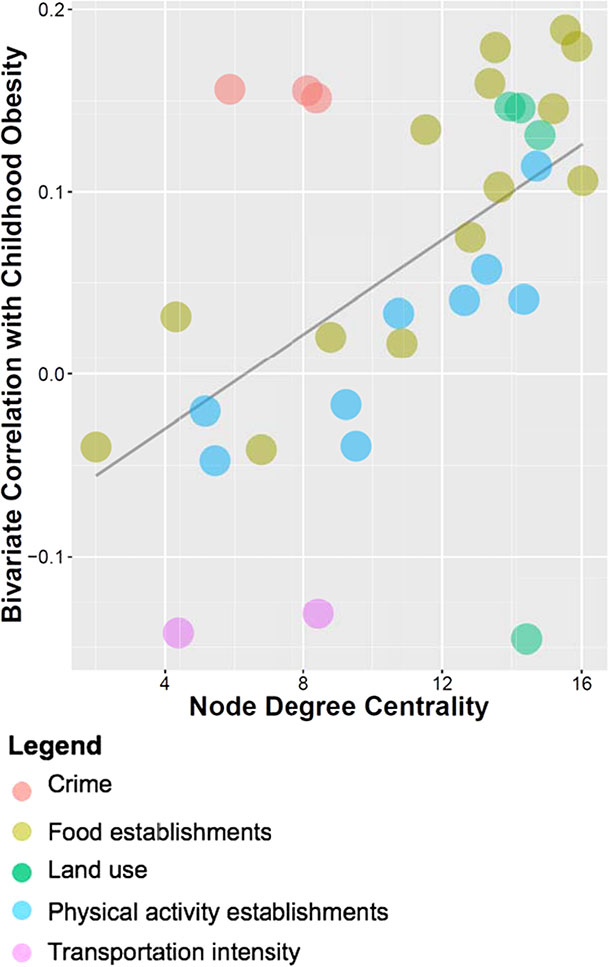
Fig. 3
Association of degree centrality of each community feature with prevalence of overweight and obesity among children. Correlation between community features and body mass index is stronger for more central variables of the obesity-related network features (R = 0.51).