
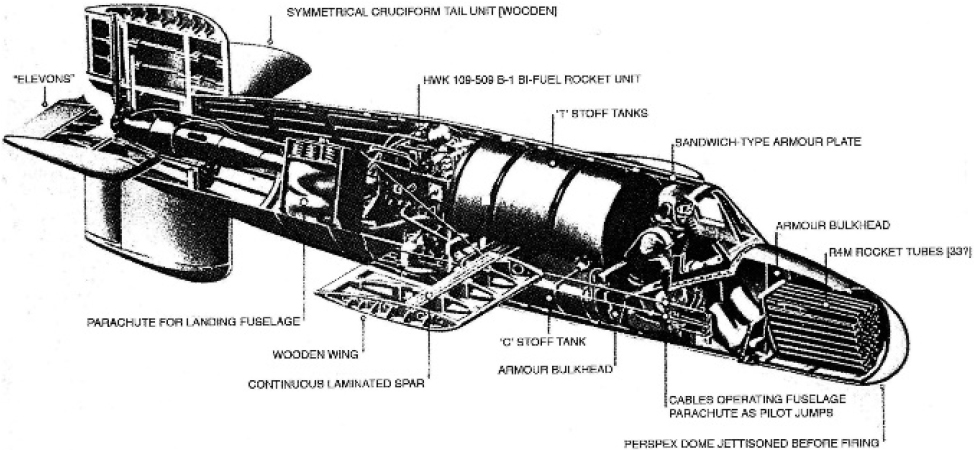
Figure 1.
Basic design of the Natter as revealed in a British Intelligence document in 1945. (G.E.F. Proctor, “BP 20B 'Natter”, British Technical Air Intelligence report 2345, 16 May 1945. Gooden, B. Natter. Manned Missile of the Third Reich. Historic step to human spaceflight. © Brett Gooden, 2019.
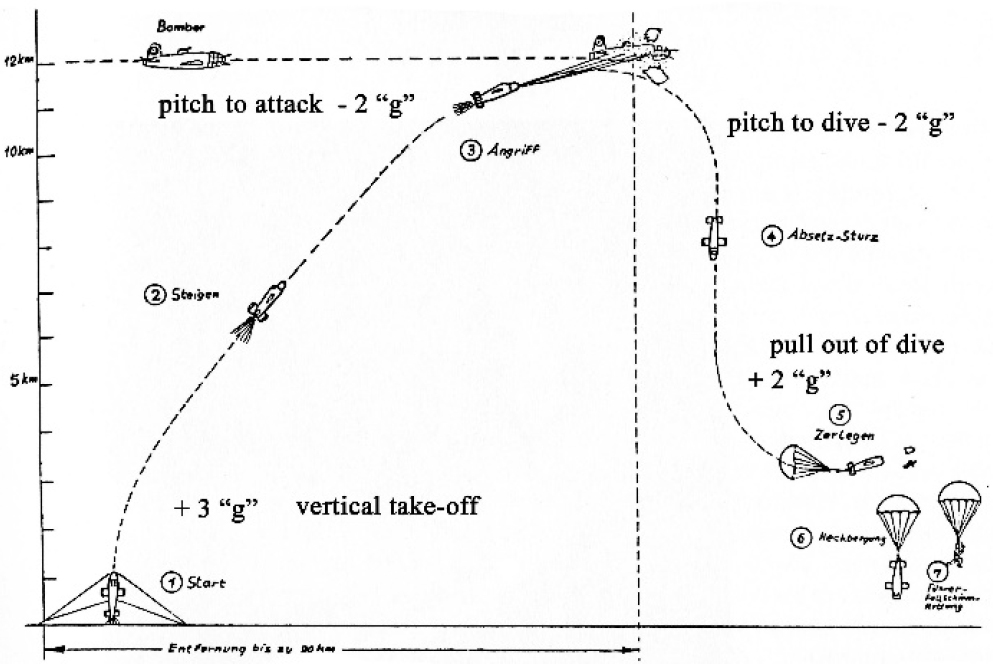
Figure 2.
Bachem-Werk schematic of the Natter mission profile with anticipated g loads appended by the author. Key to German text: 1. Start (Take-off); 2. Steigen (Ascent); 3. Angriff (Attack); 4. Absetz-Sturz (Disengage - Dive); 5. Zerlegen (Dismantle); 6. Heckbergung (Recovery of rear fuselage); 7. Führer-Fallschirm-Rettung (Pilot recovery by parachute). Bottom left: Entfernung bis zu 20 km (Range up to 20 kilometres). Bachem-Werk GmbH, Waldsee, Württemberg, “Projekt Natter” report, 20 September 1944. Gooden, B. Natter. Manned Missile of the Third Reich. Historic step to human spaceflight. © Brett Gooden, 2019.
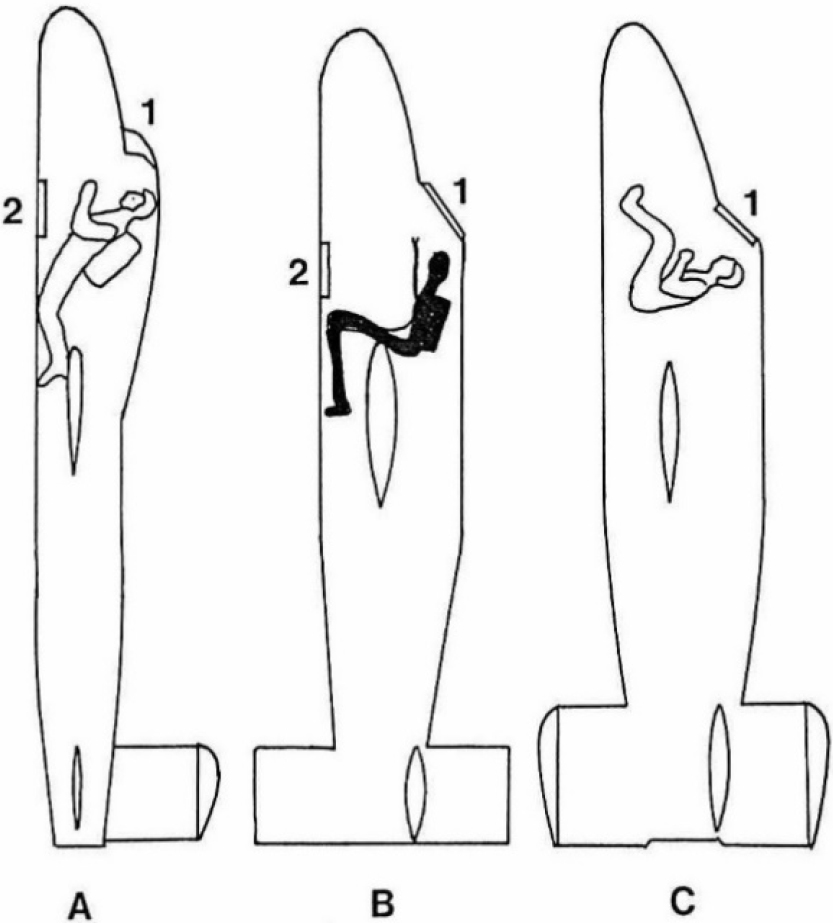
Figure 3.
Evolution of the supine pilot position at launch of Natter. Key to legend: A. Early design with prone position of pilot. 1. Windshield, 2. Belly window for viewing horizon during the boost and ascent stages of flight; B. Intermediate design with crouching pilot; C. Final design with supine pilot. Gooden, B. Natter. Manned Missile of the Third Reich. Historic step to human spaceflight. © Brett Gooden, 2019)
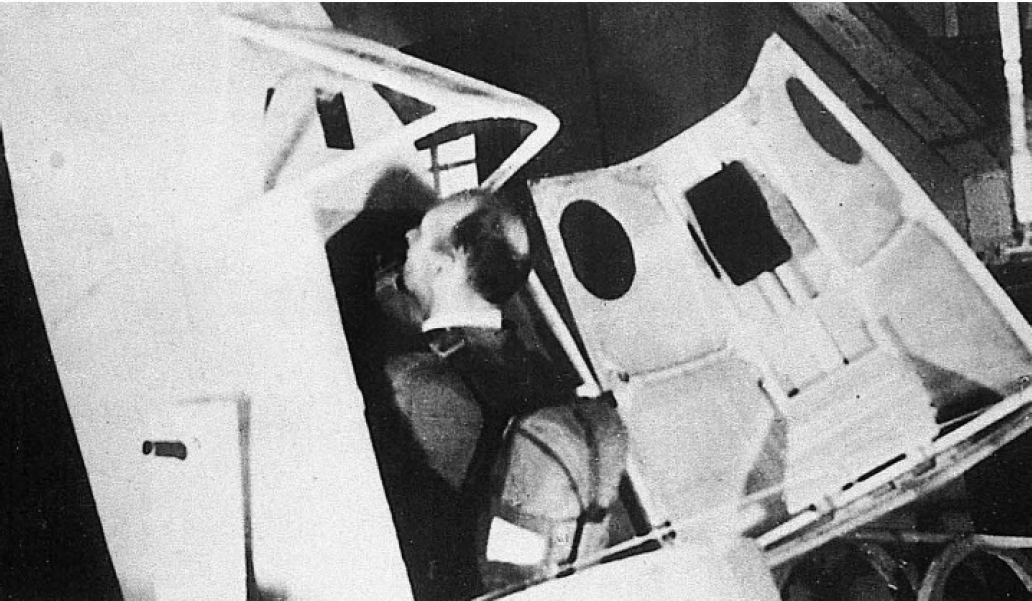
Figure 4.
The tilting seat mock-up designed to study pilot position. The fuselage is at an angle of approximately 70 degrees from the horizontal allowing the pilot to view the horizon through a belly window during the climb to altitude. Bachem-Werk GmbH, Waldsee, Württemberg, “Projekt Natter” report, November 1944. Gooden, B. Natter. Manned Missile of the Third Reich. Historic step to human spaceflight. © Brett Gooden, 2019.
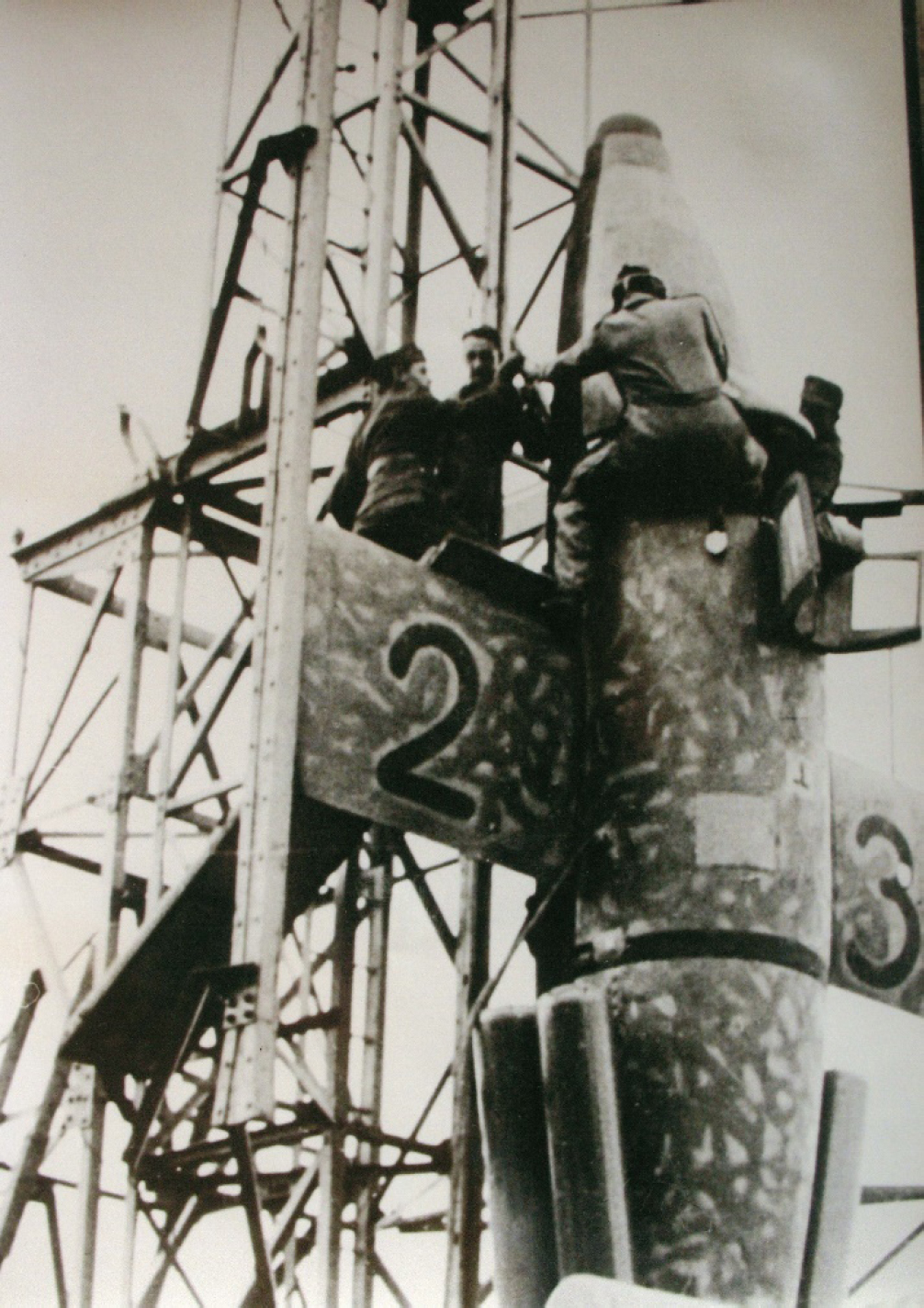
Figure 5.
Lothar Sieber enters the cockpit of M23 on 1 March 1945. Note the head cushion mounted on the underside of the open cockpit canopy. On that day he became the first human to be launched vertically off the ground by rocket power. Captured German photograph. Gooden, B. Natter. Manned Missile of the Third Reich. Historic step to human spaceflight. © Brett Gooden, 2019.
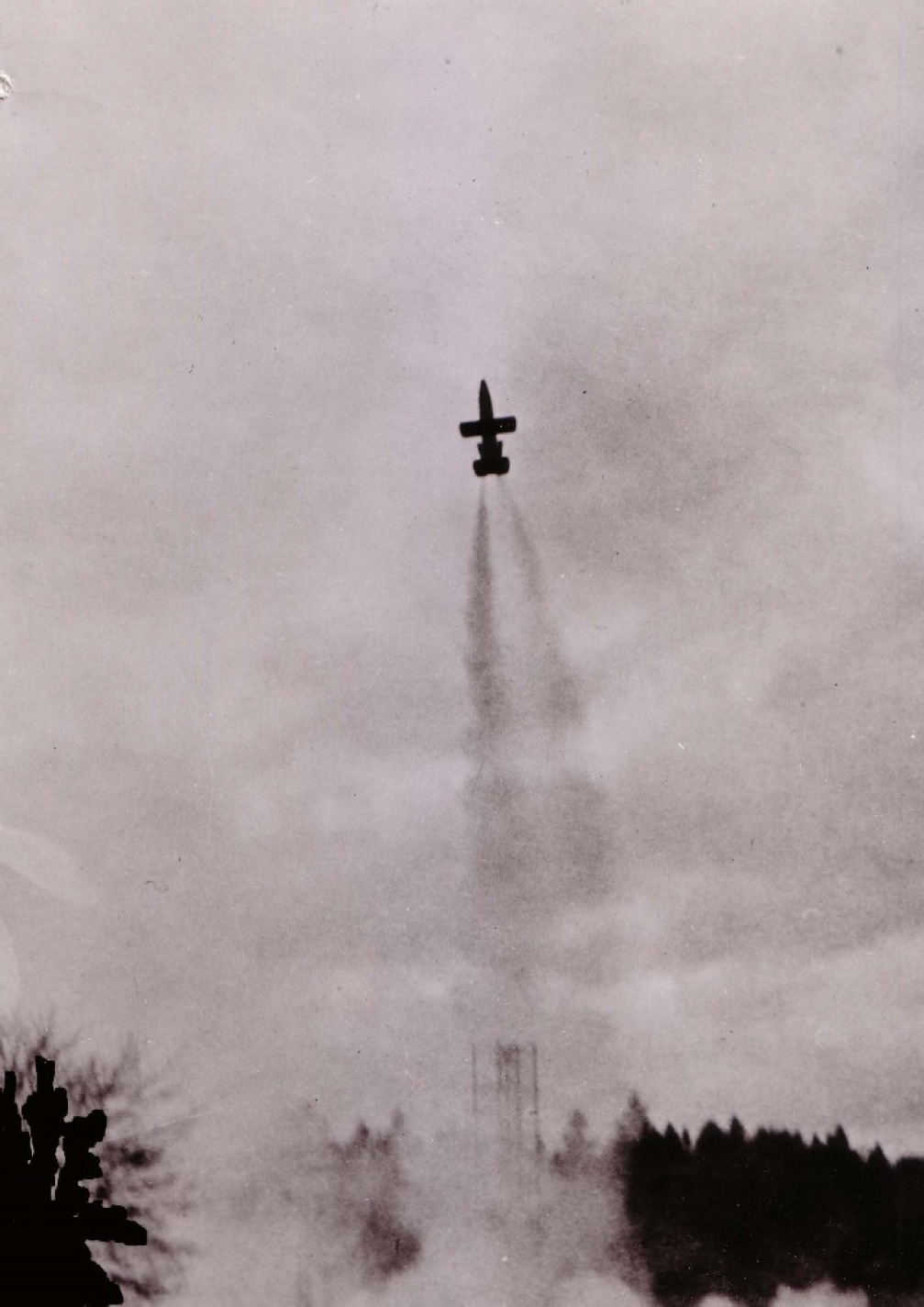
Figure 6.
M23 rises vertically above the launch tower leaving behind a cloud of steam and smoke. The two dark exhaust trails come from the four solid propellant boosters. The white trail between them is the exhaust from the Walter liquid propulsion motor. All seems well at this time. Captured German photograph. Gooden, B. Natter. Manned Missile of the Third Reich. Historic step to human spaceflight. © Brett Gooden, 2019.
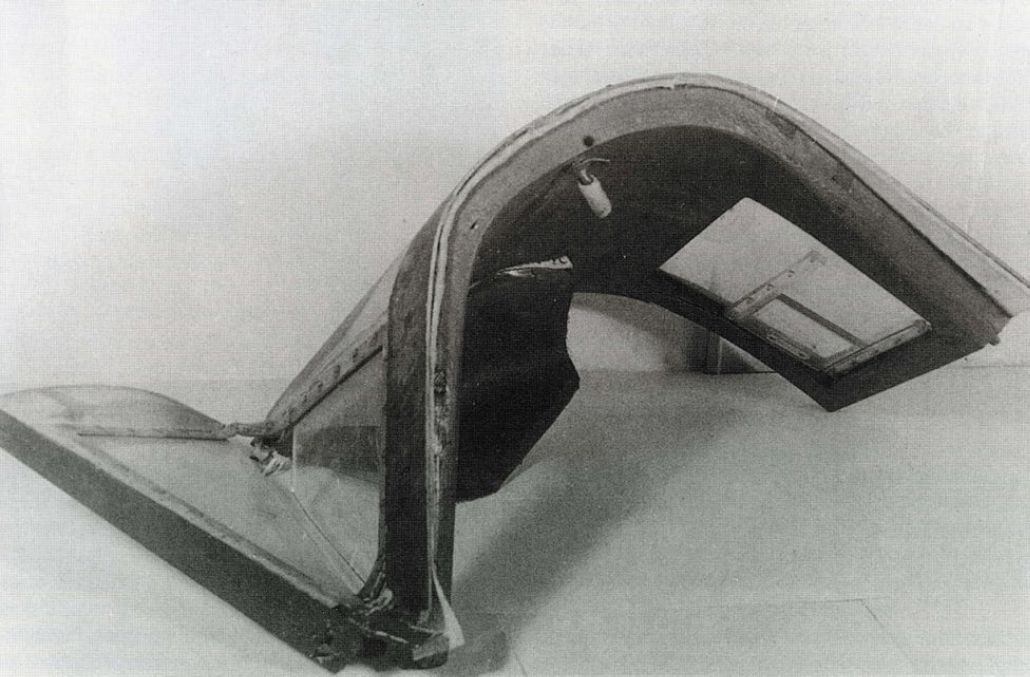
Figure 7.
The canopy of M23 which fell close to Willy Fiedler, one of the chief engineers on the Natter project, shortly after M23 disappeared into the cloud cover. The front edge of the canopy faces forwards. Top centre is the locking latch with its white handle. Note that the tongue of the latch is bent downwards. The bent starboard window is fractured diagonally. The port window is intact with its sliding ventilation window closed. The head cushion can be seen still attached on the rear underside of the canopy. Captured German photograph. Gooden, B. Natter. Manned Missile of the Third Reich. Historic step to human spaceflight. © Brett Gooden, 2019.
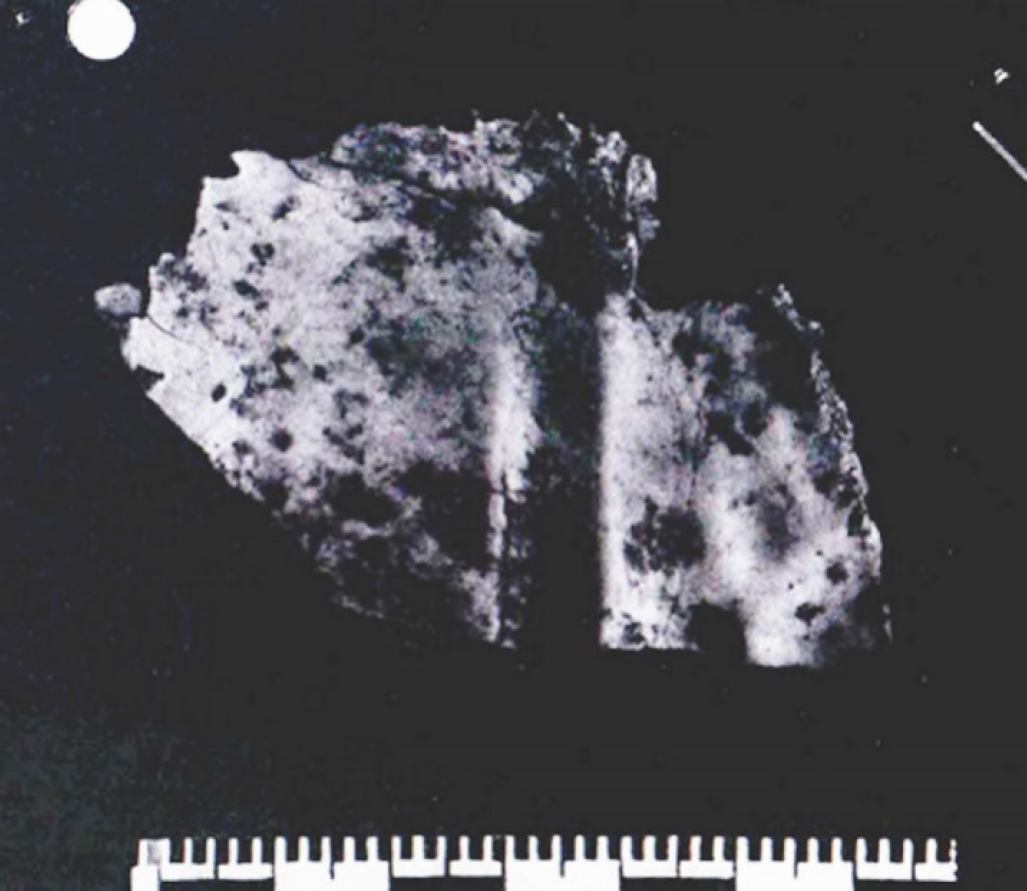
Figure 8.
A skull fragment, found near the crash site of M23 by a bush walker some years after the accident, was assessed by a police forensic pathologist and is believed to have belonged to Lothar Sieber. A 14 centimetre long calibration is at the bottom of the frame. (X-ray from Pathology Report, 27-3-1983, Tübingen courtesy of Lieutenant Marcus Klotz via of Oliver Gortat. Gooden, B. Natter. Manned Missile of the Third Reich. Historic step to human spaceflight. © Brett Gooden, 2019.
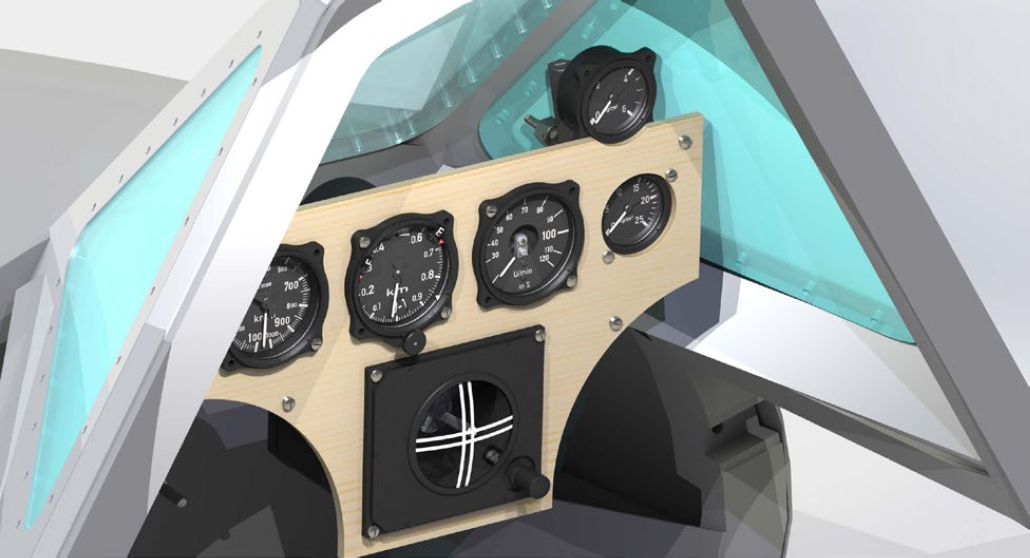
Figure 9.
Reconstruction of the instrument panel of M23. From left to right: Air speed indicator; altimeter; Walter motor propellant pump turbine speed; high range combustion chamber pressure gauge. On the right top edge of the panel is the low range combustion pressure gauge. Bottom middle is the Sichtgerät, the visual display unit, which was a gyroscopically stabilised device. A white dot painted on the end of a rod attached to the gyroscope’s frame indicated pitch (vertical lines on the window of device) and yaw movements (horizontal lines on the window of the device). Graphic supplied courtesy of Stefan Moosburg. Gooden, B. Natter. Manned Missile of the Third Reich. Historic step to human spaceflight. © Brett Gooden, 2019.
Table 1:
Predicted physiological stresses on a Natter pilot during a mission
| Stress | Effect on body function | Impaired pilot function |
|---|---|---|
| A. Stresses of take off | ||
| Noise | Overloads hearing function, acute earache | Impairs ability to communicate |
| Vibration | Shakes head and eyes | Impairs ability to read instruments |
| Fumes, dust and debris | Induces tearing of eyes Irritates lungs | Impairs reading of instruments Impairs breathing |
| g force – traverse g | Increases weight of limbs and torso | Impairs ability to operate controls |
| B. Stresses of ascent | ||
| Reduced air pressure | Expands gas in air-filled spaces causing acute pain in bowel – altitude meteorism and in middle ear – barotitis media | Impairs concentration and ability to continue mission |
| Joint pain; chest pain – decompression sickness | Unlikely to occur on such a short flight | |
| Reduced oxygen pressure | Decrease in brain oxygen – confusion; loss of consciousness – hypoxia | Impairs concentration and ability to continue mission |
| g force – negative g | Blood distends head blood vessels; impairs head circulation – “red out”; confusion | Impairs ability to read instruments and ability to continue mission |
| C. Stresses of high-altitude emergency escape | ||
| Wind blast | Airstream ram pressure on face tears off oxygen mask – hypoxia Lung and facial trauma | Impairs vision and ability to land safely |
| Cold air | Loss of body heat with frostbite – hypothermia; confusion | Impairs ability to use hands and to land safely |
| D. Stress of pull-out from drive | ||
| g force – positive g | Blood moves toward lower body; brain hypoxia – “grey out”; confusion | Impairs vision and ability to continue the mission |
Table 2
Lessons learned from the world’s first human vertical rocket flight.
| 1. | Launch and boost phase stresses on a VTO rocket pilot are multiple, rapid in onset and potentially overwhelming. |
|---|---|
| 2. | A pilot cannot be relied upon to manually control a rocket’s flight path during the powered ascent. |
| 3. | Flight control by autopilot is essential for reliable and precise powered flight of the rocket. |
| 4. | The pilot should be provided with the facility to monitor the powered flight path and autopilot function and to be able to take over control in the case of autopilot failure. |
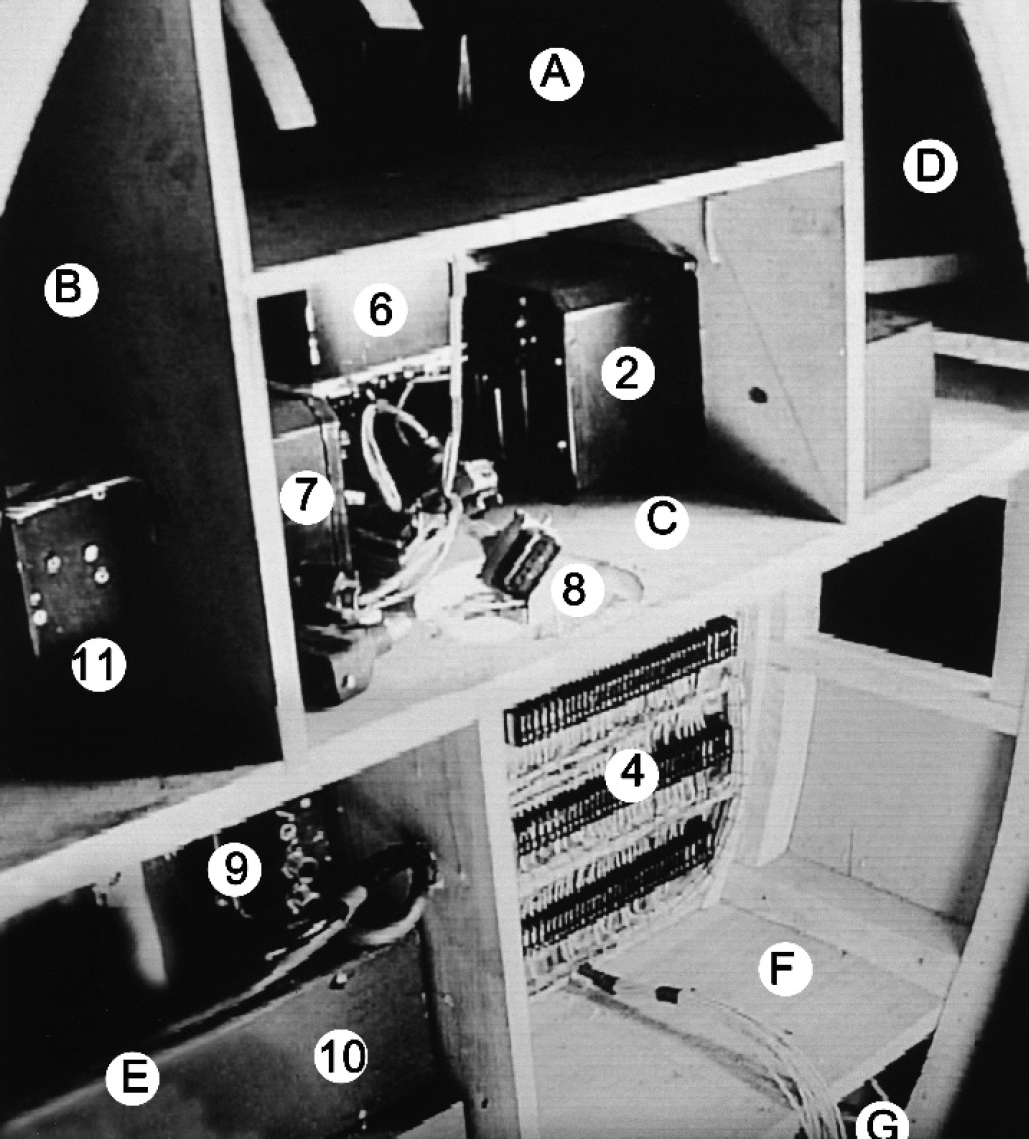
Figure 10.
Looking into the electronics bay of an unmanned trial machine equipped with the three-axis autopilot. Key to legend: A, B, C, D, E, F and G identify different compartments in the bay; 2. Back of the yaw gyroscope; 4. Distribution board; 6. Mixing unit for roll control; 7. Roll gyroscope; 8. Unattached plugs; 9. Resistance box; 10. Three damping gyroscopes; 11. Possibly the mixing unit for the pitch gyroscope which was mounted in the cockpit’s instrument panel. Captured German document. (Bachem-Werk, Waldsee, Württemberg, ca. April 1945 adapted by the author. Gooden, B. Natter. Manned Missile of the Third Reich. Historic step to human spaceflight. © Brett Gooden, 2019.
Table 3
How did the Natter project advance progress towards human spaceflight?
| 1. | It established the safest posture for the crew of a vertical take-off (VTO) rocket. |
|---|---|
| 2. | It established that a crew could not reliably control a VTO rocket manually and that autopilot control of the rocket was essential during powered flight. |
| 3. | It developed a hybrid liquid and solid propulsion system for a crewed VTO rocket. |
| 4. | It developed the first precisely timed countdown and flight mission for a crewed VTO rocket. |
| 5. | It resulted in the development of the world’s first light weight flexible pressure suit including flexible glove fingers. |