
Primary Objective
The main aim of this study was to gather demographic data regarding PDMDNS roles in Australia, encompassing population distribution, geographic spread, educational background, and clinical experience of nurses for the fourth consecutive year, 2023.
Secondary Objectives
The secondary aims included firstly delving into the scope of work undertaken by PDMDNS professionals across Australia. Secondly assessing the long-term viability of this specialised nursing workforce. Thirdly, the study aimed to scrutinise the gaps in supporting the PDMDNS profession to ensure the longevity of its presence. Fourthly, it aimed to compare data across four consecutive years to detect emerging trends. This insight will facilitate workforce planning concerning funding, education, and advocacy efforts.
Study Design
The study and its design were solely and independently initiated by the Australasian Neuroscience Nurses Association (ANNA) Movement Disorder Chapter (MDC), with no external financial funding or conflicts of interest. The ethics application was submitted to and approved by the Northern Sydney Local Health District Human Research Ethics Committee in 2019 under project number ETH12872, titled "Parkinson’s Disease Movement Disorder Nurse Specialist Demographic Survey," classified as a low or negligible risk project
Data was gathered through an anonymous online survey created using the platform https://www.surveymonkey.com. The survey encompassed a range of quantitative, multiple-choice questions along with a single qualitative free-text question. Its aim was to capture insights from a diverse group of PDMDNS professionals across all Australian states, covering aspects such as years of service, types of employers, and educational backgrounds. The survey was distributed via email to PDMDNS contacts identified by the ANNA MDC. However, only recipients employed as specialty nurses directly engaged with individuals with PD in Australia were included in the analysis. The collected data was then compared with data obtained from surveys utilising the same design in 2020 to 2023.
Results
The survey link was emailed to over 200 nurses with an interest in PDMDNS known to the Movement disorder Chapter (MDC) of the Australasian Neuroscience Nurses Association (ANNA). The survey link was closed and 57 responses met the inclusion criteria, identifying themselves as employed as a PDMDNS working in Australia or as participating in the Western New South Wales Primary Health Network Movement Disorder Nurse Project. This was comparable with responses included for analysis in previous years, 2020 n=57, 2021 n= 50, 2022 n=57 and 2023 n=57, suggesting there has been no increase in the overall numbers of PDMDNS positions between 2020 and 2023 in Australia. It is unknown how many PDMDNS did not participate in the survey each year.
New South Wales (NSW) continues to be the highest employer of the PDMDNS in the country at 37% (n=21) followed by Victoria (VIC) at 18% (n=10). NSW has had the highest growth, increasing from 16 PDMDNS positions reported in 2020 to 21 in 2023. South Australia (SA) increased from 4 in 2020 to 7 in 2023, Tasmania (TAS) increased from 3 in 2020 to 5 in 2023. Australian Capital Territory (ACT) (n=1) remains stable Victoria, and Queensland overall have had a reduction in the number of PDMDNS reported between 2020 and 2023, Victoria losing 6, 16 in 2020 and 10 in 2023, Queensland reports the biggest loss of 8 PDMDNS nurses, from 11 in 2020 to only 3 in 2023. Northern Territory continues to have one single respondent employed in the same position covering the whole state.
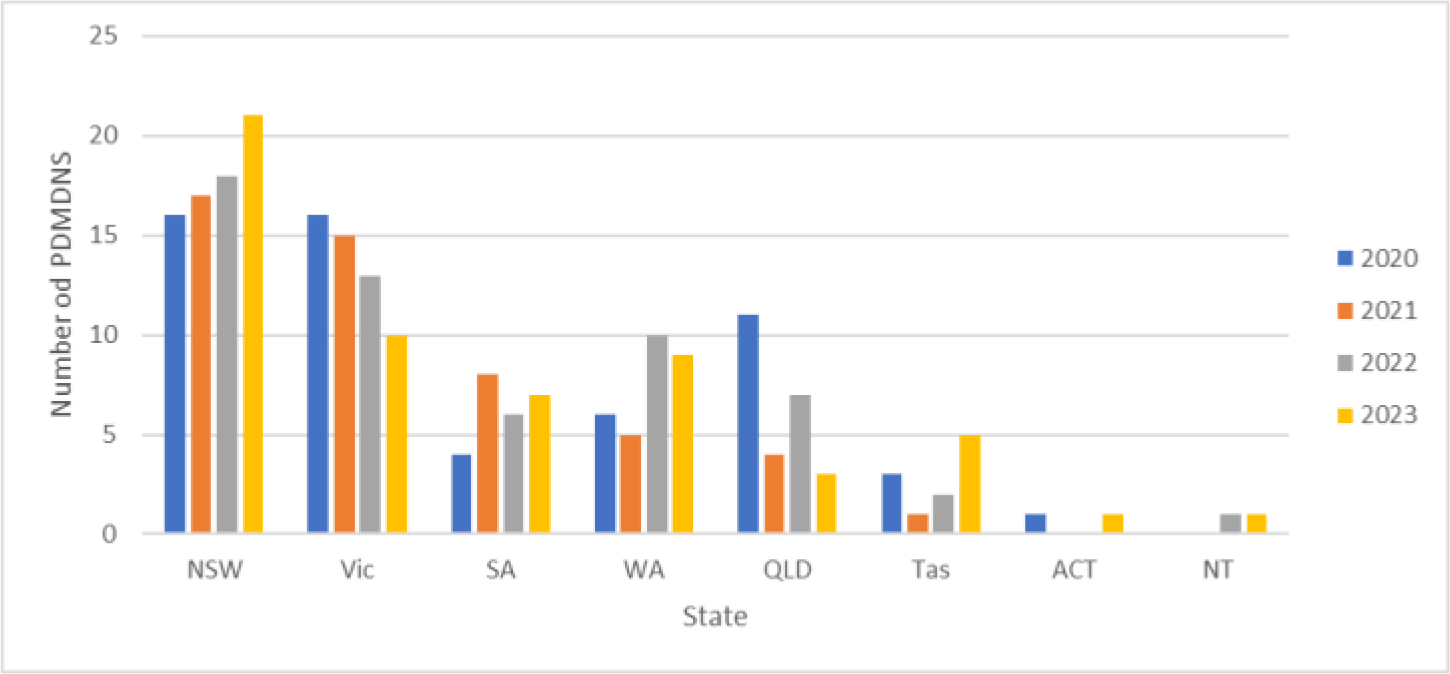
Figure 1.
Distribution of PDMDNS positions broken down by state.
Distribution of PDMDNS positions broken down by region
There has been a redistribution of PDMDNS positions with growth in the number of PDMDNS positions in the metropolitan and rural areas but a reduction of positions in the regional areas. In 2024 there were 35 metropolitan nurses increased from 28 in 2021, 17 regional nurses increased from 13 in 2020 but 4 less than 2022 and 5 rural PDMDNS increased from 3 in 2022 but holding relatively steady since 2020 (n=6).
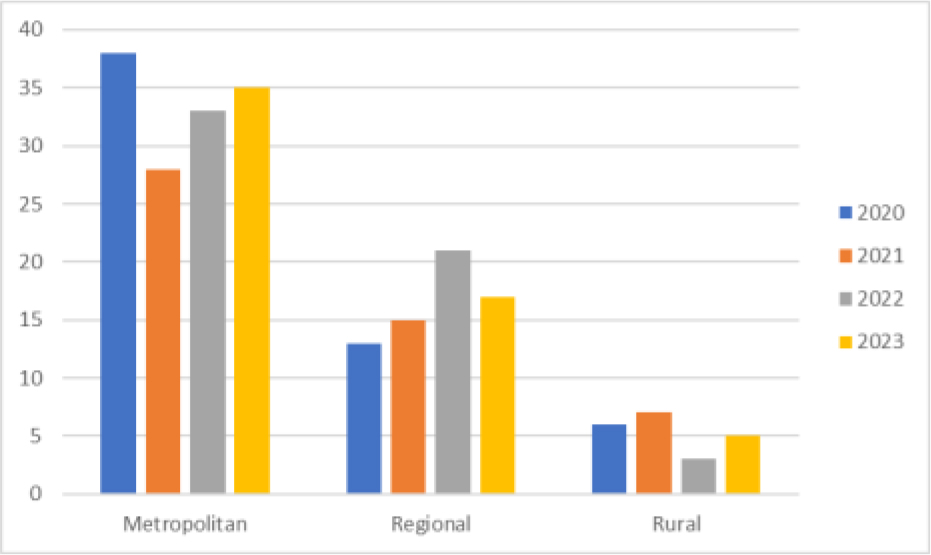
Figure 2.
Distribution of PDMDNS positions broken down by region
Distribution of PDMDNS positions by employer
The majority of PDMDNS positions continue to be employed by a State Department of Health 61% (n=33) an overall increase of 4 since 2020 (51%). The pharmaceutical industry continue to be the second largest employer of PDMDNS’s with 13% (n=7) although this is trending down from 2020 21% (n=12). Consumer organisation remain the third largest employer with 9% (n=5) loosing 4 PDMDNS since 2022 (n=9), which is fairly stable when compared with 2020 results 7% (n= 4).
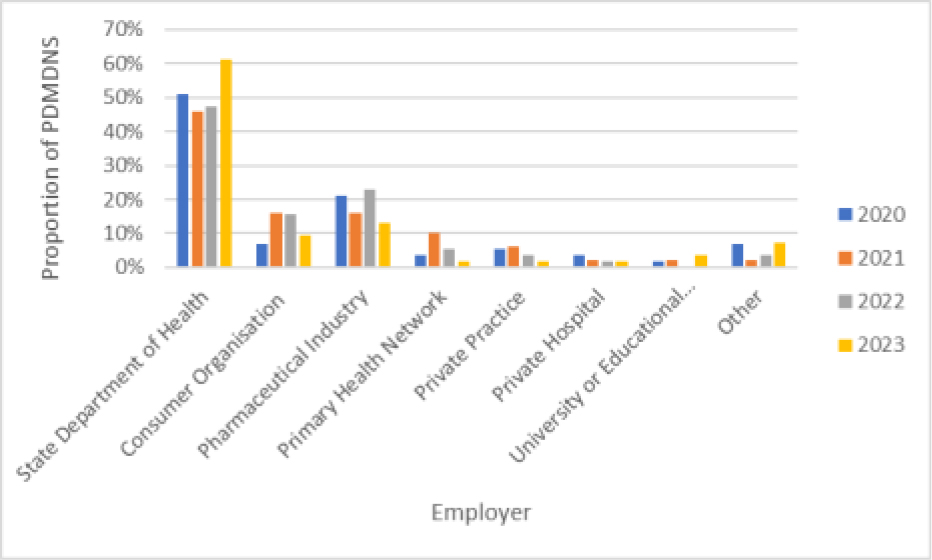
Figure 3.
Distribution of PDMDNS positions by employer.
Total number of PDMDNS and their years of experience
The cohort of nurses with less than years of experience in their PDMDNS position has had the most growth since 2020 16% (n= 9) with 31% (n=18) in 2023. The 2-5 year cohort has remained relatively stable with 25% (n=14) in 2020 and 23% (n=13) in 2023 despite a large fluctuation in 2022 32% (n=18). Concerningly PDMDNS with 5-10 years of experience have been lost with 33% (n=19) in 2020 and 21% (n=12) in 2023. The cohort of PDMDNS with over 10 years experience remains relatively stable with 26% (n=15) in 2020 and 25% (n=14) in 2023 despite a drop in 2022 19% (n=11).
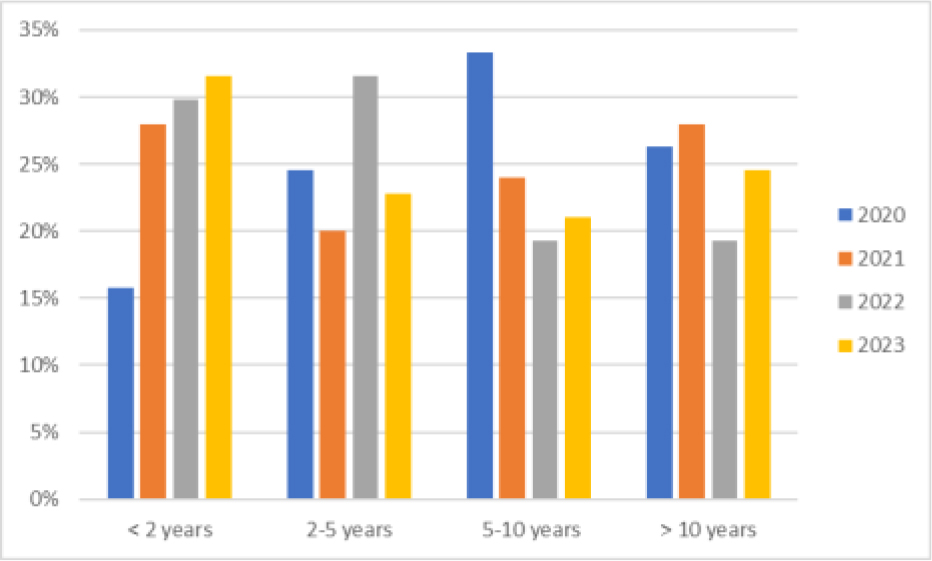
Figure 4.
Total number of PDMDNS and their years of experience
Funding Arrangements for PDMDNS Positions
The reported permanency of funding for PDMDNS positions continues to be stagnant over the past 4 years with 54% of PDMDNS responding that their position has permanent funding and 42% continuing without permanent funding in 2023. The not applicable category include those employed on a contract basis for example.
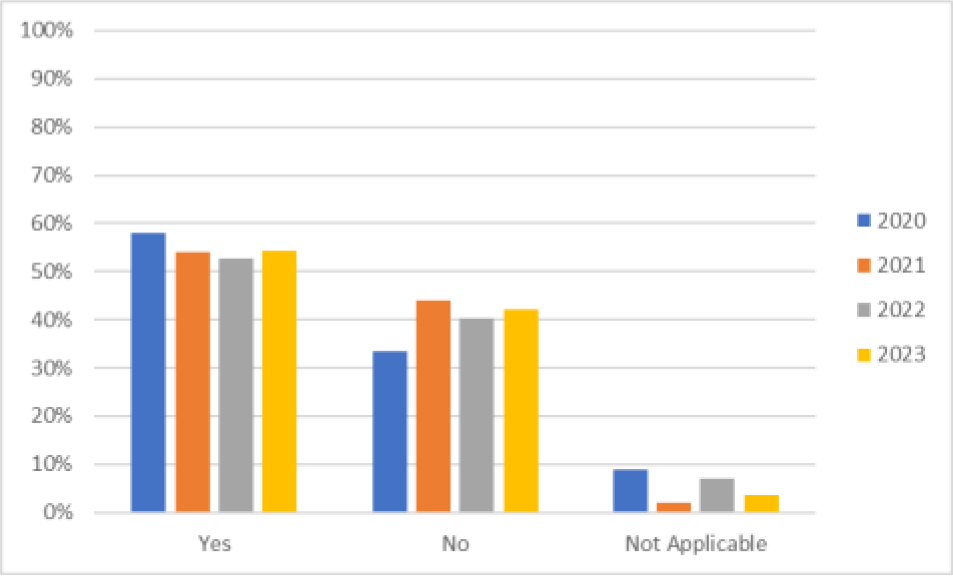
Figure 5.
Funding Arrangements for PDMDNS Positions
How long do PDMDNS intend to stay in their position
It was positive to see the growth in the number of PDMDNS planning to stay in the field for the 6-10 years and 11-15 years. The cohort intending to stay for 6-10 years has over all increased from 33% (n=19) in 2020 to 37% (n= 21) in 2023. The cohort intending to stay in the field for 11-15 years has remained relatively stable since 2020 18% (n=10) compared with 2023 19% (n=11) in 2023 despite a Dip in 2022 12% (n=7). However, there has been a decline in the number of PDMDNS planning to stay for 16-20 years 23% (n=13) in 2020 reduced to 19% (n=11) in 2023, despite an increase in 2022 23% (n=13), and the cohort intending to stay for 0-5 years. This later cohort has had the biggest decrease in between 2022 and 2023, from 33% (n=19) to 25% (n=14) but overall has remained steady 2020 26% (n=15).
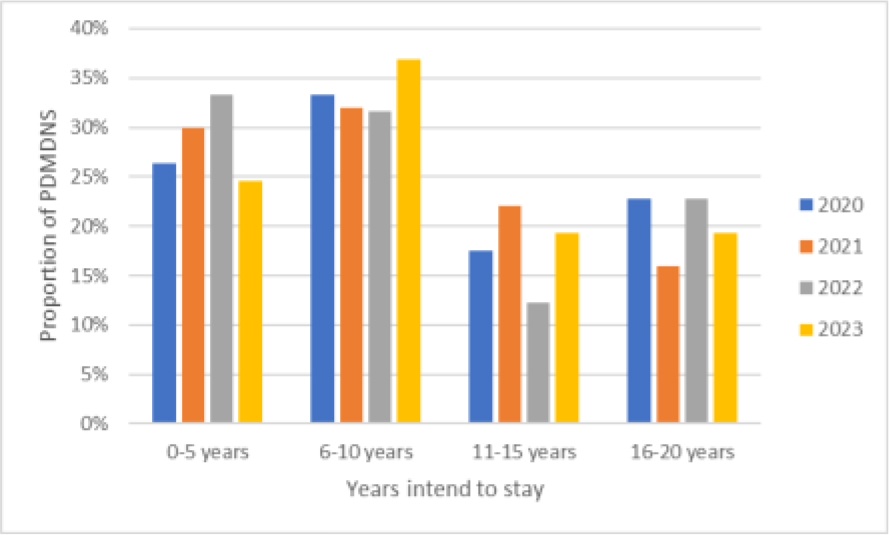
Figure 6.
How long do PDMDNS intend to stay in their position
Highest level of education obtained
The proportion of PDMNS with a registered Nurse degree has increased from 23% (n=13) in 2020, to 28% (n=14 and 16) in 20221 and 2022 to 32% (n=18) in 2023. There has also been an increase in the graduate certificates, honours degree between 2020 and 2023 from 25% (n=13) to 32% (n=18). This is consistent and correlates well with the level of expertise and years of experience our cohort of PDMDNS is trending towards. Those PDMDNS with a masters degree remains consistent, sitting at 26% for 3 years, (n=13,15,15). There have been no respondents with a Doctorate for the past 2 years.
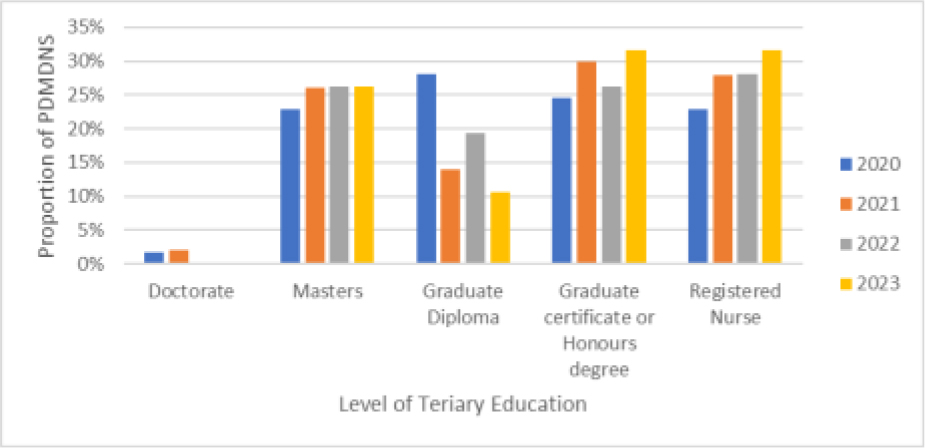
Figure 7.
Highest level of education obtained
PDMDNS Employment Grading
In the grading system utilised, Grade A designates competent nurses, typically at the registered nurse level across most states. Grade B indicates experienced or intermediate levels of specialist nurses, often corresponding to the Clinical Nurse Specialist level. Grade C is reserved for expert specialist nurses like Nurse Practitioners or Clinical Nurse Consultants.
In 2023, 25% (n=14) of PDMDNS nurses held Grade A positions, a decrease from 34% (n=19) in 2022. Conversely, there was a rise in Grade B positions, from 25% (n=14) to 37% (n=21). Grade C PDMDNS positions remained consistent at 28% (n=16) in 2023, compared to 30% (n=17) in 2022.
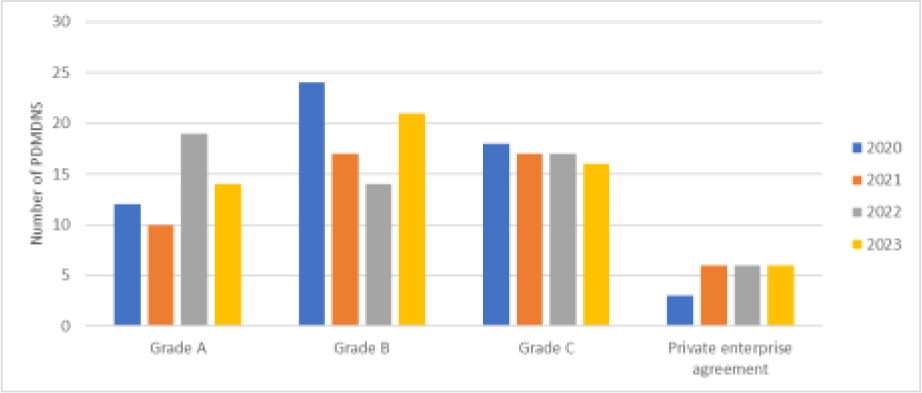
Figure 8.
PDMDNS Employment Grading
Proportion of PDMDNS who agree or disagree their pay grade reflects their level of practice
There has been a decrease in the proportion of PDMDNS who agree that their level of pay reflects their level of practice, from 51% (n=29) in 2021 to 46% (n=26) in 2023. This corresponds with an increase in the proportion of PDMDNS who disagree their level of pay reflects their level of practice, 39% (n=22) in 2021 to 44% (n=25) in 2023.
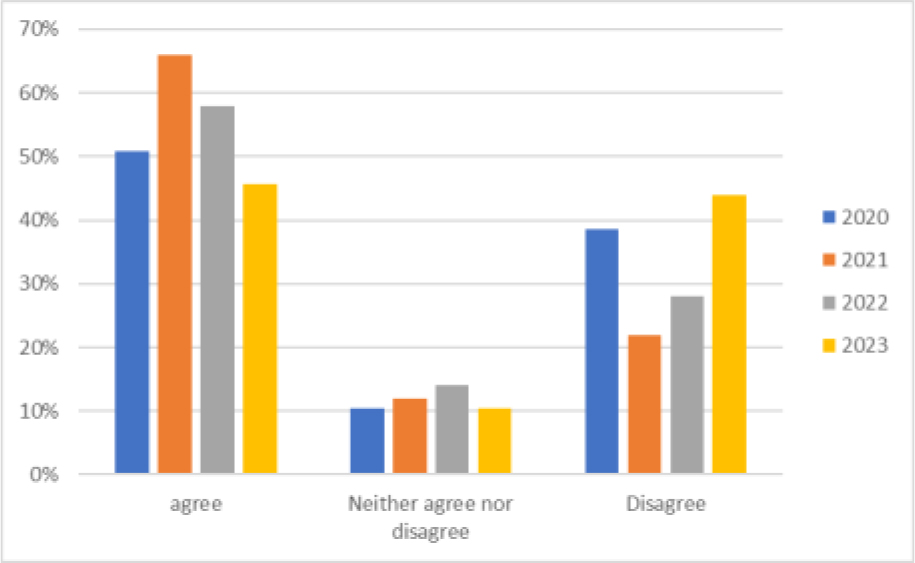
Figure 9.
Proportion of PDMDNS who agree or disagree their pay grade reflects their level of practice
Study Limitations
The goal of this study was to encompass as many PDMDNS professionals in Australia as possible. Invitations to participate were broadly distributed via email to individuals known to the ANNA MDC. However, it’s possible that some PDMDNS either did not receive the invitation or opted not to take part in the survey, which can introduce challenges in data interpretation. The ANNA MDC acknowledges the ongoing challenge of ensuring comprehensive inclusion of all PDMDNS professionals. However, it’s crucial for all PDMDNS to be represented to provide an accurate portrayal of the workforce. Efforts will continue to support and resource as many professionals as possible.
Discussion
The key highlights of the 2023 demographic survey demonstrates both positive and negative trends for the field of Parkinson’s and Movement Disorder Nursing in Australia. It is important to note it is difficult to compare these results with other nursing specialties in Australia as the authors could not find any similar studies over the same time frame.
Distribution of PDMDNS positions
Firstly, we can see a reported reduction in PDMDNS positions in regional areas. This trend is consistent with the 2019 Primary Health Network funding of $6.8million over 5 years drawing to a close. This is concerning as the longevity of these positions are not guaranteed. The growth in both NSW and metropolitan areas is likely to be associated with the $8.6 million funding injected by the NSW state government in the 2021-2022 budget. The funding was distributed across all the local health districts to initiate new nursing and allied health positions across NSW Local health districts. Six local health districts cover the Sydney metropolitan region, nine cover rural and regional NSW (NSW Health 2024).
Employers
Secondly, the second leading employers of PDMDNS positions are pharmaceutical companies employing product support nurses. Again, this reiterates our previous stance that pharma funded PDMDNS are specialised nurses with advanced practice expertise and is equally as important in the ecosystem of PDMDNS caring for people with Parkinson’s and Movement Disorders.
Skill mix
Thirdly, the expertise and skill mix of PDMDNS population is still recovering from the significant loss since 2020. Australian Studies have shown that the COVID pandemic has impacted the nursing workforce with a high proportion of nurses intending to leave the workforce within 5 years (Cornish et al 2021) There has been significant reduction in PDMDNS positions in the 2-5 years and 5-10 years of experience categories. It is also possible the decrease in the number of nurses intending to stay in their PDMDNS position for 0-5 years is associated with the planned retirement of experienced PDMDNS. This would also be consistent with the loss of more experienced nurses.
The growth in new nurses entering the field, means the mentoring and educational development of the new generation of PDMDNS is remains a priority. However, it is a positive sign to see the growth in PDMDNS undertaking entry level post-graduate studies such as graduate certificates which suggest a desire for professional growth within the cohort and a long-term commitment to the speciality.
Funding and grading
Lastly and most concerning is the funding and grading of our PDMDNS positions. For the past four years, more than 40% of these positions have remained not permanently funded. In addition, an equivalent percentage (40%) of PDMDNS professionals believe their pay grade does not align with their clinical proficiency and expertise. If this issue is left unaddressed, it is likely that dissatisfaction will continue to mount due to the lack of acknowledgment of the PDMDNS’ skills and the persistent uncertainty of the permanency and job security surrounding their positions. This could ultimately result in the loss of valuable personnel and expertise within the PDMDNS community. The increase in proportion of PDMDNS who feel their level of pay does not reflect their level of expertise may be explained a by combination of factors, those new to the specialty in 2020 now have more experience, but their pay grade has not changed. It has been well established for some time that professional status, autonomy, and remuneration are career issues of great concern for nurses and is particularly relevant to workforce retention (Cowin 2002).
Conclusion
Conducting annual surveys of PDMDNS remains a crucial endeavour. The longitudinal data obtained provides a comprehensive overview of the PDMDNS workforce in Australia, detailing aspects like population distribution, geographic spread, educational backgrounds, and clinical experience. This valuable information equips professional organisations like the ANNA to tailor education initiatives, allocate resources effectively, develop relevant materials, and establish mentoring networks. Ultimately, the goal is to empower all PDMDNS professionals to deliver care at the highest level of clinical practice.