
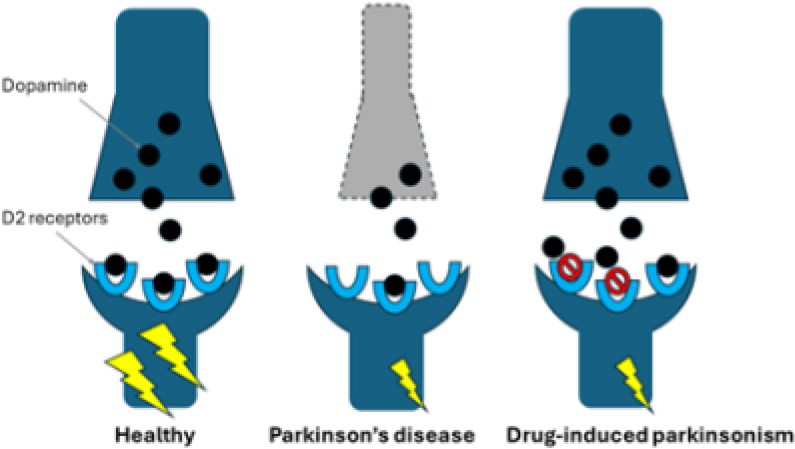
Figure 1:
A schematic of dopaminergic neurons in the striatum.
Table 1.
Drug classes and pharmaceutical agents associated with DIP
| Pharmaceutical Agents Frequently Associated with DIP | |
| Typical Antipsychotics | Chlorpromazine, Prochlorperazine, Promethazine, Fluphenazine, Haloperidol, Primozide, Sulpiride |
| Atypical Antipsychotics | Olanzapine, Risperidone, Ziprasidone, Aripiparazole, Clozapine, Quetiapine |
| Anti-emetics | Metoclopramide, Domperidone, Itopride |
| Dopamine Depleters | Reserpine, Tetrabenazine |
| Calcium-Channel Blockers | Flunarizine, Cinnarizine |
| Pharmaceutical Agents Less Frequently Associated with DIP | |
| Mood Stabilizers | Lithium Carbonate |
| Antiepileptics | Valproic acid, Phenytoin, Levetiracetam |
| Anti-hypertensives | Diltiazem |
| Antidepressants | Paroxetine, Sertraline, Fluoxetine |
| Antiarrhythmics | Amiodarone, Procaine |
| Statins | Lovastatin |
| Immunosuppressants | Ciclosporin, Tacrolimus |
| Antivirals | Acyclovir, Vidarabine |
| Antibacterials | Sulfamethoxazole, Trimethoprim |
| Antifungals | Amphotericin B |
[i] Adapted from the following tables: (Adis Editors, 2012; Shin & Chung, 2012; Vasquez Builes, Salazar, Tieck-Fernández, Rojas-Gallego, & Díaz Silva, 2021)
Table 2:
Differentiating features of Parkinson’s disease and DIP
| Feature | Parkinson’s Disease | Drug Induced Parkinsonism (DIP) |
|---|---|---|
| Age of Onset | Sixth decade (but 20% are <50 years old) | Variable |
| Sex | More common in males | Uncertain |
| Onset | Chronic | Acute or subacute |
| Symptom Onset | Unilateral or asymmetric | Bilateral and symmetric |
| Akathisia | Absent | Present |
| Bradykinesia | Present | Present |
| Tremor | Rest tremor occurs in 70% | Usually absent or a postural tremor |
| Rigidity | Progressive and may be marked | Usually mild |
| Response to Levodopa | Good | Poor |
| Response to stopping D2 blocking drug | Slight non-sustained improvement then progressive parkinsonism | Good with complete reversal of parkinsonism |
| DaTscan/VMAT scan | Abnormal: Reduced uptake of pre-synaptic markers | Normal |
Table 3.
Guide to the Diagnostic Approach to Suspected DIP
| • | No previous history of parkinsonism before the prescription of the offending drug. |
| • | Review medical history including past and present medications, assessing for potentiation, polypharmacy and potential drug interactions. |
| • | Consider possible exposure to toxins or recreational drugs. |
| • | Individuals with AIDS have an increased risk of DIP due to loss of neuronal cell bodies. |
| • | Consider the individual’s age as Parkinson’s disease is less likely in individuals younger than 50 years. |
| • | Review falls in combination with psychotropic administration as medications can lower blood pressure and increase the risk of falls in confused or at-risk patients. |
| • | Review the timeframes associated with the onset of symptoms (usually acute or subacute with DIP). DIP has a temporal relationship with new medications and can occur within days of commencing a new drug, although in some cases it may be months prior to the onset of symptoms. |
| • | Assess for signs and symptoms that are inconsistent with DIP including unilateral symptoms, significant axial impairment, freezing gait, hyposmia, or tremor. |
| • | DIP is generally characterised as bilateral and symmetric parkinsonism. |
| • | Response to levodopa is limited in DIP, yet diagnostically useful in Parkinson’s disease. |
| • | Consider DaT scan, single proton emission computerized tomography (SPECT) particularly in cases where symptoms have not resolved within six months of ceasing offending drugs. |
| • | Consider a comorbid or alternative diagnosis. |
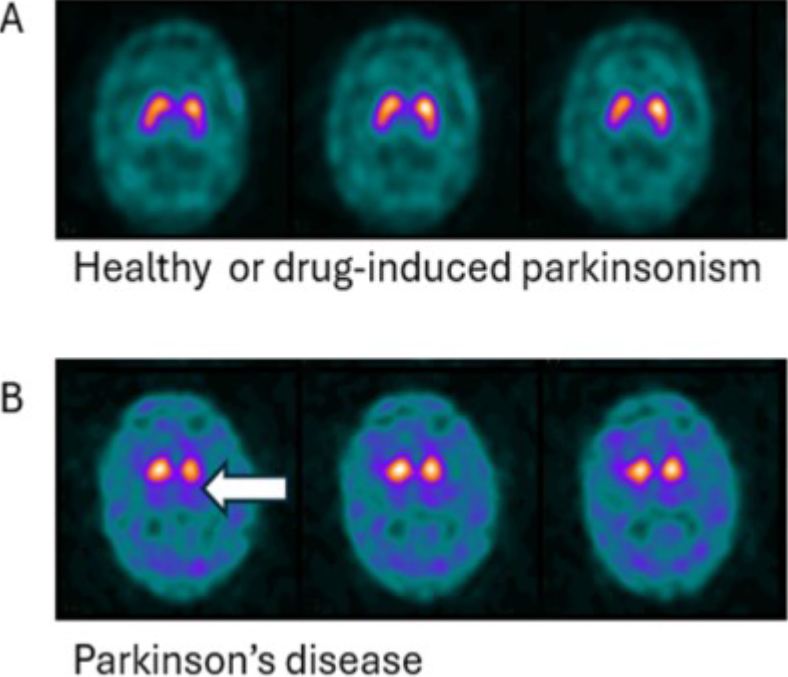
Figure 2.
DaTscan (FP-CIT SPECT): the images demonstrate the density of pre-synaptic dopaminergic neurons in the striatum. In the healthy state and in drug-induced parkinsonism, there is no loss of pre-synaptic dopaminergic neurons, and the striatum is a normal ‘comma’ shape. In Parkinson’s disease (and some other degenerative disorders), there is a loss of pre-synaptic dopaminergic neurons in the putamen (white arrow) and the striatum looks like a “full stop” shape. Later in the disease, with further progressive degeneration, the ‘full stop’ shape also disappears.
Table 4.
Differential diagnoses of DIP
| Neurodegenerative disorders | Other conditions |
|---|---|
| Parkinson’s disease | Vascular parkinsonism |
| Progressive Supranuclear Palsy | Functional neurological disorder |
| Multisystem Atrophy | Hyperthyroidism |
| Corticobasal Syndrome | Benzodiazepine withdrawal |
| Dementia with Lewy bodies | Infective and autoimmune encephalitis |
[i] Adapted from the following tables: (Alves, Forsaa, Pedersen, Gjerstad, & Larsen, 2008; Dallapiazza et al., 2018; Sethi, 2003)