
Table 1.
Use of carbon black in concrete by various researchers
| S.No. | Type of carbon waste used | Outcomes | Reference |
|---|---|---|---|
| 1 | Carbon black from local petro-chemical plant and Cabot | Authors concluded that the micro filler effect is of larger significance to strength enhancement and carbon black was effective in modifying the basic concrete mixture strength to an extent similar to that obtained by silica fume. | [5] |
| 2 | Carbon black powder from rubber industry | The Total number of 18 cubes and 12 cylinders were cast with replacement of cement in percentage of 0%, 2%, 5%, 8%, 12%, and 15%. And it is concluded that specimen with 2% and 5% carbon black show good results and 8% shows excellent stanch of pores for water absorption. | [9] |
| 3 | Carbon black powder from rubber industry | Polyethylene terephthalate’s impact on different strength properties of concrete grade M40 was conducted. In the percentage of 0%,10%,20% and 30% cement is partially replaced by carbon black. We came to know that the strength is reduced when PET ratio to fine aggregate is raised. It was found that cement till 30% substitution of carbon black in concrete is effective. | [11] |
| 4 | Carbon black from rubber industry, petrochemical plant and oil plant | Authors studied that as a filler material when carbon black powder is added in concrete mix to improve concrete properties, we can successfully add carbon black between 5% to 8% as a filler additive. | [12] |
| 5 | carbon black powder from rubber industry | Authors studied that when Carbon black was replaced in percentage of 0%, 3%, 5%, 7%, 9% and 12%, it was noted that in concrete the use of carbon black can enhance the mechanical properties. | [3] |
| 6 | Carbon dust from aluminum industry | Authors partially replaced cement particles in cement mortar production. The conclusion states that without having an effect on the mortar strength carbon dust can be added by mass of cement till 10% in concrete. Overall strength has been achieved in 5% substitution ratio improvement. | [15] |
Table 2.
Physical properties of raw materials
| Material | Physical property | Procedure | |||
|---|---|---|---|---|---|
| Sand | Specific gravity | Unit weight (kg/m3) | Silt content | As per IS 383:2016 [16] and IS 2386- Part-1 and III:1963 [17, 18] | |
| 2.45 | 1640.0 | Negligible | |||
| Coarse Aggregate | Specific gravity | Moisture content | Abrasion value | As per IS 383:2016 [17] and IS 2386- Part- III and IV:1963 [18,19] | |
| 2.78 | 2.35% | 7.5% | |||
| OPC Cement | Standard consistency | Unit weight (kg/m3) | Initial and final setting time | Fineness through 90micron sieve | As per IS 12269:2013 [20] |
| 32% | 1440 | 38 minutes and 590 minutes | 98% Passing | ||
| CBD | Fineness through 90micron sieve | - | |||
| 100% Passing | |||||
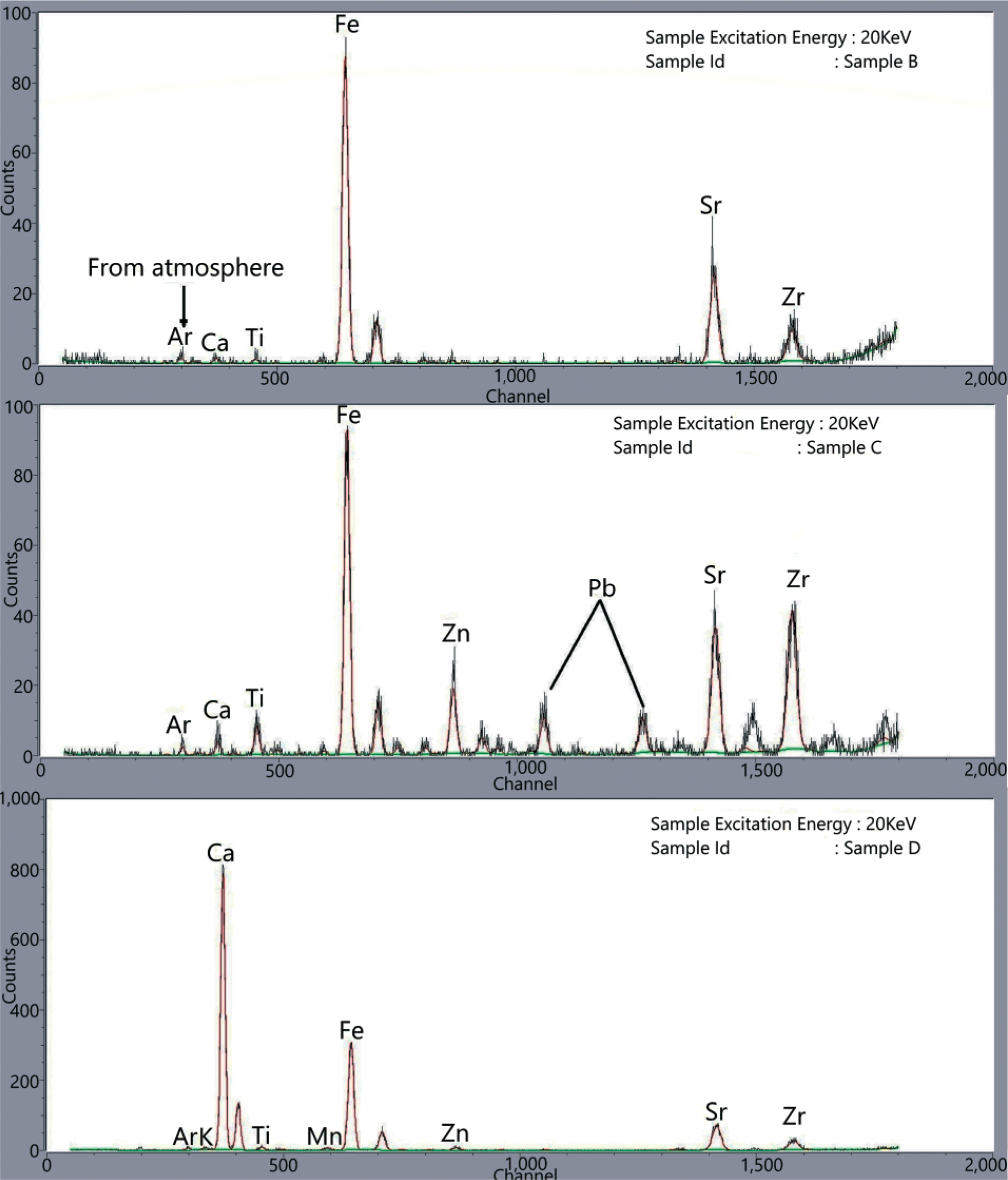
Figure 1.
XRF spectrum of sand, cement and CBD
Table 3.
Chemical analysis of raw materials
| Chemical constituent and their oxides | Material with sample identity | |||
|---|---|---|---|---|
| Sand (B) | OPC Cement (C) | CBD (D) | Oxide proportion | |
| Silica (SiO2) | √ | √ | √ | Major |
| Alumina (Al2O3) | √ | √ | √ | |
| Iron oxide (Fe2O3) | √ | √ | √ | |
| Calcium oxide (CaO) | √ | √ | √ | |
| Titanium oxide (TiO2) | √ | - | √ | Minor |
| Potassium oxide (K2O) | - | - | √ | |
| Zinc oxide (ZnO) | - | √ | √ | |
| Manganese (Mn) | - | - | √ | In (ppm) |
| Strontium (Sr) | √ | √ | √ | |
| Zirconium (Zr) | √ | √ | √ | |
| Lead (Pb) | - | - | ||
| Chromium (Cr) | - | - | - | |
Table 4.
Majorly available components and their application in concrete
| Components | Applications in concrete | References |
|---|---|---|
| Iron component | Strengthening agent | |
| Calcium, magnesium, iron and manganese components | Fluxing agents | |
| Calcium and magnesium components | CO2 Absorbing agent | [21] |
| Iron, calcium and silica components | Stabilizing agent | |
| Titanium, and manganese compound | Corrosion resisting agent |
Table 5.
Proportioning of raw materials in one cube
| Raw materials | Quantity | ||||
|---|---|---|---|---|---|
| OPC 53 grade cement | 1.297 kg | 1.297 kg | 1.297 kg | 1.297 kg | 1.297 kg |
| Sand | 1.945 kg | 1.945 kg | 1.945 kg | 1.945 kg | 1.945 kg |
| Coarse aggregate in equal combination (50% 10 mm and 50% 20 mm) | 3.891 kg | 3.891 kg | 3.891 kg | 3.891 kg | 3.891 kg |
| Percentage of CBD | 0% | 2.5% | 5% | 7.5% | 10% |
| Weight of CBD | 0 | 34.133 gm | 68 gm | 102 gm | 136 gm |
| Water quantity | 518 ml | 529 ml | 538 ml | 547 ml | 555 ml |
| Water cement ratio | 0.400 | 0.408 | 0.415 | 0.422 | 0.428 |
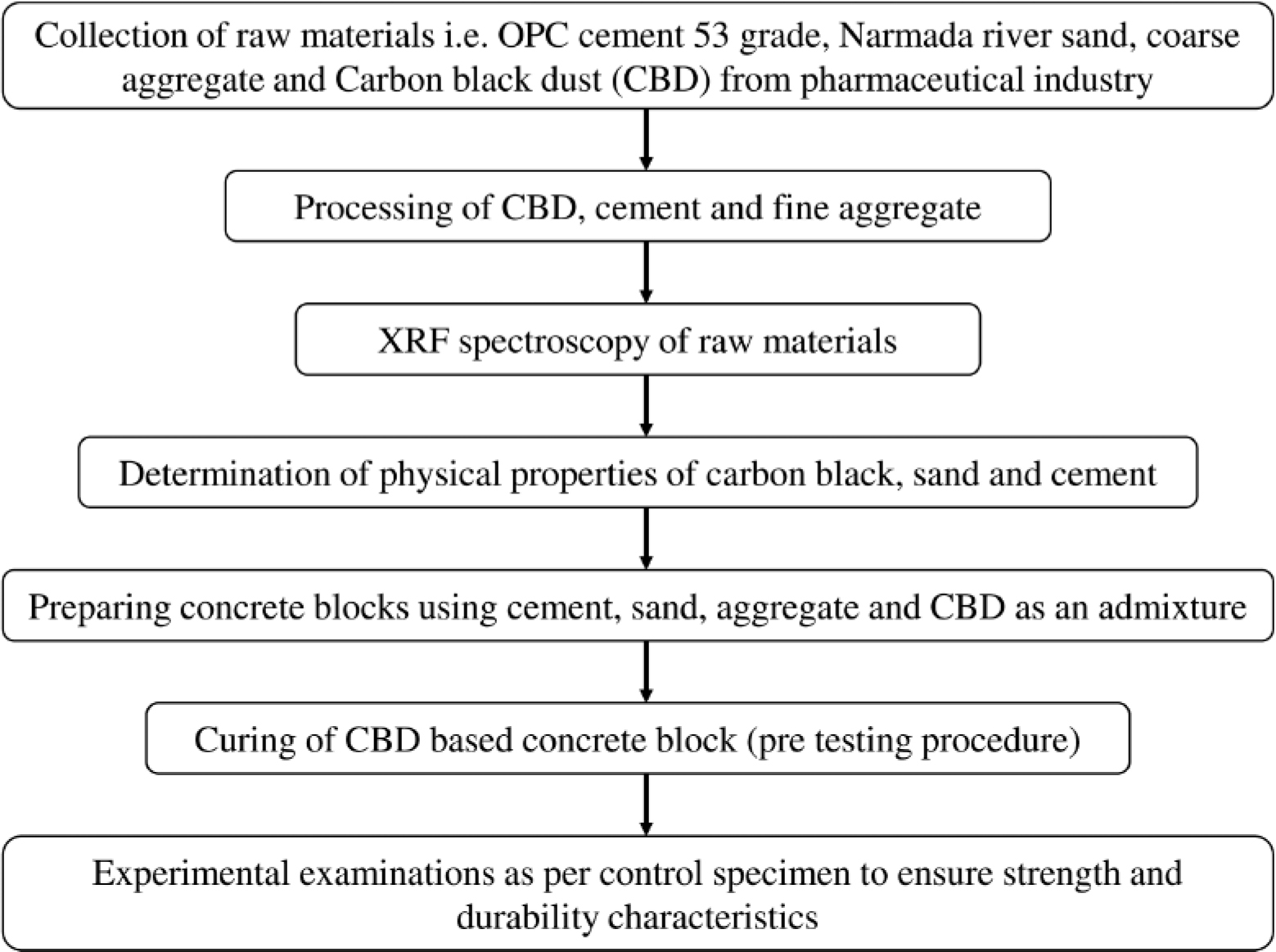
Figure 2.
Methodology for this research work
Table 6.
Water absorption percentage of CBD based concrete specimen
| Percentage of carbon | 0% | 2.5% | 5% | 7.5% | 10% |
| Water absorption percentage | 3.913% | 4.442% | 3.929% | 2.861% | 3.444% |
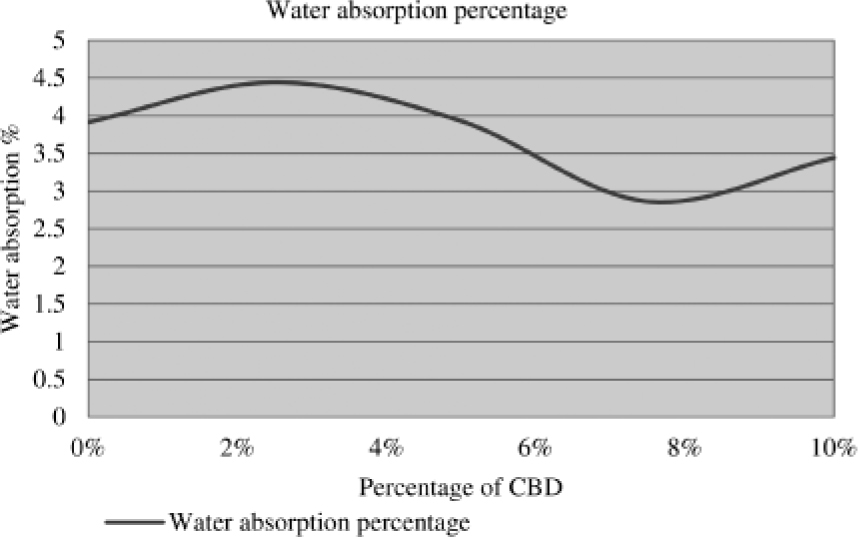
Figure 3.
Graph of Water absorption Test
Table 7.
Compressive strength of CBD based concrete specimen
| Percentage of carbon | Compressive strength (MPa) | ||
|---|---|---|---|
| 7 day curing | 14 day curing | 28 day curing | |
| 0 % | 12.889 | 19.262 | 20.230 |
| 2.5% | 13.089 | 20.022 | 21.720 |
| 5.0% | 13.080 | 17.107 | 22.711 |
| 7.5% | 12.889 | 18.804 | 23.716 |
| 10.0% | 11.898 | 17.778 | 21.431 |
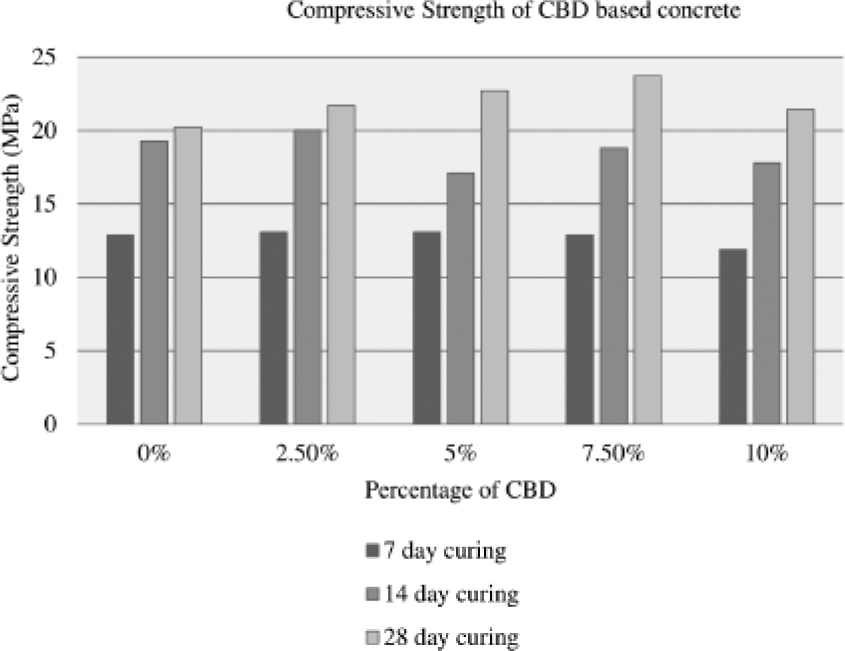
Figure 4.
Graph of Water absorption Test
Table 8.
Ultrasonic pulse velocity of CBD based concrete specimen
| Percentage of carbon | Pulse velocity (km/sec) | Concrete quality as per IS 13311-1 [18] | ||
|---|---|---|---|---|
| 7 day curing | 14 day curing | 28 day curing | ||
| 0 % | 3.807 | 3.989 | 4.098 | Good |
| 2.5% | 3.546 | 4.011 | 4.360 | Good |
| 5.0% | 3.704 | 4.098 | 4.225 | Good |
| 7.5% | 3.505 | 4.12 | 4.505 | Excellent |
| 10.0% | 3.823 | 4.011 | 4.043 | Good |
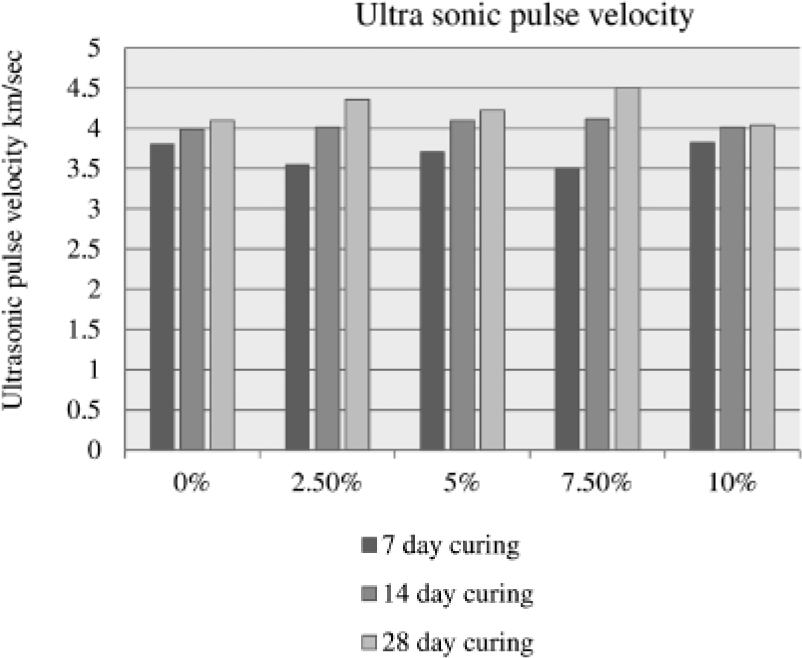
Figure 5.
Ultra sonic pulse velocity of CBD based concrete
Table 9.
Rebound number of CBD based concrete specimen
| Percentage of carbon | Rebound number | ||
|---|---|---|---|
| 7 day curing | 14 day curing | 28 day curing | |
| 0 % | 15.85 | 17.90 | 19.10 |
| 2.5% | 16.10 | 21.30 | 20.30 |
| 5.0% | 17.95 | 22.00 | 23.70 |
| 7.5% | 19.80 | 20.00 | 25.90 |
| 10.0% | 18.40 | 19.55 | 21.70 |
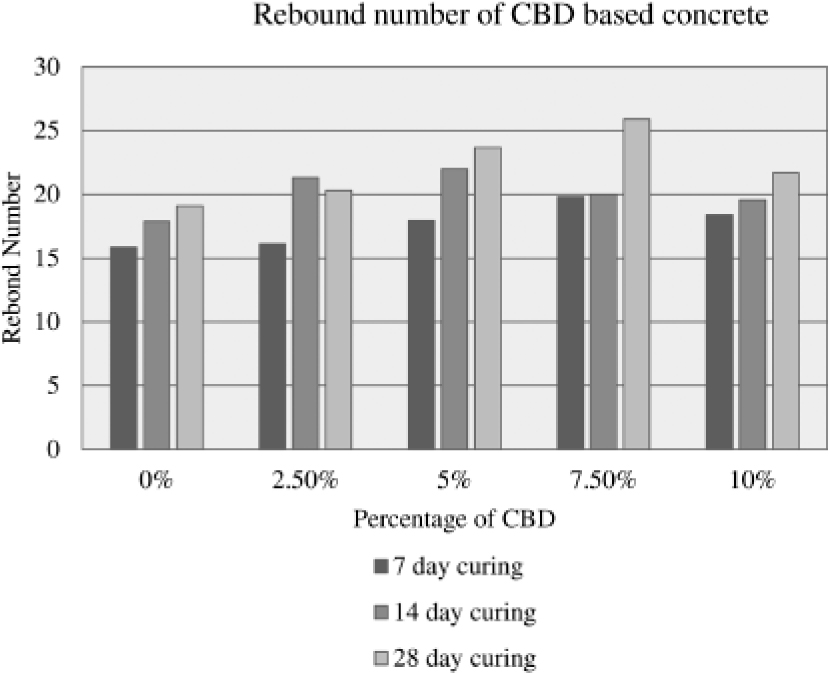
Figure 6.
Rebound number of CBD based concrete
Table 10.
Crack pattern in concrete specimen
| Failure pattern | Specimen identity | Failure type | Remark |
|---|---|---|---|
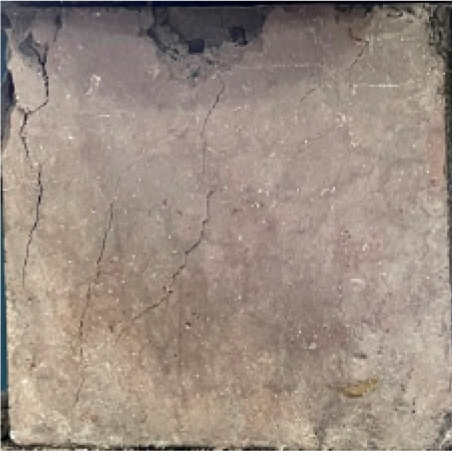 | 0% CBD | Satisfactory failure with more brittle manner | Specimen splitting out in brittle failure mode |
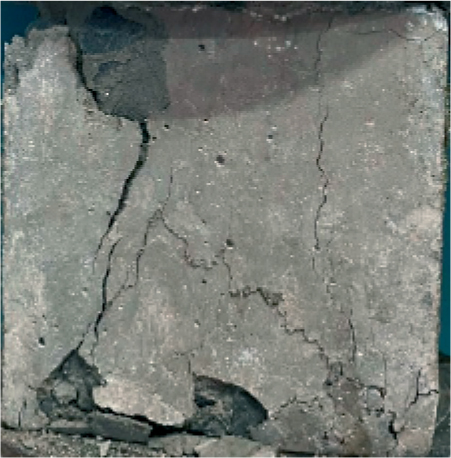 | 2.5% CBD | Satisfactory failure with brittle manner | Brittle failure without splitting |
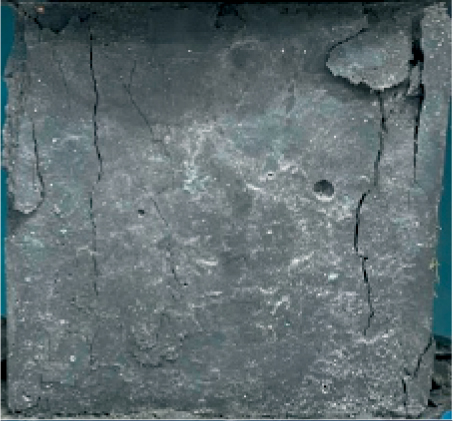 | 5.0% CBD | Satisfactory failure with ductile manner | Brittle failure without splitting due to ductile nature |
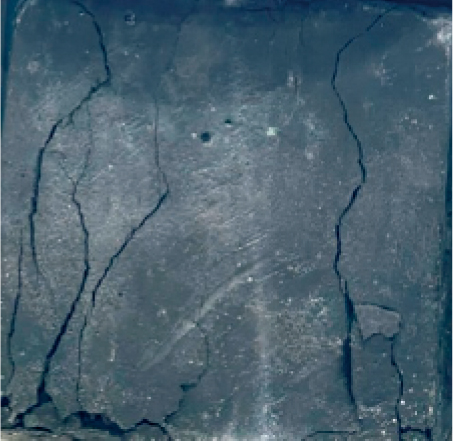 | 7.5% CBD | Satisfactory failure with more ductile manner | Ductile nature increases |
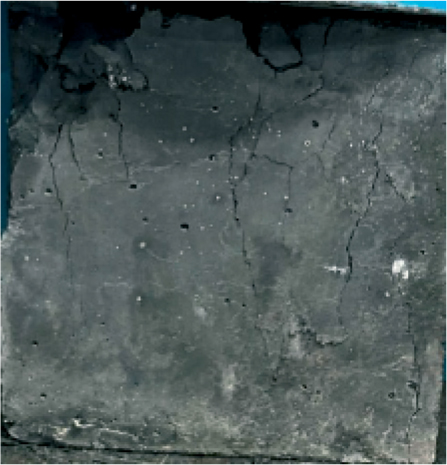 | 10.0% CBD | Satisfactory failure with more ductile manner | Ductile nature increases |